The population of adults with CHD is rapidly growing and ageing, although for those with more complex disease, life expectancy still remains shorter than the general population.Reference Khairy, Ionescu-Ittu, Mackie, Abrahamowicz, Pilote and Marelli1,Reference Diller, Kempny and Alonso-Gonzalez2 Heart failure is the leading cause of death, followed by arrhythmia and non-cardiac comorbidities.Reference Zomer, Vaartjes and Uiterwaal3,Reference Lui, Saidi and Bhatt4 The degree to which patients, families, and providers are prepared for these sequelae and for pre-mature mortality varies considerably. Approaches to optimise quality of life as well as quality of death and dying are needed. Advance care planning, namely planning ahead for the type of medical and psychosocial care one would want when very ill, is emerging as a critical component of comprehensive ACHD care.Reference Sable, Foster and Uzark5 This dialogue includes integration of the principles and practices of palliative care, a specialised type of medical care that focuses on maximising quality of life and relieving suffering.Reference Braun, Grady and Kutner6
Two North American studies revealed that approximately three-quarters of adults with CHD are interested in advance care planning discussions initiated by their cardiologists, preferably prior to the onset of life-threatening symptoms.Reference Tobler, Greutmann, Colman, Greutmann-Yantiri, Librach and Kovacs7,Reference Deng, Gleason and Khan8 However, surveyed ACHD providers tended to worry about the readiness of their patients for these discussions, particularly when life expectancy is more than 10 years or is unknown.Reference Greutmann, Tobler, Colman, Greutmann-Yantiri, Librach and Kovacs9 As a result, advance care planning is not routinely addressed while patients are feeling well, which may lead to a lack of timely provision of palliative and supportive care.Reference Tobler, Greutmann, Colman, Greutmann-Yantiri, Librach and Kovacs10,Reference Tobler, Greutmann, Colman, Greutmann-Yantiri, Librach and Kovacs11 The objectives of this study were to evaluate ACHD providers’ 1) comfort level with managing physical symptoms and psychosocial needs of adults with complex CHD and 2) perspectives on the decision/timing of initiation of advance care planning and referral to palliative care.
Materials and methods
Participants and procedure
Providers who treat adults with CHD and who were registered to attend a North American ACHD symposium were invited via e-mail to participate in this study. We emphasised that the survey was “limited to providers (physicians, nurses, nurse practitioners, physician assistants, and ACHD fellows) who are actively involved in the clinical care of ACHD patients.” A total of four e-mails were sent and a verbal announcement was made at the conference. Study participation consisted of an anonymous survey; survey completion was accepted as informed consent. This study was approved by an institutional ethics review board and endorsed by the American College of Cardiology Geriatric Section’s Palliative Care Working Group.
Survey
There were two sections to the survey, which was developed by the study authors based upon their clinical and research experiences. The first section contained six case vignettes depicting hypothetical adult patients with CHD who had varying levels of clinical disease and/or care considerations and were recently admitted to the hospital. Narratives were open-ended and did not provide descriptions of case resolution. Each case description was accompanied by up to five questions. As appropriate for each case, respondents were asked about their level of comfort in managing items such as fluid retention, dyspnea, pain, psychosocial needs, internal cardioverter-defibrillator deactivation, family disagreement, and prognosis. Response options ranged from 0 = “not at all comfortable” to 10 = “extremely comfortable.” Other questions for the cases inquired about the importance of the patient having an advance directive, whether the provider would initiate advance care planning, whether the provider would refer the patient to a palliative care specialist, and an open-ended question about case-specific barriers or facilitators to advance care planning.
The second section focused on provider background with respect to professional training and environment as well as palliative care knowledge and access. Providers rated their palliative care knowledge on a 0–10 scale and indicated whether they had previous palliative care training. They were also asked whether they had referred any patients to palliative care in the last year and to estimate the number of annual deaths among their patients. This section also contained questions about access to specialty palliative care services and storage of advance directives in the electronic health record. Finally, participants were asked what they thought was the ideal time to initiate advance care planning /end-of-life planning discussions. The survey was available both in print format and electronically, using a secure institutional online portal, Catalyst.
Statistical analysis
Numerical data are reported as frequencies/percentages, medians, or means with standard deviations as appropriate. Student t-tests and chi-square analyses were conducted to determine whether survey responses varied as a function of professional background. A significance level of 0.05 was used for all analyses. Quantitative analyses were performed using SPSS for Windows (Version 25, IBM). Barriers and facilitators to advance care planning that were reported for the cases were compiled and independently reviewed by two authors (J.S. and A.K.), organised by category, and then tabulated across all cases.
Results
Participants
We estimated that 282 of the conference registrants were clinicians, although do not know how many of these were actively involved in the clinical care of adults with CHD in one of the professional roles specified above. Fifty-three registrants completed surveys; three were later excluded because they indicated in the survey that they do not provide ACHD care. Thus, a total of 50 surveys were analysed, leading to a conservative response rate of 18% (50/282).
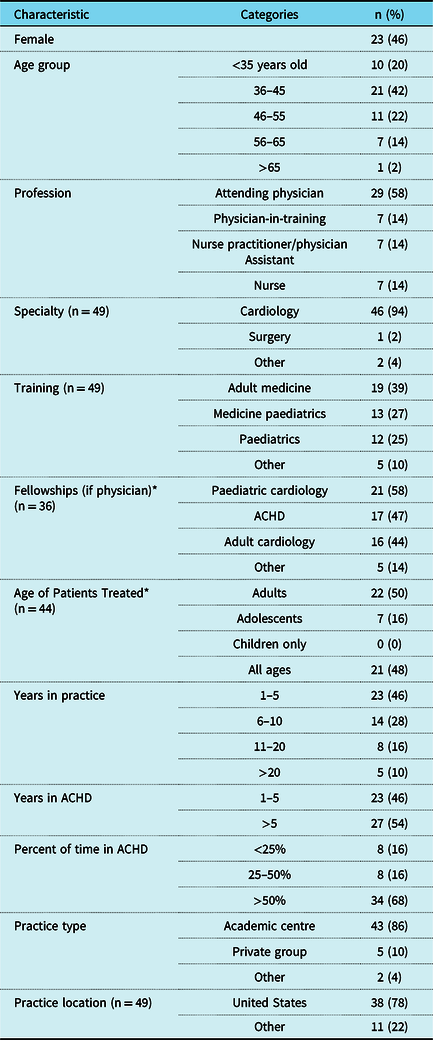
As shown in Table 1, providers in the 36–45 year age range comprised the largest proportion (42%) of respondents. Physicians comprised 72% of the sample; 94% identified cardiology as their specialty and 47% reported completion of ACHD fellowships. More than half (55%) reported having no previous training in palliative care and 42% reported participating in a workshop or a rotation while in school. Only one respondent (2%) reported completion of a palliative care fellowship.
Participant demographic and professional characteristics

(n = 50 unless otherwise noted).
* Responses are not mutually exclusive.
Responses to case scenarios
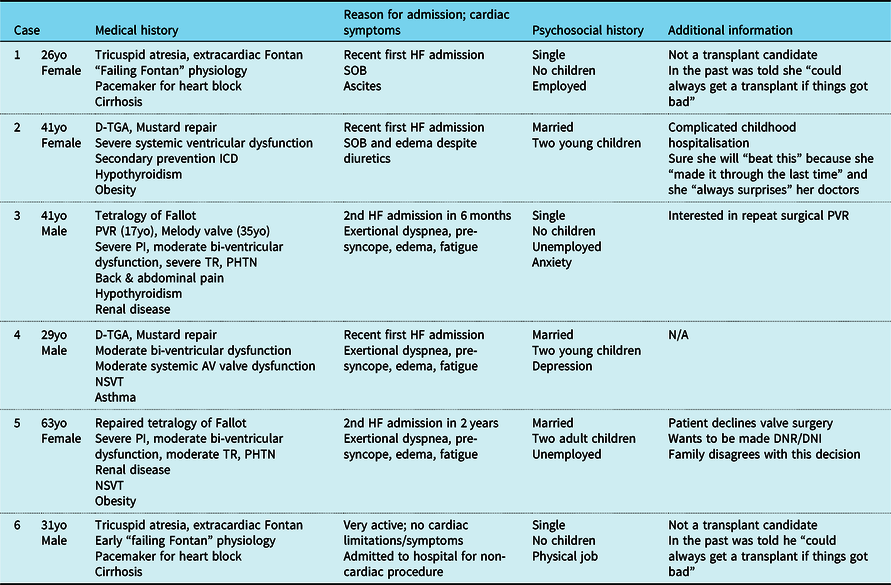
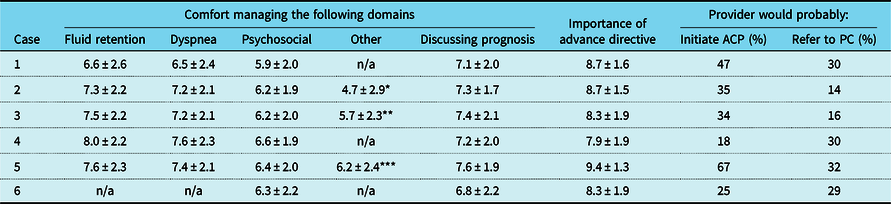
A summary of inpatient case scenarios is presented in Table 2. Average responses to closed-ended questions about the cases are presented in Table 3. For reporting purposes, cases in both tables are arranged in ascending order of the study team’s perceiveddifficulty of providing counsel, which was based on a combination of underlying disease, clinical presentation, and other patient-specific factors. For example, Case 1 described a 26-year-old woman with advanced, symptomatic “failing Fontan” physiology and liver cirrhosis who is not a transplant candidate. Case 5 described a 63-year-old woman with symptomatic heart failure related to tetralogy of Fallot who is in disagreement with her family regarding valve surgery and code status. Across the six cases (Table 3), the mean comfort levels for managing fluid retention ranged from 6.6 to 8.0, dyspnea from 6.5 to 7.6, and psychosocial needs from 5.9 to 6.6. The mean score for comfort discussing prognosis ranged from 6.8 to 7.6. In every case, the mean score was lower for comfort discussing psychosocial needs than for discussing physical symptoms and prognosis.
Case descriptions

AV = atrioventricular; DNR/DNI = do not resuscitate/do not intubate; DOE = dyspnea on exertion; D-TGA = d-looped transposition of the great arteries; HF = heart failure; ICD = implantable cardioverter defibrillator; NSVT = non-sustained ventricular tachycardia; PHTN = pulmonary hypertension; PI = pulmonary insufficiency; PVR = pulmonic valve replacement; SOB = shortness of breath; sx = symptoms; TR = tricuspid regurgitation; yo = year old.
Summary of responses to questions about six hypothetical patient cases

Cells reflect mean ± SD (0–10 scale) or percentage.
* ICD deactivation.
** Pain.
*** Family disagreement.
The importance of completion of advance directives and referral to subspecialty palliative care are also shown in Table 3. Across the six cases, the mean score for the importance of completing advance directives ranged from 7.9 to 9.4. The highest value was for the case that included disagreement between patient and family. The percentage of respondents who indicated they would probably initiate advance care planning conversations ranged from 18% (29-year-old with D-transposition of the great arteries with his first heart failure admission) to 67% (63-year-old with repaired tetralogy of Fallot with her second heart failure admission). The percentage of respondents who said they would probably refer the patient to palliative care ranged from 14% (41-year-old with D-transposition of the great arteries with her first heart failure admission) to 32% (a 63-year-old with repaired tetralogy of Fallot with her second heart failure admission).
Provider-reported barriers and/or facilitators to advance care planning with case patients
For each of the six cases, a final question posed to participants was “What are the major barriers and/or facilitators to advance care planning with this patient?” Across the cases, respondents identified 36 facilitators and 246 barriers. Collapsing across all responses and cases, there were 7 categories of facilitators and 10 categories of barriers. The most commonly reported facilitator categories were 1) the patient has already expressed some advance care planning preferences (n = 12, 9 of which were in reference to Case 5); 2) presence of severe disease or comorbidities (n = 11); 3) familial concerns, cited either as a source of support for the patient, to prevent financial or emotional stressors for family members, or the need to help oneself in absence of a family (n = 7); and 4) an upcoming surgery or procedure (n = 3).
The most commonly reported categories of barriers were 1) the possibility of improvement with treatment/too early to prognosticate (n = 64, noted across all cases); 2) familial concerns, that is, due to discrepant wishes, lack of support, or presence of young children (n = 50); 3) inaccurate patient knowledge or expectations about the disease process (n = 44, noted across all cases); 4) patient may not be ready to have these discussions (n = 25); 5) patient’s young age (n = 22); and 6) provider avoidance of the topic, be it out of a desire to fix everything, feeling like this is giving up, fearing it will crush hope, or lack of a strong relationship with the patient (n = 22).
General perspectives on advance care planning and palliative care
Providers self-rated their personal palliative care knowledge as 5.3 (SD 2.1) on a 0–10 scale. This did not vary by gender, years in practice, or prior palliative care training. Seventy-eight percent of providers reported that fewer than five of their patients die in a given year. Slightly over one-third (38%) of providers reported making a palliative care referral in the last year. Palliative care subspecialty services were available to 70% of providers in both inpatient and outpatient settings, 22% had access only to inpatient services, 2% had access only to outpatient palliative care, and 6% reported no access to specialty palliative care. Seventy-four percent of providers reported that there was a procedure by which advance care planning documents could be stored within the patient electronic or paper medical record; 20% were unsure.
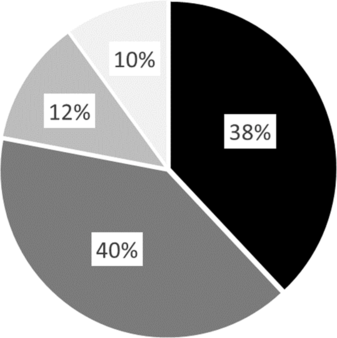
Providers were asked what they deemed the best time to begin advance care planning/end-of-life planning discussions. Seventy-eight percent of respondents (n = 39) reported these discussions should begin when patients are healthy, though roughly half of these (20 of these 39 respondents) would do so only for patients with moderate or severe lesions. Twelve percent of providers indicated that discussions should be initiated when the patient is first diagnosed with a life-threatening illness or complication, 2% thought this should occur when the patient is hospitalised with a life-threatening illness or complication, and 8% preferred to wait until multiple complications or hospitalisations have occurred (Fig 1). None of the respondents chose “when the patient is approaching end-of-life,” “prior to an intervention/surgery,” or “never”. Collapsing into two categories (one of the “when healthy” options versus one of the later options), responses did not differ by gender, years in practice, or prior palliative care training.
Provider-reported best time to initiate advance care planning (ACP)/end-of-life (EOL) discussions with patients.  Before patients get sick, while healthy (all patients with a CHD of simple, moderate, or great complexity).
 Before patients get sick, while healthy (patients with a CHD of moderate or great complexity only).
 When the patient is first diagnosed with a life-threatening illness or complication.
 After at least one hospitalization for a life-threatening illness or complication.

Discussion
This is the first study to assess ACHD providers’ views on advance care planning and palliative care utilising case-based questions. Cases utilised in this study represented a range of disease type, symptoms, comorbidities, and social circumstances – factors all thought to influence how providers make decisions about advance care planning and palliative care.Reference Nelson, Curtis and Mulkerin12 Our study revealed three important findings. First, responses to the cases suggest that providers are less comfortable managing psychosocial concerns than discussing prognosis or addressing physical symptoms. Second, most providers recognised that the optimal time to begin advance care planning/end-of-life discussions is prior to the development of a life-threatening complication or hospitalisation. Finally, providers reported low levels of palliative care knowledge, and although they recognised the importance of advance care planning, they themselves were less likely to initiate conversations or refer for palliative care specialist consultation.
Special circumstances and symptom management
Providers seemed least comfortable addressing internal cardioverter-defibrillator deactivation and familial disagreement. These are examples of complex ethical and social situations which may complicate medical and advance care planning decision-making and challenge the physician–patient relationship. Choosing to minimise aggressive care or limit life-sustaining treatment, including internal cardioverter-defibrillator deactivation, is a patient’s prerogative, even when providers or family members disagree.Reference Lampert, Hayes and Annas13–Reference Kramer, Matlock and Buxton15 Physical symptoms affecting quality of life are often what prompt patients to seek care, with the hope that the provider can offer alleviating treatments. Symptom management is a major component of palliative care, yet providers’ comfort in managing symptoms may vary. It is not surprising that our study suggests that providers may be most comfortable addressing physical symptoms, since this is the focus of cardiology training. However, providers rated their palliative care knowledge as 5.3 on a 0–10 scale, and this did not increase with years in practice, suggesting providers are not learning these skills with time. Thus, these findings present an excellent opportunity for provider education about the services palliative care can offer, and how and when to incorporate palliative care for more comprehensive and holistic patient care.
The current Core Cardiology Training Statements list knowledge of the management of psychosocial contributions to cardiovascular disease and knowledge of the principles and indications for palliative care as core competencies.Reference Halperin, Williams and Fuster16,Reference Warnes, Bhatt, Daniels, Gillam and Stout17 However, they do not direct hands-on exposure, and in a recent survey, cardiology trainees reported inadequate palliative care skills training.Reference Crousillat, Keeley, Buss, Zheng, Polk and Schaefer18 These training documents are more inclusive than prior iterations, as recognition of the importance of this type of care continues to grow, but until clear and comprehensive training recommendations for these issues exist, great potential for providers to avoid these important issues out of lack of knowledge or discomfort will remain.
Starting earlier and the need for a systematic approach
The early introduction of advance care planning and palliative care is now considered standard of care for cancer, and benefits to their use have been recognised in heart failure due to acquired disease.Reference Diop, Rudolph, Zimmerman, Richter and Skarf19 However, when patients have lived with a disease their entire lives, as they do with CHD, it can be difficult to recognise the optimal time and way to broach these discussions in order for them to be meaningful. This challenge is not unique to ACHD. Research in cystic fibrosis, another chronic illness with paediatric onset, has revealed that patients are interested in earlier advance care planning and palliative care integration, preferably while healthy.Reference Linnemann, Friedman and Altstein20,Reference Dellon, Helms and Hailey21 Cystic fibrosis providers echo the concerns that end-of-life discussions occur too late and that palliative care services are underutilised.Reference Braithwaite, Philip and Tranberg22 They also seek education regarding communicating with patients and families about these topics and managing the emotional burden of this responsibility.Reference Braithwaite, Philip and Tranberg22
Uncertainty of prognosis is a major issue driving delays in advance care planning and palliative care discussions in ACHD.Reference Lin, Cohen and Bhatt23 The natural history of ACHD in the current care era remains poorly defined, and it is thus difficult to predict when a life-threatening event may occur. Extrapolation from other conditions or others’ experiences may be helpful but not sufficient. Provider comfort with discussing prognoses does not guarantee comfort with end-of-life discussions. In this study, it seemed that it was easier for providers to envision discussing advance care planning when patients had worsening symptoms or a hospitalisation, that is, an “event” outside of the status quo. The chance that a patient’s condition might improve with treatment was perceived as a barrier. Given this prognostic uncertainty, in addition to patients’ young age and everyone’s hope for a favourable long-term outlook, the risk is that providers may forego uncomfortable advance care planning and end-of-life discussions until patients are very sick.
However, the 2018 American College of Cardiology/American Heart Association Guidelines for the Management of Adults with CHD suggest that advance care planning and palliative care discussions should not wait until death is imminent.Reference Stout, Daniels and Chair24 This way, discussions can prompt patients to think about what is important to them before the arrival of critical moments, and patients and providers can work together to plan for care that aligns with patients’ goals. Educational efforts should target providers (such as the 22% of respondents in this study) who would delay conversations until the onset of severe illness. Age 18 or the transition to adult care has been recommended by patients and providers as appropriate times to begin advance care planning discussions, although the decision must be made on an individual patient basis.Reference Sable, Foster and Uzark5,Reference Deng, Gleason and Khan8 Further, because patients’ wishes may change, decisions should be revisited at regular intervals and certainly with any upcoming procedure or major change in health status, such as initiation or heart failure medications, hospitalisations, or change in exertional capacity.Reference Steiner and Kovacs25
Comprehensive care requires a team
Complex medical and psychosocial situations may limit the likelihood that ACHD providers conduct advance care planning and palliative care conversations. Interestingly, in an open-ended question asking about case-specific facilitators and barriers to advance care planning, respondents described almost seven times as many barriers as facilitators, highlighting the often-daunting nature of this task. Furthermore, 20% of respondents were unsure whether there was a procedure by which advance care planning documents could be stored within the medical record, suggesting gaps in preparedness for initiating discussion of advance directives.
As the importance of quality of life and care preferences gain recognition in ACHD, palliative care efforts will continue to grow. In addition to education to enhance ACHD providers’ comfort providing primary palliative care, the best way forward may be a shared approach, with the creation of interdisciplinary care teams to help provide secondary or specialty palliative care. Working alongside traditional cardiology providers, teams may include nurses, social workers, and providers from related medical specialties to ensure all patient care needs are addressed. For example, dedicated nurse coordinators may assist with holistic patient assessment, including patient education and self-care management.Reference Sillman, Morin and Thomet26 Bioethicists may help define benefit, harm, and futility in the context of medical interventions, and they can assist providers, patients, and families in understanding each other’s perspectives.Reference Robinson, Cage and Erler27,Reference Wasson, Anderson, Hagstrom, McCarthy, Parsi and Kuczewski28 Palliative care specialist integration can lead to better symptom control and care continuity and coordination.Reference Siouta, Van Beek and Van Der Eerden29–Reference Smallwood, Thompson and Warrender-Sparkes31 In our current study, although 70% of respondents reported having access to palliative care consultative services, we did not ask whether services are easily accessible, which could account for the relative hesitancy to make referrals. Efforts to increase the availability of these resources, such as to decrease wait times or streamline consultation as part of another medical visit, can lead to earlier involvement. Using the combined expertise of interdisciplinary team members, care provided may be better aligned with patient and family goals.
Limitations
A few limitations to these findings must be considered. The estimated (conservative) response rate for this survey was lower than 20%. Although ours was similar to the response rate in other surveys of providers,Reference Clowse, Eudy and Kiernan32–Reference Shillinglaw, Viera, Edwards, Simpson and Sheridan34 it allows opportunity for selection bias. We cannot predict how non-respondents would have answered survey questions, but it is reasonable to hypothesise that respondents opted for study participation because they recognise the important of advance care planning, thus potentially biasing this sample more favourably to advance care planning discussions. The intent of this study was to assess providers’ views regarding palliative care based on their understanding of this type of care. Responses may have been different if formal palliative care training was provided or if vignettes included more information about palliative care interventions and case outcomes. In addition, this was largely a sample of American providers, the majority of whom have been in practice 10 years or less. Thus, generalisability to providers outside of North America remains unknown. Further, in this assessment of advance care planning discussions, we did not account for prioritisation of this amongst other issues that may take precedence during a time-limited patient encounter.Reference Arndt, Beasley and Watkinson35,Reference Dugdale, Epstein and Pantilat36 For example, a provider may feel compelled to spend visit time discussing physical needs and items that are required components of electronic health record documentation over advance care planning. Despite these limitations, results from this study are important to guide future research, including interventions.
Conclusions
In conclusion, there exists an educational opportunity to improve ACHD providers’ comfort, confidence, and skills in managing patients’ psychosocial needs and holding advance care planning conversations, particularly with regard to internal cardioverter-defibrillator deactivation, complex family dynamics, and non-cardiac symptoms. Providers in this study recognised the value of advance care planning but were less likely to deliver it themselves. This raises the critical questions of how and by whom discussion of these important matters should be initiated and how best to support ACHD providers in these endeavours.
Acknowledgements
Dr E.O. currently holds the Bitove Family Professorship of Adult Congenital Heart Disease.
Financial Support
Funding was provided by a training grant to the first author from the National Heart Lung and Blood Institute (T32 HL 125195) and the Cambia Health Foundation
Conflicts of Interest
None.
Ethical Standards
The authors assert that all procedures contributing to this work comply with the ethical standards of the relevant national guidelines on human experimentation and with the Helsinki Declaration of 1975, as revised in 2008, and has been approved by the institutional ethics review board at the University of Washington.