Introduction
As an important field of political science and an integral part of regional studies, Japanese political studies have always attracted the attention of political leaders, academia, and mass media in China. Thanks to the intensification of Sino-Japanese relations and growing efforts in the field of social sciences, great progress has been achieved in Japanese political studies in China during the past three decades. Although recently many contributions on the general subject of Japanese politics have been made, only a small number of these publications relates to or specializes in specific topics of Japanese political studies in China. However, there are various problems with regard to the political theory and methodology of Japanese political studies. Since Japan is one of the most important neighboring countries and the Sino-Japanese relation is one of the most important bilateral ones to China, it is imperative to improve the state of Japanese political studies and raise their quality in China. For this purpose, it is necessary to strengthen mutual cooperation and exchange between Chinese and Japanese political scientists.
This article's aim is to review the recent developments and current situations, discuss the progress and problems encountered so far, and explore the direction of Japanese political studies in China. The paper is divided into the following five sections: (1) Overall review – this first section will briefly discuss the historical background and developments of Japanese political studies in order to identify some of its most salient features. (2) Institutional analysis – the institutional developments in Japanese political studies will be analyzed in detail. (3) Content analysis – the major trends in Japanese political studies will be explored by comparing the main context of books and articles. (4) Approach analysis – some of the approaches used in the discipline of Japanese political studies will be analyzed by introducing several selected examples. (5) Problems and prospects.
Overall review
Japan is one of the most important neighboring countries to China. During the nearly two thousand years of contact and communication between China and Japan, a huge number of articles and books about Japanese politics have been written and published by many distinguished scholars and high-level government officials in China. According to Chinese historical records, the history of Japanese political studies can be traced back to San Guo Zhi (The History of Three Kingdoms) written by Chen Shou 1,700 years ago (Y. Li, Reference Li2009: 4). Since then, although scholars’ interest in Japanese political studies varied throughout the centuries, the historical development of Japanese political studies has never been interrupted and can be analyzed in detail during the following three periods.
The ancient period can be said to have lasted from the earliest available recordings until the middle of the nineteenth century. Throughout Chinese history, all rulers attached great importance to the documentation of their previous dynasties and tried to draw lessons in order to improve their governments. Most of these history books included an important chapter on Japan, describing the basic situation there. Those historical writings were formal and official, but sometimes contained very interesting details about Japan and Sino-Japanese relations. For example, Japan was originally called Wo (Wa) or Woren (Wajin) or Woguo (Wakoku), but it was renamed as Riben (Nihon) after the Tang Dynasty. There was an increase in research activities with regard to Japanese political studies during the Ming Dynasty because Sino-Japanese relations were confronted with new challenges and serious problems, such as Japanese pirates along East China's sea coast and Japanese plans to invade the Korean peninsula and China. Besides official historical documents on Japan, many scholars wrote and published books on Japanese politics.
The subsequent modern period lasted from the middle of the nineteenth century until the middle of the twentieth century. While Western powers began to threaten China's interests and national sovereignty after the Opium War, Japan responded successfully to Western pressure and emerged rapidly as a new power in the world through the Meiji restoration. After its defeat in the first Sino-Japanese War (1894–1895), China was forced to sign the humiliating Treaty of Shimonoseki, losing Taiwan to Japan. Chinese people were shocked by Japan's power and woke up from their old dream of China as the central kingdom. Therefore, many Chinese young people went to Japan and tried to explore why Japan had succeeded and discover what China could learn from Japanese experiences. This led to the rapid growth of Japanese political studies and the remarkable developments in Sino-Japanese relations from the late nineteenth century until the early twentieth century – a period which has been called ‘the golden decade’ by Reynolds (Reference Reynolds2006: 9). For example, Kang Youwei's research (Kang, Reference Kang2007) focusing on the Meiji restoration contributed considerably to China's effort at political reform under the leadership of Guangxi Emperor. There were 2,717 Japanese books translated into Chinese between 1896 and 1937. However, when Japan expanded its sphere of influence and plundered economic resources in China, the theme and trend of Japanese political studies changed totally. Many of Chinese scholars spared no effort in delving into the origin of Japanese imperialism and to reveal the truth about Japan's invasion of China.
The contemporary period of Japanese political studies started in the middle of the twentieth century. After the People's Republic of China was founded in 1949, the Korean War broke out in 1950, and Japan signed a Peace Treaty with Taiwan (the Republic of China), the relations between mainland China and Japan became strained for 20 years. Although some people from both China and Japan tried hard to promote economic and cultural exchange and achieved some success, Japanese political studies made little progress during the two decades because of economic and political limitations. However, a new boom of Japanese political studies was triggered after China and Japan normalized their relations in 1972, especially after China began to implement new reform policies and opened up to the outside world from 1978 onwards. According to some sources, 3,157 research books on and translations of Japanese studies were published in mainland China between December 1978 and March 1993: the annual average of 210 books was 17.5 times higher than during the years 1949–78 (Luo and Xu, Reference Luo and Xu1997: 22). Thanks to the increasingly interdependent relations between China and Japan, more academic information and more financial assistance are available to Japanese political researchers, which help to improve the quality of research.
Reflecting on the historical developments of Japanese political studies in China, the following salient features can be found. (1) Although Japanese political studies have a long history of 1,700 years, there are ups and downs in the quantity and quality of Japanese studies. During several important periods such as the Ming Dynasty, the late Qing Dynasty, the early twentieth century, and the new era of reform, Japanese political studies have been promoted with great effort and many remarkable achievements have been made. For example, Ri Ben Guo Zhi (Encyclopedia of Japan, 1887) written by Huang Zunxian, Ri Ben Lun (On Japan, 1928) by Dai Jitao, Ri Ben Ren (On Japanese, 1939) by Jiang Baili remain the classics of Japanese studies and are read widely even today. However, most of them studied and discussed Japan and Japanese in general. (2) The development of Japanese political studies has been heavily influenced by political developments in China and Japan as well as Sino-Japanese relations (Y. Li, Reference Li and Wang2009: 27–8). Japan's success during the Meiji restoration and Japan's emergence as a new world power attracted much attention from Chinese people and stimulated a phase of enthusiasm for Japanese political studies during the late nineteenth century and early twentieth century. Japan's invasion of China and the Sino-Japanese wars made Chinese people think about the origin, nature, and future of Japanese imperialism. China's reforms and the mutually beneficial Sino-Japanese relations gave fresh impetus to the research on the Japanese development model and strengthened mutual cooperation between Chinese and Japanese scholars. (3) Japanese political studies have usually been conducted in a practical way and many Chinese scholars tend to take a utilitarian view of Japanese studies. Traditionally, Chinese people tend to think and behave in a practical way, just as one scholar emphasized the ‘practical reason’ in Chinese traditional culture (Z. Li, Reference Li1986: 303). Especially after China was defeated in the Opium War and then plundered by Western and Japanese powers respectively, the Chinese people made considerable effort to learn from experience and draw lessons from Japan in order to build an independent, prosperous, and powerful China. After analyzing Japanese studies in China from the middle nineteenth century, Tingjiang Li confirmed the pragmatic way of Japanese studies and argued that we should conduct Japanese studies from all different perspectives, not only from the utilitarian perspective (T. Li, Reference Li2009).
Institutional analysis
Contrary to the formal and official description of Japan in ancient Chinese history books and private and individual studies of Japanese politics in modern China, the organizational and institutional foundations of Japanese political studies have been laid and consolidated in contemporary China. Although political science as an independent discipline was withdrawn and the teaching and research of political science were merged into some other relevant disciplines during the reorganization and reconstruction period of universities, colleges, and departments in 1952 after the founding of the People's Republic of China, Japanese political studies were emphasized by the Chinese government and the Communist Party so as to improve understanding of political developments in Japan and to further criticism of Japan's foreign policy vis-à-vis communist China. In May 1952, the Leading Small Group on Japan Affairs was established within the central government under the direct leadership of Premier Zhou Enlai, with Liao Chengzhi in charge of its operation and works. This group had overarching mandates for Japan affairs, presiding over policy research, formulation of policy proposals, sponsoring of policy experiments, and drafting of policy documents.
During the early 1960s, once China's international status had been improved and foreign exchanges expanded, the leadership and the organization of foreign exchanges and international studies were strengthened. In October 1963, the Sino-Japanese Friendship Association was established with Guo Moruo as its honorary chairman and Liao Chengzhi as its chairman. In 1964, according to an important resolution concerning the strengthening of foreign affairs studies issued by the Chinese Communist Party, three departments of international politics were set up at Peking University, Fudan University, and Renmin University of China, focusing on the studies of nationalist liberation movements in the developing world, Western capitalist politics in Western Europe and North America, and Communist movements in the Soviet Union and Eastern Europe, respectively. Meanwhile, many Japanese research institutes had been established all over China, such as the Institute for Japanese Studies at Liaoning University (1964), the Institute for Japanese Studies at Jilin University (1964), the Institute for Japanese Studies at Northeast China Normal University (1964), the Japanese Study Group at the Institute for Southeast Asian Studies in Chinese Academy of Social Sciences (1965), the Japanese Study Section at the Chinese Institute for International Studies (1965), the East Asian Study Section at the Chinese Institute for Contemporary International Relations (1965), the Research Section for Japanese History Studies at the Tianjin Institute of History (1964), the Japanese Study Section in the Institute of History at Nankai University, the Institute for Japanese Studies at Hebei University (1964), the Japanese Study Section at the Shanghai Institute of International Studies (1964), and the Japanese Economy Research Section in the Institute of World Economy at Fudan University (1964). However, Japanese political studies were suspended again because of the collapse of the whole higher education and research system during the Cultural Revolution (1966–76). Even during the hard times of the ‘Cultural Revolution’, the Department of International Politics and the Institute of World Economy at Fudan University organized jointly a series of publications on ‘government in major countries’. As a result, a series of books such as Government in Britain, Government in the United States, Government in France, Government in Federal Republic of Germany, and Government in Japan were published by Shanghai People's Press during the 1970s (Wang and Pan, Reference Wang and Shiwei2005: 199–202).
Political science and international studies were reestablished and reconfirmed as independent disciplines, drawing lessons from the dictatorship of Mao Zedong, who launched a series of political movements, ignored the rule of law, and even dismantled the political institutions of party and government. The new supreme leader, Deng Xiaoping, persecuted as an advocate of capitalist development during the preceding political struggles, called attention to political research and international studies in 1979 and said: ‘Political science, law, sociology and the studies of world politics were ignored by us for many years; now it is necessary to make up for the loss as soon as possible’, ‘All researchers must learn foreign languages until they can read social science books in foreign languages without difficulty. We have already admitted that our natural sciences lag behind foreign countries, now we must admit that the research works in social sciences lag behind foreign countries’ (Deng, Reference Deng1994: 180–1). Fudan University luckily took the lead in restoration and development of political science in China during this new era of reform and opening up to the outside world. In 1980, political science was reconfirmed as an independent discipline at the Department of International Politics of Fudan University, where the first class for undergraduate students majoring in political science was started in 1981. During the next several years, departments of political science were set up at some other universities such as Peking University, Jilin University, and Wuhan University. At the same time, the Chinese Political Science Association (CPSA) was reestablished in Beijing in 1980; and many local associations such as the Hubei Political Science Association and the Shanghai Political Science Association were set up one after another. The CPSA conducted a lot of programs, organized many conferences, and published a series of books on political science. During the late 1970s and early 1980s, many associations for Japanese studies were established, e.g. the Chinese Association for Japanese Economic Studies (1978) and the Chinese Association for Japanese Historical Studies (1980). The Chinese Association for Japanese Studies was established in February 1990 as a comprehensive organization with more than 1,800 members, including more than 100 collective members (S. Li, Reference Li2005: 9).
According to the latest survey,Footnote 1 there are about 110 centers or institutes for Japanese studies in China. All of them can be divided into three groups based on their status, budget, and relations with the Chinese government and the Communist Party.
The first group includes the centers or institutes for Japanese political studies affiliated with the Chinese government and the Communist Party, such as the Institute for Japanese Studies at the Chinese Institute for Contemporary International Relations, the Center for Japanese Studies at the Shanghai Institutes of International Studies, and the Shanghai Center for Japanese Studies and Exchanges. These institutes are supported financially and controlled politically by the Chinese government and the Communist Party. Most of them serve as national or local think tanks, collecting information and providing policy proposals.
The second group includes the centers or institutes for Japanese political studies at the Chinese Academy of Social Sciences and some local academies of social sciences, such as the Institute for Japanese Studies within the Chinese Academy of Social Sciences, the Institute for Japanese Studies affiliated with the Tianjin Academy of Social Sciences, the Center for Japanese Studies at the Shanghai Academy of Social Sciences, and the Institute for Japanese Studies at the Jilin Academy of Social Sciences. These institutes benefit from financial support from the government, but they enjoy relatively more independence and freedom from political control than governmental institutes.
The third group includes the centers or institutes for Japanese political studies in some universities and schools, such as the Center for Japanese Studies at Fudan University and the Institute for Japanese Studies at Nankai University. These centers must get some of their financial support from the government's budget. Some major centers and institutes are supported partly by the Japan Foundation. In the case of Fudan University, one third of the center's budget comes from the university, another third from the Japan Foundation, the rest from some private companies. However, Japanese political studies can be promoted in a relatively free academic atmosphere. Most of the research is conducted outside of government control.
The survey results collected by Zhiyong Song indicated that among all 110 institutes and centers for Japanese studies, the third group accounts for 70%, commanding an absolute majority; the second group takes up 10%; and the centers and institutes affiliated to the Chinese government and the Communist Party represent 20%. This means that a large number of research institutes have become increasingly independent from the government as a consequence of the deepening of market-oriented reforms and the developments in Sino-Japanese relations during the past three decades. There are more than 1,000 Japan experts doing research in the aforementioned institutes and centers. Their fields of research are as follows: 43% work in the field of Japanese language and literature, 18% on Japanese history, 14% on the Japanese economy, 12% in the area of Japanese politics and diplomacy, and 13% conduct research on Japanese philosophy and education (CAJS, 2010: 4). While those scholars are doing research in the institutes and centers for Japanese studies, there are many more Japan experts who are affiliated with other schools or departments, but conduct Japanese political researches in cooperation with those institutes and centers. For instance, there are only 11 research fellows at the Center for Japanese Studies at Fudan University, but more than 100 scholars actually conduct research on Japanese language, literature, history, culture, economy, politics, and diplomacy in many other schools and departments, among whom more than ten scholars are studying Japanese politics and foreign relations in the School of International Relations and Public Affairs and the Institute of International Studies.
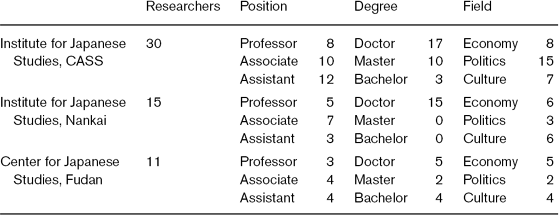
In order to look into the institutional development of Japanese studies in detail, three leading research institutes have been selected for comparative analysis from Beijing, Tianjin, and Shanghai. Although there are differences in research capacity as indicated in Table 1, much progress and great achievements have been made in building institutes for Japanese political studies in China during the past three decades. There are many centers and institutes for Japanese studies in which the quality of researchers has been greatly improved. Most of them hold a Ph.D. and can speak the Japanese language fluently. All researchers conduct various kinds of exchanges and communicate with Japanese colleagues. While Japanese studies at Fudan University focus on economy and at Nankai University Japanese studies focus on history and culture, the Institute for Japanese Studies at CASS chose Japanese political studies as its central focus.
Comparison in research capacity between CASS, Nankai, and Fudan
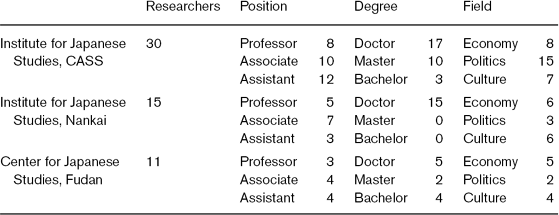
Source: The basic data are collected from the home pages of Institute for Japanese Studies of Chinese Academy of Social Sciences, Institute for Japanese Studies of Nankai University, Center for Japanese Studies of Fudan University.
The rapid development of Japanese language education has contributed greatly to the improved quality of Japan scholars and to the increase in Japanese research in China. According to statistics,Footnote 2 the number of Japanese language students increased from 390,000 in 2003 to 680,000 in 2006, and the number of Japanese language teachers went up from 6,000 to 12,000 during the same period. The latest survey by the Ministry of Education indicated that among 1,070 institutes of higher education (universities and colleges), there are 385 (36%) institutes in which departments of Japanese language have been established, and about 60 institutes in which master courses on Japanese studies are taught. Besides domestic Japanese language education, more and more young people return to continue their studies on Japan, a development which helps to improve Japanese political studies.
Content analysis
Japanese political studies in China are always influenced by political development in China and Sino-Japanese relations. In 1978 at the Third Plenary Session of the Eleventh Central Committee of CCP, the CCP with Deng Xiaoping as its core leader restored the guideline of ‘seeking the truth from the facts’, stopped using the slogan ‘politics taking command’, and shifted the major goals to the socialist construction, focusing on economic development and modernization. Just before the Third Plenum of the CCP Eleventh Committee, Deng Xiaoping visited Japan during late October 1978 for the conclusion of Sino-Japan Peace and Friendship Treaty. Deng went to see many places, including big corporations, took the high-speed train (Shinkansen), and held talks with Japanese leaders and people from various backgrounds. Those visits and talks led to Deng being shocked at Japan's rapid development. After Deng visited Japan's famous automobile company, NISSAN, and learnt that one worker produced 94 cars per year, whereas in China one worker produced only one car even in the most advanced Changchun Automobile Factory, he said despairingly: ‘I understand what modernization is at last’ (J. Yang, Reference Yang1998: 244–5). Deng Xiaoping was firmly determined to promote the modernization drive in China by learning and emulating the development experiences of all advanced countries such as Japan, introducing and importing their advanced technology and monetary capital (Tian, Reference Tian2002: 336–7). Therefore, the criteria of evaluation were geared toward a developmentalist and materialist direction. As Deng Xiaoping put it, ‘Economic works are the biggest political works at present; economic issues are the overriding political issues’ (Deng, Reference Deng1994: 194). The Chinese Communist Party and government gave priority to economic affairs and regarded economic development as the fundamental criterion for judging all policies and measures.
This developmental-oriented reform strategy encouraged the rapid growth of Japanese economic studies rather than political studies during the early period of reform and opening up to the outside world. Scholars began to study why Japan had succeeded in economic development: the economists discussed economic governance and development in Japan, political scientists analyzed the political origin of economic growth and the main reasons for the Liberal Democratic Party's long rule, and sociologists explored Japanese behavior and human relations behind the economic miracle. According to statistics on Japanese studies, 3,157 books were written and published in China from 1979 to 31 March 1993, among which 869 books studied Japanese language, 781 books focused on Japanese literature, 620 books dealt with the Japanese economy, and only 226 books had Japanese politics as their main subject. There were 19,465 articles on Japanese studies written and published in China between 1 October 1949 and 31 March 1993: 1,000 of these articles dealt with Japanese language, 2,650 articles studied Japanese literature, 2,600 articles focused on Japanese history, 2,600 articles concerned Japanese education and culture, 6,000 articles discussed Japanese economy, and only 1,340 articles had an emphasis on Japanese politics (Luo and Xu, 1997: 25).
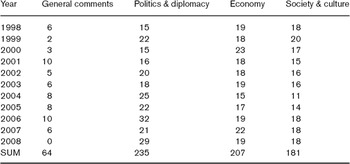
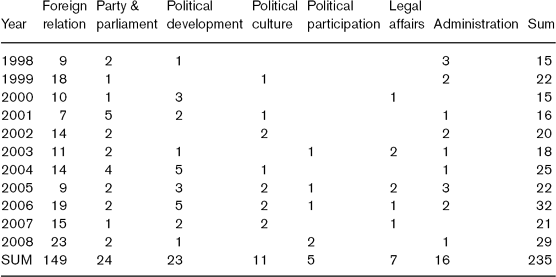
However, after the end of the Cold War and collapse of the bubble economy in the early 1990s during which Japan experienced a long and deep recession, the ruling party, the Liberal Democratic Party, finally lost its rule after its defeat in the 1993 general election. Considering these new economic and political developments in Japan, many Chinese scholars diverted their attention from economic issues and took more interest in Japanese political studies. Political regrouping and party politics, right-wing and conservative politics, historical issues and Taiwan policy became the main topics of Japanese political studies (Sun, Reference Sun2009: 146). As Table 2 indicates, there are 235 articles on Japanese politics and diplomacy in Japanese studiesFootnote 3 (1998–2008), more than 207 articles on the Japanese economy, 181 articles on Japanese society and culture. A close examination of Japanese political studies in Japanese studies (1998–2008) revealed that most of them concentrated on Japanese diplomacy and foreign relations. As Table 3 shows, among the 235 articles on Japanese politics, there are 149 articles (63.4%) on Japanese foreign policy and foreign relations, such as Sino-Japanese relations and the Japan–US alliance. There are 24 articles on Japanese party politics and parliamentary politics, 23 articles on political development and democratization.
Classification of articles in Japanese studies (1998–2008)

Classification of political studies in Japanese studies (1998–2008)
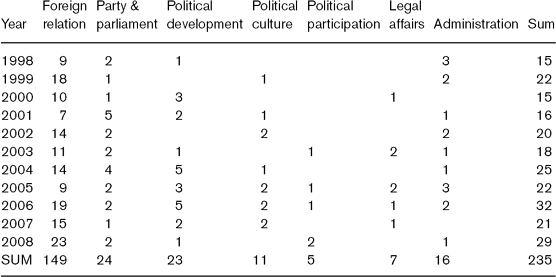
Several reasons account for the predominant weight of Japan's foreign policy as an area of specialized analysis in political studies. First, in contrast to domestic politics, Japan's foreign policy has been attracting the attention of Chinese leaders, academic circles, mass media, and public opinion because Sino-Japanese relations are the most emotional issue and Japan the most critical country in China's foreign relations (Shirk, Reference Shirk2007: 144). Second, the Liberal Democratic Party (LDP) ceased to be a model for the CCP in China after its long rule ended in 1993; the LDP was also criticized for political corruption and factional strife. Third, it is sensitive and sometimes troublesome for scholars to introduce and discuss political pluralism and democratization in a country such as China, ruled by one authoritarian Communist Party.
As Japanese political studies become increasingly important and the number of related publications go up, scholars concentrate their interests on the following themes.
The first is political analysis of the Japanese development model. After Japan achieved economic success and emerged again as an economic power, many people such as scholars and journalists were speaking of the ‘Japanese miracle’ and the ‘Japanese model’ (Wang, Reference Wang2002). In spite of the fact that many books and articles have been written and published in China by Japanese experts during the past several decades, it seems that no consensus has been reached among them. While some emphasized the fundamental role of democracy and the market in Japan's postwar development, others discussed ‘soft authoritarianism’ and ‘governed market’. Scholars tend to define the Japanese model from their own perspective and portray it in different ways. Fanjing Kong, a Chinese scholar affiliated with the National Development and Reform Commission of China's central government, defined the Japanese model as a good development model of ‘catch-up modernization’ by which Japan achieved rapid growth successfully through governmental intervention in the economy, and insisted that it is still useful and viable for developing countries seeking the goal of modernization (Kong, Reference Kong2009: 99–110). From the comparative political perspective, the following three points deserve special attention in China:
(1) Political stability that was ensured by the long rule of the LDP (Luo, Reference Luo, Luo and Zhenghua1997: 16). During the first decade after the end of World War Two, Japan had been plagued by the highly volatile political situations in which many political parties struggled for power. The Liberal Party and the Democratic Party merged into one larger conservative party, the LDP, in 1955 so as to counteract the influence of the newly founded Socialist Party. Contrary to the widespread expectation that the LDP and Socialist Party would compete and rule alternatively in the following years, the LDP managed to stay in power continuously for nearly four decades, until 1993. The LDP was then in opposition for a short time, it came back to power from the middle 1990s until its defeat by the DPJ in 2009. This one-party rule has been so long that many commentators cast doubt on the nature of Japanese democracy. Nevertheless, the LDP's long rule contributed very much to political stability and economic development under the so-called ‘1955 system’. Instead of investing resources and consuming energy in winning elections, the LDP was able to concentrate on its main strategic objectives, such as national security and economic development.
(2) The important role of the bureaucracy in economic development and social management. Thanks to historical tradition and occupation policy, there existed an efficient and highly professional bureaucracy, an elite group recruited from the top universities in Japan. It played a critical role in protecting industry from international competition, promoting industry through an active industry policy, establishing a framework for economic activities, and maintaining the economic order through administrative guidance (D. Yang, Reference Yang1998).
(3) The cooperative, close and cozy relations between bureaucracy and political parties, bureaucrats and politicians in the process of policymaking in Japan (Wang, Reference Wang2002: 63). The professional politicians and the professional bureaucrats have developed as two elite groups along with the political differentiation of structure and function of the modern state. During the postwar period, politicians played an increasingly important role in policy-making because of democratization and liberalization under the new Constitution of Japan. Especially under the long rule of the LDP, the traditional bureaucratic dominance was counterbalanced by the rising influence of politicians, political parties, and the Parliament with regard to the policy-making process. The LDP politicians have for the most part regarded the bureaucrats not as rivals but as partners in running government. Since the bureaucracy is renowned for its organizational excellence, the LDP found it advantageous to respect its independence. As a political principle, the bureaucrats came under the ultimate control of the politicians in a democracy. But many politicians were of bureaucratic origin themselves and had been classmates of the bureaucrats at the same high school and universities. Thus the two elite groups usually formed a common circle based on their similar backgrounds, which helped them to cooperate with each other in promoting economic development.
The second topic scholars have concentrated on is political analysis of institutional reforms and transitional crises. Scholars tried to explore political origins and the consequences of economic crises from the early 1990s, such as the long and deep recession after the burst of the economic bubble in 1991, the financial crisis of 1997 and 1998, and the recent economic slump along with the global economic crisis caused by the subprime mortgage loan problems in the United States. During the nearly two decades since the burst of the economic bubble, Japan has been struck by heavy pressures for political and administrative reforms because the LDP and the bureaucracy were blamed widely and strongly for democracy deficit, political scandals, economic crises, and social problems (Lin, Reference Lin1998: 447–91). Those political and administrative reforms determined the transition from the Japanese development model, but failed to create strong political leadership and good economic governance expected by the reform designers. On the contrary, those reforms brought about unexpected consequences, further weakening political leadership and exacerbating the economic downturns.
(1) Leadership deficit and policy poverty. There are many politicians and bureaucrats in Japan, but no leaders because a genuine political leader must have a sense of mission in politics and a vision for his country and our world. In the modern history of Japan, there were many great leaders especially during the Meiji Era, who had steered their country out of crises and toward progress and prosperity. Even after World War Two, there were excellent leaders such as Shigeru Yoshida who adopted a farsighted strategy about political and economic development for Japan, concentrating on recovery and growth and minimizing military expenditure. Unfortunately, during the past two decades, there have been too many politicians struggling for power, money, and sex, but no leaders reflecting upon Japan's future.
(2) Political upheaval and policy fluctuations. There have been political and administrative reforms aimed at strengthening political leadership and improving economic governance during the past two decades, but those reforms brought about meager meaningful results and many unexpected consequences. While the Japanese model has been revised and the LDP's long rule ended, Japanese politics have become increasingly volatile and extremely unstable. There were many small political parties uniting and disuniting during the middle 1990s. From the late 1990s, the Democratic Party of Japan emerged as a new strong political force attempting to defeat and replace the LDP as the ruling party. After the DJP finally secured a majority in the upper house, it adopted a non-cooperation strategy that led to unprecedented political gridlock in Japan. The DPJ's non-cooperation strategy forced Shinzo Abe to resign first and made Yasuo Fukuda step down one year later. Legislation proposed by the ruling LDP coalition has been frequently frustrated and some key appointments requiring Parliamentary approval were forced to be withdrawn, notably the nomination of the governor of the Bank of Japan. The Japanese ‘twisted Diet’ finally led to political paralysis. The electoral reform and political funding reform accelerated the disintegration of faction politics and reshaped the intra-party relations, leading to political instability and policy fluctuations in Japan. Since the LDP lost power in 1993, there have been 12 prime ministers, four of whom were from the New Japan Party, the Socialist Party, and the Democratic Party of Japan respectively. Many cabinets lasted for very short time, among which Hata Cabinet lasted only 64 days. One exception may be Junichiro Koizumi who consolidated power by ‘destroying the LDP and reforming Japan’. Some important economic and social policies were proposed and implemented by one cabinet, and then abandoned or reversed by another government. This brought about policy fluctuations and chaos and gave rise to enormous negative impacts on economic governance. The cycle of expansion and contraction in fiscal policy during the past years is a good example (Zhang, Reference Zhang2005: 53–66).
(3) Bureaucratic decay and policy distortions. Since the Meiji Restoration, the bureaucracy has played a critical role in Japan's state-led campaign of modernization from above and in economic recovery and rapid growth during postwar period. The bureaucracy enjoyed a high reputation for its efficient economic governance. However, the bureaucracy was criticized and condemned for misgovernment after the burst of Japan's bubble economy. Many political and administrative reforms have been implemented, aimed at reducing bureaucratic power, strengthening political leadership, and improving economic governance. Instead of yielding positive results, today's Japan is confronted with many negative, unexpected consequences, such as bureaucratic decay, inefficiency, and corruption (Wu, Reference Wu2003: 294–316). For example, an investigation revealed that the Ministry of Health, Labor, and Welfare misplaced pension records for over 50 million Japanese citizens. A minor change in accounting procedures at the Social Insurance Agency in 1997 resulted in data-entry mistakes and numerous ‘unidentified’ accounts with unknown owners. The problem widened in June 2007 when the Ministry stumbled across an additional 14.3 million accounts on microfilm that had never been entered into the computer systems. This kind of scandal was unthinkable in the past efficient bureaucracy.
The third major topic is the analysis of Japan's political turn to the right and its influences on Japanese politics and foreign policy, especially Sino-Japanese relations. After Japan created the economic miracle and emerged as the second largest economic power, some Japanese leaders, such as Yasuhiro Nakasone, sought to expand political influence and tried to improve Japan's political status in the world. At the same time, movements aimed at revising the peaceful constitution and rewriting the history textbook gained momentum. Chinese scholars have paid much attention to such kinds of political developments in post-Cold War Japan and published many works (Lv, Reference Lv2004; J. Li, Reference Li2005; Huang, Reference Huang2008). According to these analyses, there are many reasons accounting for Japan's turn to the political right, for example American occupation policies that appeased some of Japan's war criminals and encouraged Japan's reemergence as a global power, Japanese insularity originating from historical development as an island country, modern political inclinations towards military expansion, and the international environment lacking effective regulations. Scholars coined many new terms such as ‘neo-nationalism’, ‘neo-statism’, ‘neo-conservatism’, and ‘national conservatism’ to describe the political trends and thoughts in Japan. After analyzing the political rebirth of the conservative parties, a total political turn to the right, and the rise of nationalism, the scholars at the Institute for Japanese Studies of CASS defined the mainstream political trend as ‘nationalist conservatism’ that has been taking the place of the so-called Yoshida doctrine (Sun, Reference Sun2009: 149). During the past ten years, many studies of Japan's turn to the political right have been adopted as national projects and supported financially by the National Planning Office of Philosophy and Social Sciences in China. As shown in Appendix 1, the important projects include ‘A Study of Japanese Understanding of Historical Issues and Its Impacts on Sino-Japanese Relations’ (2001), ‘On Social Transformation and the Causes and Directions of Statism in Japan’ (2003), ‘A Study of the Japanese Right-wings’ Support to “Taiwan independence” and China's Countermeasures’ (2006), ‘A Study of Japanese Turn to Political Right and Its Impacts on Sino-Japanese Relations’ (2007), ‘The Research into the Impacts of the Rising of Japanese Right-Wingers on Northeast Asian Relations’ (2007), ‘A Study of Japan's Strategic Culture and the “Normal State” Issue’ (2007), and ‘The Research into the Cultural and Mental Roots of the Denial of Nanking Massacre by Japanese Right-Wingers’ (2007).
Approach analysis
As the institutes for Japanese political studies consolidated and the number of publications on Japanese politics increased, scholars tried to improve the quality of Japanese political studies by introducing many different kinds of new approaches. In the history of Japanese political studies in China, scholars have taken a utilitarian view of Japanese studies for historical and political reasons, ignoring the academic quality of their studies. However, during the new era of globalization, the international academic standards are accepted and adopted all over the world; some theories and methods in social sciences are discussed and applied by scholars from different backgrounds. Under these new circumstances of academic development, many scholars have made great efforts and achieved remarkable progress in Japanese political studies in China. By reviewing the literature on Japanese political studies, the following typical approaches have been used by Chinese scholars.
First of all, there is the pluralist approach to Japanese political studies. Political pluralism holds that political power in society does not lie with the electorate, nor with small concentrated elites, but is distributed between a wide number of groups. These groups may be trade unions, interest groups, business organizations, and a multitude of different possible formal and informal coalitions. Dingping Guo applied this approach to study political developments in post-war Japan (Guo, Reference Guo1994: 16–30). He found that many changes took place with regard to political power relations, institutional structures, and the decision-making process when Japan experienced rapid growth and emerged as the second largest economic power. The most important change was a movement towards political pluralism along with democratization: in post-war Japanese political developments, the traditional monist political structure was dismantled by post-war political reforms and political power was distributed among many different organizations and actors. Especially, many social and economic groups emerged as important power players in the political process and used their resources to exert influence, leading to the formation of a system of checks and balances between social and political forces. In his research project ‘A Study of Japan's Economic Associations and Foreign Policy-Making Process during Post-Cold War Period’, Zhijun Zang used the example of big business circles in order to study their political influence in the process of foreign policy-making.
Second, there is the neo-institutional approach to Japanese political studies. New institutionalism in political science holds that human behavior is fundamentally molded by the institutions it is embedded in. Institutions operate in an environment consisting of other institutions, called the institutional environment. Every institution is influenced by the broader environment. Culture is an important element of this broader environment. Institutions change over time. As Paul Pierson (Reference Pierson2004: 2) pointed out, ‘Placing politics in time can greatly enrich our understanding of complex social dynamics.’ Xiaoyang Wei applied the neo-institutional approach to study the development of the constitutional system in Japan (Wei, Reference Wei2006: 2–10). He divided institutions into two types of categories: institutions on paper and institutions in operation. Since the Meiji restoration, Japan, under great foreign pressure, has adopted two constitutions creating a gap between the institutions and culture. By practicing institutional innovation and promoting cultural transformation, different forms of equilibrium between institutions and culture have been restored and maintained. Dingping Guo used this neo-institutional approach to examine the root causes of transitional crises in Japan (Guo, Reference Guo2009: 83–90). According to his analysis, a unique model of development that contributed greatly to the rapid growth in post-war Japan has been revised and restructured through a series of political and administrative reforms after the collapse of the bubble economy and the end of the Cold War during the early 1990s. Although those reforms brought about some significant changes in political institutions and processes, promoting the transition of the Japanese model, they also had many unexpected consequences and created transitional crises, political instability, policy distortion, bureaucratic decline and decay, and confusions in the relation between politicians and bureaucrats. These problems aggravated the difficulties with regard to Japan's efforts to revitalize its economy and remake its development model.
The ecological approach to Japanese political studies is the third type of dominant approaches used by scholars. A political system exists in both a domestic and an international environment, molding these environments and at the same time being molded by them. The political ecological approach aims at examining the multiple effects and interrelatedness of political elements in a given environment. Political ecology is the study of interaction between people and environment, as well as between people and institutions. This approach allows for the integration of multiple levels and contexts to establish a bigger picture of the political process and political development. Boyu Zhang applied this ecological approach to analyze the party system in Japan and discussed many factors such as American occupation policies, social structural changes, the Cold War and its end, and the electoral reforms. (Zhang, Reference Zhang2006: 36–43). After defining ecological analysis in political science as a theory and method trying to describe the influences of environment on human political behavior, Zhang studied the interactions between the Japanese party system and the political ecological environment, analyzed ecological origins and causes of evolution of the Japanese party system, explored the influences of ecological environmental changes on the Japanese party system, and discussed the future trends of developments of Japan's party system. Her analysis focused on the following three levels: (1) life systems, such as the structure and function of political parties in Japan; (2) political ecological environmental systems, such as the constitutional structure, the forms of government, electoral system, political cleavages, and class structure; (3) system equilibrium, such as political changes and adjustment to party system.
The fourth approach to Japanese political studies concentrates on political processes. In contrast with the institutional and structural analysis, the political process approach aims at studying the distinctive activities necessary for policy to be formulated and implemented in different kinds of political systems: interest articulation, interest aggregation, policy-making, and policy implementation and adjudication. Before policy can be made, some individuals and groups in the government or the society must decide what they want and hope to get from politics. The political process begins as these interests are expressed or articulated. These process functions are performed by such political structures as parties, legislatures, political executives, bureaucracies, and courts. Xinsheng Wang applied the political process approach to study Japanese politics and made great contributions to Japanese political studies in China (Wang, Reference Wang1997: 20–6). After explaining the political process approach in the preface, Wang began with an analysis of elections and voting in the Japanese political process, then discussed interest groups, administrative ministries, the ruling party, the opposition party, and the Diet; he also examined administrative guidance, foreign policy, and mass media. He conducted several case studies, such as a study of the political process of policy-making concerning a sale tax, in order to present a comprehensive understanding of Japanese political process.
Problems and prospects
During the past three decades, especially from the early 1990s on, a huge number of publications have been made in Japanese political studies and remarkable progress has been achieved along with academic development in China. There are more than one hundred institutes and centers for Japanese studies conducting Japanese political studies and promoting exchanges with Japanese political scientists. Many political issues have been discussed and debated, such as the resurgence of nationalism and the rise of the right wing. Some political problems have been explained and explored, such as the end of the LDP's long rule, the collapse of Japan's bubble economy, the political origin of the long and deep recession. Several different kinds of approaches have been used in Japanese political studies, e.g. the political pluralist approach, the new institutional approach, the ecological approach, and the political process approach. However, some problems must not be neglected in the future.
The first one is of an institutional nature. Traditionally, Japanese political studies are conducted by the Japan expert in all different kinds of centers or institutes for Japanese studies. In other words, Japanese political studies are regarded as one sub-field of Japanese studies. Most Japan experts know Japanese affairs very well but are not up-to-date concerning the latest developments in political science. One common phenomenon is that many Japan experts can read only Japanese literature. There are little contacts and communications between Japan experts in China and political scientists all over the world. As a result, most Japanese political studies lack theoretical foundations.
The second problem is political. The Japanese issue is regarded as a very complicated and sensitive topic in the Chinese political discourse. Japanese political studies in China are always confronted with great pressure from both political leadership and public opinion. After the Chinese central government and Communist Party adopted specific policies on some sensitive issues, such as the Tokyo Tribunal, Japanese militarism, history textbooks, the Yasukuni shrine, and constitutional revision, no scholar can undertake research that challanges these official views. Academic research in those fields is heavily influenced by Chinese politics and Communist ideology. For instance, after Ma Licheng argued that China should take a mature and confident approach to Japan and move beyond history (Ma, Reference Ma2002: 41–7), he was forced to resign from the position as a senior editor of the Communist Party organ, People's Daily.
Thirdly, there are also problems of financial nature. Some sectors of Japanese political studies are supported financially by governmental budget in the institutes for Japanese studies affiliated to government, but meager academic results can be produced by them because these institutes are basically official think-tanks and their freedom of research is therefore limited. In the centers and institutes for Japanese studies at universities, the financial support provided by the Japan Foundation decreases annually and the financial support offered by universities increases only slowly. It is very difficult for Japanese political studies to get financial support from private resources because big companies rather tend to sponsor Japanese economic or business studies. There are some research projects supported financially by governmental funds, but as analyzed above, the topics of those projects are confined to some special issues, such as the right-wing forces and nationalist conservatism.
Generally speaking, the quantity and quality of Japanese political studies are influenced by political developments in China and Japan, Sino-Japanese relations, and academic progress. Since Japanese politics is entering a new era of transformation and China is rising as an open and prosperous country, Japanese political studies in China will be emphasized and strengthened in the near future. As the mutual exchanges between Chinese and foreign political scientists are deepening, the quality of Japanese political studies will improve considerably.
About the author
Dingping Guo is Professor of political science at School of International Relations and Public Affairs, Director of the Center for Japanese Studies, and Vice-dean of Institute of International Studies, Fudan University (Shanghai, China). He got his first Ph.D. from Fudan University in 1999 and another Ph.D. from Tokyo University in 2002. His researches focus on comparative political theory and East Asian politics. His publications include The Community-Building in East Asia: Theory and Practice (ed.) (Fudan University Press, 2008); Governance and Democracy in Shanghai (Chongqing: Chongqing Press, 2005); A Study of the Democratic Transition in Korea (Beijing: Social Science Press of China, 2000); Political Parties and Government (Hangzhou: Zhejiang People's Press, 1998); Pluralist Politics (Hong Kong: Joint Publishing House, 1994), and many articles in Chinese, English, and Japanese.
Appendix 1: Research projects on Japan during 1999–2008 in China