Introduction
Clostridioides difficile remains a leading cause of healthcare-associated infection in the United States, with an estimated 500,000 infections annually, and is designated an urgent public health threat by the Centers for Disease Control and Prevention.Reference Feuerstadt, Theriault and Tillotson1,Reference Magill, Edwards and Bamberg2 Traditional surveillance relies on clinical laboratory reporting, which captures only diagnosed cases and provides limited insight into reservoirs and transmission outside patient care areas. Wastewater surveillance has emerged as a population-level tool for tracking enteric pathogens such as severe acute respiratory syndrome coronavirus 2 (SARS-CoV-2) and polio, but its relevance to C. difficile epidemiology is uncertain.Reference Manor, Handsher and Halmut3,Reference Bivins, North and Ahmad4 Although C. difficile has been detected in municipal and hospital wastewater in multiple regions, few studies have directly compared wastewater isolates to clinical strains from the same catchment.Reference Romano, Pasquale, Krovacek, Mauri, Demarta and Dumontet5–Reference Baghani, Alimohammadi, Aliramezani, Talebi, Mesdaghinia and Douraghi7 Due to the “silent” nature of C. difficile colonization, determining whether wastewater samples capture clinically relevant strains is critical to establishing wastewater surveillance as a complementary approach to infection prevention. We sought to evaluate the genetic relatedness of C. difficile isolates recovered from hospital wastewater to patient clinical isolates identified at the same hospital during the sampling period.
Methods
Study setting and wastewater sampling
This study was conducted at Duke Raleigh Hospital, a 186-bed community hospital in Wake County, North Carolina. Hospital wastewater samples were collected biweekly over 20 weeks. A total of 100 mL was collected at each time point using a Teledyne Isco 4,700 refrigerated autosampler placed in a way that captured the entire inpatient facility. Samples were transported to the laboratory under refrigeration and processed within 24 hours.
Laboratory testing
Each wastewater sample was screened for C. difficile by quantitative polymerase chain reaction (qPCR) targeting the gluD geneReference Davies, Berry and Morris8, a conserved species-specific marker, and the tcdB gene.Reference Liu, Gratz and Amour9 Forty milliliters of wastewater was vacuum filtered using 0.45 μm HA filters (Thermo). DNA was extracted from the filters using the RNeasy Powerfecal Pro kit. qPCR was performed on the QuantStudio 7. An additional volume (40 mL) of wastewater was filtered using 0.45 μm membranes for the culture of C. difficile. Filters were incubated in selective broth under anaerobic conditions at 37°C for 96 hours. Broth was both directly plated and ethanol shocked before plating onto C. difficile selective agar, followed by incubation at 37°C under anaerobic conditions for 48 hours. Colonies consistent with C. difficile were confirmed using latex agglutination testing.
Clinical isolates
All clinical C. difficile isolates were obtained from the Duke Raleigh Hospital clinical microbiology laboratory during the same sampling period. Samples with insufficient volume of remnant stool were not available.
Genetic relatedness
Ribotyping was performed on wastewater and all available clinical isolates using a standardized PCR ribotyping method; isolates were assessed for concordance using the number of banding pattern differences previously described.Reference Bidet, Barbut, Lalande, Burghoffer and Petit10
Results
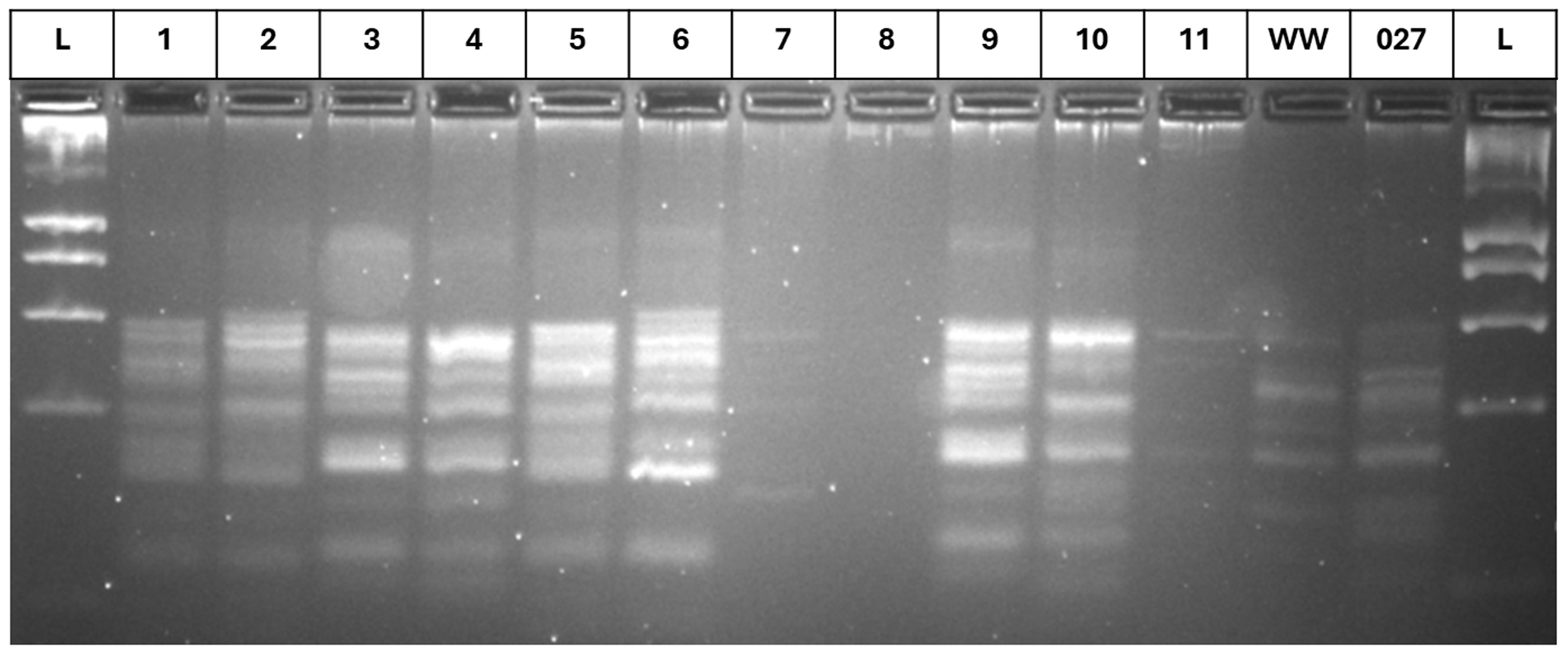
From June through October 2023, a total of 9 wastewater samples were collected over the course of the study. All 9 (100%) were positive for the gluD gene (<25,000–772,155 gene copies/L), and 8 (89%) were positive for the tcdB gene (<25,000–303,854 gene copies/L) by qPCR. A single wastewater sample yielded a culture-positive isolate. During the same period, there were 11 positive C. difficile tests processed by the hospital clinical microbiology laboratory. All 11 patient isolates were acquired by the study team. The wastewater ribotype did not match any of the ribotypes identified among the patient isolates or the highly pathogenic ribotype 0.27 control (Figure 1).
Gel image of Clostridioides difficile patient, wastewater, and ribotype 0.27 isolates. Note: Lane L = 100bp ladder; Lanes 1–11 = patient isolates; Lane WW = wastewater isolate; Lane 0.27 = ribotype 0.27.

Discussion
In this study, wastewater sampling at a community hospital consistently detected C. difficile DNA, with all samples positive for the species marker (gluD) and most positive for the toxin gene (tcdB). However, culture-based recovery was limited, with only one isolate obtained across four months of sampling. This low yield is not unexpected given the polymicrobial nature of wastewater, the small sample volumes, and the potential for physical, chemical, or competitive pressures in wastewater to reduce the recovery of viable spores. The ribotype of the single wastewater isolate did not match contemporaneous clinical isolates or the epidemic ribotype 0.27 control strain.
In our experience, overgrowth by other organisms frequently impeded selective recovery, underscoring the need for improved isolation methods or complementary molecular approaches. Although culturing isolates enables direct strain comparison, qPCR-based detection alone may still offer surveillance value, as fluctuations in genetic signal could indicate periods of increased shedding or environmental contamination even without strain-level confirmation. A major uncertainty is the source of C. difficile DNA in hospital wastewater. Wastewater captures contributions from the entire facility, including symptomatic and asymptomatic patients, staff, and visitors. Without colonization screening or distinction between hospital-onset and community-associated cases, the relative contribution of each group remains unknown, limiting interpretation. While wastewater signals can provide early situational awareness for pathogens with large outbreaks, such as SARS-CoV-2, C. difficile epidemiology is more complex, with colonization, environmental persistence, and typically smaller transmission clusters. It is unclear whether aggregated wastewater signals will have comparable predictive value or whether strain-level resolution will be necessary to determine epidemiologic relevance.
Finally, hospital wastewater surveillance requires dedicated infrastructure, sampling logistics, and laboratory expertise, and standardized protocols for C. difficile have not yet been established. Taken together, these findings highlight both the potential and the current limitations of wastewater-based approaches for C. difficile and emphasize the need for refined methods and more intensive sampling to determine whether wastewater can meaningfully complement infection-prevention efforts.
Financial support
This work was supported by the Duke–NC State Translational Research Grant (UL1TR002553).
Competing interests
The authors have no conflicts of interest to disclose.