1. The impacts of climate change: should we focus on poverty instead of GDP?
Estimates of the economic cost of climate change have always attracted the interest of policy-makers and the public. These estimates, however, have mostly been framed in terms of the impact on country-level or global GDP (Arent et al., Reference Arent, Tol, Faust, Hella, Kumar, Strzepek, Tóth, Yan, Barros, Dokken, Mach, Mastrandrea, Bilir, Chatterjee, Ebi, Estrada, Genova, Girma, Kissel, Levy, MacCracken, Mastrandrea and White2014), an approach that does not capture the full impact of climate change on people's well-being. In particular, such estimates do not reflect distributional impacts and especially how climate change may affect the poorest people and poverty. The distribution of climate impacts – that is, which countries, regions, and people are hit – will determine impacts on well-being, and thus the true value of mitigation (Dennig et al., Reference Dennig, Budolfson, Fleurbaey, Siebert and Socolow2015).
The distribution of impacts across countries is heterogeneous, and using global GDP as a metric to measure the cost of climate change may hide disproportionally large impacts on poor countries or regions (Mendelsohn et al., Reference Mendelsohn, Morrison, Schlesinger and Andronova2000; Tol, Reference Tol2002; Tol, Reference Tol2009; Hope, Reference Hope2006; Mendelsohn et al., Reference Mendelsohn, Dinar and Williams2006; Stern, Reference Stern2006; Nordhaus, Reference Nordhaus2014; Hsiang et al., Reference Hsiang, Kopp, Jina, Rising, Delgado, Mohan, Rasmussen, Muir-Wood, Wilson and Oppenheimer2017). Three-fourths of global income goes to North America, Europe, and East Asia; other regions are economically much smaller, in particular sub-Saharan Africa, which only generates 3 per cent of global GDP. Even massive impacts on poor countries will not be apparent in global statistics.
Equally important is the fact that climate change impacts will be highly heterogeneous within countries, not only across regions, but also across occupations and income classes. If impacts mostly affect low-income people, welfare consequences will be much larger than if the burden is borne by those with a higher income. Poor people have fewer resources to fall back upon and lower adaptive capacity. But – because their assets and income represent such a small share of national wealth – poor people's losses, even if dramatic, are largely invisible in aggregate economic statistics.
Investigating the impact of climate change on welfare requires a different approach, focused on people who play a minor role in aggregate economic figures, are often living within the margins of basic subsistence, and are often living in rural areas (Castañeda et al., Reference Castañeda, Doan, Newhouse, Nguyen, Uematsu and Azevedo2018). Such an approach drove a research program on ‘Poverty and climate change’ at the World Bank, which led to the publication of the report Shock Waves: Managing the Impacts of Climate Change on Poverty, published in 2016 (Hallegatte et al., Reference Hallegatte, Bangalore, Bonzanigo, Fay, Kane, Narloch, Rozenberg, Treguer and Vogt-Schilb2016). Multiple in-depth studies were conducted as part of this work program, and this special issue compiles most of the research that took place in this context.
2. The dynamics of poverty
This research starts from the idea that poverty is not static, and poverty reduction is not a monotonic, one-way process (Hallegatte et al., Reference Hallegatte, Bangalore, Bonzanigo, Fay, Narloch, Rozenberg and Vogt-Schilb2014). Over time, some people build assets and move out of poverty while others experience shocks and are pulled into poverty. What we call poverty reduction is the net result of these mechanisms (Hulme and Shepherd, Reference Hulme and Shepherd2003; Quisumbing, Reference Quisumbing2007; Moser, Reference Moser2008; Baulch, Reference Baulch2011). (Unless otherwise specified, poor people are defined as those living below a given poverty line expressed in dollars per day.)
For instance, Krishna (Reference Krishna2006) documents poverty dynamics in 36 communities in Andhra Pradesh, India, over 25 years; see figure 1. Over this period, 14 per cent of households escaped poverty while 12 per cent of non-poor households became poor, so that, overall, poverty was reduced by 2 per cent. These numbers show that a relatively small change in the flows in and out of poverty have a significant effect on overall poverty dynamics. For instance, increasing the flow into poverty by 10 per cent is enough to halve the rate of poverty reduction.
Flow in and out of poverty over 25 years in 36 villages in Andhra Pradesh (Krishna, Reference Krishna2006).

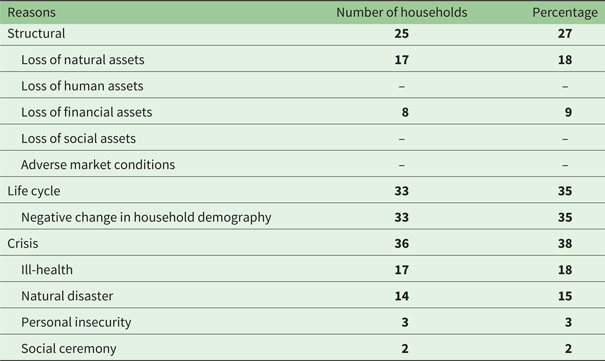
Climate change can affect the flow of people falling into poverty. Many shocks that push people into poverty are directly or indirectly related to the environment and climate. In the Andhra Pradesh sample, a household affected by droughts in the past was 15 times more likely to fall into poverty (Krishna, Reference Krishna2006). And in a survey by Sen (Reference Sen2003), 31 out of the 94 households that experienced a deterioration in well-being link it to a natural disaster or a loss of natural assets (table 1). The role of climate-related shocks on poverty has also been documented in other places, such as Ethiopia and Honduras (Carter et al., Reference Carter, Little, Mogues and Negatu2007), or the Democratic Republic of Congo (Béné, Reference Béné2009).
Reasons for the ‘deterioration in economic well-being over the last decade’ as perceived by respondents in rural Bangladesh, as reported in Sen (Reference Sen2003) (n=94)

Health shocks are also a major driver of poverty that could be affected by climate change pushing 100 million people into poverty every year, according to the WHO (2008). The implication is that even small changes in the distribution and burden of disease will impact the flow of people falling into poverty.
Climate change can also affect the flow of people escaping poverty. Poverty reduction is largely driven by asset accumulation (Moser, Reference Moser2008; Baulch, 2011). With reduced income due to lower agricultural productivity and asset losses due to natural disasters, asset accumulation would slow down, reducing poverty reduction. And natural disasters often affect human capital, a critical component of capital accumulation, especially for children who may be pulled out of school or suffer permanent health consequences (Carter et al., Reference Carter, Little, Mogues and Negatu2007; Hallegatte et al., Reference Hallegatte, Vogt-Schilb, Bangalore and Rozenberg2017).
Furthermore, natural risks, for instance the risk of a drought, can keep people poor by affecting behaviors. If increased likelihood of drought makes investments riskier, people may decide to invest less, which may make it impossible for them to escape poverty (Elbers et al., Reference Elbers, Gunning and Kinsey2007). An increase in drought frequency and intensity brought about by climate change could, therefore, hamper poverty reduction by creating a disincentive to save and invest.
If the assets of the poor are more exposed or vulnerable than the assets of richer individuals, climate change may increase inequality. Moreover, a pronounced difference in exposure and vulnerability between rich and poor could disconnect the impact of climate change on poverty from the impact on growth: it would be perfectly possible to experience minor effects of climate change on GDP, but a large impact on poverty (and the well-being of people living in or close to poverty).
The first paper in this special issue, ‘Poverty, rural population distribution and climate change’ by Edward B. Barbier and Jacob P. Hochard, supports the idea that the impacts of climate change on economic growth or GDP are very poor indicators of future impacts on poverty.
The authors perform a spatial analysis exploring the localization of people living in poverty. Their paper indicates that in the year 2000 over one-third of the rural population in developing countries was located on less-favoured agricultural land and areas, which are constrained by biophysical conditions or poor market access. They also examine whether the spatial distributions of rural population in 2000 influence subsequent changes in the rate of poverty reduction from 2000 to 2012 in 83 developing countries. Interestingly, they find no evidence of a direct impact of environmental factors on changes in poverty.
Then, the authors introduce the important concept of the ‘elasticity of poverty reduction with respect to growth.’ As demonstrated in Dollar and Kraay (Reference Dollar and Kraay2002) and Dollar et al. (Reference Dollar, Kleineberg and Kraay2013), most of the poverty reduction in the world has been achieved thanks to aggregate economic growth, rather than to a redistribution of income within countries. However, the extent to which economic growth reduces poverty differs across countries and periods: economic growth can be more or less inclusive and therefore more or less efficient at reducing poverty. When the elasticity of poverty reduction with respect to growth is high, it means that economic growth is inclusive and efficient in reducing poverty.
Barbier and Hochard (Reference Barbier and Hochard2018) show that places with poor biophysical conditions or poor market access have a lower elasticity of poverty reduction with respect to growth, which means that more economic growth is needed to achieve the same level of poverty reduction. For example, consider an annual per capita income growth rate of 3.4 per cent, which is the mean for the 83-country sample. At that rate, a country with 38 per cent of its rural population on less-favored agricultural land (the sample mean) would expect to see a rate of poverty reduction of 2.7 to 2.9 per cent per year. However, if 60 per cent of the population is on less-favored agricultural land (this is one standard deviation above the mean), then poverty would be reduced by only 1.9 per cent annually.
If climate change results in more people concentrating in less-favored areas, or increases the size of unfavourable agricultural regions, then poverty reduction could slow down, even if the aggregate rate of per capita income growth is unchanged. This result is an important note of caution regarding the assessment of climate change impact using GDP as a unique metric: such assessments may not capture the impact of climate change on poverty.
These results suggest that the difference in exposure and vulnerability of poor people to climate change impacts – compared with the rest of the population – will be a critical determinant of the impact of climate change on poverty.
Therefore, a first set of three papers (the first by Arild Angelsen and Therese Dokken; the second by Sven Wunder, Frederik Noack and Arild Angelsen; and the third by Ulf Narloch and Mook Bangalore) explores this question, focusing on the correlation between poverty and environmental scarcity and volatility. The papers conclude, as could be expected, that poor people tend to live in more marginal areas with assets and occupations that are more often affected by environmental constraints, scarcity, or volatility. They also find that poor people are made more vulnerable to environmental shocks by their high dependence on natural resources.
A second set of two papers (the first by Hessel C. Winsemius, Brenden Jongman, Ted I.E. Veldkamp, Stephane Hallegatte, Mook Bangalore and Philip J. Ward; and the second by Jisung Park, Mook Bangalore, Stephane Hallegatte, and Evan Sandhoefner) complements these findings by focusing on natural hazards, focusing on the tail of the distribution: droughts, floods and extreme heat events. Like the first set of papers, however, these papers combine socioeconomic data, here household surveys or panels, with environmental and weather-related data in order to explore the correlation between the two.
Finally, a last paper (by Michael R. Carter and Sarah A. Janzen) looks at the role of resilience – defined as the ability to cope with and recover from environmental shocks – with a focus on how social protection systems can prevent people from falling into poverty traps.
The following sections summarize the findings of these papers and the final section concludes with policy implications and further research needs.
3. Poor people are more exposed to environmental shocks and stressors
The two papers by Arild Angelsen and Therese Dokken and by Sven Wunder, Frederik Noack and Arild Angelsen use a unique and detailed pan-tropical sample of nearly 8,000 rural households in 24 developing countries from the Poverty Environment Network (PEN) project (see Angelsen et al., Reference Angelsen, Jagger, Babigumira, Belcher, Hogarth, Bauch, Börner, Smith-Hall and Wunder2014, for details) to investigate the exposure and vulnerability of poor people to climate or weather shocks. They examine the role of environmental income –defined as income from products extracted from non-cultivated (wild) areas. While this income is seldom properly accounted for, it accounts for 27 per cent of total household income in the sample. The implication is that this population is highly vulnerable to any impact that climate change could have on the environment; in parallel, this environmental income may be an opportunity if it can contribute to lifting people out of poverty.
In ‘Climate exposure, vulnerability and environmental reliance: a cross-section analysis of structural and stochastic poverty,’ Arild Angelsen and Therese Dokken analyse the links between exposure to climate extremes and shocks, vulnerability and coping strategies, environmental reliance and poverty. They create four categories of households: income & asset poor (structurally poor), income rich & asset poor (stochastically non-poor), income poor & asset rich (stochastically poor) and income & asset rich (structurally non-poor), and assess exposure and vulnerability of each group.
The income poor are found to be more exposed to extreme climate conditions. They tend to live in dryer (and hotter) villages in the dry forest zones, in wetter villages in the wet zones, and experience larger rainfall fluctuations. ‘Harvesting more environmental products’ is a standard coping strategy, regardless of the type of shock (wage loss, health shock, etc.). However, non-poor people are more likely to harvest more environmental products when facing a shock (19 per cent), compared with the structurally poor individuals (only 11 per cent). A possible interpretation is that households that have access to coping based on environmental resources are less likely to fall into (or remain in) income poverty when experiencing an income shock, which is consistent with a hypothesis of environmental income serving as a safety net.
Furthermore, Angelsen and Dokken (Reference Angelsen and Dokken2018) found that, at least in dry regions, the poorest also experience the highest forest loss. This may explain why very poor people are found to rely on environmental product extraction less than richer individuals. It also suggests that the ability of poor people to cope with future shocks (including climate-related ones) may be diminishing. The challenge therefore is to ensure access by poor people to the environmental resources they depend upon, while preserving the resources and limiting long-term degradation.
The next paper, ‘Climate, crops, and forests: a pan-tropical analysis of household income generation,’ by Sven Wunder, Frederik Noack and Arild Angelsen, provides a complementary analysis and focuses on the vulnerability of these same households.
Wunder et al. (Reference Wunder, Noack and Angelsen2018) find that rural households in developing countries depend on a combination of crops, forest extraction and other income sources for their livelihoods, and that the size and composition of these livelihood contributions are sensitive to climate change. Households have the highest crop income at 21°C temperature and 2,000 mm annual precipitation. Forest incomes increase on both sides of this agricultural maximum: crop income is relatively more important under intermediate climates that are close to optimal plant growing conditions, while forest income becomes relatively more important for rural households already living under more extreme climate conditions. It means that – unsurprisingly – people living in already hot areas are more vulnerable to climate change.
Wunder et al. (Reference Wunder, Noack and Angelsen2018) also find indications that crop income declines in response to weather shocks while forest income increases, suggesting that households may cope with shocks by reallocating inputs from agriculture to forests. Forest extraction may thus be less sensitive than crop production to climatic fluctuations, gaining comparative advantage in agriculturally suboptimal climates and under weather anomalies. This suggests that well-managed forests might help poor rural households cope with and adapt to future climate change.
These two papers highlight the role of the environment in poor people's livelihood, and the vulnerability of those households if the health of forests is affected by climate change or other environmental stressors. In terms of policy implications, it suggests strong synergies between environmental conservation (to protect forests) and other policy goals linked to climate change adaptation and resilience building.
The fact that poor people are usually living in less desirable environments is confirmed in a case study on Vietnam in the fourth paper of this issue, ‘The Multifaceted Relationship between Environmental Risks and Poverty: New Insights from Vietnam,’ by Ulf Narloch and Mook Bangalore.
Narloch and Bangalore (Reference Narloch and Bangalore2018) assess how the relationship between poverty and many dimensions of environmental risk varies as a function of the channels through which poverty and risk interact, using a set of consistent data and methods while holding constant national context. Combining high-resolution geo-spatial data on eight environmental risks (such as air pollution, land degradation and tree cover loss) and household survey data from 2010–2014, their paper shows that: (i) at the district-level, the incidence of poverty is higher in areas of high environmental risk, (ii) at the household-level, poorer households face higher environmental risks, (iii) for some risks, the relationship with household-level consumption varies between rural and urban areas, and (iv) environmental risks explain consumption differences between households, but less so changes over time. By examining multiple spatial and temporal scales, these findings provide a more nuanced understanding of the relationship between poverty and environmental risk and provide further evidence of the importance of addressing such risks in poverty reduction efforts.
4. Poor people are often more exposed to natural hazards, and are more vulnerable to their impacts
Looking at extreme events and natural disasters is particularly important in the estimation of future climate change impacts. A recent report (Hallegatte et al., Reference Hallegatte, Vogt-Schilb, Bangalore and Rozenberg2017) reviews dozens of case studies showing that poverty increases after natural disasters, and estimates that, on average, 26 million people are falling into poverty every year due to natural disasters, especially relatively frequent floods and drought. In the future, natural hazards such as floods, droughts and extreme temperatures will increase in frequency or intensity in many (but not all) regions as a result of climate change, possibly making it more difficult for people to escape poverty.
The question then is the extent to which poor people might be more exposed or more vulnerable to natural disasters than the rest of the population.
On exposure, it is often the case that poor people live in risky areas. A number of case studies have examined the exposure of poor and non-poor people to disaster risk, with most – but not all – of the studies finding poor people to be more exposed (figure 2). But the relationship between poverty and exposure to risk is not straightforward. Causality runs in both directions: poor people sometimes choose to settle in risky areas where land is available or affordable; and living in risky areas may make people poor when hazards destroy assets and livelihoods. But risky areas can also be attractive to rich people if they offer other amenities – flood-prone coastal or river areas benefit from low transport costs that attract firms and opportunities – in which case, rich people may be the ones overexposed.
Several studies have examined the exposure of poor and non-poor people to natural hazards. All but one case reviewed finds that poor people are more exposed than non-poor people.

Whether poor people are more exposed to floods and droughts is therefore mostly an empirical question, which this special issue explores for three hazards: floods, droughts and high temperatures.
In the next paper in this special issue, ‘Disaster risk, climate change, and poverty: assessing the global exposure of poor people to floods and droughts,’ Hessel C. Winsemius, Brenden Jongman, Ted I.E. Veldkamp, Stephane Hallegatte, Mook Bangalore and Philip J. Ward explore whether the bias observed for floods and droughts in many case studies (poor people being more exposed to such shocks) is valid at the global scale. To do so, they analyse household survey data and hydrological riverine flood and drought data for 52 countries to find out whether poor people are disproportionally exposed to floods and droughts, and how this exposure may change in a future climate.
Winsemius et al. (Reference Winsemius, Jongman, Veldkamp, Hallegatte, Bangalore and Ward2018) find that poor people are often disproportionally exposed to droughts and floods, particularly in urban areas, but that this pattern is far from universal. For floods, 34 out of the 52 countries show a significant result and of these 34, half (17) exhibit a disproportionally high exposure of poor people to floods. For drought, of 30 countries with significant results, 24 exhibit a disproportionally high exposure of poor people (85 per cent in population terms). This result supports the general notion that the relationship between poverty and disaster exposure is a complex one, impacted by multiple factors.
The results differ across rural and urban households, suggesting that different mechanisms may be at play in rural and urban settings. In most countries (22 out of 30 with significant results), poor urban households are more exposed to floods than the average urban population. There is no such strong signal for rural households. Land scarcity, which is more acute in urban than rural areas, may be an explanation as it creates an incentive for poor people to settle in risky areas due to lower prices.
The patterns of the poverty-exposure relationship do not change significantly under future climate scenarios, although the absolute number of people potentially exposed to floods or droughts can increase or decrease significantly, depending on the scenario and region.
Turning now toward high temperature and heat stress, the next paper in this issue, ‘Households and heat stress: estimating the distributional consequences of climate change’ by Jisung Park, Mook Bangalore, Stephane Hallegatte, and Evan Sandhoefner, assesses the current distribution of heat exposure within countries, to proxy for possible distributional consequences of climate change through temperature.
Park et al. (Reference Park, Bangalore, Hallegatte and Sandhoefner2018) find that, in 37 out of 51 countries, poor people are more exposed to high temperature than the average. And countries with a concentration of poor people in hotter regions are mostly already warm climate countries, where higher temperature is undesirable (as expected, poor people are often living in the colder regions of cold countries). Adding to these location-related factors, poorer people are found to be more likely to work in ‘exposed occupations’ (i.e., outdoor work exposed to the vagaries of the weather) in the 47 countries where data are available. While the analysis is descriptive rather than causal, these results suggest a larger vulnerability of poor people to heat extremes and potentially significant distributional and poverty implications of climate change.
Taken together, the two papers on flood, drought, and heat stress suggest that while poor people are not always more exposed to climate extremes, they often are. In Nigeria, for instance, the poorest 20 per cent of the people are 50 per cent more likely to be affected by a flood, 130 per cent more likely to be affected by a drought, and 80 per cent more likely to be affected by a heat wave than the average Nigerian. And when poor people are not more exposed, it is likely because other benefits – such as proximity to jobs or lower transport costs – make it worthwhile to bear the risk, and richer people are ready do so.
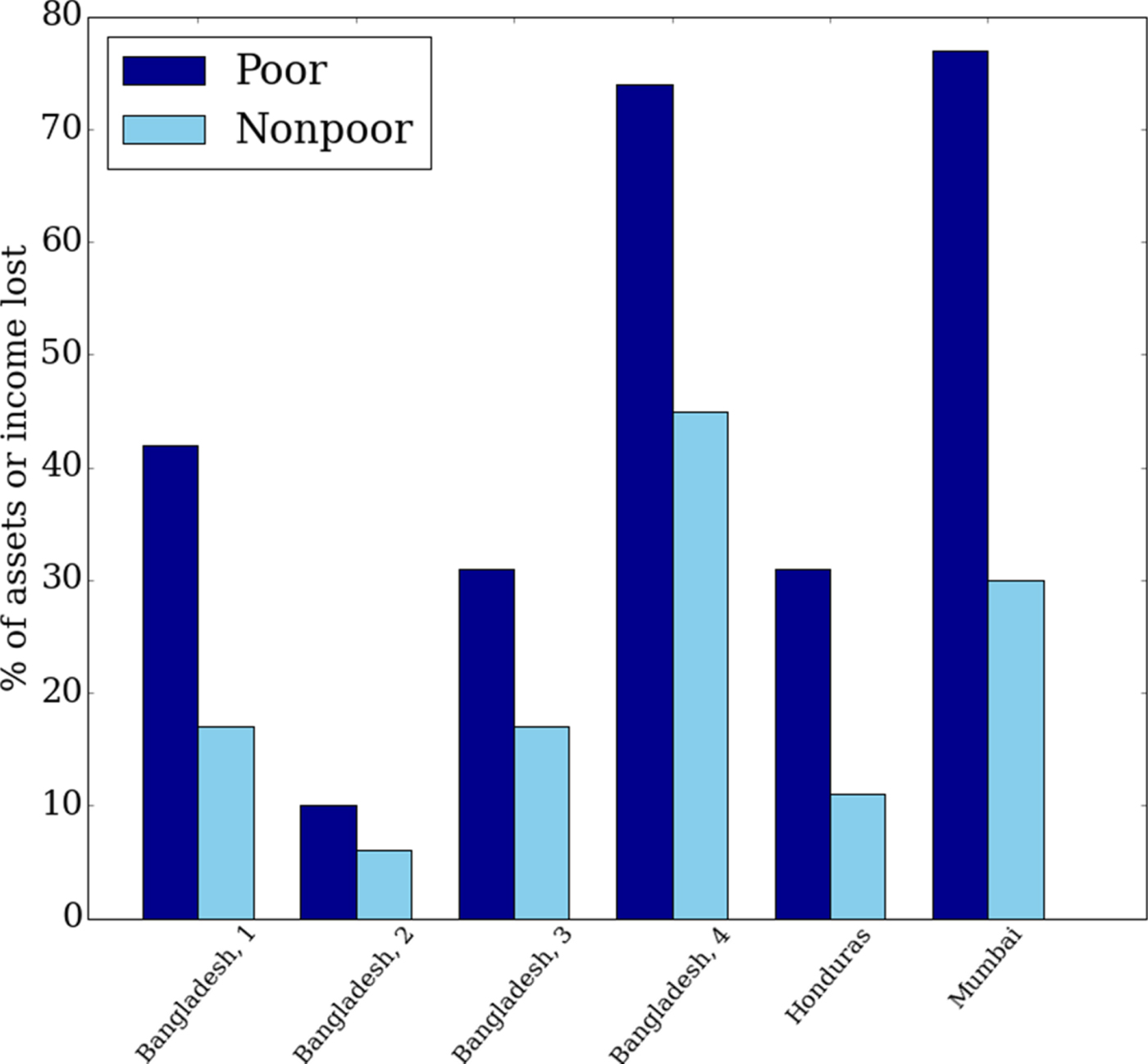
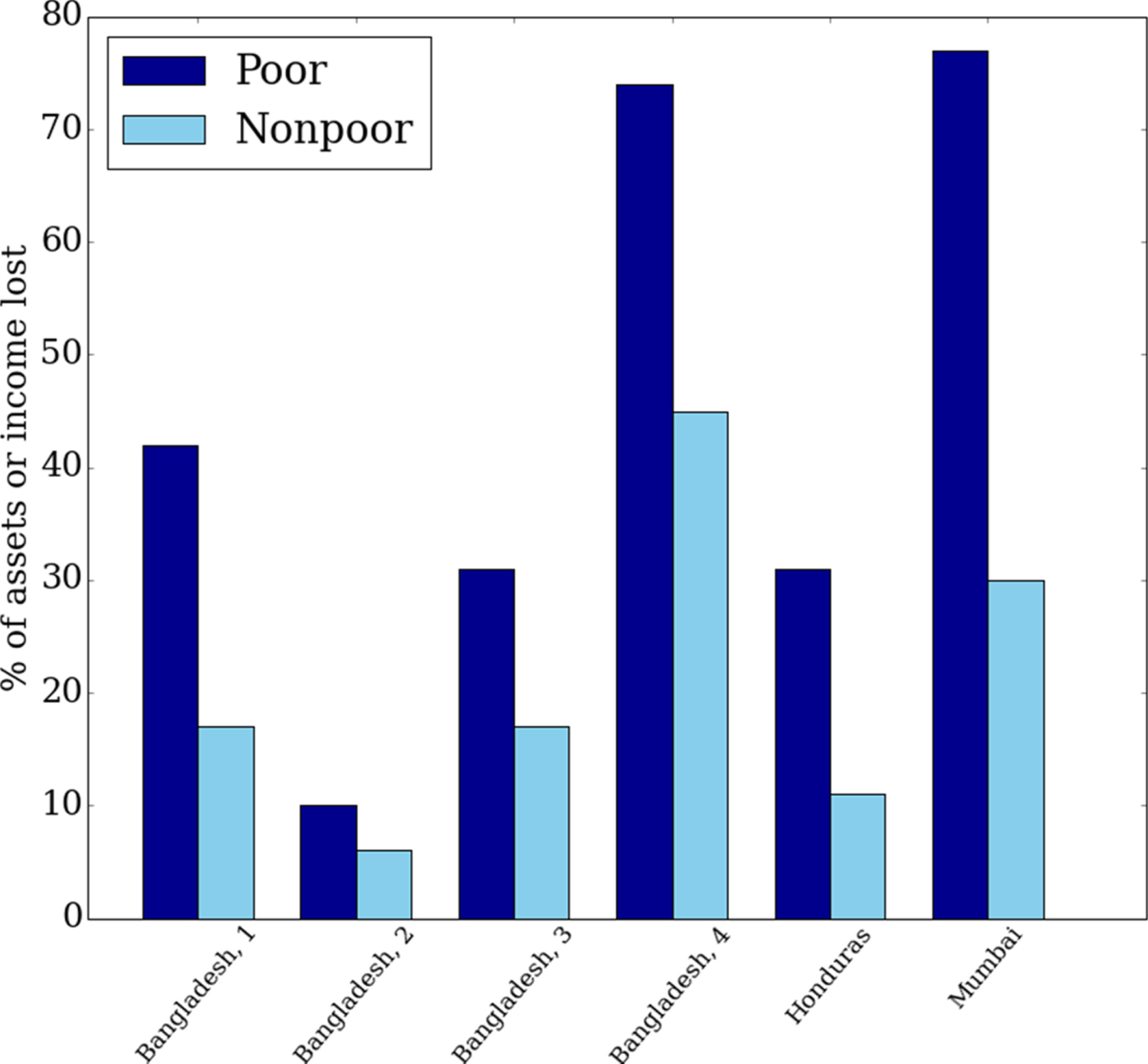
In addition, poor people are always more vulnerable when a disaster strikes. In the small number of surveys that compare asset and income losses of poor and non-poor people after floods and storms, poor people lose a larger share (figure 3). This is because they hold a large fraction of assets in material and vulnerable form (rather than as financial savings in a bank), live in lower-quality housing (e.g., slums), and depend on lower-quality infrastructure (e.g., non-paved roads). For droughts, the fact that poor people are more dependent on agricultural income makes them inherently more vulnerable to climate shocks.
Generally, poor people lose a larger percentage of assets or income after floods and storms.
Another explanation for poor people's greater vulnerability lies in their more limited access to social protection: a consistent finding across countries is that transfers received (from social protection, or from friends and families) are much lower for poor people (World Bank, 2015). For example, in Colombia, the poorest 20 per cent receives on average US$0.23 per person per day, and the richest 20 per cent, US$4.60.
Even after a disaster, ad-hoc schemes to provide compensation may not target poor people, especially where the middle class is not covered by insurance and therefore needs support after a disaster. Post-disaster transfers to higher income people were much larger than transfers to poorer individuals after the 2005 Mumbai floods (Patankar, Reference Patankar2015)) and the 2011 Bangkok floods (Noy and Patel, Reference Noy and Patel2014). With less income coming from transfers and less savings, poor households are more dependent on their labor income for their consumption, making them more vulnerable to shocks and lost days of work (their inability to smooth consumption can even translate into irreversible health impacts).
It is therefore no surprise that natural disasters have a well-documented impact on poverty (see reviews in Karim and Noy, Reference Karim and Noy2014; Hallegatte et al., Reference Hallegatte, Vogt-Schilb, Bangalore and Rozenberg2017). For example, at the municipal level in Mexico, Rodriguez-Oreggia et al. (Reference Rodriguez-Oreggia, De, Fuente, De, Torre and Moreno2013) find that floods and droughts increased poverty between 1.5–3.7 per cent from 2000 and 2005. In Peru, over the 2003 to 2008 period, one extra disaster per year increased poverty rates by 16 to 23 per cent at the provincial level. In Bolivia, poverty incidence rose by 12 per cent in Trinidad City after the 2006 floods. To compound these effects, disasters often result in reduced food consumption for children, as well as interrupted schooling, with likely lifelong impacts such as stunting and reduced earning capacity (Alderman et al., Reference Alderman, Hoddinott and Kinsey2006). In Ethiopia, children who were younger than 36 months at the apex of the 1984 famine are less likely to have completed primary school, with a resulting 3 per cent reduction in annual income later in life.
Note also that limiting the analysis to actual disasters may underestimate the effect of risk on development and poverty. Ex-ante, in the presence of uninsured weather risk, poor households engage in low-risk, low-return activities, thus perpetuating poverty: in other words, exposure to potential weather shock can reduce incomes, and even dominate the ex-post impacts of disasters (Elbers et al., Reference Elbers, Gunning and Kinsey2007).
In this context, the increase in the number of poor people being affected every year by floods, droughts and heat waves that is reported in Winsemius et al. (Reference Winsemius, Jongman, Veldkamp, Hallegatte, Bangalore and Ward2018) and Park et al. (Reference Park, Bangalore, Hallegatte and Sandhoefner2018), and more generally the increase in the frequency and intensity of extreme events expected from climate change (IPCC, Reference Barros, Dokken, Mach, Mastrandrea, Bilir, Chatterjee, Ebi, Estrada, Genova, Girma, Kissel, Levy, MacCracken, Mastrandrea and White2014), implies that climate change will represent a growing obstacle to poverty reduction, unless resilience is dramatically improved.
The good news is that poor people's resilience can in fact be enhanced. The last paper in this special issue, ‘Social protection in the face of climate change: targeting principles and financing mechanisms,’ by Michael R. Carter and Sarah A. Janzen, focuses on the potential of better financial instruments and social protection to make populations more resilient.
Their paper builds a multi-generation household model of consumption, asset accumulation, and risk management to assess the dynamic consequences of climate risk exposure. The paper's framework is fully consistent with the framework described earlier, namely that poverty is a dynamic process and that people can escape poverty through asset accumulation; the paper also looks at how better financial protection against shocks and stressors can compensate for more frequent or more intense shocks due to climate change.
Carter and Janzen (Reference Carter and Janzen2018) propose a model of household decision-making in which the relatively poor, but vulnerable, will tend to ‘asset smooth.’ That is, they choose to absorb a larger fraction of any realized climate shocks through reduced consumption, rather than by using their assets and savings. They do so because there is a minimum threshold in terms of asset ownership that they need in order to preserve their future income (typically, a minimum number of animals to make a herd sustainable). But a reduction in consumption can have long-term impacts on human capital accumulation – especially when the physical and cognitive development of children is affected – and result in poverty traps.
The analysis in Carter and Janzen (Reference Carter and Janzen2018) shows the long-term level and depth of poverty can be improved by incorporating ‘vulnerability-targeted social protection’ into a conventional social protection system. This implies using social protection systems not only to increase the consumption and well-being of the poorest, but also to support the near poor to ensure that they do not fall into poverty (and poverty traps) when affected by a shock. The paper suggests that – over the long term – such an approach is more effective in reducing poverty and is better in terms of economic growth than a narrow focus on people already poor. Moreover, the paper shows that insurance-based vulnerability-targeted social protection dominates (in terms of economic growth and poverty reduction) both in-kind transfers and asset-based vulnerability-targeted protection, even though implementation of such mechanisms can be challenging.
Carter and Janzen (Reference Carter and Janzen2018) also show that the relative performance of insurance-based vulnerability targeted social protection is even better as drought risk increases, suggesting that this approach is a promising option to help people adapt to climate change.
However, the paper also shows the limits of the approach: beyond a certain magnitude of climate change impacts, social protection alone cannot prevent an increase in the extent and depth of poverty. This finding supports one of the principal messages of the Shock Waves report (Hallegatte et al., Reference Hallegatte, Bangalore, Bonzanigo, Fay, Kane, Narloch, Rozenberg, Treguer and Vogt-Schilb2016), namely the need to tackle climate change by acting on two fronts: (1) short-term adaptation action at the local scale to increase people's resilience and enable them to manage the impacts of climate change that cannot be avoided by greenhouse gases emissions reductions; and (2) short-term emissions reductions at the global scale to ensure that future climate change does not exceed the limits of what adaptation policies and measures can achieve.
5. More research is needed to provide reliable estimates of the impacts of climate change on poverty
The papers in this special issue provide a wealth of new evidence regarding the interplay between climate impacts and poverty. But they also highlight what we do not know or do not understand. In this section, we emphasize four main issues that are in need of more research: the identification of the causal relationship between poverty and climate impact exposure; the exploration of additional mechanisms and channels through which climate can affect poverty; the estimation of future vulnerability to climate change, taking into account socioeconomic trends and development; and the consideration of the role of governance in determining how the impacts of climate change are shared and distributed.
5.1 From poverty to vulnerability? Or from vulnerability to poverty? Correlation and causality
Due to the complexity of the mechanisms at play, the papers in this special issue focus on the correlation between poverty and exposure or vulnerability to climate-related stresses or shocks. It is a critical first step to understanding the relationship between these two factors –but leaves us uncertain as to causal relationships between poverty and exposure or vulnerability.
Indeed, the causality is likely to run both ways. People may be unable to escape poverty in a sustainable way because they are affected by shocks that make it more difficult to accumulate assets. But poor people are more constrained in terms of where they live and which occupation they have, and they are therefore more likely to live in less-desirable locations (including places at risk from natural hazards or other environmental stresses) and to have less-desirable jobs and occupations (including those that expose them to risks). And poor people have fewer resources to call upon to protect themselves.
But the analysis of current and historical poverty data does not allow conclusions to be drawn on the causal link, thus limiting our ability to predict how a climate-change-related magnification of environmental shocks and stresses would increase poverty.
5.2 Climate is likely to affect poverty through many more channels
There are many more channels through which climate impacts can affect poverty than those explored in this special issue. Food security is an obvious one, of course, for which the vulnerability differential between poor people and the rest of the population is large. For instance, poor people spend a larger share of their budget on food than the rest of the population: 62 per cent on average compared to 44 per cent for non-poor people (Ivanic and Martin, Reference Ivanic and Martin2014). This is particularly true for the urban poor who spend higher shares of their incomes on food than the rural poor, and who do not benefit from the income boost provided by rising agricultural prices. In the absence of safety-nets and economic adjustments, a number of countries – including Guatemala, India, Indonesia, Pakistan, Sri Lanka, Tajikistan and Yemen – could suffer from an increase in extreme poverty of 25 percentage points when facing a 100 per cent food price increase, with severe impacts in urban areas (Ivanic and Martin, Reference Ivanic and Martin2014).
But here again, mechanisms are complex: for food producers, an increase in food prices is not necessarily a bad outcome. The final impacts will depend on how changes in prices and productivity balance (an increase in food prices due to reduced productivity does not automatically lead to increased revenues) and on how increased revenues are distributed among farm workers and landowners (Jacoby et al., Reference Jacoby, Rabassa and Skoufias2014). Taking a comprehensive view of farm households – looking at both their consumption and production – Hertel and Rosch (Reference Hertel and Rosch2010) argue that these households may benefit from climate impacts if the shock is widespread, farm-level demand for their production is inelastic (while supply response is low), there are few sources of off-farm incomes, and food represents a relatively small share of their own expenditures. Simulations in Hallegatte and Rozenberg (Reference Hallegatte and Rozenberg2017) suggest, however, that globally, the negative effects of reduced yields are likely to dominate the positive impacts of higher prices on farmers’ income.
Another factor is mobility. Independently of climate change, migration plays a key role in the ability of poor households to escape poverty by capturing opportunities for better jobs, higher pay, and improved access to services and education. Climate change may trigger more migration, for instance if opportunities disappear because of climate impacts (see Jassogne et al., Reference Jassogne, Lderach and van Asten2013, for the example of coffee in Uganda) but may also impair migration, for example through increased conflict and exclusion (see Adger et al., Reference Adger, Pulhin, Barnett, Dabelko, Hovelsrud, Levy, Oswald Spring, Vogel, Barros, Dokken, Mach, Mastrandrea, Bilir, Chatterjee, Ebi, Estrada, Genova, Girma, Kissel, Levy, MacCracken, Mastrandrea and White2014, for a review). Given the importance of mobility as an instrument for poverty reduction, it is critical that adaptation to climate change does not lock people in places or occupations from which they will become less able to escape poverty.
Finally, another important factor that has not been covered in this special issue is health impacts (Hallegatte et al., Reference Hallegatte, Bangalore, Bonzanigo, Fay, Kane, Narloch, Rozenberg, Treguer and Vogt-Schilb2016, chapter 4). Health shocks are the leading reason why households fall into poverty (Moser, Reference Moser2008). They affect households through many channels: the direct impact on well-being; consequences of death of a family member; loss of income when a member cannot work; expenses in care and drugs, especially in the absence of health insurance; and time and resources spent for caregiving. Healthcare payments send about 100 million people into poverty every year (WHO, 2008). Helping households manage health risks is already a priority, considering the role of these shocks in keeping people in poverty. Climate change only makes this task more urgent and more important.
5.3 What about future vulnerability?
Climate change is a long-term process, and most of its impacts will be felt in the decades to come, and even longer. The vulnerability of populations will change over time, in response to technological changes and socioeconomic trends, such as poverty reduction and economic growth, and factors that are only partially related to climate change (for instance, the health of ecosystems, which also depends on local policies and practices). The studies published in this special issue investigate current vulnerability, but things could change rapidly in the future.
For instance, future vulnerability to agricultural impacts will be shaped by the future of poverty and by future market structure and access. Evidence suggests that remote markets have higher price volatility (Ndiaye et al., Reference Ndiaye, Maître d'Hôtel and Le Cotty2015). Enhancing road infrastructure can strengthen links between rural markets and urban consumption centres, thus stabilizing prices. And the share of income people spend on food will decrease as people escape poverty, making the consequences of higher food prices more manageable in the future – if poverty decreases as fast as expected, and if poverty reduction reaches the remote rural areas where it is largely absent at the moment (Ravallion, Reference Ravallion2014). The same is true for other channels through which climate affects poverty: in the future, people living in poverty may all have access to financial tools, or they may be covered by health insurance. Obviously, this would make a large difference in terms of vulnerability.
In the Shock Waves report (Hallegatte et al., Reference Hallegatte, Bangalore, Bonzanigo, Fay, Kane, Narloch, Rozenberg, Treguer and Vogt-Schilb2016) and in a companion paper (Hallegatte and Rozenberg, Reference Hallegatte and Rozenberg2017), microsimulations are used to explore the impact of socioeconomic trends on the poverty impacts of climate change. This approach confirmed that climate change could have a significant impact on poverty headcount, even factoring in future reductions in vulnerability. But the uncertainty regarding future vulnerability and its implications on the poverty impact of climate change remain massive: depending on how optimistic one is about future socioeconomic trends – and especially on the inclusiveness of future economic growth – the impacts of climate change on poverty could be completely different. Simulations suggest that most impacts of climate change on poverty could be avoided until 2030, thanks to good policies. But in a pessimistic scenario in which economic growth is not inclusive, infrastructure investments are biased against poor people, and social protection and health coverage remain limited, climate change could move up to 120 million people into poverty by 2030.
5.4 The role of voice and governance in building resilience cannot be overstated
Finally, another factor is the role of governance and politics in mitigating the impacts of climate change. Most analyses of climate impacts focus on physical impacts. And even when the analyses explore distributional implications, they often look at the direct, first-order, impacts of climate change. But the final impact will depend on how communities and governments respond to these first-order impacts.
Consider an extreme scenario. Imagine that the impacts of climate change affect mostly the richest part of the population of a particular country. Say that climate change impacts arise mostly from sea level rise that make some very rich regions and areas uninhabitable, leading to massive asset losses for the wealthy. In that case, the direct impacts of climate change will spare the poorest, and reduce inequalities. But what about the response? First, economic mechanisms may transfer part of the losses from the better-off to the poorest, for instance if the former migrate out of the country with their skills and resources, or reduce their productive investments in factories and businesses. Second, political responses may shift the burden: a government could decide to fully cover the cost of coastal defences to protect the (relatively wealthy) people affected by sea level rise, at the expense of social safety nets for the poorest. In that case, while the better-off bear most of the direct impacts of climate change, it is eventually the poorest who lose the most, through reduced transfers from social protection. If all political and economic processes are biased against poor people, then the poor are likely to bear the cost of climate change, regardless of who is directly affected (Tschakert, Reference Tschakert2015).
This example illustrates the limits of an approach based only on direct impacts, and supports a research agenda that more closely combines natural and physical sciences with social sciences (economics, sociology, and political science). And it calls for caution regarding what to make of assessments of climate change impacts, for it is how societies respond to climate change impacts, more than these impacts themselves, that determines how aggregate losses are distributed across people and how climate change affects poverty and the well-being of people currently living in poverty.
The Shock Waves research program and report was prepared by a team led by Stephane Hallegatte and composed of Mook Bangalore, Laura Bonzanigo, Tamaro Kane, Ulf Narloch, Julie Rozenberg, David Treguer, and Adrien Vogt-Schilb under the supervision of Marianne Fay. The book was sponsored by the Climate Change Cross-Cutting Solutions Area of the World Bank under the leadership of Rachel Kyte and John Roome, and benefited from the generous support of the United Kingdom's Department for International Development (DFID) and the Global Facility for Disaster Reduction and Recovery (GFDRR).