Since Hanna Pitkin's seminal work, The Concept of Representation,Footnote 2 political scientists have sought to theorize and analyse dynamics of political representation. A central concern of research is whether who holds office, descriptive representation, affects the types of policies passed, substantive representation.Footnote 3 In work on gender, scholars typically examine these links through questions such as ‘Do women in politics make a difference?’ and ‘Do women act for women?’ The empirical evidence is inconclusive. Some studies find that the presence of women can lead to changes in legislative discourses, proposals, debates and outcomes. Yet, others uncover little or no difference in the styles and behaviours of male and female office-holders. Such variety is often attributed to the fact that women constitute a minority in all elected assemblies;Footnote 4 according to critical mass theory,Footnote 5 women are unlikely to have an impact until they grow from a few token individuals into a considerable minority, or ‘critical mass’, of all legislators. The problem with this explanation, however, is that its assumptions – that there is a linear relationship between numbers and outcomes and a precise, as yet unknown, tipping point at which feminized change occurs – do not hold.Footnote 6
In an effort to move beyond critical mass theory in research on substantive representation,Footnote 7 we propose an alternative approach focused (1) not on when women make a difference, but on how the substantive representation of women occurs, and (2) not on what ‘women’ do, but on what specific actors do. The first leaves open the question of ‘who’ acts on women's issues and recognizes a more fluid and evolving conception of what it might mean to ‘act for women’. The second moves away from essentialist portrayals of ‘men’ and ‘women’ as political actors, avoiding a priori expectations regarding what they ‘should’ do. Central to this new framework are what we label ‘critical actors’. Critical actors are those who act individually or collectively to bring about women-friendly policy change. This concept resonates with much in the original formulations of Rosabeth Moss KanterFootnote 8 and Drude Dahlerup.Footnote 9 These seminal authors, despite later misrepresentations in the critical mass literature, both point to diversity among women and the importance of individuals who resolve to act on behalf of women as a group.Footnote 10 The notion of critical actors has significant implications for future empirical research, not least, by calling attention to the need for research designs that enable these actors to be identified.
MAPPING SUBSTANTIVE REPRESENTATION
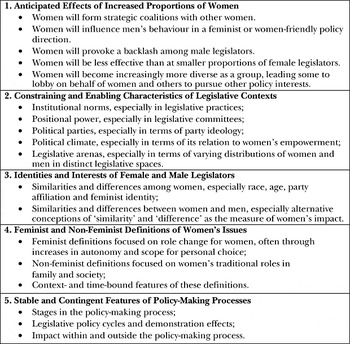
A review of more than twenty years of research on gender and politics reveals five categories of observations regarding links between descriptive and substantive representation: (1) anticipated effects of increased proportions of women; (2) constraining and enabling legislative contexts; (3) legislators' identities and interests; (4) definitions of women's issues; and (5) policy-making processes (see Figure 1). Together, these observations suggest a range of possibilities that need to be examined when analysing how the substantive representation of women occurs. They also contrast with the more limited scope of investigation association with research aimed at gauging if and when women make a difference. Finally, elaborating these dimensions offers a means for situating the findings of particular studies, which may employ distinct assumptions and measures, in relation to those of others.Footnote 11
Mapping the Substantive Representation of Women

Effects of Increased Proportions
The most common assumption in the critical mass theory literature is that as women grow more numerous in legislative chambers, they will increasingly be able to form strategic coalitions with one another to promote legislation related to women's issues.Footnote 12 However, studies point to at least four other scenarios that prove to be equally compelling starting points for analysing individual cases. First, a rise in the number of women may influence men's behaviour, causing both male and female legislators to pay more attention to women's issues.Footnote 13 Second, the increased presence of women may provoke a backlash among male legislators, who may employ a range of tactics to obstruct women's policy initiatives and keep them outside positions of power.Footnote 14 Third, a lower proportion of women may be more effective than a higher number because female legislators may be able to specialize in women's concerns without appearing to undermine male domination.Footnote 15 Fourth, a rise in the overall number of women may result in the election of an increasingly more diverse group who may or may not be interested in pursuing women's concerns. This may be either because their priorities lie elsewhere, or because they believe that other female legislators will continue to lobby on behalf of women as a group.Footnote 16
Legislative Contexts
Despite a tendency to focus on actors in critical mass theory, the broader context may limit or enhance opportunities for individuals to translate priorities into policy initiatives. For example, many studies point to rules and norms within legislative institutions that appear to reflect a bias towards men's experiences and authority.Footnote 17 These may compel male and female legislators to conform to masculine practices in ways that undermine their ability to integrate women's concerns and perspectives into public policy-making.Footnote 18 These dynamics are often exacerbated for women, however, due to lack of positional power. Women generally do not occupy high-ranking posts in important legislative committees,Footnote 19 and when they do, often face repeated challenges to their leadership as a result of gendered norms of power.Footnote 20 Nonetheless, some institutional norms can facilitate women's participation, especially when these acknowledge and seek to overcome existing exclusions.Footnote 21
Party affiliation and ideology may also be important. Most obviously, mechanisms of candidate selection and norms of party discipline determine what kinds of women and men are elected, as well as the specific policy positions that they are likely to adopt once they accede to political office.Footnote 22 Although some party ideologies may offer greater opportunities to pursue feminist policy concerns,Footnote 23 prospects for success often depend on aspects of the political climate, including global and local trends and/or the presence of women's caucuses and women's policy machineries.Footnote 24 At the same time, the potential to act for women is not necessarily uniform across all legislative spaces. For example, while women often form small minorities in broader legislative chambers, they may constitute larger minorities in party delegations or committee rooms, where they may be able to have a greater impact on policy formation.Footnote 25
Legislators' Identities and Interests
Contrary to the more static views of critical mass theory, individuals' interests, and personal sense of identity, may facilitate or undermine cooperation among advocates and potential advocates for women-friendly policy change. Key feminist political theorists suggest a shared perspective among women as a group to justify calls for greater female political presence,Footnote 26 which some scholars have corroborated using surveys showing distinct policy preferences among male and female legislators.Footnote 27 Yet, most empirical studies stress divisions among women – such as race, class, age and party affiliation – that prevent the formulation of a collective legislative agenda.Footnote 28 Some argue that identity categories such as ‘women’ are inherently exclusionary and serve to reify one difference while erasing and obscuring others.Footnote 29 They suggest that ‘gender’ is not a pre-political and fixed identity that women and men bring with them when they enter politics, but one that is partially produced and reproduced within the context of particular legislatures.Footnote 30 Others question the elision of women's bodies with feminist minds, on the grounds that being female may matter less than ‘gender consciousness’ for achieving feminist outcomes.Footnote 31
These conflicting perspectives overlap with debates on the need to establish differences in the behaviour of women and men in political office. Some scholars claim that women only have an impact when they do not act in the same way as men.Footnote 32 Others reject a focus on ‘difference’ on the grounds that it identifies women as the sex with ‘special’ interests and experiences.Footnote 33 A third group notes that convergence may occur for a number of reasons. First, women and men may share the same policy priorities, but diverge in terms of their support for, and willingness to propose legislation on, women's and/or feminist issues.Footnote 34 Second, the increased presence of women may lead men to show more interest in women's issues, either to promote women's autonomy or restrict advances in women's status.Footnote 35 Third, the presence of anti-feminist women and pro-feminist men may even out the aggregate balance of preferences across women and men as groups.Footnote 36 Fourth, ‘gendering’ processes may silence women by pressuring them to conform to positions taken by men on various political issues or blocking their opportunities to articulate freely their own views.Footnote 37
Definitions of ‘Women's Issues’
Research on substantive representation often assumes that there are ‘women's issues’, leading critical mass theorists to anticipate greater attention to these policy areas as women's numbers increase. However, scholars define these issues in different ways: as policies that increase the autonomy and well-being of women;Footnote 38 as concerns that belong to the private sphere according to established views on gender relations;Footnote 39 as areas where surveys discover a gender gap in the population;Footnote 40 and as any issues of concern to the broader society.Footnote 41 Some scholars prefer definitions that focus on role change for women through increases in autonomy and the scope for personal choice.Footnote 42 Others opt for more inclusive definitions that capture a broader range of issues affecting women's everyday lives.Footnote 43 Still others favour definitions based on the concerns articulated by women's movements at various moments in time, which allow women's issues to remain a priori undefined, context related, and subject to evolution,Footnote 44 as women interact with one another to identify their priorities.Footnote 45 Alternatively, women's issues may be regarded as constructed by those actors who claim to represent women.Footnote 46
Policy-Making Processes
Policy-making processes shape how and when women's issues reach the legislative agenda, as well as their ultimate prospects for being passed into law. Research finds that women as a group tend to differ most from men in terms of setting the legislative agenda and proposing new bills that address issues of concern to women.Footnote 47 Yet, an exclusive focus on legislative voting is often criticized for assuming that enactment is the most important stage of the policy-making process.Footnote 48 In particular, such studies overlook the fact that votes on women's issues are often not even included in the standard databases that collect this information.Footnote 49 One solution is to examine the entire legislative process.Footnote 50 Another is to recognize that policy-making involves numerous elements of contingency that make such models appear overly simplistic. On the one hand, complex combinations of actors, often in series of chance events, are generally responsible for moving an issue to agenda prominence and gaining its passage.Footnote 51 On the other hand, policy innovations rarely proceed in a vacuum, because policy cycles and demonstration effects strongly condition which issues enter and which are kept off legislative agendas, separate from any assumed prerequisites for change.Footnote 52 These possibilities, in turn, raise broader questions regarding the definition of ‘policy impact’ itself, which in many cases extends to arenas beyond policy-making, for example by leading to increased political engagement among female constituents.Footnote 53
IDENTIFYING ‘CRITICAL ACTORS’
Acknowledging these five observations reveals the importance of context when studying women's substantive representation. It does not, however, constitute an explanation for how changes in the profile of those elected to political assemblies might translate more concretely into different policy outcomes. Research in other areas of social science that employ the concept of ‘critical mass’ offers some insights, as it focuses on the contingent calculations of individuals within groups to explain why similar distributions of preferences do not always translate into comparable collective outcomes. In this work the term ‘critical mass’ is used in three main ways to analyse individual and sub-group tendencies. The literature on tokenism focuses on the mechanisms that compel minority individuals to conform to role expectations based on group stereotypes. Some authors locate these structures in tokens' lower social status outside the group, which compounds their minority status inside the group.Footnote 54 Others argue that tokenism relies upon individuals' compliance with the role expectations of the dominant majority. Marginalization thereby reflects the extent to which one accepts or rejects these expectations. Thus, while tokens may lack power, some individuals may be able to resist, based on their own task-relevant abilities. As a result, minority group members do not necessarily require a numerical shift in order to reduce attention to their uniqueness and to acquire power.Footnote 55
Studies of thresholds, in contrast, frame individual decisions in terms of the proportion of others who also choose to act, as the costs and benefits of making a certain choice depend in part on how many others decide to make the same choice.Footnote 56 Seeking to make sense of situations where collective outcomes are not consistent with individual preferences, this research separates attitudes from the ability and willingness to act on them. For subjective reasons, individuals may view costs and benefits differently and thus vary in terms of how many others need to act before they do so themselves: ‘radicals’ have low thresholds, as they will act even if many others do not, while ‘conservatives’ have high thresholds, as they will not act unless many others do as well. Thresholds may shift, depending on the density of friendship ties: people might act at lower absolute thresholds if a relatively high proportion of their friends act. Thresholds are also situation specific: two groups may be identical in composition but produce distinct outcomes due to the particular process of aggregation. Final results, therefore, do not necessarily offer an accurate reflection of what individuals would do in every situation; the interaction of individual dispositions can only be analysed after behaviour actually occurs.Footnote 57
Work on collective action, finally, theorizes action in terms of relations between individuals inside a group. It moves away from accounts that view collective action as irrational, on the grounds that self-interested individuals would not act to further group interests if they have the opportunity to free ride on the actions of others.Footnote 58 Instead, the focus is on interdependence among actors, heterogeneity within groups, and the role of mobilizing agents in order to explain how group members come together to realize collective goals. Accordingly, in most instances collective action occurs not as the result of the efforts of the average group member, but rather through the work of a relatively small number of highly interested and resourceful individuals, who either provide the collective good themselves or play a central role in mobilizing others.Footnote 59 Given these distinct levels of commitment, the fact that nothing happens does not indicate how near to being viable a certain course of action is: because the ‘critical number’ for one person differs from that of another, the definition of how many is ‘enough’ may vary from situation to situation.Footnote 60 Highly motivated individuals may thus be sufficient; they may not always achieve – or need to achieve – widespread mobilization for collective ends. In other literatures, these individuals have been variously referred to as legislative or policy entrepreneurs.Footnote 61
These three approaches resonate with the original contributions of Kanter and Dahlerup, the two main authors often cited as the sources of the concept of critical mass. Notwithstanding the dominant representation of their work in the critical mass literature, both scholars offer a nuanced view of women's behaviour in minority situations. Kanter examines women's token status in a large American corporation in the 1970s. She presents three conjectures regarding group dynamics: (1) ‘with an increase in relative numbers, minority members are potentially allies, can form coalitions, and can affect the culture of the group’;Footnote 62 (2) ‘with an increase in relative numbers, minority members begin to become individuals differentiated from each other’;Footnote 63 and (3) ‘two…is not always a large enough number to overcome the problems of tokenism and develop supportive alliances, unless the tokens are highly identified with their own social group’.Footnote 64 Importantly, Kanter offers no insights as to which scenario will prove most likely. Acknowledging that two tokens can easily ‘be divided and kept apart’, she observes that ‘it would appear that larger numbers are necessary for supportive alliances to develop in the token context’.Footnote 65 However, Kanter's contention that feminists are central to women-friendly outcomes suggests that numbers may matter less than the presence of ‘women-identified-women’.
Dahlerup extends Kanter's analysis to the study of women in politics, but is sceptical of the appropriateness of this metaphor for understanding political behaviour. She identifies six areas where increased numbers of women might have an impact, but concludes that there is little support for a relationship between specific percentages of women and changes in each of these areas. Instead, factors beyond numbers, especially broader shifts in societal attitudes, might go further in explaining both change and lack of change following the advent of more women to political office.Footnote 66 In Dahlerup's view, mechanisms for change lie in ‘critical acts’, or initiatives that ‘change the position of the minority and lead to further changes’.Footnote 67 Critical acts include the recruitment of other women, the introduction of quotas for women, and new equality legislation and equality institutions. Critical acts depend, crucially, on ‘the willingness and ability of the minority to mobilize the resources of the organization or institution to improve the situation for themselves and the whole minority group’.Footnote 68 Here, Dahlerup implicitly shares Kanter's intuition that feminist women can act critically if they form alliances with one another, despite their token status.
Developing these ideas, we privilege the concept of ‘critical actors’ over critical mass and critical acts as a means for analysing women's substantive representation. We use this term – rather than ‘legislative’ or ‘policy entrepreneur’– to stress its origins in the earlier literature on critical mass. Emphasizing agents over outcomes, we define critical actors as legislators who initiate policy proposals on their own and/or embolden others to take steps to promote policies for women, regardless of the numbers of female representatives. Importantly, they do not need to be women: in some situations, men may play a crucial role in advancing women's policy concerns.Footnote 69 The common feature of critical actors, in the language introduced above, is their relatively low threshold for political action: they may hold attitudes similar to those of other representatives, but they are much more motivated than others to initiate women-friendly policy reforms.Footnote 70 Although critical actors may operate alone, they may also stimulate others to act, setting in motion momentum for policy change (i.e. a literal critical mass effect), or alternatively, provoking a backlash among those opposed to fundamental reform.Footnote 71 As such, the shape and impact of critical actors are not absolute: while smaller numbers of women may join together in legislative caucuses to promote common goals with great success,Footnote 72 larger numbers may enhance the opportunity for critical acts but may also foil their effects.Footnote 73
Because critical acts are unpredictable and often non-linear, they become apparent only through careful examination of micro-level interactions.Footnote 74 Identifying critical actors requires asking a series of questions: Who initiates policy proposals on ‘women's issues’ or gendered policy concerns? Who acts on these policy proposals? Do they act individually or as part of a larger group? If they join with others, with whom do they cooperate, and on what basis, for what duration, and for what purpose? How do they set out to achieve policy change? Do they provoke resistance or backlash? Finally, do they achieve policy change? Answering these questions can help pinpoint the individuals and groups who mobilize to place ‘women's issues’ and gendered policy concerns on the legislative agenda. The nature of these questions indicates that the role of critical actors, and their relation to the formation of a critical mass, will most likely require post-hoc analyses. Policy successes may be easier to trace, in light of greater information on the names of bill sponsors, data on participation in legislative debates, and information on voting. However, it is crucial to recognize that critical actors may also experience policy failures, although knowledge of their efforts may be more difficult to piece together, depending on how far these initiatives advance in the policy-making process. A focus on critical actors thus opens up new avenues for research that subjects legislative behaviour to empirical investigation, promoting nuanced and more accurate accounts of how the substantive representation of women occurs.
TRACING SUBSTANTIVE REPRESENTATION
We now turn to several examples to illustrate what critical actors might look like in practice. As noted above, critical actors may: (1) operate on their own or as a group; (2) succeed or fail in efforts to promote women's concerns; and (3) be male or female, although they will tend to be female. The cases discussed here have been chosen to reflect these various possibilities, as well as activism on a wide range of ‘women's issues’, including the question of paternity leave, which is often not viewed through this lens. An instance in which it is possible to discern the central role played by a single critical actor is the British government's decision to reduce the value-added tax on sanitary protection in 2000, which was the end result of a three-year campaign waged by a backbench female Labour MP, Christine McCafferty. Her campaign had its origins in discussions among female Labour MPs soon after elections in 1997. It led her to table three Early Day Motions (EDMs) on the topic in 1997/8, 1998/9, and 1999/2000. An EDM is a notice for a motion for which no date has been set for debate. Such motions allow MPs to make their opinions known and to canvass support among other MPs, who can choose to sign the EDM as they would a petition. The three EDMs put forward by McCafferty were the thirty-eighth, thirty-first and sixth most signed motions in their parliamentary sessions and succeeded in gaining a high proportion of signatures from Labour women MPs. McCafferty had also raised the issue twice with both the prime minister and the chancellor in 1999 and 2000 and organized a poster campaign outside the House of Commons.
However, the immediate trigger in advance of the 2000 budget appears to have been McCafferty's decision to speak on BBC Radio 4's Woman's Hour. One of the chancellor's special advisers heard the interview and spoke to Gordon Brown. In spite of continued concerns inside the civil service, Treasury Minister Dawn Primarolo, who herself was in favour of the reduction, set to work on the detail. The Treasury had considered reducing the tax on sanitary protection just after the 1997 election, in fact, but it was the efforts of McCafferty that put the issue on the political agenda in advance of discussions over the budget in 2000. She also succeeded in mobilizing Labour women behind her campaign. For example there were statistically significant differences in the signing of the EDMs: the first gained the support of 59 per cent of female Labour MPs and 50 per cent of male Labour MPs, the second 71 per cent of the women and 55 per cent of the men, and the third 84 per cent of the women and 73 per cent of the men. In contrast, there was no strategic alliance involving the sympathetic female treasury minister, the women's ministers, or women's groups in civil society. With regard to this particular policy, therefore, it is highly unlikely that any progress would have been made in the absence of McCafferty, demonstrating the crucial role that an individual may play in the substantive representation of women's concerns.Footnote 75
Alternatively, critical actors may take the form of a group. An example of this dynamic can be seen in the so-called ‘coup’ waged by women in the Social Democratic Party in Sweden in 1976. This event has been viewed as an unusual occurrence, given the strong emphasis on party discipline and the long-standing view inside the party that class, not gender, was the fundamental conflict in society.Footnote 76 As early as 1972, the Social Democratic Women's Federation had demanded that the national parental leave policy be extended to an eighth month, to be reserved for the child's father, as a means to improve the party's image of equality. In 1976, the issue was raised at the party conference but the recommendation presented to delegates had bypassed the working committee on child and family policy, where women were represented. Disappointed with what they viewed as the party leadership's lack of attention to women's concerns, 18 of the party's 36 female MPs met late one evening and drafted a motion demanding compulsory paternity leave, which they presented directly to the parliamentary chancellery without informing the party council, which serves as the leadership of the party's parliamentary group.
The action was considered sensational at the time because never before had a group of MPs openly defied the council and staged a ‘coup’ by introducing a motion without its approval. The party council attempted to talk the women out of presenting the motion, but, interestingly, the council itself was not unanimous: one of its members, Lily Hansson, backed the motion despite the fact that she was not known to take strong stands on women's issues. Yet, it should also be noted that the women's federation's own members did not support the motion as a matter of course, arguing that it was important to preserve party unity. Party leader Olof Palme rebuked the women in a speech to the entire parliamentary group, saying that it was ‘devastating’ to discover that there was such a large group of disloyal MPs. In addition, he felt the action had set the party back twenty years in terms of attention to women's issues by suggesting that only women were concerned with women's and family issues. Despite this reprimand, for many women the ‘coup’ was worth the effort, even though it was voted down in parliament, as later that autumn the allocation of an eighth month's paid leave to the father was incorporated into the party's family policy programme. However, there were also negative repercussions: attempts, albeit unsuccessful ones, were made at the highest level to remove two of the female MPs who had played central roles in the ‘coup’ from their parliamentary seats in the run-up to the next elections.Footnote 77
The claim by Palme that progress on women's issues could better be achieved when men and women work together has empirical manifestations elsewhere around the globe. It should be noted, however, that this is by necessity, as in no country do women form the majority of MPs. A case where men and women have worked both individually and together to promote what they view as women's interests is the recent mobilization in the United States against the deceptive advertising practices of so-called ‘crisis pregnancy centres’. These centres provide false information about the services they provide in order to attract women who are seeking abortion information and then talk them out of the procedure. In March 2006, Representative Carolyn B. Maloney of New York introduced House Resolution 2478, known as the Stop Deceptive Advertising for Women's Services Act (SDAWS), which would require the Federal Trade Commission (FTC) to create rules that would prohibit any person from advertising with the intent to deceive the public into believing an organization is a provider of abortion services, if they in fact do not provide such services. The bill would also enable the FTC to penalize or take corrective action against such organizations, even if they are non-profit organizations and provide their services for free.
The bill was co-sponsored by 11 other representatives, nine of whom were men. After the 2006 elections, Maloney reintroduced the bill in June 2007, this time with 12 co-sponsors, eight of whom were men. While men were the majority of co-sponsors, the proportion of female advocates of both bills was higher than the percentage of female legislators overall: 25 per cent as opposed to 15 per cent in 2006, and 38 per cent versus 16 per cent in 2007.Footnote 78 In April 2008, Senator Robert Menendez of New Jersey introduced the SDAWS as Senate Bill 2793, with five co-sponsors, three of whom were men. Again, men were the majority of sponsors and co-sponsors, but women were 33 per cent of co-sponsors despite constituting only 16 per cent of the Senate.Footnote 79 Yet, it is also notable that the legislative priorities listed on Menendez's website include a section on ‘women's issues’, among these women's reproductive rights, workforce equity and protecting women from violence.Footnote 80 These patterns indicate that both men and women may engage in critical acts on behalf of women, but that women nonetheless form a disproportionate number of advocates for women's issues, including the initiation of legislation that men may later support.
CONCLUSIONS
This article makes a case for rethinking traditional approaches to women's substantive representation by asking (1) not when women make a difference, but on how the substantive representation of women occurs, and (2) not what ‘women’ do, but what specific actors do. The aim of the first shift is to explore the contexts, identities and attitudes that might motivate and inform the substantive representation of women. The goal of the second is to move beyond an exclusive focus on the actions of female legislators to identify the critical actors – both male and female – who may seek, successfully or unsuccessfully, to represent women substantively, as a group. This framework requires that scholars consider all aspects of the legislative process to explore how structure and agency interact. It can be translated into six stages of empirical analysis. The first involves establishing the composition of the legislature in terms of the specific individuals elected, with the aim of charting its ‘representational profile’. Here it is important to keep an open mind regarding the effects of sex and gender on legislative behaviour, while nonetheless making note of them – and other potentially relevant identities and attitudes – to explore their effects on policy outcomes. Such a research design presents an opportunity for scholars to map similarities and differences among male and female legislators at the group and individual levels.
The second stage is to get a sense of legislators' attitudes and interests with regard to the distribution of their beliefs and commitments vis-à-vis public policy related to women. This task requires resisting a priori definitions of women's issues, as well as assumptions about attitudes and interests, in favour of leaving these open for analysis. The third step is to delineate features of the legislative context to establish how legislative institutions may be gendered in ways that affect the behaviour of individual representatives and legislative outcomes. The point is to recognize the gendered nature of political institutions, both formal and informal, that influence the scope and content of action on behalf of women as a group. The fourth concerns mapping the policy-making process in terms of the specific procedures required in a particular context to formulate, debate and pass policy, a step that requires analysts to take a more comprehensive view of the legislative process. Through this lens it becomes possible to track both successful and unsuccessful attempts at policy reform, capturing important moments of agency for and against policy change. The fifth stage is to explore gender effects that may operate among women and men, both as groups and as individuals, in efforts to promote ‘women's issues’ and gendered policy reforms. This permits insights into how ideas and experiences of gender may influence political behaviour. The sixth and final step is to consider where critical actors fit into specific instances of policy reform. Although critical actors provide the direct link between actors and outcomes, identifying them requires the prior definitional work of the five other stages in order to determine where critical actors might appear and what role they might play – or not – in promoting policy change.
Despite our call for greater conceptual precision by shifting the focus from critical mass to critical actors, we recognize that there still may be a place for the concept of critical mass – but not critical mass theory – in studies of women's legislative behaviour. This is because critical actors, as we define them, are those who either initiate reforms themselves or play a central role in mobilizing others for policy change. In the latter scenario, the legislators who were not previously active, but who respond to the initiatives of critical actors, may lend important momentum to policy reform. As such, they may indeed form a critical mass in the sense conceptualized by the social science literature on tokenism, thresholds and collective action. In this work, critical mass is descriptive: it captures empirical dynamics that can only be known after the fact through careful studies of individual cases. By way of contrast, critical mass theory makes assumptions about women's political behaviour that generate predictions – and indeed, in some cases, prescriptions – regarding situations that are as yet unknown. Because such projections have played a crucial role in an increase in women's descriptive representation around the world,Footnote 81 activists are unlikely to give up on critical mass theory any time soon. Scholars, however, must seek greater analytical precision by abandoning a priori assumptions about women and men as political actors, exploring what it might mean to ‘act for women’, and subjecting political behaviour to closer empirical investigation. The theoretical stakes are high: holding on to critical mass theory, and its assumption that all women will act for women as soon as their numbers increase, will only serve to obfuscate, rather than to clarify, the complicated and contingent relationship between descriptive and substantive representation. A turn to critical actors, in contrast, pushes scholars to specify the mechanisms that in each case link – or uncouple – these two forms of representation.