After the Second World War, the institutionalized participation of trade unions and employer organizations in policy-making became an important feature of democratic politics in many European countries, particularly in smaller states. Since the 1970s, countries with traditions of ‘corporatist’ policy-making have developed very differently. In some of them, corporatism has been stable; in others, corporatism has declined temporarily but subsequently resurged; in at least one (Sweden), corporatism appears to be in definite decline.
This article argues that corporatist methods of policy-making have come to depend on particular modes of party competition. It is well-known that, historically, corporatism has only developed in countries with proportional representation (PR).Footnote 2 We argue that in the period after the Golden Age of capitalism – specifically, in the 1970s, 1980s and 1990s – corporatist systems within the universe of PR countries have been unstable where party competition resembles the ‘bipolar’ competition normally found in countries with majoritarian elections, but remain stable where party competition does not centre around the struggle between two well-defined ideological blocs. This is somewhat paradoxical given the emphasis on strong social democratic parties and their links to trade unions in previous work on corporatism.Footnote 3
Most studies explain the degree of corporatism with reference to structural conditions such as the size, cohesion and coverage of interest organizations. With a few important exceptions, the literature on corporatism in the 1990s and 2000s has paid little attention to party politics.Footnote 4 Some authors have even suggested that corporatism has become ‘neutral’ to the party composition of governments.Footnote 5 We present a theoretical analysis of the relationship between party competition and corporatism and demonstrate that this analysis can help to explain why corporatism has developed differently in four traditionally corporatist countries: Denmark, the Netherlands, Sweden and Switzerland.
We have selected these four countries since they represent different modes of party competition, ranging from the Swiss system, with its semi-permanent, broad coalition government, to the Swedish, with its bipolar competition between two ideological blocs.Footnote 6 We define corporatism as a method of policy-making where the state allows interest organizations to participate in negotiations and consultations regarding important political decisions (in other words, we do not define corporatism as a system of industrial relations, which is a common definition in the political economy literature on corporatism).Footnote 7 We do not consider only the existence of formal institutions that facilitate such negotiations and consultations, but also the informal norms that structure relationships among interest organizations and governments; under corporatism, interest organizations may disagree, but in the first instance they are expected to seek compromise rather than confrontation, in the spirit of what Peter Katzenstein calls an ‘ideology of social partnership’.Footnote 8
The premise of our argument – that corporatism is less resilient where party competition has a bipolar character – is that corporatism becomes unstable if interest organizations use their political influence to challenge the basic terms of class compromises. In periods of increasing prosperity, interest organizations are unlikely to do this, which accounts for the stability of corporatism in the high growth environment of the 1950s and 1960s. Corporatism can also be resilient in hard economic times, but then the party political environment matters: (1) in countries with power-sharing in the allocation of executive power or with transient or mixed government coalitions, corporatism remains stable, since governments are not able to further the aims of particular interest organizations; (2) in party systems where the left–right dimension dominates and parties seek to form ideologically cohesive left- or right-wing governments, organizations may be tempted to bypass corporatist institutions.
CORPORATISM AND PARTY POLITICS
Under corporatism, policy-making involves negotiations or consultations between interest organizations and the state. There are strong reasons to believe that this method of policy-making is only feasible if interest organizations reach agreement on fundamental matters of distribution.Footnote 9 This claim is not just a reasonable theoretical assumption; it is also supported by historical evidence: as Gerhard Lehmbruch has shown, corporatism only became a means of macro-political coordination after it had been proven capable of solving basic distributive conflicts in Western European labour markets.Footnote 10
If corporatist systems are based on class compromises over distributive politics, it follows that one of the main threats to corporatism is that either unions or employers ignore this underlying compromise and attempt to reach their distributive aims without bargaining with their counterparts, by exerting direct influence over government policy. If interest organizations bypass corporatist institutions and practices in this manner in policy areas that are essential to underlying class compromises, corporatism will suffer from a loss of relevance and legitimacy, not least because interest organizations without political access will have little incentive to go on supporting corporatist arrangements.
For a long time after the Second World War, distributive politics posed no serious threats to corporatism, since the post-war economic expansion allowed all major social groups to benefit from increasing prosperity, concealing class conflicts. It is reasonable to assume that the intensity of underlying distributive conflicts depends on the level of economic growth; the less there is to share, the greater the degree of conflict over the shrinking surplus.Footnote 11 So when recessions and structural economic crises hit the rich countries in the late 1960s and early 1970s, distributive conflicts resurfaced. The terms of post-war social contracts were challenged, and class conflict ‘resurged’ in Western Europe.Footnote 12 Since that time, wage inequality has increased in most advanced democracies, at least from the early 1980s onwards, and partisan differences in social spending priorities increased from the mid-1970s through the early 1990s.Footnote 13 Both of these trends can be seen as evidence of an intensification of distributive conflicts, beginning in the 1970s.
As the stakes have increased in distributive politics, both unions and business organizations have been tempted to use their allies within the party system to reach their distributive objectives directly, rather than through negotiations with their counterparts. But the effect of this threat on the stability of corporatist arrangements has depended on the nature of political competition. Interest organizations only have reason to seek direct political influence if they expect their political allies to control the government and to reach this position without having to compromise with other parties in a way that would make it impossible to deliver the policies that interest organizations want. This depends on party competition – especially the way in which governments are formed – and party competition varies across PR countries in at least two dimensions.
First, governments change in different ways: incumbents are either replaced by a set of parties formerly in opposition (‘wholesale alteration’), or at least one party in the previous government tends to be included in the new one (‘partial alteration’), or the same coalition of parties maintains semi-permanent power (‘non-alteration’). Second, political actors are more or less set in their ways: some systems are characterized by ‘innovation’, which means that parties sometimes invent new coalitions or government types, whereas other systems are characterized by ‘familiarity’, which means that the same government types tend to recur.Footnote 14
It follows from our argument that corporatism should be the least resilient under a bloc mode of party competition – that is, in systems dominated by one bloc of left-wing and one bloc of right-wing parties, where there is a pattern of wholesale alteration and where government types are familiar in the sense that only pure left-wing governments and right-wing governments are ever considered.Footnote 15 In such systems, interest organizations whose allies control the government have strong reasons to bypass corporatist institutions in order to seek direct political influence. Party competition has a bipolar character, reminiscent of political competition in countries with majoritarian elections.
The bloc mode of competition is relatively uncommon among PR countries, however. In some countries, there is a tradition of grand coalitions between left and right, which makes it difficult for governments to privilege one particular set of interest organizations over others. In other countries, consociational democracy provides mechanisms for institutionalized power-sharing, with similar results.Footnote 16 Finally, some political systems are characterized by partial alteration and innovative coalition formation, often leading to mixed coalitions, which means that interest organizations cannot expect their allies to remain in power for long without engaging in compromises with ideological opponents.Footnote 17 Many of these differences among European countries are enduring, since national systems of party competition and government formation are shaped by old political traditions or semi-permanent social conditions.
We will present four case studies of European countries. The case studies suggest that corporatism has tended to decline or experience crises in countries where the bloc mode of party competition has dominated, permanently or temporarily, whereas grand coalitions, institutionalized power-sharing and mixed coalitions appear to be beneficial to corporatism. Clearly, the theoretical argument developed here must be tested in a wider comparative setting before the empirical results of this four-case comparison can be generalized, but we would argue that our argument can account for certain empirical regularities that competing explanations fail to explain.
Regarding alternative explanations, the case studies first of all suggest that in the post-1970 period corporatism has not been stronger under social democratic governments. By most measures, the strongest social democratic party in the four countries considered here is the Swedish, but, as we will document, Sweden is also the clearest example of declining corporatism. Furthermore, the temporary decline of Danish and Dutch corporatism in the 1970s occurred under social democratic prime ministers, while the resurgence of corporatism in these countries in the 1980s and 1990s began under centre-right governments.
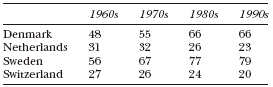
Second, while corporatism clearly depends on the existence of reasonably well-organized interest groups, the cross-country differences identified in this article are not readily explained by such structural conditions. As Table 1 indicates, for example, union membership is entirely unrelated to the development of corporatist policy-making. We will show that Danish and Dutch corporatism have developed in very similar ways, yet since the 1960s union membership has declined in the Netherlands but increased in Denmark. As several authors have recently pointed out, corporatist institutions may no longer depend on strong, encompassing interest organizations to the extent that students of corporatism assumed in the past.Footnote 18
Net Union Membership as a Percentage of the Civilian Labour Force, 1960s–1990s

Source:-Klaus Armingeon, Philipp Leimgruber, Michele Beyeler and Sarah Menegale, ‘Comparative Political Data Set 1960–2004’, Institute of Political Science, University of Berne, 2006. Original source: Evelyne Huber, Charles Ragin, John D. Stephens, David Brady and Jason Beckfield, ‘Comparative Welfare States Data Set’, Northwestern University, University of North Carolina, Duke University and Indiana University, 2004.
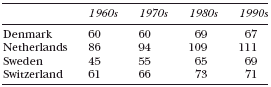
Third, as Table 2 shows, the four countries examined in this article are all increasingly exposed to the hazards of international economic competition, which means that economic openness cannot account for the diverging trends among them. Finally, the four cases differ with regard to participation in European integration – the Netherlands is one of the original members of the European Union, Denmark joined in the early 1970s, Sweden joined in 1995 and Switzerland remains a non-member – but while the (temporary) decline of corporatism in Denmark occurred in the years following EU accession, this was not the case in the Netherlands, and Swedish corporatism disintegrated before Sweden became a member of the European Union. There is thus no clear association between membership in the EU and the development of corporatist policy-making.
Exports Plus Imports as a Percentage of GDP, 1960s–1990s

Source: Armingeon et al., ‘Comparative Political Data Set’. Original source: OECD.
RESEARCH DESIGN
The four cases examined in this article represent different modes of party competition. Sweden is one of the most bloc-oriented democracies among PR countries in Europe, since the left–right dimension is strong and there is fierce competition between two well-defined ideological blocs. Government formation is characterized bywholesale alteration and familiarity. According to our theory, this should place corporatism at great risk. Switzerland, on the other hand, is a case of non-alteration and familiarity, since the major parties have been in a permanent government coalition since the 1950s. We expect this to make Swiss corporatism highly stable.
In contrast, Denmark and the Netherlands are cases of partial alteration in party political systems characterized by varying degrees of innovation: Denmark is similar to Sweden with respect to the competition between left and right, but the presence of small pivotal centre parties – who move their allegiance between left and right – has made the parliamentary coalitions that support Danish governments more ideologically mixed than coalitions in Sweden, at least before the 2000s. The Netherlands is similar to Denmark with regard to the mixed and transient nature of coalitions, but the traditionally decisive centre party – the Christian Democrats – is much bigger than the Danish centre parties.Footnote 19 Our predictions for the two cases are similar, however: corporatism ought to be relatively stable, but it should be sensitive to the coalition strategies of political parties, and in periods of bipolar competition we expect corporatism to be weaker than otherwise.
The four case studies are based on historical overviews – drawing on secondary literature – and on investigations of the role of interest organizations in the late 1990s and early 2000s in two policy areas: active labour market policy and pension policy. The reason for our choice of a case study-based approach is that we wish to go beyond formal institutions and consider norms regarding social partnership. The alternative would have been to use quantitative data on the participation of interest organizations in policy-making, but existing data are restricted to a few formal, institutional characteristics that vary little over time.Footnote 20 The empirical analysis relies primarily on the existing literature on policy-making in the four countries, but we have supplemented the secondary sources with official documents, and with 10 to 15 semi-structured interviews in each country.Footnote 21 By active labour market policy, we mean supply-side efforts to enhance the employability of labour and reduce unemployment.Footnote 22 By pension policy we mean old-age pensions only (not early retirement).
There are two reasons why we have chosen to focus on these two policy areas. First, they are obviously important to the members of labour market organizations. Second, the four countries have faced similar challenges in these areas in the period studied, such as demographic ageing (pensions) and rising unemployment (active labour market policy). We have avoided policy areas where some countries faced problems that were particular to their history or political economy.
SWEDEN: POLARIZATION AND THE DECLINE OF CORPORATISM
In Sweden, a previously strong corporatist system has fallen apart. The crucial change occurred in 1991, when the Confederation of Swedish Employers (SAF) left the governing boards of almost all government agencies.Footnote 23
Active labour market policy was the centrepiece of the Swedish model, and interest organizations used to be heavily involved in the preparation of legislation and the implementation of policy in this area. But things changed in the course of the 1980s and 1990s. Today, the main business organization – the Confederation of Swedish Enterprise – is adamant that it has left corporatism behind, and our interviews confirm that there are no institutionalized negotiations and no attempts to reach agreement among labour market organizations. Interest organizations are still influential, but they achieve their influence through lobbying efforts and political pressure – as interest organizations do in non-corporatist political systems.Footnote 24
Turning to pension policy-making, the most important event in recent times was a major pension reform in the mid-1990s. In the second half of the 1980s, interest organizations were represented in a government commission that explored ways of changing Sweden's state-run pension system. When a new commission was appointed to prepare the actual reform in the early 1990s, the design of the reform was left to a small group of politicians and experts, who deliberately excluded both labour market organizations and organizations for pensioners.Footnote 25 Interest organizations still play some role in pension politics since they manage funds that provide supplementary pension payments, but compared to the other countries explored in this article, these funds only represent a small part of total pension coverage.
There is strong evidence that the decline of Swedish corporatism is related to the predominance of bloc-oriented competitive politics. The defining feature of Swedish party politics is that governments are either left wing or right wing; that is, party competition is bloc-oriented along the left–right dimension (although policy-making in parliament tends to be more pragmatic).Footnote 26 As a result of the bloc-oriented party competition, interest organizations have been drawn into an ideological struggle between left and right in a manner that has proven to be incompatible with stable corporatism.
By the early 1970s, the social democrats had ruled for four consecutive decades. In the 1950s and 1960s, this was not a threat to corporatism, since unions and employers managed to agree on many economic and social policies in the growth economy of that period, and some of Sweden's welfare policies were supported by cross-class coalitions.Footnote 27 In the 1970s, however, Swedish politics became increasingly competitive and polarized. There were two reasons for this. First, the centre-right parties intensified their cooperation – the three centre-right party leaders held a joint press conference for the first time in 1971 – which meant that a broad centre-right coalition became a serious possibility. Second, the main trade union confederation, the LO, in 1975 proposed a system of collective ownership, so-called ‘wage earner funds’, which if implemented fully would have led to a transfer of power from capital owners to unions. As a response to this attempted bypass – which was actually successful in the sense that a social democratic government introduced watered-down legislation on wage earner funds in 1982 – the Employers' Confederation initiated an ideological campaign against the social democrats and the unions, placing their bets on centre-right electoral and ideological advances rather than corporatist bargaining.
This campaign culminated in employers' withdrawal from corporatism in early 1991. The reason they waited for so long before definitively abandoning corporatism is arguably that a centre-right election victory seemed very likely in the run-up to the 1991 election. Given the high likelihood of a change of government – the non-socialist side had a clear advantage in the opinion polls throughout 1991 – the probability that the employers would be able to influence government policy directly was high.Footnote 28
DENMARK AND THE NETHERLANDS: FROM IDEOLOGICAL CONFLICTS TO PRAGMATISM
In both Denmark and the Netherlands, corporatism was in crisis in the 1970s and early 1980s, but underwent a resurgence in the late 1980s and in the 1990s.
The crisis of Danish corporatism in the 1970s and 1980s is most apparent in pension policy-making, which was highly polarized because it was linked to a fierce debate on ‘economic democracy’ (similar to the debate on wage earner funds in Sweden). The unions and the political left favoured a state-run pension system, whereas the employers and the political right opposed any such changes. The management of labour market policy also became more conflictual in the 1970s. Corporatist practices did not vanish entirely, but the interaction of interest organizations was characterized by divisive conflicts.Footnote 29 Furthermore, the Danish government frequently bypassed interest organizations in the 1980s.Footnote 30
The deadlock in pension policy broke in the late 1980s, when labour market organizations agreed on the introduction of a decentralized pension system managed by unions and employers. The negotiated agreement was typically corporatist, as it satisfied both the unions' wish for a national pension fund and the employers' desire for decentralization.Footnote 31 In the late 1980s and early 1990s, Danish interest organizations also took an active part in a set of important labour market reforms, most significantly in the extensive reforms that were proposed by the so-called Zeuthen Committee in 1993 and adopted by parliament in 1994. The entire reform process was defined by the need to find a compromise between unions and employers. Thus interest organizations were key actors in the Zeuthen Committee, and they agreed on the need for reform and the desirability of coordinated reform.Footnote 32
The Netherlands is similar to Denmark in the sense that there was a crisis of corporatism in the 1970s and early 1980s. Some fifteen years ago, one student of the Dutch case wrote that, in the 1970s, corporatism in the Netherlands had become ‘increasingly residual’.Footnote 33 But most scholars appear to agree that, after a period of decline in the 1970s and early 1980s, Dutch corporatism resurged in the late 1980s and in the 1990s (even if, as Visser and Hemerijck have demonstrated, this was more obvious in some policy areas than in others).Footnote 34 The second half of the 1990s has been described as the ‘best of times’ for social partnership in the Netherlands, since this period was defined by an ‘atmosphere of compromise’.Footnote 35
The resurgence of corporatism in the Netherlands is most apparent in the area of pensions. There has been a series of pension reforms in the Netherlands, beginning in the mid-1980s, and throughout this period interest organizations have been ‘major players’ in pension politics.Footnote 36 Furthermore, the responsibilities of interest organizations for the management of pensions have increased, given the increasing importance of occupationalpensions, which unions and employers regard as their own turf.Footnote 37 Corporatism also remains strong in Dutch labour market policy, which is characterized by pragmatism and the agreement on a division of responsibilities between the government and the main interest organizations; there is no consensus on policy, but there is consensus on a core set of problem definitions, and on the benefits of coordination.Footnote 38
There are strong reasons to believe that party politics explains both the decline and the resurgence of corporatism in Denmark and the Netherlands, for the development of Danish and Dutch party competition has been similar in three ways in the period considered here. First, political radicalization in the late 1960s and early 1970s led both the Danish and the Dutch social democrats to opt for progressive coalition strategies, pursuing more socialist agendas than before – but they gave up after a few years and returned to cooperating with centre-right parties. Second, both party systems are innovative, in the sense that parties frequently form new types of coalitions. Third, the Danish and Dutch social liberal and liberal parties have a history of cooperation with both the social democrats and the centre-right, which means that government formation is characterized by partial alteration.
In the late 1960s and in the 1970s, the Danish social democrats started pursuing a more radical political agenda and parliamentary strategy. A socialist majority in parliament after the 1966 election raised hopes of a pure left-wing political alternative, and the blue-collar union confederation (LO) pushed the social democrats leftwards by demanding ‘economic democracy’, a proposal that if implemented would have given trade unions large power over leading Danish firms. This was an attempt to bypass corporatist institutions, since employer organizations strongly opposed the idea of economic democracy. However, by 1978 it became obvious that the social democrats were unable to deliver the policies that the unions wanted, for this year the social democrats formed a short-lived coalition with their main opponents, the liberal party Venstre – anunprecedented step in the party's parliamentary strategy that severely damaged the relationship between the social democrats and the trade unions.Footnote 39
In 1982, a social democratic minority government resigned and a four-party centre-right coalition took over. It has been argued that the formation of this government signified a shift to ‘bloc-oriented’ minority parliamentarianism, but importantly, both the centre-right governments in the 1980s and the centre-left governments in the 1990s relied on the support of the social liberal party Radikale Venstre (who had cooperated with the social democrats in the 1970s and early 1980s).Footnote 40 This is an important indication that party competition in Denmark was not completely bipolar, at least not before 2001, when a right-wing minority coalition supported by the far-right Danish People's Party took over.
Party political competition in Denmark has thus been characterized by regular changes in cabinet composition, by minority governments, by partial alteration and innovative coalition formation, and most importantly by the impossibility of forming a purely left- or right-wing government, since almost all cabinets before 2001 have relied on the open or tacit support of centre parties. The radical agenda of the social democrats and the unions in the 1960s and 1970s is an important reason for the crisis of corporatism in Denmark. The return of centrist political competition allowed for a resurgence of corporatism in the 1980s and 1990s.
The Netherlands is a clear case of partial alteration in government and innovative coalition formation. Dutch governments are normally based on large coalitions, and all the major political parties have been in government together at some point. The centrist Christian democratic party CDA and its precursors were in government continuously from 1959 to 1994, and again after 2002; the social democratic PvdA has also held cabinet seats for long periods of time. From 1994 to 2002, for example – a period when the Dutch corporatist ‘Polder Model’ was celebrated across the world – the Netherlands had a so-called purple government: the social democrats governed in coalition with the social liberal D66 and the liberal VVD.Footnote 41
As in Denmark, party politics in the Netherlands underwent a period of transition and crisis around 1970. The turning point was the late 1960s, when new parties emerged and the dominance of old parties declined. This political upheaval, and the rise of a new left, led the main left-wing party, the PvdA, to attempt a ‘progressive’ alliance that would remove, it was hoped, the need to engage in compromises with the Christian Democrats.Footnote 42 In the 1970s, the unions also tried to redefine ‘the post-war bargain’ in ways unacceptable to employers.Footnote 43 The creation of a left-of-centre cabinet in 1973 was an important reason for this radicalization. After a period of competitive politics in the late 1960s and the 1970s, however, politics again became more pragmatic and consensus oriented.Footnote 44
It is reasonable to conclude that the crisis of Dutch corporatism in the 1970s was associated with the transition to a more competitive, bloc-oriented phase of party competition, while the return of traditional Dutch shifting alliances and cross-class collaboration in the course of the 1980s made the resurgence of corporatism possible. Under the normal ‘politics of accommodation’ in the Netherlands, interest organizations arguably gain more from cooperation than they would gain from exercising direct influence over their allies within the party system.
SWITZERLAND: STABILITY THROUGH POWER-SHARING
Switzerland is different from other corporatist countries because of its weak union movement and its decentralized wage-setting system. But with regard to policy-making – as opposed to industrial relations – there is a strong tradition of corporatist consultation within individual policy areas. Interest organizations are partners in a negotiation system linked to the Swiss parliament.Footnote 45
In the area of active labour market policy, interest organizations are involved in the preparation and implementation of labour law, and labour market reforms tend to be based on compromises and agreements among the major organizations. Leading representatives of both employers and unions see the corporatist system as stable, stressing its capacity to produce compromises regarding policy responses to social and economic problems even if basic interests diverge.Footnote 46
The Swiss pension system is a three-pillar system institutionalized in 1972. The first pillar is a basic pension provided by the federal government, the second pillar consists of supplementary, occupational benefit plans funded and managed by employers and workers, and the third pillar is an optional private pension system.Footnote 47 The first pillar has always been managed by the state, and interest organizations have not been involved much – there is a tripartite commission, but it is not very influential. The second pillar, on the other hand, is predominantly corporatist, since supplementary pensions, while company-based, are managed by more centralized bipartite commissions. There are thus strong elements of corporatism also in the area of pensions.Footnote 48
The case of Switzerland shows that a tradition of oversized coalitions across the left–right divide can provide for stable corporatism. Switzerland's executive, the Federal Council, is a semi-permanent coalition of four parties: the liberal Free Democrats (FDP), Christian Democrats (CVP), the conservative People's Party (SVP) and the social democratic SP.Footnote 49 These four parties have split the seven cabinet seats between them since the late 1950s, with one seat going to the SVP and two each to the other three.Footnote 50 This means that while the political left in Switzerland is weak, it is still represented in the executive. It also means that there is no traditional opposition. Consequently, in Switzerland there has been no chance of either a strong left-wing government or a strong right-wing government, so interest organizations do not have any incentives to bypass corporatist arrangements and seek direct influence via allies inside government. This is consistent with the argument developed in this article: the mode of party competition is an important part of the explanation for the relative stability of Swiss corporatism in the last three decades.
CONCLUSION
The stability of corporatist policy-making has varied among the small European democracies, both over time and between countries. Evidence from policy-making in the 1970s, 1980s and 1990s shows that in Denmark and the Netherlands, corporatism declined in the 1970s and early 1980s, but it subsequently increased in importance and played a major part in policy reforms in the late 1980s and in the 1990s. In Switzerland, corporatism was relatively stable throughout this period, whereas in Sweden, corporatism has declined.
Our main argument is that since the 1960s, corporatism has come to depend on particular patterns of party competition. Except for a brief period in the 1970s, and perhaps the early 2000s, Denmark and the Netherlands have a history of transient and mixed political alliances and centrist party-political competition, which has generally furthered the cooperation between interest organizations and the state. Switzerland has a tradition of power-sharing that goes back at least to the 1950s. Finally, in the Swedish case – an example of declining corporatism – a social democratic-led left faces a unified centre-right, there is little power-sharing and no government coalitions have crossed the ideological divide between the two blocs since the mid-1950s.
Not only comparisons between countries but also analyses of development over time within countries support our argument. In both Denmark and the Netherlands, political events in the late 1960s and early 1970s led social democratic parties to seek progressive coalitions that would remove the need to compromise with ideological opponents. The temporary crises of corporatism in these two countries can be linked to this change in the party system. The return to a mode of political competition characterized by alliances across the left–right divide contributed to the resurgence of corporatism.
These results suggest that the emphasis on economic-structural factors in most previous research on corporatism has led to an under-appreciation of party politics. We do not claim that economic-structural factors are irrelevant, however – there is strong support for the argument that corporatism depends on certain economic-structural prerequisites. An important task for future research on the development of modern corporatism is therefore to study the interaction of economic-structural and political factors, much as Peter Katzenstein and other authors studied the interaction of these two types of variables in historical accounts of the emergence of corporatism.
Another important task for future research is to test the ideas developed in this article in studies of other countries, and in broader cross-country comparisons. Casual observations of other countries appear to lend further support to our argument. Consider, for example, the case of Finland. Corporatist arrangements appear to have been vital when Finland adjusted to its deep economic crisis in the early 1990s, and there is little evidence of any decline of corporatism over time.Footnote 51 As we would expect, political competition in Finland is not bloc-oriented: Finland has a history of power-sharing and oversized coalitions, and of increasing innovativeness when it comes to the cooperation between parties with different ideological orientations.Footnote 52
The main implication of the arguments and empirical results presented in this article is that corporatism is sensitive to the outside options that interest organizations have when they seek political influence. It is only sustainable if interest organizations respect implicit and explicit compromises over fundamental issues of distribution. Interest organizations and political parties may have strong reasons to pursue radical left- or right-wing agendas, but if they do, they should not take it for granted that corporatism will survive the distributive conflicts that ensue.