1. Introduction
One of the typical features of Caribbean creoles is the occurrence of both, overtly marked and unmarked past tenses (see, among others, Holm Reference Holm1988:148–150). This has been attested in Negerhollands, where past time reference can either be expressed by the preverbal particle (h)a or be unmarked (see Graves Reference Graves1977, Van Diggelen 1978, Stolz Reference Stolz1986, Sabino Reference Sabino1986, Bruyn & Veenstra Reference Bruyn and Tonjes1993). Quantitative variationist studies in a number of varieties of English and English-lexified creoles have shown that this variation is not random (for example, Schiffrin Reference Schiffrin1981, Tagliamonte & Poplack Reference Tagliamonte and Poplack1988, Patrick Reference Patrick1999, Poplack & Tagliamonte Reference Poplack and Tagliamonte2001, Hackert Reference Hackert2004). Following up on those studies, in this paper I investigate the impact that various factors such as narrative discourse function, aspect, stativity, and syntactic priming have on the expression of past time reference in 20th-century Negerhollands through a quantitative variationist study of de Josselin de Jong's (Reference de Jong and Benjamin de1926) corpus (abbreviated as dJdJ).
I show how Negerhollands diverges from other creoles in its expression of past time reference: Overt pasts are predominant, while in other Caribbean creoles zero pasts, typically analyzed as zero perfectives, are the default (see, for example, Winford Reference Winford1992 for Trinidadian Creole). Similarly, narrative clauses show the highest rate of overt pasts in Negerhollands, a context where varieties of English and English-lexified creoles typically display low rates of overt pasts. Nevertheless, the alternation between overt and zero pasts can be explained on the basis of the same general linguistic principles as those active in the English-lexified creoles.
Negerhollands, also known as Virgin Islands Dutch Creole, is the extinct creole language that used to be spoken in the Danish West Indies (US Virgin Islands).Footnote 1 The main superstrate languages are 17th-century variants of southwestern Dutch, that is, Zealandic and West-Flemish (Hesseling Reference Hesseling1905:61, 64, 66–67, van Rossem & van der Voort Reference Cefas van and van der Voort1996:20–22, van Rossem Reference Cefas van, Berns and van Marle2000). Negerhollands is special in that it is one of very few Dutch-lexified creoles for which there is a considerable amount of data available (Berbice Dutch being another notable example). The substrate languages spoken by the enslaved population who created Negerhollands in the late 17th or early 18th century must have been Akan, Ga, and Ewe (Stolz & Stein Reference Stolz1986:117–118, Sabino Reference Sabino1990:44). The majority of the Negerhollands data available in manuscripts and a few publications have been digitalized and collected in a publicly available database: the Negerhollands Database (NEHOL, corpus1.mpi.nl).Footnote 2 It also contains the data used for the current study, which were collected and published by de Josselin de Jong in Reference de Jong and Benjamin de1926.
2. Time Reference and Aspect
2.1. Past Time Reference
TIME (or temporal) REFERENCE is an abstract concept used to describe whether a situation is asserted to occur in the past, present, or future. It should not be confused with TENSE, a language-specific morphological category that may express both temporal and aspectual values (Bertinetto Reference Bertinetto1994:393). Thus, the combination of Negerhollands preverbal (h)a and a verb can be seen as a past tense that expresses past time reference. Since the use of (h)a does not affect the form of the verb in Negerhollands, unlike a past tense in Germanic and Romance languages where the term originates from, I instead refer to (h)a as a past marker, short for past time reference marker. TOPIC TIME is an intuitively useful term when studying time reference within a narrative context: It refers to the temporal interval at which a situation is asserted to occur but makes no reference to whether or not the situation extends in time beyond this time interval (Klein Reference Klein1994:4).
Negerhollands has been identified as having a tense system with ABSOLUTE past time reference (Bruyn & Veenstra Reference Bruyn and Tonjes1993:40). Absolute past time reference means that a situation is asserted to have occurred during a time interval or point in time prior to the moment of speech, that is, that topic time has been established as preceding the moment of speech. By contrast, RELATIVE past time reference is interpreted relative to a point of reference provided by the context (which may, but need not be, the moment of speech; Comrie 1986:58). Somewhat confusingly, in creole studies, relative past time reference usually refers to a situation whose topic time is established relative to a point of reference in the context (relative), which, in turn, is asserted to occur prior to the moment of speech (absolute) (see Comrie 1986:65, who calls these constructions “absolute relative”). In the remainder of this study, I use the term past time reference to refer to absolute past time reference.
In this study, the main focus of investigation is the alternation between clauses that do and clauses that do not overtly express past time reference. The following examples illustrate this variation. Negerhollands uses the preverbal particle (h)a to express past time reference, as in 1b. The main clause in 1a equally has past time reference, but here only the bare verb see ‘say’ is used.
(1)

I refer to the situation in 1a as an occurrence of a ZERO PAST, while the situation in 1b is referred to as an occurrence of an OVERT PAST.
2.2. Aspect
A number of studies have shown that the expression of past time reference is influenced by the aspect value of the clause in question (for example, Winford Reference Winford1992, Patrick Reference Patrick1999, Hackert Reference Hackert2004). This issue is discussed in more detail in section 4.1. In this section, I introduce and define the different aspect categories that are discussed later on in this study. Bohnemeyer (Reference Bohnemeyer2002:38ff) introduces a comprehensive model to define aspectual notions presented in figure 1 below. The following discussion and all the definitions used are derived from Bohnemeyer's model and discussion. There are six logical or conceptual boundary operators that select parts of a situation: (i) the initial boundary; (ii) the terminal boundary; (iii) the situation as a whole, including the initial and the terminal boundary; (iv) an internal part of the situation, without entailment of its boundaries; (v) the prestate; and (vi) the poststate. In figure 1, below the boundary operators there is a time axis that indicates a logical relation between time and the aspectual operators (for example, the prestate precedes the initial boundary in time, while the poststate follows the terminal boundary). The time indicated on the axis is just a random example, and instead of an hour, some situations may last only seconds, others days, or even years.
PERFECTIVE ASPECT sees the situation as a whole, and therefore coincides with boundary operator (iii). This definition corresponds to Bybee et al. (Reference Bybee, Perkins and Pagliuca1994:54), who define perfective aspect as “signal[ling] that the situation is viewed as bounded temporally,” which means that both the beginning and the termination of the situation are referred to. This makes perfective situations ideal for “narrating sequences of discrete events in which the situation is reported for its own sake, independent of its relevance to other situations” (Hopper Reference Hopper1982, cited in Bybee et al. Reference Bybee, Perkins and Pagliuca1994:54). It is a crosslinguistically common feature of past situations to have perfective aspect as the “default” interpretation (Bybee et al. Reference Bybee, Perkins and Pagliuca1994: 153).
Aspect according to six logical boundary operators, adapted from Bohnemeyer (Reference Bohnemeyer2002:38).

PROGRESSIVE ASPECT coincides with boundary operator (iv): An internal part of the situation is selected without entailment of its onset (the initial boundary) or its termination (the terminal boundary). This definition is also compatible with Bybee et al.'s (Reference Bybee, Perkins and Pagliuca1994:125), where progressive aspect is defined as “a situation in progress at a particular reference point, either in the past or present.” Progressive aspect is marked in Negerhollands with the preverbal element lo (variably occurring as lo or loo), as in 2.
(2)
HABITUAL ASPECT refers to a situation that occurs regularly during a certain time period that may be made explicit in the context (compare Dahl Reference Dahl1985:97 and Comrie Reference Comrie1976:27–28). Reference time may select all or only a part of that time, with which an unspecified number of occurrences of the situation is asserted to overlap (Bohnemeyer Reference Bohnemeyer2002:261). Negerhollands typically uses the preverbal habitual marker kan to signal habitual aspect (see 3), but also lo and kaa gwen, which occurs only once in the data.Footnote 3 All can occur with or without (h)a. In this study, clauses introduced by weni ‘when’ in the sense of ‘for each time that’ or ‘whenever’ have also been counted as habitual.
(3)
INCHOATIVE ASPECT coincides with the initial boundary of a situation and as such signals the onset of a situation. It can be expressed lexically with the verbs bigín ‘begin’ and stāt ‘start’, but also with the verb lō ‘go’, as the main clause in 4 shows.
(4)
The aspect categories perfective, progressive, habitual, and inchoative are discussed in relation to the expression of past time reference in Negerhollands in section 4.1.
3. Methodology
3.1. Quantitative Variation Analysis
The linguistic field of variationist sociolinguistics has shown that linguistic, discourse, and social factors may underlie language variation (for example, Weinreich et al. 1968 cited in Tagliamonte Reference Tagliamonte2006:5). In order to be able to determine what factors condition the variation, a quantitative approach is adopted in variationist studies. A quantitative variationist approach is used for this study following the considerable number of fruitful studies on variation in the expression of past time reference in a number of languages. Due to the limited sociolinguistic information available for the Negerhollands data used for this study, the main focus is on linguistic factors.
An important assumption of variationist research is that different forms may have the same function. They may functionally differ in certain contexts, but there can be contexts in discourse where these differences are neutralized (for example, Tagliamonte Reference Tagliamonte2006:9–10). Depending on the research question, these contexts may be exactly where the variation under investigation occurs. However, any context where (h)a's function of expressing absolute past time reference may be neutralized is excluded. In these contexts, (h)a may be in variation with, for instance, perfect marker ka, in which case a different alternation would be investigated. Section 3.3 lists all contexts included in and excluded from this study.
The quantitative method that has been the standard in variationist studies is variable rule analysis (see Sankoff Reference Sankoff, Ammon, Dittmar and Mattheier1988, cited in Tagliamonte Reference Tagliamonte2006:130–133), which uses generalized linear models (Tagliamonte & Baayen Reference Tagliamonte and Rolf2012:136). In recent years, however, a new statistical method, generalized linear mixed-effects models, has become available. I have used this method in the open source and free statistical software R (R Core Team Reference Team2012). Central to the difference between a generalized linear and a generalized linear mixed-effects model is the difference between fixed-effect and random-effect factors. Fixed-effect factors have an exhaustive possibility of levels, such as animacy (human/animate/ inanimate), or the presence or absence of a temporal adverbial: Either there is one or there is none. By contrast,
[r]andom-effect predictors […] have levels that constitute only a subset of the possible categories available in the population. Individuals (and also words, e.g., nouns, verbs, or adjectives) are typical examples of random-effect factors. If, in a statistical analysis, a random-effect predictor is analyzed as if it were a fixed-effect predictor, then the conclusions reached will only be valid for the individuals and words sampled. Thus, if the sample comprises eight individuals, the statistical model will be valid for only those eight individuals. Conclusions do not automatically generalize to the relevant populations of interest.
(Tagliamonte & Baayen Reference Tagliamonte and Rolf2012:143)
Because generalized linear models can only treat variables as fixed-effect factors, generalized linear mixed-effects models have the advantage of being able to “bring individual differences into the statistical model” (Tagliamonte & Baayen Reference Tagliamonte and Rolf2012:144).
3.2. The Data
The data set used for the current study is a collection of folktales from dJdJ. It contains narratives spoken by descendants of the enslaved population from the former Danish colony, who created Negerhollands in the late 17th or early 18th century. This is the only generally available Negerhollands source of its kind and size. The data have been collected during fieldwork in the first months of 1923. It contains 82 narratives (see section 4.3): 74 folktales, five narratives of personal experience, two generic narratives, and one generic narrative that ends in a short narrative of personal experience, seven children's rhymes, 12 ritual songs, and two lists. This equals a total of about 5160 clauses. Section 3.3. discusses which of these have been used for this study.
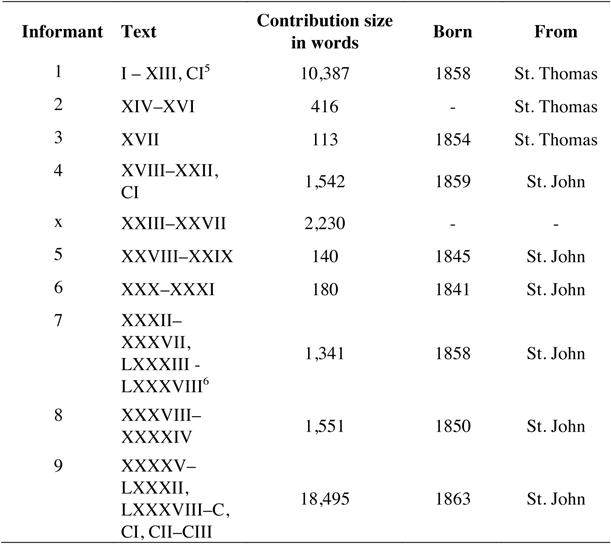
Table 1 lists the available sociolinguistic background information on de Josselin de Jong's informants.Footnote 4 The limited number of informants make it impossible to test for sociolinguistic effects on the variable expression of past time reference. The data set is too homogeneous with respect to factors age (spanning between 60 for informant 9 and 82 for informant 6) and sex (informant 6, the oldest informant, is the only female).
dJdJ's informants.
The imbalance of dJdJ's informants’ contribution is taken into consideration so far as is possible by the statistical method, discussed in 3.1. The contributions by informants 3, 5, and 6 are too marginal to be compared to those of others, but they are included for general results.
3.3. Variable Context
A precise definition of the variable context is fundamental in quantitative linguistic research as it enables one to compare the results of different studies (Hackert Reference Hackert2008:128). This section describes both, the contexts included and, of equal importance, the contexts excluded from the data set. The variable under investigation is the occurrence of (h)a expressing absolute past time reference in Negerhollands.Footnote 7
A variable context is any context where one expects to find variation with respect to a particular feature. By necessity, the variable context in this study includes all contexts where the variable occurs, and where it does not but could have occurred (Labov's Reference Labov1972b:72 “principle of accountability”, cited in Tagliamonte Reference Tagliamonte2006:12–13). Past time reference is expressed in Negerhollands through preverbal (h)a, as in 5a, or it is unexpressed, as in 5b. (H) a is a particle that precedes the verb, but it does not need to be adjacent to the verb: Aspect and mood markers may come between, as well as some adverbs, as illustrated in 5a.
(5)
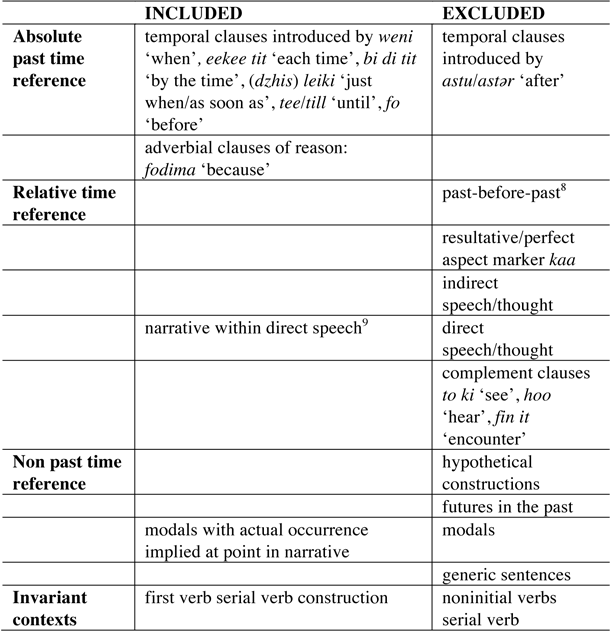
Contexts without absolute past time reference, contexts in which no variation of the variable has been attested, and contexts where the absence or presence of the variable is indeterminate must be excluded. Table 2 below gives an overview of the contexts to be included and excluded.
The variable context for the study of the expression of past time reference.
I briefly discuss the exclusion of the indeterminate contexts, the occurrence of the negator na, and verbs starting in /a-/. Na leads to complications in the analysis, because it can be both a negation marker equivalent to other negators (nə, ne, ni, no, and nu), and a contraction of negation marker nə and past marker a (dJdJ:94). Logically, na may also be a contraction of na and a. Contraction is, however, not compulsory: nə a and na a occur as well.
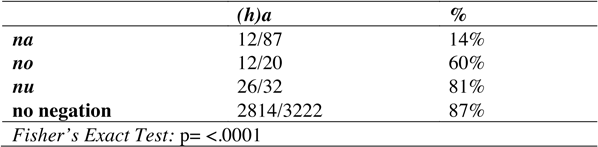
The effect of negation on the expression of past time reference.
Table 3 shows that 87% of the non-negated clauses contain overt past marking.Footnote 11 Overt past marking is only slightly less frequent in clauses negated by nu. In clauses negated by na, however, the distribution is exactly the opposite: There are hardly any occurrences of overt past marking following negator na. With p < .0001, a Fisher's Exact test strongly suggests that the differences in table 3 are not due to chance. I assume that the exceptionally low count of overt past marking with na is the result of na occasionally being a contraction of the negator (na or nə) and past marker a. This means that it is impossible to determine in any given occurrence whether a verb negated by na contains a zero or an overt past. Thus, all clauses negated by na should be excluded from the analysis as instances of invariable context. Verbs negated by na where (h)a is present can be included in the analysis for the obvious reason that in those cases, the presence of (h)a can be determined.
Verbs that start in /a-/ are significantly less often preceded by (h)a than other verbs (see table 4). There are four verbs or variants of verbs that start in /a-/: agree ‘agree’ (five occurrences), anturt ‘answer’ (22), a (variant of ha ‘have’; two occurrences), and a fo (variant of ha fo ‘have to/must’; one occurrence). When included as a fixed-effect factor, it retains high significance in the final statistical model (see section 4) with p=.0007 (see table 4). The analysis could not be extended to verbs with other vowels in the onset, as there are only three such occurrences in total: two occurrences of it ‘put out’ and one occurrence of ordə ‘demand’.
A comparison between tables 3 and 4 shows that overt past marking is considerably more frequent before verbs starting in /a-/ than before negator na. Perhaps, the speakers are less inclined to merge the two vowels into one in the former case. The lower rate of overt past marking could then be attributed to a difficulty for the annotator, de Josselin de Jong, to perceive the past marker before the verbs starting in /a-/. In any case, for the verbs agree, anturt, a, and a fo it also seems impossible to determine whether (h)a is truly absent or just not perceived. For this reason, they are excluded.
The effect of verbs that start with the vowel /a-/ on the expression of past time reference.

Thus, only contexts with absolute past time reference that allow variation in past time reference marking are included. Excluded are contexts where it is impossible to determine whether or not (h)a is used, that is, when the negator na is not followed by (h)a and before verbs that start in /a-/.
3.4. Analysis of the Data
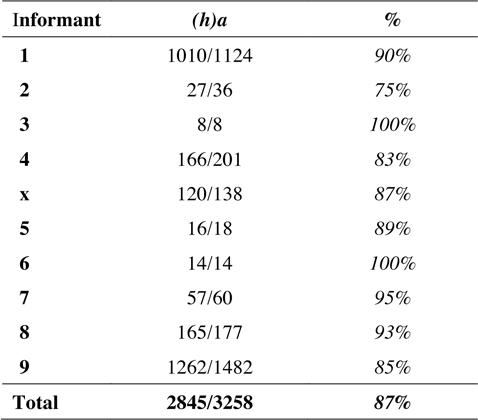
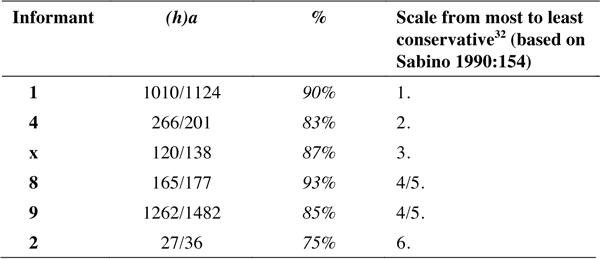
In a generalized linear mixed-effects model, one can investigate whether a predictor or factor has an effect on the variable in the data as a whole, but also whether this effect differs across individuals or different verbs. The latter two categories have indeed been included in the analysis as random-effect predictors. There was considerable variation in marking past time reference on the various verbs (estimated variance: 0.6111, standard deviation: 0.7817, number of groups: 215). However, the estimated variance for the individual speaker turned out to be zero. When the “estimated variance for [a random effect factor] is effectively zero […], [t]he random effect […] is superfluous,” and thus, “speaker variation is unlikely to distort our conclusions” (Baayen Reference Baayen2008:282). There was no deviation attested for any individual speaker with respect to any of the fixed-effect factors with a significant main effect: The predictors aspect and stativity, discussed in section 4, retain their significance.Footnote 12 An anova test used to compare the goodness-of-fit between the model with the individual speaker as a random-effect factor and one without indicates that there is no significant difference between them (p=.9994, df=1). Table 5 lists the variability with respect to past time reference marking among the various informants.
dJdJ informants and their respective variability in the expression of past time reference.
Nevertheless, an unknown part of the variation attested is likely to be attributable to social and/or regional variation. However, due to the limited number of informants and lack of sufficient (relevant) socio-linguistic background information, it is impossible to recover what social and regional predictors have played a role and to what extent.
4. ResultsFootnote 13
4.1. Past Time Reference and Aspect
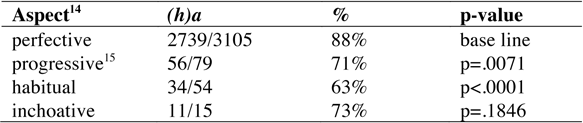
It has been observed in a number of creole languages that predicates used to describe past habitual situations are unmarked for past time reference significantly more often than predicates describing perfective situations (for example, Hackert Reference Hackert2004:171 for Bahamian Creole English; Patrick Reference Patrick1999:189 for Jamaican Creole; Winford Reference Winford1992:337 for Trinidadian Creole). The absence of overt past marking on habitual predicates is even hypothesized to be a “cross-linguistically common phenomenon” not restricted to creoles (Hackert Reference Hackert2004:171). Sentences with habitual predicates differ from generic sentences “by their lack of lawlikeness” (Dahl Reference Dahl1985:97), but in other respects they are semantically similar. In fact, according to Krifka et al. (Reference Krifka, Pelletier, Carlson, Meulen, Link, Chierchia, Carlson and Pelletier1995:17–18), habitual situations are by definition generic situations. Hackert (Reference Hackert2004:170) proposes to account for their similar behavior in terms of the similarities between the two situation types: both are nonspecific and involve “induction and generalization.” Given that “generic sentences are [most frequently] expressed with the most unmarked TMA category” (Dahl Reference Dahl1985:100), the semantic similarity between habitual and generic sentences could account for a low rate of past marking of habitual predicates. Indeed, in Negerhollands, habitual predicates are significantly less often overtly marked for past time reference than perfective predicates (see table 6) but the rate of overt past marking is also significantly lower with progressive predicates. Ongoing (progressive) situations generally overlap with adjacent situations, as can be seen in a narrative (Schiffrin Reference Schiffrin1981:50). This is illustrated in 6, where the progressive situation in 6c overlaps with the situations in 6a and 6b (examples from dJdJ:30).
(6)
In Labov & Waletzky's (Reference Labov, Waletzky and Helm1967) theory of narrative structure (discussed in section 4.3), clauses describing a situation that overlaps with that of other clauses are called RESTRICTED clauses, because they can be moved and placed elsewhere within a restricted part of the narrative (Fleischman Reference Fleischman1990:160). Depending on the narrative, a restricted clause can take scope over one to, in theory, all but one of the other clauses. There are also FREE clauses, which have scope over all of the narrative and can be placed anywhere without changing the temporal or logical interpretation of the narrative (Fleischman Reference Fleischman1990:166). Habitual predicates are typically found in either free or restricted clauses, while progressive predicates are typically found only in restricted clauses, with scope over a limited part of the narrative. Thus, what habitual and progressive situations have in common is that they can have scope over other parts of the narrative. The habitual and generic situations can thus be extended to include progressives in that all three can have scope over other elements in a narrative, albeit to different degrees (see table 6 below).
In Caribbean English-lexified creoles (CECs), perfective aspect is expressed by unmarked verbs (Winford Reference Winford1993:33–34). Unmarked verbs are typically associated with a past interpretation in CECs, but they are also used to describe generic and habitual situations (Winford Reference Winford1993:35–36). This leads to an interesting paradox: Perfective predicates are typically unmarked in terms of TMA, and habitual situations—which are semantically unlike perfective situations—are typically unmarked in CECs because the unmarked verb is seen as a perfective marker that has been extended in use to describe habitual situations. Nevertheless, as already mentioned above, habitual predicates are found to be more frequently unmarked for past time reference than perfective predicates in at least three CECs, because they are akin to, if not a type of, generic situations.
The distribution of the expressionof past time reference according to aspect.
Unlike the situation in CECs, perfective aspect is not expressed by the most neutral TMA category in Negerhollands. The TMA marker most closely associated with perfective aspect is (h)a, which is most suitably termed a past marker, as it also occurs with past imperfective situations, as in 6c. The fact that (past) habitual situations are more closely associated with the unmarked verb than perfective situations, not only in CECs but also in Negerhollands, supports the idea that habitual situations are associated with the unmarked verb for a different reason than perfective situations are in CECs (see also Winford Reference Winford1993:42–44).
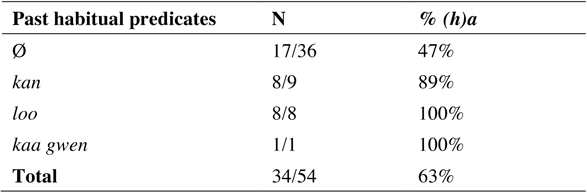
In Negerhollands, habitual predicates may be unmarked in terms of TMA, or be preceded by imperfective aspect marker lo, habitual aspect marker kan, or kaa gwe n. Table 7 shows that only habitual situations expressed by an unmarked verb have a strong preference for zero pasts, which means that the lower rate of overt past marking of habitual predicates is determined not by the presence of the imperfective marker, but rather by its absence. The interpretation of the unmarked verb in Negerhollands is discussed further at the end of section 5.2.
The expression of past time reference in past habitual predicates according to TMA marker.
A difference between the CECs discussed and Negerhollands is that not only past habitual but also past progressive predicates occur less frequently with (h)a in Negerhollands, as table 6 shows. This similar pattern with progressive and habitual predicates can be explained by the way aspect affects SITUATION TYPE, that is, the classification of situations (not verbs) based on their internal temporal features, such as duration, telicity, and stativity (Smith Reference Smith1997:17–20). Contextual information and/or aspect marking can change the interpretation of a situation to such an extent that it acquires semantics not present or, in some cases, even incompatible with its basic situation type.
It cannot be stressed enough that there is an essential difference between aspect (also known as grammatical or viewpoint aspect) discussed in section 2.2, and situation type (also known as lexical aspect). Viewpoint aspect can alter the basic situation type of a situation in such a way that it would have very different internal temporal properties. Smith (Reference Smith1997:48–53) refers to such altered situation types as DERIVED SITUATION TYPES. What habitual and progressive aspects have in common is that they induce a stative interpretation (de Swart Reference Henriette de1998:354, 359), regardless of the internal temporal features of the same situation in an aspectually neutral context.
The induced stative interpretation of habitual and progressive predicates is by no means incompatible with the observation that states can be habitual, progressive, or perfective (Bertinetto Reference Bertinetto1994:395). Habitual and progressive aspects still have their own semantics, and certainly, neither of them has the same semantics as aspectually neutral states. What is essential is the semantic feature that habitual and progressive situations have in common with states, namely, they hold for a time period preceding (and typically also following) the topic time.Footnote 16 This makes overt expression of past time reference less relevant, just as time reference is not relevant for generic situations, which are cross-linguistically described using the most unmarked TMA category available (Dahl Reference Dahl1985:99–100). The habitual and progressive situations in 7 and 8a, respectively, overlap in duration with other, perfective situations in the narrative. As mentioned earlier, the potential overlap is bigger for the habitual situation in 7 than for the progressive situation in 8a.
(7)
(8)
Thus, reduced relevance of past time reference marking can account for the lower frequency of (h)a in past progressive and past habitual predicates. Nevertheless, overt expression of past time reference is not as irrelevant for past habitual and past progressive situations as it is for generic situations. One finds that in the 20th-century Negerhollands folk stories in dJdJ, the habitual and progressive predicates are still more often overtly marked for past time reference than not.
4.2. Past Marking and Stativity
Stativity is a situation type feature recurrently investigated in creole studies with respect to the variable expression of past time reference. STATIVE situations “will continue[,] unless something happens to change that state” (Comrie Reference Comrie1976:49). As such, they are not “temporally bounded” (van Valin Reference van Valin, Mairal and Gil2006:156–157), as 9 shows, where the stative situation must be interpreted as continuing beyond the topic time.
(9)
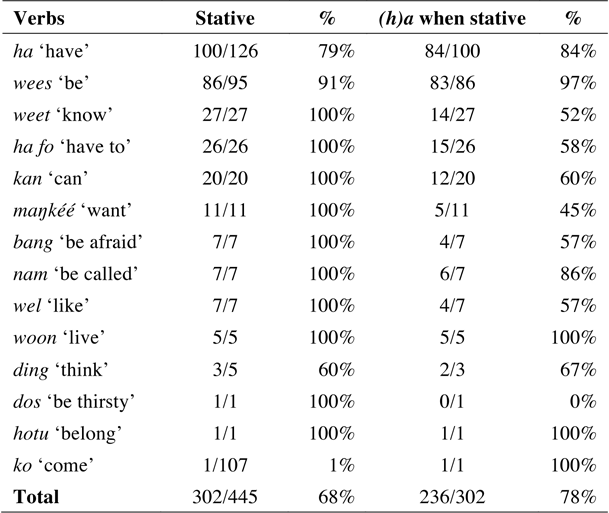
The rate of occurring as a stative predicate and the rate of overt past time reference marking on stative predicates.
Previous studies on CECs have shown that any effect exerted by stativity is often actually the result of idiosyncratic preferences of individual verbs—in particular, have—that are highly frequent and occur mainly or only with the stative meaning (see, among others, Patrick Reference Patrick1999:257, Tagliamonte Reference Tagliamonte, Baker and Bruyn1999:225, Poplack & Tagliamonte Reference Poplack and Tagliamonte2001:142, Hackert Reference Hackert2004:165–166). As table 8 above shows, the frequency of the various stative verbs differs considerably in Negerhollands, too: The verbs ha ‘have’ (N=100) and wees ‘be’ (N=86) account for 62% of all stative predicates (N=302). The rate of stative ha (84%) and wees (97%) being preceded by (h)a is considerably higher than the mean rate of overt past marking on stative predicates (78%). Two other notorious stative verbs, weet ‘know’ (52%) and maηkéé ‘want’ (40%), show significantly lower rates of overt past marking, and so do the two modals, kan ‘can’ and ha fo ‘have to’.
The statistical generalized linear mixed-effects model is able to take into account the variability in past time reference marking across the different verbs. However, the effect of stativity remains significant at p=.0169 (see table 9), despite the enormous variance already observed in table 8 (estimated variance: 0.96641, standard deviation: 0.98306, number of groups: 215). The difficulty in investigating the exact effect of stativity in the current dataset is that when the idiosyncratic verbs ha, wees, weet, kan, ha fo, and maηkéé are removed from the analysis, only a handful of infrequent verbs remain. One could remove the factor stativity from the analysis altogether, assuming that its effect actually reflects the past marking rates of individual verbs, as suggested above, which should already be captured by the random-effect predictor individual verb. However, doing so leads to a significantly worse fit of the model (anova: χ2=.021, df=3), since the residual deviance of the model including stativity is lower (1745) than that of the model without (1755). Thus, although I do not have an explanation for the divergent behavior of the six verbs mentioned above, nor am I able to define the exact effect of the predictor stativity, it does seem to have some explanatory value in the model.
Stative situations; the highly frequent verbs ha ‘have’ and wees ‘be’ included.

Thus, given its statistical significance, stativity is included in the final model on which the tables in section 4 are based, unless stated otherwise.
4.3. Past Marking and Narrative Type
The type of narrative has been found to influence the likelihood of occurrence of zero pasts (Hackert Reference Hackert2004:203). In the Negerhollands data, 98% of all narratives are folktales. In Bahamian Creole English, folktales show a lower rate of overt past marking than narratives of personal experience, which is explained assuming that overt past marking becomes redundant once it loses its temporal referential function, as is the case in fiction (Hackert Reference Hackert2004:196). Whatever the cause, this is not supported by the Negerhollands data, where folktales show a very high rate of overt pasts.
A number of studies have shown how different parts of a spoken narrative influence the likelihood of occurrence of zero pasts (for example, Schiffrin Reference Schiffrin1981, Tagliamonte & Poplack Reference Tagliamonte and Poplack1988, Hackert Reference Hackert2004).Footnote 17 They follow Labov & Waletzky (Reference Labov, Waletzky and Helm1967)'s framework for narratives of personal experience. In these narratives, people talk about situations they have experienced in their own life. Hackert (Reference Hackert2004:195) has shown that this framework is applicable to folktales too. The main building blocks of narratives are NARRATIVE EVENTS presented in NARRATIVE CLAUSES: If switching the order of two clauses results in a change in the interpretation of the order in which the events happened, then the two clauses involved are narrative clauses (Labov Reference Labov and Labov1972a, Labov & Waletzky Reference Labov, Waletzky and Helm1967, both cited in Schiffrin Reference Schiffrin1981:47). A cluster of narrative clauses forms the COMPLICATING ACTION (hence, narrative clauses are alternatively called COMPLICATING ACTION, or CA CLAUSES): This is where the story is told in a sequence of “temporally-ordered narrative events” (Schiffrin Reference Schiffrin1981: 48), as illustrated in 11a–c. ORIENTATION CLAUSES, exemplified in 10a–c, give background information, such as where and when of the narrative events, and describe “the identities of the characters” (Schiffrin Reference Schiffrin1981: 48). Hence, orientation clauses typically describe states and situations that begin before the onset of narrative events and continue into the CA (Schiffrin Reference Schiffrin1981:49). As opposed to CA clauses, orientation clauses are typically not temporally ordered: The order of orientation clauses within one orientation section can be changed without consequences for the in-terpretation of the information provided (Schiffrin Reference Schiffrin1981:49).
(10)
(11)
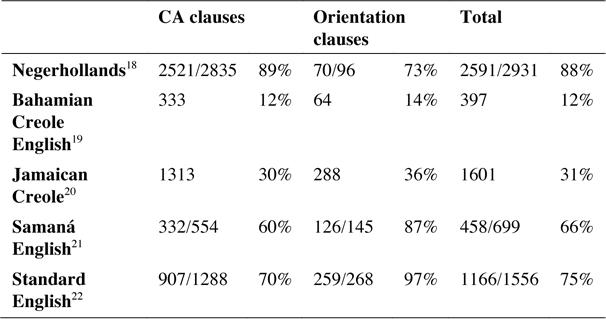
In Negerhollands, the (perfective) CA clause is the context in which past time reference is most frequently overt. For all other languages in table 10, CA clauses allow the highest rate of zero pasts, the exact opposite pattern. The high occurrence of zero pasts (or historical presents) in CA clauses in Bahamian Creole English and Standard English is attributed to the strong disambiguating force of CA clauses: Overt past time reference is redundant and can be dispensed with because CA clauses report events that are asserted to have already happened and thus receive a past (time reference) reading by default in the context of a narrative (Hackert Reference Hackert2004:192). This explanation does not apply to 20th-century Negerhollands. Table 10 makes it clear how strongly Negerhollands deviates from the other creoles in its high rate of overt pasts in CA clauses, where Bahamian Creole English and Jamaican Creole predominantly have zero pasts. Strikingly, the overall rate of overt past marking in Negerhollands surpasses even the rate of overt past marking in Standard English.
Percentage of overt pasts in CA versus orientation clauses.
The lower overt past rate in orientation clauses compared to CA clauses in Negerhollands can be accounted for by the functional similarities between orientation clauses on the one hand and progressives and habituals on the other hand, as discussed in section 4.1: Just like progressives and habituals, orientation clauses assert that the situation holds for a time period preceding and following the topic time, which means that these situations may overlap with situations described in other clauses.
4.4. Marking on the Preceding Verb (Syntactic Priming)
When form or construction X is in variation with form or construction Y, an occurrence of form or construction X increases the likelihood of form or construction X reappearing. This is referred to as the “parallel processing effect” (for instance, Poplack Reference Poplack1979, Scherre & Naro Reference Scherre and Naro1991:23) or the “principle of concord” (Sabino Reference Sabino1986:62). Poplack & Tagliamonte (Reference Poplack and Tagliamonte2001:126–127) interpret it as an effect of “morphological priming.” In cognitive linguistics, terms such as structural priming, syntactic persistence, and syntactic priming are used (Gries Reference Gries2005:265 and the references therein). Following Gries 2006:265, I adopt the latter term. This effect is so widely attested in all domains of language that “it should be considered as a serious candidate for a universal of language use and processing” (Scherre & Naro Reference Scherre and Naro1991:30).
Syntactic priming appears to be a significant factor in many studies on variable expression of past time reference. As an example, in all but one variety of Early African American English, the absence or presence of past time reference marking on a verb is a significant predictor of the occurrence of that same marker on the immediately following verb (Poplack & Tagliamonte Reference Poplack and Tagliamonte2001:126–127). The same effect has been attested for Negerhollands in dJdJ's informant 1's data (Sabino Reference Sabino1986:62). In these studies, the expression of past time reference is compared to that on the verb in a preceding clause within the same sentence.
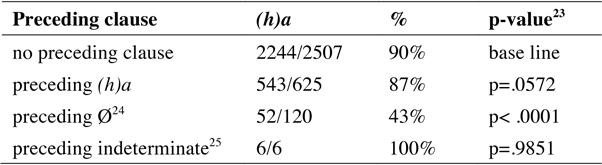
I have replicated this method of investigating the effect of syntactic priming for all of the informants of dJdJ. In table 11, the rate of occurrence of overt pasts in Negerhollands is compared in two types of environment: in clauses preceded by other clauses (within the same sentence) and in clauses not preceded by other clauses.
Syntactic priming effect on the expression of past time reference in the preceding clause within the same sentence.
The results obtained in the course of the present study of Negerhollands indicate that the frequency of overt pasts in clauses preceded by a clause containing (h)a, as in 12, does not differ from that in initial clauses or noncomplex sentences, with p=.0572.
(12)
By contrast, the effect of syntactic priming is clearly visible when the preceding or priming clause in a complex sentence is not marked for past time reference, as in 13b: In this context, zero pasts are even more frequent than overt pasts in the target clause (see table 11 above).
(13)
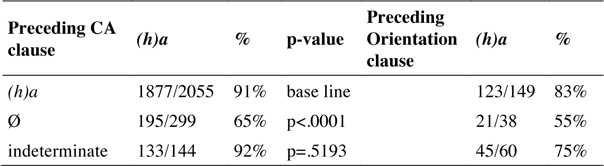
Apart from clauses within the same sentence, syntactic priming has been attested in different CA clauses in Standard English and Bahamian Creole English (Schiffrin Reference Schiffrin1981:51 and Hackert Reference Hackert2004:190, respectively). However, studies such as Scherre & Naro Reference Scherre and Naro1991 have shown that the syntactic priming effect holds in many different linguistic environments. Therefore, one would expect the effect of syntactic priming not to be confined to narrative clauses. In principle, one would expect any sentence, not only a CA clause, to exert a priming effect onto the following sentence. Table 12 shows that orientation clauses cause as much an effect of syntactic priming as CA clauses. Thus, in the analysis outlined below, I include the factor preceding sentence and examine the syntactic priming effect of the preceding CA and orientation clause.
Syntactic priming effect on the expression of past time reference.Footnote 26
So far, I have shown that the syntactic priming effect holds between clauses within the same sentence (table 11), and also between adjacent sentences, regardless of whether they contain CA or orientation clauses (table 12). The next logical step is to see if the priming effect would surface in a clause that does not immediately follow the “priming” clause. The finding that “priming is in fact long-lasting” (Gries Reference Gries2005: 374) predicts that this is indeed the case. Gries studies the alternation between bare indirect objects and prepositional objects, a variable that, unlike time reference marking, does not necessarily occur in every clause. He finds that the priming effect holds with as many as twenty-five intervening clauses.
In the case of past marking in narratives, one expects the variable to occur in every clause, with the exception of intervening direct and indirect speech, relative clauses, and the occasional clause without absolute past time reference, where the variable may occur as well, but in a different function. Although one can expect the priming effect to hold in nonadjacent clauses, every following clause with a different past marker may override the priming effect of the preceding marking. Thus, one can expect the priming effect of past markers to be more short-term.
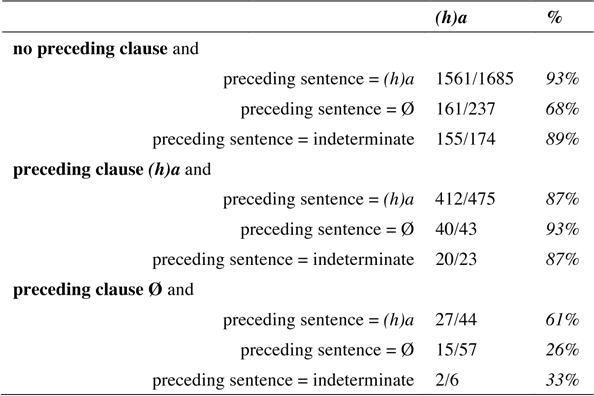
I have explored the question of whether the priming effect would hold in nonadjacent clauses by investigating whether there is an interaction between the factors preceding clause, which involves the marker in the preceding clause within the same sentence, as in 12 and 13, and preceding sentence, which involves the marker in a CA or orientation clause within a preceding sentence. As expected, there is indeed an interaction between these two factors.
First, consider the priming effect in the absence of an immediately preceding clause, that is, in adjacent simple sentences and sentence-initial clauses. When a CA or orientation clause within the priming sentence contains no past time reference marking, the occurrence rate of overt past marking within the target sentence decreases significantly, going from 83% to 67%. In contrast, when the priming sentence contains an overt past, 92% of the target sentences contain overt past marking. This is illustrated in 14: the priming CA clause in 14a, Am see, does not contain a past marker. The sentence-initial target clause in 14b, Sini see, is also unmarked for past time reference.
(14)
Second, when the priming clause within the same sentence does not contain a past time reference marker, the target clause is less likely to contain an overt past (41% overall, that is, the mean of 61%, 26%, and 33% in table 13) than when the priming clause contains (h)a (87%), regardless of the marking in the preceding sentence. Yet when there is no past marker in the preceding sentence either, as in 15c or 15d, the occurrence rate of overt past marking in the target clause drops even lower, to 26%.
(15)
Third, it seems that when the preceding clause contains (h)a, the target clause is most likely to contain (h)a as well, regardless of the past marking in the preceding sentence. This is illustrated in 16: target clause 16c contains a, and so does preceding clause 16b, despite the fact that the preceding sentence 16a contains a zero past.
(16)
These observations are summarized in table 13.
The interaction between the effects of the expression of past time reference.
Sabino (Reference Sabino1986:62) explains the variation in past time reference marking in Negerhollands by attributing it to the interaction between the following two principles: First, past time reference is overtly expressed when not redundant (the functional hypothesis; concurring with Graves Reference Graves1977:146–147). Second, in a complex sentence, the expression of past time reference in the first clause affects the expression of past time reference in the following clause (the principle of concord, or syntactic priming, as it is referred to in the current paper).
While the significance of syntactic priming is uncontested, a more nuanced approach to the data reveals that the functional hypothesis cannot in fact account for the high occurrence rate of overt pasts in initial clauses and simple sentences.Footnote 27 First, the functional hypothesis predicts that when time reference is redundant, it is not overtly expressed. Additionally, Sabino (Reference Sabino1986) assumes syntactic priming to set in where possible. However, the presence of a temporal adverbial, which makes an overt past redundant, has no effect on the absence or presence of overt pasts whatsoever, as shown in table 14.
The interaction between temporal adverbials and past time reference marking.

Even in initial clauses and simple sentences, where the functional hypothesis cannot be overruled by the concord effect, the presence of temporal adverbials has no significant effect, as shown in table 15 below.
Another context where past time reference marking can be argued to be redundant is the CA section of a narrative, which has past time reference by default (Tagliamonte & Poplack Reference Tagliamonte and Poplack1993:90). I have shown in section 4.3 that in Negerhollands, the CA section is precisely the context where the rate of overt pasts is the highest. The functional hypothesis cannot even be upheld, when I restrict functional occurrence of (h)a to the first occurrence in a CA section.Footnote 28 The first narrative clause of a CA section is no more likely to contain an overt past than any other narrative clause, as shown in table 16 below.
The interaction between temporal adverbials and past time reference marking in initial clauses.

Expression of past time reference according to position in the CA section.
Thus, it is clear that overt past time reference marking in Negerhollands is not functional, in the sense that it does not serve for temporal disambiguation; neither are past markers absent when past time reference has already been established. Rather, I assume that the high occurrence rate of overt pasts stems from its functional transparency. I propose the rule in 17 for 20th-century Negerhollands.
(17)
To describe situations in the past, past marker (h)a is preferred.
This rule can account for every occurrence of (h)a whenever the verb has past time reference. When one assumes the overt past to be the default, only the occurrence of unmarked pasts needs to be explained.
5. Discussion
5.1. Sociolectal Differences
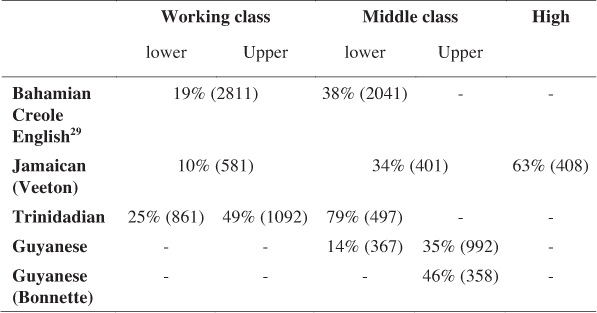
Table 17 (adapted from Patrick Reference Patrick1999:245) shows that the rate of overt past time reference marking in creole languages tends to be higher in varieties associated with higher social status. Thus, the languages in table 17 show some correlation between adjustment toward (a local variety of) Standard English and a higher occurrence rate of overt (or in the case of CECs as well: inflectional) past marking (for example, Winford Reference Winford1992: 335, Hackert Reference Hackert2004:212–213). Nevertheless, the base line varies considerably among the various languages. Strikingly, most creoles listed in table 17 show a lower rate of overt past time reference marking in their highest sociolectal varieties reported than does Negerhollands in contexts where the occurrence rate of the past marker is low compared to the Negerhollands overall average (see, for example, sections 4.1 and 4.3). This is remarkable, since dJdJ's Negerhollands informants probably belong to a working class, and some perhaps to a lower middle class.
Inflection rates of 4 creoles according to social class (in part adapted from Patrick Reference Patrick1999:245).
Negerhollands used to be spoken in the 18th century by colonists of European descent too. They spoke a variety of Negerhollands which has been referred to as Hoch Kreol in Pontoppidan 1881, a term adopted in Sabino Reference Sabino1990, Reference Sabino2012. Native German and Danish missionaries constitute another group of Negerhollands users. They have written many works in the language in which they almost invariably use a past marker to mark past time reference. This variety is referred to as Liturgical Creole in Sabino Reference Sabino1990, Reference Sabino1996, Reference Sabino2012.Footnote 30 The German speaking Moravian missionaries used the form a, while the Danish missionaries used ha. The only source written by a representative of the colonial society is Magens Reference Magens1770 grammar containing everyday life dialogues. As table 17 shows, past time reference marking is almost exclusively marked with ha. The only unmarked occurrence is in the construction wat maek ‘why’:
(18)
Either wat maek is the unanalyzable question word why, which means that example 18 contains a zero copula, or the verb maek is unmarked for past time reference. In any case, ha is in variation with perfect marker ka—a context excluded from this study—and not with a zero past in Magens Reference Magens1770.
The expression of past tense reference in Magens's (Reference Magens1770) Hoch Kreol dialogues.

The 20th-century Negerhollands speakers who provided the data for the current study are descendants of the 18th-century enslaved population of the Virgin Islands. As such, their language represents a different variety of Negerhollands than Magens's (Reference Magens1770) Hoch Kreol and the missionaries’ Liturgical Creole. Nevertheless, some of these speakers’ ancestors may have adjusted their speech toward Hoch Kreol or the missionaries’ Negerhollands. On the basis of the phonological structures he uses (Sabino Reference Sabino1990:154), and the content of his narratives (Sabino Reference Sabino1996:56), informant 2 can be identified as least conservative of dJdJ informants. He says that his father was an overseer on a plantation, which was probably run by Moravian missionaries (dJdJ:25–26). This suggests that informant 2 has had access to the missionaries’ variety of the creole, Liturgical Creole, while his father must have had a higher status than a common plantation laborer. Remarkably, table 19 shows that it is exactly this least conservative speaker, informant 2, who has the lowest overall rate of overt pasts: 75%.
Knowledge of Liturgical Creole has also been suspected in case of informant 9 on the basis of phonological characteristics and other unspecified reasons (Sabino Reference Sabino1996:56). One of these reasons may have been the biblical content of one of his stories. However, informant 9 does not pattern with informant 2, nor with informant 8, whose phonological features seem to be similar to those of informant 9.
Thus, informant's 2 relatively lower rate of overt past seems to suggest that among Negerhollands speakers, overt past was not associated with higher social status, as opposed to, perhaps, phonological features such as maintenance of word-final consonants and consonant clusters. In contrast, the frequency of use of (h)a may not have been so easy to adjust consciously. The biggest challenge is that very little is known about the informants, sociolinguistic variation and the values assigned to it, and the informants’ social aspirations.Footnote 31 As a consequence, one cannot do much more than observe that there does not seem to be a correlation between the rate of overt past and the phonological hierarchy presented in table 19.
dJdJ five most contributing informants plus informant 2.
5.2. Effects of Language Obsolescence
By the 1970s, there were only six speakers of Negerhollands left. In 1987, the last speaker died. In this section, I discuss the possibility that the high rate of overt past time reference marking in Negerhollands was due to LANGUAGE DEATH, or OBSOLESCENCE. Campbell & Muntzel Reference Campbell, Muntzel and Dorian1989 distinguish four types of language death scenarios. The most common type of language death is applicable to Negerhollands: “gradual death, the loss of a language due to gradual shift to the dominant language in language-contact situations” (Campbell & Muntzel Reference Campbell, Muntzel and Dorian1989:185). Over time, Negerhollands became obsolete, because its speakers shifted to English and English Creole. All of the de Josselin de Jong's (Reference de Jong and Benjamin de1926) informants—born between 1841 and 1863—were bilingual in English and/or English Creole, which was/were their main language(s) of use. de Josselin de Jong (Reference de Jong and Jan1924:15–16) confidently states that people from younger generations knew only a few jokingly used words and expressions in Negerhollands. The fact that all the informants in that study were fully bilingual clearly shows that bilingualism between English and/or English Creole and Dutch Creole on the Virgin Islands established in the first half of the 19th century at the latest.Footnote 33 The decrease in use of Negerhollands was already noticed at that time. For example, in 1839, the Moravians adopted English instead of Negerhollands for their sermons and slightly later abandoned Negerhollands altogether in their religious services (van Rossem & van der Voort Reference Cefas van and van der Voort1996:32).
Within a gradual death scenario, a language is typically affected by language ATTRITION, characterized as the “gradual transformation and decay of a language in a community undergoing language shift” (Muysken Reference Muysken2008:143). Although the manifestation of language attrition varies from language to language depending on the contact setting and the language's features, some specific patterns have been attested. Language attrition may affect syntax in causing overgeneralization of patterns, and loss of grammatical devices and syntactic resources (Muysken Reference Muysken2008:144). Overgeneralization is addressed in Andersen Reference Andersen, Lambert and Freed1982, who predicts that SEMI-SPEAKERS “will preserve and overuse syntactic constructions that more transparently reflect the underlying semantic and syntactic relations” (p. 99).
Similarly, Elordui (Reference Elordui2003:16–19) finds that less fluent speakers of Basque overgeneralize existing structures in cases where more fluent speakers would not use them. Similar effects are also attested in heritage language speakers, where less fluent (also more insecure) speakers have been found to prefer overt or more explicit forms (for example, Polinsky Reference Polinksy2006:244) to increase the likelihood of their message coming through properly. In the heritage language literature this is referred to as the EXPLICITNESS HYPOTHESIS (for example, Aalberse & Muysken Reference Aalberse and Muysken2013:16). On a related but different note, Meyerhoff & Walker (Reference Meyerhoff2007) find that speakers who moved outside of their language community for a prolonged period used zero copulas less frequently, but the linguistic constraints had hardly altered.
Now, the question needs to be addressed how fluent dJdJ's informants were. Semispeakers speak the language “with varying degrees of less than full fluency, and their grammar (and usually also their phonology) is markedly aberrant in terms of the fluent speaker norm” (Dorian Reference Dorian1981:107). In the case of 20th-century Negerhollands it is not a priori clear who are the most fluent speakers and who represent the semispeakers. The last speaker of Negerhollands, Mrs. Alice Stevens, has been shown to be a fluent speaker of Negerhollands (Sabino Reference Sabino1990: 65–66, Reference Sabino1994:500–501). Although there is hardly any background information available on dJdJ's informants, they are described as faithful to Negerhollands despite the fact that English and/or English/Creole was or had become their dominant language (de Josselin de Jong Reference de Jong and Jan1924:16). Guirty (Reference Guirty1989:6, cited in Sabino Reference Sabino2012:72), born in 1906 on St. Thomas, confirms that “there was a fair number of men and women who spoke Dutch Creole…” in the 1920s. Thus, there must have been Negerhollands-speaking networks in the rural areas of both St. Thomas and St. John, giving dJdJ's informants an opportunity to speak the language with their contemporaries, thereby retaining fluency.Footnote 34
Nevertheless, King (Reference King and Dorian1989) has shown that fully fluent speakers of a dying language may exhibit in their speech signs of language obsolescence. This is also true for dJdJ's informants. For example, LEXICAL FADING—the loss of lexical items that may result in the disappearance of phonological contrasts—strongly decreased the occurrence of certain phonological minimal pairs to such an extent that some minimal pairs were no longer attested within the speech of one individual, but only at the level of the community (Sabino Reference Sabino1994:520). Furthermore, BORROWING of lexical items and CALQUING of phrases and grammatical and lexical constructions was frequent, although not overwhelming.35 What is particularly interesting is that occasionally, even functional items such as pronouns were borrowed (English he would be used instead of Negerhollands am). In mi sa bidraag miself leik a gentleman ‘I will behave like a gentleman’, the English noun phrase containing the English article a instead of Negerhollands een may be a case of code switching. At the same time, the last fluent speakers preserved Negerhollands phonology (Sabino Reference Sabino1990). Thus, though certain signs of language death are clearly observable in 20th-century Negerhollands, the language does not seem to have been strongly affected.
The unmarked verb is associated with the expression of perfective aspect in Caribbean English-lexified Creoles (Winford Reference Winford1993:38), and alternates with ANTERIOR (markers of relative time reference) markers in Caribbean creoles in general (Holm 1988:149). By contrast, the picture seems to be rather complicated in Dutch-lexified creoles and Papiamentu, a creole spoken in a Dutch colony. Past perfective situations are described with the past perfective marker a in Papiamentu (for example, Maurer 1988:107ff) and with the perfective marker -tɛ in moribund Berbice Dutch (Kouwenberg Reference Kouwenberg1994:62). While past perfective situations are occasionally described without -tɛ (Kouwenberg Reference Kouwenberg1994:67), the past marker wa “cannot appear with a perfective verb form unless to create an Anterior” (Kouwenberg Reference Kouwenberg1994:65), and as such seems generally restricted to past imperfective situations. Kouwenberg (Reference Kouwenberg1994:66) reports zero pasts to occur in the “foreground,” which is here the same as the complicated action section of a narrative. However, this situation is not straightforwardly comparable to the Negerhollands situation, because one may wonder whether wa may actually occur in the foreground in the absence of perfective -tɛ, or whether a zero past in the CA section is, in fact, a zero perfective. This description of Berbice Dutch leads one to conclude that zero imperfective pasts are rare, while it is unknown whether zero perfective pasts are less frequent in Berbice Dutch than in Negerhollands.
In the case of Papiamentu, contrary to more formal registers, colloquial, conservative Papiamentu seems to make much use of zero pasts (Andersen Reference Andersen and Singler1990:78ff). Unfortunately, Andersen Reference Andersen and Singler1990 does not include any counts, so it is unknown how the use of zero pasts is actually distributed in Papiamentu. Overall Andersen's examples suggest that zero pasts mainly occur with past imperfective predicates (for example, those containing imperfective ta) and past statives. Thus, in Papiamentu zero past seems to be in variation with the past imperfective marker tabata rather than with the past perfective marker a. A variation analysis of colloquial Papiamentu is required to see whether this is in fact the case.Footnote 36
More formal varieties of Papiamentu are implicitly asserted to contain few if any zero pasts, although this is attributed to influence of Spanish, Dutch, or English through multilingual Papiamentu speakers (Andersen Reference Andersen and Singler1990:68) receiving school education in Dutch (Andersen Reference Andersen and Singler1990:91, note 3). Thus, Berbice Dutch and Papiamentu differ from Negerhollands in having an overt (past) perfective marker. Conservative Papiamentu seems to be similar to Negerhollands in using zero pasts most frequently in past imperfective situations, while Berbice Dutch seems to allow only overt imperfective pasts. Like Afrikaans, Berbice Dutch has been said to have lower overall rates of overt past time reference than Negerhollands (Bruyn & Veenstra Reference Bruyn and Tonjes1993:40–41).
The distribution of the various markers (including zero) in predicates with past time reference has not been extensively investigated in Berbice Dutch, Afrikaans, and Papiamentu. Yet the findings so far indicate that although Negerhollands is a Dutch-lexified rather than an English-lexified creole, this alone cannot explain the differences between Negerhollands and the CECs discussed. This in itself is not surprising, since these Dutch-lexified creoles and Afrikaans all have a different history of creation and development.
The assumption that in the formative period of Negerhollands, a perfective marker rather than a past marker emerged (just as in the English-lexified creoles) is not unreasonable, given the prominence of aspect in the West-African Kwa-languages, Negerhollands’ most important substrate languages. The assumption that the perfective marker was associated with the unmarked verb is reasonable, given how the perfective is encoded in the various Kwa-languages: Ewe and Dangme use an unmarked form of the verb for the perfective (Ameka & Kropp Dakubu Reference Ameka and Dakubu2008:216), Akan uses lengthening of the final vowel or consonant with or without a change in tone (Osam Reference Osam2008:75), while Ga has a tonal feature to mark perfective (Kropp Dakubu Reference Dakubu and Esther2008:96–97). Assuming that (h)a was associated with absolute past time reference, it is easy to imagine a scenario in which a zero perfective alternating with an overt past becomes reanalyzed as a zero past. The differences between the various creoles might result from the rate at which a (absolute) past tense marker was introduced into the TMA system.
The question is why the unmarked form would be relatively disfavored in past perfective situations. In fact, this is what Winford found in Trinidadian English (Reference Winford1992:338), too: First, (zero) perfective is also used to mark habituals; second, varieties of the creole closer to the regional standard of English are characterized by an increase in past marking, particularly in perfective contexts, while zero is better preserved in habitual contexts.
This scenario is in part tenable for Bahamian Creole English, too. Hackert (Reference Hackert2004:170) divides her informants into three groups (high, mid, and low) based on linguistic features.Footnote 37 In her study, speakers in the high group (lower middle class) used overt perfective pasts significantly more often (60%) than the speakers in the two lower groups, mid and low: 28% and 18%, respectively. However, they did not use overt habitual pasts significantly more often than the speakers in the mid group (28% versus 26%), and they did not proportionally increase the use of overt habitual pasts compared to the low group (10%; Hackert Reference Hackert2004:170). Perhaps, this tendency is simply attributable to the fact that perfective past situations are the prototypical past situations (Bybee et al. Reference Bybee, Perkins and Pagliuca1994:153).
There is yet another possible scenario, probably more in line with the actual attested data. Akan, one of Negerhollands assumed substrate languages, makes use of a perfective past marker that “cannot encode events that are located prior to the time of speech but which are imperfective” (Osam Reference Osam2008:85). Osam's (Reference Osam2008:84) examples are reproduced below as 19a–c.
(19)
If Negerhollands (h)a was associated for native Akan speakers with their perfective past marker, perfective situations were likely to have been the most natural context for Negerhollands (h)a from the start, while past imperfective situations were initially unmarked. At some point, Negerhollands (h)a developed into a true absolute past marker, but the preference for its use in perfective situations can possibly reflect an old distributional pattern attributable to Akan substrate influence. Sankoff (Reference Sankoff1990) states that “[v]erbs occurring with no tense markers […] constitute the historical residue of an earlier stage of the languages in which tense marking of the superstrate languages had not been transmitted and the creole markers had not yet evolved” (Reference Sankoff1990:295). In this scenario, this would account for the occasional use of zero pasts in perfective situations.
The question of how Berbice Dutch and Papiamentu unmarked verbs are used to convey absolute past time reference is subject for further research. The 20th-century situation suggests that unmarked pasts were probably never as predominant in Negerhollands, Berbice Dutch, and Papiamentu, as they were/are in the CECs. This might be because all three have an absolute tense system, while Afrikaans—the only Dutch variety discussed in this paper, which has an absolute tense system and is not a creole—is said to have high rates of zero pasts as well (Donaldson Reference Donaldson1993:228–230).Footnote 38 A quantitative variation analysis of the relevant data from these languages would yield more concrete results and enable to draw a more precise picture of how the zero past in these languages relates to the Negerhollands zero past. At least in the case of Negerhollands, one can suppose that Akan, as a substrate, influenced the marking of past time reference. Thus, it would be premature to conclude that the high frequency of occurrence of overt pasts in Negerhollands is due to language obsolescence.
6. Conclusion
This paper has shown that the expression of past time reference in Negerhollands differs crucially from that in other creole languages. Whereas Caribbean English creoles typically use zero pasts, 20th-century Negerhollands shows a strong preference for overt pasts. The different past marking behavior found in different narrative sections is probably due to the functional similarities between specific aspectual types. Perfective clauses, which constitute the majority of narrative clauses, contain the highest number of overt pasts, while progressive and habitual clauses contain zero pasts significantly more often. Low rates of zero pasts in imperfective clauses in Caribbean English-lexified creoles have been attributed to an inherent semantic feature of imperfective situations that makes it less necessary for them to be overtly marked for past time reference (for example, Winford Reference Winford1993:36, Hackert Reference Hackert2004:171). Also, this universal feature may have played a role in the distributional patterns of 20th-century Negerhollands (h)a, and the substrate influence of the Akan past perfective is also a likely source.
The high overall rate of overt pasts makes Negerhollands differ considerably from Caribbean English-lexified creoles. However, Berbice Dutch, another Dutch-lexified creole, and Papiamentu also seem to have high rates of overt pasts. These three creoles differ from the Caribbean English-lexified creoles in having an absolute, rather than a relative time reference system. Despite this similarity, there are also differences between the TMA categories of these three creoles, which may affect the use of zero pasts. A quantitative investigation of the use of zero pasts in Berbice Dutch, colloquial Papiamentu, and other creoles with an absolute time reference system, and their relation to relevant substrate categories would help understand the distributional patterns of zero pasts.