Introduction
Nasal dilators are commonly used as a non-invasive treatment for snoring, nasal valve disorders and general nasal obstruction.Reference Lindemann, Tsakiropoulou, Keck, Leiacker, Vital and Wiesmiller1 Although designs may vary, their general mechanism of action is thought to be through the widening and stiffening of the nasal valves.Reference Ellegard2
The internal nasal valve is situated obliquely in the sagittal plane. It is bounded laterally by the caudal end of the upper lateral cartilage, medially by the septum and ventrally by the inferior rim of the piriform aperture.Reference Tarabichi and Fanous3 It has the smallest cross-sectional area of the upper airway, contributing to approximately half of the airflow resistance on resting breathing.Reference Roithmann, Chapnik, Zamel, Barreto and Cole4 The external nasal valve is bounded medially by the caudal nasal septum and medial crus of the lower lateral cartilage, and laterally by the lateral crus of the lower lateral cartilage and the alar rim, with a floor consisting of the nasal sill and medial footplate of the lower lateral cartilage. This valve can occasionally have the narrowest area in patients with external nasal valve stenosis and collapse.
Nasal dilator strips are postulated to decrease this source of resistance by expanding the external valve for air intake and preventing its collapse during pressure changes.Reference Ellegard2, Reference Griffin, Hunter, Ferguson and Sillers5 The effect of dilator strips on nasal geometries and resistances has been demonstrated in the literature,Reference Lindemann, Tsakiropoulou, Keck, Leiacker, Vital and Wiesmiller1, Reference Ellegard2, Reference Roithmann, Chapnik, Zamel, Barreto and Cole4, Reference Gosepath, Mann and Amedee6–Reference Ng, Mamikoglu, Ahmed and Corey8 as have their effects on symptoms of congestion.Reference Latte and Taverner9, Reference Peltonen, Vento, Simola and Malmberg10 However, it has been suggested that differences in nasal proportions between races can influence the effectiveness of dilator strips.Reference Burres11
This study examined the effectiveness of two types of nasal dilator strips on nasal breathing, and assessed the variation in effectiveness between races. Both types of strip comprise an adhesive strip with plastic splints. They are intended to be affixed at the junction of the lateral nasal cartilages. When the splints are applied, their outward pulling force on the lateral wall of the nose provides the widening and stiffening effect described above.Reference Latte and Taverner9
Materials and methods
Baseline measurements were recorded and the two nasal dilator strip types were tested successively in a single session on Caucasian and Asian subjects. All procedures contributing to this work complied with Australian guidelines on human experimentation and with the Helsinki Declaration of 1975, as revised in 2008.
Study population
Normal, healthy, non-smoking volunteers were recruited. All subjects were 18 years or older, and had no history of sinonasal conditions, deformities, obstructions or surgeries. Subjects were not taking medications affecting the nose at the time of the study.
External nasal dilators
A prototype strip (ENT) [to our knowledge, these strips have not been commercially produced] and a GSK Breathe Right strip (GlaxoSmithKline, Brentford, UK) were used. Both dilator strips are designed to be affixed superior to the alar cartilages, at the junction of the lateral nasal cartilages. The ENT dilator strip consists of a single plastic adhesive strip with a single plastic splint running along the length of the strip. The Breathe Right dilator strip consists of a single plastic adhesive strip with two plastic splints running in parallel along the length of the strip. The latter provides approximately 25 g of force to open the nasal passages.Reference Portugal, Mehta, Smith, Sabnani and Matava12
Outcome measures
The objective outcome measures were: nasal peak inspiratory flow, nasal airway resistance in individual nasal cavities, total nasal airway resistance, minimum cross-sectional area in individual nasal cavities and total nasal airway minimum cross-sectional area. Subject-reported nasal obstruction outcomes were measured using a visual analogue scale (VAS). Measurements were taken at baseline and following the application of each strip.
Nasal peak inspiratory flow
Nasal peak inspiratory flow is a non-invasive, physiological measurement of nasal airflow recorded in litres per minute. This measure is particularly sensitive to nasal valve collapse.Reference Timperley, Stow, Srubiski, Harvey and Marcells13 In this study, nasal peak inspiratory flow was measured with an In-Check inspiratory flow meter (AllianceTech Medical, Granbury, Texas, USA) with an attached anaesthetic mask. Once a good seal had been established, the subject was instructed to make a maximal inspiratory effort with the mouth closed. The best of three attempts was recorded as the nasal peak inspiratory flow.Reference Jones, Viani, Phillips and Charters14
Nasal airway resistance
Nasal airway resistance was measured via active anterior rhinomanometry at transnasal pressure of 150 Pa, using an NR6 Acoustic Rhinomanometer (GM Instruments, Kilwinning, Scotland, UK). Active anterior rhinomanometry records nasal airflow in cubic centimetres per second with reference to the transnasal pressure, and is expressed as the difference between atmospheric pressure and the relative pressure in the nasopharynx.Reference Gosepath, Mann and Amedee6 Nasal airway resistance is calculated by dividing the transnasal pressure by the flow.15 Measurements were carried out as per the manufacturer's instructions; care was taken to calibrate the device prior to each measurement.15
Minimum cross-sectional area
Minimum cross-sectional area was determined via acoustic rhinometry using an A1 Acoustic Rhinometer (GM Instruments). In acoustic rhinometry, an acoustic signal is emitted into the nostril and its reflections detected by a microphone in the measuring device. These data are then processed by an attached computer to determine the cross-sectional area of portions of the nasal cavity.Reference Gosepath, Mann and Amedee6 In this study, the probe was held and controlled by a trained operator, and subjects were instructed to hold their breath as measurements were taken. Total minimum cross-sectional area was calculated as the summation of areas from both nasal cavities.
Subjective airflow measurement
Subjective, self-reported nasal obstruction scores were obtained using a 100 mm VAS. Subjects were asked to assess the nasal obstruction in each nostril and mark their response on a line anchored by the descriptors ‘not blocked at all’ (0 mm) and ‘as badly blocked as can be’ (100 mm). This assessment was conducted at baseline and after each dilator strip application, prior to objective testing. The subjective nasal obstruction score for breathing through both nostrils was calculated in terms of the mean score of the left and right nasal cavities.
At the conclusion of testing, the subjects were asked to decide whether the ENT dilator strip or the Breathe Right dilator strip improved their breathing more, or whether there was no difference between them.
Statistical analysis
Nasal peak inspiratory flow and minimum cross-sectional area data were analysed parametrically. Nasal airway resistance and VAS scores were analysed non-parametrically, and expressed as medians with interquartile ranges.
Baseline differences in nasal peak inspiratory flow and minimum cross-sectional area between Caucasian and Asian subjects were analysed using the independent samples t-test. Differences in VAS scores and nasal airway resistance were analysed using the independent samples Mann–Whitney U test.
Comparisons between the interventions and baseline for VAS scores and nasal airway resistance were conducted using Friedman's two-way analysis of variance by ranks (for related samples). Improvements in nasal peak inspiratory flow and minimum cross-sectional area between each dilator strip and baseline were analysed using the paired samples t-test. The related-samples Wilcoxon signed rank test was used to assess improvements in VAS scores and nasal airway resistance.
Improvements in nasal peak inspiratory flow and minimum cross-sectional area on dilator strip application between races were analysed using the independent samples t-test. The independent samples Mann–Whitney U test was used to assess VAS scores and nasal airway resistance.
Subject-reported strip preference was analysed using the chi-square test.
Although each nasal cavity is co-dependent and formed from the same piriform aperture, they each have their own unique anatomy and are independently affected by nasal obstructions. Therefore, end outcomes were assessed both in terms of the total nasal airway and individual nasal cavities.
Results
Baseline assessment
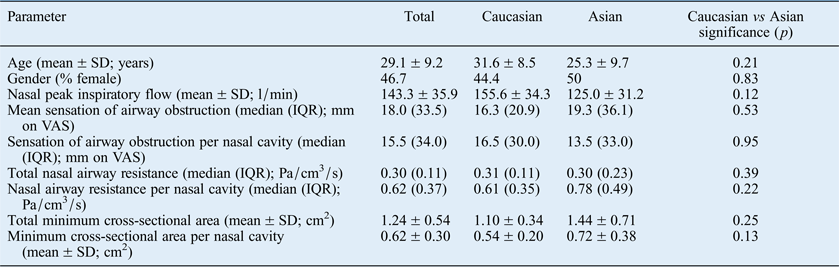
Fifteen subjects were recruited for this study (seven females (46.7 per cent) and eight males), with a mean age of 29.1 ± 9.2 years (range of 20–49 years). Nine subjects were of Caucasian descent (60.0 per cent) and six were of Asian descent. Baseline characteristics for the total group and each race individually are shown in Table I. The analyses revealed no significant differences between the cohorts for any of the outcome measures at baseline.
Baseline characteristics

There were no significant differences in the studied outcomes as measured at baseline. SD = standard deviation; l/min = litres per minute; IQR = interquartile range; VAS = visual analogue scale
Overall efficacy of nasal strips
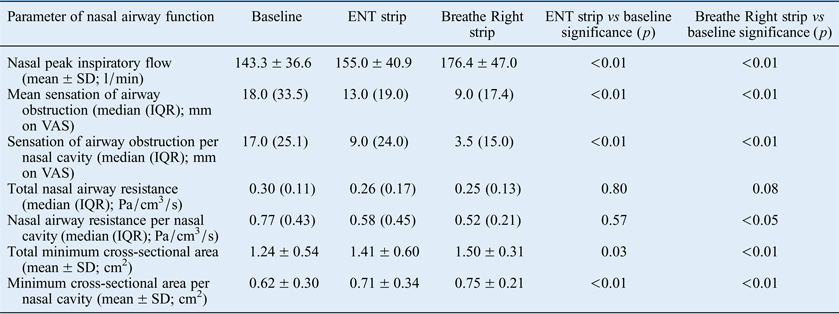
As a total cohort, without differentiation by race, both the ENT dilator strip and the Breathe Right dilator strip significantly improved nasal peak inspiratory flow compared with baseline. The ENT strip increased nasal peak inspiratory flow by a mean of 11.7 litres per minute (p < 0.01) and the Breathe Right strip increased nasal peak inspiratory flow by a mean of 33.1 litres per minute (p < 0.01). Minimum cross-sectional area in individual nasal cavities and total nasal airway minimum cross-sectional area were also significantly increased with both nasal dilator strips. Compared with baseline, the Breathe Right strip increased total nasal airway minimum cross-sectional area by a mean of 0.26 cm2 (p < 0.01) and the ENT strip increased the area by a mean of 0.17 cm2 (p = 0.03). Nasal airway resistance in individual nasal cavities was only observed to be significantly improved with application of the Breathe Right strip (p < 0.05) (Table II).
End outcomes by dilator strip compared with baseline
Both strip types yielded significant benefits in the total cohort in all measured outcomes of nasal airway function except for nasal airway resistance. The latter was only significantly improved in a cavity capacity with the Breathe Right strip. SD = standard deviation; l/min = litres per minute; IQR = interquartile range; VAS = visual analogue scale
Subject-reported VAS scores of nasal congestion were significantly decreased upon application of either nasal dilator strip (p < 0.01). All nine Caucasian subjects reported that the Breathe Right strip improved their breathing to a greater extent compared with the ENT dilator strip, with the six Asian subjects reporting no preference (p < 0.01).
Efficacy of nasal strips by race
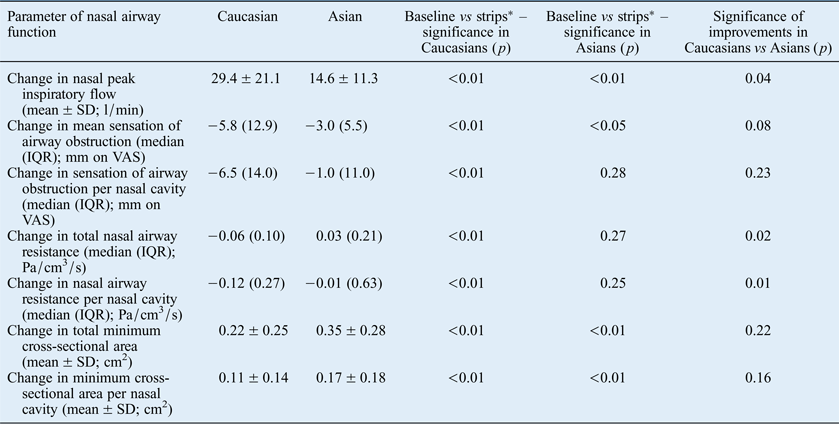
The application of a nasal dilator strip in Caucasian subjects resulted in significant improvements in all outcome measures (Table III). However, in Asian subjects, the application of a strip did not result in significant improvements in: nasal airway resistance in individual nasal cavities, total nasal airway resistance or VAS scores for individual nasal cavities.
Change scores by race
Caucasian subjects experienced significant improvements in all measured end outcomes with application of a nasal dilator strip. Nasal airway resistance and subjective sensation of nasal cavity obstruction were not significantly improved in Asian subjects. The differences in improvements rendered by the dilator strips between races were statistically significant in terms of nasal peak inspiratory flow and nasal airway resistance outcomes. *ENT dilator strip and Breathe Right dilator strip results combined. SD = standard deviation; l/min = litres per minute; IQR = interquartile range; VAS = visual analogue scale
With dilator strip application, the Caucasian subjects experienced a nasal peak inspiratory flow improvement two times that experienced by the Asian subjects (means of 29.4 litres per minute vs 14.6 litres per minute, respectively); this difference was observed to be statistically significant (p = 0.04).
In terms of total nasal airway resistance, Caucasian subjects experienced a significant median reduction of 0.06 Pa/cm3/s (p < 0.01). Caucasian subjects also experienced a significant reduction in median nasal airway resistance in individual nasal cavities of 0.12 Pa/cm3/s (p < 0.01). Changes in total nasal airway resistance and nasal airway resistance in individual nasal cavities in Asian subjects were not significant (p = 0.28 and p = 0.27 respectively). The observed differences between races in terms of the effects of dilator strips on total nasal airway resistance and nasal airway resistance in individual nasal cavities were statistically significant (p = 0.02 and p = 0.01 respectively).
Improvements in total nasal airway minimum cross-sectional area and minimum cross-sectional area in individual nasal cavities were greater among Asian subjects; however, the differences between races were not statistically significant.
Discussion
This study compared the effect of race on dilator strip effectiveness in terms of subjective and objective outcome measures of nasal function.
The results showed that both types of nasal dilator strip significantly improved nasal peak inspiratory flow, total nasal airway minimum cross-sectional area, minimum cross-sectional area in individual nasal cavities and VAS scores compared with baseline. Specifically, the Breathe Right dilator strip increased nasal peak inspiratory flow by a mean of 33.1 litres per minute (or 23 per cent) compared with baseline, whereas the ENT dilator strip increased nasal peak inspiratory flow by a mean of 11.7 litres per minute (or 8 per cent) compared with baseline.
Interracial differences in external nasal structure have been acknowledged in the literature. Caucasian noses are typically described as leptorrhine (narrow-nosed), Oriental noses are described as mesorrhine (medium-nosed) and African noses are described as platyrrhine (broad-nosed).Reference Leong and Eccles16, Reference Ohki, Naito and Cole17 Despite these external differences, a systematic review by Leong and Eccles suggested that the differences in nasal physiology are not clinically significant.Reference Leong and Eccles16 This is supported by the findings of the current study, as no statistically significant differences were observed between races in baseline measurements of nasal peak inspiratory flow, nasal airway resistance and minimum cross-sectional area.
Nevertheless, it was observed that Caucasian subjects had an increased response to nasal dilator strips compared with Asian subjects. There was a statistically significant median reduction in both total nasal airway resistance and nasal airway resistance in individual nasal cavities for Caucasian subjects, but not for Asian subjects. Furthermore, there was a significantly larger mean increase in nasal peak inspiratory flow for Caucasian subjects compared with Asian subjects (29.4 litres per minute vs 14.6 litres per minute respectively; p = 0.04) (Table III). Importantly, these improvements in nasal peak inspiratory flow reached clinically significant levels (>20 litres per minuteReference Timperley, Srubisky, Stow, Marcells and Harvey18) in Caucasian noses only.
Three mechanisms exist for the increased effectiveness of nasal dilator strips in Caucasian noses compared with that in Asian noses. Firstly, the outward pulling force exerted by the nasal dilator is provided by the angular deformation of the plastic splint in the stripReference Latte and Taverner9 and can be modelled in terms of Hooke's law. According to Hooke's law, the force exerted by a deformed solid is directly proportional to its angular deformation: F = kθ, wherein F = force, k = spring constant (determined by properties of the material) and θ = angular deformation.Reference Halliday, Resnick and Walker19 As the Caucasian leptorrhine nose has an inter-alar angle approximately 15° smaller than the mesorrhine Asian nose, 20 the nasal dilator strip will subsequently have a greater angular deformation when affixed to the narrower Caucasian nose. Thus in Caucasian noses, nasal strips will exert a correspondingly larger stenting and expanding force on the lateral nasal wall, leading to an increased effect. Secondly, the Asian subject typically exhibits a thicker skin envelope than the Caucasian subject.Reference Park, Kim, Hong and Lee21 This may decrease the compliance of the nose to the stenting and widening effect of nasal dilator strips, and thus the Caucasian subject will experience greater improvements than the Asian subject. Finally, although it has been shown that there is little difference in minimum cross-sectional area between ethnicities, a variation in internal anatomy between races has been demonstrated.Reference Leong and Eccles16 Specifically, there is a difference in the position of the minimum cross-sectional area.Reference Graamans22 As the nasal dilator strip provides a localised dilating effect, the relative positioning of the minimum cross-sectional area between races may cause dilator strips to miss areas of optimal effect in Asian subjects.
• It has been suggested that the effect of external nasal dilators may be lower in non-Caucasian subjects because of anthropological differences in external nasal proportions
• This hypothesis was tested in Asian and Caucasian subjects using objective and subjective outcome measures
• Caucasian subjects, but not Asian subjects, experienced a significant improvement in nasal airway resistance
• Caucasian subjects experienced a significantly larger improvement in nasal peak inspiratory flow with application of the nasal dilator strips compared with Asian subjects
A limitation of this study is the small population numbers. While not all parameters reached statistical significance, there were distinct differences in the examined constructs of nasal breathing, even in this small population group. Indeed, there was sufficient variation between the two races to support the conclusion of differential benefit obtained by the strips as a result of racial origin.
Conclusion
Significant improvements in nasal peak inspiratory flow, minimum cross-sectional area and subject-reported nasal obstruction sensation values were found with application of both the ENT prototype and Breathe Right nasal dilator strip types. However, only Caucasian subjects experienced a significant improvement in nasal airway resistance associated with the nasal dilator strips; Asian subjects experienced no significant improvement in nasal airway resistance. In addition, Caucasian subjects experienced a significantly greater improvement in nasal peak inspiratory flow with application of the nasal dilator strips compared with Asian subjects. Nasal peak inspiratory flow improvements only reached clinical significance in the Caucasian group. Further investigation may clarify the differences in the effectiveness of nasal dilator strips between races as experienced during different disease states.