INTRODUCTION
Currently there are about 130 known species of fish blood flukes (Aporocotylidae), all of which are internal parasites that infect the heart, gills, blood vessels, mesenteries and other sites of both freshwater and marine fishes (Smith, Reference Smith, Gibson, Jones and Bray2002). The aporocotylid life cycle requires that the eggs escape from the closed circulatory system where the flukes reside. In this process it is generally thought that the eggs pass to the gills from where the miracidia escape to the external environment; in a few species eggs probably traverse the gut or depend on the death of the host for release (Lester et al. Reference Lester, Rawlinson and Weaver2009; Bray et al. Reference Bray, Cribb and Littlewood2012). However, many eggs are caught in the circulatory system (Holzer et al. Reference Holzer, Montero, Repulles, Nolan, Sitja-Bobadilla, Alvarez-Pellitero, Zarza and Raga2008); as the eggs cannot escape from these sites, these trapped eggs eventually die and often become encapsulated. In this state, eggs may be slow to degrade and may persist for much, if not the entirety, of the fish's life (Lester et al. Reference Lester, Rawlinson and Weaver2009).
Butterflyfishes (Chaetodontidae) host a single nominal aporocotylid species, Cardicola chaetodontis Yamaguti, 1970. This species was originally reported from two species of Chaetodon from Hawaii (Yamaguti, Reference Yamaguti1970), and later from a further seven species of Chaetodon variously from the Great Barrier Reef, French Polynesia, New Caledonia and Palau (Nolan and Cribb, Reference Nolan and Cribb2006a). Based on findings of adult worms, Nolan and Cribb (Reference Nolan and Cribb2006a) mapped the host distribution of this species on a phylogeny of the Chaetodontidae derived from molecular studies by Littlewood et al. (Reference Littlewood, McDonald, Gill and Cribb2004), demonstrating an apparently haphazard distribution among species of Chaetodon.
The present study was prompted by the serendipitous discovery of aporocotylid eggs trapped in the hearts of several further Chaetodon species on the Great Barrier Reef. The goal of the study was thus to investigate the effectiveness of seeking evidence of past or present aporocotylid infection by looking for eggs trapped in the heart and gills and to determine the host range of C. chaetodontis in Chaetodontidae of the Great Barrier Reef.
MATERIALS AND METHODS
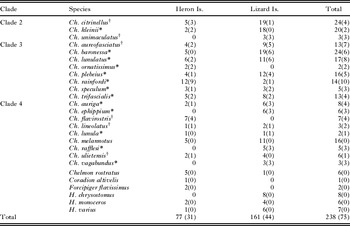
A total of 238 fish were collected by spear off Heron Island (23°27′S, 151°54′E) and Lizard Island (14°41′S, 145°27′E), between 2007 and 2012 (Table 1). Fishes were euthanized by cranial pithing. Hearts were investigated for aporocotylids by first removing them from the body and then examining them under a dissecting microscope in vertebrate saline (made from fresh seawater diluted to ∼8 ppt). In some, blood vessels in the gills were also examined by dissection. Adult flukes were heat fixed in near-boiling saline and preserved in 70% ethanol for either morphological or molecular analysis (Cribb and Bray, Reference Cribb and Bray2010). Gills were preserved in 80% ethanol for either morphological or molecular analysis.
Numbers of species of Chaetodon examined at Heron and Lizard Islands, with numbers of fishes found with Cardicola chaetodontis eggs in parentheses. New hosts of C. chaetodontis are marked with an asterisk (*), whilst species that were known hosts prior to this study are marked with a dagger (†)

Eggs were sought in tissues of the heart by roughly pulling the heart tissue apart with forceps, squashing portions (usually ultimately the entire heart) vigorously under a cover slip, and then examining them under a compound microscope. Photomicrographs of eggs were taken fresh in the field with a Nikon DS-Ril CCD digital camera mounted on an Olympus BH-2 compound microscope. Adult specimens for morphological examination were washed in fresh water, overstained in Mayer's haematoxylin, destained in a solution of 1% HCl (hydrochloric acid) and neutralized in 0·5% ammonium hydroxide solution. Specimens were then dehydrated in a graded ethanol series, cleared in methyl salicylate and mounted in Canada balsam. Gills preserved for morphological examination were dehydrated in a graded ethanol series, cleared in methyl salicylate and mounted on glass slides in Canada balsam, either as individual filaments or as complete sections of gill arches. The slides were examined using a compound microscope. Photomicrographs were taken using a SPOT Insight™ digital camera (Diagnostic Instruments, Inc.) mounted on an Olympus BH-2 compound microscope using SPOT™ imaging software.
The ITS2 rDNA region for the adult blood flukes recovered here was sequenced according to the protocols of Nolan and Cribb (Reference Nolan and Cribb2006a). rDNA was also extracted from gill tissue containing eggs of the putative Cardicola specimens and the ITS2 region sequenced according to the protocols of Nolan and Cribb (Reference Nolan and Cribb2006a). For these extractions approximately 10 gill filaments were removed from the gill arch and extracted in entirety using standard phenol-chloroform techniques (Sambrook and Russell, Reference Sambrook and Russell2001). To confirm the sequence identity of the putative Cardicola specimens recovered here, the sequences were aligned with other Cardicola spp. available on GenBank using MUSCLE version 3.7 (Edgar, Reference Edgar2004) with ClustalW sequence weighting and UPGMA clustering for iterations 1 and 2. The resultant alignments were then checked using MESQUITE (Maddison and Maddison, Reference Maddison and Maddison2009). Heart tissue containing eggs of the putative Cardicola specimens from five different infections was also extracted and attempts made to sequence the ITS2 rDNA region according to the protocols of Nolan and Cribb (Reference Nolan and Cribb2006a).
The classification of species of Indo-Pacific chaetodontids used in Table 1 was based on that of Fessler and Westneat (Reference Fessler and Westneat2007) and Bellwood et al. (Reference Bellwood, Klanten, Cowman, Pratchett, Konow and van Herwerden2010), with the addition of several species not explicitly mentioned by those studies derived from relationships inferred by Hsu et al. (Reference Hsu, Chen and Shao2007) and Littlewood et al. (Reference Littlewood, McDonald, Gill and Cribb2004).
Comparisons of prevalence were carried out using the unconditional exact test implemented in the software Quantitative Parasitology 3.0 (Rozsa et al. Reference Rozsa, Reiczigel and Majoros2000).
RESULTS
Adults
Four infections for a total of five adult Cardicola chaetodontis were found in 238 individual fish dissected (1·8%) – one in a Chaetodon kleinii from off Heron Island, three in two individuals of Chaetodon rainfordi from off Heron Island and one in a Chaetodon aureofasciatus from off Lizard Island. Two adults (one each from Ch. kleinii and Ch. rainfordi) were sequenced for ITS2 rDNA generating sequences identical to that of a sample identified as C. chaetodontis from Chaetodon unimaculatus, also from Heron Island, reported by Nolan and Cribb (Reference Nolan and Cribb2006a). The sequences are lodged in GenBank as JN418931 and JN418932. A single morphological voucher specimen of C. chaetodontis from Ch. rainfordi was lodged in the Queensland Museum (QM G232085).
Hearts
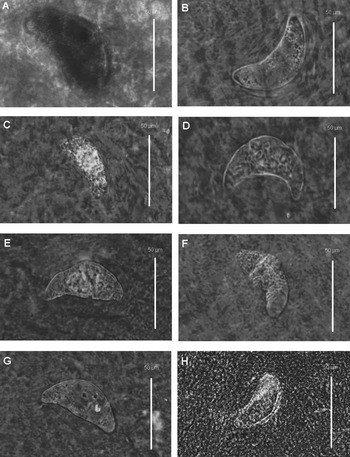
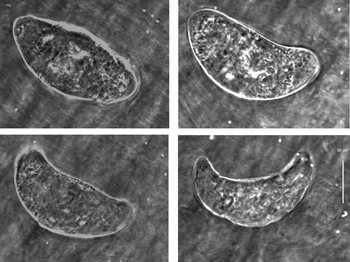
From 238 heart tissue samples we found 75 cases of trapped eggs in 19 species of Chaetodontidae for an overall prevalence of 31·5% (Table 1). Of the 75 infections, 31 were from Heron Island and 44 were from Lizard Island. There was no significant difference between the pooled prevalences for the two localities. No eggs were found in 30 individuals of six species of Chelmon, Coradion, Forcipiger and Heniochus. By contrast, distinctive crescent-shaped eggs were present in the hearts of 19 of the 20 species of Chaetodon examined; 13 of the 19 species were not previously known to harbour C. chaetodontis or any other aporocotylid fluke. The smallest individual fish in which eggs were found was a Chaetodon trifascialis with an LCF of 50 mm. Most infections were of one to many dead, degenerating eggs. In the heaviest infections, the presence of eggs could be easily predicted prior to dissection by the distinct flecked appearance of the heart. Live eggs, indicated by the presence of moving miracidia, were found in only 10 fishes, including the four animals in which live adult worms were found. The number of eggs ranged from just one to hundreds in a single heart. The four fish from which adult worms were found all had heavy infections in the heart. However, comparable heavy infections were found in several fish in which worms were not found. Numbers of recognizable trapped eggs were observed qualitatively to dwindle with the deterioration of their condition. In all cases, the eggs ranged from almost oval to (usually) strongly crescent-shaped, and were 40–60 μm in length (Fig. 1); a continuum of shapes could be observed in single infections (Fig. 2). In some cases, eggs were found encapsulated in groups (Fig. 3). In such cases the eggs had an especially degraded appearance.
Eggs of Cardicola chaetodontis trapped in the heart tissue of eight species of Chaetodon. (A) Ch. ornatissimus; (B) Ch. lunulatus; (C) Ch. plebeius; (D) Ch. rafflesi; (E) Ch. rainfordi; (F) Ch. speculum; (G) Ch. trifascialis; (H) Ch. vagabundus. All scale bars 50 μm.

Four eggs of Cardicola chaetodontis from the heart of one specimen of Chaetodon rafflesi, showing variability in shape. Scale bar 20 μm.

Eggs of Cardicola chaetodontis in the heart of Chaetodon rainfordi encapsulated in a group. Only one egg retains distinct crescent shape. Scale bar 75 μm.

Trapped eggs were completely lacking in one Chaetodon species (Ch. melannotus), Chelmon rostratus, Coradion altivelis, Forcipiger flavissimus and three Heniochus species (H. chrysostomus, H. monoceros and H. varius). When analysed by the unconditional exact test relative to the prevalence of eggs in infected Chaetodon species, the prevalence (absence) of eggs in Ch. melannotus was significant (P=<0·05) relative to those in Ch. aureofasciatus, Ch. baronessa, Ch. citrinellus, Ch. kleinii, Ch. lunulatus, Ch. plebeius, Ch. rainfordi and Ch. trifascialis. In addition, the lowest prevalences (e.g. Ch. kleinii, 2 of 20) were significantly different from the highest (e.g. Ch. rainfordi, 10 of 14) (P=0·0003). There was no evidence of seasonality in the presence of eggs; individuals of susceptible species were infected in samples collected from February to April and from September to November.
Attempts to extract and amplify the ITS2 rDNA region from putative Cardicola-infected heart tissue samples examined here failed, despite significant efforts being made to optimize the polymerase chain reaction, reagent and DNA template parameters.
Gills
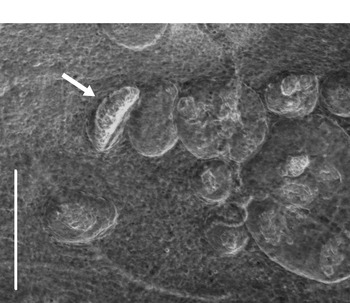
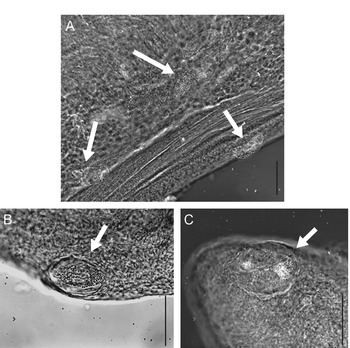
Gills from a total of 51 fishes were examined for eggs; in all cases the hearts of the fish had already been examined for adult worms and trapped eggs. Three types of observations were made; fish in which eggs were present in both hearts and gills (21 cases), fish in which eggs were present in the heart but not in the gills (13 cases), and fish that had no eggs anywhere (17 cases). There were no cases of eggs present in the gills but absent from the heart. Where eggs were present, they ranged in number from as few as one in 25 gill filaments (Ch. lunulatus) and three in 80 filaments (Ch. trifascialis) to as many as 360 in 20 filaments (Ch. speculum), 209 in 12 filaments (Ch. rainfordi) and 1043 in 25 filaments (Ch. unimaculatus). A full count of all the gills of an individual of Ch. rainfordi found 7640 eggs. The appearances of eggs in the gills (Fig. 4) matched that of those in the heart, except that dead, degenerating eggs were rarely observed; we observed no mis-formed eggs. In heavy infections, eggs were often dislodged from the surface of the gills (both fresh and fixed) during handling suggesting that they were being shed from the gills. Typically the eggs were scattered seemingly at random along the gill filaments but in one individual of Ch. plebeius they were noticeably concentrated at the tips of the filaments.
Eggs of Cardicola chaetodontis in the gills of Chaetodon rainfordi. (A) View of gill filament with eggs embedded within the lamellae; (B) and (C) Two views of eggs about to emerge from gill filament tips. In some instances (C), eggs about to hatch accumulated in aggregations. All scale bars 50 μm.

ITS2 rDNA sequences were generated from eggs lodged in gill tissue of five individual fish, all different species. The GA1-ITS2.2 primer combination proved specific enough to amplify only Cardicola genomic DNA from the Chaetodon gill extractions. Amplification of the ITS2 region was most successful for extractions from hosts with heavy infections or infections with moving miracidia. Sequences from eggs lodged in the gills were generated for infections from Ch. aureofasciatus, Ch. baronessa, Ch. lunulatus, Ch. plebeius and Ch. unimaculatus (all from Lizard Island); among these was the infection of Ch. plebeius in which the eggs were distinctly concentrated at the tips of the gill filaments. Three of the five sequences generated from trapped eggs were identical to that of the adult reported by Nolan and Cribb (Reference Nolan and Cribb2006a), whereas two sequences (from Ch. plebeius and Ch. unimaculatus) differed by a single base. This difference is a single Adenine–Guanine transition, located in position 87 of the ITS2 region. The sequences are lodged in GenBank as KF049000–KF049004.
DISCUSSION
We interpret all the adult worms and eggs reported here as belonging to C. chaetodontis. We make this identification based on a number of indications. In the first place the eggs are consistent with other aporocotylid eggs (e.g. Shirakashi et al. Reference Shirakashi, Kishimoto, Kinami, Katano, Ishimaru, Murata, Itoh and Ogawa2012). There are few other helminths of fishes for which the eggs become lodged in tissues as seen here. Eggs of the nematode genus Huffmanela Moravec, 1987 can be distinguished by their distinctive shape and absence of a miracidium (Justine, Reference Justine2004). Here the key observations are the fact that C. chaetodontis is the only aporocotylid thus far known from this fish family, that the morphologically distinctive eggs were consistent in their crescent shape across all infections (both in the heart and the gills), that the living C. chaetodontis found were associated with living eggs in all four cases, and that sequences from adult worms from three Chaetodon species and from eggs from five species were identical with the exception of a single base in two sequences. Although some variability in egg shape was observed, it was continuous both within and between host species; a range of slightly different shapes could be observed in just one infection. We noticed some differences in the distributions of eggs in the gills between individual fish, but we suspect that these relate to the size of the blood vessels and thus how far the eggs are able to travel, as discussed by Norte dos Santos et al. (Reference Norte dos Santos, Leef, Jones, Bott, Giblot-Ducray and Nowak2012) for Cardicola forsteri. The two new rDNA sequences from adults and three of the five new sequences from trapped eggs were identical to that recorded previously for C. chaetodontis from Ch. unimaculatus at Heron Island. Two sequences differed by a single base. The two haplotypes were found at a single site (Lizard Island) and both were found in representatives of species of Chaetodon belonging to Clades 2 and 3 (see below). A number of studies (Nolan and Cribb, Reference Nolan and Cribb2006a; Holzer et al. Reference Holzer, Montero, Repulles, Nolan, Sitja-Bobadilla, Alvarez-Pellitero, Zarza and Raga2008; Cribb et al. Reference Cribb, Adlard, Hayward, Bott, Ellis, Evans and Nowak2011; Ogawa et al. Reference Ogawa, Ishimaru, Shirakashi, Takami and Grabner2011) have shown that ITS2 rDNA sequences vary reliably between species of Cardicola so the lack of significant variation found here is strongly consistent with the presence of a single species. The type-locality of C. chaetodontis is Hawaii (Yamaguti, Reference Yamaguti1970). Given the amount of localized distribution of aporocotylids noted by Nolan and Cribb (Reference Nolan and Cribb2006a, Reference Nolan and Cribb2006b) on the Great Barrier Reef, it will be of great interest to compare sequences of C. chaetodontis from the type-locality with those obtained from the GBR. It is noteworthy that the distinctive morphology of the eggs reported here is broadly consistent with that from Gulf of Mexico chaetodontids figured by Bullard and Overstreet (Reference Bullard, Overstreet, Eiras, Segner, Wahli and Kapoor2008) and it seems likely that those eggs will also prove to relate to the genus Cardicola.
Although the sample of 30 individuals across six species of Chelmon, Coradion, Forcipiger and Heniochus cannot be considered definitive, there is no evidence that these genera are infected by C. chaetodontis. In phylogenetic analyses (e.g. Fessler and Westneat, Reference Fessler and Westneat2007; Bellwood et al. Reference Bellwood, Klanten, Cowman, Pratchett, Konow and van Herwerden2010) these genera form a clade to the exclusion of Chaetodon. By contrast, of the 20 species of Chaetodon examined, only Ch. melannotus produced no infections despite the substantial sample of 17 individuals examined. We conclude that the apparent absence of infection in this species is best considered as part of a continuum of prevalence. In well-studied fish (n=10+), prevalence in infected fish ranged from 71% in Chaetodon rainfordi to just 10% in Ch. kleinii and although the 0% prevalence in Ch. melannotus was significantly different from that of heavily infected species, the difference was not significant relative to the least heavily infected species. Thus, further sampling may well demonstrate that Ch. melannotus is a rarely infected species. We therefore predict that all or almost all species of Chaetodon in the geographical range of C. chaetodontis will ultimately prove susceptible to this species. The observed apparent differences in susceptibility suggested by significantly different prevalences are not readily explained.
The 13 new hosts reported here increase the host range of C. chaetodontis to 21 species of Chaetodon. This is exceptional for aporocotylids in that most species are known from one or two fish species (Kirk and Lewis, Reference Kirk and Lewis1994). Only one species, Littorellicola sebastodorum Holmes, 1971, is reported from a comparable range; it infects 20 species of sebastids along the North American Pacific coast (Holmes, Reference Holmes1971; Sekerak and Arai, Reference Sekerak and Arai1977). Notably, however, there has as yet been no molecular exploration of this host range. Prior to the present study, C. chaetodontis was known from nine species of Chaetodon. These species were spread seemingly haphazardly across five subgenera (Littlewood et al. Reference Littlewood, McDonald, Gill and Cribb2004; Nolan and Cribb, Reference Nolan and Cribb2006b). Since that study, two further molecular analyses of the relationships of Chaetodontidae have been published (Fessler and Westneat, Reference Fessler and Westneat2007; Bellwood et al. Reference Bellwood, Klanten, Cowman, Pratchett, Konow and van Herwerden2010), both downplaying the value of the large number of subgenera previously recognized within Chaetodon and instead emphasizing the recognition of four major clades. In the context of this simplified scheme, our study shows that multiple species of all three clades represented on the Great Barrier Reef are infected by C. chaetodontis.
Overall the pattern of host-specificity detected here corresponds well with the general pattern of stenoxenicity (infection of closely related hosts) summarized for trematodes of Great Barrier Reef fishes by Miller et al. (Reference Miller, Bray and Cribb2011). However, the lack of host-specificity within the genus Chaetodon contrasts strongly with that reported for four other well-studied trematode genera. Bray et al. (Reference Bray, Cribb and Barker1994) reported five species of Paradiscogaster Yamaguti, 1934 (Faustulidae) from chaetodontids of the southern Great Barrier Reef. All five species showed restricted distributions among species of chaetodontids, infecting no more than 12 species. McNamara and Cribb (Reference McNamara and Cribb2011) reported 10 species of Hurleytrematoides Yamaguti, 1953 (Monorchiidae) from chaetodontids from the Great Barrier Reef and all were restricted to a narrow range of the available host species; the greatest number of hosts for any Hurleytrematoides species was six. Downie et al. (Reference Downie, Bray, Jones and Cribb2011) reported that two species of Symmetrovesicula Yamaguti, 1938 (Fellodistomidae) were found as gravid adults in only highly restricted ranges of species of Chaetodontidae. Hunter and Cribb (Reference Hunter and Cribb2012) reported the transversotrematid Transversotrema borboleta Hunter and Cribb, 2012 as occurring almost exclusively in species of Chaetodon from clade 4. Some of the distinction in host-specificity between these species and C. chaetodontis may relate to the mode of transmission. Faustulids, fellodistomids and monorchiids are all transmitted in the diet of their hosts whereas aporocotylids are transmitted independent of diet. The dietary habits of chaetodontids vary dramatically from corallivory to omnivory (Harmelin-Vivien and Bouchon-Navaro, Reference Harmelin-Vivien and Bouchon-Navaro1983; Bellwood et al. Reference Bellwood, Klanten, Cowman, Pratchett, Konow and van Herwerden2010) thus restricting the range of chaetodontids susceptible to various trophically transmitted trematodes (McNamara and Cribb, Reference McNamara and Cribb2011). However, transversotrematids are transmitted by direct attachment of the cercaria which is analogous to the direct penetration of aporocotylids.
A striking feature of this study is the high prevalence of aporocotylid eggs (31·5%) in the hearts of species of Chaetodon, contrasting with the low prevalence (1·9%) of living adults found, which was replicated in samples collected on multiple occasions. In most infections the eggs were dead and at various stages of degradation, consistent with an interpretation of old infections in which the flukes had infected the fish earlier in its life and had subsequently died. Several infections did have relatively intact eggs and in several cases the eggs were observed containing moving miracidia, including in the four infections simultaneous with live trematodes. In several cases where live miracidia were observed, adult trematodes were not detected; they were either overlooked (potentially in vessels in the gills, kidneys or elsewhere) or had recently died. Infections that included living eggs had larger numbers of trapped eggs than infections where the eggs were all dead and more degraded, suggesting that dead eggs are progressively removed by host reaction. The fact that some hearts had only a single recognizable egg suggests that ultimately the eggs may be completely degraded to the point of being unrecognizable and that thus they do not persist for the life of the host. Our data do not allow a calculation of the rate at which eggs disappear from host tissue. However, our results suggest that the prevalence of live C. chaetodontis at any given time is low, but eggs trapped in the heart long after infections have been lost are lasting indicators of prior infection. In contrast to the abundance of dead eggs in the heart, it is of interest that obviously dead and degenerate eggs were never detected in the gills of specimens of Chaetodon. Live eggs were abundant when adult worms were present and large numbers of eggs were clearly escaping the fish through the gills. There were numerous cases where no eggs were found in large numbers of gill filaments despite the discovery of eggs in the heart. Thus, at least for chaetodontids, examination of the gills has considerably less value for detecting past infections than examining the heart. Overall it appears that individuals of C. chaetodontis have short, highly fecund lives as illustrated by the count of 7640 eggs in a fish in which no adult worms were found.
Aporocotylid eggs trapped in tissues other than those through which the miracidia escape have been reported several times previously. Overstreet and Thulin (Reference Overstreet and Thulin1989) reported aporocotylid eggs from the hearts of several serranid (grouper) species. Ogawa et al. (Reference Ogawa, Hattori, Hatai and Kubota1989) reported eggs of Paradeontacylix spp. in the hearts of Seriola purpurascens and Bullard and Overstreet (Reference Bullard and Overstreet2002, Reference Bullard, Overstreet, Eiras, Segner, Wahli and Kapoor2008) reported eggs of Elaphrobates euzeti Bullard & Overstreet, 2003 embedded in the heart of Lutjanus campechanus. Lester et al. (Reference Lester, Rawlinson and Weaver2009) used the eggs of Plethorchis acanthus Martin, 1975 systematically to explore the life history of populations of Mugil cephalus along the east coast of Australia. The present study, however, represents the first that has systematically sought the eggs of aporocotylid flukes in multiple fish species to explore host range. Cribb and Bray (Reference Cribb and Bray2011) calculated that the Aporocotylidae was objectively the least well-known family of trematodes of fishes given the current rate of proposal of new genera. This study demonstrates a potentially powerful method to improve the efficiency of discovery of further new taxa. We conclude that aporocotylid eggs trapped in the heart and perhaps other tissues can act as powerful markers of past infections in fish species which would, for the lack of a living fluke, be otherwise overlooked and require large samples of fish to detect by the discovery of adult worms.
ACKNOWLEDGEMENTS
We thank Dr Rodney Bray, Pablo Diaz Morales, Holly Heiniger, Dr Abigail Downie, Jayde Kersnovske and Derek Sun for aid in obtaining and examining fish for this study. We also thank the staff of the Heron and Lizard Island research stations for their support of our research.
FINANCIAL SUPPORT
This study was supported by, and is partly a contribution from, the Australian node of the CReefs global research initiative (grant number: 209/29), a partnership between the Australian Biological Resource Study (ABRS), BHP Billiton, the Great Barrier Reef Foundation, the Census of Marine Life and the Australian Institute of Marine Science (AIMS). The CReefs Australia Project is generously sponsored by BHP Billiton in partnership with The Great Barrier Reef Foundation, the Australian Institute of Marine Science (AIMS), the Australian Biological Resource Study and the Alfred P. Sloan Foundation. CReefs is a field program of the Census of Marine Life. This study was also supported by United States NSF-REVSYS grant DEB-1051106.