

Introduction
Over a century has passed since the first attempts in Greece to explore past human–animal relations from the bones of the latter (see Trantalidou Reference Trantalidou2001: 186). Zooarchaeological research in Greece, as elsewhere in the world, has gradually developed robust methodologies and a multitude of conceptual frameworks, reflecting both the epistemological affinities of its practitioners (ecology, biology, archaeology) and the research focus of various projects (on cultic features, industrial remains, landscape reconstruction, etc.). Several factors affect the way zooarchaeology is practiced and its outcomes: research traditions developed to suit the archaeology of different chronological periods (for an application of this in archaeoichtyological studies, see Mylona Reference Mylona, Bekker-Nielsen and Gertwagen2016), technological innovations (including DNA research), and developments in higher education, research infrastructure, funding, and in the publishing domain (Albarella et al. Reference Albarella, Rizzetto, Russ, Vickers and Viner-Daniels2017). A comprehensive discussion of these issues in Greece until the turn of the 20th century is given by Trantalidou (Reference Trantalidou2001).
This paper provides a review of zooarchaeological research in Greece since 2010 and until June 2022. The choice of this chronological span is somewhat arbitrary, but it roughly coincides with the period of global financial crisis and its aftermath, which created new, mostly adverse conditions for research in the country, including archaeology (Plantzos Reference Plantzos2018 with references). The piece here is the latest in a series of reviews, some focusing on general trends of the discipline (see, for example, Payne Reference Payne, Wilkie and Coulson1985; Reese Reference Reese and Kardulias1994; Trantalidou Reference Trantalidou2001) and others on the development and characteristics of specific branches within it (see, for instance, for fish bones: Mylona Reference Mylona, Kotjabopoulou, Hamilakis, Halstead, Gamble and Elefanti2003; for carnivore bones: Yannouli Reference Yannouli, Kotjabopoulou, Hamilakis, Halstead, Gamble and Elefanti2003; for osteological research in Classical archaeology: MacKinnon Reference MacKinnon2007).
Reviewing the current zooarchaeological research in Greece is not a straightforward endeavour. It requires taking some decisions as to how to define zooarchaeological research, a debate that is held among zooarchaeology practitioners all over the world. The discipline is constantly broadening to include new methodologies, topics, and purposes, encompassing both old favourites, such as the economic role of animals, and new concerns, such as environmental conservation. A cursory review of recent monographs or edited books that serve as handbooks and introductions to zooarchaeology clearly illustrates this situation by the very broad scope of their contents (for example, Russell Reference Russell2011; Wolverton and Lyman Reference Wolverton and Lyman2012; Albarella et al. Reference Albarella, Rizzetto, Russ, Vickers and Viner-Daniels2017; Albarella et al. Reference Albarella, Detry, Gabriel, Ginja, Pires and Tereso2021).
A total of 267 publications have been identified as relevant and are presented in the online supplementary material, which must be read as an integral part of this paper. This list includes works that are typically zooarchaeological (for example, short or longer analysis of bone and molluscan assemblages), but also analyses of animal remains using new methodologies (for example, morphometrics, isotopes, genetics, etc.). It also includes publications that synthesize zooarchaeological data on a local or broader geographical scale, works that integrate the results of zooarchaeological analysis in different ways (contextually, with written sources, biology, ethnography, etc.) or use zooarchaeological data to explore themes that, in the past, were not so directly associated with the subject (for example, animals in art, cult, social relations).
For each bibliographical entry, several parameters are recorded: the archaeological context of the animal remains; the type of analysis performed; the way zooarchaeological results are published; and the key themes that emerge from them. This form of data presentation has been chosen in place of more conventional formats (see, for example, earlier reviews in this journal, such as Christakis Reference Christakis2020; Tourloukis Reference Tourloukis2021) for two reasons. First, the sheer volume and variety of publications present a challenge of categorization and comprehensive presentation within the confines of a short paper. Second, this form of data presentation assembles in a clear, comprehensive way the work done by practitioners of different professional statuses and in different languages and publication venues. By doing so, this record highlights a persistent problem of unequal exposure of and access to this disparate literature in the course of the standard bibliographical research in zooarchaeology.
Zooarchaeological research in Greece is clearly a dynamic field, which actively participates in the international processes that shape the subject today. Thus, the descriptive categories used here can feel like a rather tight garment, not fully expressing the variety, complexity, and uniqueness of much of the research presented in this review. These categories should be viewed as indicative, and certainly not definitive and exclusive.
Zooarchaeological research in Greece in numbers
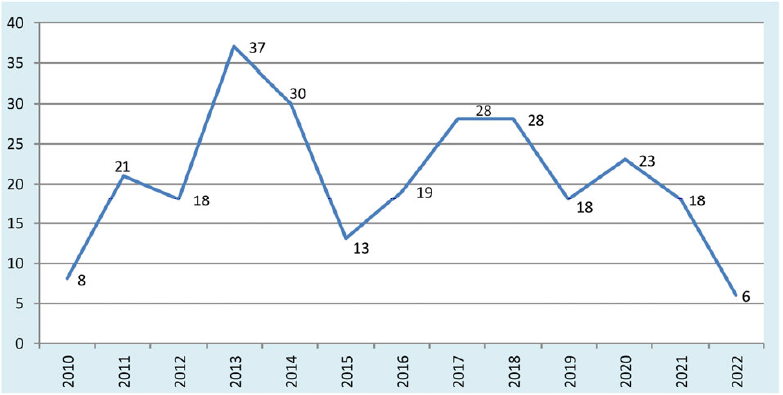
The 267 publications of the period under consideration (online supplementary material) were produced with uneven frequency during the first half of the period (up until 2015), as the number of publications vary considerably from year to year. The trend becomes more even from 2015 onwards (Fig. 4.1 ). This could perhaps reflect the uncertainties of the financial crisis both in Greece and abroad.
Number of zooarchaeological publications per year (2022 only includes publications from January to June). © D. Mylona.

The majority of publications are in English (219), but the body of work in Greek seems to be increasing: in the bibliographic review by Reese (Reference Reese and Kardulias1994), only 3.95% of publications were in Greek (11 publications by just two authors), while in the years under consideration here this percentage has almost tripled to 10.22% (27 publications by 12 authors). This probably reflects the increasing number of zooarchaeologists of Greek nationality, but also the increase in excavation publications in Greek and the willingness of Greek language journals to accommodate zooarchaeological research. French is the third most common language (14) followed by German and Italian (three each) and Spanish (one). A comparison with the review by Reese (Reference Reese and Kardulias1994) shows a marked decrease of publications in languages other than English and Greek.
Most publications have just one author (169), 40 have two, and the rest have more than two. In some cases the number of authors is very high, in one case reaching 100 people (Frantz et al. Reference Frantz, Haile, Lin, Scheu, Geörg, Benecke, Alexander, Linderholm, Mullin, Daly, Battista, Price, Gron, Alexandri, Arbogast, Arbuckle, Bălăşescu, Barnett, Bartosiewicz, Baryshnikov, Bonsall, Borić, Boroneanţ, Bulatović, Çakirlar, Carretero, Chapman, Church, Crooijmans, De Cupere, Detry, Dimitrijevic, Dumitraşcu, du Plessis, Edwards, Erek, Erim-Özdoğan, Ervynck, Fulgione, Gligor, Götherström, Gourichon, Groenen, Helmer, Hongo, Horwitz, Irving-Pease, Lebrasseur, Lesur, Malone, Manaseryan, Marciniak, Martlew, Mashkour, Matthews, Matuzeviciute, Maziar, Meijaard, McGovern, Megens, Miller, Mohaseb, Orschiedt, Orton, Papathanasiou, Pearson, Pinhasi, Radmanović, Ricaut, Richards, Sabin, Sarti, Schier, Sheikhi, Stephan, Stewart, Stoddart, Tagliacozzo, Tasić, Trantalidou, Tresset, Valdiosera, van den Hurk, Van Poucke, Vigne, Yanevich, Zeeb-Lanz, Triantafyllidis, Gilbert, Schibler, Rowley-Conwy, Zeder, Peters, Cucchi, Bradley, Dobney, Burger, Evin, Girdland-Flink and Larson2019). These papers provide a synthesis of data of whole projects or are thematic, with a broad geographical scope. They reflect an increasing tendency towards collaborations and inter-disciplinarity.
Most zooarchaeological work in Greece since 2010 has been published in journals (79), both Greek and international, in thematic edited volumes, some of which resulted from thematic conferences (74) and in site publication volumes (67). Most of these adopt a peer-reviewed selection process. A fair number is published in conference proceedings (27), in monographs (four), or are the results of Master’s or PhD research (16). Some works are less easily accessible to the research community. Local conference proceedings and site publications are the most difficult to access because they are often not available online nor to be found in most libraries.
It has been observed in previous reviews that work on Greek zooarchaeology mostly focuses on materials of prehistoric date (Payne Reference Payne, Wilkie and Coulson1985; Reese Reference Reese and Kardulias1994; Trantalidou Reference Trantalidou2001; Mylona Reference Mylona, Kotjabopoulou, Hamilakis, Halstead, Gamble and Elefanti2003). This trend is still dominant, with Neolithic and Bronze Age case studies claiming the lion’s share of publications. Palaeolithic and Mesolithic as well as combinations from multi-period sites further increase the number of publications in the ‘Prehistory’ category (total number of cases: 174). Zooarchaeological studies on materials of historical date are fewer, but their number is still considerable. As a group, 62 publications exist, some for single period materials and some for multi-period ones. Finally, there are 28 publications for materials that span from prehistory to historical times and two for which the chronology of animal remains is not relevant to the subject of the study.
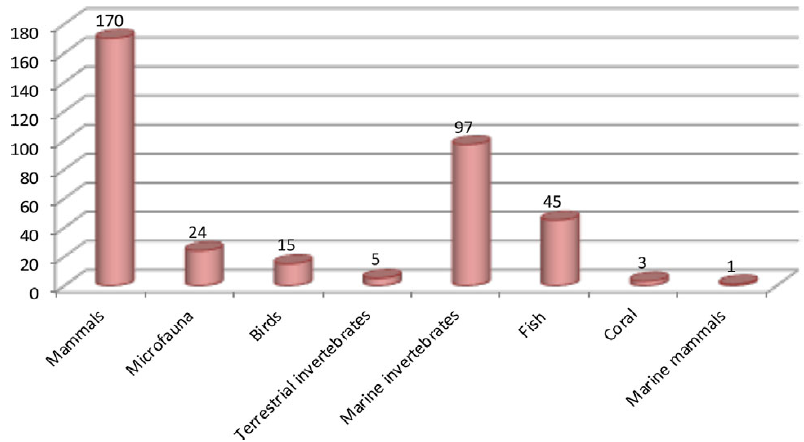
While in the past most zooarchaeological studies were about mammals, now there are a considerable number of studies of other types of remains (Fig. 4.2 ). Mammal remains are still the dominant type under study (170), but fish and marine invertebrates make up the focus of a large proportion of the published works (fish: 45, marine invertebrates: 97). In the last decade, analysis of microfauna, mostly micro-mammals, has emerged as a fairly dynamic field (24), while bird bones have still not attracted as much attention (15). It seems that emphasis on the study/publication of non-mammalian animal remains reflects the presence of specialized researchers. Studies that include more than one category of animal remains are also numerous and are the result either of individual researchers who cover several different fields of expertise or of collaborative teams of researchers. A novelty on the materials studied in zooarchaeology in Greece is the presence of isotopic and genetic analysis (indicatively: Meiri et al. Reference Meiri, Stockhammer, Marom, Bar-Oz, Sapir-Hen, Morgenstern, Macheridis, Rosen, Huchon, Maran and Finkelstein2017; Isaakidou et al. Reference Isaakidou, Styring, Halstead, Nitsch, Stroud, Le Roux, Lee-Thorp and Bogaard2019; Alagich et al. Reference Alagich, Trantalidou, Miller and Smith2021).
Number of publications by type of animal remains. The category ‘Microfauna’ includes micro-mammals, reptiles, and amphibians. This graph is based on the number of papers that deal with each animal type. In case of papers where more than one animal type is analysed or discussed, those are counted as more than one. © D. Mylona.

What is zooarchaeology like in Greece today?
Analytic and synthetic approaches
Zooarchaeology in Greece certainly reflects global developments in the discipline both in terms of theory and of methodology. Currently, however, only three organizations host facets of zooarchaeological activity in a structured manner: the Wiener Laboratory of the American School of Classical Studies at Athens, the Fitch Laboratory of the British School at Athens, and the INSTAP Study Center for East Crete. They provide reference collections, occasionally funded short-term research positions, and, in one case, the INSTAP Study Center for East Crete, a full-time zooarchaeology position. None of them, however, offers a strong basis and a dedicated centre for zooarchaeological research in the country.
New types of analysis are now part of zooarchaeological practice in Greece, with isotopic and genetic analysis being the most cutting-edge. Animal remains from Greek excavations are analysed in the framework of international co-operative projects that tackle broad research questions (indicatively: NEOMATRIX, ZOOCRETE, AGRICURB – links provided at the end of this paper). Two new facilities in Greece are expected to accelerate this type of research: a new DNA and isotopic methods laboratory has been set up as part of the Foundation of Research and Technology on Crete (https://ancient-dna.gr/index.php/en/); and the Stable Isotope Laboratory which has been established as part of the Institute of Nanoscience and Nanotechnology at the NCSR Demokritos (https://inn.demokritos.gr/research_group/meig/).
Zooarchaeology continues to contribute to palaeoenvironmental reconstructions, with several publications based on microfaunal remains providing the most robust examples of this – especially for the Palaeolithic and Mesolithic periods: Kolendrianou (Reference Kolendrianou2015) and Starkovich and Ntinou (Reference Starkovich and Ntinou2017) for Cave 1 at Kleisoura, the Argolid; Konidaris et al. (Reference Konidaris, Athanassiou, Tourloukis, Thompson, Giusti, Panagopoulou and Harvati2018) for Marathousa I at Megalopolis, but see also the synthetic work by Weiberg et al. (Reference Weiberg, Unkel, Kouli, Holmgren, Avramidis, Bonnier, Dibble, Finné, Izbebski, Katrantsiotis, Stocker, Andwinge, Baika, Boyd and Heymann2016) for the Peloponnese and Moody (Reference Moody, Cadogan, Iacovou, Kopaka and Whitley2012) for Crete; and, more generally, Post (Reference Post2017). Often, palaeoecological or environmental observations or inferences are included in zooarchaeological studies of a different focus, but in a cursory manner with no particular methodological agenda (for example, Rivals, Gardeisen and Cantuel Reference Rivals, Gardeisen and Cantuel2011; Papayianni Reference Papayianni2012a; Theodoropoulou Reference Theodoropoulou and Tsipopoulou2012; Karali Reference Karali, Renfrew, Philaniotou, Brodies, Gavalas and Boyd2013; Samartzidou Reference Samartzidou2014; Hadjikoumis Reference Hadjikoumis, Marom, Yeshuran, Weissbrod and Bar-Oz2016; Dibble and Finné Reference Dibble and Finné2021), reflecting perhaps the epistemological roots of zooarchaeology in the broad field of environmental archaeology (Albarella et al. Reference Albarella, Rizzetto, Russ, Vickers and Viner-Daniels2017; also Post Reference Post2017). A large number of zooarchaeological publications are typical zooarchaeological analyses of assemblages (of mammal, fish and microfaunal bones, marine invertebrates) that normally focus on taxonomic and anatomical part representation, mortality patterns, taphonomic processes, cut marks, other traces of modification, measurements, etc. Such works form the staple focus of interest of the discipline. These can be fully developed analyses (that examine and discuss all aspects of an assemblage), especially in cases of large assemblages (indicatively: Veropoulidou Reference Veropoulidou2011, 425–61; MacKinnon Reference MacKinnon and Bravo2018; Gotsinas Reference Gotsinas2021; Mylona Reference Mylona and Soles2022), or shorter contributions (Cantuel Reference Cantuel2013; Huber and Méniel Reference Huber, Méniel and Verdan2013; Molloy et al. Reference Molloy, Day, Bridgford, Isaakidou, Nodarou, Kotzamani, Milić, Carter, Westlake, Klontza-Jaklova, Larsson and Hayden2014; Isaakidou Reference Isaakidou and Tsipopoulou2016; Knappett et al. Reference Knappett, Pomadère, Gardeisen, Gomrée, Theodoropoulou and Westlake2017).
An interesting development of the latest years is the proliferation of studies that are thematic and make use of already published zooarchaeological data in a variety of topics relevant to Greek zooarchaeology (indicatively: Moody Reference Moody, Cadogan, Iacovou, Kopaka and Whitley2012; Binberg Reference Binberg2013; Papathanasiou, Theodoropoulou and Valamoti Reference Papathanasiou, Theodoropoulou, Valamoti, Voutsaki and Valamoti2013; Palmer Reference Palmer, Touchais, Laffineur and Rougemont2014; Thomas Reference Thomas, Touchais, Laffineur and Rougemont2014; Halstead and Isaakidou Reference Halstead, Isaakidou, Albarella, Rizzetto, Russ, Vickers and Viner-Daniels2017; Trantalidou Reference Trantalidou, Mazarakis Ainian, Alexandridou and Charalambidou2017; Samartzidou et al. Reference Samartzidou, Pandolfi, Tsoukala, Maniatis and Stoulos2021). In many cases, these published data are used in large syntheses that go beyond the geographical borders of Greece (indicatively: Gaastra Reference Gaastra2014; Karali Reference Karali, Cantillo, Bernal and Ramos2014; Trantalidou and Masseti Reference Trantalidou, Masseti, Baker, Carden and Madgwick2014; Bogaard et al. Reference Bogaard, Halstead, Fowler, Harding, Hofmann, Fowler, Harding and Hofmann2015; Bernal-Casasola et al. Reference Bernal-Casasola, Gardeisen, Morgenstern, Horwitz, Piqués, Theodoropoulou and Wilkens2016; Meiri et al. Reference Meiri, Stockhammer, Marom, Bar-Oz, Sapir-Hen, Morgenstern, Macheridis, Rosen, Huchon, Maran and Finkelstein2017; Mylona Reference Mylona, Mylona and Nicholson2018; Cucchi et al. Reference Cucchi, Papayianni, Cersoy, Aznar-Cormano, Zazzo, Debruyne, Berthon, Bălășescu, Simmons, Valla, Hamilakis, Mavridis, Mashkour, Darvish, Siahsarvi, Biglari, Petrie, Weeks, Sardari, Maziar, Denys, Orton, Jenkins, Zeder, Searle, Larson, Bonhomme, Auffray and Vigne2020; Andrews et al. Reference Andrews, Di Natale, Bernal-Casasola, Aniceti, Onar, Oueslati, Theodoropoulou, Morales-Muñiz, Cilli and Tinti2022). It seems that zooarchaeology in Greece is mature enough now to produce metadata.
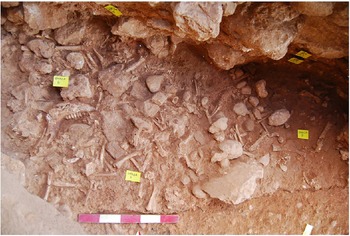
Integration of zooarchaeological data is another strong trend in the publications discussed here. These data are often integrated in the wider narrative of excavated sites, with contextual spatial analysis of remains being fairly common (Fig. 4.3 ) (indicatively: Alagich Reference Alagich2012; Cosmopoulos and Ruscillo Reference Cosmopoulos and Ruscillo2014; Macheridis Reference Macheridis2016; Ruscillo Reference Ruscillo, Shaw and Shaw2018c; Starkovich et al. Reference Starkovich, Elefanti, Karkanas and Panagopoulou2018; Brogan et al. Reference Brogan, Mylona, Apostolakou, Betancourt, Sofianou, Chalikias and Oddo2019; Mylona and Kopaka Reference Mylona and Kopaka2021; Mylona Reference Mylona and Soles2022). The ‘Appendix’ form of presentation persists, but zooarchaeologists more often than not include broader archaeological questions in their analysis. Data on animal remains are often combined with other types of bioarchaeological data or other types of archaeological finds (plant remains, phytoliths, tools, pottery, etc.; indicatively: Galik et al. Reference Galik, Forstenpointner, Weissengruber, Thanheiser, Lindblom, Smetana, Gauß, Voutsaki and Valamoti2013; Mylona et al. Reference Mylona, Ntinou, Pakkanen, Penttinen, Serjeantson, Theodoropoulou, Voutsaki and Valamoti2013; Pappa et al. Reference Pappa, Halstead, Kotsakis, Bogaard, Fraser, Isaakidou, Mainland, Mylona, Skourtopoulou, Triantaphyllou, Tsoraki, Urem-Kotsou, Valamoti, Veropoulidou, Voutsaki and Valamoti2013; Tiverios et al. Reference Tiverios, Manakidou, Tsiafaki, Valamoti, Theodoropoulou, Gatzogia, Voutsaki and Valamoti2013; Trantalidou et al. Reference Trantalidou, Lazaridis, Trimmis, Gerometta, Maniatis, Milidaki, Papadea, Aida-Zikidi, Kotzamani, Papayianni and Stefanou2019; Mylona Reference Mylona2020; Stratouli et al. Reference Stratouli, Bekiaris, Katsikaridis, Kloukinas, Koromila and Kyrillidou2020), with written sources and art (indicatively: MacKinnon Reference MacKinnon, Ekroth and Wallensten2013; Groot Reference Groot2014; Ekroth Reference Ekroth, Hitch and Rutherford2017; Pomadére and Papayianni Reference Pomadére, Papayianni, Davis and Laffineur2020; Isaakidou and Halstead Reference Isaakidou, Halstead, Palaima and Laffineur2021; Shapland Reference Shapland2022; Trantalidou Reference Trantalidou, Caseau and Monchot2022), or with ethnography, biology, and experimental archaeology (indicatively: Halstead and Isaakidou Reference Halstead, Isaakidou, Albarella and Trentacoste2011; Forstenpointner et al. Reference Forstenpointner, Galik, Thanheiser, Weissengruber, Zohmann, Gauß, Philippa-Touchais and Touchais2013; Halstead Reference Halstead2014; Doukas and Papayianni Reference Doukas, Papayianni, Harvati and Roksandic2016; Mylona Reference Mylona, Bekker-Nielsen and Gertwagen2016; Trantalidou Reference Trantalidou2018; Isaakidou and Halstead Reference Isaakidou, Halstead, Palaima and Laffineur2021; Jannke Reference Jannke2022). All these studies expand the interpretative potential and the relevance of zooarchaeology to other disciplines and contemporary concerns (Trantalidou Reference Trantalidou2001; Hamilakis Reference Hamilakis, Kotjabopoulou, Hamilakis, Halstead, Gamble and Elefanti2003: 245).
Articulated animal bones, found in situ with human bones attest to a composite human and animal sacrifice at Kydonia, Crete (ca. 1275 BC). © Kasteli Excavations Archive.

Emerging themes and novel methodological tools
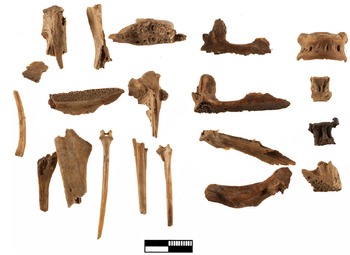
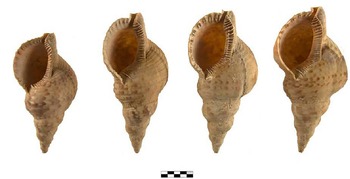
There are certain themes in Greek zooarchaeological research (as noted above), which currently appear to attract much attention; for example, research on marine animals and the relation of humans to the sea in terms of subsistence, technology (fishing, processing, and preservation), and symbolism in the field of cult and social relations (Fig. 4.4 ). The application in the last three or four decades of systematic soil sampling and water flotation in an increasing number of excavation projects of all chronological periods has made this development possible. It has resulted in the accumulation of many fish bone assemblages (for the importance of this technique, see Mylona Reference Mylona, Kotjabopoulou, Hamilakis, Halstead, Gamble and Elefanti2003). Hand-collected or dry-sieved marine molluscs were always part of most excavations’ finds repertoire (Fig. 4.5 ), and some seminal earlier works (for example, Shackleton Reference Shackleton1988) established their significance as environmental markers and to a lesser degree as objects of cultural significance (Karali Reference Karali1999). The recent training of researchers in ichthyo-archaeology and archaeo-malacology has allowed the proliferation of basic research in these fields but also of more nuanced, synthetic works that tackle broader environmental, economic, and social issues. The number of such works is too large to cite here, but out of the 267 publications (online supplementary material), 109 (40.5%) fall in this category, focusing either on a single category or a combination of marine animal types.
Archaeological fish bones from Late Bronze Age Mochlos. © Mochlos Excavations Archive.

Triton shells (Charonia tritonis) from Late Bronze Age Papadiokambos, Crete. © Papadiokambos Excavations Archive (published in Mylona Reference Mylona2019).

Studies on microfaunal remains are on the rise, mostly within the field of Palaeolithic and Mesolithic archaeology, where microfauna is studied for its potential as a paleoenvironmental indicator (Papayianni Reference Papayianni2012a; Reference Papayianni2012b; Doukas et al. Reference Doukas, van Kolfschoten, Papayianni, Panagopoulou and Harvati2018), but also in later periods, where studies highlight the usefulness of microfaunal remains to elucidate cultural traits such as crop storage, trade, and ritual (Papayianni Reference Papayianni2012a; Reference Papayianni2012b; Lymberakis and Iliopoulos Reference Lymberakis and Iliopoulos2019). Hopefully this trend will develop further and will also be followed by the study of non-mammalian microfaunal species (for example, birds and reptiles), where similar developments are observed (Trantalidou Reference Trantalidou and Sakellarakis2013; Starkovich Reference Starkovich2014; Serjeantson Reference Serjeantson2019).
The use of isotopic and genetic analysis of animal bones to explore anew broad research questions that have preoccupied researchers for decades is another emerging and quite dynamic trend, both in Greece and internationally. In the recent past, mammal and fish bones were mostly analysed as controls for the isotopic investigation of human remains and past diet (Vika and Theodoropoulou Reference Vika and Theodoropoulou2012; Papathanasiou, Theodoropoulou and Valamoti Reference Papathanasiou, Theodoropoulou, Valamoti, Voutsaki and Valamoti2013). Recently, however, the animals themselves have become the subject of isotopic investigation, with research questions pertaining to animal diet as a means to examine pastoral territories and to animal mobility as a proxy for human mobility (Nitsch et al. Reference Nitsch, Andreou, Creuzieux, Gardeisen, Halstead, Isaakidou, Karathanou, Kοtsachristou, Nikolaidou, Papanthimou, Petridou, Triantafyllou, Valamoti, Vasileiadou and Bogaard2017; Vaiglova et al. Reference Vaiglova, Halstead, Pappa, Triantaphyllou, Valamoti, Evans, Fraser, Karkanas, Kay, Lee-Thorp and Bogaard2018; Isaakidou et al. Reference Isaakidou, Styring, Halstead, Nitsch, Stroud, Le Roux, Lee-Thorp and Bogaard2019; Alagich et al. Reference Alagich, Trantalidou, Miller and Smith2021). Similar topics are explored with genetic analysis of micromammal bones (Meiri et al. Reference Meiri, Stockhammer, Marom, Bar-Oz, Sapir-Hen, Morgenstern, Macheridis, Rosen, Huchon, Maran and Finkelstein2017; Frantz et al. Reference Frantz, Haile, Lin, Scheu, Geörg, Benecke, Alexander, Linderholm, Mullin, Daly, Battista, Price, Gron, Alexandri, Arbogast, Arbuckle, Bălăşescu, Barnett, Bartosiewicz, Baryshnikov, Bonsall, Borić, Boroneanţ, Bulatović, Çakirlar, Carretero, Chapman, Church, Crooijmans, De Cupere, Detry, Dimitrijevic, Dumitraşcu, du Plessis, Edwards, Erek, Erim-Özdoğan, Ervynck, Fulgione, Gligor, Götherström, Gourichon, Groenen, Helmer, Hongo, Horwitz, Irving-Pease, Lebrasseur, Lesur, Malone, Manaseryan, Marciniak, Martlew, Mashkour, Matthews, Matuzeviciute, Maziar, Meijaard, McGovern, Megens, Miller, Mohaseb, Orschiedt, Orton, Papathanasiou, Pearson, Pinhasi, Radmanović, Ricaut, Richards, Sabin, Sarti, Schier, Sheikhi, Stephan, Stewart, Stoddart, Tagliacozzo, Tasić, Trantalidou, Tresset, Valdiosera, van den Hurk, Van Poucke, Vigne, Yanevich, Zeeb-Lanz, Triantafyllidis, Gilbert, Schibler, Rowley-Conwy, Zeder, Peters, Cucchi, Bradley, Dobney, Burger, Evin, Girdland-Flink and Larson2019; Renaud et al. Reference Renaud, Hardouin, Chevret, Papayianni, Lymberakis, Matur, Garcia-Rondriquez, Andreou, Çetintaş, Sözen, Hadjisterkotis and Mitsainas2020). Currently, several major research projects use isotopic and genetic tools to explore human–animal relations in the region of the Mediterranean and Europe more broadly, which include zooarchaeological material from Greece (for example NEOMATRIX, ZOOCRETE, AGRICURB – links provided at the end of this paper). The next 10 years will witness a blooming of publications in these fields.
New approaches to old themes
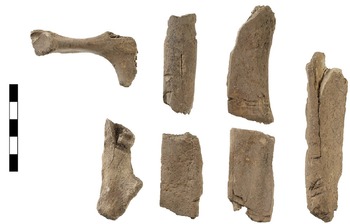
Balancing this trend towards innovative approaches, old challenges persist in Greek zooarchaeology. Animals in cult contexts of prehistoric and historical date remain a popular theme, obviously reflecting the continuous emphasis in excavating cult places, with the issue of animal sacrifice dominating the discourse, followed by feasting (indicatively: Cosmopoulos and Ruscillo Reference Cosmopoulos and Ruscillo2014; Groot Reference Groot2014; Ruscillo Reference Ruscillo and Schaus2014; Sanavia Reference Sanavia, Touchais, Laffineur and Rougemont2014; Mylona Reference Mylona, Godart, Sacconi and Negri2015b; 2019; Halstead and Isaakidou Reference Halstead, Isaakidou, Albarella, Rizzetto, Russ, Vickers and Viner-Daniels2017; Trantalidou 2017; Reference Trantalidou, Caseau and Monchot2022; Veropoulidou and Nikolaidou Reference Veropoulidou, Nikolaidou, Livarda, Madgwick and Riera Mora2017; Dibble Reference Dibble2021) (Fig. 4.6 ). What is new in this recent wave of studies on animals in cult is the inclusion in the discussion of types of animals that were rather peripheral in the past, such as fish, marine invertebrates, birds, reptiles, and the atypical sacrificial animals such as dogs (indicatively: Theodoropoulou Reference Theodoropoulou, Ekroth and Wallensten2013; Mylona Reference Mylona, Haggis and Antonaccio2015a; Hadjikoumis Reference Hadjikoumis, Marom, Yeshuran, Weissbrod and Bar-Oz2016; Lymberakis and Iliopoulos Reference Lymberakis and Iliopoulos2019; Serjeantson Reference Serjeantson2019). The proliferation of analysed and published bone and shell assemblages and of thematic approaches to zooarchaeological data from Greece leads to an increased inclusion of these data in broader studies, often by non–zooarchaeologists (indicatively: Shapland Reference Shapland2010; Reference Shapland2022; Masseti Reference Masseti2012; Halstead Reference Halstead2014; Palmer Reference Palmer, Touchais, Laffineur and Rougemont2014; Kindt Reference Kindt2020), thus promoting the integration of zooarchaeological studies in the broader archaeological and historical discourse. Analysis of animal remains from funerary contexts, an area of research related to cult, has increased in the period under review (Valla et al. Reference Valla, Triantaphyllou, Halstead, Isaakidou, Lochner and Ruppenstein2013; Isaakidou Reference Isaakidou and Tsipopoulou2016; Macheridis Reference Macheridis2017; Gotsinas Reference Gotsinas and Karamitrou-Mentesidi2018; Ruscillo Reference Ruscillo, Papadopoulos and Smithson2018a; Karali Reference Karali, Docter and Webster2021). It includes cases of animal burials (mostly equids and dogs) and bones as funerary feasting waste.
Animal bones from the Sanctuary of Poseidon at Kalaureia (Hellenistic–Early Roman), with cut marks that are related to the treatment of animal carcasses, food preparation, and eating in the sanctuary. © Kalaureia Excavations Archive.

Two other topics persist that were dominant in Greek zooarchaeology in previous decades; namely, palaeoeconomy and the role of animals in shaping and expressing social complexity. The geographical and chronological coverage of this type of research has expanded, encompassing cases from the Palaeolithic (Starkovich et al. Reference Starkovich, Elefanti, Karkanas and Panagopoulou2018) to the Medieval period (Ruscillo Reference Ruscillo and Campbell2018b). Also, discussion has been enriched by the inclusion of the non-mammalian categories of data (for example, Pappa et al. Reference Pappa, Halstead, Kotsakis, Bogaard, Fraser, Isaakidou, Mainland, Mylona, Skourtopoulou, Triantaphyllou, Tsoraki, Urem-Kotsou, Valamoti, Veropoulidou, Voutsaki and Valamoti2013; Bogaard et al. Reference Bogaard, Halstead, Fowler, Harding, Hofmann, Fowler, Harding and Hofmann2015; Brogan et al. Reference Brogan, Mylona, Apostolakou, Betancourt, Sofianou, Chalikias and Oddo2019; Berger et al. Reference Berger, Forstenpointner, Kreuz, Weilhartner, Berger, Lang, Reinholdt, Tober and Weilhartner2020; Mylona Reference Mylona2020; Reference Mylona, Doumas and Devetzi2021).
Concluding note
Zooarchaeological research in Greece today is certainly a very vigorous field. Its practitioners originate from research institutions from various countries, as was indeed always the case (Trantalidou Reference Trantalidou2001). A new element is the emergence of a noticeable group of indigenous practitioners. Most are educated abroad, as Greek universities do not cover zooarchaeology (the single seat of environmental archaeology with emphasis on archaeo-malacology in the University of Athens does not exist anymore; for an extensive discussion on the issue of academic and research infrastructure in Greece, see Trantalidou Reference Trantalidou2001). The fact that several PhD and Master’s theses have been produced in Greek universities despite this fact (Veropoulidou Reference Veropoulidou2011; Nikolaidou Reference Nikolaidou2012; Papayianni Reference Papayianni2012a; Samartzidou Reference Samartzidou2014; Kolendrianou Reference Kolendrianou2015; Michalopoulou Reference Michalopoulou2017; Chronaki Reference Chronaki2020) shows the, at present, stifled but exciting potential of the field of zooarchaeology in the country.
This review shows clearly the progress that has been achieved in zooarchaeological groundwork in terms of quantity and geographic/chronological coverage of basic zooarchaeological analysis as well as in terms of taxonomic focus and methodological awareness. The maturity of the discipline is expressed in the multitude of approaches and themes of the studies that produce or utilize zooarchaeological data and by the fact that these are increasingly integrated in the main archaeological narratives for each chronological period or geographical region. The adoption of new tools and techniques and the incorporation of zooarchaeological data from Greece to studies of broader geographical and thematic scope are elements responsible for its vigour.
Supplementary material
To view supplementary material for this article, please visit https://doi.org/10.1017/S0570608422000047.
Acknowledgments
This paper has been produced as part of the zooarchaeology research at INSTAP Study Center for East Crete. I would like to thank the editors of AR for inviting me to contribute this review and a number of zooarchaeologists who provided me with copies of their most recent publications. The paper has benefited from Don Evely’s editorial care, and I am thankful for that. The editors of this journal did a splendid job in streamlining the large number of references and data.