

Although the personal and environmental variables that impact upon individuals’ experience of workplace stress and strain have been extensively investigated, the exact relationship between these elements within the stress process itself has remained somewhat unclear. Therefore, the challenge has existed to further define the role of both the direct and indirect influences on strain experienced by workers in the context of a dynamic interaction between individuals and their given work environments.
The characteristics of work roles themselves can be a source of strain. Two characteristics that have been consistently linked to high levels of work-related stress are perceptions of role conflict and role ambiguity (e.g., Anderson, Reference Anderson1991; Cooper, Reference Cooper and Smith1991; Duquettee, Kerouac, Sandhu, & Beaudet, Reference Duquette, Kerouac, Sandhu and Beaudet1994; Kahn & Byosiere, Reference Kahn, Byosiere, Dunnette and Hough1990; O’Driscoll & Beehr, Reference O’Driscoll and Beehr1994; Schaubroeck, Cotton, & Jennings, Reference Schaubroeck, Cotton and Jennings1989).
Role ambiguity refers to a lack of clarity surrounding the criteria for undertaking or adequately performing a given task, or the unpredictability of the consequences of performing a work role (Kahn, Wolfe, Quinn, Snoek, & Rosenthal, Reference Kahn, Wolfe, Quinn, Snoek and Rosenthal1964). Role ambiguity places workers in a position of uncertainty regarding the way in which they should go about their work, and the potential rewards or repercussions of their actions. Breaugh and Colihan (Reference Breaugh and Colihan1990) suggest that rather than just a global construct, role ambiguity can be further divided into three sub-areas: (1) method role ambiguity, (2) scheduling role ambiguity, and (3) performance role ambiguity. Method role ambiguity refers to uncertainty regarding how to go about performing a particular task. Scheduling role ambiguity refers to uncertainty surrounding when to perform particular tasks or aspects of a job. Finally, performance role ambiguity concerns uncertainty with regard to what constitutes adequate performance of a task in the eyes of a supervisor (Breaugh & Colihan, Reference Breaugh and Colihan1990).
Role conflict occurs when demands placed on a worker are incompatible or are at odds with other tasks or roles they are also required to carry out, leading workers to perceive that they are unable to perform one or more of their given roles effectively. Role conflict can occur between: (1) different people who communicate incompatible requests (intersender role conflict), (2) incompatible requests communicated by a single person (intrasender role conflict), (3) incompatible personal values or expectations and values or expectations of the organisation (person-role conflict), and (4) different roles that one individual is required to fulfil (inter-role conflict; Quick & Quick, Reference Quick and Quick1984).
Despite the discussion above pointing to a suite of common environmental variables contributing to an individual's experience of ‘strain’, they may only be considered distressful when considered alongside the individual's capacity to cope with such events. There may be, therefore, no generally applied direct cause and effect relationship between certain events and strain. Applied to the workforce, this ‘interactive’ model of stress suggests that there exists an exchange between the individual worker and their work environment, with no single work environment guaranteed to prove stressful to any worker.
The transactional model of stress (Lazarus, Reference Lazarus1991) considers the interaction of all factors involved in the interactional models, but views their interface as a dynamic and fluid process. It has at its core three fundamental themes: (1) a dynamic cognitive state, (2) a disruption to normal functioning, and (3) a resolution of the disruption (Dewe, Cox, & Ferguson, Reference Dewe, Cox and Ferguson1993). The transactional model considers the relationship between stressors, individual psychological dispositions and appraisals, responses, and how the outcomes of those responses may again influence a reaction to stressors in subsequent instances. It is also particularly concerned with the cognitive appraisal of events, which it conceptualises as a two-stage process.
In the first instance (primary appraisal), the transactional model proposes that an individual gives meaning to an event by appraising it as representing either harm, a threat of harm, or a challenge. In the second ‘secondary appraisal’ stage the individual then identifies the availability of coping resources necessary to deal with the threat, harm, or challenge (Lazarus, Reference Lazarus1991). The result of this analysis yields the level of strain that the person experiences.
Self-efficacy is a personal judgment of how well an individual perceives that they are able to execute courses of action required to deal with potentially challenging situations (Bandura, Reference Bandura1982). Usually measured as a situationally specific construct, perceptions of self-efficacy may change from moment to moment or as individuals consider their capacity to overcome particular challenges at hand. Self-efficacy can, however, also be measured as a general concept dealing with global perceptions of how capable people feel in dealing with challenges that they may come across on a day-to-day basis. Where individuals believe themselves to be highly efficacious, they are likely to exert sufficient effort that, if well executed, will lead them to be successful. Conversely, individuals with a perception of low self-efficacy are more likely to avoid difficult tasks, believing that they are beyond their capabilities and are consequently more likely to give up prematurely (Judge & Bono, Reference Judge and Bono2001).
At the core of self-efficacy theory is the consideration of an ability to cope with demands. Related to transactional models of stress discussed above (Lazarus, Reference Lazarus1991), which as a central theme also contain an evaluation of individual capacity to match demands with coping resources, the relationship between the two concepts becomes apparent. That is, where individuals are more self-efficacious (i.e., where they are more likely to believe that they are able to cope with the demands of a given situation), they will be less likely to believe that workplace events (stressors) will tax or exceed their coping resources. Hence, they will be less likely to experience symptoms of strain.
A closely related construct to self-efficacy is self-esteem. Self-esteem can be generally described as an individual's overall global evaluation of themselves as a person, from negative to positive (Coopersmith, Reference Coopersmith1967; Damon, Reference Damon1983). Positive self-esteem has been linked to successful adjustment across a wide variety of domains (Kling, Hyde, Showers, & Buswell, Reference Kling, Hyde, Showers and Buswell1999).
Self-esteem has also been demonstrated to be a useful buffer for people facing a wide variety of life challenges, including workplace stressors (Mossholder, Bedian, & Armenakis, Reference Mossholder, Bedian and Armenakis1981). Self-esteem's role in protecting individuals from strain is proposed to occur through principles contained within the ‘behavioural plasticity’ model (Brockner, Reference Brockner1988). Behavioural plasticity refers to the level to which an individual's behaviour is affected by factors external to them. People high in self-esteem appear to be protected from the effects of external factors, enabling them to continue to trust their own thoughts and actions, conform less to others’ expectations, and to disallow criticism of one area of their work to generalise to other areas of their performance. Workers who are low in self-esteem lack this ‘buffer’ against stressors and hence are more likely to be sensitive to, and adversely affected by, the presence of negative environmental or workplace events. Therefore, although the general relationship between level of workplace stressors and psychological strain is acknowledged, sensitivity to workplace stressors may be exacerbated by an individual's sense of self-esteem and/or self-efficacy.
The present study sought to support the interactional and transactional models of stress through testing the hypothesis that the core self-evaluation measures of self-esteem and self-efficacy moderate the relationship between workplace stressors and the strain measures of depression, anxiety, and tension-stress. It was hypothesised that significant direct contributions to the prediction of anxiety, depression, and stress would be provided by the workplace stressors of role ambiguity and role conflict, whereupon higher levels of these role stressors would result in higher levels of strain. It was also hypothesised that the interaction terms between the core self-evaluation components of self-esteem and self-efficacy and the workplace stressors of role ambiguity and role conflict will significantly contribute to the prediction of depression, anxiety, and stress. Higher levels of role stressors were expected to produce higher levels of strain among persons with low self-esteem and self-efficacy, but this effect was expected to be reduced for persons with high self-esteem and/or high self-efficacy.
Method
Participants
Seventy-eight participants took part in the study, which included 32 males and 46 females. The average age for males was 38.5 years (SD = 12.1) and 37.5 years for females (SD = 9.9). Participants were recruited through organisations, clubs and educational institutions that gave permission for their organisation's members or employees to be approached to participate. Participants were drawn from a broad variety of organisations and work backgrounds; however, the majority came from professional backgrounds in the public service, nursing, or teaching industries in Victoria, Australia.
Procedure
Each participant completed a series of questionnaires divided into four sections. The sections measured demographics (age, sex), stressors (role ambiguity, role conflict, and work overload), core self-evaluations (self-esteem and self-efficacy), and strain (depression, anxiety and stress). Participants were given the option of completing either hard-copy or electronic questionnaires, both of which took around 10 minutes to complete. Hard-copy questionnaires were mailed to participants along with a self-addressed envelope, or delivered and picked up from workplaces. Electronic questionnaires were emailed to participants and contained a ‘hyperlink’ to a web-based questionnaire that was completed online. After completion, participants pressed a ‘submit’ button that electronically returned the questionnaire back to the researchers. Over 90% of respondents participated using the web-based version of the questionnaire. Consequently, it may be assumed that a similar proportion of participants had access to computers and internet services through their place of work and/or computer use constituted a component of their duties.
Measures
Role ambiguity
Role ambiguity was measured using Breaugh and Colihan's (Reference Breaugh and Colihan1994) nine-item Role Ambiguity questionnaire. As well as providing an overall Role Ambiguity measure, Breaugh & Colihan's questionnaire can be divided into three subscales measuring three component parts of role ambiguity: method, scheduling, and performance ambiguity.
Role conflict
Role conflict was measured using the eight-item Role Conflict subscale of Rizzo, House, and Lurtzman's (Reference Rizzo, House and Lirtzman1970) Role Questionnaire.
Self-esteem and self-efficacy
Self-esteem was measured using Rosenberg's (Reference Rosenberg1965) Self-Esteem Scale and self-efficacy was measured using Bandura's (Reference Bandura1977) unidimensional General Self-Efficacy Scale (Scholz, Guiterrez Dona, Sud, & Schwarzer, Reference Scholz, Gutiérrez-Doña, Sud and Schwarzer2002; Schwarzer & Born, Reference Schwarzer and Born1997).
Depression, anxiety and stress
Depression, anxiety and stress were measured using the short version of the Depression, Anxiety, and Stress Scale (DASS21; Lovibond & Lovibond, Reference Lovibond and Lovibond1995). Although also able to be combined to form an overall scale of vulnerability (Lovibond, Reference Lovibond1998), the DASS21 can be divided into three subscales, each containing seven items covering depression, anxiety, and stress. The depression subscale contains items such as anhedonia, inertia, and hopelessness, the anxiety subscale includes items relating to autonomic arousal, situational anxiety, and skeletal muscle effects, and the stress subscale assesses chronic, non-specific arousal such as nervous arousal, difficulty relaxing, and being easily upset or agitated. Subjects are asked to rate the extent to which they have experienced each item over the past week.
Results
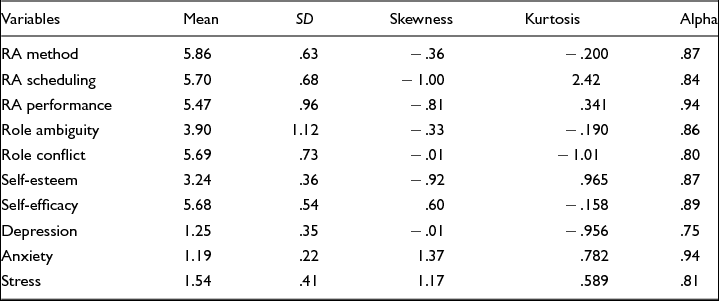
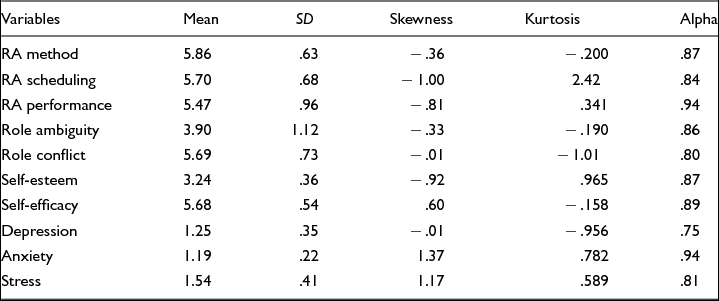
Measures were initially screened for missing values and multivariate outliers using Mahalanobis distances. After screening, eight participants’ scores were removed from the analysis due to missing and/or unusually distributed scores across multiple variables. All measures then tested for violations to assumptions of normality, and internal reliability. Table 1 shows the mean and standard deviation scores, skewness and kurtosis values, and alpha coefficients for each variable. Ranging from .75 to .94, the alpha coefficients were within an acceptable range for all measures. Depression, Anxiety and Scheduling Role Ambiguity demonstrated skewed distributions, while distributions with non-normal kurtosis were observed in Scheduling Role Ambiguity, and Role Conflict. Although not unexpected given the nature of the measures in question, such violations to the assumptions of distribution normality indicated that caution also needed to be used in the interpretation of regression analyses conducted using these variables.
Descriptive Scores of All Variables in the Study
Analysis of the direct and indirect effects of role stressors (role conflict, role ambiguity, method role ambiguity, scheduling role ambiguity, and performance role ambiguity) and core self-evaluations (self-esteem and self-efficacy) on measures of strain (depression, anxiety, and stress) was conducted using hierarchical regression analysis, as suggested by Baron and Kenny (Reference Baron and Kenny1986). These were examined separately for depression, anxiety and stress. In step 1, individual role stressors and core self-evaluations were entered as separate variables. The interaction effect of individual role stressors and core self-evaluations on depression, anxiety and stress were examined by entering the role stressor × core self-evaluations term in step 2. Using this regression approach, significant contributions to the predictions of the three strain measures by role stressors and core self-evaluations can be interpreted as supportive of a direct effect. Significant interaction effects can be interpreted by significant role stressor × core self-evaluation interactions (Cohen & Cohen, Reference Cohen and Cohen1983). Where significant interactions were found, graphs were plotted depicting the direction of the slopes. For all graphs, the effect of core self-evaluations and stressors were plotted at +1SD and −1SD of their centred mean of zero. As non-centred cross-product terms are not interactions, centred scores (i.e., the actual score minus the mean score) for role stressors and core self-evaluations were used for all regression analyses. The use of centred scores also has the advantage of reducing issues of multicollinearity of product terms (Cohen & Cohen, Reference Cohen and Cohen1983).
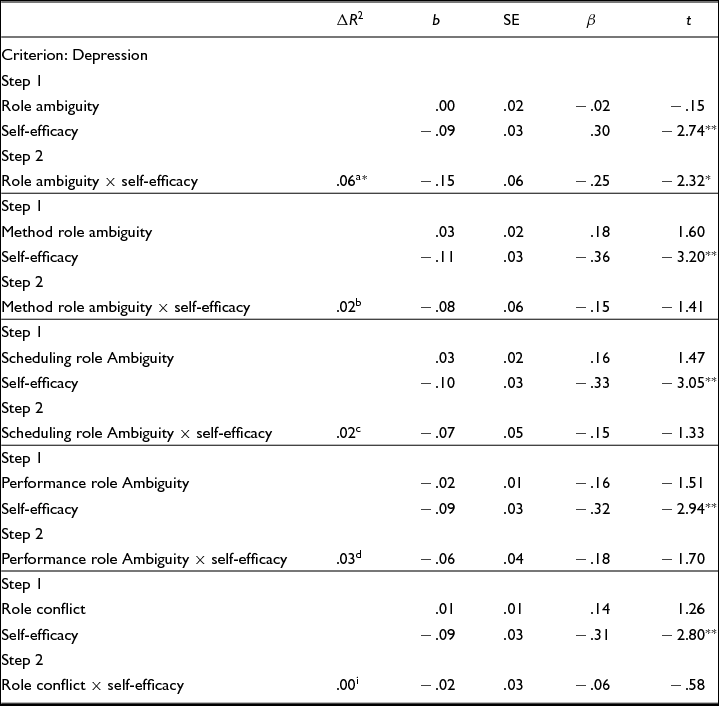
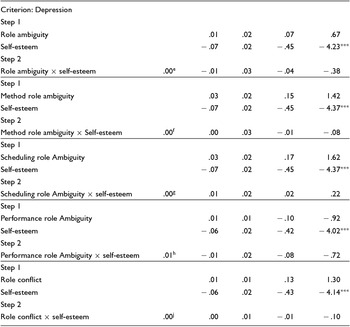
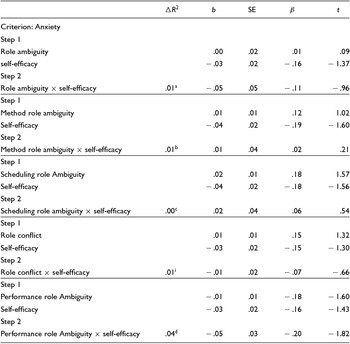
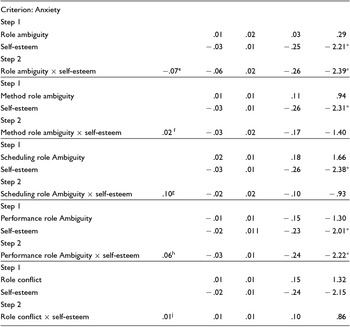
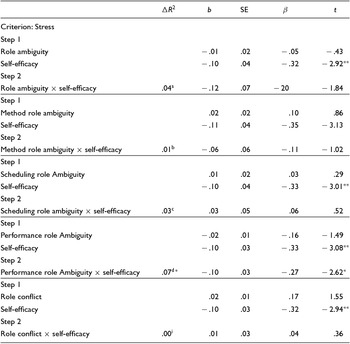
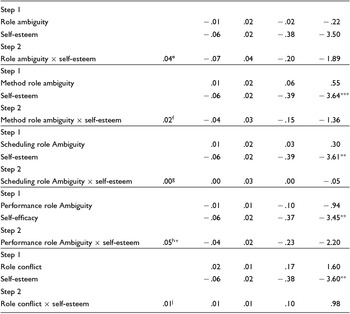
Tables 2a and 2b show the results of the regression analyses for both additive and interaction effects for all regression equations predicting depression. Tables 3a and 3b show the results of the regression analyses for both additive and interaction effects for all regression equations predicting anxiety. Tables 4a and 4b show the results of the regression analyses for both additive and interaction effects for all regression equations predicting stress.
Results of the Regression Analyses for Both Additive and Interaction Effects for All Regression Equations Using Depression as the Criterion and Self-Efficacy as the Moderator
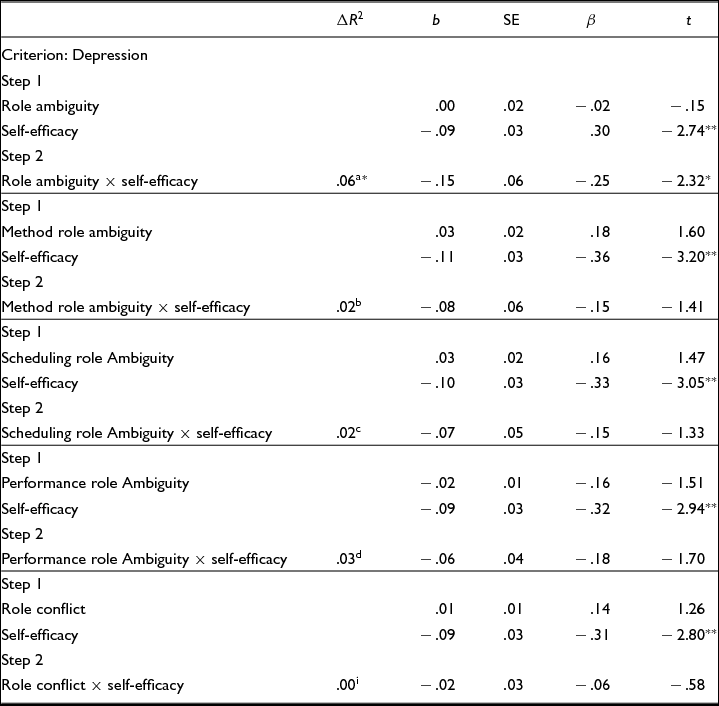
Note: b and β are unstandardised and standardised beta coefficients, respectively, from the final step of the regression equation; *p < .05, **p < .01, aF(1, 74) = 5.40, bF(1, 74) = 1.97, cF(1, 74) = 1.78, dF(1, 74) = 2.86, iF(1, 74) = .34.
Results of the Regression Analyses for Both Additive and Interaction Effects for All Regression Equations Using Depression as the Criterion and Self-Esteem as the Moderator

Note: b and β are unstandardised and standardised beta coefficients, respectively, from the final step of the regression equation; ***p < .001, eF(1, 74) = .15, fF(1, 74) = .01, gF(1, 74) = .05, hF(1, 74) = .51, jF(1, 74) = .01.
Results of the Regression Analyses for Both Additive and Interaction Effects for All Regression Equations Using Anxiety as the Criterion and Self-Efficacy as the Moderator

Note: aF(1, 74) = .92, bF(1, 74) = .04, cF(1, 74) = .29, iF(1, 74) = .42, dF(1, 74) = 3.30.
Results of the Regression Analyses for Both Additive and Interaction Effects for All Regression Equations Using Anxiety as the Criterion and Self-Esteem as the Moderator

Note: b and β are unstandardised and standardised beta coefficients, respectively, from the final step of the regression equation; *p < .05, eF(1, 74) = 5.70)*, fF(1, 74) = 1.96, gF(1, 74) = .86, hF(1, 74) = 4.93*, jF(1, 74) = .74.
Results of the Regression Analyses for Both Additive and Interaction Effects for All Regression Equations Using Stress as the Criterion and Self-Efficacy as the Moderator

Note: b and β are unstandardised and standardised beta coefficients, respectively, from the final step of the regression equation; *p < .05, **p < .01, aR 2 = .16, F(1, 74) = 3.39, bF(1, 74) = 1.03, cF(1, 74) = .27, dF(1, 74) = 6.88, iF(1, 74) = .13.
Results of the Regression Analyses for Both Additive and Interaction Effects for All Regression Equations Using Stress as the Criterion and Self-Esteem as the Moderator

Note: b and β are unstandardised and standardised beta coefficients, respectively, from the final step of the regression equation; *p < .05, **p < .01, ***p < .001, eF(1, 74) = 3.57, fF(1, 74) = 1.84, gF(1, 74) = .00, hF(1, 74) = 4.82, jF(1, 74) = .01.
Direct and Interaction Effects of Stressors and Self-Evaluations on Depression, Anxiety and Stress
To examine support for the additive model, measures of strain (depression, anxiety and stress) were regressed on individual stressors (role conflict, role ambiguity, method role ambiguity, scheduling role ambiguity, performance role ambiguity) and self-evaluations (self-esteem and self-efficacy). Evidence of support for the additive model was interpreted as a significant contribution to the prediction of strains made by both individual stressors and self-evaluations.
Support for the additive model was not demonstrated when predicting depression or stress as only self-esteem and self-efficacy significantly contributed to the prediction of depression. Similar to the prediction of depression and stress, support for the additive model was not demonstrated when predicting anxiety, with only self-esteem significantly contributing. The measures of role ambiguity, method role ambiguity, scheduling role ambiguity, performance role ambiguity, or role conflict did not significantly contribute to the prediction of depression, anxiety, or stress.
Interaction Effect of Role Ambiguity and Self-Efficacy on Depression
Shown in Tables 2a and 2b are results of all regression analyses using depression as the criterion. Significant role ambiguity × self-efficacy interactions were found, suggesting that the interaction of role ambiguity and self-efficacy affects levels of depression, t(77) = −2.32, p < .05.
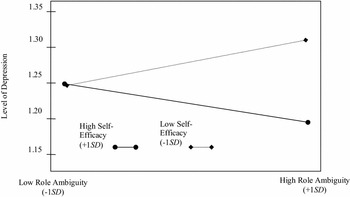
Figure 1 demonstrates the direction of the slopes for low and high self-efficacy and low and high role ambiguity against levels of depression. The slopes indicate that role ambiguity affects levels of depression, but that this effect varies with levels of self-efficacy. The relationship is such that persons high in self-efficacy experience decreased levels of depression at high levels of role ambiguity. Conversely, levels of depression increased for persons with low self-efficacy at high levels of role ambiguity. Levels of depression were similar at levels of both high and low self-efficacy for persons reporting within low levels of role ambiguity.
The interaction of role ambiguity and self-efficacy on levels of depression.

The Interaction Effect of Role Ambiguity and Self-Esteem on Anxiety, and Role Ambiguity and Self-Esteem on Stress
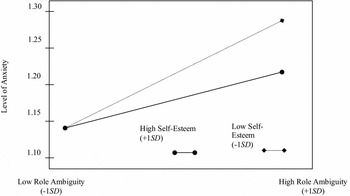
Tables 3b and 4b show the results of the regression analyses for the interaction effect of self-esteem × role ambiguity on anxiety and stress, respectively. When regressed on anxiety, significant role ambiguity × self-esteem interactions were found, suggesting that the interaction of role ambiguity and self-esteem impacts upon levels of anxiety, t(77) = −2.38, p < .05.
Figure 2 shows that the nature of the self-esteem × role ambiguity interaction is that levels of anxiety increase with increases in role ambiguity, and this effect changes with levels of self-esteem. Although both high and low self-esteem individuals demonstrated similar levels of anxiety at low role ambiguity levels, at high role ambiguity levels, anxiety increased more markedly at low levels of self-esteem than at high levels of self-esteem.
The interaction of role ambiguity and self-esteem on levels of anxiety.

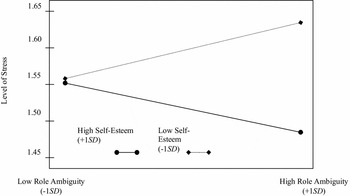
A similar trend was found for the interaction effect of role ambiguity × self-esteem on stress; however, this interaction failed to reach significance, t(77) = −1.89, p > .05. Worth noting, however, is the nature of the interaction, demonstrating a similar pattern of results to those found above (see Figure 3).
The interaction of role ambiguity and self-esteem on levels of stress.

The Interaction Effect of Performance Role Ambiguity and Self-Esteem on Anxiety, Performance Role Ambiguity and Self-Esteem on Stress, and Performance Role Ambiguity and Self-Efficacy on Stress
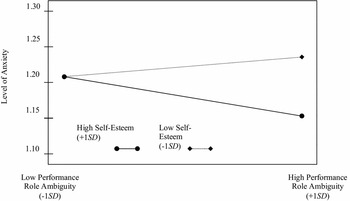
Tables 3b, 4a and 4b show the results of the regression analyses for the interaction effect of self-esteem × performance role ambiguity on anxiety, self-efficacy × performance role ambiguity on stress, and self-esteem × performance role ambiguity on stress. When regressed on anxiety, significant performance role ambiguity × self-esteem interactions were found, suggesting that the interaction of performance role ambiguity and self-esteem impacts upon levels of anxiety, t(77) = −2.22, p < .05.
Figure 4 demonstrates the direction of the slopes for low and high self-esteem and low and high performance role ambiguity against levels of anxiety. The slopes indicate that performance role ambiguity affects levels of anxiety, but that this effect varies with levels of self-esteem. The interaction is such that at high levels of performance role ambiguity, anxiety decreased for persons at high levels of self-esteem and increased slightly for persons at low levels of self-esteem. Similar to the pattern of interactions reported above, levels of anxiety were similar for both high and low self-esteem individuals within work environments containing low levels of performance role ambiguity.
The interaction of performance role ambiguity and self-esteem on levels of anxiety.

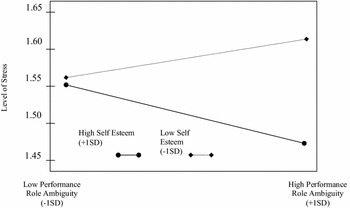
Once again, a similar pattern to the results above was found for the significant interaction of performance role ambiguity and self-esteem on levels of stress, t(77) = −2.20, p < .05 (see Table 4b). Figure 5 demonstrates the direction of the slopes for low and high self-esteem and low and high performance role ambiguity against levels of stress. The slopes indicate that performance role ambiguity affects levels of stress, and that this effect varies with levels of self-esteem. At high levels of performance role ambiguity, stress decreased for persons with high self-esteem and increased for persons with low self-esteem. Anxiety scores were similar for both high and low self-esteem individuals within work environments containing low levels of performance role ambiguity.
The interaction of performance role ambiguity and self-esteem on levels of stress.

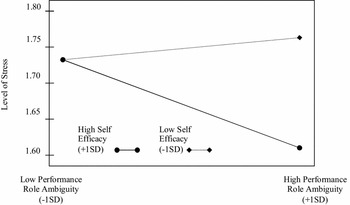
Finally, a significant interaction was also found for the interaction of performance role ambiguity and self-efficacy on levels of stress, t(77) = −3.45, p < .05 (see Table 4a). Figure 6 demonstrates the direction of the slopes for low and high self-efficacy and low and high performance role ambiguity against levels of stress. The slopes indicate that at high levels of performance role ambiguity, stress decreased for persons at high levels of self-efficacy and remained relatively stable for persons with low self-efficacy. Stress scores were similar for both high and low self-esteem individuals within work environments containing low levels of performance role ambiguity.
The interaction of performance role ambiguity and self-efficacy on levels of stress.

Discussion
The findings of the present study support our hypotheses in implying that stressors alone do not significantly predict strain in individuals, but rather the interaction between individuals and their work environments provides the best prediction of subsequent strain. Further to this, these results indicate that the function of self-esteem and self-efficacy as moderators in the stress process is not identical, but varies in relation to the type of strain in question. These findings reinforce the importance of considering role stress variables in relation to the context of an interactive person/environment fit model.
Perceptions of role conflict and role ambiguity have been consistently linked to high levels of work-related stress, including increased levels of anxiety, depression, emotional exhaustion, and burnout (e.g., Anderson, Reference Anderson1991; Cooper, Reference Cooper and Smith1991; Duquettee et al., Reference Duquette, Kerouac, Sandhu and Beaudet1994; Kahn & Byosiere, Reference Kahn, Byosiere, Dunnette and Hough1990; O’Driscoll & Beehr, Reference O’Driscoll and Beehr1994; Schaubroeck et al., Reference Schaubroeck, Cotton and Jennings1989). Contrary to such results, however, the present study found no direct relationship between any measured role stressors and strain through either the zero-order correlation matrix or regression analyses. Only overall role ambiguity and performance role ambiguity interacted with self-esteem and self-efficacy to significantly predict strain. Otherwise, significant correlations found between self-esteem, self-efficacy and depression, anxiety, and stress, were consistent with those produced in previous studies (e.g., Antony, Beiling, Cox, Enns, & Swinson, Reference Antony, Beiling, Cox, Enns and Swinson1998; Hagborg, Reference Hagborg1993; Judge & Bono, Reference Judge and Bono2001).
These results are further evidence to suggest that stimulus-based models of stress, which assume a direct relationship between the magnitude of a stressor and consequent strain, fall short of being able to discriminate between individuals for whom stressors result in strain for some and not for others. It also supports the view that psychological variables interact with environmental stressors to produce an overall experience of strain (e.g., Edwards & Cooper, Reference Edwards and Cooper1988).
The Moderating Role of Self-Efficacy
The results of this study show that self-efficacy moderates the relationship between role ambiguity and depression and between performance role ambiguity and stress. Similar to results obtained by Jex and Gudanowski (Reference Jex and Gudanowski1992), these results indicate that when faced with high levels of role ambiguity, people's confidence in their abilities determines whether levels of depression and stress rise or fall. That is, in highly role-ambiguous situations, persons with low levels of self-efficacy showed increased levels of depression, while depression decreased for persons with high self-efficacy. Similarly, levels of stress decreased for persons with high self-efficacy at high levels of performance role ambiguity, but remained relatively stable for persons with low self-efficacy at high levels of performance role ambiguity. More than simply mitigating the effects of high stressor levels, these findings suggest that for persons high in self-efficacy, low levels of role ambiguity actually produce greater levels of strain than do high levels of role ambiguity. This has important implications for interventions designed to decrease workplace strain, suggesting that ‘blanket’ approaches designed to reduce strain through the clarification of roles and performance criteria in the workplace may actually increase strain for a proportion of the workforce.
The specific moderating role of self-efficacy in relation to depression and stress as opposed to anxiety can only be speculated upon; however, some concepts common to both theories of self-efficacy and depression may explain the relationship. As self-efficacy is a personal judgment of how well an individual perceives that they are able to execute actions required to combat potentially challenging situations (Bandura, Reference Bandura1982), a central tenet of self-efficacy theory is the consideration of a person's capacity to cope with demands. Hence, where individuals are more self-efficacious, they will be less likely to believe that potential workplace stressors such as role ambiguity will exceed their coping resources. When people are less self-efficacious, however, they are more likely to believe that their actions will be ineffectual or that their efforts will be unlikely to lead to success.
The ‘cognitive triad’ model of depression proposes that depressed patients develop a negative view of themselves, their world, and their future. Depressed patients view their environment and the obstacles that it presents as overwhelming and unsurmountable. Furthermore, they often exhibit symptoms of hopelessness and helplessness, believing that any efforts they make will be both ineffectual and insufficient (Young, Beck, & Weinberger, Reference Young, Beck, Weinberger and Barlow1993). Hence, when faced with highly ambiguous situations in the workplace, it follows that persons low in self-efficacy will reinforce beliefs that their efforts to exert sufficient change over their environment will be inadequate. In turn, this may lead them to report higher levels of helplessness, hopelessness and consequently, depressive symptoms. For persons high in self-efficacy, however, the opposite pattern may hold true; reinforcing a belief in their ability to combat challenging situations and that their actions are both effectual and sufficient.
In relation to performance role ambiguity and strain, it is interesting to note that although stress remained relatively stable for persons with low self-efficacy at both high and low levels of performance role ambiguity, stress decreased markedly with the combination of high self-efficacy and high role ambiguity. This finding supports those of Bandura (Reference Bandura1997), suggesting that when charged with challenging tasks where performance criteria may be either absent or vague, highly self-efficacious individuals may be less likely to exhibit symptoms of stress as they may be more confident of having satisfactorily executed effective and appropriate courses of action.
The Moderating Role of Self-Esteem
Contrary to the results obtained for self-efficacy, self-esteem did not moderate the relationship between role ambiguity and depression, but rather between role ambiguity and anxiety and between performance role ambiguity and anxiety and stress. In all instances, the pattern of results was similar to that found above where persons reporting high levels of role ambiguity and performance role ambiguity demonstrated increased levels of anxiety and stress at low levels of self-esteem in comparison to persons at high levels of self-esteem where the trend was either lessened or reversed. These results are consistent with the behavioural plasticity model (Brockner, Reference Brockner1988), indicating that people with higher self-esteem are less likely to be adversely affected by negative workplace events.
Comparative Roles of Self-Esteem and Self-Efficacy in the Stress Process: Implications for the Transactional Model of Stress
The differences observed in this study between the moderating roles of self-esteem and self-efficacy indicate that their functions within the stress process may not be identical, as has been previously suggested (Semmer, Reference Semmer, Schabracq, Winnubst and Cooper1996). In turn, this leads us to consider their relative roles in relation to the transactional model of stress.
The transactional model of stress proposes that an individual initially gives meaning to an event in the ‘primary appraisal’ stage by assessing its potential as either a harm, threat, or challenge. In the ‘secondary appraisal’ stage, the individual then identifies the availability of effective coping resources necessary to deal with the threat, harm, or challenge (Lazarus, Reference Lazarus1991). The result of this analysis yields the level of strain that the person experiences.
The transactional model considers that all strains occur at the same temporal point and does not distinguish between the types of strain that may occur at either the primary or secondary appraisal stage. It also assumes that persons move through both appraisal stages before strain occurs. The present results, however, suggest that these assumptions may need to be revisited.
As aforementioned, where individuals are more self-efficacious, they are more likely to have confidence in their ability to cope with demands placed upon them. Related to the transactional model of stress, considerations of self-efficacy would therefore be enacted at the ‘primary appraisal’ stage where events are evaluated as potential threats, harms or challenges. For example, persons high in self-efficacy who consider that they can ‘Always manage to solve difficult problems if they try hard enough’ and can ‘Remain calm when facing difficulties because they can rely on their coping abilities’ may be less likely to believe that they will be unable to cope with potential threats. In turn, this would lead such individuals to be less likely to experience symptoms of depression such as helplessness or hopelessness or to believe that threatening events are either overwhelming or insurmountable. For such individuals, once the primary appraisal process is complete, they are then prepared to undertake the ‘secondary appraisal’ stage where the identification and mobilisation of coping resources (e.g., self-esteem) required to deal with the challenge takes place (Lazarus, Reference Lazarus1991). The opposite, however, may be true for persons with low self-efficacy.
Where an individual is less self-efficacious, and believes, for example, that they are unable to ‘solve most problems if they invest the necessary effort’ or are not ‘confident that they can deal efficiently with unexpected events’, the secondary appraisal process may not occur as it would above because the individual has already determined that the threat is insurmountable during the primary appraisal process. Consequently, the individual may experience symptoms of helplessness and hopelessness associated with depression and consistent with believing that any efforts or attempts they make to combat the challenge will be futile. If this then leads them to ‘give up’, they may not attempt to identify or access available coping resources through the secondary appraisal process as they have already determined that any attempt to cope would be ineffective. In this instance, persons with low self-efficacy who have adopted more passive ‘giving up’ behaviours may be less likely to demonstrate symptoms of anxiety or stress associated with utilising self-esteem as a coping resource as they would not progress through the secondary appraisal (i.e., coping) process.
For persons with high self-efficacy this would not be the case, however, as the secondary appraisal process may still lead them to find that despite their confidence that they can overcome difficult situations, their coping resources may still be stretched by the actual demands of a situation. Assuming that self-esteem is one of those coping resources, the behavioural plasticity hypothesis (Brockner, Reference Brockner1988) would predict that anxiety and stress would be reduced for persons high in self-esteem and increased for persons with low self-esteem. The results found in this study would appear to support this conceptualisation.
It is conceivable that simply through engagement in the initial ‘primary appraisal’ process of the transactional model of stress, individuals may experience reduced or increased levels of strain (i.e., depression) prior to the completion of the secondary appraisal process. Post the ‘secondary appraisal’ stage, the individual may then experience symptoms of anxiety or stress, based upon the coping process engaged upon and the level of coping resource (i.e., self-esteem) available to them.
A limitation of this research is that higher participant numbers (>N = 78) may have produced clearer results. Many analyses neared statistical significance; however, the strength of these associations may have been better clarified with greater statistical power. Further, given the relatively small sample and the recruitment procedures employed, it is unclear whether this sample is representative of a broader Australian workforce or whether differences in effects would be apparent between employment categories. Future research may wish to conduct similar research, ensuring that employee types are well controlled for or are broadly representative of an industry, location, or population.
Conclusions and Implications for Future Research
A previous criticism of research into moderator variables has been their inability to provide insight into the stress process itself or to provide a sense of the manner in which moderator variables impact upon strain outcomes in a cause and effect manner (Cooper et al., Reference Cooper, Dewe and O’Driscoll2001). We believe that these results have gone some way to providing such insight and consider that they have presented a platform for the conduction of future research into the conceptualisation of the stress process itself. Furthermore, this study has demonstrated that the strain produced through the stress process varies not only in intensity, but also in symptomatology, given the type of person/environment interaction under consideration.
Future research may wish to further explore the ability of the transactional model of stress to explain the results found here as it appears that assumptions regarding the temporal pattern of events, moderators, and consequent strain relationships require further exploration. At the very least, the transactional model may need to be revisited in terms of the assumption that strain occurs only as a result of analysis at the secondary appraisal stage and that persons move through both appraisal stages before an impact upon strain occurs.
These findings reinforce the importance of considering the issue of interventions designed to reduce workplace stress in the context of a person/environment fit model; one where the responsibility for creating ‘stress’ cannot be solely laid on either the person or the workplace and where ‘stressful’ work environments cannot be objectified (Lazarus, Reference Lazarus1991; Edwards & Cooper, Reference Edwards and Cooper1988). Rather, the ‘fit’ between an individual and their work setting provides the best explanation of the presence or absence of strain.