Introduction
Delirium is a complex neuropsychiatric syndrome highly prevalent among advanced cancer patients, with previous studies reporting a prevalence of 80%–90% (Lawlor et al., Reference Lawlor, Gagnon and Mancini2000; Morita et al., Reference Morita, Tei and Tsunoda2001). Delirium frequently causes great distress not only to patients themselves, but also to family caregivers and healthcare professionals with previous studies demonstrating high levels of distress among family members of patients with and recovering from delirium (Breitbart et al., Reference Breitbart, Gibson and Tremblay2002; Bruera et al., Reference Bruera, Bush and Willey2009; Cohen et al., Reference Cohen, Pace and Kaur2009; Finucane et al., Reference Finucane, Lugton and Kennedy2017; Fuller, Reference Fuller2016; Grover et al., Reference Grover, Ghosh and Ghormode2015; Grover & Shah, Reference Grover and Shah2011; Kerr et al., Reference Kerr, Donnelly and Wright2013; Partridge et al., Reference Partridge, Martin and Harari2013). Delirium negatively affects communication between patients and their families and medical staff as well as their treatment decision-making and assessment of physical symptoms (e.g., pain) (Bruera et al., Reference Bruera, Fainsinger and Miller1992; Milisen et al., Reference Milisen, Steeman and Foreman2004). Moreover, delirium during the terminal phase of disease raises specific palliative care issues including palliative sedation and balancing the benefit of examination and management of precipitating factors with treatment burden (Bell et al., Reference Bell, Olivier and King2013).
Delirium occurring in the dying phase, in which reversal is unlikely, is defined as terminal delirium (Bush et al., Reference Bush, Leonard and Aga2014). Although several assessment tools for delirium are available (e.g., the Delirium Rating Scale-Revised 98 [Trzepacz et al., Reference Trzepacz, Mittal and Torres2001], the Memorial Delirium Assessment Scale [Breitbart et al., Reference Breitbart, Rosenfeld and Roth1997]), these tools are principally designed for evaluating frequency of symptoms in reversible delirium. Furthermore, consensus regarding care and treatment for irreversible terminal delirium is lacking. Because it is infeasible and difficult for patients with terminal delirium and their family caregivers to tell about their experience and views of terminal delirium in clinical settings, qualitative studies evaluating the views and perspectives of clinical staffs are required to identify treatment goals in terminal delirium.
The aim of this study is to identify goals of care and treatment in terminal delirium by interviewing healthcare professionals regarding their views on currently used approaches.
Methods
Study design
We performed a qualitative exploratory research of healthcare professionals engaging in the treatment of terminally ill cancer patients. Interviews were conducted to assess the views of healthcare workers regarding goals of care and treatment in terminal delirium for patients and their families. The study protocol was approved by the Institutional Review Board and Ethics Committee of Nagoya City University, Graduate School of Medical Sciences. The present study was conducted in accordance with the principles of the Declaration of Helsinki. Written consent was obtained from all participants.
Participants
Healthcare professionals were recruited from two university hospitals, four general hospitals, and four home care clinics in Japan to collect views of participants working in a variety of medical facilities. Eligibility criteria for inclusion in the present study were (1) currently engaged in the care and treatment of terminally ill cancer patients and (2) speaking Japanese. We recruited multiple occupations/specialities (palliative care physician, oncologist, psycho-oncologist, and clinical psychologist) to get wide a range of views and perspectives and a total of 20 clinical staff members were interviewed before theoretical saturation was reached.
Procedures
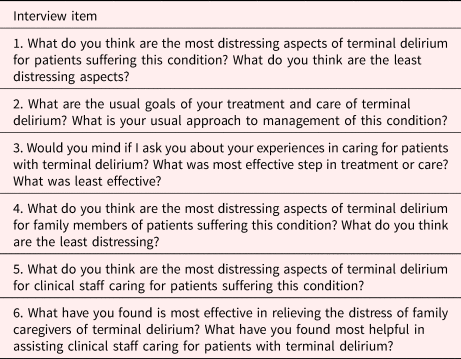
Healthcare professional were invited to participate in this study via e-mail. Semistructured, one-on-one interviews were performed, either in person at the hospital or by telephone, between January and March 2014. We also collected participants’ backgrounds. Interviews were audiotaped and they were approximately 30–60 minutes. Interviewers were four female master's degree psychology students, each of whom received a 1-hour interview training session before study initiation. Interviewers and participants did not know each other before study initiation. Interview questions for healthcare professionals addressed goals of care and treatment in terminal delirium for patients and their families (Table 1). This interview was developed based on discussions with oncologists, nurses, palliative care specialists, and psycho-oncologists. We defined terminal delirium as any episode of delirium occurring in the dying phase, thus implying reversal was not pursued (Bush et al., Reference Bush, Leonard and Aga2014). Reports were provided according to consolidated criteria for reporting qualitative research (Tong et al., Reference Tong, Sainsbury and Craig2007). Transcripts were not returned to subjects for comment or correction.
Interview guide
The aims of this study are to investigate the views and perspectives of clinical staff regarding the treatment and care of cancer patients with terminal delirium.

When the participant is a doctor, please ask about treatment.
When the participants are the others, please ask about care.
Analyses
We used the grounded theory approach, which is a recognized method for investigating phenomena where little prior knowledge exists. Transcripts were reviewed by two research coders (M.U. and Y.I.). A written text-driven inductive approach allowed themes to arise. Arising patterns and themes were analyzed with an initial open-coding method; they were then clustered into axial coding categories. Categories were thereafter refined into more abstract themes. Reliability of coding was assured through consensus agreement of two coders under the supervision of an experienced palliative care specialist (T.M.). Data collection continued until further data collection produced minimal or no new information to affirm. Software was not used to analyze any data in the present study. Data from both family caregivers and healthcare professionals were analyzed together because views and experiences regarding terminal delirium were largely similar.
Results
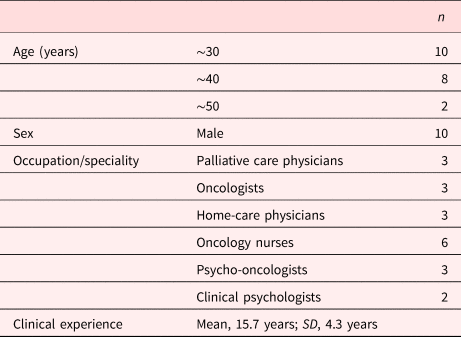
Of the eligible 21 health professionals, 20 agreed to participate in this study. One refused to participate because of a failure in matching. Of the 20 included participants, three were nurses with experience of terminal delirium as family caregivers. Participant characteristics are shown in Table 2.
Participant characteristics (n = 20)

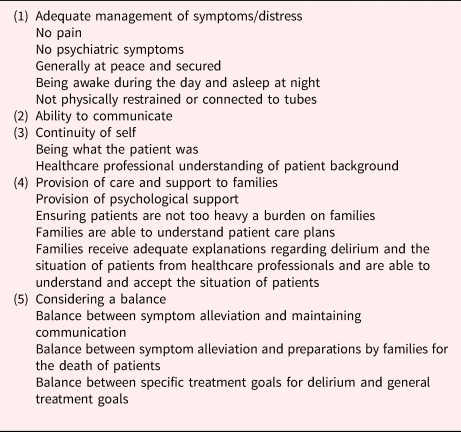
Data were classified into five categories: (1) adequate management of symptoms/distress, (2) ability to communicate, (3) continuity of self, (4) the provision of care and support to families, and (5) considering a balance (Table 3).
Categories identified in interviews with healthcare professionals

Adequate management of symptoms/distress
No pain (n = 5)
Participants stated that the alleviation of physical discomfort, particularly pain, was essential.
“As for physical symptoms, when patients are delirious, they cannot understand why they have pain…So when they have pain or other physical symptoms, it causes more distress as they cannot understand why they are in such a situation. Hence, I think neither mental nor physical distress is best.” (Home-care physician 1)
No psychiatric symptoms (n = 15)
Participants stated that patients need psychiatric symptoms of delirium to be controlled, without causing patient agitation and using inappropriate language or behavior or severe disorientation. Participants emphasized the need for patients to be oriented: know where they were, understand their own situation and surroundings, and recognize their family members.
“In some cases, patients cannot recognize their family members’ faces. In such cases, they may feel lonely and anxious.” (Psychologist 1)
Generally at peace and secure (n = 11)
Participants stated that being generally peaceful, feeling secure even in cases in which patients had impaired consciousness, and spending time in a natural way were all important.
“I often hear from families that just being peaceful is enough for them. So, I see patients thinking that a peaceful situation is good for both patients and families.” (Psycho-oncologist 3)
Being awake during the day and asleep at night (n = 12)
Participants stated that patients needed to sleep well at night and maintain a normal circadian rhythm.
Not physically restrained or connected to tubes (n = 1)
One participant stated that the avoidance of distress caused by connection to medical instruments and body restraints was important.
Ability to communicate (n = 11)
Participants stated that patients need to be able to communicate (n = 10), even if delirium did not obtain complete remission (n = 2); communicate until the time of death (n = 4); express their appreciation to their families (n = 1); understand explanations from the healthcare professionals (n = 11); and indicate their intention to their treatment and care (n = 7).
“I know that patient and family have a lot of thing to talk with each other in terminal phase. So I think that the best goal is to produce such a situation to do so. This needs to include effective communication.” (Oncologist 1)
“If delirium doesn't disappear, family would hope to communicate effectively.” (Oncologist 2)
“Well…I think the treatment goal that patients can communicate with their families, until the last minute of the last day …… until the last moment of the diminishing level of consciousness not by delirium but by cancer progression.” (Home-care physician 2)
“It depends on the situation……but if the patients can express what they prefer and/or what is distressing to them, it is easy for us…for medical staff to catch their distress.” (Clinical psychologist 1)
Continuity of self (n = 9)
Participants stated that retaining what the patient is even if he or she were delirious (n = 5), retaining what the patient is until the end (n = 4), retaining patients’ own facial expressions (n = 2), and maintenance of past relationships (n = 3) were all important. Participants also indicated a need for healthcare professionals to be aware of patient backgrounds (n = 2).
“I think that if the patient has changed from what he/she is, the family feels distant from the patient, although they know that the patient is delirious.” (Oncology nurse 5)
“The patient's facial expression is important…..family is sensitive to the difference from original patient, uh…in other words, the facial expression without the patient's original personality is not good.” (Psychologist 1)
“Treatment goal? Uh… maintaining past relationship or feeling a same sense of distance as before between medical staff or ….especially between family is ideal.” (Oncologist 3)
“If we think only about the moment, we tend to focus on what bothers us…for example, saying strange things. However, if we have heard about the patient's whole life, we can view the situation as a continuation of the life.” (Home-care physician 1)
Provision of care and support to families
Participants stated that the following aspects of the care and support of families were important: provision of psychological support; ensuring the patient was not a heavy burden on the family; families were able to understand patient care plans; and families receiving adequate explanations regarding delirium and the situation of patients from healthcare professionals and were able to understand and accept the situation of patients.
Provision of psychological support (n = 5)
Participants stressed the need for healthcare professionals to care about the feelings, worries, anxieties, and guilt of families and to understand and consider family preferences for methods of patient symptom alleviation in addition to patient preference. One participant thought it was important that health professionals were with the family when families did not know which actions to take in relation to the care of patients.
“Family members feel a sense of guilt that they cannot do anything for the patient, so they may alternatively ask healthcare professionals to do something, in my opinion.” (Psycho-oncologist 3)
“As for my grandmother's case, my mother mainly looked after her. It was good for my mother that medical staff was available for her when she did not know what to do.” (Oncology nurse 6)
Ensuring the patient was not too heavy a burden on the family (n = 4)
Participants thought it imperative that families were able to maintain their daily lives and get adequate sleep. Participants further stated that the management of medical instruments or lines should performed by healthcare professionals. In addition, one participant stated adequate rest was important for families.
“If families cannot keep their eyes off from the patient at all or are continue[d] to be called, they cannot go anywhere or do anything. I think it is one of treatment goal that this doesn't happen.” (Home care physician 1)
“When patients become increasingly delirious, it is hard for families to continue to care and spend time with them. In such a situation, it might be better to provide family with time for rest.” (Psycho-oncologist 3)
Family can find a meaning in patient's care (n = 1)
Participants recognized the importance of families being able to find meanings in patient's care, feel rewarded by healthcare professionals, be aware of the hopes of the patient, and feel as though they are playing an important role on behalf of the patient.
Families receive adequate explanations regarding delirium and the patients’ situation from healthcare professionals and are able to understand and accept the situation of patients (n = 8)
Participants thought it was essential that families receive adequately understandable explanations regarding the situation of patient and state of delirium from healthcare professionals, accept the situation of the patient, and calmly accept the delirious state of patients.
“When a patient becomes delirious, we repeatedly explain to families that cancer progression is a cause of delirium until they can understand. If we don't do so, they are mostly shocked at not being recognized as a family suddenly. So we try to give [a] comprehensible explanation.” (Oncology nurse 4)
Considering a balance
Participants thought that balance was important in the following aspects of patient care and treatment: between symptom alleviation and maintaining communication, between symptom alleviation and family preparations for the death of patients, and between specific treatment goals for delirium and general treatment goals.
Balance between symptom alleviation and maintaining communication (n = 5)
Participants emphasized that a good balance between symptom alleviation and maintaining communication was important.
“In terminal phase, as recovering cognitive function completely is difficult, I think it is not the goal…. I think that the goal is to provide the situation that we can feel that patients have no distress on the whole.” (Psycho-oncologist 2)
“Well, the best situation is where both distress of delirium is alleviated by medication and patients can communicate with others; in other words, healthcare professionals need to provide the best balance between both of these.” (Palliative care physician 2)
Balance between symptom alleviation and family preparations for the death of patients (n = 1)
One participant stated that a good balance between the alleviation of patient distress and family preparations for the death of patients was important.
“Whether [the] family has prepared for the patient's death or not has impact on symptom management. In case that the family strongly wants the patient to be awake though there is no other way but to make the patient sedated, matching the opinions is difficult…I often bother…” (Palliative care physician 2)
Balance between specific treatment goals for delirium and general treatment goals (n = 2)
Participants stated that treatment goals for delirium should be explored and that healthcare professionals should clarify when treatment goals did not include recovery from delirium.
“If the time left for the patient is limited to few days or medical staff members know that the cause of delirium is irreversible, then at first, we try to discuss the goal for the patient with himself/herself and the family…When it is difficult for the patient to discuss, we try to talk with families…” (Palliative care physician 3)
Discussion
This interview study revealed the views and experiences of healthcare professionals regarding the effect of care and treatment goals for terminal delirium on patients and their families. We evaluated five distinct categories: adequate management of symptoms/distress, ability to communicate, continuity of self, provision of care, and support to families and considering a balance.
Study results’ utility in improving treatment goals for delirium
In the present study, we evaluated the ability of patients to communicate effectively as a care and treatment goal in terminal delirium. Careful management is required to ensure that good communication between patients and families is maintained for as long as possible (Namba et al., Reference Namba, Morita and Imura2007). To assess continuity of self in delirious patients, healthcare professionals need to communicate effectively with patients and families. Balanced approaches to the care and treatment of delirium may be facilitated through discussion of the opinions of healthcare professionals and the preferences and feelings of families. Active approaches may provide more balanced comprehensive care for terminal delirium; however, the particular styles of communication between healthcare professionals and families that lead to the best outcomes for all parties remain unclear. Further studies are required to determine the most efficacious communication styles.
The evaluation of views regarding family support indicates care for families is vital as World Health Organization (2018) guidelines suggest palliative care should include the care of family. Healthcare professionals are required to be sensitive to the feelings and expectations of families in addition to those of patients. Because previous studies have demonstrated that good relationships between healthcare professionals and family at the end of life are important for patients (Ando et al., Reference Ando, Morita and Ahn2009; Hirai et al., Reference Hirai, Miyashita and Morita2006; Miyashita et al., Reference Miyashita, Morita and Sato2008), healthcare professionals need to actively listen to family members. Health professionals are required to provide psychological support to families where required by attending to the preferences, feelings, and worries of families regarding patient care (Namba et al., Reference Namba, Morita and Imura2007) and support families in continuing their daily lives without unnecessary burden. In addition, healthcare professionals should appreciate the efforts of families and support them in contributing as surrogate decision-makers (Morita et al., Reference Morita, Akechi and Ikenaga2007). Healthcare professionals have a continuing need to explain the patient's situation regarding disease progression and delirium for families to completely understand and accept the medical condition of the patient and states of delirium (Namba et al., Reference Namba, Morita and Imura2007).
Utility of study results in developing an assessment tool for terminal delirium
The Delirium Rating Scale-Revised 98 (Trzepacz et al., Reference Trzepacz, Mittal and Torres2001), Memorial Delirium Assessment Scale (Breitbart et al., Reference Breitbart, Rosenfeld and Roth1997), Confusion Assessment Model (Inouye et al., Reference Inouye, van Dyck and Alessi1990), and Nursing Delirium Screening Scale (Gaudreau et al., Reference Gaudreau, Gagnon and Harel2005) are commonly used to assess delirium in clinical settings. These assessment tools predominantly assess psychological and psychiatric symptoms, with only Nursing Delirium Screening Scale including communication items. However, these assessment tools are largely designed for evaluating reversible delirium with many aspects of the care of terminally ill patients not adequately assessed. For example, areas including the ability to communicate, continuity of self, provision of care, support to families, and considering a balance to the treatment of delirium are generally not included in commonly used assessment tools and were consequently evaluated in the present study. These items are specifically required for the assessment of terminal delirium.
We further identified several common points regarding terminal delirium care between the present study and previous studies of medical staff. Brajtman et al. (Reference Brajtman, Higuchi and McPherson2006) interviewed nurses working in palliative care and observed that healthcare workers, as in the present study, emphasized the importance of presence of healthcare professionals with families and multifaceted care. Although these aspects of care are difficult assess using quantitative tools, they are important considerations in clinical settings.
Study limitations
There were several limitations to this study. This was a qualitative study involving healthcare professionals. Further studies evaluating the views and experiences of patients and families are required. In addition, we included Japanese healthcare professionals only; therefore, differences resulting from ethnicity could not be evaluated and may have an unknown effect on healthcare workers’ perspective of terminal delirium.
Conclusions
In the present study, we evaluated the views and experiences of healthcare worker regarding five categories of terminal delirium care and treatment (adequate management of symptoms/ distress; ability to communicate; continuity of self, provision of care and support to families; considering a balance).
The findings of this study indicate that care and treatment goals in terminal delirium that involve the views of patients, families, and healthcare professionals may aid in reducing unnecessary distress caused to patients with terminal delirium and their families in the clinical setting.
Acknowledgments
We wish to thank Ms. Saki Nada, Sonomi Nonogaki, Ai Sezaki, and Maya Suzuki for their contribution to the study as research assistants. This study was supported by Grant for Research on Hospice Palliative Care, Japan Hospice Palliative Care Foundation, 2014.4-2015.3 (13001).
Conflict of interest
We declare no conflict of interest in connection with the present study.
Author ORCIDs
Megumi Uchida, 0000-0003-2815-8400