INTRODUCTION
Hudson Bay is a subarctic ecosystem in which seals play a significant role. The ringed seal, Pusa hispida (Schreber, 1775) and the bearded seal, Erignathus barbatus (Erxleben, 1777) are both important species in the marine ecosystem, being the major consumers of marine fish and invertebrates. The listed seal species have a significant role in the diet of coastal Inuit communities (Hopping et al., Reference Hopping, Mead, Erber, Sheehy, Roache and Sharma2010), who consume semi-dried flesh, which carries a risk of anisakiasis, zoonosis caused by the third-stage larvae of nematodes from the Anisakidae family. Also, as definitive hosts for anisakids, seals play an important role in the transmission of these parasites to fish, which are traditionally consumed raw, or prepared in ways that do not kill the larvae, such as smoking or light salting. Potentially dangerous for humans, anisakid nematodes, Contracaecum osculatum s.l. and Pseudoterranova decipiens s.l. are the only common members of the family Anisakidae in pinnipeds from the northern hemisphere. In Canada, not many cases of anisakiasis are documented (Couture et al., Reference Couture, Measures, Gagnon and Desbiens2003), mainly because clinical symptoms, such as diarrhoea, vomiting, a tingling sensation in the throat, are similar to other diseases and are often overlooked in differential diagnostics. The success of any parasitic disease control depends on the accurate identification of the parasites causing the diseases. For anisakid nematodes the life cycle stage identification is central to the diagnosis of anisakiasis in humans and animals, and therefore is an important step for disease surveillance and control (Chen et al., Reference Chen, Yu, Lun, Chen, Song, Lin and Zhu2008).
The parasite fauna of the ringed seal, Pusa hispida, from Arctic waters is known from studies performed by Myers (Reference Myers1957), Adams (Reference Adams1988) and Measures & Gosselin (Reference Measures and Gosselin1994). The most abundant parasites of P. hispida are helminths of the gut tract (Johansen et al., Reference Johansen, Lydersen, Aspholm, Haug and Kovacs2010). Ringed seal is described as a host for C. osculatum s.l. (Valtonen et al., Reference Valtonen, Fagerholm and Helle1988), a common parasite in other Arctic seal species, such as Phoca groenlandica, Cystophora cristata and the bearded seal, E. barbatus (Adams, Reference Adams1988; Measures & Gosselin, Reference Measures and Gosselin1994). Another anisakid worm, Pseudoterranova decipiens s.l., has a more boreal distribution and is more common in grey seals (Halichoerus grypus) and harbour seals (Phoca vitulina) (McClelland, Reference McClelland1980; Brattey & Stenson, Reference Brattey and Stanson1993). Both nematode species listed above constitute a complex of sibling species, which are morphologically almost indistinguishable, but are different genetically, so that molecular characterization is necessary.
The bearded seal is the main definitive host so far detected for Pseudoterranova bulbosa (species from P. decipiens complex) (Mattiucci et al., Reference Mattiucci, Paggi, Nascetti, Ishikura, Kikuchi, Sato, Cianchi and Bullini1998). Also, Contracaecum osculatum A, species from C. osculatum s.l., which occurs in the Norwegian and Barents Seas, Canadian Atlantic and Pacific waters, Icelandic waters and the Sea of Japan, is known as a parasite of E. barbatus and the grey seal, H. grypus (Brattey & Stenson, Reference Brattey and Stanson1993). Halichoerus grypus is also a definitive host for C. osculatum C (Nascetti et al., Reference Nascetti, Cianchi, Mattiucci, D'Amelio, Orecchia, Paggi, Brattey, Berland, Smith and Bullini1993), but this helminth was not recorded in E. barbatus (Mattiucci & Nascetti, Reference Mattiucci and Nascetti2008).
The purpose of this work was to study the occurrence of parasitic nematodes, potentially dangerous for humans, in two species of seals at two sites in the Canadian Arctic. The occurrence of Anisakidae in ringed and bearded seals was studied because, as definitive hosts of C. osculatum s.l. and P. decipiens s.l., they play an important role in the transmission of these parasites to fish used as food source by the Inuit. Also, the infection mechanisms were investigated by looking into the developmental stages of the parasites in seals to assess the risk of zoonotic diseases in Inuit traditional foods.
MATERIALS AND METHODS
Parasite materials
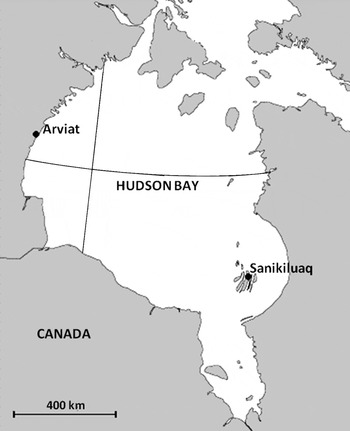
Pusa hispida and Erignathus barbatus seal species, commonly consumed in Inuit communities, were hunted by professional hunters from October 2007 to January 2008 in two Nunavut communities (Arviat and Sanikiluaq, Figure 1). Hunts were not regular, but seasonal, dependent on temperature, time and funds available for hunting. Hunters were trained in sample collection techniques, provided with sampling kits and asked to record on standardized forms where the animal was caught. Basic morphometrics, e.g. body length, weight and sex, were recorded for 28 of 66 caught seals. The samples were frozen until analysis in the laboratory. Seal stomach contents and stomach walls were macroscopically examined by Inuit students for lesions and anisakid parasites, as an important source of human infection. Seals were systematically investigated only for the presence of nematodes, because of their high zoonotic potential. Anisakids from the stomachs of 59 ringed and seven bearded seals were isolated, counted and collected. After isolation from host tissues, worms were washed in deionized water and stored until analysis in 70% ethanol. Parasites were divided into three parts. Anterior and posterior parts were stored in 70% ethanol with 5% glycerol and examined using a light microscope by evaporation of the ethanol/glycerin mixture. The systematic classification of the worms was established on the basis of features described by Fagerholm (Reference Fagerholm1991). Central parts were prepared for molecular identification by fixing in 70% ethanol.
Study area.

DNA isolation and amplification
Random samples of nematode species identified morphologically were also checked using a molecular key. The central parts of the parasites, including 45 of Contracaecum osculatum s.l. and 45 of Pseudoterranova decipiens s.l., taken randomly from hosts and locations, were used for the DNA isolation.
Genomic DNA from nematodes was isolated using a procedure described by Hoarau et al. (Reference Hoarau, Holla, Lescasse, Stam and Olsen2002). Amplification of rDNA markers was done according to the procedure described by Zhu et al. (Reference Zhu, Gasser, Podolska and Chilton1998). Each reaction mixture (total volume of 16 µl) contained 1 µl solution of isolated genomic DNA, 1U DyNAzyme II DNA Polymerase (Finnzymes, Finland), dNTPs (250 µM each), 100 µM of each primer (NC2 and NC5; Zhu et al., Reference Zhu, Gasser, Podolska and Chilton1998) and buffer 1 × (10 mM Tris-HCl (pH = 8.4), 50 mM KCl, 0.1% Triton X-100 and 1.5 mM MgCl2). Amplification was carried out in a Techne Progene (UK) thermocycler. The cycling protocol was 5 min at 94°C, 30 cycles with 30 s at 94°C, 30 s at 60oC and 30 s at 72oC, followed by 5 min at 72oC. Polymerase chain reaction (PCR) products were separated electrophoretically on 1% agarose gels and visualized by staining with ethidium bromide.
Restriction fragment length polymorphism
The amplified DNA samples were digested with AluI, RsaI, TaqI, HhaI, HinfI and BsuRI (Fermentas, Lithuania) restriction enzymes and the products were separated on 4% agarose gels and visualized by staining with ethidium bromide (Sambrook et al., Reference Sambrook, Fritsch and Maniatis1989). The pUC Mix Marker (0.5 µg/µl; Marker 8, Fermentas) was used as a marker. Product sizes were compared to rDNA ITS1–5.8S–ITS2 digestion patterns keys (D'Amelio et al., Reference D'Amelio, Mathiopoulos, Santos, Pugachev, Webb, Picanco and Paggi2000; Kijewska et al., Reference Kijewska, Rokicki, Sitko and Węgrzyn2002).
In the case of unclear digestion patterns, the rDNA ITS1–5.8S–ITS2 region was amplified, sequenced and used as a control. Primers Nc13 (Zhu et al., Reference Zhu, Gasser, Podolska and Chilton1998) and Anc13 (Kijewska et al., Reference Kijewska, Dzido, Shukhgalter and Rokicki2009) were used. Sequencing was performed by Macrogen Inc. (Seoul, Korea).
In this paper, whenever we talk about the results of genetic tests, we use the names of particular sibling species from the complex (e.g. P. bulbosa). When we describe the results of morphological studies, we name the species complex (e.g. P. decipiens s.l.), because not all specimens have been examined molecularly.
Statistical analysis
The basic parasitological parameters were calculated according to the Rózsa et al. (Reference Rózsa, Reiczigel and Majoros2000) definition. Only certain species data were subjected to statistical analysis, based on adequate sample sizes and distribution of samples in both Arviat and Sanikiluaq. The non-parametric tests (Mann–Whitney U-test and Spearman's rank correlation) were used because of irregular distribution of parasites caused by accumulation of larvae and the diet preferences of each seal. The data were checked according to differences between the intensity of parasite infection in two areas of hunting.
RESULTS
The Sanikiluaq seals stomach contents were thoroughly investigated. In bearded seal stomachs, Sticheidae spp. and a few shrimps were observed. In the case of ringed seals, the shrimps and Ammodytidae were found in 85% and 57% of stomachs, respectively. The stomach content of seals from Arviat was not investigated.
In the Arviat community, 2428 anisakids were observed in 31 ringed and six bearded seals, while in Sanikiluaq, 316 Anisakidae were isolated from 28 ringed and one bearded seal. In one ringed seal from Sanikiluaq a few specimens of cestodes were found and used as a teaching material for Inuit students to learn the different preservation and collection techniques. Unlike the the anisakids, not all cestodes were systematically collected.
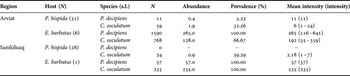
Nematodes morphologically of two species, Pseudoterranova decipiens s.l. and Contracaecum osculatum s.l., were observed. Among these species, the most numerous in Arviat was P. decipiens s.l., while in Sanikiluaq C. osculatum s.l. was present in greater numbers (Table 1). Accordingly, mixed infection with C. osculatum s.l. and P. decipiens s.l. was observed, especially in the Arviat community. Note that P. decipiens s.l. in ringed seals was not reported in Sanikiluaq but was observed in Arviat (intensity 11.00). Mean prevalence of anisakids infection was 43.2% and 41.4% in Arviat and Sanikiluaq, respectively.
Number, abundance, prevalence (%), intensity and mean intensity of infection of the ringed seal (Pusa hispida) and bearded seal (Erignathus barbatus) from the Nunavut region.

P. decipiens, Pseudoterranova decipiens; C. osculatum, Contracaecum osculatum.
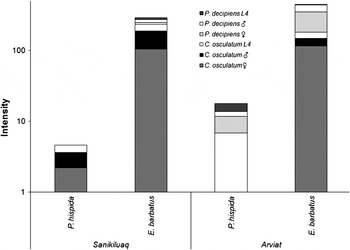
Bearded seals in both communities have a greater number of nematodes than ringed seals (Figure 2). Furthermore all Erignathus barbatus specimens are hosts for P. decipiens s.l. (prevalence 100%), while in Pusa hispida, C. osculatum s.l. is the dominant species. Moreover, ringed seals in Arviat are characterized by a greater intensity of C. osculatum s.l. infection (6.00) than in Sanikiluaq (2.18) (Table 1). There are significant differences between the intensity of parasite infection between ringed and bearded seals in the two areas of hunting (Mann–Whitney U-test; P < 0.0001).
Developmental stage intensity of Pseudoterranova decipiens s.l. and Contracaecum osculatum s.l. of ringed and bearded seals in Sanikiluaq and Arviat.

Generally, more adult worms were noted than L4 larval stages, while females were more numerous than males in the two communities (Figure 2). Exceptionally, in Arviat ringed seals, L4 dominated, with 98.3% prevalence. There was a high predominance of female C. osculatum s.l. and P. decipiens s.l. in bearded seals from Arviat.
Molecular determination confirmed the affiliation of nematodes to the identified species' complexes. Genetically, C. osculatum A (in both seal species and communities), C. osculatum C (in ringed seals from Sanikiluaq) and P. bulbosa (in one ringed seal from Arviat and bearded seals from both localities) were identified. All of P. decipiens s.l. studied molecularly were P. bulbosa.
DISCUSSION
Anisakids are cosmopolitan parasites with a wide geographical distribution. In Canadian Arctic waters, so far, Pseudoterranova bulbosa has been recorded in bearded seal and Contracaecum osculatum A in bearded and grey seals (Mattiucci & Nascetti, Reference Mattiucci and Nascetti2008). In the present study, seals from the Nunavut region were infected with three anisakids species: P. bulbosa, C. osculatum A and C. Interestingly, C. osculatum A occurred in ringed and bearded seals from the two communities, while C. osculatum C was noted only in Pusa hispida from Sanikiluaq. It is the first record of C. osculatum A and C in Hudson Bay. Contracaecum osculatum C in P. hispida has so far been observed in the waters around Iceland and the Baltic Sea, but never reported in the western part of the Atlantic or Pacific waters (Mattiucci & Nascetti, Reference Mattiucci and Nascetti2008). It is important to investigate the occurrence of anisakid nematodes in seals because high anisakid prevalence in definitive hosts can potentially contribute to stronger infection in fish.
Contracaecum osculatum s.l. is the dominant species in P. hispida, and it has greater mean intensity of infection in Arviat (6.00) than in Sanikiluaq (2.18). Note that Pseudoterranova bulbosa in ringed seals occurred in only one specimen in Arviat and in none in Sanikiluaq. Notes taken from this study showed that the stomachs of ringed seals from Sanikiluaq were dominated by shrimps and a large number of Ammodytidae, which are a major component of ringed seal autumn diet (Chambellant, Reference Chambellant, Ferguson, Loseto and Mallory2010). Both zooplankton and fish (anisakid intermediate hosts) are planktonic, which explains the absence of P. bulbosa in Pusa hispida from Sanikiluaq. In Sanikiluaq's bearded seals stomachs, benthic organisms such as Sticheidae and shrimps were found, which confirms the food preferences of Erignathus barbatus, which feed on the bottom, primarily on crustaceans, molluscs, clams, squid and fish (Finley & Evans, Reference Finley and Evans1983). Different food preferences of the two studied seal species have an impact on the state of their parasitic fauna. Bearded seals, which feed on benthic organisms, are much more strongly infected in both localities (P < 0.0001).
Based on this survey, we can conclude that the food preferences of seals have an impact on anisakid species infection. Finding only the Anisakidae L4 larval forms and adult stages leads us to a conclusion that the consumption of semi-dried seal intestines does not pose such a threat of anisakiasis infection for humans as the fish-living invasive stages of L3 larvae. Nevertheless we should still remember that seals play an important role in the transmission of anisakid parasites to fish used as a prominent food source by the Inuit.
ACKNOWLEDGEMENTS
We would like to thank the Research Council of Norway, Erica Pufall, University of Guelph, Sandy Suppa, Nunavik Research Centre, hunters from Sanikiluaq and Arviat, Tara Bortoluzzi and Ole Nielsen at the Department of Fisheries and Oceans, Winnipeg, Magda Cherek and Ewa Jarosz, University of Gdansk.
FINANCIAL SUPPORT
The research was supported by the Polish Ministry of Education and Science (grant no. 1180/IPY/2007/01 and 2011/01/B/NZ8/04194).