Introduction
Organizational innovations are widely recognized as cumulative processes, including idea generation, idea evaluation and product development (Troy, Szymanski, & Varadarajan, Reference Troy, Szymanski and Varadarajan2001). However, the majority of generated ideas often turn out to be worthless in commercial terms (Lybbert & Sumner, Reference Lybbert and Sumner2012). The value of each innovation source depends on a firm’s existing stock of knowledge and its ability to access, absorb and exploit new ideas (Fernanda, Reference Fernanda2014). To improve the success of implementation from idea generation to commercialization, firms are continually identifying innovation sources and analyzing their relationships with organizational performances (Abecassis-Moedas & Mahmoud-Jouini, Reference Abecassis-Moedas and Mahmoud-Jouini2008). However, existing typologies of innovation sources overly emphasize general classification criteria (such as internal vs. external sources, pull vs. push sources), and it is considerably difficult to identify the origins of organizational innovation activities and their empirical measuring (Spithoven, Frantzen, & Clarysse, Reference Spithoven, Frantzen and Clarysse2010). These difficulties are specially emphasized by nonprofit organizations because their systems and operative dynamics are greatly different and more complicated than those of private enterprises (Bryant & Koksarova, Reference Bryant and Koksarova2010). In addition, most studies on innovation sources and their relationship with strategic organizational performance have only focused on private organizations.
The absorptive capacity, that is the capability to learn and absorb new knowledge, is seen as central to the performance of firms (Zhang, Baden-Fuller, & Nangematin, Reference Zhao and Wu2013). In addition, organizational innovations are critical to a firm’s competitive and sustainable advantage (Filippetti & Archibugi, Reference Filippetti and Archibugi2011). Accordingly, this paper constructs a conceptual model to prove whether the quality of the characteristics of innovative sources can determine a firm’s absorptive capacity, which in turn can have an impact on the performance of firms. Therefore, it is expected that absorptive capacity can mediate the relationships of innovative sources with the performance of firms. To examine the propositions, this study integrates absorptive capacity from three complementary theoretical perspectives. The first one is the normative perspective of the firm. Normative contexts can range from strong top-down policies to mutually evolving regulations. Many studies have asserted that the deeper the normative is embedded in an organization, the more likely it is that the organization will be revolutionary rather than evolutionary (Cohen & Levinthal, Reference Cohen and Levinthal1990; Greenwood and Hinings, Reference Greenwood and Hinings2006). The normative context has important implications for the access and transfer of knowledge. Therefore, this paper proposes that if a firm, adopting a portfolio of norms, restricts both the distribution and access to knowledge sources, its financial performance will worsen in the long run. The second perspective is the working attitude of employees. When ‘the working attitude of the employee’ is included as a main parameter, there should be a distinction between subjective job satisfaction and objective criteria of ‘good working conditions’ (Gallie, Reference Gallie2007; Robbins & DeCenzo, Reference Robbins and DeCenzo2007). Here, the context of working attitude should have important implications for the absorption, transfer and creation of knowledge. Working attitudes should indicate subjective job satisfaction rather than good working conditions, and imply high motivation rather than high degrees of loyalty. Therefore, this paper proposes that if members of a firm possess a strong work ethic, then the performance of the firm will be improved in the long run since the distribution and access of knowledge sources will be accelerated. The third perspective is related to the triad members of nonprofit firms: suppliers, internal customers and partners (Tangpong & Pesek, Reference Tangpong and Pesek2007; Nair & Bhatnagar, Reference Meyer and Rowan2015). Since heterogeneous and conflicting interests among these three main stakeholders make strategic management difficult, it is essential to consider these three different roles in nonprofit firms when absorbing, distributing and creating knowledge (Narver & Slater, Reference Nair and Bhatnagar1990; Olson, Slater, & Hult, Reference Nunnally2005).
In China, the agrifood business, founded according to the law of specialized farm cooperatives, since 2007, has become one of the biggest and newest types of nonprofit organizations. Up to 2014, there were >980,000 agrifood firms in China. For this reason, the Chinese agrifood industry has been selected as the area of interest for our empirical research. This paper seeks to clarify two issues. First, the social structures and operative features require a more comprehensive classification concerning innovation sources. Second, the relationships of these innovation sources with strategic organizational performance, implemented technologies and the achievement of competitive and sustainable advantages are analyzed herein.
The rest of the paper is organized as follows. Literature reviews are presented in next section. In the third section, the conceptual model and some hypotheses are developed to examine the relationships of innovation sources with strategic organizational performances. Some research settings and methodologies for an empirical study are proposed and examined in the penultimate section. Discussion and conclusion are provided in the last section.
Literature Review
The background and definition of the social and cooperative agrifood firms
A nonprofit organization is an organization that does not distribute its surplus to its owners or shareholders, but instead uses the surplus to help pursue its common goals (NFPL, Reference Narver and Slater2009). A cooperative organization is defined as an autonomous association of persons united voluntarily to meet their common economic, social and cultural needs and aspirations through a jointly owned and democratically controlled enterprise (O’Sullivan & Sheffrin, Reference Olson, Slater and Hult2003). The law of specialized farmers cooperatives in China was promulgated and went into effect on July 1, 2007 for the purpose of supporting the development of farmers, regulating their organizations and behaviors, protecting their lawful rights and interests, and promoting the development of agriculture and the economy of rural areas (SFC, 2007). Specialized farmers cooperatives are mutual-help economic organizations voluntarily joined and managed in a democratic manner by the producers and operators of the same kind of farm products or by the providers or users of services for the same kind of agricultural production and operation. Specialized farmers cooperatives mainly offer services to their members by purchasing, marketing, processing, transporting and storing farm products, and providing technologies and information related to agricultural production and operation. The government promotes the development of the cooperatives through services such as government financing, preferential taxation, fund raising, science and technology as well as human resources, and guidance through industrial policies. Then, from the definition of the law, specialized farmers cooperatives are a kind of cooperative organizations. However, from the facets of practical operations, they are a kind of nonprofit organizations since they are service oriented but not for making profit (Ish, Tyrner, & Fulton, Reference Ish, Tyrner and Fulton2006), semipublic intermediaries liaising the government, farmers and corporations to provide turn-key services (Zhang, Reference Zhang, Baden-Fuller and Nangematin2010), and semipublic organizations to promote various government policies and subsidies (SFC, 2007).
Agrifood firms are one of the largest types of social and cooperative movement with over one billion farm members in the world (International Cooperative Alliance, 2010). Actually, social and cooperative firms for agricultural products are currently an important socioeconomic phenomenon in European and American countries in terms of the large number of companies, and also the employment they generate, and the volume of business they create (Kim & Manbotgne, Reference Kim and Mauborgne1997; Nunnally, Reference Nunnally1978; Pavia, Reference Pavia1991). According to the data from General Confederation of Agricultural Cooperatives in the European Union (COGECA, 2008), the agrifood companies roughly employ 860,000 workers and have a turnover of >€400,000 million in EU. This turnover indicates that social and cooperative companies account for >50% of production, transformation and commercialization of agricultural products. In the middle of 2015, it has over 127,000 agrifood firms and occupies over half of the sales volume of agricultural products in Shandong province of China (Chinanews, 2015). The importance of agrifood organizations in socioeconomic activities results from agricultural innovations such as seeds, greenhouses technology and irrigation systems, and the significance they have gained in rural development justifies the growing interest in studying the performances of their innovations (Guzman & Arcas, Reference Guzman and Arcas2008).
Absorptive capacity
Absorptive capacity denotes a firm’s ability to identify, accumulate, process and use the new knowledge gained from external sources. Absorptive capacity has been linked to organizational outcomes such as innovation and subsequent financial profits (Kim, Reference Kim1998). Even in this stream of research, the role of absorptive capacity in determining a firm’s potential gains from alliances has only been theorized, but not empirically tested (Cohen & Levinthal, Reference Cohen and Levinthal1990; Zahra & George, Reference Zahra and George2000). Zahra and Hayton (Reference Zahra and Hayton2008) suggested that the characteristics of alliance portfolio determine a firm’s absorptive capacity, which, in turn, can impact on the performance of firms. The study considers alliance portfolio from two complementary theoretic perspectives (George, Zahra, Wheatley, & Khan, Reference George, Zahra, Wheatley and Khan2001; Ritala & Hurmelinna-Laukkanen, Reference Ritala and Hurmelinna-Laukkanen2013). First, the context of relational view has important implications for the creation, sharing and transfer of knowledge. Second, the perspective of the learning theory views the value of knowledge as a key source of competitive advantage (Filippetti & Archibugi, Reference Filippetti and Archibugi2011; Maclndoe & Barman, Reference Pavia2014). Huang, Lin, Wua, and Yu (Reference Huang, Lin, Wua and Yu2015) studied absorptive capacity and autonomous R&D climate roles in firm innovation. The results show that absorptive capacity partially mediates the relationship between R&D investment and firm innovation and that there is a negative moderating effect of R&D autonomy on the relationship between absorptive capacity and firm innovation. Gholizadeh, Bonyadi Naeini, and Moini (Reference Gholizadeh, Bonyadi Naeini and Moini2015) first presented new concepts for absorptive capacity, applied structural equation modeling analysis to categorize dimensions of absorption capacity, and then proposed a model for measuring absorption capacity.
Many studies have described two aspects of absorptive capacity: the ability to evaluate and assimilate knowledge, and the ability to apply that knowledge (Kim, Reference Kim1998; George et al., Reference George, Zahra, Wheatley and Khan2001). Normative theorists declare that regularized organizational behaviors are a mixture of ideas, policies, strategies and beliefs that originate in the institutional context (Meyer & Roman, Reference McAdam, McAdam, Dunn and McCall1977). The context of norms has important implications for the access and transfer of knowledge. Thus, the ability to evaluate and apply knowledge may be seriously impacted by organizational norms. Working attitudes are value statements concerning objects, people or events, and originate from the values, beliefs, opinions, visions, knowledge and information held by a person. Naturally, organizational managers are interested in job-related attitudes; these attitudes can be divided into subjective job satisfaction and (more or less) objective criteria of ‘good working conditions’ (Gallie, Reference Gallie2007; Robbins & DeCenzo, Reference Robbins and DeCenzo2007). Since the context of working attitude should have important implications for the absorption, distribution and creation of knowledge, working attitudes here should indicate subjective job satisfaction rather than good working conditions, and imply high motivation rather than high degrees of loyalty. Thus, the ability to assimilate and apply knowledge may be strongly affected by working attitudes. This paper reinforces the theoretical integrity of absorptive capacity to include both the perspectives of organizational norms and working attitudes.
Main stakeholders of the social and cooperative firms
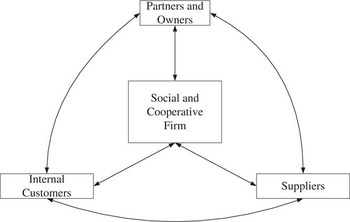
Several studies have discussed the relationships of innovation management with strategic organizational performances within private firms (Gatignon & Xuereb, Reference Gatignon and Xuereb1997). However, the systems of social entities and the operative dynamics in social and cooperative firms require special attention. Actually, they are alternative forms of business organization, whose managerial decisions are profoundly influenced by their strategic relationship with main stakeholders. The configuration of these relationships becomes very complex because of the coexistence of members which assume a triple role in a social and cooperative firm, including as partners-owners, as suppliers of products commercialized by the firm and as internal customers benefiting from a range of services within the firm (Narver & Slater, Reference Nair and Bhatnagar1990; Olson, Slater, & Hult, Reference Nunnally2005).
A social and cooperative firm is an autonomous organization. Participants work with high aspirations through a jointly owned and democratically controlled environment for the purpose of their similar goals including economic, social and cultural needs (International Cooperative Alliance, 2010). They put members, but not capital, at the heart of all their business. These companies can be defined in terms of three basic interests: ownership, control and beneficiary. Only in the social and cooperative enterprise are all three interests in the hands of the participants. They follow a broader set of values other than those associated purely with making a profit. Because social and cooperative firms are owned and democratically controlled by their members, the decisions must balance the need for profitability with the need for interests of the community (International Cooperative Alliance, 2010). Firms manage relationships with stakeholders and handle trade-offs among competing stakeholders based on their corporate cultures and institutions (Jones, Felps, & Bigley, Reference Jones, Felps and Bigley2013). Nevertheless, managerial decisions in social and cooperative firms are profoundly influenced by the organizational relations in whom they are embedded. It implies that the need to identify organization-level factors could help predict how these firms manage their stakeholder relationships (Tangpong & Pesek, Reference Tangpong and Pesek2007). McAdam, McAdam, Dunn, and McCall (Reference Maclndoe and Barman2015) examined how a combined innovation and social network perspective can be adopted in regional horizontal networks within the small and medium-sized enterprise agrifood sector to develop innovative capability and outcomes. A complex life cycle development was found within the regional SME networks, and the development required unique strategies to attain explorative and exploitative innovation-based knowledge exchange at different life cycle stages.
The assignment of property rights implies that the decision making process becomes inefficient because some partners try to influence results of voting or any agreement arranged by the majority (Lybbert & Sumner, Reference Lybbert and Sumner2012). Strategic decisions will be harder to carry out since there are heterogeneity and conflicting interests among members of a firm. This situation lets strategic management difficult to make decisions, and the firm becomes politicized. Thus, it definitively increases the discretion of managers to impose their own preferences, and all of these would make the firm more vulnerable to the prospects and exigencies of stakeholders. In this sense, it requires special comprehension of triad concept of members and its influence on the organization governance. This triad constitutes characteristic factors of social and cooperative firms. The influence of this triad may lead the firm to make more ‘organization-oriented’ rather than ‘profit-oriented’ or more ‘technology-oriented’ rather than ‘market-oriented’ strategic decisions (Freeman, Reference Freeman1999; Tangpong & Pesek, Reference Tangpong and Pesek2007; Jaskyte, Reference Jaskyte2014; Nair & Bhatnagar, Reference Meyer and Rowan2015).
The Conceptual Model and Some Proposed Hypotheses
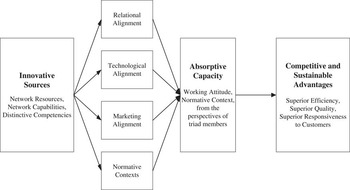
A conceptual model is displayed in Figure 1 for the purpose of identifying innovation sources and analyzing their relationship with strategic organizational performance. Innovative sources originate from network resources, network capabilities and distinctive competencies. Network resources contain both tangible properties, such as financial capital, core equipment, complementary technologies and human resources, as well as intangible properties, like patents, trademarks and brand loyalty. Mutual trust, interorganizational structure, working processes and specific control systems are the network capabilities of a firm (Abecassis-Moedas & Mahmoud-Jouini, Reference Abecassis-Moedas and Mahmoud-Jouini2008). Distinctive competencies are the capabilities to integrate and coordinate network resources and capabilities to produce superior performances (Spear & Bowen, Reference Spear and Bowen1999). Innovation sources may be classified into relational alignment, technological alignment, marketing alignment and normative contexts, which will be discussed in the subsequent section. Absorptive capacity, mediating the relationship of innovative sources with corporate performance, may be measured based on working attitudes and normative contexts. From Figure 2, opinions related to the above measurement should be considered from the perspectives of a triad: partners and owners, suppliers and internal customers, because of the complexity of making decisions in nonprofit organizations (Nair & Bhatnagar, Reference Meyer and Rowan2015). Absorptive capacity allows firms to differentiate their offerings and lower their cost structure, resulting in superior quality, superior efficiency and superior responsiveness to customers (Hill & Jone, Reference Hill and Jones2007). Thus, firms can achieve competitive and sustainable advantages (Zhao & Wu, Reference Zhang2014).
The relationship among innovation sources, absorptive capacity and competitive/sustainable advantages

Three different roles in a social and cooperative firm

The classification of innovation sources
For the design of the questionnaires, the authors thoroughly studied literature reviews and interviewed 25 experienced managers in three leading agrifood firms, and 25 professional managers in five major private firms in China. The characteristics of the representative agrifood firms are introduced as follows. The Hansun Cooperative is one of the leading firms providing a complete range of vegetables and fruits to supermarket chains throughout the year. Food safety, sustainable development, innovation and logistic efficiency have a higher priority in their activities. The Moondragon Cooperative represents another leading agrifood firm in China. Its mission is to adopt democratic methods in its organization, take special emphasis on job creation, promote its workers in humanistic and professional terms, and commit to the development of its social environment. Entrepreneurial innovation is the heart of creation for the permanent employment in the Moondragon Cooperative. These innovation activities have two different scopes: an internal scope including processes, products and management innovations, and an external scope including the creation of mixed technological centers, entrepreneurial involvement structures for young people and entrepreneurial intercooperation elements. The Onecoop Cooperative is also a market leader in the field of fruit and vegetables in China. This firm focuses on improving varieties of products and developing new products (i.e., seeds) to suit changing consumer trends. Red and yellow seedless watermelons, vine tomatoes, nectarines and various kinds of lettuce are some of the new products successfully introduced into the market. These three agrifood firms provide lots of revolutionary new products that offer new opportunities to both farmers and customers. They have set up strict quality standards and R&D systems aimed at improving processes and procedures. They have brought production line paralleled with demand from the perspective of quality, seasons, varieties, volume, and adopted hazard analysis and critical control point methodology for food safety. Oppositely, the five private representative firms are from new energy, flat panel display, information technology, shoes and clothes industries.
Previous papers have summarized the classification of innovation sources for developing new products and services into three dimensions: relational alignment, technological alignment and marketing alignment (Emden, Calantone, & Droge, Reference Emden, Calantone and Droge2006; Spithoven, Frantzen, & Clarysse, Reference Spithoven, Frantzen and Clarysse2010). Castro (Reference Castro2015) asserted that firms, especially in knowledge-based and high-tech industries, need to rely on external relationships and networks for complementing knowledge domains and developing better and faster innovations. Three constructs that are interrelated and should be focused include collaborative/open innovation, absorptive capacity and market orientation. However, for nonprofit firms, the operative dynamics of social entities are profoundly influenced by conflicting interests between the participants and its main stakeholders. Freeman (Reference Freeman1999), Tangpong and Pesek (Reference Tangpong and Pesek2007), Hienerth and Lettl (Reference Hienerth and Lettl2015) pointed out the need to identify normative factors that could help predict how these firms manage their stakeholder relationships and their innovation sources. Accordingly, our paper extends the framework for the classification of innovation sources to include a new ‘normative contexts’ factor. The assumptions of the framework for innovation sources cover four basic phases: (1) relational alignment (belief of value, similar culture and close relationships, etc.); (2) technological alignment (technology complementarities, facility complementarities, overlapping knowledge bases, etc.); (3) marketing alignment (market complementarities, market share and quality, etc.); and (4) normative contexts (structure control, institutional rule, motivation correspondence, etc.).
The relationships of innovation sources with corporate performances
Based on the conceptual model shown in Figure 1 and the characteristics of social and cooperative firms described in the Literature Review section, the paper proposes the following hypotheses.
Hypothesis a : Relational alignment has positive relationship with absorptive capacity.
Hypothesis b : Technological alignment has positive relationship with absorptive capacity.
Hypothesis c : Marketing alignment has slightly positive relationship with absorptive capacity.
Hypothesis d : Normative contexts have negative relationship with absorptive capacity.
Social and cooperative firms aim to provide overall services to their participants rather than to merely earn a return from an investment (International Cooperative Alliance, 2010). Therefore, decisions made balance the need for profitability with the needs of the interests of the community. These firms are used to making more ‘organization-oriented’ rather than ‘profit-oriented,’ or more ‘technology-oriented’ rather than ‘market-oriented’ strategic decisions, which are profoundly influenced by the organizational relations in which they are embedded (Freeman, Reference Freeman1999; Tangpong & Pesek, Reference Tangpong and Pesek2007; Jones, Felps, & Bigley, Reference Jones, Felps and Bigley2013; Nair & Bhatnagar, Reference Meyer and Rowan2015). Relational alignment actively integrates the abilities of external members, solves information asymmetry to promote knowledge flow, and provides professional service to increase customer knowledge. As a result, most members have stronger common visions and beliefs, and favorable attitudes may also be stronger. In addition, specialized farm cooperatives mainly offer services to their members by purchasing, marketing, processing, transporting and storing farm products, and provide technologies and information related to agricultural production and operation. Technological alignment and marketing alignment should motivate members to possess stronger working attitudes, and so result in positive impacts on absorptive capacity. Contrarily, normative contexts, emphasizing efficiency and effectiveness, may result in a lower capacity for action and reformative commitment (Zilber, Reference Zilber2002). Most members of firms influenced by stronger normative contexts for competitive environments may have less favorable attitudes.
Hypothesis e : Absorptive capacity has positive relationship with the performance of firms.
The absorptive capacity is seen as central to the performance of firms (Zhang, Baden-Fuller, & Nangematin, Reference Zhao and Wu2013). Thus, it may enhance the competitive and sustainable advantages of firms.
Data Collection and Analysis
This empirical study on agrifood firms is carried out because of the peculiarities and significances of this sector, as well as the importance of this major type of nonprofit organization in China. This paper will compare innovation sources and their impacts on final performance in nonprofit firms and in private firms.
Research setting and data collection
Based on the proposed model in Figure 1 and extensive literature reviews and interviews, 41 innovation sources, absorptive capacity (measured from the perspectives of working attitudes and normative contexts by three kinds of triad members), and competitive and sustainable advantages (including superior efficiency, superior quality and superior responsiveness to customers) were included in the questionnaires. This paper then organizes experts’ opinions and adopts a statistical analysis to obtain objective results. Based on a 7-point Likert scale, 546 participants (including owners/partners, internal customers and suppliers) from 147 agrifood firms and 824 participants from 212 private firms were asked to evaluate the significant contributions to realizing competitive and sustainable advantages. The answers with high scores indicate that the participants strongly approve of the attribute, and low scores reflect disapproval.
Data analysis and discussions
The data were analyzed using a t-test procedure; there is no significant difference (p<.05) between the interview and mailed responses. Since some variables may influence the results, variables such as age, gender, areas and level of education were examined. However, the results did not show any significant difference.
Innovation sources of agrifood and private firms
(a) Factor analysis
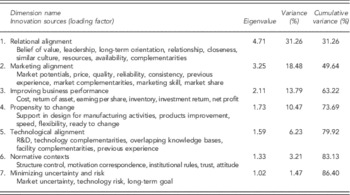
The responses were collected and then evaluated by factor analysis to differentiate the significant attributes and create similarity measures among the attributes. After analyzing the answered questionnaires by factor analysis, innovation sources with eigenvalues >1 were extracted as common factor dimensions. Cronbach α equaling 0.812 suggests a satisfactory level of reliability, and an average-variance extracted scoring 0.753 demonstrates a convergent level of validity (Fornell & Larker, Reference Fornell and Larker1981; Streiner, Reference Streiner2003). Rotated method, varimax with Kaiser Normalization, was adopted to determine the extracted factors. The evaluation factors in the same group were put together, and the factors with a loading >0.40 were selected. Then, the extracted innovation sources for agrifood and private firms were obtained as follows: relational alignment, marketing alignment, improving business performance, propensity to change, technological alignment, normative contexts, minimizing uncertainty and risk. Table 1 lists the eigenvalues, variances and cumulative variances of these seven extracted innovation sources, and these seven sources can explain 86.40% of the variances in the original data.
The innovation sources of the firms

(b) Cluster analysis
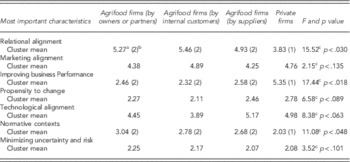
The different extracted innovation sources are then compared in agrifood firms and in private firms. These comparisons involve an analysis of variance test with a Benforroni post hoc pairwise comparison test. Analysis of variance is used to examine the differences in the mean values of the dependent variables associated with the effect of the independent variables. Table 2 shows that the results have different relationships for agrifood firms and private firms. The solutions differ significantly at the 5% level for the three extracted characteristics: ‘relational alignment,’ ‘improving business performance’ and ‘normative contexts’. The most important characteristics for agrifood firms from the perspective of owners (and partners) are ‘relational alignment (5.27),’ ‘technological alignment (4.45),’ ‘marketing alignment (4.38)’ and ‘normative contexts (3.74).’ The results make sense since agrifood firms are more ‘relationship-oriented’ rather than ‘market-oriented’ and more ‘technology-oriented’ rather than ‘profit-oriented.’ The most important characteristics for agrifood firms from the perspective of internal customers are ‘relational alignment (5.46),’ ‘marketing alignment (4.89),’ ‘technological alignment (3.89)’ and ‘normative contexts (2.98).’ Compared with the ranking from the owners (and partners), the second and the third most important characteristics are switched since internal customers tend to be more focused on marketing management. The most important characteristics for agrifood firms from the perspective of suppliers are ‘technological alignment (5.17),’ ‘relational alignment (4.93),’ ‘marketing alignment (4.25)’ and ‘normative contexts (3.38).’ Compared to the ranking from the owners (and partners), the first and the second most important characteristics are switched since suppliers tend to be more focused on quality and innovation management. Oppositely, the most important characteristics for private firms are ‘improving business performance (5.35),’ ‘technological alignment (4.98),’ ‘marketing alignment (4.76)’ and ‘relational alignment (3.83).’ Since private firms focus on effectiveness and efficiency, they are more ‘profit-oriented’ and ‘market-oriented.’
Results for agrifood and private firms

Notes.
a Mean based on 7-point Likert scale comparing the data collected in the end of 2014.
b Numbers in parentheses indicate the cluster groups from which this cluster is significantly different at α=0.05 according to the Bonferroni, post hoc pairwise comparison procedures.
c F and corresponding p-values based on analysis of variance test.
The relationships of innovation sources with competitive and sustainable advantages
(a) Agrifood firms (the perspective of owners and partners)
Absorptive capacity is operationalized as a second-order latent factor reflective of the four first-order factors (with the highest cluster mean value): relational alignment, technological alignment, marketing alignment and normative contexts, which is consistent with the works of other scholars (Leana & Pil, Reference Leana and Pil2006; Fredette & Bradshaw, Reference Fredette and Bradshaw2012). Our first-order factors are measured by using a series of scales that have demonstrated reliability and validity in prior researches. In all cases, item wording and scale content are adapted to fit our research context.
The research operationalizes relational alignment by asking respondents to rate their level of agreement or disagreement with a given statement. Nine items were measured, including ‘belief of value,’ ‘leadership,’ ‘long-term orientation,’ ‘relationship,’ ‘closeness,’ ‘similar culture,’ ‘resources,’ ‘availability’ and ‘complementarities.’ For example, the triad members share similar value beliefs with one another from their environments of normative contexts and working attitudes. The result has a Cronbach’s α of 0.82.
Technological alignment was measured by asking respondents to rate five items, including ‘R&D,’ ‘technology complementarities,’ ‘overlapping knowledge bases,’ ‘facility complementarities’ and ‘previous experience.’ An example in the measurement includes ‘the triad members acknowledge the importance of overlapping knowledge bases with one another from the perspectives of normative contexts and working attitudes.’ The result has a Cronbach’s α of 0.79.
Marketing alignment was measured by asking respondents to rate nine items, including ‘cost,’ ‘price,’ ‘quality,’ ‘reliability,’ ‘consistency,’ ‘previous experience,’ ‘market complementarities,’ ‘marketing skill’ and ‘market share.’ An example in the measurement includes ‘the triad members acknowledge the importance of sharing previous experience with one another from their environments of normative contexts and working attitudes.’ The result has a Cronbach’s α of 0.76.
Five items, including ‘trust,’ ‘attitude,’ ‘structure control,’ ‘motivation correspondence’ and ‘institutional rule,’ were adapted to operationalize normative contexts. For example, an item used as an indicator of normative contexts construct can be ‘the triad members acknowledge the importance of structure control with one another from the perspectives of normative contexts and working attitudes (reverse coded).’ The result has a Cronbach’s α of 0.85.
In the analysis of competitive and sustainable advantages, the research constructs and tests the fit of a first-order measurement model composed of three items measured on a 7-point Likert scale. Respondents were asked to rate their satisfaction with their firms’ capability to achieve competitive and sustainable advantages using three items: (1) superior quality such as increasing market share, entering new markets and improving quality of product; (2) superior efficiency such as gaining a higher return on investment, and lowering cost of product; and (3) superior responsiveness to customers such as increasing customer satisfaction, and reducing response time for customer complaint. The measurement model of competitive and sustainable advantages provides a very good approximation for the data (χ2/df=0.726, p=.435; CFI=1.000; RMSEA=0.000, p-close=.614), with all three items strongly loading on a single latent factor. The result has a Cronbach’s α of 0.85.
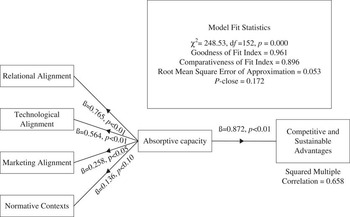
Based on the above results, the overall fit of the structural model and the relationships among variables are examined. The results show that Pearson coefficients of each first-order construct are relatively consistent with prior research (Leana & Pil, Reference Leana and Pil2006; Fredette & Bradshaw, Reference Fredette and Bradshaw2012). Next, the paper illustrates the structural model in Figure 3, and provides a summary of model fit statistics with standardized regression weights and squared multiple correlations to demonstrate the relative contribution of each facet on absorptive capacity, as well as the influence of absorptive capacity on competitive and sustainable advantages. Our structural model provides a good approximation for the underlying structure of the data (χ2/df=1.635, p=.000; GFI=0.961; CFI=0.896; RMSEA=0.053, p-close=.172), thus suggesting that our theorizing of the relationship is appropriate (Arbuckle, Reference Arbuckle2007). In addition, we find strong support for our first hypothesis (β=0.765, p<.01) that a relational alignment positively contributes to absorptive capacity. Our second hypothesis, which predicts a positive influence of technological alignment on absorptive capacity, is also supported (β=0.564, p<.01). Hypothesis 3, which predicts a slightly positive relationship between marketing alignment and absorptive capacity, is supported in the predicted direction (β=0.258, p<.05). Our fourth hypothesis, which predicts a negative impact of normative contexts on absorptive capacity, is not supported and not significant (β=0.136, p<.10). Finally, and perhaps most importantly, we find support for our fifth hypothesis that absorptive capacity is positively related to competitive and sustainable advantages (β=0.872, p<.01), with the predictor accounting for an estimated 65.8% of variance in our dependent variable as derived from the squared multiple correlation.
The structural model of innovative sources – corporate performance relationship (agrifood firms from the perspectives of owners and partners)

(b) Agrifood firms (the perspective of internal customers and suppliers)
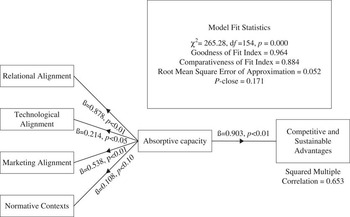
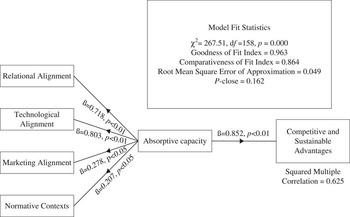
Applying the same methods and procedures, a structural model for agrifood firms from the perspective of internal customers is shown in Figure 4. Similarly, a structural model for agrifood firms from the perspective of suppliers is shown in Figure 5.
The structural model of innovative sources – corporate performance relationship (agrifood firms from the perspectives of internal customers)

The structural model of innovative sources – corporate performance relationship (agrifood firms from the perspectives of suppliers)

(c) Private firms
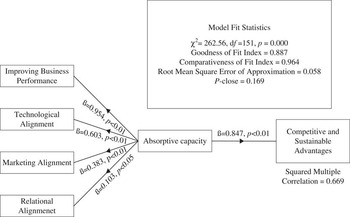
For private firms, the structural model for relationships between innovative sources and corporate performance is obtained and shown in Figure 6. Improving business performance would positively contribute to absorptive capacity (β=0.954, p<.01). A positive influence of technological alignment is on absorptive capacity (β=0.603, p<.01). A positive relationship between marketing alignment and absorptive capacity is predicted (β=0.383, p<.01). A positive relationship between relational alignment and absorptive capacity is predicted (β=0.103, p<.05). Finally, absorptive capacity is positively related to competitive and sustainable advantages (β=0.847, p<.01).
The structural model of innovative sources – corporate performance relationship (private firms)

Discussion and Conclusion
This paper finds that the characteristics of innovation sources of agrifood firms and private firms differ significantly at the 5% level for three extracted characteristics: ‘relational alignment,’ ‘improving business performance’ and ‘normative contexts.’ Private firms focus more on ‘improving business performance,’ while agrifood firms put more stress on ‘relational alignment.’ Our paper concludes that the influence of triad members leads firms to make more ‘organization-oriented’ rather than ‘profit-oriented’ strategic decisions. In addition, this paper also finds that while the origins of innovation sources for different kinds of triad members in agrifood firms are the same, their prioritizing orders differ. The most important characteristics for agrifood firms are ‘relational alignment’ from the perspective of owners (and partners), ‘relational alignment’ and ‘marketing alignment’ from the perspectives of internal customers, and ‘technological alignment’ from the perspective of suppliers. However, the relationship of normative contexts with absorptive capability differs among the triad members. Its value is positive with no significance (β=0.136, p<.010) from the perspective of owners, negative without significance (β=−0.108, p<.10) from the perspectives of internal customers and negative with significance (β=−0.207, p<.05) from the perspectives of suppliers. Finally, the structural models for private firms and agrifood firms are compared. For private firms, extracted innovation sources, including ‘improving business performance,’ ‘technological alignment,’ ‘marketing alignment’ and ‘relational alignment,’ have positive and significant impacts on competitive and sustainable advantages. However, for agrifood firms, ‘normative contexts’ replace ‘improving business performance,’ and negative impacts on competitive and sustainable advantages only happen from the perspectives of suppliers and internal customers. In addition, when comparing opinions from the differing views of triad members in agrifood firms, the paper finds that the value and the significance of each coefficient differ slightly.
Current existing typologies of innovation sources are mostly related to private organizations, whose social systems and operative dynamics are very different from nonprofit entities. In addition, the coexistence of members, including partners-owners, suppliers and internal customers, complicates the decision making related to innovation. This paper provides an assessment for the use of innovation sources and finds critical factors that will result in sustainable and competitive advantages in one of the main types of nonprofit organizations. The contributions of this paper include the following stages. First, a conceptual model associated with an empirical investigation on social and cooperative agrifood firms in China is proposed in order to examine relationships of innovation sources with competitive and sustainable advantages. Second, the innovation sources are categorized by factor analysis into four extracted dimensions, and are compared by cluster analysis for private firms and agrifood firms. Third, this paper adopts absorptive capacity from the perspectives of working attitudes and normative contexts as a mediator to examine the relationships of categorization of innovation sources with strategic organizational performance. The results were originally found in nonprofit sectors; in this paper, the integrity of the theory, as it relates to absorptive capacity, is reinforced. Fourth, because of the complexity of making decisions in nonprofit organizations, opinions related to the above measurements are considered from the perspectives of three kinds of triad members.
Acknowledgments
The authors thank the three anonymous reviewers for many helpful comments and suggestions that led to significant improvement for the paper. In addition, the authors are thankful for the support from the Science and Technology Development Fund of Macau (Grant no. 069/2011/A).