International adoption and the abrupt change of linguistic environment
The adoption of children from abroad to affluent western countries has evolved over the last 50 years. In some countries statistics show a considerable recent increase; in the U.S., for example, the number of children involved has doubled over the last ten years and now amounts to approximately 22,000 per year (U.S. Department of State, 2007). In France there has been an increase from around 2,500 international adoptions per year at the end of the 1980s to approximately 4,000 per year from 2003 onwards (Ministère des Affaires étrangéres, 2007). Population statistics from other countries such as Canada present a stable number of around 2,000 international adoptions yearly since 1995 (Adoption Council of Canada, 2007). In Sweden, which is the setting for the present study, the number of children adopted from other countries has been stable at approximately 1,000 per year since 1969 (MIA, 2007). The majority of international adoptions concern infants, but where statistics are available figures show that between 5 and 10 percent arrive at ages 4–5 years and another 10 percent arrive at the age of 6 years or older.
China, Guatemala, Russia, South Korea, and Ukraine are among the leading countries for international adoption, but many other developing or war-torn countries in Asia, Europe, South America and Africa are among the providers. It is a fact that the majority of children come from countries where the language spoken differs from the one spoken by the adoptive families. What is common to the children is that they have experienced one or more social separations, and in the majority of cases they have spent time at an institution before being adopted. While the understanding of emotional, cognitive and educational effects of international adoption is becoming fairly well established (see, e.g., van Ijzendoorn, Juffer and Klein Poelhuis, Reference van Ijzendoorn, Juffer and Klein Poelhuis2005), the study of linguistic effects is still limited. Nevertheless, it is clear that whatever L1 development has taken place before the adoption, within a period of time with no exposure to this language in the new linguistic environment, the child rapidly becomes unable to use the L1 (Glennen and Masters, Reference Glennen and Masters2002). The length of this period may be weeks or months depending on the age at adoption and corresponding L1 development of the individual child. It is important to note that even children who have been adopted as late as around the age of 10 are reported to be unable to use their L1 after a relatively brief period of time (Gardell, Reference Gardell1979; Hene, Reference Hene1987, Reference Hene, Hyltenstam and Lindberg1993).
Internationally adopted children are thus unique as language acquirers. They are similar to L1 learners in that they acquire the new language from child-directed speech in their families, but differ from L1 learners in that they have some prior experience with another language. They are similar to normal L2 learners in that they acquire the new language after one language has been established, at least to some extent, but differ from normal L2 acquirers in that the learning and use of the first language ends as the learning of the second starts. Furthermore, many of them can be categorized with simultaneous bilinguals in that they acquire two languages before the cut-off point of age three (McLaughlin, Reference McLaughlin1984: 10), but they differ from this group because their experience of acquiring each language is clearly successive. This situation evokes two theoretical questions. The first is what long-term effects the non-use of the L1 has, whether it leads to a loss of actual linguistic competence in this language or rather is limited to a processing or access problem. In other words, is the long-term inability to use the L1 associated with language representation or with production, perception and control? The second question concerns the acquisition of the language of the new environment. Does the abrupt change of language environment have any specific effects on the acquisition of the L2 as compared to the more usual situation where a new language is added while the first language is still in communicative use, as is the case with children who immigrate with their families? The present article aims at contributing answers to these two questions.
Dominant-language change
As far back as the first case studies of child bilingualism, we have clear documentation of the fact that one of the child's languages often dominates the other, and that the strength of a language in the child's repertoire corresponds to the frequency and quality of input in each language (Leopold, Reference Leopold1939–1949). This imbalance may occur not only in cases of second language acquisition, where one language is added later, but also in situations where both languages are acquired simultaneously from the start, as two L1s (Bernardini and Schlyter, Reference Bernardini and Schlyter2004), even though simultaneous bilinguals in many ways resemble monolingual L1 acquirers (for an overview, see Genesee and Nicoladis, Reference Genesee, Nicoladis, Hoff and Shatz2006). The child may feel less confident, less comfortable, or indeed less fluent in the weaker language due to actual restrictions in its lexicon and grammar and/or restrained access to these linguistic levels. In addition, as Leopold's study of his daughter Hildegard's English–German bilingualism clearly illustrates, a change in language domination pattern in the individual young bilingual child is the normal consequence of significant environmental changes of input, as, for example, when the child moves from a country where one of the two languages is socially dominant to a country where the other language has this role. We will refer to this phenomenon as dominant-language change. As has been pointed out many times, “‘balanced’ bilinguals, those who are equally fluent in both languages, are probably the exception and not the norm” (Grosjean, Reference Grosjean1982, p. 235), or, in an even stronger formulation, “[m]onolingual-like attainment in each of a bilingual's two languages is probably a myth (at any age)” (Harley and Wang, Reference Harley, Wang, De Groot and Kroll1997, p. 44). A change of language dominance is a frequent phenomenon in the present world of migration, not only during childhood; Grosjean (Reference Grosjean1982, p. 238) reports on his own threefold change of dominant language over the first three decades of his life, from French to English, back to French and then back to English again.
It is also clear that a language, once dominant in a bilingual child, may become entirely inaccessible to the child within a short time-span of non-use due to lack of input in that language. Burling's (Reference Burling1959) well-known case study of his son Stephen's Garo–English bilingualism provides a good illustration. At the age of five, after the family's return from India to the U.S., Stephen was no longer able to use his earlier dominant language, Garo. Faced with this fact Burling contemplates “whether hidden deep in his unconscious [Stephen] may not still retain a remnant of his former fluency in Garo that might be reawakened if he again came in contact with the language” (p. 67).
Although present knowledge about the process of regaining a language that has become inaccessible due to non-use is limited, various accounts indicate that it is generally a rapid process, although less so for younger than for older children (Yukawa, Reference Yukawa1997, p. 226). Research within the framework of the savings paradigm, first applied to the field of language attrition by de Bot and Stoessel (Reference de Bot and Stoessel2000), encourages the hypothesis that even after a long period of time, a once “forgotten” language may be “reawakened” (de Bot, Martens and Stoessel, Reference de Bot, Martens and Stoessel2004). This is in line with the idea put forth by Bahrick (Reference Bahrick1984) in his often-cited study of long-term retention (cf. his notion permastore) in situations of non-use of foreign language skills in Spanish. After an initial period of rapid “forgetting”, residual knowledge may be retained at a stable level over long periods of time; Bahrick documented such knowledge after 50 years of non-use. An additional piece of evidence relevant to the regaining issue comes from research on people who overheard or spoke a language during childhood and abandoned it later on. Such studies have found that the early exposure is advantageous when relearning certain phonological features (Au, Knightly, Jun and Oh, Reference Au, Knightly, Jun and Oh2002; Oh, Jun, Knightly and Au, Reference Oh, Jun, Knightly and Au2003). Findings of this kind lend support to the assumption that remnants of a lost language can be expected to be found primarily at the phonological level.
Dominant-language replacement: two recent investigations
The present article focuses on the special case of dominant-language change that results from the removal of a monolingual child from his/her L1 environment and his/her introduction into a setting where a different language is spoken. Situations of this type, typically manifested in cases of internationally adopted children, have received focused attention over the last decade. The linguistic effects for the individual child who is moved from one monolingual situation into another will here be referred to as dominant-language replacement.Footnote 1 On the level of the individual, the notion of dominant language is generally used to account for the lack of balance between two languages in bilinguals. Accordingly, although the status of the adoptees' L1 is at stake here, and even if the process of dominant-language replacement entails going from monolingualism in L1 to a subsequent apparent “monolingualism in L2”, it is our basic assumption that there is still an interaction between two languages, in this case one that is entirely dominant and another one that is completely inaccessible but still present in some form of representation. We would like to underscore that we are thus talking about replacement of a language in the role of dominance, not about replacing one language entirely with another language.
In particular, we will discuss two recent studies, one by Pallier, Dehaene, Poline, LeBihan, Argenti, Depoux and Mehler (Reference Pallier, Dehaene, Poline, LeBihan, Argenti, Dupoux and Mehler2003) and the other by Ventureyra, Pallier and Yoo (Reference Ventureyra, Pallier and Yoo2004), that have addressed the interdependence of L1 attrition and L2 acquisition in children who have experienced what appears to be – and what the authors interpret as – a “total” loss of their L1 and a corresponding “complete” acquisition of their L2. These authors investigated attrition in adoptees of Korean origin living in France. The participants of each study arrived in France at ages 3–8 years and 3–9 years, respectively, and their length of residence was approximately 20 years. Using functional magnetic resonance imaging (fMRI), Pallier et al. (Reference Pallier, Dehaene, Poline, LeBihan, Argenti, Dupoux and Mehler2003) examined brain activation patterns in the adoptees when they were exposed auditorily to Korean and French, as well as to other languages. In addition, the participants performed behavioural tests on Korean including sentence identification, translation and speech segment tasks. The results suggested that there was no difference between the adoptee group and the L1 French control group regarding activation patterns in relation to Korean exposure. Ventureyra et al. (Reference Ventureyra, Pallier and Yoo2004) examined discrimination of Korean voice onset time (VOT) categories and found no differences between the adoptees and the French control group. There was no advantage for those with higher ages of adoption compared to those who had been adopted at a younger age. In both studies, the authors concluded that despite the earlier exposure to Korean, the adoptees seemed to have no advantages in the Korean tests in comparison with the French control group. Furthermore, the authors characterized the adoptees' proficiency in L2 French as entirely nativelike, something that was interpreted to have been made possible through their total L1 loss: “When exposure to L1 ceases, then the [neural] network could somehow ‘reset’ and L2 would be acquired fully” (Ventureyra et al., Reference Ventureyra, Pallier and Yoo2004, p. 89).Footnote 2 It should be noted that Pallier et al. and Ventureyra et al. did not discuss language acquisition beyond puberty.
Observing that their results differed from those obtained in studies of L2 ultimate attainment in immigrant children who maintain their L1, such as Johnson and Newport (Reference Johnson and Newport1989) or Weber-Fox and Neville (Reference Weber-Fox and Neville1999), Pallier et al. and Ventureyra et al. suggested that the negative correlation between age of onset (AO) and the L2 ultimate attainment observed in these studies should not be ascribed to the reduction of brain plasticity as predicted by the Critical Period Hypothesis (CPH) or, more generally, by any maturational account. Instead, the authors considered that the lack of L2 nativelikeness observed in such studies was due to the “stabilization” of the neural network that subserves the maintained L1, this stabilization thus acting as “a filter that distorts the way in which a second language can be acquired” (Pallier et al., Reference Pallier, Dehaene, Poline, LeBihan, Argenti, Dupoux and Mehler2003, p. 160). In other words, L1 was supposed to obstruct or even block the full acquisition of an L2. Pallier et al. use the term interference to characterize such obstruction. As this term is generally used for more specific aspects of cross-linguistic influence in second language acquisition (SLA) research at large, we prefer to focus on obstruction or blockage and refer to Pallier et al.'s position as the Impediment Hypothesis (IH) rather than using their terminology. In any case, the IH thus suggests that there is a considerably high plasticity in the language processing system up until the end of the first decade of life. This would account for the severe L1 attrition observed in the adoptees of their studies, that is, even among those who were adopted as late as nine years of age.
Several questions remain, however. First, in spite of what seem to be clear results in the Pallier et al. and Ventureyra et al. studies, one can ask, as the authors do themselves, whether the L1 was attrited to such an extent that there was no residual knowledge at all that could have been registered or documented with other techniques. Secondly, it is not clear whether the claim that the L2 French was indistinguishable from native speaker versions of French is correct. Thirdly, there is no accounting for the implications of the age at which attrition starts. Moreover, there is reason to question the general absence of differences between participants with different ages of attrition; on the basis of a maturational account, which is indeed rejected by the authors, the fate of both L1 and L2 ought to differ depending on whether the child is taken to a new linguistic environment at the age of one, two, five, or ten.
With respect to the first of these problems, to the best of our knowledge no published data exist on residual L1 knowledge in adoptees other than those presented by Pallier et al. and Ventureyra et al. Therefore, the data that we will present below on possible L1 remnants in Korean adoptees in Sweden add new information on this issue.
Regarding the second problem, again no detailed linguistic analyses of the L2 ultimate attainment in adoptees have been published. However, a number of studies have been carried out on L2 acquisition in international adoptees during their first post-adoption years (see Roberts, Krakow and Pollock, Reference Roberts, Krakow and Pollock2003; Krakow and Roberts, Reference Krakow and Roberts2003; Xing Tan and Yang, Reference Xing Tan and Yang2005). In these studies the age of adoption is usually below 36 months and the vast majority (85% according to Roberts et al., Reference Roberts, Krakow and Pollock2003) of the participants are reported to score as well as their native-born peers on vocabulary tests. A study by Snedeker, Geren and Shafto (Reference Snedeker, Geren and Shafto2007) with participants in the age range of 2;7 to 5;6 (years;months) showed that the adoptees went through the same stages as L1 infants in terms of vocabulary acquisition and syntactic complexity but more rapidly (“at roughly 4 times the rate of infants”, p. 83).
Two investigations treating long-term aspects of L2 proficiency in adoptees are particularly relevant to our discussion. The first is Gardell's (Reference Gardell1979) report on the situation of 177 internationally adopted children in Sweden. The age of arrival of the adoptees ranged from 3 months to 12 years (biased below 6 years of age) and their chronological ages at the time of the study were equally distributed from 10 to 18 years. The children claimed not to remember anything of their L1, except for some children with higher ages of adoption, who could remember individual words such as the word for “teddy bear” or even fragments of a nursery rhyme. Several of the children expressed frustration with expectations in the environment that they knew their L1. Gardell concluded that 43% of the participants showed deviations in Swedish language use when compared to their Swedish-born peers. The non-native features found in the adoptees comprised errors in both syntax and morphology, as well as “inexplicable gaps” in the understanding of “perfectly common, basic Swedish words” (p. 37). It was also pointed out that the language problems became more salient when the adoptees reached the senior level of elementary school and new demands were made on their command of Swedish (p. 38). Even though the report might be limited in the sense that detailed linguistic observations are lacking, we maintain that the findings can be seen as an indicator that L2 acquisition in adoptees does not result in a more nativelike L2 than that of immigrant children who arrive together with their families and therefore maintain their L1.
Another important – and linguistically more systematic – account is Hene's (Reference Hene1993) investigation of L2 Swedish vocabulary comprehension in 24 international adoptees. A matched group of 24 native Swedish children was also included. The post-adoption period in this study was 6–10 years, and the age of arrival ranged from 3 months to 6 years. The chronological age of the participants at the time of the study was 10–12 years. None of the children had any “active command” of their L1 except in some cases when they claimed to remember one or two individual words (p. 16). Hene concluded that the L2 proficiency in the participant group showed clear non-native features. Moreover, what was remarkable about the findings was the qualitative aspect of the deviations: when compared to a native control group, the adoptees showed a surprisingly low understanding of high-frequency words and phrases such as fortfarande “still” or i början av “in the beginning of”. In Hene's (Reference Hene, Hyltenstam and Lindberg2004) study of the same children's metaphoric interpretations of adjectives, comparisons were made between results of those children who had been adopted before the age of 2 (younger-age-of-adoption group) and after the age of 2 (older-age-of-adoption group). It was observed that the younger-age-of-adoption group generally had results similar to the Swedish native controls, but more so for those who were studied at ages 10 or 11 than for those who were studied at age 12. Among the 12-year-old adoptees only one, who had been adopted at the age of 3 months, had results comparable to the native 12 year olds. Most of the participants in the older-age-of-adoption group provided almost only concrete rather than metaphorical interpretations of adjectives (p. 294). It is obvious that the observations made by Hene about the low understanding of basic vocabulary as well as the interpretation of metaphorical adjectives are congruent with – and underscore – the results presented by Gardell (Reference Gardell1979). In spite of the fact that the studies reviewed are not conclusive in terms of ultimate attainment, we suggest that they pose a serious problem to the proposal of L2 nativelikeness in participants having gone through dominant-language replacement.
The third problematic issue mentioned above, age of attrition, is generally considered an important variable for the proficiency outcome in attrition research. The existing empirical evidence supports the view that age of attrition correlates positively with degree of L1 retention (cf. Yukawa, Reference Yukawa1997, Reference Yukawa1998; Bylund, in press a). In a discussion of attrition variables, Köpke and Schmid (Reference Köpke, Schmid, Schmid, Köpke, Keijzer and Weilemar2004, p. 20) propose that “[w]ith respect to attrition, the sensitive period hypothesis would imply that the easier it is for the child to learn L2, the more likely is it that she will forget her L1”.Footnote 3 These authors suggest that children are vulnerable to attrition up until 9 years of age, which can therefore be related to a sensitive period for L2 acquisition. If this link between age and attrition exists, a later age of adoption would correlate with a higher degree of retention of L1 (cf. Bylund, Reference Bylund2008, in press b).
Aim and scope of the present article
As mentioned above, the present article focuses on the current position on dominant-language replacement expressed by Pallier et al. (Reference Pallier, Dehaene, Poline, LeBihan, Argenti, Dupoux and Mehler2003) and Ventureyra et al. (Reference Ventureyra, Pallier and Yoo2004). Our argumentation is based on empirical data taken from two ongoing research projects. In one data set we examined possible L1 remnants in 21 Korean adoptees in Sweden, who, as adults, studied Korean at a Swedish university (see Park, forthcoming ). In the other data set we focused on the ultimate L2 attainment in Swedish of 4 adults who, as children, had been adopted into Swedish families from a Spanish speaking South American background. These four second language users were participating in a larger study on age of onset and ultimate attainment in second language acquisition of Swedish (see Abrahamsson and Hyltenstam, in press ). We would like to underscore that the two sets of data from adoptees were not elicited primarily in order to address the issue of dominant-language replacement and related hypotheses per se. Instead, we realized that these data, which we already worked with for other reasons, had a strong bearing on the current theoretical discussion of dominant-language replacement. Challenging the IH, we will propose (1) that even if these participants believe they have “forgotten” their L1, it is not completely gone as L1 vestiges seem to remain, (2) that normal maturational effects are seen in the ultimate L2 attainment of individuals who have experienced dominant-language replacement, and (3) that the interdependence of L1 attrition and L2 acquisition is not a case of resetting the neural networks for an L2 made possible by a weakened or lost L1, that is, we find no evidence of a causal relationship between these two facts such that a total loss of L1 is a prerequisite for complete nativelikeness in L2.
Present data on first language remnants in adoptees
The overall design of this study was a comparison of two groups of adult learners of Korean in Sweden. One group had been adopted from South Korea as children and had thus L1 acquisition experience with Korean. The other group consisted of native Swedes with no prior experience with Korean. The issue in focus was whether the L1 experience of the adoptees had any impact on their learning of Korean.
One possible result could be that there are no differences between the two groups. Such a result would support the position of Pallier et al. (Reference Pallier, Dehaene, Poline, LeBihan, Argenti, Dupoux and Mehler2003) and Ventureyra et al. (Reference Ventureyra, Pallier and Yoo2004). Alternatively, it is possible that differences exist between the two groups, demonstrating either an advantage or a disadvantage for the adoptee group. If the adoptees are shown to have an advantage, there are several possible explanations, either related to the difference in experience with Korean earlier in life or to other background differences between the groups.Footnote 4 If their earlier experience with Korean gives the adoptee group any advantages, one might suspect that these advantages would be manifest in domains related to phonology/phonetics rather than in the domains of grammar, especially for those who were adopted at an early age, before an elaborated grammar of Korean could be expected to have developed. Furthermore, one might expect that age of adoption plays a role such that those who were adopted at a later age with a more firmly established L1 system would have a greater advantage than those adopted at a younger age. In the case of disadvantages for the adoptees, it is difficult to hypothesize a narrow linguistic background related to L1 for this. Such a result could more reasonably be assumed to result from differences in socio-psychological background factors.
Participants
The study included 32 participants, who were all current or former students of Korean at a Swedish university: 21 Korean adoptees (11 males, 10 females) and 11 native Swedes (7 males, 4 females). In addition, 3 native Korean control participants (2 males, 1 female) were included. Detailed background information and test scores for the individual participants are presented in Appendix 1. Some of this information will be commented on here. Of the adoptees, six had been adopted before age 1 year, eight at age 1–2 years, and seven at ages beyond 2 years (total range: 0;3–10;5). Prior to their Korean studies, the adoptees had been unexposed to Korean since adoption for an average of 22 years. The average length of studies for the students of Korean was approximately three years, although the variation was great: while some had completed only their first semester, some had a Ph.D. degree in Korean language and culture and were now teachers of Korean at their former department. The mean age at testing was 31 years for both the group of adoptees and the group of native Swedes, and 25 years for the Korean controls. All but one of the adoptees claimed explicitly not to have had any opportunity whatsoever to use Korean after their arrival in Sweden. One, participant, A20, claimed to have had sporadic Korean heritage language instruction during grades 7–9 (at ages 14–16 years).
The two learner groups differed from each other in some important ways. First of all, the length of Korean language study in Sweden for the adoptees was shorter than that for the native Swedes. The average length of Korean study was 2.1 years for the adoptees (SD = 1.46, range = 0.5–6 years) but 4.1 years for the native Swedes (SD = 5.15, range = 1–13 years). Secondly, although all but four participants had visited (or re-visited) Korea, the average time spent in the country was 6–7 months for the adoptees, but 12–13 months for the native Swedes. Furthermore, while in Korea, the native Swedes had on average spent a few more months on university studies of Korean than had the adoptees. Moreover, nine of the 11 native Swedes (82%), but only seven of the 21 adoptees (33%) had had continued exposure to Korean after their studies. The average time-span with no exposure to Korean after studies was three years for the adoptees. Moreover, while seven of the 11 native Swedes (64%) were, in fact, exposed to the Korean language on a daily basis (through a native Korean spouse in Sweden, boyfriend/girlfriend in Korea, and/or through their professional activities), this was the case for only two of the 21 adoptees (10%). Finally, when we asked the participants why they had chosen to study the Korean language, all of the 11 Swedes had strong integrative and/or instrumental motivations: they were very interested in languages in general, had a strong interest in Korean or East Asian culture and political/financial life, and/or had ambitions to use the language professionally in their future careers. In contrast, among the 21 adoptees, 19 gave reasons which were oriented toward origin and identity, for example, “to be able to speak with my biological mother”, “to learn more about my home country and language”, “to be able to travel around in my home country some day”, “to strengthen my Korean identity”, or “to feel more Korean”. The instrumental and/or integrative reasons given by the native Swedes for taking Korean may have made them better prepared for the persistent and hard work that language studies indeed require, especially in a language so distant from Swedish as Korean.
All the above differences suggest that the learning circumstances for the native Swedes may have been more favourable than those of many of the adoptees. Nevertheless, since Swedish students of Korean are, on the whole, difficult to find, these were the individuals that could be included as participants in the present study.
Procedure and materials
All participants, including the native Korean controls, first went through a hearing test with an OSCILLA SM910 screening audiometer. In order to make sure that the participants' knowledge of Korean was sufficiently good for the following tests, the learner participants also went through a relatively simple translation task (from Korean to Swedish). After that, they answered a questionnaire, which gathered information on their background, age, previous studies, reasons for studying Korean, etc. All participants were then tested individually in a sound-treated room, and the whole session took approximately 2–3 hours. After the session, participants received financial compensation.Footnote 5 The experimenter was a female native speaker of Korean who had advanced proficiency in Swedish. Instructions were given in Swedish, except to the three Korean controls.
The language testing consisted of two tests of Korean proficiency: a grammaticality judgment (GJ) test and a voice onset time (VOT) perception test.
The GJ test was a paper-and-pencil task which consisted of 40 Korean sentences presented in writing. The Korean grammatical phenomena tested were case morphology (including allomorphic variation), verb morphology, and adverb placement. Half of the sentences were grammatically correct, half contained one grammatical error, and the participants' task was to tick one of two boxes on a paper sheet: correct or incorrect.
The VOT perception test involved one distinguishing feature of Korean, namely that the stops p, t and k, as well as the affricate c, can be either aspirated, giving the phonemes /ph, th, kh, ch/, unaspirated, /p, t, k, c/, or glottalized, that is, produced with a partially constricted glottis and additional subglottal pressure, /p', t', k', c'/ (see, e.g., Pyun, Reference Pyun1987; Ventureyra et al., Reference Ventureyra, Pallier and Yoo2004). These consonants are distinguished foremost by their differing VOT values (Kim, Reference Kim1965). The Korean three-way VOT system is known to be difficult to acquire for speakers of languages with binary systems (e.g., aspirated/unaspirated, voiceless/voiced), such as Swedish and English.
The present test consisted of 40 word pairs. Of these, 26 were minimal pairs, differing only in the quality of the first consonant, for example, /pul/ – /p'ul/, /pul/ – /phul/, or /p'ul/ – /phul/; 14 were pairs consisting of the same words, for example, /p'ul/ – /p'ul/. The word pairs were presented to the participants in a random order through earphones, one pair at a time. Every word pair appeared twice in the material (giving a total of 80 test items), but they never occurred consecutively. The participants' task was to decide whether they heard the same word or different words. Decisions were made by pressing one of two keys on a computer keyboard.
The two words in each pair were read by two different female native speakers of Korean; that is, the first word in a pair was read by reader #1, and the second word was read by reader #2. The two readers' voices were clearly distinct from each other, and the participants were informed about this aspect of the experimental design. The reason for not using the same reader for both words in a pair was to prevent intra-speaker variation from causing judgments based on features other than the VOT of the initial consonant (e.g., different voice qualities, reading rates, or pitch levels for identical words). We believe that listeners may be more tolerant towards inter-speaker variation and that features other than VOT are automatically disregarded if such variation is explicitly included in the experimental design. In other words, listeners will simply not expect two different speakers to pronounce the same word in identical ways, whereas any variation in the pronunciation by one and the same speaker may cause them to suspect that they are actually hearing different words; thus, the use of two distinct readers potentially makes variation in reading an irrelevant factor for the participants.Footnote 6
Results
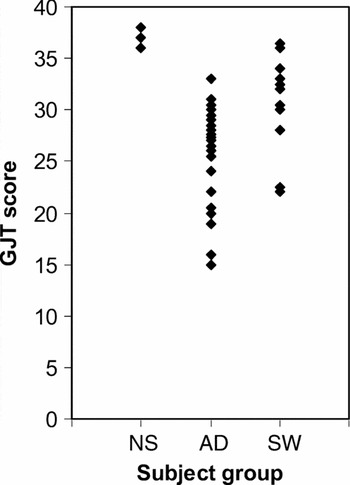
The results on the GJ test are presented in Figure 1. As expected, the three native Korean controls scored almost at ceiling, M = 37.0 (out of 40). The native Swedish group scored significantly better than the adoptee group, M = 30.5 and 25.4, respectively, t(2, 32) = −2.78, p < .01. We can also see that the variation was only marginally greater among the adoptees (SD = 4.94, range = 15–33) than among the native Swedes (SD = 4.84, range = 22–36). Two of the native Swedes scored within the range of Korean controls, whereas none of the adoptees did. As suggested above, the somewhat less advantageous learning conditions for the adoptees could possibly be a relevant background factor for these results.
Results of the grammaticality judgment test (GJT). NS = native speakers; AD = adoptees; SW = native Swedes.

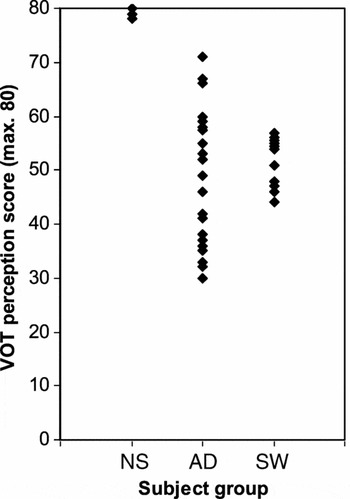
Given this result, one might expect a similar patterning in the results of the VOT perception test. These results are presented in Figure 2.
Results of the VOT perception test. NS = native speakers; AD = adoptees; SW = native Swedes.

Again, the native Korean controls scored at ceiling, M = 79.0 (out of 80), suggesting a high degree of validity and reliability of the test. Here, there was no statistically significant difference between the learner groups: the mean score was 48.5 for the adoptees and 51.6 for the native Swedes, t(2, 32) = −0.78, p = .44. However, in terms of variation the VOT result clearly differs from the GJ result. The variation was much greater among the adoptees (SD = 12.6, range = 30–71) than among the native Swedes, who performed more homogeneously (SD = 4.55, range = 44–57). An ANOVA carried out on the two sets of scores showed that both groups were fairly homogeneous on the GJ test (variance = 24.448 for the adoptees; 23.473 for the native Swedes), but clearly differed on the VOT test where the adoptees were highly heterogeneous, while the native Swedes were homogeneous (variance = 159.662 for the adoptees; 20.673 for the native Swedes). This implies that members of the two groups performed differently on the tests of pronunciation and grammar.
This difference in variation between the groups on the VOT perception test makes it interesting to study the performance of individual participants. In fact, seven of the 21 adoptees performed better than the highest-performing native Swede on this test, and, in fact, another seven performed worse. Also of interest is the fact that the highest-performing adoptee (score: 71) was the one with the highest age of adoption, 10 years and 6 months, while the second best performer (score: 67) had the second-highest age of adoption, 9 years. These two participants' high results on the VOT test can be compared to their mediocre scores on the GJ test: 26 and 22, respectively (adoptees' M = 25.4; non-adoptees' M = 30.5). The two of them were 36 years old at the time of testing, which means that they had spent 26–27 years in Sweden since the time of adoption. However, not all the high-performing participants had a late age of adoption. Third and fourth in rank (score: 66 and 60, respectively) were adopted at <1 and 2 years, respectively. Obviously, one may consider an interaction between various factors. For example, the participant who was third in rank (score: 66) had spent three years and six months in Korea after his university studies in Sweden. He had also worked at a Korean company during his stay in Korea and was married to a Korean woman; thus, he was exposed to daily input. He was one of the two adoptees who had an instrumental and/or integrative motivation for studying Korean. This is a case in which the actual advantageous learning environment could reasonably explain (part of) his good result. This can be contrasted with the participant who was fourth in rank. She had spent only 9–10 months in Korea, had no daily exposure to Korean and had been unexposed to Korean for six years after her studies. All this can be taken as an indication that L1 experience of Korean during childhood makes possible, but does not necessarily lead to, advantages with aspects of Korean phonology/phonetics.
In summary, the native Swedish participants seem to have been more committed and successful (or “good”) learners of Korean, as revealed by both their attitudes towards (and intentions with) Korean studies, by their more beneficial circumstances, as well as by their significantly higher knowledge of Korean grammar. This, however, does not imply that their perception of phonetic details was better; on the contrary, one third of the adoptees, regardless of their grammatical proficiency, had higher results on the VOT experiment than the best-performing native Swedish student. It is worth mentioning that, according to the students as well as the course administrators of Korean studies, vanishingly few class hours are being spent on Korean phonetics and pronunciation; the emphasis is on grammar, lexicon, translation, and literature. Therefore, the seven adoptees who performed highest on the VOT test could either have acquired their perceptual skills through their own intensive study and/or training, through an extraordinary aptitude for phonetic perception, or through retrieved L1 phonetic remnants. Given the learning conditions for the adoptees just outlined, it is not far fetched to opt for the last interpretation. In line with our theoretical assumptions, the remnants of the adoptees' L1 seem to consist primarily of basic and detailed features of Korean phonology and phonetics rather than of more complex, higher-order grammatical features.
Present data on second language nativelikeness in adoptees
This study presents a detailed linguistic analysis of the degree of nativelikeness in Swedish L2 ultimate attainment among adults with an international adoption background. The data are interpreted against the results of comparable L2 users with a regular immigrant background. From our earlier studies of seemingly nativelike or near-native second language users (Hyltenstam and Abrahamsson, Reference Hyltenstam, Abrahamsson, Fraurud and Hyltenstam2003a, Abrahamsson and Hyltenstam, in press ; Abrahamsson, Stölten and Hyltenstam, in press), we expect a majority of the immigrant participants in this study, in spite of the fact that they have a low AO, to differ from native speakers in certain details of Swedish proficiency. For the four adoptees one possible result is that they are indistinguishable from native speakers. This would be congruent with the position of Pallier et al. (Reference Pallier, Dehaene, Poline, LeBihan, Argenti, Dupoux and Mehler2003) and Ventureyra et al. (Reference Ventureyra, Pallier and Yoo2004) that their attrition of L1 would allow them to reach a nativelike ultimate attainment in their L2. An alternative result would be that they behave like other second language learners and end up with a second language proficiency that is slightly below the range of native speaker proficiency.
Participants
Four adult second language users of Swedish who had been adopted into Swedish-speaking families as children were found in a pool of 195 adult L2 speakers of Swedish with Spanish as their L1, all of whom identified themselves as advanced, even potentially nativelike in Swedish. The four adoptees had been adopted at 1, 2, 4, and 9 years of age, respectively. The two youngest encountered their new language at so young an age that one might speak of their developing systems as two L1s. However, as noted in the introduction, for adoptees in general their situation is radically different from that of children who are considered in studies of bilingual first language acquisition because they were exposed to the two early languages in clear consecutive order. We therefore opt for speaking about L1 and L2 even in these cases. At the time of the investigation, the participants were 29, 28, 33, and 30 years old, respectively. Their level of education was senior high-school at a minimum (i.e. at least 12 years of schooling). All of the adoptees claimed to have “forgotten” their L1 totally.
The results from the four adoptees were compared to and interpreted against the results from 27 participants selected from the same pool of 195 L2 speakers of Swedish. These 27 participants had all come to Sweden as immigrants with their Spanish-speaking families. Their ages of onset of L2 acquisition ranged between 1 and 9 years. Their mean age at the time of investigation was 31 years (range 21–52) and their mean length of residence was 27 years (range 14–44) (for details, see Abrahamsson and Hyltenstam, in press ). The 27 participants had passed a screening test, in which at least six of 10 native judges had perceived them as native speakers of Swedish on the basis of a 20–30 seconds spontaneous speech sample.
A native-speaker control group consisting of 15 native speakers of Swedish was included. This group was matched with the L2 speakers regarding educational level, age (M 30 years, range 23–46), and sex.
Procedure and materials
The whole testing procedure took place in a sound treated room with each participant individually. The session lasted for approximately four hours. Prior to language testing and speech elicitation, participants went through a hearing test with an OSCILLA SM910 screening audiometer. After the session, participants received a financial compensation.Footnote 7 The experimenter was a male native speaker of Swedish.
The test battery contained a range of instruments covering speech production, speech perception, morphosyntax, and formulaic language – in other words, a representative sample of the broad spectrum of L2 knowledge and processing abilities. The present set of results comes from 10 instruments.
Voice onset time (VOT)
The test battery included two VOT-related measures based on one production task (Instrument 1) and one categorical perception test (Instrument 2). In the production task, the participants read aloud the Swedish words par, tal, and kal. Each word was read 10 times. Spectral analyses were made in Soundswell (for details, see Stölten, Reference Stölten, Eriksson and Lindh2005; Abrahamsson et al., in press ). The categorical perception test included the minimal Swedish pairs par–bar, tal–dal, and kal–gal, which had been recorded in an anechoic chamber by a female native speaker. Using Soundswell, a 5-millisecond step VOT continuum between −60 and +90 milliseconds was created for all three minimal pairs, and the stimulus items were presented through earphones in different random orders. Each word was presented together with the carrier phrase Nu hör du . . . “Now you will hear . . .”, and the participants' task was to decide whether they heard the voiceless or the voiced member of the word pair by pressing one of two buttons (for details, see Stölten, Reference Stölten2006; Stölten, Abrahamsson and Hyltenstam, submitted).
Speech perception in noise
Two tests of speech perception in noise were used, one babble noise test (Instrument 3) and one white noise test (Instrument 4). In the babble noise test (McAllister, Reference McAllister2003), participants were presented (through earphones) with 30 simple and highly frequent bi-syllabic Swedish words in increasing noise consisting of multiple voices, that is, a word recognition test. The words were randomly and automatically selected from 100 potential stimulus words and presented with the carrier phrase Nu hör du . . . “Now you will hear . . .”. The words had been recorded in an anechoic chamber by a female native speaker. The participant's task was to repeat each word, while the experimenter entered the response words into the computer. An inbuilt metric calculated the phonological distance between the stimulus word and the response word, and the noise level for the next stimulus word was automatically adjusted accordingly. This means that whenever the participant repeated the correct word, or responded with a phonologically similar word, the signal-to-noise ratio (SNR) increased, but decreased when the stimulus word and the response word exhibited a certain degree of phonological difference. In this way, a perceptual threshold level for noise tolerance could be established for each participant.
In the second noise test, the participants were presented (through earphones) with 28 Swedish sentences containing both predictable and unpredictable information, and which together formed an informational text. The stimulus sentences had been recorded in an anechoic chamber by a male native speaker. The sentences were masked with white noise, and the noise level successively increased after every seventh sentence, giving SNRs of 13 dB, 6 dB, and 2 dB, respectively (the first seven sentences were presented without noise and were therefore not included in the analysis). The task for the test taker was to repeat the sentences verbatim, and repetitions were recorded. A strict scoring procedure was adopted, in which only exact repetitions were scored as correct.
Grammaticality judgment
A demanding 80-item GJ (grammaticality judgment) test was administered in two versions – one auditory (Instrument 5) and one written (Instrument 6). The Swedish morphosyntactic phenomena tested were verb–subject inversion, reflexive possessive pronouns, placement of sentence adverbs in relative clauses, and gender and number agreement. Half of the sentences were grammatically correct, half contained one grammatical error. They were presented through earphones in the auditory version and on a computer screen in the written version. By pressing one of two buttons, the participants indicated whether they perceived it as grammatically correct or incorrect. In addition to YES/NO responses, the auditory GJ test also registered reaction times (Instrument 7).
Grammatical, lexical, and semantic inferencing
A cloze test (Instrument 8) was used in order to obtain a more global measure of L2 proficiency. The test consisted of a 300-word text where every seventh word had been removed. The test was a pen-and-paper task, in which the participants were to fill in the 42 blanks with words that would fit into the context.
Formulaic language
Two tests of formulaic language – one of idioms (Instrument 9) and one of proverbs (Instrument 10) – were included. Each test included 50 items, which were presented in writing on a computer screen (one at a time and in the same order for all participants) with a blank to be filled in (a missing word or chunk). The oral responses were recorded.
For the analysis, performance within the native-speaker (NS) range was used as a way of defining nativelike behaviour, and the lowest native-speaker result on each of the 10 measures was defined as the minimum criterion of nativelikeness for that specific aspect of Swedish.
Results
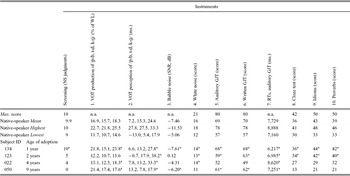
Table 1 presents the results for the four adoptees. The table also shows the mean results on each of the 10 test instruments for the 15 native control participants, as well as the highest and lowest native-speaker results (i.e. the NS range). As can be seen, only one of the four adoptees exhibited results within the NS range across the board of measures, and this was also the participant with the lowest age of adoption (1 year). The others had results within the native-speaker range on 8 (AO = 2), 4 (AO = 4), and 6 (AO = 9) measures. When results fell within the NS range, they were almost always found at or below the NS mean.
Results for the four adoptees on 10 measures of Swedish proficiency plus results from the screening experiment.

* = result within the native-speaker range; n.a. = maximal score not applicable; WL = word length
In addition to results on the 10 instruments, results from the screening experiment mentioned above are included in Table 1. It was only one of the adoptees (with an AO of 1 year) who was perceived as nativelike by all 10 native judges. The others were perceived as nativelike by only half or less than half of the judges. In one case (AO = 9), none of the judges thought this was a native speaker of Swedish.
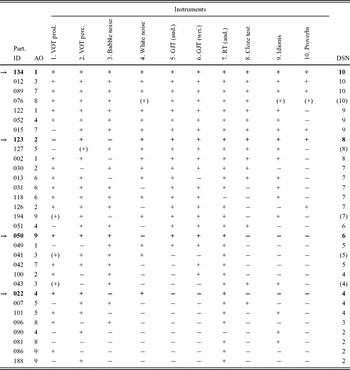
Table 2 presents the results of the 10 instruments for all L2 participants, both immigrants and the adoptees. Adoptees are marked with an arrow and appear in bold type. The rank order is determined by the number of tests within the native-speaker range. If we look at the results from the 27 immigrant participants, we note that in this latter group only two participants (with AOs 3 and 7, respectively), had indisputable results within the native-speaker range across all 10 instruments. There is no indication that the four adoptees differ at all from the immigrant participants; they perform like normal near-native L2 speakers.
Overall results for 31 participants (27 immigrants, 4 adoptees) on the 10 measures of Swedish proficiency. Adoptee participants are marked with an arrow and their results are given in bold type.

+/− = results within/below NS range; (+) = data missing; DSN = degree of scrutinized nativelikeness
In summary, our results suggest that the four participants in the study who were adopted and thus had experienced dominant-language replacement did not outperform those participants who had maintained their L1. In terms of how their Swedish was perceived by native listeners, the results point in the same direction. They do not stand out favourably, but could rather be seen to fit in among any group of advanced, potentially nativelike or near-native second language users with similar AOs. Therefore, we conclude that their severe L1 attrition has not served them in their acquisition of a new dominant language as the IH (Impediment Hypothesis) predicts.
Discussion
L1 remnants
In order to address the issue of L1 remnants in adoptees who have undergone dominant-language replacement we would like to underscore the fact that in our study, after a period of regaining their L1, one-third of the adoptees of Korean origin scored higher than all the native Swedish learners of Korean in perception of Korean VOT contrasts. This was in spite of the fact that several of the native Swedish learners had had more advantageous learning conditions than the adoptees and were considerably more advanced in their general Korean proficiency.
Our results on L1 remnants are thus different from those of Pallier et al. (Reference Pallier, Dehaene, Poline, LeBihan, Argenti, Dupoux and Mehler2003) and Ventureyra et al. (Reference Ventureyra, Pallier and Yoo2004). We believe that our investigation has demonstrated first of all that in order to identify possible remnants, the search for L1 vestiges in adoptees requires a methodological approach different from that pursued by Pallier et al. and Ventureyra et al. If there are remnants of a seemingly lost L1, these are most likely not easily retrievable for the individual. It is reasonable to believe that a re-exposure to this language is necessary to boost accessibility. Due to the fact that there were no effective relearning activities for the adoptees of Pallier et al. and Ventureyra et al., we propose that their results on L1 remnants should be interpreted primarily as evidence of severe attrition and inhibition, and not as complete L1 loss. However, in the study by Ventureyra et al. nine of the 18 participants had actually been re-exposed to Korean for a period of between ten days and six months in the four-year period prior to testing. The result showed no statistical significance between the participants who were re-exposed and those who had no ability to discriminate in most categories; in only one out of six VOT categories was there a significant difference. On this statistical basis, Ventureyra et al. concluded that re-exposure did not help in promoting access to L1 distinctions.Footnote 8 Nevertheless, in each of the remaining five VOT categories the scores of the re-exposed participants were still slightly higher than the scores of the group with no previous re-exposure. In view of our data from adoptees who had been re-exposed to Korean, it is plausible to believe that the differences in discrimination scores in favour of the re-exposed participants seen in Ventureyra et al. might have come out more clearly if re-exposure had taken place during a longer period of time and more intensively.
Nativelike or near-native L2 ultimate attainment
Turning to the issue of ultimate L2 attainment, results from our four Latin American adoptees showed that their L2 Swedish was not entirely nativelike when compared to native Swedish controls, except in one case, where adoption had taken place at around this participant's first birthday. Compared to L2 learners of Swedish who had maintained their L1 Spanish to various degrees because they had immigrated with their Spanish-speaking parents, the adoptees had not gained any advantage in their acquisition of L2 Swedish as a consequence of their severe L1 attrition, although the IH predicts that they would.
It was mentioned earlier that in none of the studies on L1 remnants in adoptees has a detailed examination of the L2 proficiency been carried out. In Pallier et al. (Reference Pallier, Dehaene, Poline, LeBihan, Argenti, Dupoux and Mehler2003) the supposed L2 nativelikeness in the participants was based on informal observations made by the test administrators. Although the authors point out that the reliability of the observations was limited, they later take this apparent nativelike proficiency as support for the claims of L2 nativelikeness made by the IH.
Accumulating empirical results show that even advanced L2 speakers who are perceived as native speakers in everyday conversation or in screening experiments score below the native range when their proficiency is scrutinized in detail (Hyltenstam and Abrahamsson, Reference Hyltenstam, Abrahamsson, Fraurud and Hyltenstam2003a; Abrahamsson and Hyltenstam, in press ). The relatively high rates of nativelikeness proposed for post-puberty learners in some studies (Marinova-Todd, Reference Marinova-Todd2003; Birdsong, Reference Birdsong, Kroll and De Groot2005, p. 120; Bongaerts, Reference Bongaerts2005, p. 261) may be due to ceiling effects resulting from easy tasks or tests, from data limited to single aspects of language proficiency (Hyltenstam and Abrahamsson, Reference Hyltenstam, Abrahamsson, Doughty and Long2003b, p. 577), or from a plethora of combined methodological problems (Long, Reference Long2005). For pre-puberty learners, it is only recently that empirical research has shown an ultimate attainment of younger learners that is not always entirely nativelike (Hyltenstam, Reference Hyltenstam and Harris1992; Flege, Munro and MacKay, Reference Flege, Munro and MacKay1995; Flege, Frieda and Nozawa, Reference Flege, Frieda and Nozawa1997; Ekberg, Reference Ekberg, Møller, Quist, Holmen and Jørgensen1998; Butler, Reference Butler, Oshima-Takane, Shirai and Sirai2000; McDonald, Reference McDonald2000; Hyltenstam and Abrahamsson, Reference Hyltenstam, Abrahamsson, Fraurud and Hyltenstam2003a; Tsukada, Birdsong, Bialystok, Mack, Sung and Flege, Reference Tsukada, Birdsong, Bialystok, Mack, Sung and Flege2005; MacKay, Flege and Imai, Reference MacKay, Flege and Imai2006; Abrahamsson and Hyltenstam, in press ; see also Harley and Wang, Reference Harley, Wang, De Groot and Kroll1997). In our group of 27 immigrant participants, we found only two clear cases (with AOs 3 and 7, respectively) who had results within the range of native controls on all 10 instruments.
In our review of maturational effects in SLA, we concluded that “many of the L2 learners identified in studies to be ‘within the range of native controls’ should in actual fact be characterized as near-native rather than nativelike speakers” (Hyltenstam and Abrahamsson, Reference Hyltenstam, Abrahamsson, Doughty and Long2003b, p. 571). Near-native L2 proficiency is taken to mean “apparent” nativelikeness, that is a proficiency level perceived as nativelike in everyday spoken communication because near-native L2 levels are not distinguishable from native levels in everyday oral communication, but only through detailed linguistic analyses (Hyltenstam and Abrahamsson, Reference Hyltenstam and Abrahamsson2000, p. 163; Reference Hyltenstam, Abrahamsson, Doughty and Long2003b, p. 571). We have earlier introduced the notion of non-perceivable non-nativeness to characterize the manner in which this proficiency level differs from nativelike proficiency (Hyltenstam and Abrahamsson, Reference Hyltenstam, Abrahamsson, Doughty and Long2003b, p. 571f).
As pointed out earlier, there are no controlled data on the ultimate L2 attainment of international adoptees, but the observations by Gardell (Reference Gardell1979) and Hene (Reference Hene1993) mentioned above are suggestive. Gardell's (Reference Gardell1979) report, for example, neatly illustrates the concept of apparent nativelikeness; when describing the linguistic behaviour of the adoptees it was observed that the vast majority of them had a competent and fluent command of their L2 according to their families and school personnel. This impression was also shared by Gardell and her co-workers during the data collection. The language proficiency of the adoptees was nevertheless subject to an empirical study after which Gardell stated that “since the children were so proficient in Swedish, we were surprised to find that . . . 43% had a deficient command of the language” (p. 36).
In view of these observations, we believe that the notion of non-perceivable non-nativeness is central when interpreting the data regarding the French proficiency in the adoptees of Pallier et al. (Reference Pallier, Dehaene, Poline, LeBihan, Argenti, Dupoux and Mehler2003): it is likely that the participants have achieved a proficiency level in their L2 allowing them to be casually perceived as native speakers. We suggest that until further studies which thoroughly analyse the participants' L2 proficiency have been carried out, informal observations about nativeness should first and foremost be interpreted as indications of a level of attainment characterized by non-perceivable non-nativeness.
The age dimension
With respect to the age dimension, our data from the Korean adoptees suggest that the later the time of adoption occurs, the better are the chances for access to L1 remnants in the process of re-exposure to this language. The two participants who were best at identifying the Korean VOT contrasts were those with the highest age of adoption. This result is entirely congruent with what has been found in the literature on regaining a “lost” language reviewed in the beginning of this article.
The results on L2 ultimate attainment in our four Latin American adoptees pattern exactly as a maturation hypothesis predicts. The participant with the lowest age of adoption (age 1) was perceived as nativelike by all the ten native listeners. This participant also had results within the native-speaker range on all 10 measures of L2 proficiency. Higher ages of adoption correspond to a successive decrease in scores; the participant with the highest age of adoption (age 9) was perceived as a native speaker by none of the native listeners and had results within the native-speaker range on six of the 10 measures of L2 proficiency. What is clear, therefore, is that there was no evidence that the adoptees were at all different from comparable L2 learners who had maintained their L1. In particular, the results from the adoptees do not provide any reason to believe that their L1 attrition resulted in more efficient L2 acquisition.
The reason our data differ from those of Pallier et al. and Ventureyra et al, again, lies in the comprehensive and detailed analyses of the L2 proficiency we carried out upon our participants while the characterization of L2 proficiency in the other two studies was based on an impressionistic assessment. Our close examination of the correlation between age of adoption and detailed aspects of both L1 and L2 proficiency has given us results that are congruent with a maturational account of language development.
The Impediment Hypothesis vs. a maturational account
To reiterate, the Impediment Hypothesis contends that L2 nativelikeness is blocked by an interfering L1 and that once L1 is lost, nativelike command of L2 can be achieved. As was seen earlier, the IH postulates that there is no irreversible maturation process of the brain but rather full brain plasticity during the first decade of life; non-native features found in immigrant L2 speakers are due to L1 retention. We will treat the issue of irreversibility presently, but first apply a broader perspective to the IH.
First of all, Pallier et al. (Reference Pallier, Dehaene, Poline, LeBihan, Argenti, Dupoux and Mehler2003) and Ventureyra et al. (Reference Ventureyra, Pallier and Yoo2004) are by no means alone in believing that it is the L1 of a second language learner that prevents nativelike L2 proficiency. On the contrary, this is a common point of view, especially among researchers critical of the CPH or other maturational accounts. Some researchers (see below) contend that the L1 factor is a better candidate for explaining variation in L2 proficiency than maturation. The interpretations of the interaction between the two languages in situations of dominant-language replacement proposed by Pallier et al. and Ventureyra et al., in actual fact, interlock perfectly with other current discussions about L1 and L2 interaction in situations of dominant-language change (e.g., Major, Reference Major, Hyltenstam and Viberg1993; Flege et al., Reference Flege, Frieda and Nozawa1997; Francis, Reference Francis2005; Mackay et al., Reference MacKay, Flege and Imai2006). Flege and his colleagues present strong evidence that the degree to which a learner continues to use his or her L1 and the developmental status of L1 (its strength of representation, or stabilization in Pallier et al.'s and Ventureyra et al.'s terminology) influence the accuracy of nativelike production in L2. For example, a high frequency of L1 use would correlate with a high degree of foreign accent in the L2 (see also Flege, Reference Flege1999). The interpretations proposed in Flege's research range from a straightforward strong claim that “AOA [age of arrival] effects on foreign accent are due to the development of the native language phonetic system rather than to maturational constraints on L2 speech learning” (Mackay et al., Reference MacKay, Flege and Imai2006, p. 157) to the more modest claim that “ultimate success in pronouncing an L2 is [not] determined solely by an individual's state of neurological development [i.e. maturation] at the time of first exposure to the L2” (Flege et al., Reference Flege, Frieda and Nozawa1997, p. 169; emphasis added). That is, a maturational or CPH account is either totally rejected, which is a radical position, or rejected as the single explanation, which is, of course, a considerably weaker stance. Flege et al. (Reference Flege, Frieda and Nozawa1997) propose the “Single System Hypothesis” as a theoretical account of their results. This hypothesis “predicts that the loss of the L1 . . . may reduce the degree of perceived foreign accent in L2. Put another way, the ‘less’ L1 there is, the smaller will be its influence on the L2” (Flege et al., Reference Flege, Frieda and Nozawa1997, p. 171), an idea which they trace back to Dunkel (Reference Dunkel1948), and which, it must be added, fits long-lived popular views of limited brain capacity for balanced bilingualism generally.Footnote 9 “Full” development of an L2 is possible only with zero remnants of an L1. The idea also has family resemblance with what has been termed the Balance Theory of bilingualism (see Cummins, Reference Cummins1981), assuming that “the brain has only a limited capacity and therefore the addition of a second language automatically leads to a decrease of proficiency in the L1” (Hoffmann, Reference Hoffmann1991, p. 129).Footnote 10 Francis (Reference Francis2005) offers an extensive, partially similar, discussion of the interaction of an attrited L1 and L2 in “early imbalanced bilingualism” (p. 492).Footnote 11 Francis is particularly concerned with situations where only one of the two languages that the bilingual child is exposed to develops into a “complete L1”. In discussing these situations, Francis, in a sense, moves between both our categories of dominant-language change and dominant-language replacement. Even if the child's L1 in these situations may play a role in the environment, he actually discusses the possible consequences of replacing an entirely attrited L1 with “a new L1” (i.e. the former L2), hence his notion of replacing language. This new L1 would “occup[y] ceded domains systematically” (p. 502). Francis' idea is further based on what he calls “Replacing Language completeness” (p. 509) and the “no semilingualism condition” (p. 496), that is, disregarding states of transition, all healthy children end up with at least one fully-fledged dominant language, meaning minimally “the core grammatical competencies that underlie language ability of the typical 9- to 10-year-old monolingual speaker” (ibid.).
The notion of irreversibility is central to maturational accounts of language acquisition, and it is precisely this notion that Pallier et al. and Ventureyra et al. use to oppose the CPH. They predict total brain plasticity at least for the first decade of life allowing fully nativelike acquisition of the L2 given that the L1 is lost. Through our own data and through published second language data from adults and children, we have provided evidence that maturation plays a decisive role. Empirical data from other language acquisition settings point in the same direction. In studies of the acquisition of American Sign Language (ASL), Mayberry and her colleagues (see, e.g. Mayberry and Lock, Reference Mayberry and Lock2003) showed that delayed linguistic exposure to ASL results in non-native ultimate proficiency levels although there is no other language that could have impeded this kind of language development. Adult signers who had experienced a delayed exposure to ASL in childhood, that is, children with “no early language” (p. 373), scored notably lower on grammaticality tests than did those ASL speakers who had had full ASL exposure from birth. Furthermore, when compared to normally-hearing children who started to acquire a second language at the same age as the deaf children with delayed ASL started to acquire their first language, it was found that the ASL group had considerably lower scores than the second language learners. It was therefore suggested that the absence of early language exposure “seriously compromises development of the ability to learn any language throughout life” (p. 382). Moreover, studies on children who have suffered from severe hearing impairment during their first year of life provide further evidence for long-term implications of delayed first language acquisition. These studies, by Ruben (Reference Ruben1997, Reference Ruben1999), demonstrate that at nine years of age the participants' score was lower than controls on tests of phonetic and semantic–syntactic measures. On the basis of these results it was suggested that even a minimally delayed exposure has a permanent effect on the language learning ability. The findings from Ruben (Reference Ruben1997, Reference Ruben1999) and Mayberry and Lock (Reference Mayberry and Lock2003)Footnote 12 are strong evidence in favour of an interpretation of the maturation process as irreversible.Footnote 13
Irreversibility is part and parcel of most theories of language development. One example is the converging evidence demonstrating that infants (under 12 months of age) improve their ability at discriminating native speech sounds and at the same time become less sensitive to non-native speech sounds (Werker and Tees, Reference Werker and Tees1984; Kuhl, Williams, Lacerda, Stevens and Lindblom, Reference Kuhl, Williams, Lacerda, Stevens and Lindblom1992; Cheour, Ceponiene, Lehtokoski, Luuk, Allik, Alho and Näätänen, Reference Cheour, Ceponiene, Lehtokoski, Luuk, Allik, Alho and Näätänen1998); suggestions about an early and irreversible plasticity loss of the cortical areas responsible for phonetics and phonology are congruent with such findings (Pulvermüller and Schumann, Reference Pulvermüller and Schumann1994; Weber-Fox and Neville, Reference Weber-Fox and Neville1999). The fact that the traces of early language exposure are primarily manifested at a phonetic level is consistent with the research on phonetic discrimination in infants and the scheduled maturation of the corresponding cortical areas.
It is possible, nevertheless, to argue that the findings on delayed L1 acquisition are not entirely incompatible with the idea of a neural resetting: according to the Exercise Hypothesis (Bever, Reference Bever and Diller1981; see also Johnson and Newport, Reference Johnson and Newport1989), the human capacity for acquiring languages will decline if not exercised early in life; if exercised, this capacity will remain intact throughout a lifetime. Hence, it is conceivable that if the language learning mechanism is triggered without delay and thus kept intact, it is still hypothetically possible for “a new L1” to arise (cf. Francis, Reference Francis2005). However, neither the evidence from delayed L1 acquisition nor the Exercise Hypothesis is discussed by the advocates of the IH, and an interpretation along these lines would be farfetched. Rather, we suggest that our findings on the advantages of L1 stop discrimination in our Korean adoptees, as well as the non-native features in the L2 of our Latin American adoptees, provide evidence that the gradual loss of brain plasticity is a fact even in cases where the condition of a triggered language learning mechanism has been met. Consequently, instead of explaining L2 non-nativeness in terms of interference effects from L1, we propose that a fruitful approach to the proficiency levels in dominant-language “replacers” must seriously take into account research on maturational constraints and early language exposure.
Conclusions
In this paper we set out to treat certain problems involved in the study of dominant-language replacement. Throughout the text, we have suggested that the notion of non-perceivable non-nativeness can be useful when explaining an apparent nativelike L2 proficiency in language users who have experienced dominant-language replacement. Likewise, we have illustrated how the use of a sensitive L1 assessment methodology can be fruitful in the search for remnants of a “lost” language.
We believe that the preliminary findings of the advantages in L1 phonetic discrimination in the Korean adoptees we studied, as well as the non-native features in the L2 of the Latin American adoptees, have made clear that the effects of early first and second language exposure on language proficiency in general are both persistent and qualitative in nature. Consequently, the suggestion that L1 impedes L2 nativelikeness must be seen as a less convincing explanation than one based fundamentally on maturational factors. This does not in any way disregard the effects of non-maturational factors, including L1 or other cross-linguistic influences, which are certainly also important ingredients in the total make up of language proficiency.
Appendix 1: Personal data on the Korean adoptees (A) and the native Swedes (S)