

Introduction
Chronic conditions such as type 2 diabetes mellitus (T2DM) are increasing and pose a significant threat to public health and economic development. Globally, according to the International Diabetes Federation, about 589 million adults aged 20–79 years had diabetes in 2024, and this number is expected to rise to 853 million by 2050 [1]. In Africa, diabetes cases are projected to increase by 142%, from 24.6 million in 2024 to 59.5 million by 2050 [1]. In Malawi, the age-adjusted comparative prevalence of diabetes is estimated at 5.7%, and 78.7% are undiagnosed [1]. Among adults with T2DM in Malawi, it is concerning that over 60% have elevated glycosylated hemoglobin (HbA1C > 8%) [Reference Mphwanthe, Weatherspoon, Kalimbira and Weatherspoon2].
In resource-limited settings such as Malawi, the lack of standardized, context-tailored/patient-centered nutrition resources for diabetes management, along with conflicting dietary information, poor diet quality, and food insecurity, affects diabetes self-management [Reference Mphwanthe, Carolan, Earnesty and Weatherspoon3–Reference Althubyani, Gupta and Tang5]. A prior study in Malawi found that the diet of adults with T2DM is disproportionately high in carbohydrates, primarily from staple foods such as cereals, roots, and tubers, and was associated with elevated HbA1C, underscoring the need for carbohydrate-counting (CC) resources [Reference Mphwanthe, Weatherspoon, Li and Weatherspoon6]. CC is an approach to meal planning for diabetes management that focuses on the total carbohydrate content of a meal/food and supports diverse food choices to achieve optimal glycemic targets [Reference Gillespie, Kulkarni and Daly7–Reference Warshaw and Kulkarni11]. The concept of CC is that approximately 15 g of carbohydrate is equivalent to one carbohydrate (carb) choice, count, or serving in a meal, food item, or drink, which can raise blood glucose [Reference Gillespie, Kulkarni and Daly7–Reference Warshaw and Kulkarni11] unacceptably if not sufficiently balanced across meals and snacks and if disproportionately high in refined carbohydrate foods. For patients with type 1 diabetes, the CC approach helps to match insulin doses to planned meals/food intake, and for those with T2DM or prediabetes, it helps manage blood glucose levels [Reference Gillespie, Kulkarni and Daly7–Reference Warshaw and Kulkarni11]. The CC approach allows food substitution within the same food group and improves adherence to dietary recommendations [Reference Gillespie, Kulkarni and Daly7–Reference Warshaw and Kulkarni11]. Resources similar to CC have been developed to reflect the foods commonly consumed by specific cultures and ethnic groups and to guide appropriate dietary choices and diabetes self-management [Reference Coulibaly, O’Brien and Galibois12–Reference Marques-Lopes, Menal-Puey, Martínez and Russolillo15].
The diabetes resources developed to date, unfortunately, do not reflect the traditional foods and dishes commonly consumed in Malawi, posing a challenge for diabetes nutrition education and counseling. Studies have shown that culturally tailored diabetes resources improve glycemic status, diabetes knowledge, uptake, and participation in diabetes education [Reference Sun, Tsoh, Saw, Chan and Cheng16–Reference Abu and Llahana20]. Therefore, we developed CC resources that incorporate foods commonly consumed by patients with diabetes in Malawi, informed by our prior research [Reference Mphwanthe, Weatherspoon, Li and Weatherspoon6]. Given that there is limited health literacy among patients with diabetes [Reference de Carvalho, Silva and Treptow21–Reference Ouedraogo, Some, Benedikter and Diallo23], a pictorial paper-based approach was first developed to improve the fundamental understanding and readability of patients with diabetes. Subsequently, the advances in technology and the widespread use of mobile phones led to the adaptation of the tool into a mobile application. A user-centered design/user experience design [Reference Bonet-Olivencia, Carrillo-Leal, Rao and Sasangohar24–Reference Harte, Glynn and Rodríguez-Molinero27] was used to tailor to the needs of the primary users, who were clinical dietitians, to enhance the usability and delivery of nutrition and dietetics care. The pictorial paper-based and mobile app prototypes were then tested for feasibility within the existing clinical workflow used by clinical dietitians to provide nutrition education, counseling, and meal planning for inpatient and outpatient adults with diabetes, prior to the effectiveness study involving patients with diabetes.
This paper discusses the steps taken to develop pictorial paper-based and mobile app CC materials and to qualitatively elucidate dietitians’ perceived feasibility and usefulness of integrating these resources into their existing clinical workflow.
Materials and methods
The study was conducted between 2021 and 2023 in three phases: (1) developing a pictorial paper-based CC resource, (2) developing a mobile app prototype, and (3) a qualitative feasibility/usefulness assessment among clinical dietitians.
Phase 1: Development of pictorial paper-based resource
We previously conducted a study on the dietary quality among adults with T2DM in Malawi, using 24-hour and typical-day recalls to identify the foods commonly consumed by patients with T2DM [Reference Mphwanthe, Weatherspoon, Li and Weatherspoon6]. We also collected information on the foods frequently mentioned by patients with diabetes during nutrition education and counseling sessions conducted by clinical dietitians at Kamuzu and Mzuzu Central Hospitals in Malawi. Food items and dishes were prepared and portioned using standardized utensils, such as cups and spoons, and then weighed using a kitchen scale to determine the net weight in grams. We determined the energy and macronutrient content of the foods/dishes mainly from the Malawi Food Composition Table [28]. If foods or dishes were not available in the Malawi Food Composition Tables, the following food databases were consulted based on the best alignment with the food in Malawi: the US Department of Agriculture National Nutrient Database for Standard Reference [29], the Food Composition Tables for South Africa [Reference Van Graan, Chetty and Links30], the Kenya Food Composition Table [31], and the Tanzania Food Composition Table [Reference Lukmanji, Hertzmark, Mlingi, Assey, Ndossi and Fawzi32]. If dishes were not found in the food composition tables, nutrients were determined by summing the nutrient values of the individual food items that comprise them. We purchased the packaged, ready-to-eat foods from grocery stores and local markets and determined their nutrient values from the nutrition facts labels. In some instances, ready-to-eat foods without nutrition facts labels had their nutritional composition determined using food composition tables such as the Malawi Food Composition Table [28]. Throughout the process, we photographed all portioned food items or dishes to guide the visualization of food portion sizes. Clinical dietitians translated food items or dishes into the local Chichewa language. Using the American Diabetes Association guidelines on CC, one carbohydrate (carb) count or choice is equivalent to 15 g of carbohydrate in a meal, a dish, or a food item [10]. Hence, in this study, we presented pictorial representations of food items or dishes, along with the amount of carbohydrate in grams and the number of carb choices or counts. Furthermore, we summarized the energy, macronutrient content, and carb counts/choices of the different food items/dishes in a table.
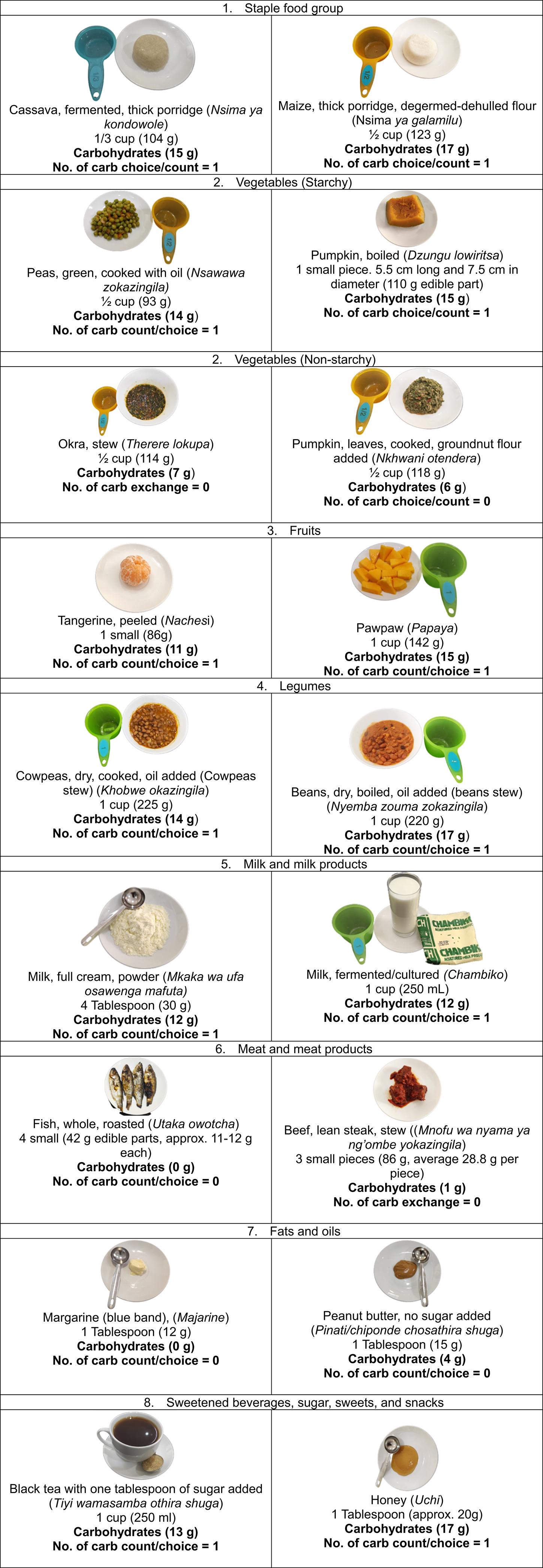
Figure 1 shows an example of the pictorial paper-based CC resource. Two food items per food group are included for illustration. The food grouping in the CC resource developed in this study aligns with Malawi’s six food groups: staples, fruits, fats and oils, legumes, and vegetables (both starchy and non-starchy) [33], except for animal-source foods. The animal-source food group was separated into meat and meat products and milk and milk products, since the latter contain carbohydrates [10,Reference Warshaw and Kulkarni11]. Additionally, a new food group for beverages, sweets, sugar, and snacks was added, including items consumed outside the traditional six food groups in Malawi. The rationale for the new food group of beverages, sweets, sugar, and snacks was based on our previous study in Malawi, which showed that these foods are consumed by many patients with diabetes [Reference Mphwanthe, Weatherspoon, Li and Weatherspoon6], and since they contain added sugars and refined carbohydrates, they are more likely to negatively affect blood glucose targets. This was evident in patients with T2DM who had significantly higher HbA1c in our previous studies [Reference Mphwanthe, Weatherspoon, Kalimbira and Weatherspoon2,Reference Mphwanthe, Weatherspoon, Li and Weatherspoon6]. In addition, it was deemed important to align our CC with existing CC resources developed by the American Diabetes Association, and other resources tailored for the Somali, Malian, and Jamaican communities [10–Reference Goldschmidt, Sankavaram and Udahogora14].
Example of a pictorial paper-based carbohydrate-counting resource per food group.

Figure 1. Long description
An example of the pictorial paper-based CC resource, showing two food items per food group. The food groups are: staples, fruits, fats and oils, legumes, and vegetables (both starchy and non-starchy), meat and meat products, milk and milk products, and beverages, sweets, sugar, and snacks.
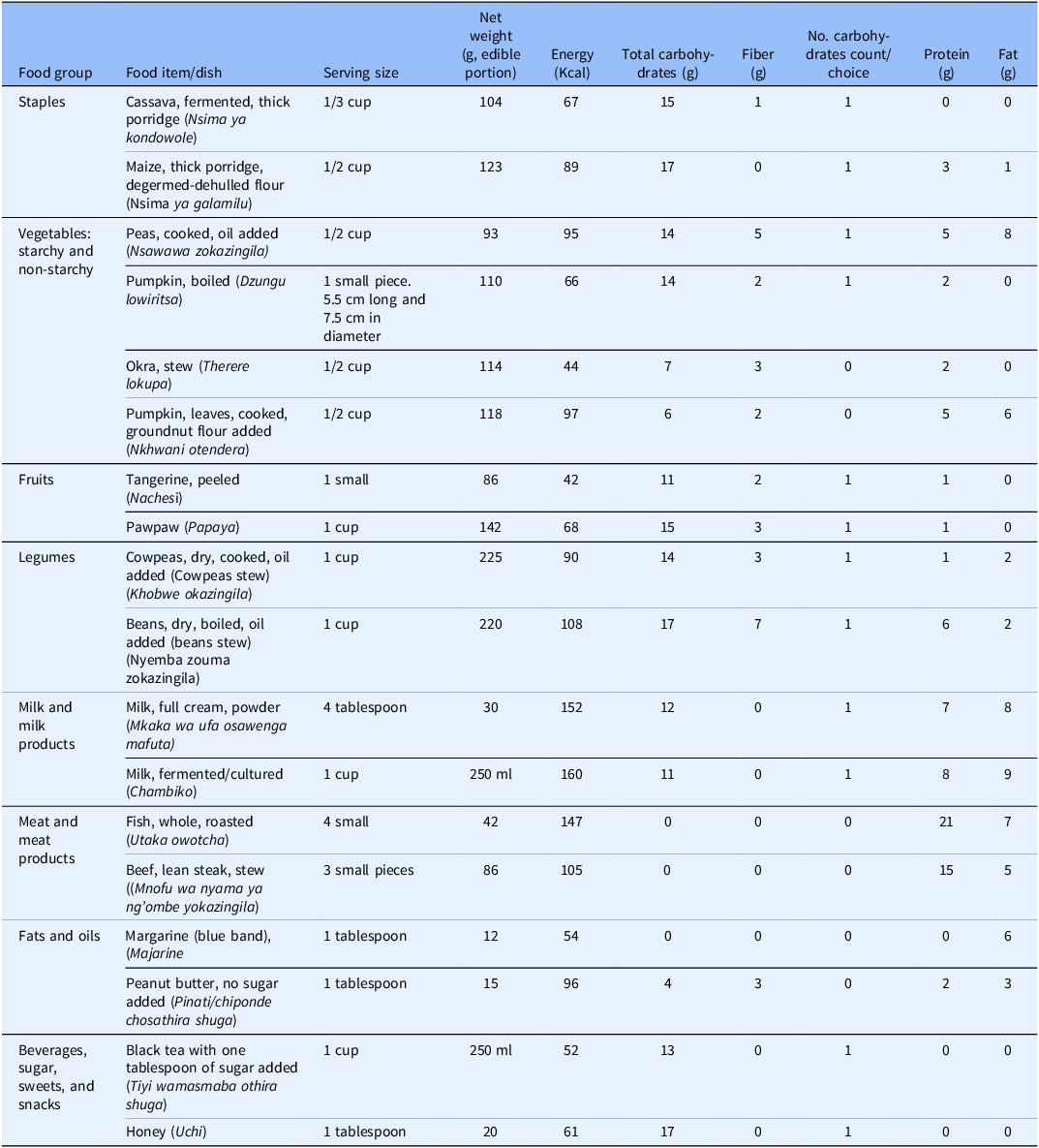
Photos of the food items were displayed with standardized measuring utensils, net weight in grams, total carbohydrate content, and the number of carb counts or choices. We also presented the food names in English and Chichewa, the common local language in Malawi. We provided a detailed, pictorial paper-based CC resource as a PDF in Supplemental Material 1. To complement the information presented in Figure 1, additional details are provided in Table 1. For all the food items in the pictorial paper-based CC resource, the information includes the food group, food item/dish, serving size, net weight of the edible portion, energy, total carbohydrate, number of carb count/choices, protein, and fat content. This information will guide clinical dietitians and patients in assessing the energy and macronutrient composition of the food items.
Summary of energy, macronutrients, and carbohydrate count/choice per serving of the food item based on the pictorial paper-based resource

Table 1. Long description
Table 1 complements the information presented in Figure 1. For all the food items in the pictorial-paper-based CC resource, the information includes the food group, food item/dish, serving size, net weight of the edible portion, energy, total carbohydrate, number of carb count/choices, protein, and fat content.
Phase 2: Mobile app prototype development
We used a user-centered/user experience approaches [Reference Bonet-Olivencia, Carrillo-Leal, Rao and Sasangohar24] to develop a mobile app prototype. This approach is iterative and involves the main users, in our case, clinical dietitians, in the development and testing process by focusing on their needs and experiences to ensure usability and easy adoption in practice [Reference Bonet-Olivencia, Carrillo-Leal, Rao and Sasangohar24–Reference Harte, Glynn and Rodríguez-Molinero27]. Multiple virtual meetings and two in-person workshops were held with five clinical dietitians from Kamuzu and Mzuzu Central Hospitals, as well as two expert app developers. Prior to the workshops, Zoom meetings were held with the clinical dietitians to introduce the pictorial paper-based CC resource, to gather feedback on whether the food items or dishes reflected what patients with diabetes frequently mentioned during nutrition education and counseling sessions, and to discuss which features the app should include to improve dietetic services. At the first in-person workshop, the primary researcher presented a draft pictorial paper-based CC resource to gather input from clinical dietitians and to discuss the initial prototype of the mobile app, to guide the app developers. Clinical dietitians and app developers drew on their prior experience with various nutrition apps to brainstorm the key features for the CC mobile app. The goal was to develop an app with features that would be simple and easy to navigate, considering the demographics of patients with diabetes in Malawi. Then, the clinical dietitians drew the desired app features on paper for visualization and shared them with the app developers. More specifically, the researchers wanted to establish high-fidelity prototypes, similar to those in Bonet-Olivencia et al. (2023), that would be viable and user-friendly for the user testing phase [Reference Bonet-Olivencia, Carrillo-Leal, Rao and Sasangohar24]. Feature finalization was based on a literature review and consensus among the clinical dietitians, primary researchers, and app developers. The app developers received a pictorial paper-based CC resource to incorporate into the app, aligned with the agreed-upon features. Regular Zoom meetings were held among the primary researchers, app developers, and clinical dietitians to ensure that prototype development met the end users’ needs. During the second workshop, app developers presented the prototype, and clinical dietitians tested it by entering data and navigating its features to inform and refine the prototype. Clinical dietitians provided feedback on the content, layout, navigation, and areas needing improvement. The revised prototype was subsequently tested in the third phase of the formative feasibility assessment in a clinical setting by the clinical dietitians.
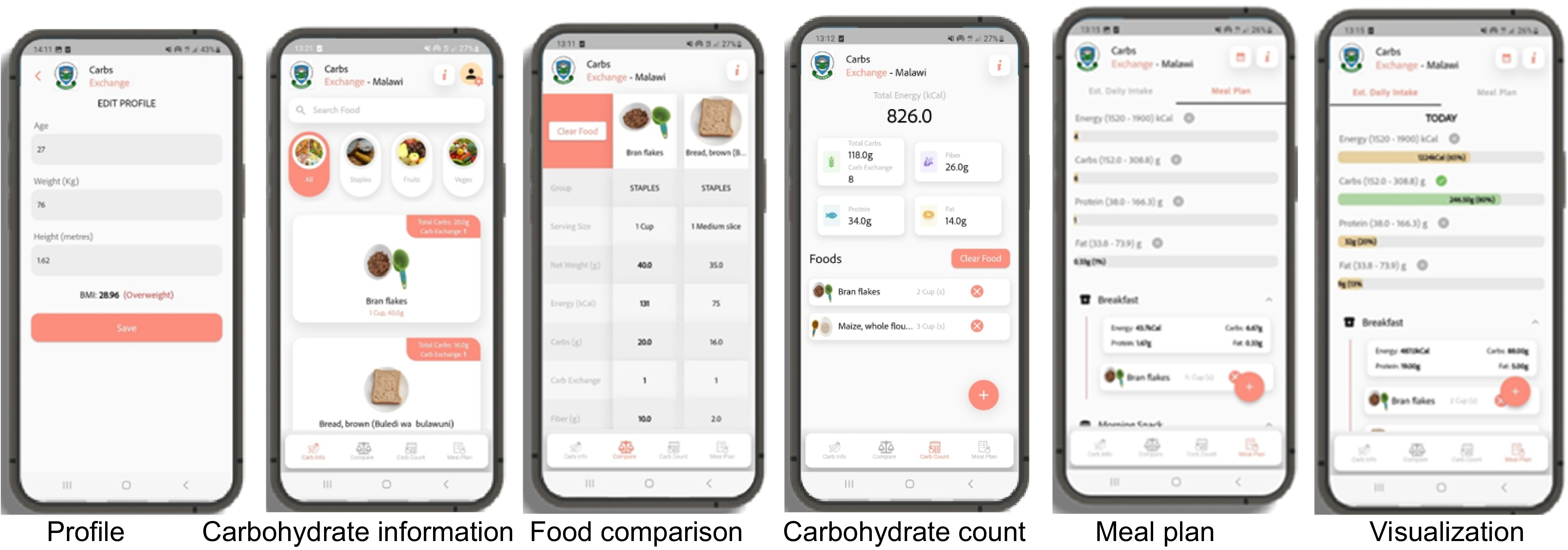
The mobile app features (Figure 2) include:
Mobile app carbohydrate-counting resource features.

Figure 2. Long description
An example of a mobile app with its features. The features include: 1) A profile, 2) carbohydrate (carb) information, 3) food comparison, and 4) meal planning.
-
1. A profile tab, which encompasses age in years, height in meters, and weight in kilograms, and then calculates the body mass index. The information provided in the profile was used to estimate the individual’s total energy needs using 25–30 kilocalories per kilogram of body weight, based on European Society for Parenteral and Enteral Nutrition guidelines on hospital nutrition [Reference Thibault, Abbasoglu and Ioannou34], focusing on the standard and hospital diets as typically used in Malawi. We used the estimated energy to estimate Acceptable Macronutrient Distribution Ranges based on dietary reference intakes for healthy adults of 45–55% for carbohydrates, 10–35% for protein, and 20–35% for fat [35–Reference Marcason37].
-
2. Carbohydrate (carb) information tab, providing details on all the foods included in the app, the food groups, and for each selected food, it displays its total carbohydrate content and the number of carb counts.
-
3. Food comparison tab: which allows users to choose foods within the same food group and compare their energy, total carbohydrate, fiber, carb count, protein, and fat content.
-
4. The CC tab allows users to add different types of foods, and it will display the total energy, total carbohydrates, carb count, fiber, protein, and fat content of all the food items added.
-
5. Meal planning tab: users can plan meals for breakfast, lunch, dinner, and snacks for a specific number of days. Based on the meal plan, the app calculates energy and macronutrient intake and displays the percentage of estimated requirements, thereby indicating the extent to which normal ranges are met.
Phase 3: Qualitative formative feasibility study
The five clinical dietitians from the two referral hospitals (Kamuzu and Mzuzu Central Hospitals) volunteered to use the mobile app and pictorial paper-based CC resources for 10 working days as part of their routine clinical nutrition workflow. The resources were used for dietary education, counseling, and meal planning for both inpatient and outpatient adults with diabetes. Subsequently, in-depth individual interviews with each clinical dietitian were conducted via Zoom to elucidate their perceptions of the tool(s) and to elicit experiences, challenges, and potential areas for improvement for both the mobile app and the pictorial paper-based CC resources. Two researchers (moderator and note taker) conducted the interviews, which were audio-recorded. Each interview lasted an average of 50–65 minutes, after which the moderator and the note taker debriefed and shared the notes. More specifically, the moderator summarized the main points, and each participant was asked to confirm the content and to identify any additional points or areas requiring clarification. The following questions guided the interview:
Interview guide for the in-depth interviews
-
1. What are your experiences with the CC resources (mobile app and pictorial paper-based) after using them for ten working days in your daily clinical workflow?
-
2. What are your general thoughts about these tools?
-
• Probe: How acceptable and feasible do you find these tools for dietetics counseling, education, and meal planning, especially for patients with diabetes?
-
-
3. How user-friendly are these tools to use for dietary education and counseling, especially for patients with diabetes?
-
• Probe: How easy would these tools be for patients with diabetes to understand?
-
-
4. What are some advantages of incorporating these tools into your daily routine when providing dietary diabetes education and counseling sessions?
-
5. What challenges did you face while using the tools during dietary education and counseling sessions with patients with diabetes?
-
6. What are your suggestions for improving these tools, that is, the mobile app, and the pictorial paper-based version?
-
• Probe: What are some examples of things that might be helpful a) to you as a professional, and b) to the patient with diabetes?
-
Data analysis
The audio recordings were transcribed verbatim by a trained graduate research assistant and the primary researcher. Transcriptions were compared with the interview notes to ensure data accuracy, and a brief discussion was held between the research assistant and the primary researcher to further validate the data. Using the six steps of thematic analysis and following an inductive approach [Reference Braun and Clarke38,Reference Naeem, Ozuem, Howell and Ranfagni39], the qualitative data were coded line-by-line in two phases by four trained research assistants. During the first phase of data analysis, two research assistants independently coded the data manually and then met to discuss the emerging codes and any discrepancies until consensus was reached. Furthermore, to establish credibility and rigor, two additional research assistants also independently coded the data and met to discuss the emerging codes, thereby confirming the codes identified in the first phase of coding and ensuring alignment. We compared two sets of the coded data to identify common codes which were then summarized into the emerging theme, subthemes, and matched with supporting direct quotes [Reference Braun and Clarke38,Reference Naeem, Ozuem, Howell and Ranfagni39].
Ethical consideration
The National Health Sciences Research Committee in the Ministry of Health in Malawi approved the study (protocol number 23/03/4017). Permission to conduct the study at two hospitals, Kamuzu and Mzuzu Central Hospitals, was sought. Each clinical dietitian provided written informed consent to participate in the study.
Results
Emerging themes from qualitative formative feasibility study
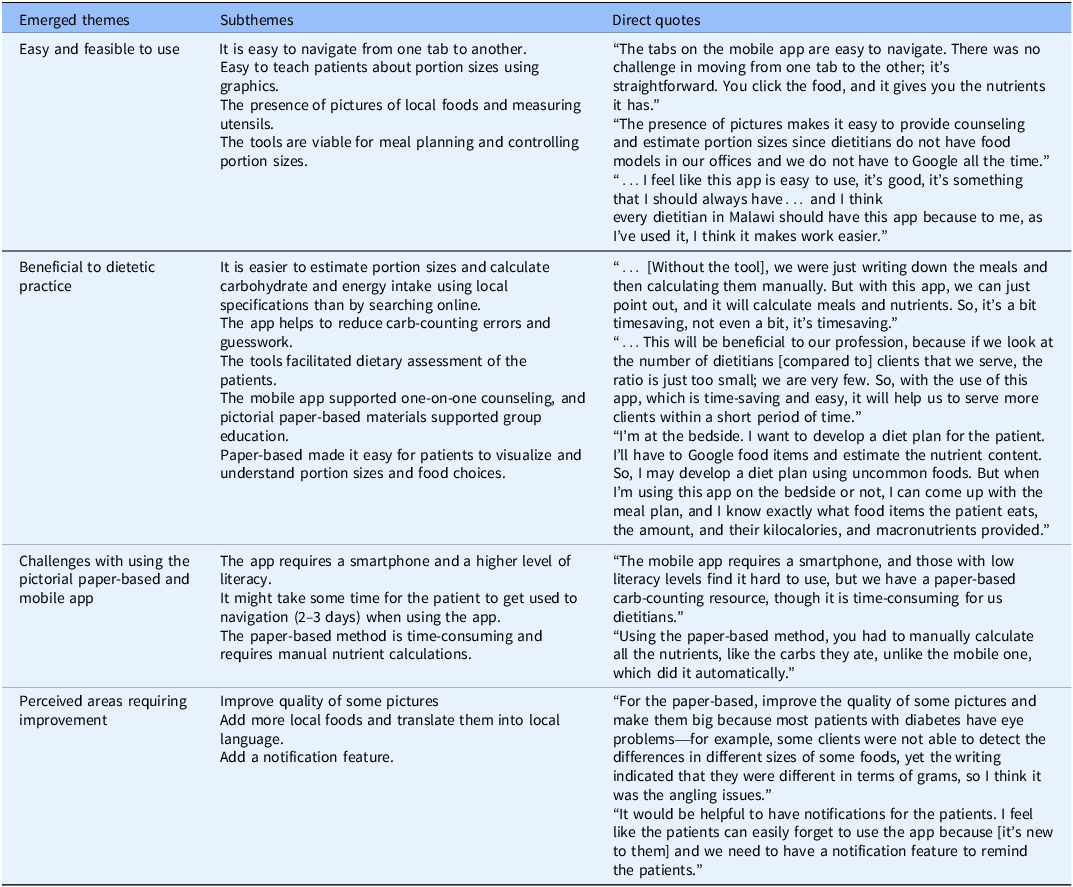
The clinical dietitians involved in the feasibility study comprised of two males and three females, all having a Master of Science in Clinical Dietetics and with more than three years of clinical practice. As presented in Table 2, four main themes and subthemes, with supporting direct quotations, emerged after the clinical dietitians piloted both the pictorial paper-based and the mobile app CC resources. These include:
Emerging themes, subthemes, and direct quotes

Table 2. Long description
Table 2, represents four main themes and subthemes, with supporting direct quotations, emerged after the clinical dietitians piloted both the pictorial paper-based and the mobile app CC resources.
Theme 1: Ease and feasibility of use
Clinical dietitians found that both tools were practical and compatible with current clinical workflows, owing to the inclusion of food portion images, representation of local foods, and the mobile app’s simple, easy-to-understand, and user-friendly tab navigation. One clinical dietitian stated, “…I feel like this app is easy to use, it’s good, it’s something that I should always have… and I think every dietitian in Malawi should have this app because to me, as I’ve used it, I think it makes work easier.” Displaying local foods in various portion sizes aided dietary counseling for patients with diabetes. Another clinical dietitian added, “The presence of pictures makes it easy to provide counseling and estimate portion sizes since dietitians do not have food models in our offices and we do not have to Google all the time.”
Theme 2: Beneficial to dietetic practice
The clinical dietitians reported that the pictorial paper-based CC was preferred by patients and made it easier for them to see portion sizes, take notes, and choose foods. However, the clinical dietitians liked the mobile app and found both tools helpful for dietary assessment and for communicating with patients with diabetes about their diet. They found that the resources saved time, allowing them to see more patients with diabetes, reduced errors and guesswork in dietary assessments, and supported dietary counseling and nutrition education. For example, one clinical dietitian said, “…This will be beneficial to our profession, because if we look at the number of dietitians [compared to] clients that we serve, the ratio is just too small; we are very few. So, with the use of this app, which is time-saving and easy, it will help us to serve more clients within a short period of time.” The CC resources also helped with meal planning for both inpatient and outpatient adults with diabetes. One dietitian explained, “I’m at the bedside. I want to develop a diet plan for the patient. I’ll have to Google food items and estimate the nutrient content. So, I might develop a diet plan using uncommon foods. But when I’m using this app on the bedside or not, I can come up with the meal plan, and I know exactly what food items the patient eats, the amount, and their kilocalories, and macronutrients provided.”
Theme 3: Challenges with using the pictorial paper-based and mobile app
Challenges with the CC resources included the need for smartphones and a certain level of literacy to use the mobile app, which can create barriers for patients from diverse sociodemographic backgrounds, as well as the need for more time to learn how to use the app. Clinical dietitians also reported that using pictorial paper-based CC increased the time spent with patients, thus not time-saving. For example, one clinical dietitian said, “The mobile app requires a smartphone, and those with low literacy levels find it hard to use, but we have a paper-based carb-counting resource, though it is time-consuming for us dietitians.”
Theme 4: Perceived areas requiring improvement
Clinical dietitians suggested ways to improve both the pictorial paper-based and mobile app CC resources. They recommended clearer images to help patients with vision impairments, particularly for distinguishing food portion sizes in the pictorial paper-based version. It was mentioned that, “For the paper-based, improve the quality of some pictures and make them big because most patients with diabetes have eye problems—for example, some clients were not able to detect the differences in different sizes of some foods, yet the writing indicated that they were different in terms of grams, so I think it was the angling issues.” They also proposed adding a notification feature in the mobile app to allow users to receive individualized alerts.
Discussion
Studies show that adherence to diabetes self-management education support (DSMES) is low when not tailored to patients’ needs, especially in low-resource settings and among those with low literacy [Reference Mphwanthe, Carolan, Earnesty and Weatherspoon3,Reference Woodward, Walters and Davies4,Reference Abu and Llahana20,Reference de Carvalho, Silva and Treptow21,Reference Bekele, Asefa, Getachew and Belete40]. To address this, we developed a pictorial paper-based CC tool for clinical dietitians to use during counseling to help low-literacy patients better understand suggested portion sizes of local foods. We then adapted the tool into a mobile app for clinical dietitians and higher-literacy smartphone users. The context-tailored CC materials align with DSMES recommendations by providing culturally tailored diabetes education resources that promote patients’ self-care, informed decision-making, and healthy eating, with the goal of optimizing health outcomes [41]. Clinical dietitians used both CC resources in routine clinical care and found them user-friendly, which helped in dietary assessment, counseling, education, and meal planning. As a result, clinical dietitians were able to serve more patients with diabetes. These findings suggest that both culturally tailored CC resources could be a helpful means of providing diabetes education/interventions, either alone or together, depending on patient ability, thereby reducing barriers to accessing evidence-based nutrition information for optimal diabetes care.
Context-specific diabetes education programs and interventions that address the needs of patients with diabetes have been shown to improve patients’ nutrition behaviors, diabetes knowledge, self-monitoring of blood glucose, confidence, patient empowerment, participation in diabetes education, and clinical outcomes, particularly HbA1C [Reference Wadi, Asantewa-Ampaduh, Rivas and Goff17,Reference Joo18,Reference Abu and Llahana20,Reference Flores-Luevano, Pacheco, Shokar, Dwivedi and Shokar42–Reference Goff, Rivas, Moore, Beckley-Hoelscher, Reid and Harding44]. Therefore, developing a pictorial paper-based and mobile app CC that incorporates foods commonly consumed by patients with diabetes in Malawi provides an easy-to-interpret, reliable source of dietary information for patients, which can improve dietary knowledge and adherence and ultimately help achieve glycemic targets when used as a guidance tool. Furthermore, a simplified pictorial paper-based and mobile app CC addresses challenges identified in our previous studies, specifically conflicting dietary information sources, high-carbohydrate diets, and the associated difficulty in achieving optimal glycemic targets [Reference Mphwanthe, Carolan, Earnesty and Weatherspoon3,Reference Mphwanthe, Weatherspoon, Li and Weatherspoon6].
The use of mobile applications in dietetics practice as a source of nutrition information for patient nutrition education and counseling, patient communication, and patient self-monitoring is increasingly common [Reference Chen, Lieffers, Bauman, Hanning and Allman-Farinelli45–Reference Chen, Gemming, Hanning and Allman-Farinelli48]. Clinical dietitians are uniquely positioned to provide expert dietary education to patients with diabetes [Reference Early and Stanley49–Reference Davidson, MacLeod, Lau, Hui and Gilmore51]. Therefore, in this study, clinical dietitians were involved in the development and testing of the mobile app and pictorial paper-based CC to support its implementation in dietetic practice. The mobile app and pictorial paper-based CC resources were perceived as beneficial for dietitians, as they facilitated dietary assessment and meal planning, were easy to use and feasible, and helped dietitians to assist more patients with diabetes. Previous studies showed that involving dietitians in app development and in educational and skills-building sessions on integrating apps into dietetic practice provided evidence-based dietary information, facilitated familiarity and usability with the app, and improved dietitians’ self-efficacy in incorporating the app into their existing workflow, thereby enhancing the quality of patient care [Reference Chen and Allman-Farinelli46,Reference Chen, Lieffers, Bauman, Hanning and Allman-Farinelli52].
Strengths and limitations
A primary strength of the study was the development of a pictorial paper-based CC that incorporated traditional foods, which will help patients with diabetes and those with limited literacy to recognize familiar foods and better visualize portion sizes. In addition, the clinical dietitian’s involvement in developing and pilot testing, in a clinical setting, both the mobile app and the pictorial paper-based CC, authenticated the process. Limitations include the use of only two clinical sites and the lack of qualitative data from patients to close the loop on the user-centered/user experience designs; however, the forthcoming results on the effectiveness of using both pictorial paper-based and mobile app CC in nutrition education and counseling on patients’ CC knowledge and glycemic status will help to offset this limitation. Future efforts to further develop and expand feasibility testing should also involve patients with diabetes, caregivers, and other healthcare providers, such as nurses, and clinicians. Furthermore, it would be helpful to extend sites to community settings to test sustained/extended application and use. Since the qualitative data focused on integrating CC materials into existing clinical workflows, even though not used formally, the general principles associated with the Consolidated Framework for Implementation Research [Reference Damschroder, Aron, Keith, Kirsh, Alexander and Lowery53,Reference Reardon, Damschroder and Ashcraft54] guided the feasibility assessment component of this study. More specifically, we considered barriers and facilitators to provide insights into the factors influencing implementation processes from the clinical dietitian’s perspective [Reference Damschroder, Aron, Keith, Kirsh, Alexander and Lowery53,Reference Reardon, Damschroder and Ashcraft54].
Conclusions
The context-specific CC materials developed were considered easy to use and practical, with the potential to benefit both dietitians and patients with diabetes. However, results on the effectiveness of materials aimed at patients diagnosed with both type 1 and type 2 diabetes delivered through nutrition education and counseling will further validate the tools.
Supplementary material
The supplementary material for this article can be found at https://doi.org/10.1017/cts.2026.10787.
Data availability statement
Data will be made available upon reasonable request to the corresponding author.
Acknowledgments
We would like to thank the Management of Kamuzu and Mzuzu Central Hospitals for permitting us to conduct the study. Special thanks to the clinical dietitians at Kamuzu and Mzuzu Central Hospitals, namely: Limbikira Wasambo, Jonathan Misolo, Lustia Mndoliro, Triza Columbus, and Felistace Mtande, for providing valuable input on the development of the app and for testing both the pictorial paper-based and mobile app CC resources in clinical settings.
Getrude Mphwanthe, PhD., RD, FAND, was a Senior Lecturer at Lilongwe University of Agriculture and Natural Resources during the funding acquisition and study implementation. But she is now an Assistant Professor at Utah State University.
Author contributions
Getrude Mphwanthe: Conceptualization, Funding acquisition, Investigation, Methodology, Supervision, Visualization, Writing – original draft, Writing – review & editing; Bridget Mkama: Formal analysis, Investigation, Visualization, Writing – review & editing; Humphrey Chatenga: Formal analysis, Visualization, Writing – review & editing; Lydia Lowe: Formal analysis, Visualization, Writing – original draft, Writing – review & editing; Lorraine Weatherspoon: Conceptualization, Funding acquisition, Methodology, Writing – original draft, Writing – review & editing.
Funding statement
This research was supported by UNESCO-The World Academy of Sciences, Seed Grant for New African Principal Investigators (SG-NAPI). SG-NAPI Agreement No. 4500454080.
Competing interests
Authors declare no potential conflict of interest.


 Open access

