INTRODUCTION
Current treatment for schizophrenia aims to control psychotic symptoms with the use of antipsychotic (AP) medication and to reduce psychosocial disabilities with the implementation of psychosocial treatments such as skills training (Liberman, Reference Liberman1998a, Reference Libermanb; Kopelowicz et al. Reference Kopelowicz, Zarate, Gonzalez, Mintz and Liberman2003), social skills training (Liberman & Corrigan, Reference Liberman and Corrigan1993; Marder et al. Reference Marder, Wirshing, Mintz, McKenzie, Johnston, Eckman, Lebell, Zimmerman and Liberman1996) and psychosocial skills training (PSST; Heinssen et al. Reference Heinssen, Liberman and Kopelowicz2000). The focus has been to teach a broad range of skills to individuals with schizophrenia who present disabilities in several areas of their psychosocial functioning (PSF). Research has established the effectiveness of various modalities of PSST for schizophrenia (Benton & Schroeder, Reference Benton and Schroeder1990; Corrigan, Reference Corrigan1991; Wallace et al. Reference Wallace, Liberman, MacKain, Blackwell and Eckman1992; Liberman & Corrigan, Reference Liberman and Corrigan1993; Hayes et al. Reference Hayes, Halford and Varghese1995; Huxley et al. Reference Huxley, Rendall and Sederer2000). Most skills trials have been conducted using treatment as usual (TAU), with pharmacological treatment as the control group.
However, in Latin America, and in this case in Mexico, there is no evidence that PSST research has been conducted in patients with schizophrenia, and for many decades there has been a tradition of using exclusively AP medication as ‘customary treatment’ and not including any modality of psychosocial treatment for these patients. Therefore, it is not known whether the implementation of PSST in Mexico could be as effective and produce therapeutic changes as demonstrated previously in other countries (Liberman, Reference Liberman1994; Lehman & Steinwachs, Reference Lehman and Steinwachs1998; Heinssen et al. Reference Heinssen, Liberman and Kopelowicz2000; Glynn et al. Reference Glynn, Marder, Liberman, Blair, Wirshing and Mintz2002; Kopelowicz et al. Reference Kopelowicz, Zarate, Gonzalez, Mintz and Liberman2003). This study is the first attempt to carry out a PSST approach in Mexican out-patients with schizophrenia.
Prior to the design of the intervention, a study was conducted to assess the clinical and psychosocial variables (i.e. relapse, rehospitalizations, compliance, disabilities, psychosocial functioning) in patients with schizophrenia receiving treatment at the National Institute of Psychiatry (Instituto Nacional de Psiquiatría Ramón de la Fuente, INPRF) in Mexico City (Valencia & Rascon, Reference Valencia and Rascon1998). The findings indicated that some patients had never acquired certain abilities and others had lost certain capacities because of their illness. As a result we were able to identify seven domains in which patients needed to learn certain skills necessary to improve their functioning. The design considers each domain as a treatment area with a specific set of skills that are taught to the patients. PSST combined techniques that have demonstrated success in helping patients with schizophrenia to acquire a repertoire of skills (Wallace et al. Reference Wallace, Liberman, MacKain, Blackwell and Eckman1992; Liberman & Corrigan, Reference Liberman and Corrigan1993; Heinssen et al. Reference Heinssen, Liberman and Kopelowicz2000; Kopelowicz et al. Reference Kopelowicz, Zarate, Gonzalez, Mintz and Liberman2003), along with other techniques that were modified and adapted to our study population. The PSST programme was developed in Spanish and included AP medication, PSST and family therapy (FT).
This paper reports the results of the effectiveness of a randomized controlled PSST trial applied to chronic out-patients with schizophrenia. The aim of the intervention was to acquire psychosocial skills to improve role performance as well as psychosocial and global functioning, to reduce symptoms and prevent relapse and rehospitalization. We hypothesized that when compared to subjects who received TAU alone, patients who received TAU+PSST+FT would show significant changes in their symptomatology, in psychosocial and global functioning, a lower rate of relapse and rehospitalization and a higher level of compliance with AP medication and therapeutic adherence.
METHOD
Participants and procedure
Participants included out-patients with schizophrenia attending the hospital of the INPRF, an institution that belongs to the National Institutes of Health of the Ministry of Health in Mexico. Ninety-eight out-patients of the Schizophrenia Clinic were randomly assigned to two groups: 49 patients to the PSST programme (experimental treatment) and 49 to TAU alone (control treatment). Of the 98 initial patients, six from the PSST group (12·2%) and 10 from TAU (20·4%), a total of 16 patients (16·3%), failed to complete the study, leaving a final sample of 82 patients: 43 in the PSST group and 39 in TAU. The two groups were evaluated before and after completion of 1 year of treatment. Measures included clinical and psychosocial variables such as: symptoms, psychosocial functioning, global functioning, relapse, rehospitalizations, desertion from the intervention, and therapeutic adherence. Participants included patients diagnosed with schizophrenia according to DSM-IV (APA, 1994) and corroborated with the Composite International Diagnostic Interview (CIDI; Robins et al. Reference Robins, Wing, Wittchen, Helzer, Babor, Burke, Farmer, Jablenski, Pickens, Regier, Sartorius and Towle1988) who met the following criteria: out-patients who were taking AP medication and were clinically stable in terms of their psychotic symptoms (corroborated by a lower score of 60 in the Positive and Negative Syndrome Scale, PANSS), men or women aged 16 to 50 who had completed at least 6 years of elementary education, lived with their families and resided in Mexico City or the metropolitan area, and who had provided written informed consent to participate in the research project. The study protocol was approved by the Ethics Committee of the INPRF.
Treatment groups
Experimental treatment
PSST is composed of seven treatment areas; each area includes a specific set of skills that are taught to the patients. The seven areas are as follows, according to the sequence of the training, with one example of the skills to be learned for each area: (1) symptom management (e.g. identifying warning signs of relapse), (2) medication management (e.g. emphasizing compliance with AP medication), (3) social relations (e.g. initiating conversations), (4) occupational (e.g. helping with chores at home), (5) money management (e.g. counting change in a store), (6) couple relations (e.g. being able to go on a date), and (7) family relations (e.g. maintaining a conversation with a relative).
A therapist's manual (Valencia et al. Reference Valencia, Rascón, Ortega, Ortega and Valencia2001) describes all the areas, the skills corresponding to each area, and the training strategies for each session. The therapists (trainers) were two psychologists (postgraduates in clinical psychology) who used six learning activities to teach patients skills acquisition: (1) introduction and explanation of the skills to be taught, including preparing and motivating patients to participate actively in the learning activities; (2) demonstration of the skills by one of the therapists, followed by a question-and-answer segment that allowed for clarification; (3) role playing: patients practiced the skills by role playing during sessions; (4) role playing feedback to allow patients to identify the resources needed to perform the skills in the real world; (5) practice of skills in their natural environment; and (6) at the beginning of the following session a segment was dedicated to verifying the practice of the skills in the community; this information was registered in a skills learning check-up list (Valencia, Reference Valencia1996). The learning activities (Liberman & Corrigan, Reference Liberman and Corrigan1993; Kopelowicz et al. Reference Kopelowicz, Zarate, Gonzalez, Mintz and Liberman2003) were similar to the seven instructional techniques proposed by Wallace et al. (Reference Wallace, Liberman, MacKain, Blackwell and Eckman1992) for teaching social and instrumental skills to the severely mentally ill. These were modified to six learning activities for the participants of the present study.
Patients participated in group sessions, eight patients per group, with a time limit of 1 hour 15 min, once a week for a total of 48 sessions during 1 year of PSST. To verify that each treatment area was being covered systematically and adequately, a therapist fidelity evaluation form was used (Valencia, Reference Valencia1996). A research assistant was in charge of assessing the therapists' competency for each treatment area. Prior to the initiation of the study, competency levels had to be demonstrated with at least a 90% level of efficacy. Monitoring for maintenance of fidelity occurred throughout the study, and when fidelity levels were lower than 90%, feedback was given to the therapists to regain competency.
FT consisted of two parts: the first was psychoeducation, which included eight group sessions where all the patients' relatives received information about the illness, symptoms and medication management. The second part consisted of four sessions for each family, including the patient, oriented to problem solving as needed by each family to improve communication skills, the recognition and management of warning signs of relapse, the importance of medication and its side-effects, compliance with AP medication, and keeping appointments with physicians. Two family therapists conducted the FT.
Recreational activities for the patients, conducted by an arts teacher, included singing, musical games, creative movement, and arts and crafts, once a week for 2 hours. Recreational activities were not considered as a therapeutic modality.
Control treatment
TAU for the experimental and control patients was provided at the Schizophrenia Clinic of the INPRF by two clinical psychiatrists, who were blind to the two treatment conditions and carried out the following tasks for the patients: they provided 20-min monthly appointments during a 1-year period, controlled the prescription of their AP medication based upon the assessment of their psychotic symptoms, checked their medication compliance, recorded their attendance to the consultations, and registered all this information in their clinical files.
Instruments
Symptomatology was assessed using the PANSS, which is a validated 30-item scale. The Spanish adaptation (Kay et al. Reference Kay, Fizbein, Vital-Herne and Fuentes1990) consisting of three subscales: positive (seven items), negative (seven items) and general psychopathology (GPS) (16 items). Each item is scored from 1 (absence of psychopathology) to 7 (extremely severe).
Psychosocial functioning (PSF) was measured using the Psychosocial Functioning Scale (PSFS; Valencia et al. Reference Valencia, Rojas, González, Ramos and Villatoro1989). Functioning was assessed in five areas (occupational, social, money management, marital, and familial), and the patient's global psychosocial functioning (GPSF) was also assessed. PSF evaluates role performance through the level of satisfaction reported by the patient in the above-mentioned areas of functioning. The instrument is composed of a total of 35 items (seven per area). Each item is scored from 1 (very satisfied) to 5 (very unsatisfied). A low score indicates better psychosocial functioning. The validity and reliability of the PSFS have been established (Valencia et al. Reference Valencia, Rojas, González, Ramos and Villatoro1989). A varimax rotation differentiated five factors (areas) for the construct validity. These factors explained 52% of the total variance. Internal consistency was determined through Cronbach's α. Reliability coefficients for all areas were over 0·80 (p=0·01).
Global functioning was evaluated using the Global Assessment of Functioning (GAF) scale in DSM-IV (APA, 1994), which measures the combination of two elements: (1) symptom severity, and (2) any serious impairment in psychological, social and occupational functioning on a mental health-illness continuum (level of functioning).
During the intervention, relapse, rehospitalization rates, compliance with AP and therapeutic adherence were evaluated for all participants. Compliance occurred when patients took their AP medication in the full prescribed dose by their treating psychiatrist. To obtain these data, patients were asked if they had taken their AP medication during treatment according to their psychiatrist's instructions. This information was verified using two sources: the patients' psychiatrist and the patients' medical records. A criterion of adequate compliance was determined when patients had taken at least 80% of the prescribed AP medication verified by all three sources.
To evaluate therapeutic adherence, two elements were considered: (1) patients' attendance at sessions was registered to measure their percentage of attendance during the intervention, and (2) the level of therapeutic adherence was obtained by considering the number of patients who completed the intervention, compared with those who dropped out. To determine the corresponding therapeutic adherence, the levels of therapeutic adherence must be verified (see Table 5). The percentage of desertion (non-adherence) was obtained by considering the number of patients who dropped out in comparison with the number of patients who initiated the intervention.
Independent interviewers, properly trained in all research instruments and unaware of which study group the patients belonged to, evaluated the two groups under study: initial and final assessments. To ensure blindness the interviewers were instructed to remind all patients to abstain from mentioning what type of treatment they were receiving. The independent interviewers did not participate in the treatment team and had no knowledge of the research project.
Statistical analysis
Data analysis was carried out using SPSS version 11.5 (SPSS Inc., Chicago, IL, USA). Descriptive and χ2 analyses were carried out to compare percentages while initial measurements were compared with Student t tests to verify that there were no significant differences between the two groups in their initial levels of symptomatology, PSF and global functioning. The two groups under study were compared before and after treatment, using repeated measures analysis of variance (ANOVA). Standardized estimates of effect sizes were calculated using Cohen's (Reference Cohen1977)d defined as: d=( 1–2)/s, where 1 and 2 are the means of the initial and final assessments of the treatment respectively, and s is the pooled within-group standard deviation. To establish differences three levels of effect sizes were identified: small=0·25, medium=0·50 and large=1·00 irrespective of the sign (+ or −) of the number. At the time of the initial assessment, no statistically significant differences were found between the two groups with regards to the PSFS, the GAF scale or the PANSS scores.
RESULTS
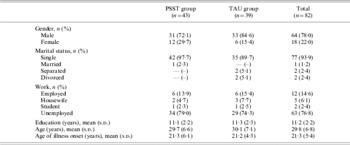
The demographic and clinical characteristics of the two groups under study and of the total sample are shown in Table 1.
Demographic and clinical characteristics of the sample

PSST, Psychosocial skills training; TAU, treatment as usual; s.d., standard deviation.
Symptomatology
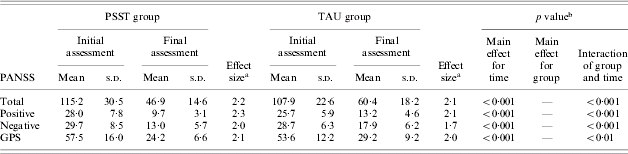
Table 2 illustrates the results of the initial and final mean scores on the PANSS. There were statistically significant differences between groups after completion of the treatments on the total score, positive and negative symptoms and in GPS in comparison with the TAU group. ANOVA showed that there was a main effect for time on total symptoms (p<0·001), positive symptoms (p<0·001), negative symptoms (p<0·001) and GPS (p<0·001), as well as an interaction of group and time on total symptoms (p<0·001), positive symptoms (p<0·001), negative symptoms (p<0·001) and GPS (p<0·01). A comparison of the standardized effect sizes showed a large effect size for the two groups under study.
Comparison of PANSS between the initial and final assessments for the PSST and TAU groups

PSST, Psychosocial skills training; TAU, treatment as usual; PANSS, Positive and Negative Syndrome Scale; GPS, General Psychopathology Scale; s.d., standard deviation.
Lower scores indicate a better level of symptomatology.
a Standardized estimate of effect size. Levels of effect size: small=0·25; medium=0·50; large=1·00.
b Repeated measures analysis of variance (ANOVA).
Psychosocial functioning
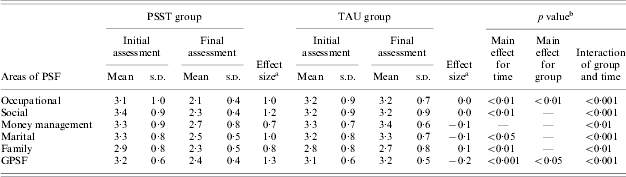
Table 3 compares functioning for each area and GPSF scores between the initial and final assessments in the two groups under study. Patients in PSST at the time of the initial assessment scored at level 3 in all areas except the familial area, where they scored at level 2, indicating that they were satisfied but with a tendency towards level 3 of neutral-indifferent. At the final assessment they scored at level 2, indicating that they were satisfied in all areas. Statistically significant differences were found between the initial and final assessments in all areas and in GPSF (p<0·05). Patients in the TAU group showed no changes between the initial and final assessments. At the time of the final assessment, they scored at level 3 in all areas and in GPSF with the exception of the familial area, where they scored at level 2. TAU patients showed no improvements or statistically significant differences between the initial and final assessments in any of these areas or in GPSF. When an ANOVA was carried out, statistically significant differences (p<0·05) were found after analysing the combined effects of the type of treatment (PSST+TAU v. TAU) and the two measurements (initial and final) in all the areas and in GPSF. Differences were observed between the two groups at the initial and final assessments. PSST had an effect between the first and second measurements in all areas and in the level of GPSF. In the same analysis, when the components of the model were separated and the effect of the type of treatment was considered (PSST+TAU v. TAU), significant differences were only observed (p<0·05) between the groups in the occupational area and on the GPSF. Finally, when the changes between the initial and final assessments were analysed, without considering the group, differences were observed (p<0·05) from the initial to the final evaluation in the following areas: occupational, social, marital, and familial, as well as in GPSF, but not in the money management area. A comparison of the standardized effect sizes showed a medium and large effect size for the PSST group with a range from 0·7 to 1·3. For the TAU group there were non-effect sizes ranging from 0·0 to 0·2.
Comparison of psychosocial functioning (PSF) between the initial and final assessments for the PSST and TAU groups

PSST, Psychosocial skills training; TAU, treatment as usual; s.d., standard deviation; GPSF, global psychosocial functioning.
Levels of PSF: 1=very satisfied, 2=satisfied, 3=neutral, indifferent, 4=unsatisfied, 5=very unsatisfied.
a Standardized estimate of effect size. Levels of effect size: small=0·25; medium=0·50; large=1·00.
b Repeated measures analysis of variance (ANOVA).
Global functioning
Table 4 shows that patients in the PSST group demonstrated greater improvement in their functioning than the TAU group. There were statistically significant differences (p<0·05) between the initial score and the score obtained after completion of the intervention in the PSST group. Patients in the TAU group experienced no improvement and remained at the same level of functioning. There were no statistically significant differences between the initial and final assessments in the TAU group. At the initial assessment, both groups scored in the same range of functioning: 41–50. After completion of the intervention, patients in the TAU group remained at the same range of functioning (41–50) at which they started, indicating a certain degree of stability in their symptoms, but with no significant changes in their psychological, social and occupational functioning. Patients in the PSST group improved two ranges of functioning, increasing from the 41–50 range at the initial assessment to the 51–60 and 61–70 ranges after completion of the intervention. The ANOVA model showed the effect (p<0·05) of the type of treatment (PSST+TAU v. TAU), with differences being found between the two groups. Differences were also found (p<0·05) from initial to final assessment when the changes between the two measurements were analysed, regardless of the group. Finally, when the effects of the changes in the groups considering the two measurements were observed, the variations proved to be statistically significant (p<0·05), indicating an effect of the type of intervention between the initial and final evaluations, revealing differences in GAF between patients from the two groups after the completion of the intervention. A comparison of the standardized effect sizes showed a large effect size (3·6) for the PSST group and a non-effect size (0·1) for the TAU group.
Comparison of global functioning between the initial and final assessments for the PSST and TAU groups

PSST, Psychosocial skills training; TAU, treatment as usual; s.d., standard deviation.
Higher scores indicate a better level of global functioning on the Global Assessment of Functioning (GAF) scale.
a Standardized estimate of effect size. Levels of effect size: small=0·25; medium=0·50; large=1·00.
b Repeated measures analysis of variance (ANOVA).
Relapse, rehospitalizations, compliance and therapeutic adherence
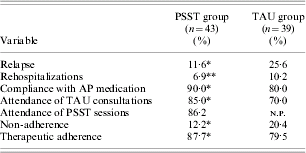
Table 5 presents the results for relapse and rehospitalization rates during the intervention, revealing that only five of the 43 (11·6%) patients from the PSST group relapsed as compared to 10 of the 39 (25·6%) patients from TAU. Statistically significant differences were found between the two groups (p<0·05). Rehospitalization rates indicated that three of the 43 (6·9%) patients from the PSST group were rehospitalized, in comparison to four of the 39 (10·2%) patients from TAU. No statistically significant differences were found between the two groups. PSST patients showed a higher level of compliance with AP medication (90%) (p<0·05) in comparison with TAU subjects (80%). Attendance of consultations for pharmacological treatment was much higher in the PSST group (85%) (p<0·05) than the TAU group (70%). The number of patients who completed treatment (therapeutic adherence) was 43 out of 49 (87·7%) for the PSST group (p<0·05) and 39 out of 49 (79·5%) for the TAU group. Non-adherence (drop-out rate) was six out of 49 patients (12·2%) for the PSST group (p<0·05) and 10 out of 49 patients (20·4%) for TAU. Attendance at the PSST sessions was 86·2%, indicating a high level of therapeutic adherence.
Clinical variables and therapeutic adherence during psychosocial skills training (PSST) and treatment as usual (TAU)

AP, Antipsychotic; n.p., non-participation in PSST.
Therapeutic adherence levels: 90–100 (excellent); 80–89 (high); 70–79 (good); 60–69 (regular); 50–59 (poor); 40–49 (bad).
* p<0·05, ** non-significant.
DISCUSSION
The effectiveness of the psychosocial intervention was clearly demonstrated by this study, patients using the PSST approach improving their symptomatology considerably with respect to PSF and GAF. Considering the level of PSF after completion of the intervention, it can be concluded that PSST patients acquired psychosocial skills and therefore improved their role performance in all areas of the PSST approach. This finding was corroborated by the significant statistical differences found for all areas, as well for GPSF. The results for global functioning were similar to those found for PSF. The global functioning of the patients who participated in the PSST programme improved considerably from a range of 41–50 at the initial assessment to a range of 61–70 after completion of the intervention, with statistically significant differences, improving by two levels, compared with TAU patients who remained at the same level (range of 41–50) from the start to the end of the intervention, with no statistically significant differences in this group.
The results indicated that effect sizes were large and medium for the PSST approach in symptomatology, PSF and GAF, and small for the TAU group, with the exception of symptomatology, where the effect size was large for the two groups under study. Patients who did not receive PSST (e.g. those in the control treatment) failed to improve in any of the clinical and psychosocial variables, their improvement was only in symptomatology, and this is clearly an effect of the pharmacological treatment. To assess the degree of change, three indexes as proposed by Kazdin & Bass (Reference Kazdin and Bass1999) were considered: symptom change, and improvement in psychosocial and global functioning. In the PSST group, change, improvement and effectiveness were demonstrated by all indexes. The changes indicated a clinically significant effect as well as an improvement in their functioning. In the TAU group, clinical and statistical significance and also a large effect size were found in symptomatology, but not in PSF or in global functioning.
The clinical variables also indicate differences between the two groups under study, with patients who participated in PSST registering lower relapse and rehospitalization rates compared with patients in the TAU group. The differences can be explained by the fact that patients who participated in the PSST approach had the opportunity to learn about several aspects of the disease, for example knowing what a relapse is, what the warning signals are, how to recognize them and, above all, how to prevent both relapse and rehospitalizations. The PSST patients also established a weekly therapeutic relationship with mental health professionals for over 1 year. This point is clearly illustrated when psychosocial intervention is added to pharmacological treatment in that relapse rates can be reduced by as much as 50% when compared with relapse associated with medication alone (Hogarty & Ulrich, Reference Hogarty and Ulrich1998). According to compliance with AP medication, attendance of TAU consultations and attendance of PSST sessions, therapeutic adherence was within the range from high to excellent in the PSST group, while the range for these variables for the TAU group was from good to high. When patients had the opportunity to participate in a psychosocial intervention such as PSST, the level of therapeutic adherence was high and the drop-out rate was low.
In conclusion, the combination of AP medication, PSST and FT produced a favourable outcome. A comprehensive psychosocial treatment programme appropriate for our patients was developed. The PSST approach was designed based on the characteristics and the needs of our patients, and their cultural, clinical and psychosocial problems, which in some cases might differ from those of other cultures and other countries. Most of our patients do not have a job or an income, and they need emotional and economic support from their relatives. Furthermore, all of our patients do not pay taxes, do not read newspapers, do not use credit cards, and do not have a checking account. Certain implications should be mentioned, such as that in the USA a modular approach has been used for skills training (ST). Considering the five modules of the ST as proposed by Liberman & Corrigan (Reference Liberman and Corrigan1993), in three of them (medication management, symptom management and conversational skills) the original skills of those modules and those needed by our patients were similar. We did not include the other two modules (recreation for leisure and grooming and self-care) because they were not requested by our patients. We added four treatment areas (occupational, money management, couples relations, and family relations) that were important to our patients. The advantage of the modular approach is that each module ‘can be tried and either rejected or adopted, either alone or in combination with other modules’ (Wallace et al. Reference Wallace, Liberman, MacKain, Blackwell and Eckman1992). We did not use the term module because this word in Spanish is never used in clinical and therapeutic environments. As an equivalent of ‘modules’ we used the term ‘treatment areas’.
From a cultural point of view, it would be difficult to compare our results with those from Latinos in the USA, as it is well known that the population that migrates to the USA is of rural origin and we work mostly with patients of urban origin. It is worth noting the adaptations that we made: (1) we only used six out of seven learning activities that are currently used in the USA; (2) we did not use video-assisted modelling because skills training technology in Spanish has not been developed in Mexico; (3) the demonstration of the skills to be learned was made by one of the therapists and patients felt comfortable with this situation; (4) patients accepted homework assignments (i.e. practice of the skills at home) but they did not accept any type of written material (i.e. writing exercises during sessions or at home). They had never expected that they would have to use any type of written material. They considered that therapy was for listening, talking and learning; the use of any type of written material was considered as a school activity that had nothing to do with therapy. The patients showed a certain level of anxiety and felt uncomfortable at the time of the written activities during the initial sessions such that we desisted with these activities. Their relatives reported the same situation to family therapists, that patients were annoyed and irritable at home because of the written activities, and we therefore decided to suspend written activities of all types during treatment so as not to generate negative reactions. (5) The learning activities were appropriately translated and included in the therapist's manual.
The results of this study coincide with current views on the management of patients with schizophrenia, in the sense that psychosocial interventions provide an excellent opportunity for patients to improve their skills in different areas of functioning, as well as prevent relapse and rehospitalizations, so that they have a more satisfactory psychosocial function in the community (Bellack & Mueser, Reference Bellack and Mueser1993; Valencia, Reference Valencia1996, Reference Valencia1999a, Reference Valenciab; Hogarty & Ulrich, Reference Hogarty and Ulrich1998; Mojtabai et al. Reference Mojtabai, Nicholson and Carpenter1998; Valencia & Rascon, Reference Valencia and Rascon1998; Wykes et al. Reference Wykes, Tarrier and Lewis1998; Diaz et al. Reference Díaz, Rascón, Valencia, Unikel and Murow1999, Reference Díaz, Ortega, Leaños, Rodríguez, Rascón, Valencia, Gutierrez, Mares and Sánchez2005; Lauriello et al. Reference Lauriello, Bustillo and Keith1999; Brenner & Pfammatter, Reference Brenner and Pfammatter2000; Huxley et al. Reference Huxley, Rendall and Sederer2000; Marder, Reference Marder2000; Wallace et al. Reference Wallace, Liberman, Tauber and Wallace2000; Glynn et al. Reference Glynn, Marder, Liberman, Blair, Wirshing and Mintz2002; Valencia et al. Reference Valencia, Lara, Rascon and Ortega2002a, Reference Valencia, Ortega, Rascon and Gomezb, Reference Valencia, Rascón and Quiroga2003, Reference Valencia, Ortega, Rodríguez and Gómez2004a, Reference Valencia, Ortega, Rodríguez and Gómezb; Kopelowicz et al. Reference Kopelowicz, Zarate, Gonzalez, Mintz and Liberman2003). In this respect, the implementation of psychosocial interventions has made a significant contribution to improving the treatment of people with schizophrenia.
ACKNOWLEDGEMENTS
This research was supported by The National Institute of Psychiatry Ramon de la Fuente (INPRFM-DIES 4546) and the National Council on Science and Technology (CONACYT 26243H).
DECLARATION OF INTEREST
None.