Nearly half a century ago, Nelson Polsby authored three works that together constitute one of the most influential empirical and normative statements about the role of the U.S. House of Representatives in the American political system.Footnote 1 These works—two articles in the American Political Science Review and an essay in the Handbook of Political Science—took a comparative perspective that spanned both timeFootnote 2 and space. In this article we revisit one of those works, Polsby's article “The Institutionalization of the U.S. House of Representatives” (hereinafter “Institutionalization”), with two goals in mind. First, and most simply, we extend Polsby's historical analysis to the present and assess on its own terms the degree to which the House has continued along the institutionalization path that he documented. Second, we assess Polsby's larger normative claims, in light of congressional scholarship since the late 1960s and more recent concerns about congressional “dysfunction.”
The title of this article suggests that a question has arisen about whether institutionalization is still a process that can be associated with the House or whether events have conspired to undo the trends that Polsby documented. On the surface, there is plenty to suggest that the institutionalized features that Polsby described have been in retreat since the 1960s. Pathways to party leadership have become more porous, previously automatic systems such as seniority have been undermined, staff and budgetary support for committees have diminished, and loyalty to the body itself has waned. Yet, as we shall show, when we simply revisit Polsby's measures of institutionalization and continue them to the present, it seems that much of the institutional evidence that Polsby described remains apt. There are notable exceptions, of course. Still, even if the House is less institutionalized today (as Polsby measured it), it is still highly institutionalized compared to its own history and other national legislatures.
Polsby's empirical investigation had a strong normative component that was attuned to the different ways legislatures function, even in open democracies. This larger perspective is especially clear when “Institutionalization” is read alongside his essay “Legislatures,” published in the Handbook of Political Science. Footnote 3 In that later essay, Polsby suggests a continuum of legislature types, arranged with “transformative” legislatures at one end and “arenas” at the other. The U.S. Congress is used as the example of a highly transformative legislature. In Polsby's words,
At one end lie legislatures that possess the independent capacity, frequently exercised, to mold and transform proposals from whatever source into laws. The act of transformation is crucial because it postulates a significance to the internal structure of legislatures, to the internal division of labor, and to the policy preferences of various legislators. Accounting for legislative outputs means having to know not merely who proposed what to the legislature and how imperatively but also who processed what within the legislature, how enthusiastically—and how competently.Footnote 4
The British and Belgian Parliaments and the legislature under the French Fifth Republic are used as examples of the pure arena type. Again, in Polsby's words,
Arenas in specialized, open regimes serve as formalized settings for the interplay of significant political forces in the life of a political system: the more open the regime, the more varied and the more representative and accountable the forces that find a welcome in the arena…. The existence of legislative arenas leaves unanswered the question of whether the power actually resides that expresses itself in legislative acts—whether (as is palpably the case in many modern democratic systems) in the party system, or the economic stratification system, the bureaucracy attached to the king, the barons and clergy, or wherever.Footnote 5
This interplay of the concept of institutionalization that appears in Polsby's 1968 article with the classification of legislatures along the transformative–arena continuum in the 1975 essay raises important questions about how we understand legislative activity in the contemporary Congress. It is clear that a half century ago the important legislative enactments of the era bore the mark of the congressional apparatus, and it is not a great leap to assume that the particularities of the internal structure of the House allowed for the active and capable disposition of executive proposals by Congress.
If we look at today's gridlock and dysfunction through a Polsbian lens, we are prompted to consider the possibility that, first, the House is transitioning to arena status, and, second, it is also shedding itself of the institutional features that supported legislative transformation in the middle twentieth century. Of course, Mayhew's recent assessment of the institutional capacity of Congress, framed in terms of how Congress performed during thirteen major “impulses” of significant policy development throughout American history, provides a different perspective on what it means for Congress to have a constructive influence on the path of national policymaking.Footnote 6 We return to this insight in the conclusion.
The remainder of this article is organized as follows. First, we briefly review the larger argument made in “Institutionalization” and place the article within the larger context of the evolution of congressional scholarship. Second, we proceed empirically in parallel with “Institutionalization,” updating Polsby's measures of the establishment of boundaries, the growth of internal complexity, and the rise of particularistic criteria and automatic decision making. Third, we conclude by reflecting on the relevance of Polsby's conceptualization of the link between institutional features and institutional capacity, in light of both intellectual and institutional history over the past half century.
1. “Institutionalization” Revisited
To understand Polsby's institutionalization argument, it helps to have a sense of the American politics literature at the time in which he was writing. During the mid-1960s, the “behavioral revolution” was in full swing. The dominant approach, the Michigan School, applied social-psychological models to the study of individual behavior.Footnote 7 While Michigan School advocates contributed to the study of congressional behavior, their greatest influence came in the areas of public opinion, mass political behavior, and political psychology.Footnote 8 An older, sociological approach, the Columbia School, was still the central means of studying congressional organization.Footnote 9 Such work “brought the internal structure and culture of Congress to the top of the academic agenda.”Footnote 10 This literature “abounded in terms like role, norm, system, and socialization.”Footnote 11
In writing “Institutionalization,” Polsby was working within a branch of sociology called organization theory.Footnote 12 His goal was to study Congress as a system, particularly how such a legislative organization (1) succeeds in performing its requisite tasks (like resource allocation, problem solving, and conflict settlement), while (2) remaining democratic, that is, an institution characterized by permeable membership that both legitimates and contains minority opposition. For Polsby, a legislature becomes “institutionalized” when “it has become perceptibly more bounded, more complex, and more universalistic and automatic in its internal decision making” (1968, p. 145). These aspects of an institutionalized legislature, as Polsby applied them to the House of Representatives, will be described in detail in this article. Importantly, Polsby sought to quantify these characteristics so that the House as a system could be compared across time.
Polsby's analysis of the House, and his related time series plots, conclude in the mid-1960s. Updating these data series is more than a bookkeeping exercise, as important factors and conditions internal and external to the House have changed considerably. The committee-centered House of the Lyndon Johnson administration—wherein committee chairs exercised disproportionate influence within their domains, the seniority system was in full flower, and the conservative coalition operated on a range of issues—is no more. Over time, led by the realignment in the South (following the Voting Rights Act of 1965), the parties began to both homogenize and polarize while majority party power in the House grew considerably. As party power increased, committee power waned, and factors important to committee dominance—like seniority and budgetary support for committee staff—diminished accordingly. In addition, loyalty to the system declined in importance, as loyalty to party and to self (revealing an emergence of “individualism”) grew.
While exploring the dynamics of institutionalization over the past fifty years strikes us as both interesting and important, this line of research has been largely neglected by students of Congress. Why? Just as Congress itself was at an inflection point when Polsby was writing, the study of Congress was also at an inflection point. The influence of sociological and social-psychological approaches to institutions like Congress was at its zenith in the mid-1960s. Around the same time, economic approaches to institutions, which viewed political actors as purposive and endowed with agency, were beginning to take hold. The first wave of economics-based (or “rational choice”) political scholarship was largely theoretical in nature.Footnote 13 Before long, however, rational-choice approaches were applied directly to substantive research areas—with the study of Congress being an early target.Footnote 14
Illustrating this intellectual succession was the transition of two important congressional scholars, Richard Fenno and David Mayhew, who followed up two largely sociological-based analyses (The Power of the Purse [1966] and Party Loyalty among Congressmen [1966])Footnote 15 with two rational-choice-based analyses (Congressmen in Committees [1973] and Congress: The Electoral Connection [1974]).Footnote 16 These latter two books became foundational works in the rational-choice study of Congress, and the literature today is still dominated by the rational-choice approach. As a result, political sociology, of the type pursued by Polsby, has fallen into disuse.Footnote 17
Returning to “Institutionalization,” Polsby situated his analysis of the House in the structural-functionalism of the day. He began by noting that students of politics were in agreement about two things:
First, we agree that for a political system to be viable … it must be institutionalized. That is to say, organizations must be created and sustained that are specialized to political activity… . Secondly, it is generally agreed that for a political system to be in some sense free and democratic, means must be found for institutionalizing representativeness with all the diversity that this implies, and for legitimizing yet at the same time containing political opposition within the system.Footnote 18
Failing institutionalization, “the political system is likely to be unstable, weak, and incapable of servicing the demands or protecting the interests of its constituent groups.”Footnote 19 The House was a suitable place to investigate institutionalization in a modern, open polity because it was “one of the very few extant examples of a highly specialized political institution which over the long run has succeeded in representing a large number of diverse constituents, and in legitimizing, expressing, and containing political opposition within a complex political system… .”Footnote 20
To make the idea of institutionalization operational, Polsby proposed that an institutionalized organization has three characteristics:
1) It is relatively well-bounded, that is to say, differentiated from its environment. Its members are easily identifiable, it is relatively difficult to become a member, and its leaders are recruited principally from within the organization. 2) The organization is relatively complex, that is, its functions are internally separated on some regular and explicit basis, its parts are not wholly interchangeable, and for at least some important purposes, its parts are interdependent. There is a division of labor in which roles are specified, and there are widely shared expectations about the performance of roles. There are regularized patterns of recruitment to roles, and of movement from role to role. 3) Finally, the organization tends to use universalistic rather than particularistic criteria, and automatic rather than discretionary methods for conducting its internal business. Precedents and rules are followed; merit systems replace favoritism and nepotism; and impersonal codes supplant personal preferences as prescriptions for behavior.Footnote 21
Because of the commanding position that “Institutionalization” holds in the congressional literature,Footnote 22 it is instructive to take Polsby's markers of institutionalization as given and to revisit them half a century later. That is the approach that we take in this article. Other approaches could be similarly instructive. For instance, relying on the work of Keith Krehbiel and his collaborator Thomas W. Gilligan,Footnote 23 one can easily conceive of a study that operationalized the degree to which the House was an “informed legislature,” supporting a set of internal institutions that encouraged the revelation of information about proposed legislation.Footnote 24 Such an approach is more easily conceived than implemented, however, so for now, we extend the path blazed by Polsby.
2. Revisiting Metrics of Institutionalization
Polsby structured his discussion of the institutionalization of the House along the three markers delineated above—the establishment of boundaries, the complexity of organization, and the use of universalistic decision criteria. In this section we first review these measures by updating them. In all cases we have extended the time series he analyzed; in some cases we have corrected (or confirmed) his analysis through the use of data that have been assembled more recently. Extending the time series allows us to take the next step, which is to comment on the path of institutionalization that unfolded after the appearance of Polsby's article fifty years ago.
2.1. The Establishment of Boundaries
The first mark of the institutionalization of the House from Polsby's perspective was the establishment of boundaries, that is, “the differentiation of an organization of its environment.”Footnote 25 Polsby operationalized the establishment of boundaries in terms of the channeling of careers. First, among the rank and file, institutionalization was indicated by the degree to which it was difficult to enter the House and easy, once elected, to remain in the chamber.Footnote 26 Second, institutionalization was also measured by the degree to which a long apprenticeship was served before ascending to party leadership (particularly the speakership), and the degree to which the speakership was the end of a long and distinguished political career.
2.1.1. The Growth of House Careers
Polsby began by noting that across the great sweep of American history, House membership turnover had generally declined, to the point that in the first half of the twentieth century the Congress with the greatest turnover (the 73rd, in 1933, with more than one-third new members) was still twice as stable as the typical House in the nineteenth century.Footnote 27
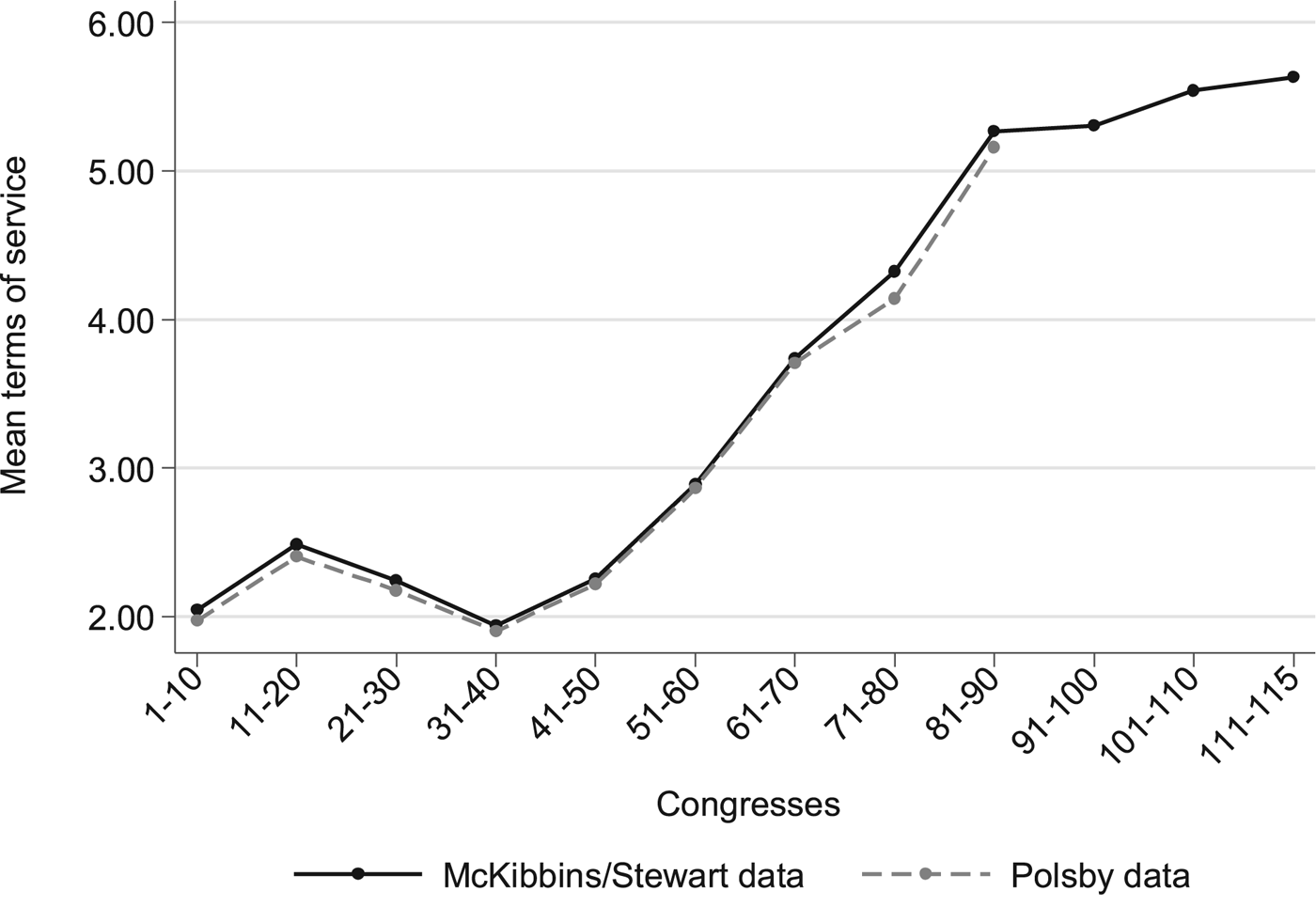
We have updated Polsby's time series showing the percentage of first-term members of the House in Figure 1.Footnote 28 The time series showing the average terms of service by members of the House appears in Figure 2.Footnote 29 Both include data up to the 2016 election.
Decline in Percentage of First-Term Members, U.S. House of Representatives, 1789–2017 (Update of “Institutionalization” Figure 1).

Increase in Terms Served by Incumbent Members of the U.S. House of Representatives, 1789–2017 (Update of “Institutionalization” Figure 2).

Figure 1 shows the well-known pattern of gradual decline in the fraction of new members in the House, starting around the turn of the twentieth century.Footnote 30 Polsby's data stopped with the 81st–90th Congress period, which is almost precisely the time when membership turnover in the House bottomed out. The fraction of the House that was new reached an average of roughly 15 percent by the 1950s and stayed in that vicinity (with Congress-to-Congress fluctuations) through the 2010s. Figure 1 suggests that the fraction of rookies in each House has crept up a bit in recent elections. Still, the average has yet to return to pre–New Deal levels.
The measure of average terms served by member tells a similar story (see Figure 2). Like the measure of first-term members, the average terms of service in the House took a significant leap between the 1940s and 1950s (continuing the long-term trend begun around the Civil War), and then plateaued from the 1960s onward. At the time of Polsby's writing, the average House member had served just over five terms. Mean terms of service have continued to creep up since the time Polsby wrote, reaching an average of 5.6 terms in the period since the 111th Congress, but the rate of change has slowed significantly.
The rise in average terms served, along with the related decline in the percentage of new members, became fodder in the years immediately following “Institutionalization” for an empirical literature that examined the rise of the “incumbency advantage”Footnote 31 and a related literature that has examined a decline in responsiveness over time that is correlated with the rise of the incumbency advantage.Footnote 32 Of course, the literature that documents a decline in responsiveness provides an alternative normative perspective on the existence of boundaries between the House and other American institutions. While it may have been the case that the persistence of long careers in the House after 1968 helped contribute to an institutionalized chamber, scholars such as Fiorina suggested that the lengthening of careers may have coincided with a rise in rent seeking among members of Congress.Footnote 33
Stated more directly, the literatures that grew up starting in the 1970s to explain and interpret the rise of careerism and the insulation of members from reelection perils raise the question of who benefitted more from the institutionalization of the House, the country as a whole or the members themselves? Even if the institutionalization of the House helped produce a common good of more expertly drawn legislation, the rent-seeking behavior of members serving longer and longer terms in a legislature that was passing laws to give the U.S. government a bigger role in the economy suggests that institutionalization may have had its costs.
An important contextual change since the publication of “Institutionalization” is that the House is no longer presumptively controlled by Democrats. In the year that “Institutionalization” was published, the House had been controlled by Democrats for thirty-four of thirty-eight years; after its publication, it would continue to be controlled by Democrats for an additional twenty-six. Because the most coveted positions of power (the speakership and committee chairs) were doled out solely to members of the majority party, Democrats had an incentive to work hard to secure reelection.
The presumption of Democratic control of the House has changed, of course. Since 1994 the House has been controlled by Republicans for all but six years. Across the half century since the publication of “Institutionalization,” the House has been controlled by Democrats for thirty-two of those years and Republicans for eighteen.
A different (but perhaps just as important) contextual change has been the realignment of the political parties since the 1960s into two camps that are now more ideologically coherent. At the time of the publication of “Institutionalization,” the Republican Party had come to terms with the larger role for the federal government ushered in by the New Deal. Even small-government champions of Main Street within the GOP could pursue federal spending for their own districts without facing charges of hypocrisy.
Putting this all together, it is easy to see that House members from both parties had reasons to seek long careers in the House when Polsby was writing in 1968, and therefore the institutionalization project was bipartisan. Things have changed since then. Most importantly, the realignment of the parties means that most House Republicans cannot rest their reelection hopes on taking credit for their prowess in bringing home the bacon. Furthermore, a disdain of government has driven many Republican office holders to eschew the life of a career politician and to impose term limits on themselves.
The shifting partisan tides since the late 1960s suggests that the career trajectories that Polsby examined in 1968 may have taken different paths since then. We find that this is in fact true. If we take the data displayed in Figures 1 and 2, but analyze them separately for Democrats and Republicans, we see that Democrats have typically enjoyed longer House careers than Republicans.Footnote 34 In the first half of the twentieth century, which would have been the most apparent to Polsby, the Democratic advantage in career length was only slight. However, in the immediate postwar years, this gap had begun to grow. More recently, from the 1990s to the 2010s, each Congress has seen an average of 20 percent new members among the Republicans, compared to only 15 percent among the Democrats.
These differences in turnover rates, while seemingly small, have been compounded over time.Footnote 35 Since the 1950s, the average number of terms of service among Republicans has drifted up only somewhat, whereas the number of terms served among Democrats has grown perceptibly. By the 2010s, the average Democrat was serving about a term and a half longer in the House than the average Republican.
To the degree that long House careers are a marker of an institutionalized House, we can suggest an amendment to Polsby's insights that pertains to party. It is certainly true that the long rise of careerism that Polsby documented, and others confirmed, applied to both Democrats and Republicans.Footnote 36 However, even in the 1960s, Democrats were more likely than Republicans to regard the House as a place to stay. While this may be an artifact of the lack of two-party competition in the South, further analysis reveals that this was only part of the picture.
At the time Polsby was writing, the differences in career patterns among members of the “three parties” of the House—Northern Democrats, Southern Democrats, and Republicans—were well in evidence. Starting with Reconstruction and moving into the 1950s, the average career lengths of all three party contingents grew secularly, with the rate of growth among Southern Democrats outpacing the other two for most of this period. The growth in the length of Republican House careers leveled off around 1950, but the career lengths of Southern Democrats peaked almost precisely at the time “Institutionalization” was being written. Following a period in the 1970s and 1980s when the average career length of Southern Democrats collapsed, owing to the replacement of Southern Democrats with Southern Republicans, average terms of service of Southern Democrats rebounded at the turn of the twenty-first century, so that now, the average Southern Democrat has served nearly as long in the House as the average Northern Democrat.
The implications of this partisan divergence in career paths seem obvious as we consider the fate of House institutionalization over the past half century. Right as Polsby was writing, the Rube Goldbergian coalitions making up the parties were beginning to shift. These shifts not only eventually yielded two ideologically unified parties but also produced party contingents that had different attitudes toward the House as a place to make a political career. The Democrats—the party of an activist federal government—continued to regard the House as a place to come and stay awhile. The Republicans—the party increasingly skeptical of most federal government activity, even activity that had previously been conceived of in bipartisan terms—increasingly regarded House service as a necessary nuisance, endurable for only so long. Thus, if we take seriously the larger intellectual argument that framed Polsby's analysis, it wouldn't surprise us that institutionalization itself would become a partisan and ideological issue.Footnote 37
2.1.2. Leadership Recruitment: The Careers of Speakers
If one measure of institutionalization was the degree to which rank-and-file members regard membership in the House as a career unto itself, then a related measure would be the degree to which leadership in the House was integrated into that career as a special track. Adapting the mid-twentieth-century corporate view that the path of effective organizational leadership was most likely to resemble that of a ladder, Polsby contrasted the leadership path of the most peripatetic of nineteenth-century House leaders, Henry Clay, with that of typical leaders in the twentieth century.
Just as the career paths of House members were about to take a turn when Polsby published “Institutionalization,” so, too, were the career paths of leaders. We illustrate this by first updating the measures that Polsby presented.
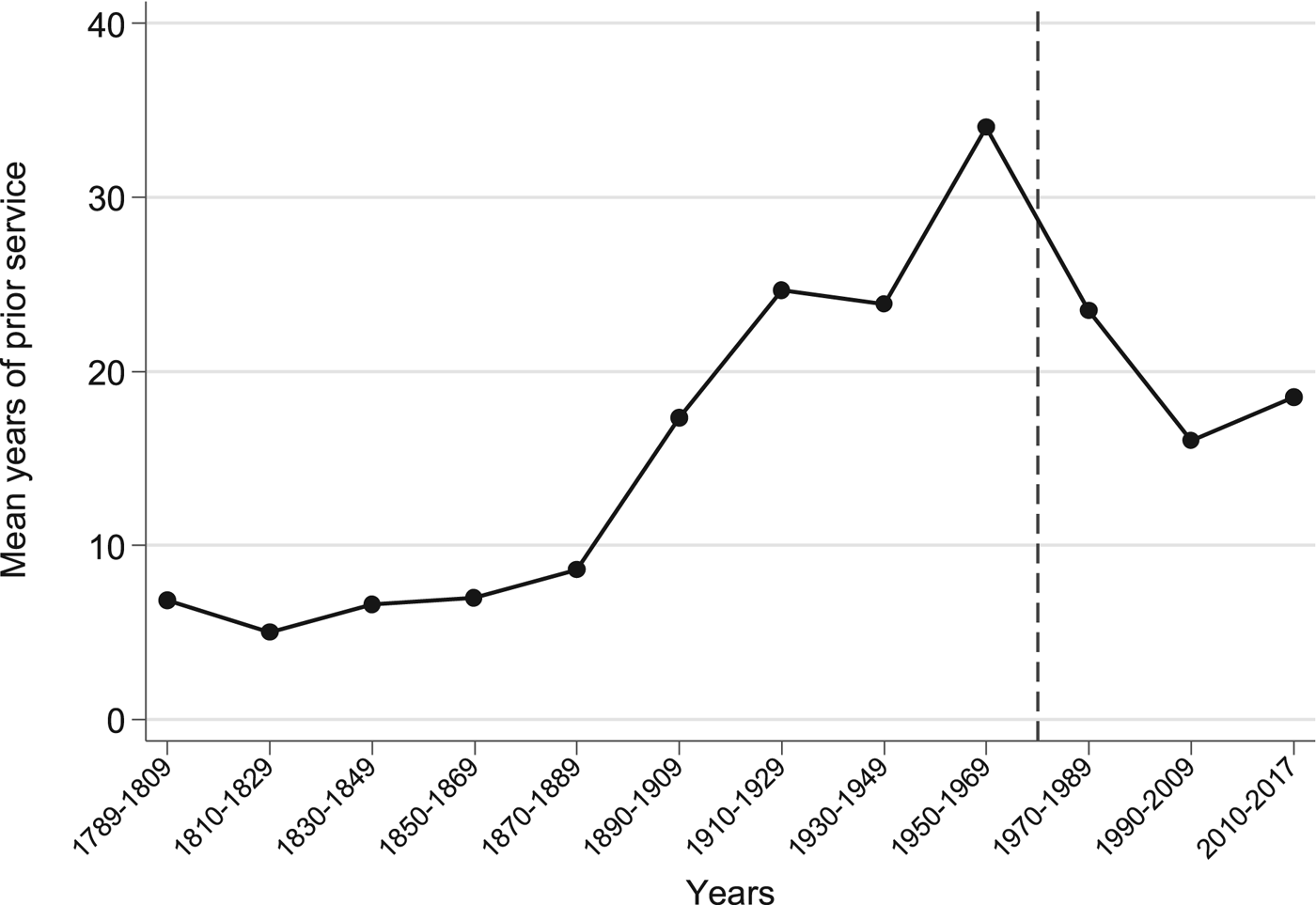
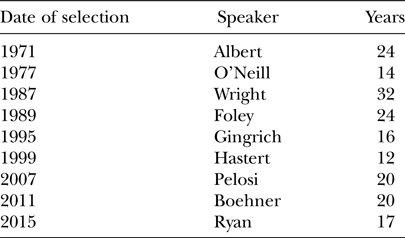
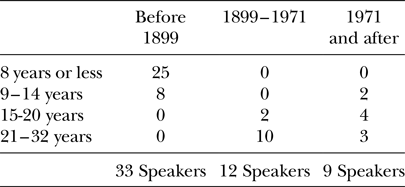
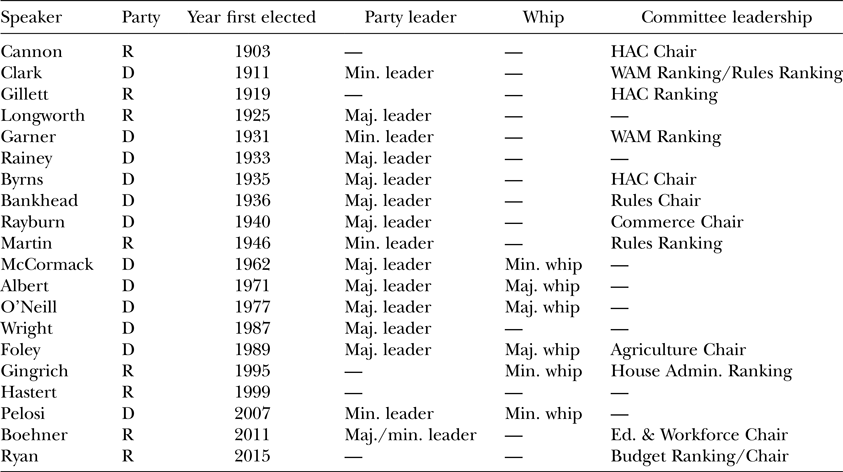
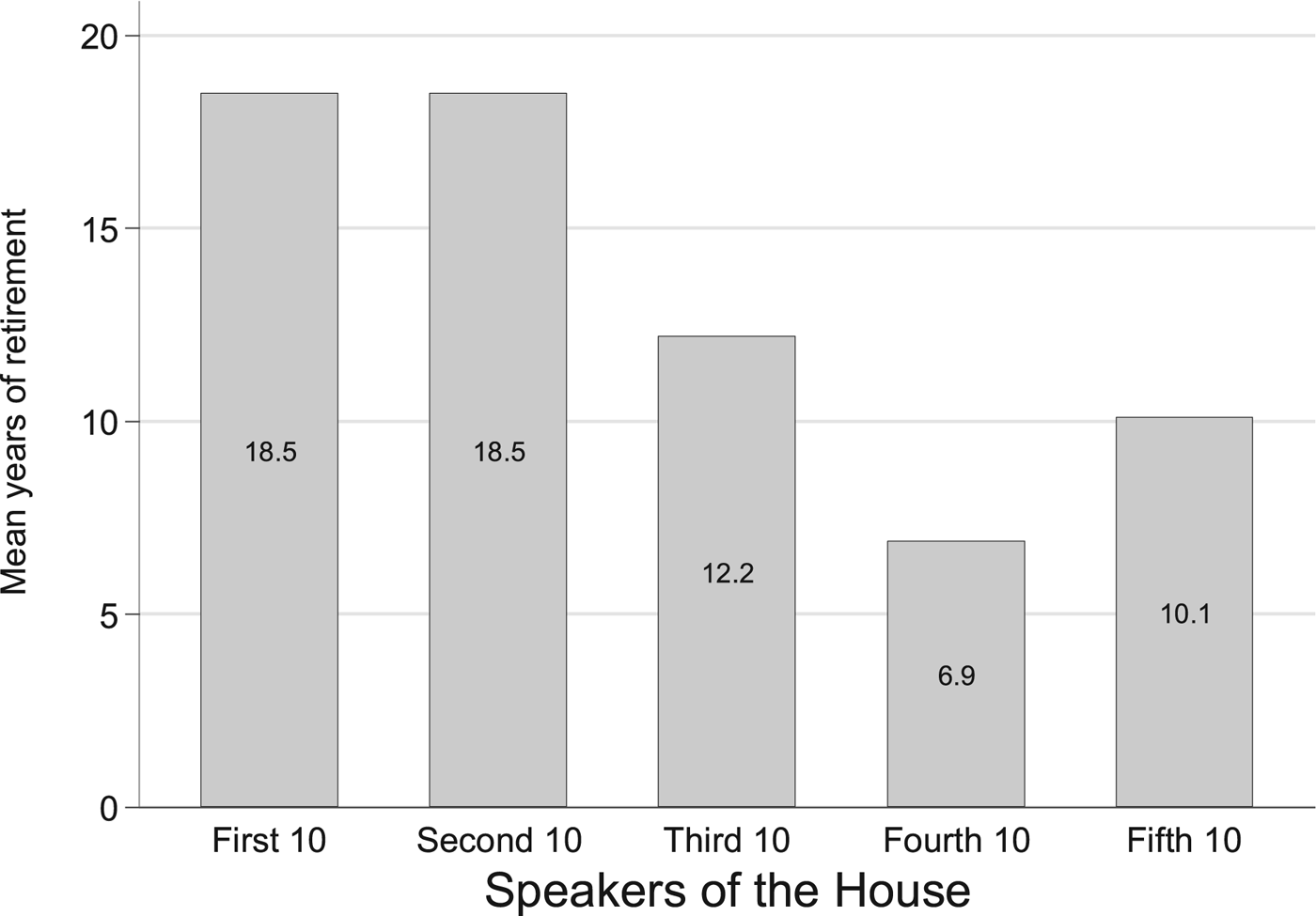
We begin with the path to the speakership itself. At the time “Institutionalization” was being written, the career path of party leaders, especially on the Democratic side, was becoming increasingly predictable and differentiated from the committee leadership track.Footnote 38 This was illustrated, first, by the years of service by Speakers before they ascended to the speakership. In Table 1, Table 2, and Figure 3, we have updated Polsby's “Institutionalization” data—which appear in his Table 3, Table 4, and Figure 3—to reflect the new Speakers who were elected after 1968.
Mean Years Served in Congress before First Becoming Speaker by 20-Year Intervals (Update of “Institutionalization” Figure 3).

Years Served in Congress before First Selection as Speaker, 1971–2015 (Update of “Institutionalization” Table 3)

Sources. Nelson W. Polsby, “The Institutionalization of the U.S. House of Representatives,” American Political Science Review 62 (1968): 144–68; data collected by the authors.
Summary Of Years Served in Congress Before First Selection as Speaker (Update of “Institutionalization” Table 4)

Sources. Nelson W. Polsby, “The Institutionalization of the U.S. House of Representatives,” American Political Science Review 62 (1968): 144–68; data collected by the authors.
Previous Formal House Leadership Positions Held by Speakers Selected in the Twentieth and Twenty-First Centuries

Sources. Nelson W. Polsby, “The Institutionalization of the U.S. House of Representatives,” American Political Science Review 62 (1968): 144–68; Garrison Nelson, Committees in the U.S. Congress, 1947–1992 (Washington, DC: CQ Press, 1993); David T. Canon, Garrison Nelson, and Charles Stewart III, Committees in the United States Congress, 1789–1946, 4 vols. (Washington, DC: CQ Press, 2002); Garrison Nelson and Charles Stewart III, Committees in the United States Congress, 1993–2010 (Washington, DC: CQ Press, 2010); data collected by the authors.
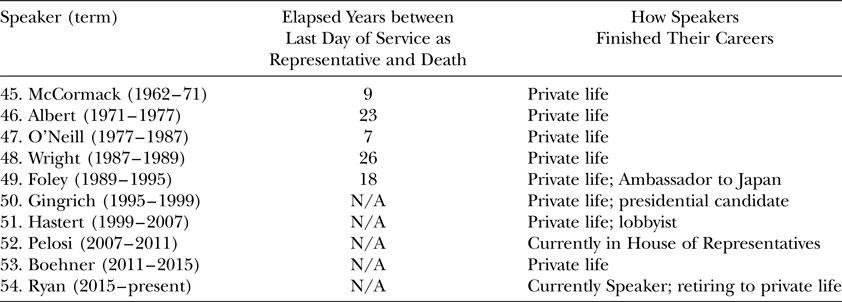
Postcongressional Fates of Speakers (Update of “Institutionalization” Table 5)

Sources. Nelson W. Polsby, “The Institutionalization of the U.S. House of Representatives,” American Political Science Review 62 (1968): 144–68; data collected by the authors.
Focusing our attention on Figure 3, “Institutionalization” was being written at the end of a long period in which the years of preparation for the speakership grew steadily each generation. As well, soon after Polsby wrote, the rules of leadership selection below that of the Speaker became more explicit, at least among Democrats, which underscored the fact that party leadership careers were becoming regularized. On the whole, the growing institutional experience of Speakers paralleled the growing institutional experience of the rank and file. However, as with the rank-and-file membership trend, the growth in years of prior experience before being elected Speaker stopped almost immediately and (unlike the rank-and-file trend) returned to earth following the publication of “Institutionalization.”
Two trends conspired to bring the prior service of new Speakers down to a level last seen a century ago. The first was the coming volatility of the tenure of Speakers. Of the nine Speakers elected since 1968 (Carl Albert to Paul Ryan), at least four left office under various forms of duress.Footnote 39 Jim Wright (D-TX) left under the cloud of an ethics investigation that itself was stoked by the heightened degree of partisanship that he had interjected into the job. His successor, Thomas Foley (D-WA) in 1994 became the first Speaker defeated for reelection since before the Civil War. Newt Gingrich (R-GA) resigned in 1998, taking responsibility for the midterm drubbing of his party that year. And, finally, John Boehner (R-OH) stepped down in 2015, after repeated conflicts with co-partisans on his right flank (embodied in the House Freedom Caucus). The fates of these four Speakers resulted in speakerships that were unusually short. Three of these—Wright, Gingrich, and Boehner—were rare cases of Speakers stepping down without party control of the House changing hands. Regardless of the source of the turnover, the practical fact is that the parties had to go to their “bench” more quickly than they had anticipated, driving down the prior experience of Speakers elected from the 1970s onward.Footnote 40
The second trend, probably related to the first, was a short-circuiting of the leadership track that was developing within the parties, distinct from the committee leadership track. This is illustrated in Table 3 (an update of Polsby's Table 5), which shows the prior leadership experience of Speakers when they were first selected, starting with Joseph Cannon (R-IL) in 1903. From the election of Cannon through the election of Joseph Martin (R-MA) as Speaker in 1946, the standard path to the speakership involved leaving a leadership position on one of the top legislative committees and ascending to the leadership of the party.Footnote 41 Only two Speakers during this period, Cannon and Frederick Gillett (R-MA), moved directly from committee leadership to the speakership.
Percentage of House Election-Contest Roll Calls Classified as Party Votes, by Era

Source: Jeffery A. Jenkins, “Partisanship and Contested Election Cases in the House of Representatives, 1789–2002,” Studies in American Political Development 18 (2004): 112–35; data collected by the authors
John McCormack, who was Speaker when “Institutionalization” was published, represented a potentially new path to the speakership. Although McCormack served as a member of the Ways and Means Committee the first time he was elected majority leader in 1940, he had only risen to fourth in rank on the committee. McCormack gave up his Ways and Means seat and remained in leadership even when Democrats lost control of the House in the 1948 election, dropping back to minority whip for one Congress. The next three Speakers—Carl Albert (D-OK), Tip O'Neill (D-NY), and Jim Wright—similarly ascended to the speakership having never risen to committee leadership.
However, Foley's ascent to the speakership in 1989 represented a breaking of the party-committee leadership barrier that had arisen with McCormack. Since then, all Speakers, with the exception of Dennis Hastert (R-IL), have previously served as the chair or ranking member of a committee.Footnote 42
In Polsby's view, time after serving as Speaker was just as important an indicator of the specialization of the position as time spent before becoming Speaker. As he notes (p. 149), in the nineteenth century the speakership was typically just a waystation en route to other positions of influence at the state and national levels. As a consequence, none of the individuals who served as Speaker during the first eighty-six years of the Republic's history died in office, whereas of the ten Speakers who served immediately before the publication of “Institutionalization,” six had died in office. (The incumbent Speaker, McCormack, died nine years after he stepped down in 1971.)
Table 4 and Figure 4 (which update Polsby's Table 5 and Figure 4, respectively) show the post-speakership careers of all the individuals who have served in that office. Looking first at Figure 4, the only additional data point added to Polsby's analysis is the final bar, which shows that the last ten Speakers to serve have lived an average of 10.1 years after leaving the speakership. (In “Institutionalization,” this bar was described by the statistics associated with five former Speakers, all of whom had died in office.) Thus, it is clear that the pattern Polsby observed, of Speakers “going out with their boots on,” did not become the new normal.
Average Elapsed Years between Last Day of House Service and Death (Update of “Institutionalization” Figure 4).

Furthermore, as Table 4 suggests, the speakership may have emerged once again as a waystation en route to greater responsibility, fame, and fortune. Starting with Foley, all former Speakers have continued on with careers related at least in part to government activity and attempts to influence national policy debates and outcomes. (The jury is still out on how Boehner will spend what will no doubt be many decades of retirement from the speakership.) As the tawdry matter of Dennis Hastert's post-speakership life has revealed, it is not hard for an ex-Speaker to cash in as a lobbyist.Footnote 43 A less tawdry, but still controversial, example is illustrated by the post-speakership financial success of Newt Gingrich.Footnote 44
Taken together, it is difficult to make a case that the speakership has remained as the pinnacle of a leadership system that is specialized to the point of precluding lateral movement.Footnote 45 Among Republicans especially, there is a degree of permeability that failed to exist in the earlier part of the twentieth century. Whether this permeability has been a contributing factor to the difficulties that leaders have had in corralling their followers, or is simply another indicator of the relatively low esteem in which political leadership is held, is a topic we save for future consideration.
2.2. The Growth of Internal Complexity
The section of “Institutionalization” that is the least quantitative and most impressionistic analyzes the growth of internal complexity. As Polsby notes, simple objective metrics such as the number of committees are insufficient to measure the institutional complexity of the House because they fail to capture the evolving degree to which the House differentiated its functions over time and then assigned various tasks to these differentiated subsystems. Take the committee system as an example. The number of committees is a poor measure of the growth of internal complexity in the House because, first, the rise in the number of committees in the nineteenth century occurred in a process that could hardly be called planned; to the degree that motivations could be discerned in the creation of new committees, they were a mix of function, partisan, and particularistic.Footnote 46 Second, the decline in the number of House committees, particularly the consolidation induced by the 1946 Legislative Reorganization Act (LRA), was generally accompanied by an increase in jurisdictional specificity and rationalization. The decline in the number of committee was also met with an increase in the number of subcommittees, which is just another way of noting that the complexity and internal differentiation of the committee system is consistent with both a large and small number of parent committees.
Polsby never comes out and says it, but one gets a sense that he is avoiding the use of the word “bureaucratization” to describe the long-term trend of House organization leading up to the late 1960s. The two major organizational subsystems of the House, the committee and leadership systems, either had become or were becoming pyramidal. The House rules were becoming more complex, committees were becoming more protective of their jurisdictions, and the paths to leadership were becoming regularized as the leadership system itself expanded and became formally recognized. Of course, there was still much about the House that defied the label “bureaucratization,” particularly the parts that had to account for the formal equality of all members when it came to voting. And the rules themselves, which could be taken as another marker of institutional complexity, could hardly be called “rational” in the sense used by organization theory and oftentimes were honored in the breach anyway.Footnote 47
To continue along his qualitative path for the moment, Polsby's discussion of the rise of internal complexity focused on three major topics: the committee system, floor leadership, and internal House management. In the case of the committee system, he identified four phases of committee development throughout congressional history. Phases I and II, both in the earliest years of the Republic, saw an ad hoc reliance on select committees, with a handful of standing committees thrown in, as the House wrestled with power sharing dynamics of first a Federalist administration (Phase I) and then Jefferson's administration (Phase II). Phase III was ushered in by the speakership of Henry Clay and lasted for a century.Footnote 48 It is Phase IV that could be considered the “textbook period” of committee governance,Footnote 49 which was ushered in by the revolt against Cannon and the subsequent reshuffling of committee appointment powers from party leaders to the rank and file. Polsby described Phase IV as follows:
Under the fourth, decentralized, phase of the committee system, committees have won solid institutionalized independence from party leaders both inside and outside Congress. Their jurisdictions are fixed in the rules; their composition is largely determined and their leadership entirely determined by the automatic operation of seniority. Their work is increasingly technical and specialized, and the way in which they organize internally to do their work is entirely at their own discretion. Committees nowadays have developed an independent sovereignty of their own, subject only to very infrequent reversals and modifications of their powers by House party leaders backed by large and insistent majorities.Footnote 50
In reflecting on the evolution of House committees since 1968, one can see ways in which the tendencies of Phase IV were both reinforced and undermined.Footnote 51 Most notably, the Subcommittee Bill of Rights in 1973 extended many of the marks of rationalistic/bureaucratic organization down one level, by mandating fixed jurisdictions and removing membership decisions from the unilateral control of committee chairs. Other reforms, such as the creation of multiple referrals and “Speaker discharge,” could be considered efforts to bring greater rationality to a system that had become encrusted with conflicting and dysfunctional rules.Footnote 52
At the same time, an attack on the Phase IV committee system became a central feature of Newt Gingrich's ascent to the speakership in 1995, particularly the rules and informal practices that maintained firewalls between the party leadership and committee systems. Below, we show how seniority, one marker of the Phase IV committee regime, has been thoroughly destroyed. More generally, the blurring of the lines between the committee and party systems has become part-and-parcel of case studies about congressional policymaking in recent years.Footnote 53
In summarizing the long sweep of the history of formal party leadership, Polsby noted “a contrast between the practices of recent and earlier years with respect to formal party leaders other than the Speaker”:
(1) Floor leaders in the 20th century are officially designated; in the 19th, they were often informally designated, indefinite, shifting or even competitive, and based on such factors as personal prestige, speaking ability, or Presidential favor. (2) Floor leaders in recent years are separated from the committee system and elected by party members; earlier they were prominent committee chairmen who were given their posts by the Speaker, sometimes as a side-payment in the formation of a coalition to elect the Speaker. (3) Floor leaders today rely upon whip systems; before 1897 there were no formally designated whips.Footnote 54
To a first approximation, much of this summary still applies to the formal party leadership positions in the House. Indeed, in the years immediately following the publication of “Institutionalization,” the trends noted by Polsby in 1968 continued apace. Not only did the formal leadership system continue to be differentiated from the committee system, but it grew and became more complex. The whip systems of both parties grew, to incorporate party factions into leadership as well as to facilitate the coordination of co-partisan action. Beyond the whip system, party committees themselves—the steering, policy, and campaign committees—have become more prominent, and leadership for the chairs of these committees has become more contested. As Jenkins and Stewart note, the Republican Party particularly has rationalized election procedures for the leaders of party organizations, making it much less likely that the party will become hamstrung over fights to control the short-term direction of the party.Footnote 55
These developments since 1968 provide further context for the empirical patterns we previously observed about the paths to and from the speakership. If we measure the party leadership component of institutionalization only by focusing on the career path of the Speaker, it appears that party leadership has become less institutionalized, as Polsby understood it. However, the greater fluidity of Speaker careers since “Institutionalization” has moved in parallel with a more complex and capable set of party organizations overall. Thus, if we were to add to Polsby's measures other indicators of party organization capacity—indicators that Polsby did not even conceive of—we would probably reach different conclusions about how much change to the congressional parties has contributed to the institutional development of the chamber.
As well, if we admit that a growth in complexity of party organs in the House should be credited toward the plus side on the institutionalization ledger, then it becomes easier for us to find a balance between a growth in party capacity and a decline in committee capacity. Who is to say that a House whose party leaders are better able to coordinate legislative activity to the benefit of the majority party is less institutionalized than a House whose party leaders facilitated the capable autonomous committees that were the keystone of that era's interest-group liberalism?
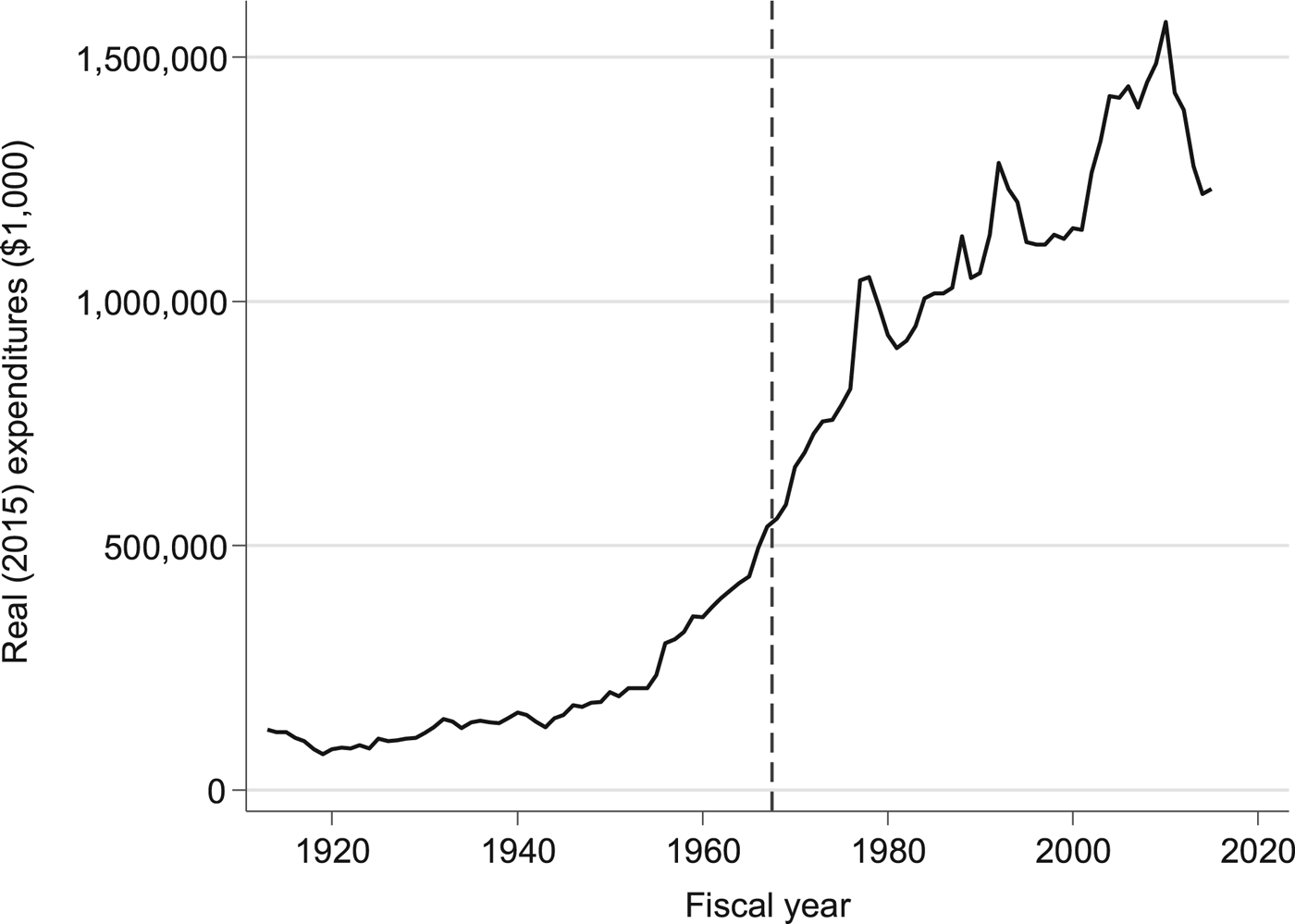
Finally, Polsby remarked on internal House management, which he noted could be measured in terms of “personnel, facilities, and money.”Footnote 56 Before the passage of the LRA in 1946, the House (and Congress more generally) could not be said to have much of any of these, although the Congress in general, and the House in particular, was not totally devoid of personnel, facilities, and money.Footnote 57 The LRA changed this, of course. This is illustrated in Figure 5, which updates Polsby's account of appropriations for the House of Representatives that ends in the mid-1960s.Footnote 58
Real Expenditures by the House of Representatives, FY 1940–2021 (Estimated).

Figure 5 graphs appropriations for the support of the House of Representatives, shown in real (2015) dollars.Footnote 59 The inflection point after 1946 is clear. The dashed line is drawn right after 1967 and helps us to see that the steady increase in House expenditures continued for about another decade after the publication of “Institutionalization,” before enduring a series of up-and-down years. We have yet to examine in depth the reasons behind the peaks in spending that started regularly occurring in the late 1970s. However, even if we assume all of these peaks are due to short-term projects, it is hard to escape the conclusion that real spending for the House has continued its secular upward climb since the publication of “Institutionalization.”Footnote 60
One period of internal retrenchment that is difficult to see in Figure 5 is the slight downturn associated with the Republican takeover in 1995. Measured from the local peak in real spending for FY 1992 ($1.283 billion) to the trough in FY 1997 ($1.116 billion), the House made an immediate 13.1 percent cut in its own budget during the early Gingrich years. However, from this trough to FY 2015, House spending has rebounded to a level that was 22.5 percent greater than it was before Gingrich came to office.
A similar story can be told using total personnel levels, a time series not examined by Polsby. These data, displayed in Figure 6, show a rise in House employment into the 1980s. After reaching a plateau in the early 1980s, employment in the House began a steady decline at the beginning of the Gingrich years, a decline that accelerated after 2010. From 1994 to 2010, the total number of House personnel fell by 5.1 percent (from 7,390 to 7,012). By 2015, personnel numbers were down to 6,030, an additional 14.0 percent decline in just five years.
Personnel Employed by the House of Representatives, 1947–2015.

These spending and employment figures encompass all of the House's activities and therefore do not tell the story of how spending has been distributed internally. Thus, they do not provide a precise picture of whether these types of objective measures of institutional capacity can help document a shift in capabilities from the committee system to the leadership (or the individual members). Discerning these shifts using official budgetary documents is tricky, which is reflected in the accounting contained in the estimable Vital Statistics on Congress.
Using one set of statistics reported in Vital Statistics, the number of staff assisting House committees has grown by 104 percent since Polsby's time (from 571 in 1965 to 1,164 in 2015), while district staff have grown 207 percent (from 1,035 in 1970 to 3,175 in 2016), and overall House employment has grown 48.7 percent (from 4,055 in 1967 to 6,030 in 2015).Footnote 61 There was a notable dip in committee and overall House employment right after 1994, which leveled out quickly, before taking a renewed dive after 2010.
Another set of statistics from the 2017 online update of Vital Statistics covers a shorter time period, but allows a glimpse into the shifting of staff within the House over the past generation. Since 1979, the total number of House staff has fallen 28.3 percent, from 10,743 in 1979 to 7,703 in 2015. The subcategories of staff experiencing drops include committee staff, at 42.6 percent (from 2,027 in 1979 to 1,164 in 2015), and staff for officers of the House (Clerk, sergeant at arms, etc.), at 79.3 percent (from 1,487 in 1979 to 308 in 2015). Growing throughout this period has been leadership staff, by 24.1 percent, from 162 in 1979 to 201 in 2015.
If we focus on the post-Gingrich period, the relative shift in staff from committees to leadership is even more apparent. In this shorter period (1993 to 2015), overall employment levels have fallen 28.9 percent, with committee staff falling 45.8 percent and personal staff falling 18.5 percent, but leadership staff growing 52.3 percent.Footnote 62 Within the committee system itself, it appears that the number of staff in each committee is greater than it was in the late 1960s. However, since 1994 the number of staff has fallen significantly in every committee.
Viewing the topic of institutional complexity broadly, we come out pretty much where Polsby did, insofar as the complexity of the House today continues to be in a different league from the complexity of the House in the nineteenth century. However, although the House today seems about as organizationally complex as the House of the 1960s in historical perspective, the locus of that complexity has changed over time. There is no mistaking the fact that the institutional center of gravity has shifted from committees toward House party leadership. Whether this has also led to an institutional shift away from the House toward the executive branch and the courts is a matter that we can only speculate about at this point. We leave this speculation to the conclusion.
2.3. Universalistic and Automated Decision Making
Finally, Polsby turned his attention to the shift from particularistic to universalistic and automated decision making in the House. He focused on two important aspects of congressional activity. The first was the path to leadership in the committee system; the second was the process of adjudicating contested election cases. About each he stated that the “best evidence we have of a shift away from discretionary and toward automatic decision making is the growth of seniority as a criterion determining committee rank and the growth of the practice of deciding contested elections to the House strictly on the merits.”Footnote 63
For both aspects of congressional activity, he found a profound shift over time away from particularism toward practices that diffused partisan and ideological tensions. As we shall see, the first mechanism he explored, the committee seniority system, appears to be all but dead, at least among Republicans. The second mechanism, contested elections, continues to appear universalistic in practice using the measure Polsby employed. However, the subsequent dynamics of particular cases that were considered after “Institutionalization” was published raises the real possibility that contested election cases may once again take a more persistently partisan cast.
2.3.1. Committee Seniority
In “Institutionalization,” Polsby measured the rise of seniority simply, as the percentage of committees in which the chair was the most senior majority party member of the committee.Footnote 64 By Polsby's accounting, majority party seniority as the mechanism through which chairs were chosen witnessed two sea changes. The first occurred around the 1890s and can be associated with the rise of the Reed Rules and what we have termed the “organizational cartel,” which links together party unity in electing Speakers with an agreement to “spread the wealth” in committee assignments among the various factions of the majority party.Footnote 65 The second major shift occurred around the passage of the LRA in 1946, when the sheer number of committees plummeted and the practice of following seniority became virtually universal.Footnote 66
We update Polsby's core finding concerning the use of seniority in appointing committee chairs in Figure 7 (based on his Figure 5).Footnote 67 In updating Polsby, we have not simply picked up the analysis after 1969, but have also taken advantage of subsequent research that has scoured the record thoroughly for evidence of committee appointments across time; thus, we are able to correct what appears to be an overestimation by Polsby of the number of seniority violations in the last decades of the nineteenth century.Footnote 68
Decline in Violations of Seniority, Committee Chairs, U.S. House of Representatives, 1861–2013 (Update of “Institutionalization” Figure 5).

The gray dashed line in Figure 7 reproduces the statistics as reported by Polsby. The solid black line reports comparable statistics using the more recent committee data sets. As noted above, Polsby reported seniority violation rates well above 50 percent for the period spanning the 47th to 56th Congresses (1881–1901). With the longer time series stretching back to the 37th Congress (1861), we see that the rate of seniority violations hovered in the 20 percent range from the Civil War until the period that includes the transition to the post-LRA committee system.Footnote 69 The most notable exception was the 62nd–66th Congress period (1911–1921), which spans the transition to the “textbook Congress” committee system, in which the rate of seniority violations fell to 6.6 percent (using the new data).Footnote 70
Polsby was only able to report the rate of seniority violations for one full decade following the LRA (82nd–86th Congress, 1951–1961), when that rate fell to 0.7 percent by Polsby's accounting and 3.2 percent using the more recent data. Picking up on the data that describe the reliance on pure seniority after the publication of “Institutionalization,” the decade of the 1960s also saw virtually no seniority violations in the naming of committee chairs. That rate took a dramatic shift upward in the 1970s, continuing into the 1980s and 1990s and reflecting the committee appointment reforms that passed in the House Democratic caucus in the 1970s and the various revolts against certain chairs that resulted. The onset of term limits for Republican committee chairs first instituted in the 104th Congress is associated with a slight uptick in seniority violations in the 1990s (102nd–106th Congresses), but the rate began to skyrocket in the 2000s; across the past two Congresses, most House committee chairs have not been the most senior majority party member.Footnote 71
The sequential erosion of seniority as the rule to select committee chairs, first by the Democrats in the 1970s and then by the Republicans in the 1990s, is part of the larger well-known tale of the shifting locus of control in the House from the committees to the parties (or, alternatively, to the rank and file of the parties). In the words quoted earlier in this article from Polsby's “Legislatures” essay, this tale usually focuses on who makes the mark on lawmaking in a legislature. The “Legislatures” essay suggests another question to be asked about this shift in the locus of legislative control, which is whether it has shifted the House away from being a transformative legislature to an arena. This is not to suggest that the House has slid all the way over to share continuum space with the British and Belgian Parliaments, just that the question needs to be considered about how far the House has moved.
The most likely answer to this question lies in a consideration of the House as being a collection of “work horses,” contrasted with the Senate and its “show horses.” By rewarding continued service on a committee at the virtual ignorance of other considerations, the seniority system as documented by Polsby and others of his generation created a disincentive for House members to do anything other than focus on their committee work. At least for those who intended to spend more than a couple of terms in the chamber, House members were incentivized to find the committee that would best serve their own political goals, convince the respective committees on committees of the rightness of that fit, and then keep their heads down and do their work. A wandering eye—either to other committees or to leadership—was not rewarded.
This is not to say that hard work on committees is no longer rewarded, only that it has become just one of several considerations that can lead to the eventual ascent to a committee chair. In that sense, seniority has become what it was in the nineteenth-century House, just one factor among many. Aspiring committee chairs must now convince their co-partisans, including those who serve on other committees, that they are attuned to party goals and have contributed generously (quite literally) to the party's electoral efforts.Footnote 72 Sometimes these party goals require a mastery of the subject matter associated with a committee, for the purposes of drafting effective legislation. At other times, these party goals may be even better served by a committee chair who can effectively position-take on behalf of the party's brand. If this is the mark of an institutionalized House, it is not one that Polsby appears to have had in mind.
The comments in these last two paragraphs pertain primarily to Republicans, since they have held the House majority persistently over the past two decades, and therefore it is useful to start the discussion by equating “the House” with the “Republican-controlled House.” Whether Democrats would keep to the same path if they gained control of the House for the next two decades remains to be seen. (When they gained control following the 2006 election, they rolled back some, but not all, of the Republican changes of the Gingrich Revolution.) Because the Democratic Party is the party of activist government, it is imaginable that should Democrats regain control of the House for a long period of time, they would revert to the earlier system that rewarded work-horse behavior in committees. On the other hand, the continued decline in public confidence about an activist federal government and the ability of Congress to legislate may push Democrats, too, to continue along the path that the Republicans have trod.
2.3.2. Contested Elections
Polsby measured contested elections in terms of the number of House seats contested (or disputed) in five-Congress increments over time. Polsby provided anecdotal evidence—short accounts of cases and quotes from contemporaneous political actors—to suggest that contested elections were used in a particularistic fashion in the past, as a way to decide outcomes in a partisan (as opposed to a “meritorious”) fashion. In short, Polsby argued that the House majority party sometimes used the chamber's constitutional authority (Article I, Section 5) to “flip” election outcomes to their benefit.
We update Polsby's count of House election contests in Figure 8 (based on his Figure 6)—both in terms of assembling data after the 88th Congress and more thoroughly scouring various primary and secondary sources for evidence of contested elections for the period that Polsby covers.Footnote 73 Polsby's count and our count track each other reasonably well for most of the five-Congress periods. Differences exist in the 26th–30th and 36th–40th Congress periods; the former because of a presumed oversight on Polsby's part (a single case affecting not just one seat but twenty-one seats in four different states) and the latter because of how contests were counted in states no longer in the Union (with Polsby counting them). Nonetheless, both series indicate a reduction in contested seats beginning around the turn of the twentieth century and declining further in the ensuing decades. Our count in the five decades after Polsby indicates the virtual elimination of election contests altogether.
Contested Elections in the House by Decades, 1789–2010 (Update of “Institutionalization” Figure 6).

Polsby interpreted the declining incidence of contested elections as evidence that “the practice of instigating contests for frivolous reasons has passed into history.”Footnote 74 Since the publication of Polsby's “Institutionalization,” the House passed new legislation to make the dismissal of election contests easier. The Federal Contested Election Act of 1969 (FCEA; Public Law 91-138, title II, 381 et seq.) was the first major update on contested election procedure since 1851. In enacting the FCEA, members sought a more efficient and expeditious process for resolving contested election cases. Among other things, the FCEA clarified who had standing to initiate a contest (primarily—but not exclusively—the contestant, or losing candidate in the election), outlined procedures for taking testimony, and established a framework for disposition of a case.Footnote 75
Since the adoption of the FCEA, most cases have been “dismissed due to failure by the contestant to sustain the burden of proof necessary to overcome a motion to dismiss”Footnote 76 or “withdrawn by the contestant for various reasons.”Footnote 77 In only one case since the passage of the FCEA has the House ruled in favor of the contestant: McCloskey v. McIntyre (99th Congress, election to the 8th District of Indiana). In that case, the seating of Frank McCloskey (the Democratic contestant) over Richard McIntyre (the state-certified Republican winner) by the Democratic majority in the House generated significant partisan rancor in the chamber and ultimately led to a walkout protest by Republicans.
While Polsby stops short of providing more systematic evidence—beyond the raw counts of election contests over time—for a move to universalism in the twentieth century, he does lay out how the transition to a universalistic norm could be identified, specifically by:
measuring the extent to which party lines are breached … in voting on the floor in contests cases. I have made no such study, but on the accumulated weight of contemporary reports such as I have been quoting, I predict that a time series would show strict party voting in the 19th century, switching to unanimity or near-unanimity, in most cases, from the early years of the 20th century onward.Footnote 78
We can explore Polsby's prediction by first identifying those election cases that were determined by roll call, and then assessing the degree to which partisanship was a factor in the outcome.Footnote 79 A first cut would be to gauge how many election-contest roll calls were in fact “party votes,” or votes in which at least 50 percent of one major party opposed at least 50 percent of the other major party. Table 5 provides a summary total, as well as a cross-period breakdown. In fact, since the beginning of the twentieth century, the number of election-contest roll calls that can be characterized as party votes is quite high—nearly 80 percent—with roughly one in six being perfectly aligned party votes (in which all voting members of one party oppose all voting members of the other party). And while these results represent a drop-off from the late nineteenth century—when nearly 95 percent of roll calls were party votes and more than one out of every five was a perfectly aligned party vote—the reduction is relatively slight.
If universalism had indeed emerged as the new norm in the twentieth century, per Polsby, party lines should have (largely) broken down on election-contest roll calls in favor of unanimous (or near-unanimous) coalitions, and we thus should observe no (or few) votes that would be characterized as party votes. This is not the case. And the evidence for a new twentieth-century norm of universalism is even less compelling when we examine individual-level votes on election-contest roll calls. In the late nineteenth century, 92.7 percent of individual votes were correctly classified by a simple party model.Footnote 80 Since the beginning of the twentieth century, that percentage has actually increased: 93.5 percent of individual votes are correctly classified by a simple party model.Footnote 81
The preceding analysis considers particularism (partisanship) and universalism in the context of roll call votes. However, not all election contests have been decided by roll call. Thus, we consider the distribution of cases that elicited roll calls. Table 6 provides a breakdown, both generally and across the three time periods from Table 5. Overall, less than one-third of all contested election cases have been decided by roll call, with the remaining cases dealt with by voice vote or by the House taking no action (and thereby accepting the outcome from the initial election). The cross-period distribution reveals an interesting pattern: The percentage of cases determined by roll call was reasonably high prior to the twentieth century but has dropped off considerably since then. In fact, since the beginning of the twentieth century, it would not be a stretch to characterize an election contest decided by roll call as something of a “rare event”—only about one in eight has elicited a roll call vote. These results suggest that the disposition of contested election cases has become more routinized in recent years.
Percentage of House Election Contests Decided by Roll Call Vote, by Era

Source: Jeffery A. Jenkins, “Partisanship and Contested Election Cases in the House of Representatives, 1789–2002,” Studies in American Political Development 18 (2004): 112–35; data collected by the authors.
Thus, while partisanship is still a driving force in election-contest roll calls, the proportion of election contests that elicits a roll call has declined significantly since the turn of the twentieth century. The latter fact may provide some indirect support for a universalistic story. However, we caution against arguing too strongly that the reduction in the proportion of roll calls is an indication that the contested election process has become less partisan over time. A number of cases since the beginning of the twentieth century have been highly partisan, but have still been resolved in the end by a voice vote.Footnote 82 The move to more routinized disposition of contested election cases, for example, could simply be a function of the changing costs and benefits attributed to election contests by partisan decision makers in the twentieth and twenty-first centuries. These issues deserve additional investigation. Moreover, it seems to us quite plausible in today's highly polarized House that contested elections could once again take on an overtly partisan cast—especially if partisan seat divisions in the chamber remain close and flipping election outcomes becomes important for assembling an effective partisan governing coalition.
3. Discussion
This article has revisited an argument and accompanying empirical evidence that Nelson Polsby adduced to illustrate his thesis in “Institutionalization.” In doing so, we are impressed yet again with the range of scholarship Polsby brought to bear on the question. His original article not only alerted the discipline to how the House had been transformed across its long history, but also placed those changes within the broader literature on the functioning of legislatures in democratic institutions. It was impressive, not only for its time but for any time.
The first topic to cover is simply the narrow conclusions we draw from an examination of the updated time series. The first point to make is that the House is still clearly on the “institutionalized” side of the scale of legislatures. Even to the degree that there has been slippage—and there has been at least a little slippage on most of the measures—the current House is currently much more like the House that Polsby analyzed than the House of the antebellum period.
And yet, the slippage needs to be acknowledged. Of course, Polsby understood that the path of institutionalization was not unidirectional. Still, it is bracing to reveal that the institutional capacity of the House has taken a step back from most of the characteristics that described in the House in the 1960s. House careers no longer are getting longer and longer; instead, Democratic careers have gotten a little longer while Republican careers have plateaued. The committee system has been scaled back, both in terms of the number of committees and the resources given to them for operation. The road to the speakership is more varied; the specialization of committee functions and leadership functions has been blurred.
Taking a note from Polsby's “Legislatures” essay, it is natural to suspect that the House in this time has migrated from the firm extreme of the “transformative legislature” pole toward the “arena” pole. Considering the House in comparative perspective, it would be inaccurate to suggest that the House has become a full-fledged arena legislature. However, there is no escaping the conclusion that fewer institutional resources and incentives are now devoted to the development of subject-matter expertise in the House, while at the same time more resources and incentives have been shifted toward the parties and their drives to facilitate branding the partisan legislative product and to play more of an “outside game.”Footnote 83
Still, we acknowledge that an open question remains about how institutionalized the House needs to be to be constructively influential in the guidance of national policymaking. David Mayhew's recent book, The Imprint of Congress, documents how Congress has contributed to the development of major national policies throughout American history, as it has participated in thirteen major “impulses” of policy activity, ranging from the launch of the new nation during the Founding period to the more recent efforts to contain the debt and the deficit. Mayhew does not address Congress's institutional structure head-on, but instead is interested in the “imprint” the institution has on the most important policy projects of each historical age.Footnote 84
It is striking that, under Mayhew's accounting, Congress was more likely to be the “chief leverer” of policy change before it institutionalized (by Polsby's accounting) than after. In the twentieth century, during the period of strongest institutional growth, Congress at best only shared the initiative of major policy change, rather than initiated outright. Mayhew's analysis helps us see that the consequence of institutionalization did not make Congress the lead policy institution in the twentieth century, but most likely allowed Congress to remain relevant even as the president set the policy agenda.
In our discussion in Section 1, we noted that Polsby's “Institutionalization” article was part of a congressional literature that was steeped in sociological organization theory. Within that intellectual paradigm, it was easier to address normative topics like institutional performance and functionality. Almost as soon as the ink was dry on the printing of “Institutionalization,” the theoretical focus of congressional studies turned to that of the purposive actor and more positive (i.e., empirical) intellectual goals. The rational-choice paradigm provides powerful tools to help us understand the behavior of individuals from the perspective of their political goals, but it is not clear that it provides equally compelling insights into normative questions about the collective performance of the House within the American political system.
We hope that by focusing the profession's attention back onto Polsby's classic article, we can encourage a reconsideration of how our theoretical perspectives serve to provide insights into the collective output of Congress. We are not saying that rational-choice perspectives on legislatures are worthless in this regard (far from it!), only that they have not been put to good use in helping us measure the degree to which Congress functions as a positive contributor to governmental outputs. As modern students of Congress grapple with the broad popular consensus that Congress is no longer a particularly effective legislature, to the point of being “dysfunctional” in a variety of ways,Footnote 85 Polsby provides an apt model for how theory can provide an effective path that marries empirical analysis of Congress with a strong normative judgment about its contribution to the common good.
Supplementary Material
To view the supplementary material for this article, please visit https://doi.org/10.1017/S0898588X18000093.