FOCUS POINTS
• Polymorphisms in enzymes involved in folate metabolism, such as methylene tetrahydrofolate reductase (MTHFR) and methionine synthase (MS), may be among the underlying contributors to the relationship between folate metabolism anomalies and depression.
• In a sample of depressed adults, of which a subset underwent open treatment with fluoxetine, the prevalence of the C677T polymorphism of the MTHFR gene and the A2756G polymorphism of MS was consistent with previous reports. The polymorphisms did not significantly affect antidepressant response.
• No significant associations were observed between either of the two polymorphisms and mean baseline levels of folate, B12, and homocysteine, except for one association between A2756G and plasma B12.
• Individuals with the above polymorphisms appear to have no added risk of non-response to SSRI antidepressants compared to those without the polymorphisms. However, these preliminary results from a small sample require replication in larger samples before more definitive conclusions can be reached.
Introduction
Folate deficiency has been associated with depression, presumably because of its impact on neurotransmitter synthesis, which relies on the folate-dependent one-carbon pathway.Reference Mischoulon and Raab1 Individuals with major depressive disorder (MDD) have shown lower serum/plasma and red blood cell (RBC) folate than non-depressed controls.Reference Mischoulon and Raab1 Low folate may dampen antidepressant response,Reference Fava, Borus, Alpert, Nierenberg, Rosenbaum and Bottiglieri2, Reference Papakostas, Petersen, Mischoulon, Ryan, Nierenberg, Bottiglieri, Rosenbaum, Alpert and Fava3 may increase risk of depressive relapse,Reference Papakostas, Petersen, Mischoulon, Ryan, Nierenberg, Bottiglieri, Rosenbaum, Alpert and Fava3 and delay improvement in antidepressant-treated individuals.Reference Papakostas, Petersen, Lebowitz, Mischoulon, Ryan, Nierenberg, Bottiglieri, Alpert, Rosenbaum and Fava4 Folate supplementation may improve response to selective serotonin reuptake inhibitors (SSRIs).Reference Coppen and Bailey5, Reference Alpert, Mischoulon, Rubenstein, Bottonari, Nierenberg and Fava6
One particular focus of the connection between folate and depression has been the enzyme methylene tetrahydrofolate reductase (MTHFR), which synthesizes 5-methyl tetrahydrofolate, a carbon donor in methylation of homocysteine to methionine. A C677T missense mutation (cytosine-to-thymine) in the MTHFR geneReference McGuffin, Knight, Breen, Brewster, Boyd, Craddock, Gill, Korszun, Maier, Middleton, Mors, Owen, Perry, Preisig, Reich, Rice, Rietschel, Jones, Sham and Farmer7, Reference Frosst, Blom, Milos, Goyette, Sheppard, Matthews, Boers, den Heiger, Kluijtmans, van den Heuvel and Rozen8 results in an alanine-to-valine substitution that renders MTHFR thermolabile, and may lead to elevated plasma homocysteine, a cardiac risk factor.Reference Frosst, Blom, Milos, Goyette, Sheppard, Matthews, Boers, den Heiger, Kluijtmans, van den Heuvel and Rozen8 Various lines of research have suggested a greater prevalence of the homozygous (T/T) or heterozygous (C/T) thermolabile MTHFR genotypes in depressed individuals,Reference Arinami, Yamada, Yamakawa-Kobayashi, Hamaguchi and Toru9–Reference Gaysina, Cohen, Craddock, Farmer, Hoda, Korszun, Owen, Craig and McGuffin23 with ranges from 28–56% for the C/C wild-type phenotype, 35–62% for C/T, 5–28% for T/T, and 25–50% overall for the T allele.Reference Gilbody, Lewis and Lightfoot22
Further along the one-carbon cycle, the enzyme methionine synthase (MS) converts homocysteine to methionine. Its common functional polymorphism A2756G (adenine-to-guanine substitution), results in an aspartic acid-to-glycine conversionReference Leclerc, Campeau, Goyette, Adjalla, Christensen, Ross, Eydoux, Rosenblatt, Rozen and Gravel24 that might similarly disturb the one-carbon pathway, and has shown mixed results regarding association with cardiac disease.Reference Ashavaid, Shalia, Kondkar, Todur, Nair and Nair25–Reference Yu, Zheng, Qi, Lian and He37 The A2756G polymorphism has been associated with lower cobalamin and folate levels,Reference Miriuka, Langman, Evrovski, Miner, D'Mello, Delgado, Wong, Ross and Cole36, Reference Miriuka, Langman, Keren, Miner, Mamer, Delgado, Evrovski, Ross and Cole38 and yielded mixed results regarding plasma homocysteine elevation.Reference Laraqui, Allami, Carrie, Coiffard, Benkouka, Benjouad, Bendriss, Kadiri, Bennouar, Benomar, Guedira, Raisonnier, Fellati, Srairi and Benomar27, Reference Tsai, Welge, Hanson, Bignell, Vessey, Schwichtenberg, Yang, Bullemer, Rasmussen and Graham39, Reference D'Angelo, Coppola, Madonna, Fermo, Pagano, Mazzola, Galli and Cerbone40 A2756G has an estimated prevalence of 5% for the G/G homozygote and 20–30% for the A/G heterozygote.Reference Dai and Zhang28, Reference Zhang and Dai31, Reference Yu, Zheng, Qi, Lian and He37, Reference D'Angelo, Coppola, Madonna, Fermo, Pagano, Mazzola, Galli and Cerbone40, Reference Hiraoka, Kato, Saito, Yasuda and Kagawa41
There has been surprisingly little research into C677T's impact on response to antidepressant treatment, and virtually no studies on the relationship between A2756 and depression or its treatment. We therefore investigated whether C677T or A2756G would negatively affect antidepressant response rates. We hypothesized that a sample of patients with major depressive disorder (MDD) would have a prevalence of 40–50% for the C677T C/C wild-type phenotype, 40–50% for the C/T heterozygote, and 10–15% for the T/T homozygote. Likewise, we expected a prevalence of 70–80% for the A2756G A/A phenotype, 20–30% for the A/G heterozygote, and 4–8% for the G/G homozygote. In a subsample obtained from a study of open fluoxetine treatment, we hypothesized that subjects with the C677T or A2756G polymorphisms would have a poorer response compared to subjects with the wild-type genotypes.
Methods
Participants
A total of 224 MGH-based patients, ages 18–65 (52% female, mean age 39 ± 11 years) with MDD were recruited from various parent studies involving: 1) acute and long term fluoxetine treatment of depressed subjects (n = 52)Reference McGrath, Stewart, Quitkin, Chen, Alpert, Nierenberg, Fava, Cheng and Petkova42; 2) treatment of smoking cessation with bupropion or placebo, in combination with cognitive-behavioral therapy and the nicotine patch, in patients with current or past depression (n = 50) (Fava etal., unpublished); 3) a genetic analysis of untreated patients with current or past depression (n = 113)Reference Perlis, Purcell, Fagerness, Cusin, Yamaki, Fava and and Smoller43; 4) a study examining prevalence of depression in college students (n = 3) (Sonawalla etal., unpublished); 5) a study examining the prevalence and management of depression in the primary care setting (n = 4).Reference Mischoulon, McColl, Howarth, Lagomasino, Alpert, Nierenberg and Fava44 An additional two subjects who were not participating in any other depression trials agreed to be screened for this study. Subjects were recruited per usual methods, including IRB-approved advertising in newspapers, television and radio, and referrals from other clinicians.
All patients were required to meet criteria for major depressive disorder (MDD) as determined by the Structured Clinical Interview for DSM-IV (SCID-patient edition).Reference First, Spitzer, Gibbon and Williams45 Patients of all ethnic and racial categories were included. Exclusion criteria included alcohol abuse, bipolar disorder, psychosis, unstable medical illness, pregnancy, breastfeeding, and concurrent treatment with other psychotropic medications. All subjects who entered our study after signing an IRB-approved consent form were compensated with $20, in addition to usual reimbursement of parking or commuting expenses.
Biochemical Assays
At the baseline visit for each parent study, blood samples were drawn in 10 ml lavender top (EDTA) tubes, and processed so as to separate into plasma, buffy coat, and red blood cells prior to entry in each parent study. Samples were immediately cooled at 4°C and the plasma separated within 1–2 hours in a refrigerated centrifuge. Genomic DNA was extracted using the Easy-DNA kit from Invitrogen (Carlsbad, CA) and processed for the assessment of the C677T polymorphism in MTHFR and the A2756G polymorphism in MS. Plasma and RBC aliquots were saved in 1 ml cryogenic, screw-cap tubes, and stored at −70°C until assayed.
Samples were analyzed for levels of plasma folate, RBC folate, and plasma B12 and homocysteine. Plasma folate and B12 concentrations were determined by a radioassay method using a commercially available Quantaphase II B12/folate radiobinding assay (Bio-Rad). Total plasma homocysteine was determined by a method based on the principles described by Araki and Sako.Reference Araki and Sako46 This analysis employs a C18 column on a Waters HPLC instrument equipped with a WISP automatic injector an attached to a fluorimeter.
Clinical Outcomes in Subjects Undergoing Fluoxetine Treatment
Fifty-two of our subjects were recruited from the MGH arm of a clinical trial based at the New York State Psychiatric Institute and the MGH Depression Clinical and Research Program.Reference McGrath, Stewart, Quitkin, Chen, Alpert, Nierenberg, Fava, Cheng and Petkova42 These subjects received open fluoxetine 20–60 mg/day for 12 weeks, followed by a discontinuation phase during which responders underwent random assignment under double-blind conditions, either to continue taking fluoxetine at the dose to which they had responded or to take placebo for 52 weeks or until relapse.Reference McGrath, Stewart, Quitkin, Chen, Alpert, Nierenberg, Fava, Cheng and Petkova42
Since these 52 subjects represented the only ones in our sample who were receiving treatment for major depression, the impact of the MTHFR and MS polymorphisms on response and remission during the open-label treatment phase was examined in this group, both in completers and in an intent-to-treat (ITT) sample, using the last-observation-carried-forward (LOCF) method. Response to treatment was defined as a 50% or greater decrease in the 17-item Hamilton-D Scale for depression (HAM-D-17)Reference Hamilton47 score compared to baseline. Remission was defined as an endpoint HAM-D-17 score of 7 or less. Changes in HAM-D-17 scores, response and remission rates, and their association with C677T and A2756G status were examined. Non-parametric procedures such as the Wilcoxon test and the Mann Whitney U Test were used, because the assumptions about the population distribution strictly necessary for the parametric methods to apply were inappropriate for this small sample. The relationship between the presence of these polymorphisms, treatment response, and levels of folate, B12, and homocysteine were examined by descriptive statistics, regression analysis, and univariate ANOVA.
In all statistical analyses, two-tailed significance was defined as P < 0.05. Statistical procedures were carried out with SPSS version 16.0. Power analysesReference Cohen48 were performed using G*PowerReference Faul, Erdfelder, Lang and Buchner49 software version 3.0.10.
Findings
Prevalence of C677T and A2756G
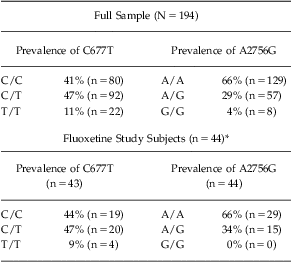
A total of 194 samples viable for genetic screening were obtained from the 224 study participants. Some of the 224 original samples had been lost, damaged, or decomposed during the storage period, such that no analyzable DNA could be obtained. Prevalence of the C677T and A2756G polymorphisms is summarized in Table 1. The homozygous C677T polymorphism T/T was present in 11% of the sample (n = 22), and the C/T heterozygote (n = 92, 47%) was slightly more prevalent than the wild type C/C (n = 80, 41%). The homozygous A2756G polymorphism G/G was present in 4% of the sample (n = 8), and the heterozygous A/G was found in 29% (n = 57).
Prevalence of C677T and A2756G polymorphisms in the study sample
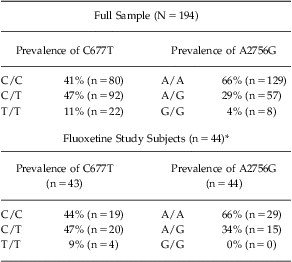
MTHFR C677T: C/C = wild type; C/T = heterozygote; T/T = homozygote
MS A2756G: A/A = wild type; A/G = heterozygote; G/G = homozygote
*Among the 52 subjects from the fluoxetine parent study, 44 produced viable genetic samples, of which 43 were successfully analyzed for C677T polymorphisms and 44 for A2756G polymorphisms.
The ethnic distribution of our sample was approximately 83% Caucasian, 7% Black, 2% Hispanic, 1% Asian/Pacific Islander, 3% self-describing as “Other,” and 4% of subjects not providing ethnic data. Among Caucasians, the genotypic distribution for MTHFR and MS polymorphisms was: C/C = 42%, C/T = 48%, T/T = 10%, A/A = 67%, A/G = 29%, G/G = 3%. Among the small sample of Black participants, we found a distribution of C/C = 23%, C/T = 62% and T/T = 15% for MTHFR polymorphisms, and an MS polymorphism distribution of A/A = 69%, A/G = 31%, G/G = 0%, similar to that obtained for Caucasians.
Among the 52 subjects from the fluoxetine parent study,Reference McGrath, Stewart, Quitkin, Chen, Alpert, Nierenberg, Fava, Cheng and Petkova42 44 produced viable genetic samples, of which 43 were successfully analyzed for C677T polymorphisms and 44 for A2756G polymorphisms. Prevalence of the genetic polymorphisms was similar to that seen in the larger sample (Table 1), but no G/G homozygotes of A2756G were found in this small subgroup.
Impact of polymorphisms on clinical improvement and response to open fluoxetine
In subjects from the fluoxetine parent study,Reference McGrath, Stewart, Quitkin, Chen, Alpert, Nierenberg, Fava, Cheng and Petkova42 we examined changes in HAM-D-17 scores and response rates in completers (n = 27; 48% female; mean age 39 ± 11 years) and the intent-to-treat (ITT) sample (n = 49; 49% female; mean age 36 ± 11 years). For ITT subjects, the last HAM-D-17 score obtained was used as the outcome in a Last-Observation-Carried-Forward (LOCF) analysis. Given the low prevalence of the homozygous T/T variant of C677T (Table 1), all subjects having a T allele (T/T and C/T) were pooled together for the analysis. Since no subjects with the G/G variant of A2756G were present in the fluoxetine study sample (Table 1), comparisons were made between wild-type subjects (A/A) and heterozygotes (A/G).
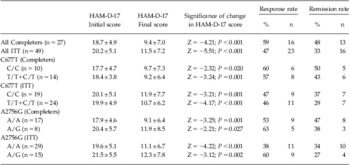
The degree of improvement in depression, based on mean HAM-D-17 score change with fluoxetine treatment is summarized in Table 2. Among completers of the open-label treatment period, the C/C and the pooled C/T and T/T groups both showed comparable and statistically significant improvement in HAM-D-17 scores (P < 0.05 for each group by Wilcoxon test), and the difference in HAM-D-17 score decrease between the two genetic groups was not significant by Mann-Whitney U test (U = 67.50; Z = −0.15; P = 0.89). The same pattern was observed in the intent-to-treat (ITT) sample, with comparable decreases in HAM-D-17 score between both groups (U = 208.50; Z = −0.48; P = 0.63).
Degree of improvement in mean HAM-D-17 score and response rates with open fluoxetine treatment

MTHFR C677T: C/C = wild type; C/T = heterozygote; T/T = homozygote
MS A2756G: A/A = wild type; A/G = heterozygote
All response and remission rate comparisons between genetic groups were nonsignificant (P > 0.05).
All HAM-D-17 score change comparisons between genetic groups were nonsignificant (P > 0.05).
Similarly, completers from the A2756G A/A and A/G groups both showed comparable and statistically significant improvement in HAM-D-17 scores in the open-label treatment phase (P < 0.05 for each group by Wilcoxon test), and the difference in HAM-D-17 score decrease between the two groups was not significant by Mann-Whitney U test (U = 66.50; Z = −0.09; P = 0.93). The ITT analysis showed a similar pattern in both genetic groups (U = 193.50; Z = −0.60; P = 0.55) (Table 2).
Response and remission rates are also summarized in Table 2. Acute phase completers with the wild type MTHFR C/C genotype had a comparable response rate to the pooled C/T and T/T group (60% vs 57%); a similar pattern was observed for remission, with a 50% rate for the C/C group (50%) and 43% for the pooled C/T and T/T group. The ITT sample yielded similar response and remission patterns for both genetic groups. None of the between-group comparisons of response or remission rates attained statistical significance by Fisher's exact test (P > 0.05; Table 2).
Among completers with the wild type A/A genotype there was a lower response rate compared to those with the A/G variant (53% vs 63%); remission rates gave an opposite pattern, with an advantage for the A/A group (47% vs 38%). The ITT sample yielded similar patterns for response and remission, with the A/A group showing a weaker response rate than the A/G group (38% vs 60%), but a more robust remission rate (34% vs 27%). These comparisons did not reach significance by Fisher's exact test (P > 0.05; Table 2).
To test for any interaction between the C677T and A2756G polymorphisms, logistic regression was carried out, with fluoxetine response as the dependent variable, and the interaction term of the C677T and A2756G as the independent variable. Among completers, no significant interaction with regard to treatment response was observed (P = 0.57, OR = 1.52, 95% CI = 0.37–6.31). Likewise, no interaction was observed in the ITT sample (P = 0.79, OR = 1.19, 95% CI = 0.35–4.05).
This pilot investigation was designed to examine medium or large effect sizes by Cohen's criteria.Reference Cohen48 A power analysis for a sample of 44 showed that we would have a power of 99% to detect a difference in treatment response rates between the samples (wild type versus polymorphism) if the effect size were large (0.8). With a medium effect size of about 0.5, the power to detect a difference would have been approximately 73%, approaching the desired 80% power. A smaller effect size would therefore require a larger sample size to be detectable.
Relationship between polymorphisms, plasma and RBC folate, plasma B12 and homocysteine levels, and response to open fluoxetine
As an ancillary investigation, we examined levels of folate, B12, and homocysteine in the treatment sample, to determine whether there were any associations with the polymorphisms or with fluoxetine response. Plasma folate levels of 2.5 ng/ml or greater, B12 levels of 200 pg/ml or greater, and RBC folate levels greater than 150 ng/ml were considered normal.Reference Papakostas, Petersen, Lebowitz, Mischoulon, Ryan, Nierenberg, Bottiglieri, Alpert, Rosenbaum and Fava4, Reference Mischoulon, Burger, Spillmann, Worthington, Fava and Alpert50, Reference Pfeiffer, Johnson, Jain, Yetley, Picciano, Rader, Fisher, Mulinare and Osterloh51 Homocysteine levels below 13.2 nmol/ml were considered normal.Reference Papakostas, Petersen, Mischoulon, Ryan, Nierenberg, Bottiglieri, Rosenbaum, Alpert and Fava3, Reference Papakostas, Petersen, Lebowitz, Mischoulon, Ryan, Nierenberg, Bottiglieri, Alpert, Rosenbaum and Fava4
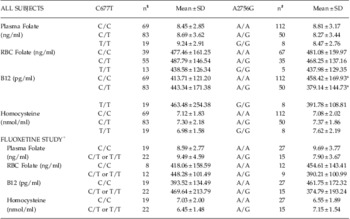
In our sample (N = 194), mean levels of plasma and RBC folate, B12, and homocysteine were within the normal range, independent of the presence or absence of C677T or A2756G polymorphisms (Table 3). The difference in plasma B12 levels between the A/A and A/G groups was significant by Mann-Whitney U test (U = 2034.00, Z = −2.78, P = 0.005). All other comparisons between genetic subtypes were non-significant (P > 0.05). In the fluoxetine study subsample, the Mann Whitney U test yielded no significant differences between wild type subjects and those with the C677T or A2756G polymorphisms (P > 0.05 for all comparisons) (Table 3).
Plasma and RBC Folate, and Plasma B12 and homocysteine levels, by genetic status in the sample as a whole and in the fluoxetine study

MTHFR C677T: C/C = wild type; C/T = heterozygote; T/T = homozygote
MS A2756G: A/A = wild type; A/G = heterozygote
‡ n based on number of viable samples for each analysis produced by each genetic group.
* The difference in plasma B12 levels between the A/A and A/G groups in the sample as a whole was significant by Mann Whitney U test (U = 2034.00, Z = −2.78, P = 0.005). All other differences between genetic groups were non-significant (P > 0.05).
+ All differences between genetic groups in the fluoxetine study sample were non-significant by Mann-Whitney U test (P > 0.05).
To test for any interaction between the C677T and A2756G polymorphisms, univariate ANOVA was carried out, with plasma and RBC folate, B12, and homocysteine as dependent variables, and the interaction term of C677T and A2756G as the covariate. We found a significant interaction between C677T and A2756G with regard to plasma B12 only (F(8, 159) = 2.14; P = 0.035). No significant interactions were found for folate or homocysteine (P > 0.05 for all).
The relationship between treatment response in the fluoxetine subsample and levels of plasma and RBC folate, B12, and homocysteine was examined. All these parameters were within the normal range for fluoxetine responders and for nonresponders. Only the difference in plasma folate between responders and nonresponders was significant by Mann-Whitney U test in completers (9.75 ± 1.80 ng/ml for nonresponders, and 6.83 ± 2.49 ng/ml for responders; U = 29.00; Z = −2.69; P = 0.006) and in the ITT sample (10.35 ± 3.75 ng/ml for nonresponders, and 7.38 ± 3.54 ng/ml for responders; U = 132.00; Z = −2.75; P = 0.006), favoring lower plasma folate levels. A similar pattern was observed for plasma folate and remission, but it reached significance only in the ITT sample (9.74 ± 4.32 ng/ml for nonremitters, and 7.18 ± 2.31 ng/ml for remitters; U = 129.00; Z = −2.44; P = 0.015).
Logistic regression analysis showed a significant association between plasma folic acid levels (independent variable) and response to fluoxetine treatment (dependent variable) among completers (R-square = 0.401; P = 0.013; OR = 0.55; 95% CI = 0.34–0.88) and the ITT group (R-square = 0.221, P = 0.022; OR = 0.77; 95% CI = 0.62–0.96), independent of the presence or absence of C677T. A similar association was found for completers (R-square = 0.541, P = 0.015; OR = 0.46; 95% CI = 0.24–0.86) and the ITT group (R-square = 0.291, P = 0.041; OR = 0.79; 95% CI = 0.63-0.99) independent of the presence or absence of A2756G. Similar analysis yielded no significant relationship between response rates and levels of B12, homocysteine, or RBC folate (P > 0.05 for all). Univariate ANOVA suggested no significant association between change in HAM-D-17 score, genetic status, and any of the folate, B12, and homocysteine parameters (P > 0.05 for all).
Discussion
The prevalence of the C677T and A2756G polymorphisms in our sample was comparable to that reported in past investigations.Reference Gilbody, Lewis and Lightfoot22, Reference Dai and Zhang28, Reference Zhang and Dai31, Reference Yu, Zheng, Qi, Lian and He37, Reference D'Angelo, Coppola, Madonna, Fermo, Pagano, Mazzola, Galli and Cerbone40, Reference Hiraoka, Kato, Saito, Yasuda and Kagawa41 Our sample was predominantly Caucasian, and our findings therefore suggest that the prevalence of these polymorphisms in U.S. Caucasians with MDD is similar to that seen in samples from other countries with different ethnic populations.Reference Gilbody, Lewis and Lightfoot22
In the subgroup of patients treated with fluoxetine, HAM-D-17 score improvement was significant and comparable for wild type subjects and for those with C677T or A2756G polymorphisms. Likewise, response and remission rates were not significantly different between subjects with and without these polymorphisms. The presence of the C677T or A2756G polymorphism, whether in the heterozygote or homozygote form, did not appear to have a significant impact on antidepressant response, and we found no significant interaction effect between the two polymorphisms on treatment response.
The presence of C677T or A2756G did not have a significant effect on plasma levels of folate and homocysteine, but a significant difference in plasma B12 levels was observed between the wild type A2756G A/A and heterozygous A/G group. While previous investigations in small samples have suggested an association between A2756G and B12 levels,Reference Miriuka, Langman, Evrovski, Miner, D'Mello, Delgado, Wong, Ross and Cole36, Reference Miriuka, Langman, Keren, Miner, Mamer, Delgado, Evrovski, Ross and Cole38 a similar comparison between A/A and G/G did not yield significant results, though the G/G group (n = 8) was likely too small to allow for a valid comparison. The lack of influence on homocysteine levels was somewhat surprising, since such an effect has been reported, especially for the T alleles of MTHFRReference Frosst, Blom, Milos, Goyette, Sheppard, Matthews, Boers, den Heiger, Kluijtmans, van den Heuvel and Rozen8, 52–Reference Crider, Zhu, Hao, Yang, Yang, Gindler, Maneval, Quinlivan, Li, Bailey and Berry56 and the G alleles of MS.52 The very small number of subjects with homozygous TT and GG in our sample may explain these findings, since the genetic load might have been insufficient to produce a measureable effect. Likewise, the small number of homozygotes does not permit adequate testing of potential epistatic interactions of TT with GG to alter homocysteine or folate levels or fluoxetine response.
Interestingly, we found a significant inverse association between plasma folate and treatment response, but this association was not seen for the change in HAM-D-17 score, which is a more sensitive measure of response to antidepressants. Given the known impact of folate deficiency on depression, and folate's beneficial antidepressant effect,Reference Coppen and Bailey5, Reference Alpert, Mischoulon, Rubenstein, Bottonari, Nierenberg and Fava6 it would seem doubtful that a lower (but still in normal range) plasma folate level would increase one's chances of responding to fluoxetine.
While the presence of C677T may render certain individuals more vulnerable to depression, we found no significant impact on response to antidepressant treatment in our sample. It is possible that folate metabolism anomalies may play a limited role in the etiology of depression, and that antidepressants may carry out some of their effects via mechanisms not directly affected by folate, which could explain the limited impact of C677T on treatment response. While even less is known about a link between A2756G and mood disorders, our findings likewise do not suggest much impact on antidepressant response.
Our power analysis suggests that if there is any difference in treatment response between subjects with and without the polymorphisms, this difference is not so strong that it could be detected using the present sample size. While our study is underpowered to detect differences with smaller effect sizes,Reference Serretti, Kato and Kennedy57 an effect size that small is less likely to be clinically significant. Another limitation of our study is that the key findings are based on an open treatment sample, which makes our results more vulnerable to placebo effects. These data must therefore be interpreted with caution. Our observations about the MS polymorphism in particular require more investigation to better clarify whether it has any significant relationship with depressive disorders.
Conclusion
In a small sample, the presence of the C677T and A2756G polymorphisms did not appear to significantly affect response to fluoxetine. A2756G appeared to have an impact on plasma B12 but not on folate or homocysteine, and we found no significant associations for C677T. These results must be interpreted with caution and considered preliminary, however. Replication in larger samples is necessary to confirm or refute these findings. Likewise, investigations to further examine the correlation between folate deficiency and depression, for example via polymorphisms in other genes such as those for cystathionine beta synthase (CBS),Reference Tchantchou, Graves and Shea58, Reference Kim and Fay59 and the impact of combined genotypic anomalies on MDD also seem warranted.
Professional Positions
1. David Mischoulon has an MD and PhD from Boston University School of Medicine. He is Director of Research in the Depression Clinical and Research Program, Massachusetts General Hospital, and Associate Professor of Psychiatry at Harvard Medical School, Boston, MA.
2. Stefania Lamon-Fava, has an MD from the University of Padua School of Medicine, Italy, and a PhD from the University of Modena, Italy. She is Associate Professor in the Gerald J. and Dorothy R. Friedman School of Nutrition Science and Policy at Tufts University, and Scientist I in the Lipid Metabolism Laboratory, Jean Mayer USDA Human Nutrition Research Center on Aging at Tufts University, Boston, MA.
3. Jacob Selhub has a PhD from Case Western Reserve University. He is Professor in the Gerald J. and Dorothy R. Friedman School of Nutrition Science and Policy at Tufts University, and Senior Scientist and Director of the Vitamin Metabolism Laboratory, Jean Mayer USDA Human Nutrition Research Center on Aging at Tufts University, Boston, MA.
4. Judith Katz has a BS from Cornell University. She is a Research Assistant in the Depression Clinical and Research Program, Massachusetts General Hospital, Boston, MA.
5. George I. Papakostas has an MD from New York University. He is Director of Treatment-Resistant Depression Studies in the Depression Clinical and Research Program, Massachusetts General Hospital, and Associate Professor of Psychiatry, Harvard Medical School, Boston, MA.
6. Dan V. Iosifescu, has an MD from Carol Davila University of Medicine and Pharmacy, and an MSc from Harvard Medical School. He is Director of Neuroimaging Studies in the Depression Clinical and Research Program, Massachusetts General Hospital, and Associate Professor of Psychiatry, Harvard Medical School, Boston, MA.
7. Albert S. Yeung has an MD from National Taiwan University Medical College, and an ScD from Harvard. He is Director of Health Services Studies in the Depression Clinical and Research Program, Massachusetts General Hospital, and Associate Professor of Psychiatry, Harvard Medical School, Boston, MA.
8. Christina M. Dording has an MD from Tufts University. She is Director of Sexual Behavior Studies in the Depression Clinical and Research Program, Massachusetts General Hospital, and Instructor of Psychiatry, Harvard Medical School, Boston, MA.
9. Amy H. Farabaugh has a PhD from Northeastern University. She is Director of Psychotherapy Studies in the Depression Clinical and Research Program, Massachusetts General Hospital, and Assistant Professor of Psychiatry, Harvard Medical School, Boston, MA.
10. Alisabet J. Clain has an MS from the University of Massachusetts. She is Database Manager in the Depression Clinical and Research Program, Massachusetts General Hospital, Boston, MA.
11. Lee Baer has a PhD from Nova Southeastern University. He is Clinical Professor of Psychology at Harvard Medical School, and Associate Chief of Psychology, Department of Psychiatry, Massachusetts General Hospital, Boston, MA.
12. Jonathan E. Alpert has an MD from Yale University, and a PhD from Cambridge University. He is Associate Director of the Depression Clinical and Research Program, Massachusetts General Hospital, and Associate Professor of Psychiatry, Harvard Medical School, Boston, MA.
13. Andrew A. Nierenberg has an MD from Albert Einstein School of Medicine. He is Associate Director of the Depression Clinical and Research Program, Massachusetts General Hospital, and Professor of Psychiatry, Harvard Medical School, Boston, MA.
14. Maurizio Fava has an MD from the University of Padua, Italy. He is Director of the Depression Clinical and Research Program, Massachusetts General Hospital, and Professor of Psychiatry, Harvard Medical School, Boston, MA.
Acknowledgements
Dr. David Mischoulon was supported in this investigation by a Young Investigator Award from the National Association for Research on Schizophrenia and Depression (NARSAD).
The fluoxetine parent study was supported by NIMH grant R10-MH56058 to Dr. Patrick McGrath and by infrastructure and salary support from the State of New York. The authors thank Dr. McGrath and his colleagues at Columbia University College of Physicians and Surgeons and the New York State Psychiatric Institute, New York.
Medication for the fluoxetine parent study was donated by Eli Lilly.
Disclosures
Dr. David Mischoulon has received research support from Nordic Naturals, Fisher Wallace, the Bowman Family Foundation, and Ganeden. He has served as a consultant to Bristol-Meyers-Squibb Company. He has received writing honoraria from Pamlab and Nordic Naturals and speaking honoraria from Nordic Naturals. He has received royalties from Back Bay Scientific for PMS Escape, and royalties from Lippincott Williams & Wilkins, for textbook “Natural Medications for Psychiatric Disorders: Considering the Alternatives” (David Mischoulon and Jerrold F Rosenbaum, Eds.).
Dr. George Papakostas has served as a consultant for Abbott Laboratories, AstraZeneca PLC, Brainsway Ltd, Bristol-Myers Squibb Company, Cephalon Inc., Dey Pharma, L.P., Eli Lilly Co., GlaxoSmithKline, Evotec AG, Inflabloc Pharmaceuticals, Jazz Pharmaceuticals, Otsuka Pharmaceuticals, PAMLAB LLC, Pfizer Inc., Pierre Fabre Laboratories, Ridge Diagnostics (formerly known as Precision Human Biolaboratories), Shire Pharmaceuticals, Takeda Pharmaceutical Company LTD, Theracos, Inc., and Wyeth, Inc. He has received honoraria from Abbott Laboratories, Astra Zeneca PLC, Bristol-Myers Squibb Company, Brainsway Ltd, Cephalon Inc., Dey Pharma, L.P., Eli Lilly Co., Evotec AG, GlaxoSmithKline, Inflabloc Pharmaceuticals, Jazz Pharmaceuticals, Lundbeck, Otsuka Pharmaceuticals, PAMLAB LLC, Pfizer, Pierre Fabre Laboratories, Ridge Diagnostics, Shire Pharmaceuticals, Takeda Pharmaceutical Company LTD, Theracos, Inc., Titan Pharmaceuticals, and Wyeth Inc. He has received research support from AstraZeneca PLC, Bristol-Myers Squibb Company, Forest Pharmaceuticals, the National Institute of Mental Health, PAMLAB LLC, Pfizer Inc., and Ridge Diagnostics (formerly known as Precision Human Biolaboratories). He has served (not currently) on the speaker's bureau for BristolMyersSquibb Co and Pfizer, Inc.
Dr. Daniel Iosifescu has received research support from Aspect Medical Systems, Forest Laboratories and Janssen Pharmaceutica; he has been a consultant for Forest Laboratories, Gerson Lehrman Group and Pfizer, Inc., and he has been a speaker for Cephalon, Inc., Eli Lilly & Co., Forest Laboratories, and Pfizer, Inc.
Dr. Christina Dording has received speaking honoraria from Wyeth.
Dr. Jonathan Alpert has received research support from Aspect Medical Systems, Eli Lilly, Pamlab, and Pfizer; he has received speaker's honoraria from Reed Medical Education and Belvoir Publishing.
Dr. Andrew Nierenberg has received honoraria or travel expenses from: American Society of Clinical Psychopharmacology, Australasian Society for Bipolar Disorder, Bayamon Region Psychiatric Society, San Juan, Puerto Rico, Belvoir Publishing, CRICO, Dartmouth, Dey Pharma, L.P./Mylan Inc., Israel Society for Biological Psychiatry, John Hopkins University, National Association of Continuing Education, Physicians Postgraduate Press, Slack Publishing, University of Florida, University of Michigan, University of Miami, Wolters Klower Publishing. Dr. Nierenberg owns stock options in Appliance Computing, Inc. (MindSite.com) and Brain Cells, Inc. Additional income is possible from Infomedic.com depending on overall revenues of the company but no revenue has been received to date. Through MGH, Dr. Nierenberg is named for copyrights to: the Clinical Positive Affect Scale and the MGH Structured Clinical Interview for the Montgomery Asberg Depression Scale exclusively licensed to the MGH Clinical Trials Network and Institute (CTNI).
Dr. Maurizio Fava has received research support from Abbott Laboratories, Alkermes, Aspect Medical Systems, Astra-Zeneca, BioResearch, BrainCells, Inc., Bristol-Myers Squibb Company, Cephalon, Clinical Trial Solutions, LLC, Eli Lilly & Company, EnVivo Pharmaceuticals, Inc., Forest Pharmaceuticals Inc., Ganeden, GlaxoSmithKline, J & J Pharmaceuticals, Lichtwer Pharma GmbH, Lorex Pharmaceuticals, NARSAD, NCCAM, NIDA, NIMH, Novartis, Organon Inc., PamLab, LLC, Pfizer Inc, Pharmavite, Roche, Sanofi-Aventis, Shire, Solvay Pharmaceuticals, Inc., Synthelabo, and Wyeth-Ayerst Laboratories. He has served as an advisor and consultant to Abbott Laboratories, Affectis Pharmaceuticals AG, Amarin, Aspect Medical Systems, Astra-Zeneca, Auspex Pharmaceuticals, Bayer AG, Best Practice Project Management, Inc, BioMarin Pharmaceuticals, Inc., Biovail Pharmaceuticals, Inc., BrainCells, Inc, Bristol-Myers Squibb Company, Cephalon, Clinical Trials Solutions, LLC, CNS Response, Compellis, Cypress Pharmaceuticals, Dov Pharmaceuticals, Eisai, Inc., Eli Lilly & Company, EPIX Pharmaceuticals, Euthymics Bioscience, Inc., Fabre-Kramer, Pharmaceuticals, Inc., Forest Pharmaceuticals Inc., GlaxoSmithKline, Grunenthal GmBH, Janssen Pharmaceutica, Jazz Pharmaceuticals, J & J Pharmaceuticals, Knoll Pharmaceutical Company, Labopharm, Lorex Pharmaceuticals, Lundbeck, MedAvante Inc., Merck, Methylation Sciences, Neuronetics, Novartis, Nutrition 21, Organon Inc., PamLab, LLC, Pfizer Inc, PharmaStar, Pharmavite, Precision Human Biolaboratory, Prexa Pharmaceuticals, Inc., PsychoGenics, Psylin Neurosciences, Inc., Ridge Diagnostics, Inc., Roche, Sanofi-Aventis, Sepracor, Schering-Plough, Solvay Pharmaceuticals, Inc., Somaxon, Somerset Pharmaceuticals, Synthelabo, Takeda, Tetragenex, TransForm Pharmaceuticals, Inc., Transcept Pharmaceuticals, Vanda Pharmaceuticals Inc, Wyeth-Ayerst Laboratories. He has received speaking and publishing honoraria from Adamed, Co., Advanced Meeting Partners, American Psychiatric Association, American Society of Clinical Psychopharmacology, Astra-Zeneca, Belvoir, Boehringer-Ingelheim, Bristol-Myers Squibb Company, Cephalon, Eli Lilly & Company, Forest Pharmaceuticals Inc., GlaxoSmithKline, Imedex, Novartis, Organon Inc., Pfizer Inc, PharmaStar, MGH Psychiatry Academy/Primedia, MGH Psychiatry Academy/Reed-Elsevier, UBC, and Wyeth-Ayerst Laboratories. He holds equity in Compellis. He currently holds a patent for SPCD and a patent application for a combination of azapirones and bupropion in MDD, and has received copyright royalties for the MGH CPFQ, SFI, ATRQ, DESS, and SAFER diagnostic instruments.
The remaining authors (Dr. Stefania Fava, Dr. Jacob Selhub, Ms. Judith Katz, Dr. Albert Yeung, Dr. Amy Farabaugh, Dr. Lee Baer, and Ms. Alisabet Clain) report no conflicts of interest.