Introduction
Satellite communications have played an important part in the global connectivity. Typically the frequency bands in the Ka, Ku range are utilized for satellite links. As the demand for high data throughputs are growing, there have been investigations in utilizing the mm-wave range, especially the 60–90 GHz band for satellite high speed data links. It is expected to achieve data rates of up to 10 Gbits/s with such data links [Reference Harati, Schoch, Tessmann, Schwantuschke, Henneberger, Czekala, Zwick and Kallfass1].
For conventional satellite systems, mostly reflector antennas are utilized [Reference Harati, Schoch, Tessmann, Schwantuschke, Henneberger, Czekala, Zwick and Kallfass1, Reference Boes, Antes, Messinger, Meier, Henneberger, Tessmann and Kallfass2]. However, these antennas are very bulky in nature and can increase the payload of the satellite significantly. Therefore, it is important to have lightweight and low profile antennas and at the time maintain a reasonable antenna performance. Slotted waveguide based antennas [Reference Ahmad, Adel and Schühler3] can be one solution for getting flat profile antennas. However at mm-wave frequency bands it becomes complex to manufacture such kind of antenna structures and they also require high precision Computer Numerical Control (CNC)machining.
This works presents a 3D printed lens antenna integrated with an orthomode transducer (OMT) structure. This antenna structure can support two individual polarization channels or achieve left handed circularly polarization or right handed circularly polarization wave by combining the individual ports with a phase delay of 90°. Conventional OMT structures are manufactured using precise machining in a brass or copper block. This technique makes it expensive to fabricate and at the same time difficult to integrate. Polyjet printing can be an alternative to conventional machining approach as a resolution of 60 µm can be achieved with a Connex 500 Polyjet printer. Moreover, materials for the Connex printer demonstrate good mechanical strength and can later be electroplated to replace the bulky metallic waveguide structures. Fused filament fabrication (FFF) technique is adopted for printing the lens antenna with a material whose permittivity and loss tangent provide a reasonable Radio Frequency (RF)performance. Typically the materials used for the printers are made keeping in mind the mechanical properties and have high loss tangent varying permittivity which makes them not feasible to be used in RF applications.
Antenna and OMT design
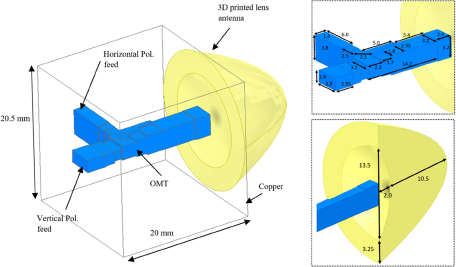
A 3D elliptic domed lens integrated together with an OMT can be seen in Fig. 1 along with dimensions. The OMT has can be manufactured in multiple ways and is used extensively in communication systems to provide dual polarization capability and increase the throughput of the system [Reference Srikanth and Solatka4, Reference Dunning, Srikanth and Kerr5]. An OMT based on a T-section splitter [Reference Reck and Chattopadhyay6] is adopted for this work for its relative ease in manufacturing. The dimensions of the OMT are the same as provided in paper [Reference Ahmad and Hesselbarth7], which presents a working OMT for the V-band integrated with a 2 × 2 array antenna. In order to have more gain and integration a 3D printed lens antenna [Reference Bahr, He, Tehrani and Tentzeris8, Reference Bisognin, Nachabe, Luxey, Gianesello, Gloria, Costa, Fernandes, Alvarez, Arboleya-Arboleya, Laviada, Las-Heras, Dolatsha, Grave, Sawaby and Arbabian9] is designed to work together with the OMT. The hemispherical shape of the lens is optimized using finite-element based field simulation for impedance bandwidth and gain performance.
Top view of the printed Vivaldi antenna with E-field distribution across the structures and dimensions.

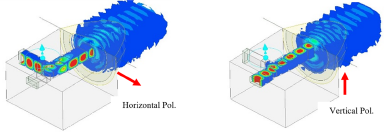
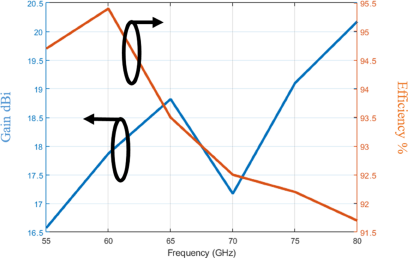
Figure 2 shows the E-field inside the OMT and lens structure for horizontal and vertical polarizations. Red arrows indicate the orientation of polarization. The isolation between the two polarization remains below −40 dB. The feed interface for the OMT is with a standard WR-15 waveguide interface. When the OMT is integrated with the printed lens this increases the directivity of the antenna to above 16 dBi over the 55–80 GHz band. The simulated efficiency of the structure remains above 90% as seen in Fig. 3.
Electric field distribution in the OMT and lens antenna for horizontal and vertical polarization.

Simulated gain and efficiency of the OMT integrated lens.

The lens antenna is manufactured using the FFF technique using a commercially available filament from PREMIX with a relative permittivity of 3.0 and a loss tangent of 0.004.
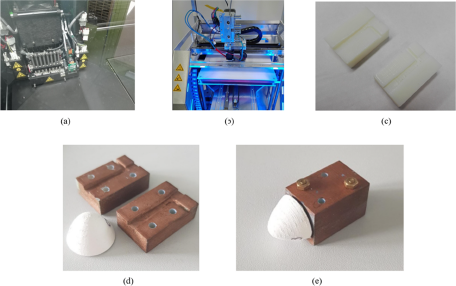
The OMT is fabricated with 3D printing and electroplating technology as opposed to conventional milling techniques. The parts are printed as two separate blocks with Polyjet printer using Verowhite material. Afterwards a layer of Titanium is applied on the printed parts and is electroplated with approximately 5μm of copper. Figure 4 shows the printed OMT and lens antenna.
Manufacturing of OMT and antenna. (a) Polyjet printing process for the OMT. (b) FFF printing for the dielectric lens antenna (c) Poly jet printed OMT as a split block (d) Copper plated OMT parts (e) OMT integrated with the lens antenna.

Antenna performance
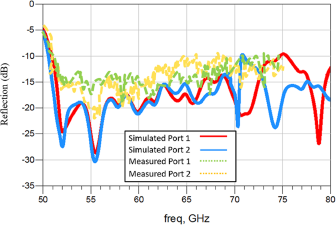
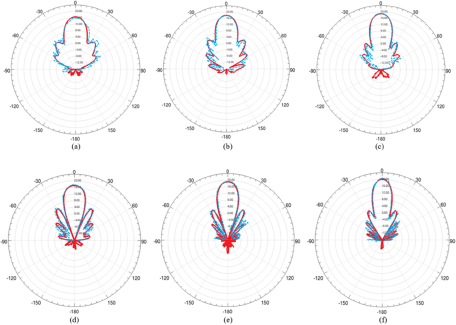
The reflection of the antenna is measured with a VNA. The interface of the extender module for the network analyzer has a WR-15 standard interface which is the same for the two ports of the OMT integrated antenna. A single port is measured at a time while the orthogonal port is connected with termination load. The calibration is done to the WR-15 interface with Thru-Reflect-Line standard. Figure 5 shows the S-parameters of the OMT integrated antenna simulated and measured. The simulated and measured radiation pattern of the antenna is shown in Fig. 6.
Measured and simulated reflection of the antenna on Port 1 and Port 2.

Radiation pattern of the antenna simulated and measured at (a) 55 GHz (b) 60 GHz (c) 65 GHz (d) 70 GHz (e) 75 GHz (f) 80 GHz.

Conclusion
In this work a fully 3D printed OMT structure is integrated with a lens antenna. The main advantage this design has is that it has significantly wide bandwidth and can accommodate two orthogonal polarization. At the same time, it provides a high efficiency and a reasonable gain performance. 3D printing enables a low cost and light weight solution. Further work can be done on designing a 3D printed feed network for a larger array antenna.
Author contributions
All authors contributed equally to analyzing data and reaching conclusions, and in writing the paper.
Funding statement
This research received no specific grant from any funding agency, commercial or not-for-profit sectors.
Competing interests
The authors report no conflict of interest.