- CUL
Cambridge University Library
- CYS
Canterbury and York Society
- RS
Rolls Series
- SCH
Studies in Church History
- VCH
Victoria County History
- WHS
Worcestershire Historical Society
A man who presented himself for ordination in the Middle Ages needed a title, an assured income sufficient for his support. A bishop who ordained a man without a title became responsible for his future maintenance.Footnote 1 In the eastern Mediterranean in the fourth century, when the need for a title was first established, the diocesan bishop controlled the assets and staffing of churches in his city and, insofar as Christianity had penetrated the surrounding area, in those places as well. Over the following eight centuries the spread of Christianity, in particular in the less urban north-west of Europe, produced a more complex pattern of provision for the foundation and maintenance of churches and the appointment and support of their priests. Periods of breakdown of civil and ecclesiastical government and law and order undermined at times the security of priestly service, but the bishop remained responsible for ordinations and bore the concomitant responsibility to ensure that the men whom he ordained had means of support. In general, most priests would be ordained to the service of a specific church and would be likely to remain in it, although the precise status of the church to which a man was ordained and the nature of his service in it might vary considerably. The ecclesiastical authorities would have achieved two aims, at least in principle: the priest would not be in danger of bringing the clerical order into shame by becoming a wandering beggar, and his basic income would be independent of lay patronage and control. From at least the later twelfth century it was also acceptable for an ordinand to possess a title ‘de sua vel paterna hereditate’.Footnote 2
The ordination lists
The Statute of London (1237) required bishops to maintain lists of men examined and ordained but the earliest surviving ordination lists, apart from a few isolated entries in the register of Walter Bronescombe of Exeter, date from 1268 to 1274 in the register of Walter Giffard, archbishop of York. The next are from 1277 to 1280 in the register of Thomas Cantilupe, bishop of Hereford. Neither series appears to be complete. The first surviving extensive and reasonably complete series begins in 1282 in the registers of John Pecham, archbishop of Canterbury, and Godfrey Giffard, bishop of Worcester. The Canterbury lists continue, with short gaps, to 1328, and the Worcester lists to the end of our period. For Lincoln the ordination lists cover the years 1290 to 1299, the second half of Oliver Sutton's episcopate, and there is then a gap until 1345. The next series to begin is Carlisle, in 1294, and this runs, with a gap between 1324 and 1332, until after the end of our period. Thereafter coverage of ordinations in episcopal registers is: Coventry and Lichfield from 1300; Winchester 1305–33 and from 1346; Exeter 1308–21; Rochester from 1320; Hereford from 1328; Durham from 1334; Ely from 1338; York from 1342.Footnote 3
Ordination lists for a diocese normally include the names and titles not only of ordinands from that diocese but also of ordinands from other dioceses holding letters dimissory from their diocesan bishop.Footnote 4
This was a period in which the nature or apparent nature of titles of unbeneficed clergy, who now formed the great majority of ordinands, changed markedly. By comparing the process of change in the various dioceses at least tentative conclusions can be drawn as to the nature of titles and the reasons for the changes. Also, the early lists show a greater variation in the ways in which titles are described, including often the nature of the evidence adduced to testify to their validity, which may make visible certain realities which are hidden by the more formulaic language of the majority of later lists.Footnote 5
Titles: the overall pattern
In this period the three predominant titles of unbeneficed secular clergy were those described as the ordinand's patrimony, titles granted by named laymen or women, and titles granted by religious houses.Footnote 6 Lesser numbers of titles might be granted by secular clergy, either specified by their office as, for example, archdeacon, precentor, rector or vicar, or simply by name, or by secular cathedrals and other collegiate churches. Sometimes a title was expressed as a sum of money or as property, which may be described as the ordinand's patrimony or as having been granted to him by a named person, but may simply be stated as an amount without further information. Some joint titles occur, for example naming a layman or religious house together with the ordinand's patrimony. Chantries may also be named as titles, and even where the chantry was endowed and its chaplain formally instituted to it, such men usually seem to have been regarded as unbeneficed clergy. Some men were ordained ‘by grace of the bishop’, either without a title being stated or specifically described as not possessing a title.
The overall pattern of change in the nature of titles as they are described in the registers has long been recognised. In the thirteenth century, in most dioceses, patrimonial titles and titles from laymen and women predominate, with relatively few being granted by religious houses. The first half of the fourteenth century is marked by a move, widespread but not universal, sometimes gradual and sometimes dramatic, towards most, and in many dioceses nearly all, unbeneficed ordinands obtaining their titles from religious houses. Many of these houses were small and poor monasteries, nunneries and hospitals which could not have undertaken the lifetime maintenance of the large numbers of priests to whom they gave titles.Footnote 7
The actual pattern is more complex. The two earliest series of lists, for York and Hereford, already include almost the whole range of titles to be found later.Footnote 8 In 1268 Giffard ordained Robert de Edwinstowe, presented by the prior and convent of Thurgarton; Robert de Hoteringham, ordained to the title of his own patrimony; Ralph son of Elias, to the title of five marks in Nottingham ‘ut celebret de Beata Virgine’; Robert le Waleys, to the title of ten marks in the church of Fryston; Gilbert de Clarborough, ordained by order of the archbishop; William de Sancto Dionisio, presented by the chancellor of York; and men presented by the chapters of York, Beverley and Ripon.Footnote 9 Adam de Preston was ordained at the presentation of Peter de Chester (provost of Beverley Minster); John de Egrum at the presentation of Sir John de Everingham; and Peter de Dewsbury to the title of five marks from the free men of Dewsbury.Footnote 10 At Easter Eve 1269 John de Malton was ordained ‘ad instanciam domine A de Vescy’.Footnote 11 The subdeacons ordained in September 1273 included Alan de Wytington, presented by the rector of Keyingham.Footnote 12 Among the priests ordained in September 1274 were Robert de Tatham and Robert de Wetherby, presented by the Templars of Wetherby and Ribston; Richard de Copgrave to a title from the house of St John of Jerusalem; William Palmere to the title of the chantry of the brothers of the house of Newton; and John de Ilkley and Robert de Brueria, each of whom was ordained to a title of five marks annual rent.Footnote 13 Already, therefore, we find patrimonial titles and titles expressed as sums of money; titles from named laymen and women and from local communities; from ecclesiastics, both in their official and perhaps in personal capacities; ordinands presented by religious houses, including the military orders, and by secular colleges; chantries as titles; and ordinations at the mandate of the archbishop. Too few titles are stated to provide a clear pattern but patrimonial titles predominate.
In Hereford, at first sight, probably as many as two-thirds of the 214 titles were patrimonial and we might assign at least fourteen as being granted by religious houses, sixteen by laymen and women, and twenty-one by secular clergy. Five men were ordained to the title of a chantry.Footnote 14 The reality seems to be more complex. A number of titles do not use the word ‘chantry’ but are clearly service of an altar in a church, and these in turn seem not to be easily distinguishable from some of the titles described as patrimonial or as being granted by rectors, vicars or laypeople of parishes. Hugh de Clun was ordained subdeacon ‘to a title of his patrimony and the service of Blessed Mary of Clun to which he is presented by the parishioners of the same’, which might be interpreted as a patrimonial, lay or, in a broad sense of the word, chantry title.Footnote 15 John de Marcle was ordained deacon ‘at the presentation of the parishioners of the same place to celebrate mass of the Blessed Virgin Mary; John Joye presented him’.Footnote 16 Robert de Eardisley was ordained subdeacon at the presentation of the parishioners of the same to celebrate mass.Footnote 17 These titles were presumably similar to those as priest of Stephen de Bromyard to the service of Blessed Mary of the same; Robert de Clifford to the service of Blessed Mary of the same; Geoffrey de Ocle to the chantry of the chapel of Streddowy [Stradway?]; Walter de Woolhope to the chantry of Blessed Mary of the same; and, as subdeacon, Nicholas de Mamble to the title of the chantry of Mamble ‘et fidejusserunt pro eo decanus de Bureford et W de Bayton’.Footnote 18 The titles of Richard de Cowarne ‘at the presentation of parishioners of Cowarne viz Roger le Venur and Roger le Fremon’ and of Hugo de la Barre ‘at the presentation of the parishioners of All Saints’ (presumably Hereford) were no doubt similar,Footnote 19 and the eleven vicars and rectors who presented ordinands may well have been vouching for similar titles, especially since eight of them were vicars, who would normally not be wealthy enough to support assistant clergy from their own resources. John de Newent was ordained deacon to the title of his patrimony ‘et pro sufficiencia cavit vicarius de Neuwent’.Footnote 20 William Berd of Ledbury was ordained subdeacon, ‘non juratus ad titulum quem sibi dedit Willelmus, vicarius de Bromyard, qui vicarius repromisit indempnitatem domini cum sacramento’.Footnote 21 The vicar may have had the authority to appoint him to an altar in the church or to an outlying chapelry, but he may have been acting on behalf of parishioners who had endowed an altar or have been vouching for a patrimonial title.Footnote 22 David de Ashperton was ordained deacon on the presentation of Martin, rector of the same, and then priest to the title of a sufficient patrimony.Footnote 23 This may suggest that the rector was vouching for the adequacy of David's patrimonial title.
The process of change
In four, and probably five, of the dioceses for which there is evidence before 1300 most titles were patrimonial or from laymen and women. This is true of the early lists from York and Hereford described above, and also of Canterbury and probably Worcester. Patrimonial titles predominate in all of these.Footnote 24 In Carlisle almost all of the titles were granted by laymen and women. The exception is Lincoln, where more than 80 per cent of the titles were from religious houses.Footnote 25 In that diocese, patrimonial titles were relatively few and were specified in some detail. They were attested, usually by the relevant archdeacon, which suggests that they were regarded with caution.
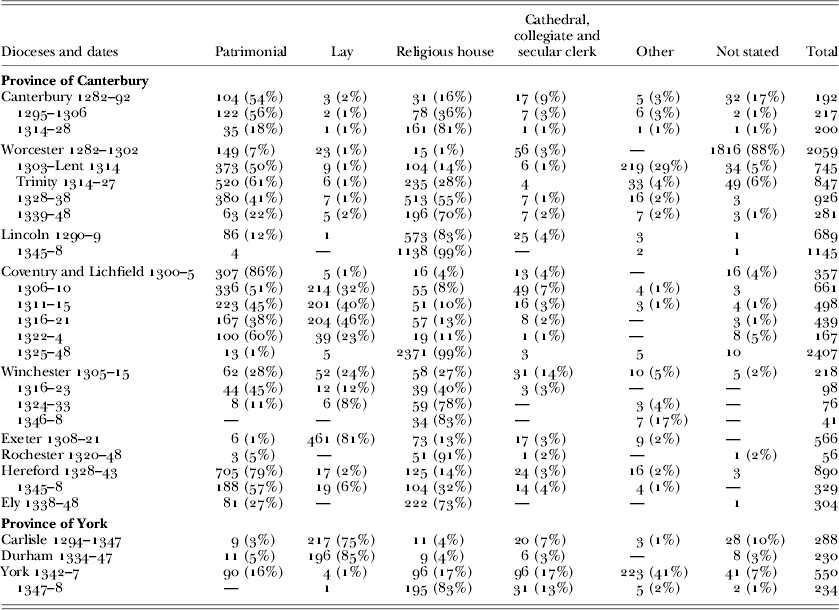
Titles of men ordained subdeacon, 1282–1348

NOTES
1. Percentages are rounded to the nearest 1%. Where a percentage is not given it is less than 0.5%.
2. Titles of deacons and priests show little difference from those of subdeacons, except that changes in the nature of titles occur somewhat later.
3. Within the two provinces the dioceses are listed in order of the first date of the series of ordinations. Within dioceses periods are divided to show significant changes in the nature of titles. In a number of cases they also relate to individual episcopates, although the dates given here are those of first and last ordinations and may also include ordinations sede vacante before or after an episcopate.
4. Lay titles include, notably in Hereford, titles granted by ‘the parishioners of…’. Religious house titles include titles from Oxford and Cambridge colleges.
5. Other: these include ordinands ordained ‘gracia episcopi’. Significant kinds of title included as ‘Other’ include Worcester 1303–Lent 1314, 172 titles expressed as money or land without a source being stated; Winchester 1346–8: the ‘other’ titles were all granted by the Winchester fraternities; Hereford 1328–43 includes 15 chantry titles. York 1342–7 includes 214 titles expressed as money or land without a source being stated: see pp. 537–8 below for discussion of York titles in this period.
Lincoln was to set the pattern for the future. During the first two decades of the fourteenth century several dioceses in the south-east of England moved from patrimonial and lay titles towards religious house titles. In Canterbury, religious house titles, which comprised less than one-fifth of known titles in the 1280s, increased to one-third during the 1290s and were almost equal to patrimonial titles by the beginning of the fourteenth century. At Archbishop Reynolds's first ordination in 1314 eighteen out of twenty-six subdeacons had titles from religious houses, and between 1317 and Reynolds's last recorded ordination in 1326 such titles were held by seventy-three out of eighty-eight subdeacons.Footnote 26 In the diocese of Rochester ordination lists begin with the first surviving register, that of Hamo Hethe, in 1320, and from the beginning the titles were almost exclusively from religious houses. The evidence of letters dimissory suggests that the change may have taken place at about the same time as in Canterbury. In the third south-eastern diocese for which series of ordination lists survive, Winchester, records begin in 1305, and until 1315, the end of Bishop Woodlock's episcopate, over half of the titles were patrimonial or lay and about a quarter from religious houses. In the following eight years, under Bishops Sandale and Asserio, the proportion of religious house titles increased, and from 1324, the first ordination held by Bishop Stratford, until the end of his episcopate in 1333 almost 80 per cent were from religious houses. In the next surviving lists, from 1346 in Bishop Edington's register, all titles of unbeneficed clergy from within the diocese, except a few granted by fraternities, were from religious houses.
Although ordination lists for the dioceses of London, Chichester and Salisbury do not survive, it appears that London may have made the change at an early date. London men ordained in Canterbury were already being ordained predominantly to religious house titles by the 1290s, and in Winchester the evidence for London ordinands, mainly after 1316, shows that religious house titles predominate.Footnote 27 In Chichester the change seems to have occurred in the second decade of the fourteenth century. Chichester ordinands in Canterbury had mainly patrimonial titles to 1300; between 1315 and 1317 numbers of patrimonial and religious house titles were almost equal, and thereafter titles were exclusively from religious houses. In Winchester, between 1307 and 1311, thirty out of thirty-six known Chichester titles were patrimonial, whereas from 1312 to 1318 nineteen out of thirty were from religious houses. From 1321 titles were almost all from religious houses. Salisbury also seems to have moved to religious house titles early in the century. Already from 1307 to 1315 there was a majority of religious house titles among Salisbury men ordained in Winchester and after 1316 almost all titles were from religious houses.
The other dioceses of the southern province seem to have moved rather later. In Exeter the lists, from 1308 to 1321 in the register of Walter Stapledon, show a massive predominance of titles from laymen and women, with relatively few titles from religious houses and secular clerks and very few patrimonial titles. There are no further lists for our period, but the evidence of letters dimissory suggests that lay titles remained predominant until at least the early 1330s although by 1340 most titles were from religious houses.Footnote 28 In the diocese of Worcester, where titles are regularly given from 1303 onwards, the great majority were patrimonial under Bishops Gainsborough (1303–7) and Reynolds (1308–13).Footnote 29 Under Maidstone (1314–17) and his successor Cobham (1317–27) the proportion of religious house titles increased, although patrimonial titles continued to be more than double the number of religious house titles. Thereafter, under Bishops Orleton (1327–33), Montacute (1334–7), Hempnall (1337–8) and Bransford (1339–49), more than half the titles were from religious houses, increasing to 70 per cent in the 1340s. The movement was none the less uneven. At an ordination in September 1323 Bishop Cobham ordained fourteen subdeacons, all of them to religious house titles, but at the ordination in December of that year by the bishop of Clonfert thirty-five of the forty-five subdeacons were ordained to patrimonial titles.Footnote 30 At Orleton's first ordination in 1328 almost all the subdeacons were ordained to religious house titles, the sole patrimonial title being marked as ‘approved’, and several of the patrimonial titles of deacons and priests were marked as ‘approved on another occasion’.Footnote 31 Yet thereafter the proportion of patrimonial titles increased and in May 1331 they again exceeded religious house titles, which became a clear majority only under Montacute. In Ely, to which Montacute was provided in 1337, his register is the first to survive: almost three-quarters of titles were from religious houses, the others being patrimonial.Footnote 32 Norwich, from the evidence of ordinations in Canterbury and Ely in particular, seems to have moved relatively slowly from patrimonial titles to approximately equal numbers of patrimonial and religious house titles by the second decade of the fourteenth century and a majority of religious house titles by the end of that decade, and then to almost exclusively religious house titles in the 1340s. Hereford was exceptional in the southern province in that patrimonial titles remained predominant until the 1340s, when there is the beginning of a change to religious house titles.Footnote 33
The most dramatic changes were in the most northerly diocese in the southern province, Coventry and Lichfield, in 1325, and in the diocese of York in 1347. In each of these dioceses titles before those years were predominantly patrimonial or lay but within a year or two almost all the titles were from religious houses. York was late in making the change, and the other two dioceses in the northern province did not change to religious house titles in our period. In both Carlisle and Durham, titles from laymen and women remained predominant, and titles described as patrimonial, as well as titles from religious houses, remained rare.Footnote 34
In summary, Lincoln seems to have been the first diocese to move to religious house titles, probably as early as the 1280s. Canterbury and probably London, Rochester and Salisbury were following by the end of the first decade of the fourteenth century, and Winchester and Chichester in the second. Coventry and Lichfield turned dramatically to religious house titles in 1325. Norwich and Ely moved towards predominantly but not exclusively religious house titles by about 1320 and Norwich titles were almost exclusively from religious houses by 1340. Exeter and probably Bath and Wells adopted religious house titles by the end of the 1330s. Worcester moved slowly over the course of the half-century. York moved sharply to religious house titles in 1347 and Hereford began to move slowly in that direction in the later 1340s. By 1348 Carlisle and Durham were alone in having predominantly titles from laymen and women and Hereford in having predominantly patrimonial titles. Ely and Worcester still had a significant minority of patrimonial titles, but these titles were rarely found in the other English dioceses.Footnote 35
Lay and patrimonial titles
In those dioceses in which titles from named laymen and women predominated or were at least common, such titles were granted by a considerable number of different people, numbering approximately 350 in Exeter (1308–21), 180 in Carlisle (1294–1347), 650 in Coventry and Lichfield (1303–25), and 200 in Durham (1334–47). There seems to be a marked gap between a small number of relatively liberal sponsors and the great majority who granted only one or two. In Exeter, Sir Henry de Champernoun granted twenty-one titles, Nicholas Giffard and Sir Nicholas Dawnay fourteen each, Sir William Botriaux and Sir Robert de Horton thirteen each, Sir John de Treiagu twelve, and four or perhaps five men granted ten or eleven each. In Coventry and Lichfield the leading grantor by far was Sir Thomas de Garshal, who granted thirty-two titles between 1306 and 1320. He was followed by Sir Philip de Somervill (fifteen), Sir Robert de Verdon and Sir Richard de Herthill (twelve each), Sir John de Lodbrok (eleven) and Sir Robert de Napton (ten).Footnote 36 Most of the grantors of titles, and certainly in the south those who granted significant numbers, were local landowners. In the north townsmen were more active. In Carlisle diocese Robert de Tebay, citizen of Carlisle, was the main grantor, and seventeen Carlisle men granted a total of thirty-three titles. Tebay granted eight, John son of Richard de Capella six, and the others either one or two. They include men named, or described as, butcher, baker, dispenser, tanner, furber and goldsmith. In the diocese of Durham thirteen men described as burgesses of Newcastle granted nineteen titles, three other Newcastle men granted one title each and six other grantors whom we can identify as coming from Newcastle or its suburbs granted titles to eight ordinands. This predominance may reflect the northern towns' having remained relatively wealthy compared with the countryside, which was more open to devastation at the hands of the Scots.
In some cases the title was granted by the local community or its representatives. In Bristol John Cosh was presented by the mayor and Martin de Sancta Marina was ordained to a title from the burgesses.Footnote 37 Such grantors may have taken on themselves corporate responsibility knowing that there was regular demand for masses in the city churches. Even a small and non-corporate urban community might grant a title, and such titles were not given only to local men.Footnote 38 In a number of cases a patrimonial title is linked with a layman or secular clerk as, in effect, a co-grantor. This may take the form of a simple joint title but occasionally the ordinand was ‘presented’ by the layman or clerk to the patrimonial title.Footnote 39
There remain instances in which titles are not expressed in such a formulaic manner, and where the complex reality may still be seen. In Hereford, although most of the titles between 1328 and 1348 were patrimonial, we also find a range of titles, similar to some of those granted in the 1270s which were clearly linked to the service of an altar in a church, but which, because we can now see the men as they pass through the three orders, we may also find being described as granted by townsmen or villagers or as patrimonial titles.Footnote 40 Between 1328 and 1348 men were ordained to chantries of St Mary in Brinsop, Pipe, Lydney, Newent, Holme Lacy, Withington, Richards Castle, Bodenham, Lugwardine, Wigmore, St Martins (presumably Hereford), Norton Canon, Leintwardine, Knighton (probably), Dilwyn, Churchnam, Cleobury Mortimer (Walter de Malleye to a title of a pension of 40s. for service of the Virgin there) and Clifton, and to chantries of Holy Cross, Lydney, and St Giles, Sutton Sturmy.Footnote 41 John Bach was ordained subdeacon to a chantry in the gift of Walter Bach and as deacon and priest to a title from Bach, and other ordinands were ordained to chantries in St Nicholas, Hereford, one of them in the gift of Bartholomew Spicer, and unspecified chantries in Kyre Wyard, Willey, Eau Withington and Fownhope (the Willey and Fownhope titles were combined with patrimonial titles).Footnote 42 In many of these cases a man's ordination to one or two of the orders was to a patrimonial title. A chantry title might become a title from the parish,Footnote 43 and titles from parishes occur in other cases.Footnote 44 The title of William son of John Arnald of Orleton, from Thomas de Causewall, Adam Colveyll, William de la Boure, Richard le Bailiff and Roger le Clerk, was probably similar to the ‘parish’ titles, and this became a patrimonial title when William was ordained deacon and priest.Footnote 45 Many of the men ordained to these titles, like those ordained in the 1270s, show in their names that they were from the parish which gave them their title, and there seems to have been a widespread assumption that chantries would be filled by local men.Footnote 46
In outlying parts of the large parishes of the north chapels were founded by the inhabitants and they and their successors might have the right to appoint the priest. The chapels might sometimes be described as chantries, although the duties of their priests extended to a significant amount of pastoral responsibility, provided that the interests of the mother church were not harmed. In the West Riding of Yorkshire the outlying chantries of Baildon, Burley in Wharfedale and Farnley in the parish of Otley are good examples of a parochial chapel serving as a title.Footnote 47 In December 1342 Adam, son of Simon de Otley, was ordained subdeacon in York to the title of Baildon chapel and in the following September he was ordained deacon to the same title. When he was ordained priest in Durham diocese in March 1344 his title was described as being ‘from John le Vavasour of Weston, Adam de Baildon and William de Baildon, proctors and wardens (custodes) of the chapel of Baildon, by consent and assent of all the parishioners of the same, and by all the rents and possessions pertaining to the said chapel in the vill and territory of Baildon granted to him’.Footnote 48
In York in the 1340s another piece of evidence enables us to pierce through the standard formulae. At this period in the diocese there appear at first sight to be very few titles from laymen and women, although many men were ordained to a title of ‘five marks’ without the source of the title being stated. Many of these, and also a number of the patrimonial titles, appear to have been from lay grantors. After an ordination in Thirsk parish church on Trinity eve 1347, the ordaining suffragan bishop, Richard ‘episcopus Bisaciensis’, did not send a list of ordinands' names to the archbishop's clerks. The ordination was a major one and a page at least was left in the register for the names. Below the heading are the names of only seventeen subdeacons (one of them beneficed), nine deacons (two beneficed) and two priests. These were men who had afterwards proved their orders ‘per testes’. Their titles, as expressed in the formal record, were predominantly patrimonial (fifteen), with five expressed as money or land and five as being from religious houses, in one case by provision. The rough notes from which the register entries were compiled were bound into the register. They show that, for example, John de Sutton of Aynderby Steeple, ordained to a title of five marks, received his title from Roger de Sinningthwaite; Robert de Marton of Ormesby's ‘title of his patrimony’ was a title of five marks from William de Loftus; the patrimonial title of William son of Robert Marchaunde of Malton was one of five marks from Adam Barbour of New Malton; and William son of William de Kilvington of Thornton-le-Street's patrimonial title was five marks from M. Adam de Pickering. John de Forsete's five-mark title in the register appears in the rough note to be from Easby Abbey; and John Otwy of Barrowby, who appears in the register with a title from Egglestone Priory, is stated in the note to have a title of five marks from Sir Alexander Nevill.Footnote 49 While scribal error may explain these last two cases, it seems clear that in general the rough notes show the reality of titles granted or underwritten by the laity, albeit still with the formulaic reference to ‘5 marks’, lying behind patrimonial titles or those ‘5 marks’ titles which appear to come from the candidate's family resources. The formal language used in respect of patrimonial titles and titles from laymen and women conceals a variety of sources of funding and employment for the ordinands; probably only a small proportion of patrimonial titles were in fact from the ordinand's own parents.Footnote 50
Religious house titles
In those dioceses in which religious house titles were predominant, they were granted by large numbers of houses: 117 houses in Lincoln in the 1290s and 160 in the 1340s; 156 in Coventry and Lichfield; 136 in Worcester; 66 in Winchester; and even 70 in the tiny diocese of Ely, although in this case only six of the houses themselves lay within the diocese. In each of the dioceses a small number of houses gave a large number of titles, several were quite liberal, and most gave only a few, although the last category included many houses outside the diocese, some of which were substantial grantors in their own dioceses. The houses which granted the greatest numbers of titles were medium-sized and small monasteries and included many hospitals.Footnote 51 In Lincoln St Michael's nunnery, Stamford (Benedictine), granted 134 titles between 1345 and 1348; in Worcester Bruern Abbey (Cistercian) granted 194 and St John's hospital, Lechlade, 181 between 1303 and 1348. In Coventry and Lichfield Rocester Abbey (Augustinian) granted 282 and Merevale Abbey (Cistercian) 223 between 1322 and 1348. The number of titles granted per annum gives a good indication of the scale on which these houses were operating. In Lincoln in the 1340s the most liberal houses were granting over twenty titles a year, in Coventry and Lichfield Rocester and Merevale were granting about ten titles a year in the 1330s and 1340s, and in Worcester Bruern and Lechlade were granting similar numbers at their peaks.
The Benedictine cathedral priories and the great abbeys, whether Benedictine such as Westminster, St Albans and Gloucester, or Cistercian such as Fountains and Rievaulx, were totally or almost totally absent as grantors of titles. The abbots of St Albans and Bury St Edmunds possessed the privilege of granting letters dimissory to ordinands from their peculiar jurisdictions but they hardly ever granted titles. The titles of the St Albans ordinands were predominantly from the small local nunneries of Sopwell and St Mary des Pres, both dependencies of the abbey.Footnote 52 Six of the men ordained in Ely with letters dimissory from the abbot of Bury St Edmunds held patrimonial titles and the other eleven held titles from nine religious houses.
The memoranda of grants of letters dimissory in the register of Bishop Wyvill of Salisbury hint at a more complex reality which may lie behind religious house titles. Most of the titles which are stated are from religious houses. There are very few instances in which a title is stated to be from a layman or woman and there is some evidence that these were being regarded as less desirable: Hugh Oter, whose title in 1334 was from Sir John de Brumpton, knight, to subdeacon and deacon, was ordered to produce a better title to the priesthood. On the other hand the letters dimissory themselves were often granted ‘at the request of’ (‘ad rogatum’) or ‘at the instance of’ (‘ad instanciam’) a named individual. Although these phrases seem to refer to the grant of letters dimissory rather than the title, there is a striking similarity between the patrons involved and the kinds of people who granted titles in other dioceses. Knights such as Sir William de Whitefield (for Anketil de Ore), secular clerks such as M. Elias de Coleshill (for Nicholas Pomeray of Coleshill), M. Walter de Stratton (for Richard atte Style of Stratton) and the vicar of Shrivenham (for Thomas Gylot of Shrivenham); laymen of lesser rank, such as Stephen le Criour, founder of a chantry in Fisherton Anger (for Ralph Elyne of Fisherton Anger) and Thomas de Hame, stationer of Oxford (for Henry de Malmesbury): these are typical of the range of men who might have supported an ordinand, on their own behalf or on behalf of a community. Religious houses are also represented: the abbot of Sherborne (for Robert de Wydecomb), John of Tilshead, clerk of the abbess of Shaftesbury (for John le Lord of Shaftesbury) and Agnes Duket, nun of Wilton (for Thomas de la Mare of Stourton). What is striking is that for several of these ordinands the entry also names the grantor of his title, and this is in each case a religious house. Pomeray's title was from Lechlade, and both Ralph Elyne's and Robert de Wydecomb's were from Ivychurch. Sponsors or patrons such as these may well have lain behind the religious house titles of other dioceses.Footnote 53
The wording and value of titles
In 1269 the abbot and convent of Byland granted a title to Ralph de Marisco, which was entered in slightly abbreviated form into Archbishop Giffard's register:
reverentissimo patri etc. frater H abbas de Bella Launda et eiusdem loci conventus salutem. Paternitati vestre Radulphum de Marisco diaconum ad ordinem sacerdotii ex benignitate gracie vestre recipiendum ad titulum monasterii nostri sancte Marie de Bellalanda presentamus devotissime supplicantes quatinus etc. In cuius rei etc.
Similar language was used by the abbot and convent of Buildwas in 1347 when they presented Richard de Ivelith, acolyte, for ordination to all holy orders.Footnote 54 Sometimes grantors make a fairly formal reference to the ordinand's honesty of conversation and often they take upon themselves responsibility for his promotion. The letter of 1303 from Henry Hoese, dean of Wells, on behalf of Robert Quarel of Bridport is more personal in nature: ‘vestram piam paternitatem [Bishop Ghent of Salisbury] humiliter duxi rogandum’ to ordain Quarel or grant him a licence for ordination by any bishop of the province of Canterbury willing to ordain him ‘onus autem sue promocionis seu provisionis in me totaliter suscipio et eidem quamcicius michi facultas competit providebo de perpetuo beneficio aliquali, volente bonorum omnium Promotore; nam eius conversacionem laudabilem bene novi’.Footnote 55 The final phrase bears the stamp of personal recommendation.
Surviving lay titles are fewer. The letters of title granted, also in 1303, by Adam de Compton, son and heir of Odo de Compton, of the Isle of Wight, to John Tylie, were worded in formal vein similar to the religious house titles, although Adam bound himself to pay four marks a year from his chamber, two marks at Christmas and two at the Nativity of St John the Baptist, ‘quousque de aliquo beneficio ecclesiastico competenti eidem per me provisum fuerit’. It was signed with Adam's seal and the seal of the dean of the Isle. Laurence Priket's title for Thomas Reyner of Shrewsbury also granted the ordinand four marks, in this case from Laurence's tenements in Shrewsbury, but it was limited to being ‘in subsidium studii et pro statu excercendo nec non sacris ordinibus quos nondum sussepit sussipiendis’.Footnote 56
The minimum income for a title seems to have been variable but often in the range of 40–60s. until the second decade of the century and five marks thereafter.Footnote 57 This may suggest a degree of tightening-up akin to the move towards religious house titles. As with that initiative, it is not clear how far the title changed in reality.
Titles and the numbers, backgrounds and careers of ordinands
The nature and availability of titles does not seem to have affected the numbers of men coming forward for ordination. Numbers of unbeneficed ordinands were fairly even at diocesan level across much of England from York to Exeter. The two areas which produced lower numbers of ordinands were south-eastern England, which moved early to religious house titles, and the far north where lay titles continued to predominate. Hereford, with mainly patrimonial titles, appears to have produced more ordinands than the average. Lincoln pioneered religious house titles, but the southern part of the diocese produced relatively few ordinands, akin to the south-east, whereas the rest of the diocese, at least by the 1340s and probably earlier, was producing numbers of ordinands similar to the overall average. The number of ordinands in a diocese does not change when the nature of titles changes.Footnote 58 In dioceses which were not ‘monochrome’ we again find no significant correlation between numbers of ordinands and the nature of titles. Eastern Gloucestershire produced a remarkably high number of ordinands, but only in two hundreds, Crowthorne and Brightwells Barrow, was the proportion of religious house titles somewhat higher than the diocesan average: a little over two-thirds of the ordinands in these hundreds possessed religious house titles against a diocesan average of about half. There was an area of mid-Worcestershire around Droitwich which was marked by the almost total absence of religious house titles, but numbers of ordinands were similar to elsewhere. In Ely there were parishes from which ordinands had predominantly religious house titles and others where patrimonial titles predominated, but there is no significant difference in the numbers of ordinands in relation to the wealth of the parishes as assessed in the lay subsidy. In a few cases the availability of patronage, rather than titles as such, may have encouraged men to decide to take holy orders, even though the patronage would not lead them to those heights of success which might be enjoyed by the ‘privileged’ clergy. Broadwas in Worcestershire may be a case in point, where the combination of Worcester cathedral priory patronage and, perhaps more important, the local origin of M. John de Broadwas, the bishop's sequestrator and founder of chantries in Broadwas church, may have been responsible for the high number of ordinands from the village.Footnote 59
There seems to be no general relationship between titles and the social background of ordinands. No change in the social classes from which ordinands were drawn could have occurred as swiftly as the change in the nature of titles in most of the dioceses. Comparing surnames with those found in the lay subsidies is a crude measure but one which might reasonably be expected to reveal any major difference between men with different kinds of title. Neither in Worcester nor in Ely, dioceses in which patrimonial and religious house titles appear simultaneously, is any significant correlation visible.Footnote 60
In most cases titles are not related to later careers. Although the Hereford evidence shows that there was often a link between the ordinand's title and his immediate employment, the rare survival of a clergy list for the deanery of Tamworth and Tutbury in the diocese of Coventry and Lichfield fails to reveal a pattern of connections between the titles of parochial and other chaplains and their current employment.Footnote 61
Most unbeneficed ordinands would not expect to obtain a benefice, and with one significant exception it is rare to find religious house grantors, even those which possessed a number of advowsons, presenting their ordinands to benefices in their gift. The exception is that in some cases a house would grant a title to a man who had been identified as a potential vicar of a benefice in its patronage. In Exeter in particular many of the relatively few religious house titles were granted to ordinands who would quite soon obtain vicarages in the gift of the house.Footnote 62 Also in Exeter a number of men were ordained ‘ad graciam domini’ [Bishop Stapledon] and immediately collated to vicarages by the bishop.Footnote 63 There is even less evidence of laymen and women granting titles to men who would later fill benefices in their gift. They did not have the patronage of vicarages but of rectories which, not requiring residence or, in the first instance, priests' orders, and being in general more valuable, attracted men who would in many cases acquire their benefice as an acolyte or ‘clericus’ and then seek ordination.Footnote 64 We can occasionally trace the founder of a perpetual chantry granting a title to a man who was to serve it.Footnote 65 We may also assume that Robert de Embleton and other Newcastle merchants who granted titles and founded chantries were likely to see the ordinands whom they supported as strong candidates for their patronage but we do not have direct evidence.
What did titles really mean?
What are the reasons for the different kinds of title and the changes in our period? Until the twelfth century in England, where a large parochia was served by a minster, perhaps with outlying chapels, its clergy, whether based in the minster or in a chapel, could no doubt be ordained to the service of their church without any clear definition of certain posts as benefices. The large numbers of parishes founded between the tenth and twelfth centuries in town and countryside offered a livelihood, albeit in many of the town churches an exiguous one, for considerable numbers of clergy but each possessed only one incumbent who was beneficed. By the thirteenth century developments in canon law had largely ossified the parochial structure and formalised the distinction between the rector or vicar with freehold in his benefice and other clergy in the parish who were defined as unbeneficed chaplains. When a minster became a parish church, and especially when it retained all or most of its parochia and prevented any subordinate churches from attaining parochial status, there would now be only one ‘beneficed’ minister, the rector or vicar, together with perhaps considerable numbers of unbeneficed clergy serving in the parish church or its chapels. As the population increased, waste and forest was cleared and settled and new towns were founded, churches established to serve the new settlements were no longer able to attain independent parochial status and remained as chapels, and responsibility for serving them might rest with the rector, impropriator or vicar of the parish church or the lord or residents of the area served by the chapel.
Also, from the twelfth century onwards, there were changes in the pattern of provision for the service of God and the salvation of souls. The impulse to endow worship to the praise of God and for the benefit of the living and the departed, which had in earlier centuries led landowners to found a variety of churches which in their origins or in their later evolution might be Benedictine monasteries or secular churches, and which in more recent centuries had led to the foundation of houses of the newer orders and the establishment of parish churches, was increasingly directed towards the employment of secular priests to say masses for the living and the departed. As wealth and population increased, a wider range of individuals was able to pay for masses for at least a limited period, and groups of townsmen and villagers, whether organised in gilds or bodies such as the ‘Kalendars’ of Bristol and Winchester and the Palmers of Ludlow or as the ‘community of the vill’ or (at least as described in the registers) as groups of individuals, were able to employ a priest. This created a greatly increased demand for altars in existing churches and for priests to serve them. Churches were rebuilt or enlarged with transepts and aisles to accommodate the increased number of altars. These were encouraged by two developments in theology and spirituality. The doctrine of transubstantiation reflected and encouraged devotion to the presence of Christ in the mass and enhanced the importance of its ministers. Also, as devotion to the Virgin Mary increased, Lady chapels and altars were established in churches and the Lady Mass became increasingly important in the liturgical week: the number of Hereford ordinands ordained to chapels of the Blessed Virgin is testimony to this and ordinands in other dioceses must in practice have been ordained to such service, whatever the formal description of their title.
With the increase in population, there seems in most of the country to have been no lack of men prepared to come forward to serve the newly-established altars. In the more formal structure of ecclesiastical law and government which now prevailed, employment at an altar would not be seen as the service of a church sufficient in itself to provide a title, and the accepted sources of titles, religious houses and the laity, and ‘patrimony’, were pressed into wider service. The extension of the patrimonial title from well-to-do ordinands with serious expectation of a benefice in the near future to men drawn from lower levels of society must have always been problematical as a security for the ordaining bishop. Bishops tried initially to maintain the requirement of an independent income capable of supporting the ordinand throughout his life, but they seem to have come to accept that what was needed was support for the ordinand during the early stages of ‘professional development’ until, as a priest, he was able to say mass and be paid to do so, together with some form of insurance to protect him against the effects of illness and old age. It is probably not surprising that ordinands, feeling sure of their ability to make a reasonable living if they could be ordained, offered to return charters once they had shown them to the examiners or came to less formal agreements with those prepared to vouch for their titles.Footnote 66 The movement of ordinands between lay grantors such as took place in Exeter diocese and the granting of titles ‘to this order only’ by religious houses together with Laurence Priket's title ‘in subsidium studii et pro statu excercendo nec non sacris ordinibus quos nondum sussepit sussipiendis’ reflect this development.Footnote 67 The commitment to ‘promote’ the ordinand became a formality and the more precise requirement of providing a benefice was no longer expected.Footnote 68 The financial commitment implied by a title, if it had extended to supporting a priest throughout his life or until he obtained a benefice, would have been insupportable whether borne by his family, fellow-villagers, the lord or a religious house. It would also have given the priest a double income: his title and the payments for his service.Footnote 69
None the less, some priests would fall by the wayside. Bishops and the higher clergy themselves welcomed the multiplication of clergy and masses both in their rhetoric and in their own bequests, despite an apparent earlier synodical preference for quality rather than quantity, but they needed to insure themselves and their successors against the danger that they would become financially responsible for maintaining an indefinite number of ordinands; a danger which the papal dispensation to Bishop Gainsborough of Worcester from liability for ‘more than two thousand’ clerks ordained by his predecessor Godfrey Giffard showed was no empty risk.Footnote 70 They also saw clerical poverty as a stain on the order and may reasonably have considered that a man who fell into poverty long after his ordination, indeed most likely in old age, might well not be able to secure support from the heirs of the relative, lord, merchant or neighbours who had granted his title. In the early years they relied on a variety of precautions in addition to the formal ordination examination procedures: production of charters, the swearing of oaths, the testimony of local witnesses, both clergy and lay and including religious houses, the inclusion of the lord or incumbent in the title, sometimes worded in the list as ‘presentation’ of an ordinand with a patrimonial title or as a joint title. We know from other sources that nomination to a chantry or chapel might be by local inhabitants to the lord and that a lord and his villagers might act together in the interests of their local chapel. No doubt similar cooperation might apply in the granting of a title.Footnote 71
A corporate body provided the greatest security and, provided the risk of the priest falling into poverty was small, it would not itself be at undue risk of needing to provide support, which might in some cases be available within its doors in the form of a corrody. The uncertainties of lay wealth in the famine conditions of the mid-1310s may have given some bishops special reason to seek a continuing source of insurance, although the change to religious house titles in a number of dioceses preceded the worst of the famine.Footnote 72
Most ordinands who obtained religious house titles came from towns or villages less than fifteen miles from the house granting their title. The house may therefore have been able not only to check the relevant documents but to make local enquiries in cases of doubt. Nevertheless some of the smallest and poorest houses which granted titles liberally can hardly have been in a position to undertake more than the most cursory examination.Footnote 73 Presumably religious houses received a fee for this service, but this was no doubt a less rigorous local examination than the archdeacon or his official would have required. The result may have been the removal of risk from the bishop, a small source of income for the house and reduced expense for the ordinand and those supporting his ordination. It was by no means a perfect system but, provided the number of ordinands did not exceed the demand for priests, it would serve its purpose.
Why did dioceses change their policies at different times? The differences do not seem to have reflected the number or wealth of religious houses in the respective dioceses. Given the small size and the poverty of many of the houses which gave titles, it would be difficult to find any part of the country lacking in such houses, although it is possible that the poverty and unsettled nature of the two northernmost dioceses may have made houses there reluctant to undertake commitments or bishops feel less able to rely on them. Elsewhere, when diocesan policy changed or with the passing of time, houses came forward to give titles. There is no common factor in the backgrounds of the bishops under whom changes in titles occurred nor unambiguous evidence of changes in the nature of titles following the election or translation of a bishop, and when bishops were translated there is no sign of their taking the policy of their previous dioceses with them.Footnote 74
The most plausible reason may therefore be the relative size of dioceses and the extent to which they hosted mobile clergy. It was no doubt possible for the examiners in the diocese of Carlisle, with a small number of ordinands at each ordination, to examine titles in detail and, with grantors of titles and their jurors mostly close at hand, to require their attendance, but there could be no way in which the examiners in Lincoln, confronted by large numbers of ordinands, and with grantors of titles and the properties on which the titles were based spread across a diocese which extended from the Humber to the Thames, could have done more than check that the documentation looked plausible. Local investigation, as practised for patrimonial titles, was presumably time-consuming for the diocesan administrators and expensive for the ordinand or the grantor of his title. This may be the reason for religious house titles being pioneered in the diocese of Lincoln. The other ‘early adopters’ were dioceses in the south-east which ordained large numbers of men with letters dimissory. Although in some cases the titles of these men were stated in the letters, more often the grant was ‘dumtamen ordinatori tuo titulum sufficientem exhibeas’. The archbishop of Canterbury and the bishops of London, Winchester and Rochester could not easily confirm a patrimonial title or one from a layman far distant from their dioceses. Relatively few men with letters dimissory were ordained in the northern dioceses or in Exeter or, except when there was a vacancy at Worcester, in Hereford.Footnote 75 Ely was a small diocese and one-quarter of its own ordinands possessed patrimonial titles, but by the beginning of its surviving ordination lists, those ordinands from its neighbouring dioceses of Lincoln and Norwich who were ordained in Ely had almost exclusively religious house titles.
However the title might appear in the registers, the reality was that lay people were willing and even eager to support the ordained life of the unbeneficed clergy. Initially most men who went forward for ordination probably depended on their relatives or neighbours, often with the support of leading members of their community. Thereafter, whether he remained in his home town or village, moved a short distance away, or took himself off to a distant town or city, the priest was likely to depend on chapels and altars, gilds and fraternities, payments for obits for a period of years or for a short time after a death, or individual masses on behalf of fearful or thankful men and women who saw him as a labourer worthy of his hire.