1. Introduction
According to FAOStat data (2007), more than half of global wood production is classified as non-industrial roundwood, mostly used as fuelwood for energy production. Wood and charcoal are the dominant energy sources for cooking and heating for over two billion people, mainly rural households in developing countries. Fuelwood collection in rural areas can potentially contribute to deforestation and forest degradation, although the extent to which this occurs depends on sources of supply and demand, the nature of fuelwood and charcoal markets and household behaviour (Arnold et al., Reference Arnold, Köhlin, Persson and Shepherd2003). There is a two-way relationship between fuelwood collection and forest degradation. Fuelwood demand can cause degradation to the extent that collection exceeds sustainable yield, while degradation can lead to a situation of physical, fuelwood scarcity (Heltberg et al., Reference Heltberg, Channing and Sekhar2000). Dependence on forests for energy implies that physical scarcity can impact on household welfare.
Fuelwood, while ‘free’ financially, incurs opportunity costs in the form of collection labour time (Amacher et al., Reference Amacher, Hyde and Joshee1993). Higher opportunity costs or shadow prices imply increasing economic scarcity. Economic scarcity is household-specific and dependent on a wide range of factors including physical scarcity, household endowments, and institutions for natural resource management (Heltberg et al., Reference Heltberg, Channing and Sekhar2000). It is perhaps a better measure of ‘scarcity’ than purely physical measures of resource stocks due to being a better predictor of household behaviour and, hence, pressure on resource stocks (Amacher et al., Reference Amacher, Hyde and Joshee1996). Potential impacts of increasing economic scarcity include constraints on resource degradation, inducements to improved energy efficiency, and substitution to alternatives such as crop residues or animal dung.Footnote 1
Empirical evidence about the consumption and production of fuelwood in rural households has shown that fuelwood consumption tends to be own-price inelastic (Cooke et al., Reference Cooke, Köhlin and Hyde2008). While its consumption declines with increases in its price (market or shadow), household expenditures increase, often in the form of increased labour allocated to collection (Kumar and Hotchkiss, Reference Kumar and Hotchkiss1988; Cooke, Reference Cooke1998a, Reference Cookeb). With higher incomes households may switch to marketed energy sources such as kerosene or coal (Hyde and Köhlin, Reference Hyde and Köhlin2000; Chen et al., Reference Chen, Heerink and Berg2006).
In 2004, data on household forest use were collected by Namibia's Ministry of Environment and Tourism (MET), in collaboration with the Institute for Environment and Development (IIED).Footnote 2 Similar to much of Africa, Namibia remains mired in poverty, with up to 90 per cent of a rising population dependent on fuelwood and other biomass for their energy needs (FAO, 1997, 2007). The study's objective was to develop Namibia's physical and economic forest resource accounts (see Barnes et al., Reference Barnes, Nhuleipo, Macgregor and Muteyauli2005; Nhuleipo et al., Reference Nhuleipo, MacGregor, Muteyauli and Barnes2005). Forest stocks were addressed by the former, while the latter measured the economic value of direct forest uses, including non-marketed goods such as fuelwood and poles (for buildings). Variation in levels of forest stocks was observed, ranging from relative physical resource abundance to scarcity. The raw data also permitted the estimation of the household demand for fuelwood in Namibia, which is the focus of this paper.
As is usual in much of the developing world, many Namibian households collect fuelwood for internal consumption. A household's primary input to fuelwood collection is labour so its shadow price is defined by the opportunity cost of the time spent collecting. Since livelihoods in Namibia are mainly farm-based, the opportunity cost of labour can be measured as the marginal product of agricultural labour. A household is better-off choosing self-sufficiency in fuelwood if its subjective price falls inside a ‘price band’ for fuelwood, i.e. between market purchase and sales prices. Wide price bands for factors of production and produced goods reveal market failures (Sadoulet and de Janvry, Reference Sadoulet and de Janvry1995). Missing markets for fuelwood suggests the use of a non-separable or non-recursive household model, where all production, consumption, and labour time decisions are decided simultaneously (Hyde and Köhlin, Reference Hyde and Köhlin2000).
Additional to fuelwood collectors, the Namibian sample contains a number of collectors that also purchase fuelwood from the market. This implies that households sometimes switch to buying fuelwood when its shadow price exceeds the purchase price, i.e. households are sometimes better-off participating in the market instead of collecting fuelwood, and vice versa. Guided by the model, we empirically estimate household demand for fuelwood and the factors underlying substitution between collected and purchased fuelwood, and cattle dung. In order to deal with potential selectivity bias in the sample due to the presence of different price regimes among households, we derive the model parameters using maximum likelihood estimates (MLE) of the Heckman two-step estimator. Furthermore, to estimate fuelwood collection and consumption, we use a novel three-stage approach in order to control both for sample selection bias and endogeneity problems.
We find that with higher collection times, Namibian households reduce fuelwood consumption just slightly more than by increasing their labour allocation to fuelwood collection, although the difference is negligible. There is limited evidence for substitution to dung, particularly where there is a lower availability of forest stock. Households do not respond to economic scarcity by purchasing more fuelwood from the market. Market participants may be more price sensitive than non-participants. The paper joins a relatively small, empirical literature on this topic, one that is dominated by South Asian cases (see Cooke et al., Reference Cooke, Köhlin and Hyde2008). In line with these studies, fuelwood demand among households in Namibia is inelastic. By contrast, in one of few studies undertaken in Africa, Mekonnen (Reference Mekonnen1998) found fuelwood consumption in the more arid uplands of Ethiopia to be relatively less inelastic. Mekonnen also found that fuelwood and dung are used as energy complements instead of substitutes for cooking.
The paper begins with a presentation of the background to the study area and data collection along with some results of the resource accounting exercise, in section 2. A conceptual model for the supply and demand of fuel is outlined in section 3. In section 4, the method of empirical application is described, with the results discussed in section 5. Conclusions and policy implications are presented in section 6.
2. Background
2.1. Background to Namibia's forests and study area
Situated on the south-west coast of Africa, Namibia's 7.7 million hectares of forests, 9 per cent of the country's land area, are mainly contained in woodlands and savannas (shrublands). These increase in density from the extremely sparse, arid desert environment in the south towards the semi-arid north-east. Between 1990 and 2005, Namibia's forest area declined by 1.1 per cent (United Nations, 2007). In common with much of Africa, the country contains relatively little ‘forest’ in the conventional sense.Footnote 3 Forest resources are defined in this paper as all woody plants that occur in the woodlands and savannas.
Per capita GDP of N$46,000 (US$7,400)Footnote 4 masks acute income inequality and widespread poverty. An estimated 90 per cent of the population lives on less than US$2 per day, with high dependence on natural resources for livelihoods. Fuelwood is typically gathered from land classified as ‘public forest’. Namibia's forest resources are, in effect, de facto open access. Relatively little was known about forest utilization rates and the direct use values derived by local people, particularly those that are unmarketed or traded in the informal sector. Namibia's MET in collaboration with the IIED designed a survey to assess forest resource utilization, through the development of asset and flow accounts (Barnes et al., Reference Barnes, Nhuleipo, Macgregor and Muteyauli2005).
The survey focuses on the semi-arid woodlands in the north-central regions (NCR). While only comprising 4 per cent of Namibia's land area, it is densely populated, supporting half of the country's population of around two million. Low-value rainfed crop production and livestock grazing along with forest use dominate the local, infrastructure-poor economy. Forest cover has declined in recent decades, especially in the densely settled central area of the NCR (see Erkkilä, Reference Erkkilä2001).
2.2. Surveys and data collection
The datasets were established in 2004. Household and focus group surveys were conducted to obtain data on the use of forest resources (specifically fuelwood, poles, and non-timber forest products (NTFPs)) among rural residents. The household questionnaire was aimed at obtaining quantitative information on volumes of forest products harvested, consumed, and sold, along with prices and harvesting costs.Footnote 5
A stratified sample of 182 households from 19 villages in the Ohangwena, Omusati, Oshana, and Oshikoto sub-regions of NCR was selected. It was designed to cover residents in all of the biomesFootnote 6 present in the sub-regions. Household sampling within biomes was randomized on the basis of forest dependence for livelihoods (see MacGregor et al., Reference MacGregor, Palmer and Barnes2007). A comparison with NCR Census data from 2001 showed that household characteristics are, in general, representative of the entire population of the NCR. Furthermore, the NCR shares a number of characteristics (climate, flora, fauna, etc.) with other regions in northern Namibia. Thus, findings in this paper have policy implications beyond the NCR.
2.3. Descriptive statistics and Namibian resource accounts
Rural life in the NCR is largely based on subsistence, with 83 per cent of respondents classifying themselves either as subsistence farmers or unemployed. Compared to the national average, average incomes are low at around N$2,000, derived mostly from paid employment, local informal economic activity, and pensions. Access to a car is limited to less than 10 per cent of households, distributed evenly among political and ecological regions. At 7.5 people, average household sizes are large.
The NCR account for 10 per cent of Namibia's forest area, 29 per cent of forest biomass, and 27 per cent of physically suitable yield for fuelwood and poles (Nhuleipo et al., Reference Nhuleipo, MacGregor, Muteyauli and Barnes2005). The area also accounts for an estimated half of all Namibia's fuelwood demand and two-thirds of that for poles. Excluding the use of forests for grazing, Namibia's standing forests had a total asset value of almost N$600 million in 2004, with fuelwood alone accounting for over half of this estimate (Barnes et al., Reference Barnes, Nhuleipo, Macgregor and Muteyauli2005). Poles and fuelwood in the NCR account for around a third of the total asset value for the whole country. By contrast, Namibia's official forest sector contributed N$430 million to GDP in 2004, or 1.1 per cent of total GDP.
There is a high, local dependence on forest resources for cooking, heating, and building materials. On average, a household uses almost 12,000 kg of wood for energy and shelter annually, split between fuelwood and poles. The average per capita consumption of fuelwood is 913 kg, ranging from 144 kg in Oshana to 1,202 kg in Ohangwena. With annual harvests in fuelwood and poles exceeding the physically suitable annual yield, forests appear to be over-harvested in Oshana (see Nhuleipo et al., Reference Nhuleipo, MacGregor, Muteyauli and Barnes2005; MacGregor et al., Reference MacGregor, Palmer and Barnes2007). The other sub-regions are characterized by relative forest resource abundance rather than scarcity with current rates of use below sustainable yields. Over half of the sample is unaware of official restrictions about the utilization of public forest resources.
There is seasonal variation in fuelwood collection with stockpiling occurring between September and December. This is to ensure enough fuelwood in the household during the rainy season (see Nhuleipo et al., Reference Nhuleipo, MacGregor, Muteyauli and Barnes2005). Although data were not collected, field observations revealed that much fuelwood was gathered by women and children,Footnote 7 with collection linked to other activities, particularly livestock grazing.
Limited but active local markets exist for fuelwood and for other forest products such as NTFPs, as is typical for rural subsistence households (Hyde and Köhlin, Reference Hyde and Köhlin2000). There are 30 fuelwood-purchasing households, comprising 16 per cent of the sample. Of these, 22 buyers collect fuelwood as well. Fuelwood is typically bought from traders at open markets in the local town or by the side of the road. Purchased and collected fuelwood are sourced from similar areas. For the sample as a whole, fuelwood purchases account for 9 per cent of total annual consumption, and 39 per cent of annual consumption for the buying sub-sample. Only three households in the sample sell fuelwood, one of which also buys fuelwood. Thus, buyers easily outnumber sellers in the Namibian household sample.
In addition to fuelwood and poles, the main forest resources used by households are NTFPs, e.g. for food, medicine, and cosmetics. Almost 80 per cent of sampled households received some income from NTFPs, while an average of 19 per cent of declared household incomes across the sample were derived from NTFP sales (MacGregor et al., Reference MacGregor, Palmer and Barnes2007). Forest resources are also used for grazing and shelter of livestock. There are substantial tracts of open-access grazing land throughout the NCR, and ownership of livestock (cattle, goats, donkeys) is widespread. Respondents do not purchase fodder for their livestock.
3. Household model
The model captures a rural subsistence household engaged in agricultural production, off-farm work, and energy collection. Namibian households are located in an environment characterized by market failures for some of their inputs, e.g. to agricultural production, and products. A market may fail for a particular household when it faces ‘wide’ price margins between the low price at which it could sell a commodity or factor and the high price at which it could buy that product or factor (Sadoulet and de Janvry, Reference Sadoulet and de Janvry1995).Footnote 8 Faced with such a margin, the household may choose self-sufficiency in the good or factor if its shadow price falls inside the margin. Given the relatively small numbers of buyers and (in particular) sellers, the Namibian dataset provides limited evidence for a fuelwood price band: average sales and purchase prices are N$0.33 and N$0.41 per kg, respectively.Footnote 9
As most rural domestic fuels are not traded but produced and consumed by the household itself, the model used is non-separable (or non-recursive).Footnote 10 When markets fail, there are direct interrelations between production and consumption decisions. In the context of energy collection, this implies that household resource allocation (including energy supply, energy demand, and farm and off-farm labour supply) is decided simultaneously. Each household determines energy production and consumption by maximizing its utility subject to a shadow price of energy which is unobserved and unknown except to the household itself. Such a model was originally developed by Amacher et al. (Reference Amacher, Hyde and Kanel1999) and Heltberg et al. (Reference Heltberg, Channing and Sekhar2000), focusing on the substitution of forest and non-forest fuels in Nepal and India, respectively. Closely following Heltberg et al. (Reference Heltberg, Channing and Sekhar2000), our model focuses on the choice of energy sources for heating and cooking, among fuelwood gathered from the forest, producing energy using cow dung and fuelwood purchases. The hypothesis to be tested is that fuelwood, dung, and marketed energy sources are substitutes in domestic energy consumption. First, the household maximizes utility defined as

where cE denotes consumption of household goods and services such as cooked food and heating that require energy inputs; cM are other consumption goods and services; and cL is leisure for all working household members. No distinction is made between time allocation for male and female household members due to a lack of data. zHC is a vector of household characteristics relating to consumption such as wealth and household size.
In the Namibian context, household goods and services, including cooking and heating, are mainly produced with energy inputs from fuelwood and dung

Consumption of fuelwood collected from de facto open access forest areas,Footnote 11 as undertaken by 86 per cent of sampled households, is denoted cFW. Consumption of dung, by 13 per cent of sampled households, is denoted cD. No stove technology or similar is used by any of the sampled households.
As described in the previous section, there are 30 households, comprising 16 per cent of the sample that bought fuelwood during the study period. Only three households sold fuelwood. The net marketed quantity of fuelwood is thus qFW−cFW, where qFW denotes household fuelwood production. If no fuelwood is bought or sold by the household, this quantity is equal to zero, i.e. supply is equal to consumption. To simplify the model and the empirical analysis in the following section, we focus on fuelwood buyers and non-buyers, hence excluding sellers. The net, non-negative amount of fuelwood used in the household can be written as

Fuelwood production is assumed to be a concave function of household labour time spent collecting fuelwood, lFW, and household fixed factors of production (e.g. harvesting equipment such as hand-held parangs), aFW

where zV is a vector of exogenous characteristics describing forest stock and access conditions. These include population density, management institutions, and distance from the household to the forest.
Households produce agricultural goods using the following production function

where lAG is household farm labour, dAG denotes the use of animal dung as an agricultural input, and zK is a vector of household agricultural endowments such as land and livestock. Labour was not hired in by any of the sampled households. As in Heltberg et al. (Reference Heltberg, Channing and Sekhar2000), the total amount of dung available is modelled as a fixed proportion of agricultural output αqAG. To capture the trade-off in using dung as a farm input or as a source of energy, dung energy supply is given as net of dung not used as inputs

where qD denotes the amount of dung collected by the household from cattle left to graze in fields and forest. Dung is not traded, i.e. consumption of dung equals production, qD = cD. The household budget constraint is given by the income from agricultural production, off-farm employment, and other sources such as savings

where pFW, pAG, and pM refer to the exogenous, market prices of fuelwood, agricultural goods, and other goods, respectively; w is the exogenous wage rate; lOFF is household labour time in off-farm work; and e is other household income.
Households have a labour endowment, T, which is allocated over fuelwood collection and on- and off-farm employment. Thus, total household leisure, cL, is

Additional to (3), the following non-negative constraints apply to the model

By inserting (2)–(8) into (1), the Lagrangian for an internal solution to the problem can be formulated

The first-order conditions for this problem are


The conditions in (10) can be rearranged to give

Equation (11) shows how the household allocates its time among leisure, fuelwood collection, and agricultural activities. More precisely, households collect fuelwood until the marginal utility of leisure, i.e. the opportunity cost of household labour, is equal to the marginal product of household labour in agriculture, which in turn is equal to the marginal product of household labour in fuelwood collection. It is also equal to the off-farm labour wage.
While only limited fuelwood markets exist, it can be seen from the first and third conditions in (10) that the marginal utility of fuelwood consumption for all households is equal to the shadow cost of collecting it, ψ. For the majority of sampled households, the reservation price of fuelwood is lower than the purchase price and higher than its sale price implying that they prefer to consume whatever they collect, i.e. are self-sufficient.Footnote 12 For buyers, the reservation price exceeds the market buying price, N$0.41 per kg, at the upper-end of the price band. Thus, the market price determines fuelwood production and consumption levels for fuelwood buyers.
Dung is used for energy production and as an input to agriculture. From the fifth condition in (10), dung is used as a source of energy until the marginal utility of energy is equal to the marginal product of dung as an agricultural input. Thus, dung use is determined by the opportunity cost of dung as an input to agriculture.
In summary, fuelwood collection is determined by the households' opportunity costs of time, which are mainly determined by agricultural activities. Dung use is determined by the opportunity costs of using dung as an input to agriculture. The opportunity costs of household time are driven by the wage. An increase in the wage draws labour away from agriculture, and also from fuelwood collection.Footnote 13
4. Empirical application
To test for the determinants of energy sources among rural households in Namibia, the model presented in section 3 is applied empirically to the dataset presented in section 2. Missing markets for fuelwood and labour across the sample and the non-separable property of the model imply that household fuelwood demand and supply decisions have to be considered together. From the first-order conditions in (10), four reduced-form equations are derived, showing amount of fuelwood collected, amount of time spent collecting, amount of dung produced, and amount of fuelwood consumed as functions of all the exogenous variablesFootnote 14

These equations are used to investigate the household demand for energy in Namibia.
The household sample consists of 29 buyers, two sellers, one buyer and seller, and 150 households that neither bought nor sold fuelwood. The presence of numerous sub-groups complicates the empirical analysis, although the very small sizes of the seller and buyer/seller sub-samples preclude these from further meaningful consideration. Divided between buyers and non-buyers, the sample is reduced to 179 households; the buyer sub-sample can be further divided into 22 buyer-collectors and seven buyers. Following Acharya and Barbier's (Reference Acharya and Barbier2002) study of groundwater valuation in Nigeria, fuelwood demand in Namibia is estimated by considering first, the demand for collected fuelwood using ‘collect-only’ and ‘collect-and-purchase’ households only, followed by the demand for purchased fuelwood using ‘purchase-only’ and ‘collect-and-purchase’ households.
As noted in the previous section, purchase-only (PO) households face fuelwood market prices, while collect-only (CO) households are influenced by unobservable shadow prices. Collect-and-purchase (CAP) households face both market and shadow prices for fuelwood, which may be different for some households (see Amacher et al., Reference Amacher, Hyde and Joshee1996). The presence of different price regimes among households cannot be accommodated by dividing the sample and conducting separate ordinary least squares (OLS) regressions. Since households are distributed non-randomly, this would lead to inconsistent parameter estimates and selectivity bias. The method used to address this problem and estimate the parameters of the model is Heckman's (Reference Heckman1976, Reference Heckman1979) two-step estimator, in which a prediction from the first model is used as a covariate in a second model.Footnote 15 For estimating collected-fuelwood demand, the binary indicator variable is whether or not households buy fuelwood; for purchased-fuelwood demand, the binary variable is whether or not households collect fuelwood. Chow tests of structural change are applied to examine whether or not there are any behavioural differences between the sub-groups in the sample.
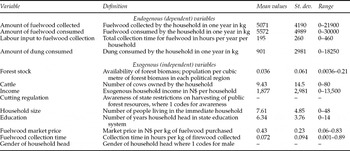
The independent variables used for estimation are listed and summarized in table 1, along with their summary statistics. Given the original focus of the fieldwork on constructing forest resource accounts, these data are limited in their application to this analysis, e.g. there is no variable that can usefully proxy for household labour endowment, T.
Independent and dependent variables

Source: Ministry of Environment and Tourism (MET), Namibia.
Cow dung is not traded and, hence, its price is not included among the independent variables. Since dung is used as an energy input, its relative scarcity is assessed through head of cattle owned. This is expected to have a positive impact on dung consumption because households with larger herds have easy access to dung. Cattle owned also proxies for household capital, zK, since these tend to be the household's most valuable form of capital.Footnote 16 Moreover, households with more cattle tend to have other forms of capital, which were not captured in the survey. For a given labour input, greater capital may have a positive impact on agricultural production and household incomes. Income and cattle owned are not collinear. In turn, this may induce a greater consumption of leisure in addition to goods and services requiring energy inputs. The expected effect on fuelwood consumption is positive, while those for fuelwood collection and labour input to fuelwood collection are unclear.
Regarding other household characteristics, zHC, household size is expected to influence fuelwood collection positively, both because of increased energy demand (e.g. for cooking) and because of increased labour supply. The expected impact of household size on dung consumption is unclear because more household labour means increased demand for energy, but also greater scope for substituting fuelwood, which is relatively labour intensive, for dung. There are data on exogenous market incomes for almost all households. Wealthier households may collect less of their own fuelwood and rely more on market purchases with an indeterminate overall effect on fuelwood consumption.
Collection time (per kg of fuelwood collected) captures the shadow price of gathering fuelwood. Potential endogeneity is tested by undertaking the Durbin–Wu–Hausman test.Footnote 17 With the exceptions of amounts of fuelwood collected and consumed, the coefficient of the residuals for collection time is found to be insignificant (including at the 0.10 level) when considering each of the dependent variables. For estimating fuelwood collection and consumption, a three-stage model is adapted from Mroz (Reference Mroz1987) to control for sample selection bias and endogeneity. Stages one and three are similar to the usual two-step estimator, while stage two is similar to the first step of a two-stage least squares (2SLS) estimation. An instrumental variable (IV) in the form of gender of household head is fitted to collection time in stage two.Footnote 18 Increasing shadow prices are expected to have a negative effect on fuelwood collection. Labour allocated to collection is also expected to rise with increasing shadow price. The estimation of demand for collected fuelwood combines the CO and CAP households, which totals 172 households, i.e. excluding PO households.
For CAP households, the decision to buy fuelwood occurs when its market price, pFW, is either smaller than or equal to its shadow price. Rising shadow prices may be expected to increase fuelwood purchases, although a decline in collection means that the overall effect on consumption is unclear. Given missing markets, market prices are unlikely to be completely exogenous. Potential endogeneity is again tested using the Durbin–Wu–Hausman test, with market prices not found to be endogenous. Holding all else equal, we expect rising market prices to increase the amount collected. PO and CAP households are combined to estimate the demand for purchased fuelwood. Since this sub-sample only totals 29 households, its small size implies that we treat the results with caution.
Cross-price elasticities of demand for fuelwood and dung are used to assess the extent to which households substitute among energy sources. Substitution between dung and fuelwood can be evaluated through the impact of price on dung consumption and through the effect cattle herd size has on dung collection. Increasing prices are expected to have a positive impact on use of dung. A number of household dung collectors neither collect nor buy fuelwood. Other households only buy but do not collect fuelwood. Missing price observations for these 28 non-fuelwood collecting households are proxied by upper-bound collection time data collected for other households sampled in their villages and respective ecological regions. In light of potential biases in the regression results, a sensitivity analysis is undertaken in the next section using the lower-bound collection time estimates.
Data for agricultural output prices, pAG, and those for other goods, pM, were not collected. However, fieldwork observations confirm the assumption that these vary relatively little across households. Also, data for off-farm wage rates, w, are unavailable. Instead, a continuous variable measuring the number of years the household head had spent in education is included to account for unobserved labour market opportunities. Greater labour market opportunities are expected to effect less input to fuelwood collection, less fuelwood and dung collection, and more fuelwood purchases. Another proxy for labour market opportunities is age of household head; a relatively young household head may have the skills, strength, and ambition to realize an off-farm labour opportunity compared to an older one. However, age is collinear with a number of other variables thus excluding it from the model.
Collected fuelwood can have high opportunity costs, which varies according to the density, distance, and accessibility of forest resources (zV). Forest stock availability is measured as a ratio of population per cubic metre of forest biomass in each political region. These stocks are assumed to be contained within public forests. With higher population relative to forest stock, it is expected that more households will substitute fuelwood for dung. Access to forest for fuelwood could be given by distance from the household, although this is collinear with collection time. While improved access to forest resources or to the market could be measured through access to motorized transport, the data are limited to private ownership and no information is available on access to public forms of transport. Awareness of state restrictions on harvesting open access forest resources is included as a dummy variable. Increased awareness is expected to lead to less fuelwood collection, more dung use, and more fuelwood purchases.
5. Empirical results and discussion
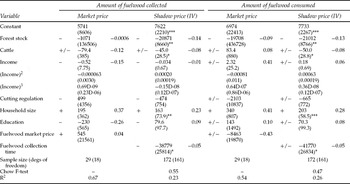
Chow F-test results, shown in tables 2 and 3, demonstrate that the pooling of CAB and CO households in a single sample is not rejected by the data, i.e. there appears to be few behavioural differences between buyers and non-buyers. Due to small sample size, the validity of data pooling is not tested for PO and CAB households. All regressions are estimated using the Heckman two-step estimator in which a predictor from the first, probit model is used as a covariate in a second, linear regression model. For fuelwood collection and consumption, an extra stage is introduced in order to control for endogenous shadow prices. In the probit model, variable values are only recognized when the household is identified as a fuelwood buyer (collector) in estimating the demand for fuelwood collected (purchased). In the final stage, the predictors are regressed on buyer-dependent (collector-dependent) variable values. Results for collected- and purchased-fuelwood demand are reported separately for each equation, i.e. using shadow and market prices, respectively.Footnote 19 Despite its consistency, the relative inefficiency of the Heckman estimator suggests using the maximum likelihood estimate (MLE) of the same model (see Puhani, Reference Puhani2000).
Final stage model estimates (MLE) – amount of fuelwood collected and consumed

Notes: For each regression equation, the first column gives the expected sign, the second gives the coefficient and standard error, and the third gives the elasticity (evaluated at the mean). *significant at the 0.10 level; **significant at the 0.05 level; ***significant at the 0.01 level.
Source: Ministry of Environment and Tourism (MET), Namibia.
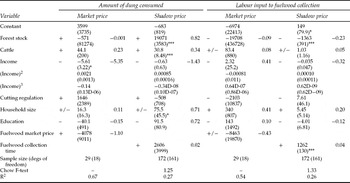
Final stage model estimates (MLE) – amount of dung consumed and labour input to fuelwood collection
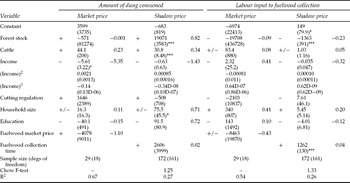
Notes: For each regression equation, the first column gives the expected sign, the second gives the coefficient and standard error, and the third gives the elasticity (evaluated at the mean). *significant at the 0.10 level; **significant at the 0.05 level; ***significant at the 0.01 level.
Source: Ministry of Environment and Tourism (MET), Namibia.
The final stage MLE results from the selection model regressions of fuelwood collection and consumption, labour allocation to collection, and dung consumption are presented in tables 2 and 3. Due to the presence of heteroscedasticity in the income variable, a third-degree polynomial in household income variable is included in all four equations. The model generally conforms to prior expectations. With collinearity problems minimized, the MLE gives interesting results that are robust to minor changes in specification.
The prediction success rate is high at around 90 per cent for the probit equation in all equations. Although the probit results are not shown in the tables, relatively insignificant effects are recorded for all variables on the probability of being a fuelwood purchaser (or collector).
As shown in tables 2 and 3, respectively, fuelwood collection time has a negative effect on the amount of fuelwood collected (with instrumentation) and a positive effect on labour input to fuelwood collection. Both effects are significant. As forest resources become increasingly scarce, CO and CAP households react by reducing the amount collected. A 1 per cent increase in time to collect one kg of fuelwood results in a 0.05 per cent decline in the amount of fuelwood collected, thus revealing price inelasticity. A similar effect was found for consumption, which suggests that households are not responding to economic scarcity by purchasing more fuelwood from the market. This estimate is lower than those observed by Amacher et al. (Reference Amacher, Hyde and Joshee1993) and Heltberg et al. (Reference Heltberg, Channing and Sekhar2000).Footnote 20 Mekonnen (Reference Mekonnen1999), using demand shadow price rather than collection time, obtained a less inelastic result in the more arid uplands of Ethiopia. A 1 per cent increase in collection time also leads to 0.04 per cent increase in labour input to fuelwood collection, a result that is consistent with those found, for example, by Kumar and Hotchkiss (Reference Kumar and Hotchkiss1988) and Cooke (Reference Cooke1998a,Reference Cookeb). Thus, households respond to economic scarcity, as measured by collection time, by reducing energy consumption just slightly more than by increasing labour input to collection and, hence, household expenditures.Footnote 21 In general, CO and CAP households appear to be less responsive to changes in shadow prices than to changes in other variables such as household size or the availability of forest stock.
On the basis of a limited sample of PO and CAP households, i.e. with relatively few degrees of freedom, increasing market prices seems to have positive though insignificant impacts on the amount of fuelwood collected (table 2), labour input to collection and dung collection (table 3). As market prices rise, however, households seem to respond by reducing overall fuelwood consumption more than by increasing fuelwood collection. These directions of effect for market prices on fuelwood demand are consistent with those found by Acharya and Barbier (Reference Acharya and Barbier2002) in their study of water demand in Nigeria. Similar to households in Nepal (Amacher et al., Reference Amacher, Hyde and Joshee1996), fuelwood market participants may be more price responsive than non-participants.
With respect to dung consumption, in table 3 the effect of collection time is positive but insignificant. This suggests that households do not respond to scarcity by switching directly from fuelwood to dung collection. These results are consistent with those obtained by Kumar and Hotchkiss (Reference Kumar and Hotchkiss1988), Amacher et al. (Reference Amacher, Hyde and Joshee1993), and Heltberg et al. (Reference Heltberg, Channing and Sekhar2000). Our elasticity estimate, 0.02, is smaller than that of Heltberg et al. (Reference Heltberg, Channing and Sekhar2000), a result they also found to be insignificant.Footnote 22
Cattle ownership is found to significantly increase dung collection for CO and CAP households. As expected, owning cows leads to the increased availability of dung both for energy and as an agricultural input. Evidence for dung being used as an energy source can be seen with the negative and significant impact of cattle ownership both on fuelwood collection and consumption in table 2. Cattle ownership appears to be a better proxy of dung price than of household capital at least when considering the CO and CAP households. This result, while very inelastic, seems to imply that dung is used to a limited extent as an energy substitute for fuelwood instead of as an input to agriculture. Data on agricultural inputs would be required to substantiate this, however. Cattle ownership has a positive albeit insignificant impact on labour input to fuelwood collection. Households with larger herds may spend more time in grazing areas, which often doubles-up as time for collecting fuelwood as well.
Availability of forest stock, measured as the ratio of population to forest biomass, is found to have a positive and significant effect on dung collection, while having a negative and significant effect on labour input to fuelwood collection (for CO and CAP households). In other words, the greater (smaller) the number of people relative to available biomass, the more (less) dung that is collected and the smaller (greater) the labour input to fuelwood collection (see table 3). Thus, a 1 per cent increase in the ratio of people to forest stock leads to a 0.82 per cent increase in dung collected (equal to approximately 80 kg) and a 0.23 per cent decline in labour input to fuelwood collection (equal to 40 hours). These estimates, while having similar signs, are inelastic compared to those observed in Heltberg et al. (Reference Heltberg, Channing and Sekhar2000). Moreover, Mekonnen (Reference Mekonnen1999) finds that Ethiopian households do not use less dung when forest biomass is more available due to complementarity between dung and fuelwood for cooking particular local dishes. Similar to Heltberg et al. (Reference Heltberg, Channing and Sekhar2000), the effects of forest stock availability on fuelwood collection are also significant for CO and CAP households, i.e. the greater the ratio of people to available biomass, the less fuelwood that is collected. Overall consumption also seems to decline with declining availability of forest stock.
Taken together, these results provide limited evidence for substitution between dung and fuelwood. With increasing scarcity, poor rural households usually have relatively few alternatives available to them (Cooke et al., Reference Cooke, Köhlin and Hyde2008). Rearing cattle may require substantial investment, suitable grazing areas, as well as specialized knowledge. For poorer households residing in densely populated areas with relatively little pastoral knowledge, substituting between fuelwood and dung may not be a feasible option. Households in arid areas such as Oshana, where a pastoralist culture is long established and where forest stocks have long been low, increasing dung collection would be a rational response to physical scarcity. Note, however, that cattle grazing also leads to the degradation of forest resources and, hence, physical scarcity, which in turn may affect the household response to scarcity.
Size of household has a positive and significant impact both on fuelwood collection and consumption. A weaker though still positive effect is observed for dung collection when considering CO and CAP households. These results show that larger households have higher energy demands. Household size has a positive though insignificant effect on labour input to fuelwood collection, in contrast to Heltberg et al. (Reference Heltberg, Channing and Sekhar2000) who found a significant result.
The other independent variables listed in tables 2 and 3 generally have weaker effects on the dependent variables. In particular, household incomes and years of education (a proxy for off-farm labour opportunities) appear to have little impact on household behaviour. The exception is that increasing income in PO and CAP households has a negative and highly elastic impact on dung consumption. The directions of effect are as anticipated for dung collection and labour input to fuelwood collection. Small negative income effects on fuelwood production should be contrasted with positive effects on overall consumption, which suggests that fuelwood purchases may be making up the difference as incomes rise. Mekonnen (Reference Mekonnen1999) found a similar albeit significant result for income effects on consumption in Ethiopia. Awareness of state restrictions on the utilization of forest resources also has little effect on fuelwood consumption or collection, although not all the signs on the coefficients are as expected. One explanation may be that most households know that they can harvest fuelwood with impunity in areas where the government's capacity to enforce its own rules may be very weak.
In section 4, missing shadow price observations for the 28 non-fuelwood collecting households in the sample were approximated to upper-bound collection time data collected for other households residing in the same villages and ecological regions.Footnote 23 A sensitivity analysis is undertaken to test the upper-bound assumption. Data for the lower-bound estimates are entered into the four equations. The results show that the independent variables remained consistent in their effects on the dependent variables. One exception is a weakening of the effect of collection time on fuelwood collection. This is perhaps to be expected given that use of lower-bound price estimates decreases the measure of economic scarcity.
6. Conclusions and policy implications
A household model for domestic energy supply and demand is estimated using primary data originally collected in the NCR of Namibia for the development of its forest resource accounts. As described in section 2, the population of the NCR relies on forests for its energy needs and shelter as well as providing shelter and grazing for livestock. Our findings for northern Namibia are also relevant for people residing on semi-arid, communal lands throughout southern Africa where fuelwood demand continues to rise (FAO, 2007).
Despite the limitations of the survey data, the results of the empirical analysis presented in section 5 broadly support the predictions made in sections 3 and 4. In line with previous studies, including those undertaken in South Asia, many of the key estimated elasticities are very low. As fuelwood is a basic necessity, perhaps only the poorest households should be expected to be particularly responsive to fuelwood (economic) scarcity (Hyde and Köhlin, Reference Hyde and Köhlin2000). We find that Namibian households respond to increasing economic scarcity by reducing fuelwood consumption just slightly more than by increasing labour input to collection, although the difference is negligible. The inelasticity of fuelwood demand, however, suggests limited scope for demand-side policy interventions (Cooke et al., Reference Cooke, Köhlin and Hyde2008).
The response to economic scarcity in our sample is underlined by the relative abundance of forest resources in three out of four sub-regions, as revealed by the resource accounts. Nevertheless, increasing ratios of people to biomass, i.e. decreasing availability of forest resources, in these areas negatively impacts on the amounts of fuelwood collected and consumed, and labour input to collection. Thus, rising populations may impact on fuelwood demand even in areas where current rates of extraction are far below physically suitable annual yields. Given relative forest abundance in many areas, policies to encourage population dispersal may improve forest stock availability for fuelwood-dependent households without necessarily leading to over-harvesting.
There is limited evidence for substitution between fuelwood and dung. The inelasticity of fuelwood demand suggests that there are few genuinely close substitutes available. Using cattle dung as an energy source instead of fuelwood only appears to be a serious option where cattle herding is already a way of life, which can be passed on from generation to generation, and where there is acute physical forest scarcity, i.e. in Oshana. Adoption of cattle herding by households on a wider scale is likely to be very difficult given costs and a lack of grazing lands in densely populated areas.
Policy intervention could also focus on purchased fuelwood markets. Our analysis shows that making a distinction between collecting and purchasing households is important. Small sample size means that we should, however, interpret our results with caution. Should these hold in a larger sample of market participants, we may find that households are generally more price responsive than non-participating households. This in turn might give more leeway with regards to demand-side policy interventions. Improving market participation, for example, by reducing transaction costs or supporting prices and regulating local markets may enable better control of the local commons while improving welfare in households with higher opportunity costs.
Given the importance of the role of women and children in collecting fuelwood in many parts of Africa, one key weakness of our study is the lack of distinction among household members and how fuelwood collection is allocated. We would certainly expect some differences in opportunity cost of time among men, women, and children. A follow-up survey would benefit from making such a distinction, along with data collected on local resource management, market access, and household landholdings.