Plagiarism is a misrepresentation of authorship. In some domains plagiarism is more grave than in others. In academic domains it is typically taken quite seriously, insofar as the integrity of scholarship, conceived of as an ongoing conversation among multiple contributors, depends on authentic identification of contributors and the ability to trace the genealogy of ideas.Footnote 1 In Catholic theology (academic and otherwise), hermeneutic factors compound the problem of plagiarism: theologians are expected to help expound revealed and authoritative discourse, and a reader's disposition toward a text depends in part on knowing the status of its author. In this article, we closely examine several examples of theological plagiarism specifically involving authoritative (magisterial or quasi-magisterial) texts. These examples highlight the particular challenges that plagiarism poses for theological discourse, and they shed light on issues of authority and interpretation in the practice of theology.
I. Background: The Case of Rosica
Beginning in February 2019, the discovery of extensive plagiarism in the academic and journalistic writings of Basilian priest Thomas Rosica was widely reported in the press.Footnote 2 Fr. Rosica was an international figure of some standing in Catholic circles, often touted as a biblical scholar, whose many high-profile positions included Vatican spokesperson, sometime media attaché of the Holy See Press Office, CEO of the Salt and Light Catholic Media Foundation, and president of Assumption University in Windsor, Ontario. He was the national director for World Youth Day 2002 in Toronto and served as an English-language commentator for events including the 2013 papal conclave and the Third Extraordinary General Assembly of the Synod of Bishops concerning the family in 2014. He made international news in September 2018 when, with Federico Lombardi, former director of the Holy See Press Office, he issued a joint statement calling into question certain elements described in a public 2018 letter by former Papal Nuncio to the United States Archbishop Carlo Maria Viganò, a letter that had called on Pope Francis to resign.Footnote 3 In addition to being an internationally known conference speaker and retreat master, Rosica served on the boards of several universities and received honorary academic degrees and awards for achievements in Catholic communications and journalism.
The scrutiny of Rosica's journalistic and theological works that followed the initial reporting of plagiarism prompted some newspapers and magazines (including America, Catholic Herald, National Catholic Reporter, The Catholic Register, and The Globe and Mail) to issue retractions and corrections. The Canadian newspapers National Post and Windsor Star published statements indicating that his articles were under review for plagiarism. Academic theological publishers also issued retractions. Some theology journals, including The Bible Today, Ecumenism, and Worship, were explicit in using “plagiarism” in their published retractions, stating that “portions” or “large portions” of the articles were “plagiarized from a variety of sources.”Footnote 4 Other journals, such as Seminary Journal and Humanitas, were more circumspect in wording their retractions, stating that a given article “demonstrates a sufficient number of inadequate citations as to warrant its retraction from the historical record” and further specifying that “quotation marks were not placed where they ought to have been.”Footnote 5 Toronto Journal of Theology retracted three reviews, explaining that they “fail to meet academic standards governing originality and attribution of nonoriginal work.”Footnote 6 The Canadian Conference of Catholic Bishops formally retracted three books, publishing a notice explaining that the books “failed to provide all the appropriate citations, as well as bibliographic references, and did not acknowledge a number of original sources.”Footnote 7 The Tablet published a statement from the editors acknowledging that “Fr Rosica foolishly padded out his piece with texts lazily pieced together from various authors with neither quotation marks nor attribution.”Footnote 8 Origins, a publication of Catholic News Service, flagged eight articles published by Rosica between 2009 and 2017 because they “contain numerous instances of the words of others without proper citation.”Footnote 9
In some cases, certain publishers went to unusual lengths to avoid using the word “plagiarism” in their corrections. The journal Horizon: Journal of the National Religious Vocation Conference issued a revised version of one of Rosica's articles, accompanied by a note that acknowledged unspecified “errors and omissions in attributions” in the original. The changes in the revised version reveal the enormity of the plagiarism, however. Not only have the genuine authors whose works were misappropriated been newly added as secondary coauthors, but the title has been changed from “How the Pope's Jesuit Roots Affect His Ministry,” to the anodyne “What Observers Are Saying about How the Pope's Jesuit Roots Affect His Ministry: A Roundup of Commentary.”Footnote 10 What had appeared to be a new valuable theological study of the pope's Ignatian outlook turned out to be merely a florilegium of the insights of others taken without credit.
Despite some journalistic coverage of the discovery of the serial plagiarism and subsequent retractions, the nature and significance of Rosica's misappropriated source material and its significance for theological dialogue have been largely ignored. Rosica's plagiarizing works take, without attribution of any kind, passages from a wide variety of sources (academic and journalistic, Catholic and non-Catholic). Notably, his sources often include magisterial documents. In their plagiarizing versions, the magisterial passages are shorn of their ecclesiastical endorsement and appear instead to be authored by Rosica himself. An examination of this unusual phenomenon of theological works deceptively appropriating magisterial teaching highlights important facets of authorship and authority in the practice of theology as well as the nature of authority in magisterial teaching.
Although we anticipate some will object that, at this point, further public discussion of Rosica's plagiarism involves us in the sin of detraction, the public nature of plagiarism itself requires some public attention. In the case of publishers, that usually means statements of retraction or apology. In cases of extensive plagiarism within a scholarly or other intellectual community, it is important for there to be clear and sober reflection on the nature of the harm. Venues for discussing plagiarism are few, and the topic of plagiarism in Catholic theology is an almost entirely unexplored area of theological reflection.Footnote 11 Here we have sought a properly academic venue for the discussion of some theological implications of Rosica's plagiarism. This article does not address the extent or method of Rosica's plagiarism; our use of limited examples in this discussion should not lead readers to think that Rosica's plagiarism is only a matter of a few isolated sentences. In our research we have discovered evidence of extensive plagiarism in dozens of Rosica's works. In accordance with academic and publishing standards, we have shared our findings with publishers and have requested retractions for four books and thirty-four articles. So far, we are aware of twenty-six retractions that have been issued as a result of our work and that of others.Footnote 12 Here we will focus on plagiarism of magisterial sources in Rosica's theological works rather than plagiarism in journalistic venues.Footnote 13 Assessing the significance of Rosica's plagiarism of magisterial texts in his theological works requires a general assessment of the problem of plagiarism, an understanding of the difference between endorsement and authorship in magisterial texts, and a recognition of the precise role of authoritative texts in a Catholic context.
II. Plagiarism
Acts of plagiarism misrepresent authorship. The plagiarist's personal endorsement of a text is presented as actual authorship in contexts where such an identification is in violation of professional norms. That is, plagiarism occurs in a context where there is an expectation of authorial integrity and where readers rightly assume that authors will employ common conventions (e.g., quotation marks, footnotes, block quoting, in-text citations) to signal the difference between what they are representing as their own voice and what deserves to be represented as someone else's. Without the context of expected authenticity of authorial representation, there can be no plagiarism.Footnote 14 The plagiarist, forgoing these conventions of attribution (intentionally or not),Footnote 15 appears to the reader as the source of a text actually produced by someone else.
Although commonly characterized as a kind of “theft,” etymologically plagiarism invokes kidnapping (from Latin plagium), deriving more generally from what is slanted or crooked (from the Greek plagios). The nature of the offense is not simply the illicit appropriation of something but presenting it to others as one's own. Plagiarism does not depend on the unwillingness of a source author to cooperate, but on the inability of the audience to identify the true nature of what is presented. Like counterfeiting, forgery, impersonation, or other forms of fraud, what is essential to the offense is not property violation but false representation. Even though legally plagiarism is sometimes prosecuted under laws about intellectual property, some plagiarized sources are freely given away, and morally and professionally the primary victims of plagiarism are not the plagiarist's sources so much as the plagiarist's audience, deprived of a chance to properly evaluate the nature and worth of what they receive from the alleged “author.”Footnote 16 Thus even publishers seeking to repair the damage of plagiarism by securing after-the-fact permission from sources instead of issuing retractions will still issue a public statement of acknowledgment and apology to past readers and to correct the record for future readers. Such apologies often note that plagiarism is a breach in the mutual trust that members of scholarly communities must have as a condition for the enterprise of knowledge to flourish.Footnote 17
Plagiarism in academic and journalistic venues produces additional harm. Duplications of content muddy the scholarly and journalistic records and produce inefficiencies for readers attempting to master the research in a given area. Regarding the plagiarizing of articles, successful plagiarists often receive promotions, honors, awards, speaking engagements, and grants that should have gone to authentic writers. Furthermore, the time, resources, and limited page space of publishers are wasted by plagiarizing content that should have been reserved for original research.Footnote 18
Cases of plagiarism in academic and journalistic venues have increased in recent years, and there are debates about the etiology of the problem.Footnote 19 Some commentators identify the increased pressure to publish.Footnote 20 Others emphasize that the incentives to publish are unrelated to an evaluation of whether a genuine contribution to knowledge has been made. On this view, plagiarists are not seeking high-profile publications, but rather aim for near-invisible publications that match “the performance metrics used by their academic institutions.”Footnote 21 There is general agreement, however, that the ultimate responsibility for plagiarism rests with the author.Footnote 22
It is often unrecognized that plagiarism has additional discipline-specific harm. In medicine, for instance, plagiarism of a study may falsely suggest that the efficacy of a particular drug regimen has been replicated. In education, plagiarism of an article describing a special education intervention may produce the illusion that a novel intervention has been established as an evidence-based practice.
In the specific context of Catholic theology, plagiarism can pose particular harm. Catholic theological discourse engages with, and depends upon, a recognition of texts with different authoritative status. The faithful (scholars and nonscholars) are expected to be deferential to words from Scripture or from ecclesiastical authorities in a way that they do not need to be with regard to academic theological speculation. Plagiarism thus puts readers at a disadvantage, presenting them with a text in a manner that obscures the status of the source. Readers are harmed when plagiarizing theologians pass off magisterial documents as original works of theology. Such plagiarism of magisterial sources typically prevents Catholic readers from approaching texts with the proper hermeneutical disposition that is part of the practice of Catholic theology.
III. Endorsement and Authorship in Magisterial Texts
In many domains, a document's authority depends primarily on its actual authorship. In journalistic and academic writing, for instance, the named author is presumed to have composed the piece in question. Any exceptions are expected to be registered according to established conventions (in notes, acknowledgments, or integrated into the main text), and uncredited changes introduced in the editorial process are presumed to have the consent of the original author. When the credited author of (all or part of) a work is revealed to be different from the genuine author, publishers typically issue statements of retraction. These statements—often issued for authorship violations such as plagiarism, guest authorship, or ghostwriting—mitigate the damage that authorship violations inflict on the reliability of the scholarly and journalistic records.Footnote 23 In humanities disciplines, plagiarism and text recycling are the principal reasons why articles are retracted by publishers.Footnote 24 In comparison with retraction rates in the sciences, however, retractions in humanities have been described as “rare occurrences.”Footnote 25 One 2013 comparative study found that there are 0.14 retractions per 1,000 papers in medical and biological fields, but only 0.01 retractions per 1,000 papers in humanities.Footnote 26 There are reasons to think that humanities fields are catching up, however, in the years since the study.Footnote 27
In other domains and contexts, the status of a text is not primarily a matter of authorship. In general, the authority of a document issued from a formal office does not necessarily depend on the process or source of composition. Uncredited law clerks often draft decisions rendered by judges, and anonymous speechwriters can compose official statements for diplomats and political leaders. Likewise, a pope or a bishop need not personally write the document that gains magisterial status by his endorsement. In legal, political, and ecclesiastical contexts, the authority or status of a text comes from its official endorsement (authorization as being issued from a position of status), not from its compositional history (actual authorship).
That magisterial status is a matter of official, authoritative endorsement, not of direct authorship, is part of the distinction in Catholic theology between the teaching function of the ecclesial office and the teaching function of theologians.Footnote 28 Francis A. Sullivan explains in his classic study of the Catholic notion of the magisterium that “there is a genuine kind of teaching in the church which is distinct from and different from the work of the university professor of theology.”Footnote 29 Similarly, Avery Dulles maintains “theologians do not, as such, have a magisterial status.”Footnote 30
On a standard Catholic view, when the pope and the bishops in hierarchical communion with him teach authoritatively, they manifest the magisterium of the Catholic Church. This exercise of teaching, to clarify with authority what falls under the Christian faith and what is extrinsic to it, typically takes the form of papal or episcopal documents. These include a variety of papal works (e.g., encyclicals, apostolic constitutions, homilies, general audience addresses, and the like) and various forms of episcopal documents (e.g., pastorals, exhortations) issued to those under a bishop's spiritual care. These documents carry differing degrees of authority.Footnote 31 According to a commentary on the Professio fidei issued by the Congregation for the Doctrine of the Faith in 1989, magisterial documents “require degrees of adherence” by the faithful that are differentiated “especially by the nature of the documents, by the frequent repetition of the same doctrine, or by the tenor of the verbal expression.”Footnote 32 Signed by prefect of the Congregation for the Doctrine of the Faith (CDF) at the time, Cardinal Joseph Ratzinger, along with the secretary, Archbishop (later Cardinal) Tarcisio Bertone, the commentary cites section 25 of Lumen Gentium, which underscores the magisterial teaching authority of the pope and bishops.
As noted, a separation of authorship (compositional source) and endorsement (official issuance) is allowed in magisterial documents and is perhaps even common. Even so, it can cause controversy and presents challenges for theological interpretation. Shortly after Pope Francis issued his 2016 post-synodal apostolic exhortation Amoris Laetitia, some readers observed that the document incorporated verbatim and near-verbatim sentences from at least four theology articles authored by (now Archbishop) Victor Manuel Fernández published in 1995, 2001, 2005, and 2006.Footnote 33 Although the particulars provoked criticism,Footnote 34 the case usefully highlights the difference between magisterial and other theological authorship: as promulgated in the apostolic exhortation, propositions and arguments originally found in Fernández's theological writings had acquired an endorsement or attestation that gave them an authoritative, magisterial weight they had previously lacked. Situated in a new magisterial document, individual passages from Fernández thereby also acquire a new interpretive context, so they would now be read differently than when they originally appeared in theological articles. By becoming the formal “author” (auctor) of the previously written words of Archbishop Fernández, Pope Francis bestowed a new authority (auctoritas) to those words, thus putting theological readers into a new relationship with those words.
Rosica's plagiarism of magisterial texts in his theological works can be approached, with some qualifications, as a distinctive reversal and abuse of the authorship/endorsement distinction that the case of Fernández and Amoris Laetitia highlights. When texts from Archbishop Fernández's early theological writings were incorporated into the final text of Amoris Laetitia, they acquired a new magisterial weight and context they previously did not enjoy. In contrast, Rosica's theological works present the words, sentences, and paragraphs of popes and bishops to readers, but without any acknowledgment that they present portions of magisterial texts already promulgated to the faithful in specific contexts and with varying degrees of authority.
When plagiarized magisterial texts appear in Rosica's works, the prior occasion and approbation by a pope or bishop is not disclosed, and the texts appear as if Rosica—and he alone—is their author and (non-magisterial) endorser. The plagiarism removes evidence of the explicit magisterial endorsement, and unsuspecting readers are deceived not only about the true origins of the passages but also about the weight that they bear and the role they might play in a specific document. Readers of the misappropriated magisterial texts in Rosica's writings are under the impression that the words are offered in the mode of theological reflection, and therefore represent Rosica's non-magisterial contribution to the exploration and articulation of the faith qua theologian. Such readers are denied the opportunity to consider those words under the formality of required adherence as described by the CDF, and they are deprived of the opportunity to consider the magisterial claims in the context of their place in a document with its own dialectical force and rhetorical structure.
An examination of select examples will illustrate the nature and extent of this problem and help clarify the theological task of engaging with magisterial documents and the nature of the interpretive relationships presumed by theological practice.
Papal Texts
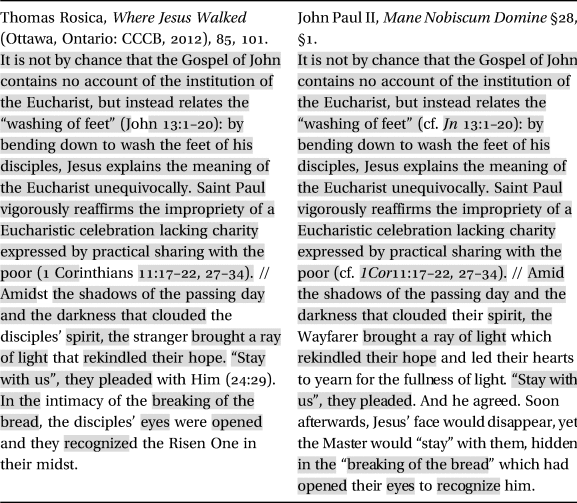
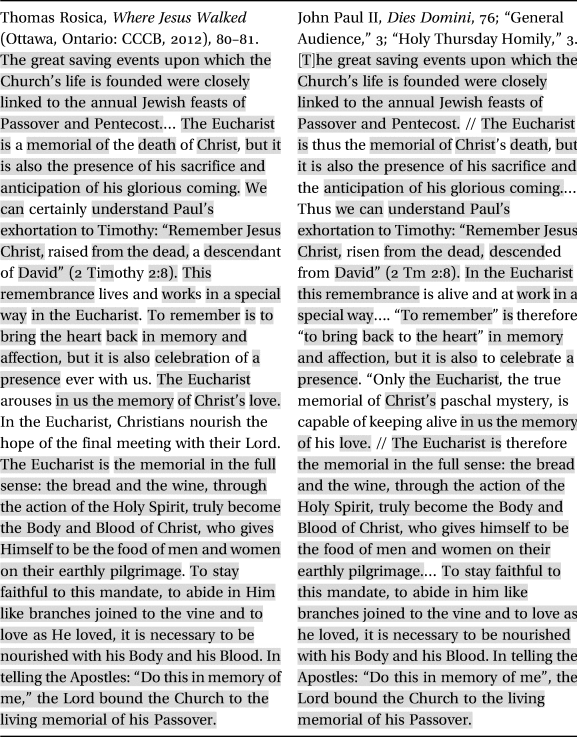
To begin, we offer representative examples of plagiarism from papal texts in Rosica's writings. The first column of Table 1 presents two short passages found in Rosica's 2012 now-retracted biblical commentary, Where Jesus Walked, published by the Canadian Catholic Conference of Bishops. The subject of the passages is the institution of the Eucharist and the Emmaus story in the Gospel of Luke. The undeclared source for both passages is Pope John Paul II's 2004 apostolic letter Mane Nobiscum Domine.Footnote 35 The second column in Table 1 presents the text of the pope, and verbatim overlap is highlighted in both columns. All tables hereafter follow a pattern of presenting Rosica's work in the first column and using highlighting to identify the verbatim overlaps.
Comparison of Thomas Rosica's Where Jesus Walked and Pope John Paul II's Mane Nobiscum Domine

The undisclosed source text, John Paul II's Mane Nobiscum Domine, opened the 2004 celebration of the Year of the Eucharist, and the words appropriated by Rosica, without citation of any kind, are taken from the official English translation of the pope's document by the Vatican Secretariat of State as found on the Vatican website. Papal documents are typically issued in translations in several modern languages; the extent of overlap in Table 1 indicates that the Vatican English rendering of the text has been used. In the first portion, on the institution of the Eucharist viewed in light of select New Testament passages, the only differences between the passage and its reproduction by Rosica is the deletion of “cf.” and the expansion of abbreviations for two books of the New Testament. Readers of Rosica's book are unlikely to discern that these words are really those of John Paul II as set forth in the apostolic letter. In the second portion, on the Lucan account of Jesus’ appearance to two disciples on the road to Emmaus, Rosica introduces several minor modifications. The pope's term for Jesus, “Wayfarer,” becomes “stranger” in the plagiarizing text. Despite some additions and deletions, the substantive dependence of Rosica's text on John Paul II's apostolic letter is manifest.
The uncredited use of texts by John Paul II is common in Rosica's writings. Sometimes the source text by John Paul II is written in the first person, and sometimes the pope provides an exposition of his own earlier writings or provides an interpretation of other ecclesiastical documents. In such cases, one finds magisterial interpretations of magisterial texts. Table 2 exhibits a 2002 passage in which John Paul II reflects on, and quotes from, his own apostolic letter from the previous year, Novo Millennio Ineunte.Footnote 36
Comparison of Thomas Rosica's John Paul II: A Saint for Canada and John Paul II's The XXXIX World Day of Prayer for Vocations

In his 2014 book on John Paul II, Rosica's plagiarized version of the passage changes the first person to third person, so that Rosica himself rather than the pope appears as the interpreter and excerpter of the apostolic letter. Even the ellipses found in the pope's quotation of his earlier apostolic letter recur in the plagiarizing version. A reader of the book will believe that Rosica is presenting his own theological exposition of John Paul II's apostolic letter; the book does not signal that the exposition is really from the pope reflecting on his own earlier work. The formality of an exegesis of Novo Millennio Ineunte by John Paul II is different in kind from an exegesis of Novo Millennio Ineunte by Rosica, not only because John Paul himself is the author of the apostolic letter, but also because his interpretation carries magisterial weight that Rosica does not share.
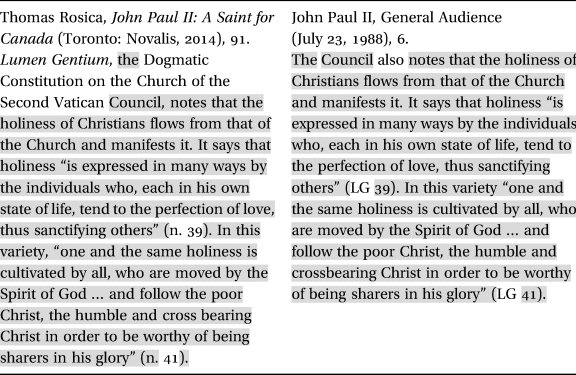
A similar appropriation can be found in Table 3. The source text is one of John Paul II's Wednesday General Audience addresses from 1988; here the pope is expositing the idea of holiness as presented in Lumen Gentium.Footnote 37
Comparison of Thomas Rosica's John Paul II: A Saint for Canada and John Paul II's General Audience (July 23, 1988)

In its plagiarizing version, the pope's brief exposition appears as if by Rosica, and it is identical down to the selection of quotations from sections 39 and 41 of Lumen Gentium and small stylistic matters such as the ellipses. The translation of Lumen Gentium is again from the English Vatican rendering found in John Paul II's address. The exposition of Lumen Gentium in both documents is the same, but John Paul II's authorship is not acknowledged when Rosica presents the exposition as his own.
The above examples of plagiarism in Tables 1 through 3 are startling, not the least because the authoritative papal interpretations of Scripture, an apostolic letter, and a document from Vatican II are presented in the guise of novel interpretations by Rosica. What were originally magisterial interpretations of magisterial or sacred texts appear as Rosica's own reflections. Something significant has been lost in the removal of papal approbation, and Catholic readers seeking to develop the disposition of sentire cum ecclesia are placed at a hermeneutical disadvantage when they encounter magisterial texts in Rosica's works with no acknowledgment of their papal endorsement. To encounter a text as said by Rosica is fundamentally different than to encounter a text as said by Pope John Paul II, and it is a disservice to the Catholic reader who encounters these texts under the first formality. On the one hand, the reader may treat the text less reverently because a Catholic is not bound to consider the statements of a theologian qua theologian in the way one may be bound to consider magisterial statements qua magisterial statements. On the other hand, the Catholic reader may treat the text with both more, and misdirected, critical engagement, presuming that Rosica has put something forward as a theological reflection deserving of a certain kind of dialectical investment, when in fact the passages have been separated from their original context in magisterial teaching.
Plagiarism and the Use of First-Person Narrative
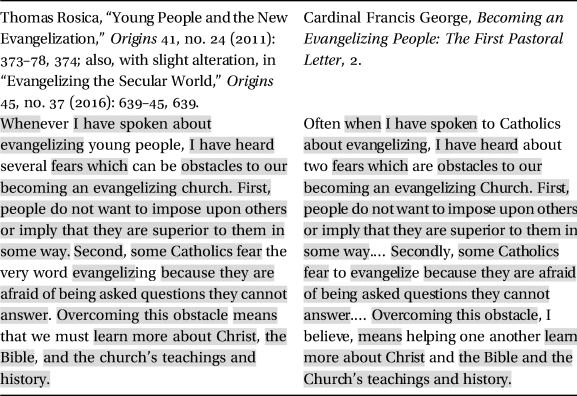
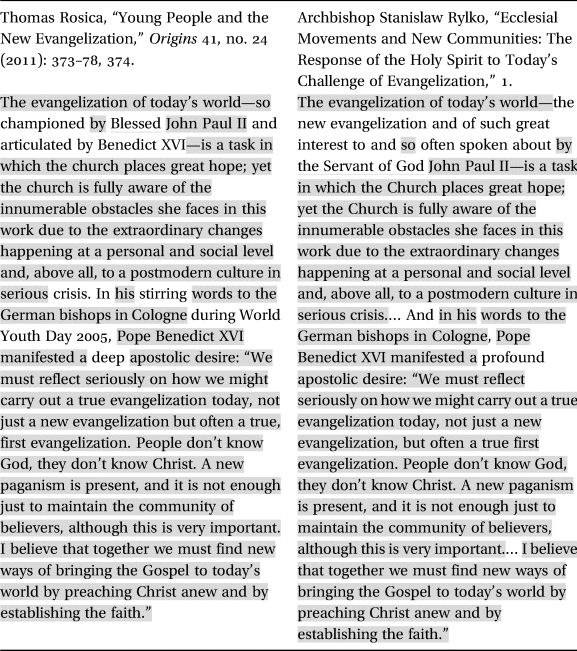
Unlike the example from Table 2, in which Rosica adopted the third person to describe the author of Novo Millennio Ineunte, sometimes Rosica's plagiarism leaves source texts in the first person. Many of Rosica's theological writings illustrate points of doctrine, history, and ministry in what appear to be autobiographical reflections on past experiences or personal insights into spiritual matters. These first-person narratives, however, are at times plagiarized from magisterial documents from prelates who use a first-person point of view to teach those under their spiritual care. One example (Table 4) is from a 2011 article on evangelization. The uncredited source is a first-person text from 1997 by Archbishop (later Cardinal) Francis George.Footnote 38 (Rosica also reused the same text later in a 2016 article on evangelization, again appropriating Cardinal George's words including the first-person pronoun “I.”)
Comparison of Thomas Rosica's “Young People and the New Evangelization” and Cardinal Francis George's Becoming an Evangelizing People

In this case, the undisclosed source text is Cardinal George's first Pastoral Letter to the Archdiocese of Chicago issued during his first year as archbishop. The source text and the plagiarizing text are identical in many respects, including the use of the first person (e.g., “I have spoken … about evangelizing”; “I have heard”). But the voice of a bishop addressing those under his immediate spiritual care is different from the voice of a theologian addressing readers in general. A bishop's authority to teach is especially directed to those in his diocese, and his words have a magisterial weight not possessed by the theologian as such. The “I” of Cardinal George who addresses Catholics in his diocese is not identical to the “I” of Rosica who addresses his theological readers. In this case, Rosica was presenting to priests in the archdiocese of Chicago, so he was addressing some of the original audience of his plagiarized source.
In an odd twist, Cardinal George later cited this same plagiarized passage by Rosica, apparently forgetting that he himself had authored the very words fourteen years earlier. In an article dated November 6, 2011, Cardinal George praised Rosica's speech to priests, saying “Father Rosica's remarks were well received by the priests of the archdiocese, and I would like to quote some passages that will help everyone look at evangelization.”Footnote 39 Then the cardinal provided several extracts from Rosica's address, including the passage given in the first column of Table 4, with no indication that he was aware he was citing himself through the plagiarizing text. The cardinal ends his article noting that “Father Rosica reminded the priests … to think and act in order to involve young people in the evangelizing mission of the church today.”Footnote 40
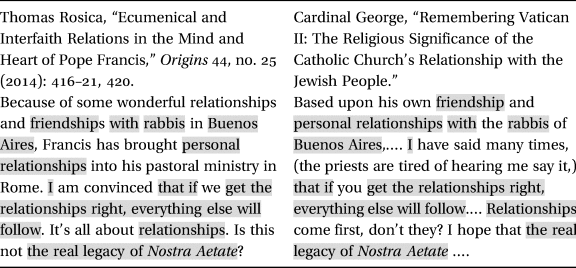
This instance of Rosica's appropriation of the words of Cardinal George in the first person is not unique. A more subtle instance from a 2014 article involves a passage from an address that Rosica presented to the USCCB Committee for Ecumenical and Interreligious Affairs (Table 5). The subject is Pope Francis’ views on interreligious dialogue, and the passage excerpted covertly draws from an address that Cardinal George delivered less than two months earlier at the Annual Meeting of the Jewish Federation of Metropolitan Chicago.Footnote 41
Comparison of Thomas Rosica's “Ecumenical and Interfaith Relations in the Mind and Heart of Pope Francis” and Cardinal Francis George's “Remembering Vatican II”

Readers of Rosica's article will not likely identify that the insights into Pope Francis’ history of relations with those of the Jewish faith are really those of Cardinal George.
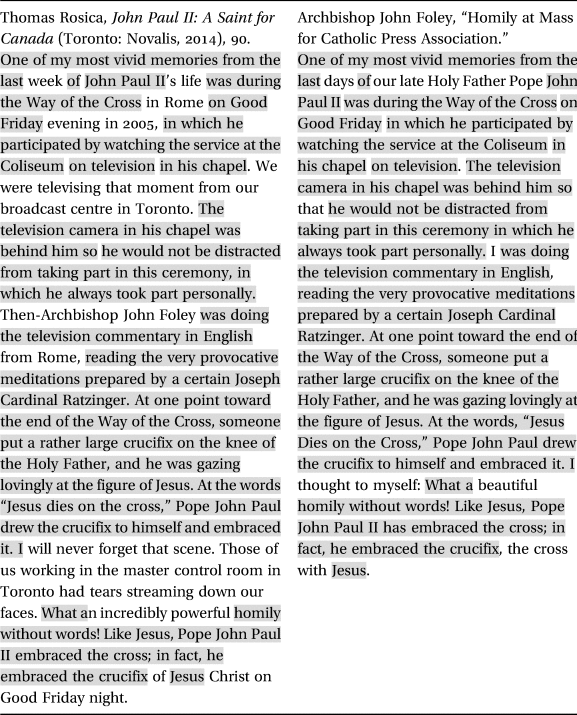
Rosica's appropriation of texts employing the first person also extends to texts by bishops recalling personal life experiences. What appears to be Rosica's 2014 personal recollection of the final period of John Paul II's life (Table 6) is entirely unoriginal; he is simply passing off verbatim and near-verbatim the remarks of Archbishop (later Cardinal) John Foley from his 2005 homily the month following John Paul II's death.Footnote 42 Rosica's reuse of Foley's expression “one of my most vivid memories,” followed by a detailed reminiscence of elements of how the pope spent Holy Week in 2005, take on a different sense when one sees that the “memories” are really those as expressed by Cardinal Foley. (The plagiarizing text was published most recently in Rosica's 2014 book on John Paul II, after initially appearing in 2011 article in The Catholic Register.Footnote 43 To date, only the publisher of the 2011 version has issued a retraction.)
Comparison of Thomas Rosica's John Paul II: A Saint for Canada and Archbishop John Foley's, “Homily at Mass for Catholic Press Association”

Rosica has managed to retain a reference to Archbishop Foley in the plagiarizing text, but rather than presenting the archbishop as the genuine author of these recollections, Rosica has relegated him to the role of a side character in the event.
These examples of plagiarism that feature the appropriation of source texts in the mode of first-person narrative certainly place readers at a disadvantage, and their existence undermines our confidence in Rosica as a writer. Nevertheless, because the subject matter of the plagiarizing passages involves uncontroversial claims about the faith, they may not seem to be as serious as other instances of plagiarism that deal with more central issues of the faith. To such passages we now turn.
Repurposing of Texts
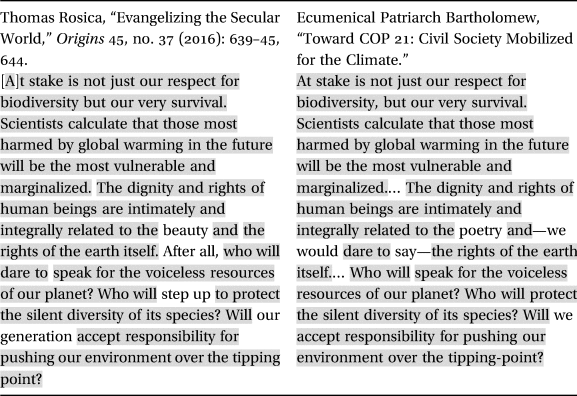
Sometimes Rosica radically repurposed source texts to a new aim unrelated to the intention of the genuine author. Table 7 displays an instance of plagiarism where a text from an early 2015 talk on the environment by Ecumenical Patriarch Bartholomew, Archbishop of Constantinople, has been repurposed by Rosica in 2016 as a new interpretation of Pope Francis’ encyclical letter Laudato Si’.Footnote 44 Bartholomew's talk preceded publication of the encyclical by several months and does not discuss Pope Francis’ views, yet Rosica takes the patriarch's words as his own and presents them as his own exposition of the “heart” of Laudato Si’.
Comparison of Thomas Rosica's “Evangelizing the Secular World” and Ecumenical Patriarch Bartholomew's “Toward COP 21”

There are some minor modifications and rearrangements to Ecumenical Patriarch Bartholomew's words: “beauty” replaces “poetry”; “our generation” replaces “we,” and Rosica's version speaks of “rights” of the earth without the qualification of the Ecumenical Patriarch's original. Nearly all readers of Rosica's theological text will likely believe that they are encountering a novel exegesis of Laudato Si’; but the original text is not an exposition of that encyclical, only a talk that shares the theme of environmental concerns.
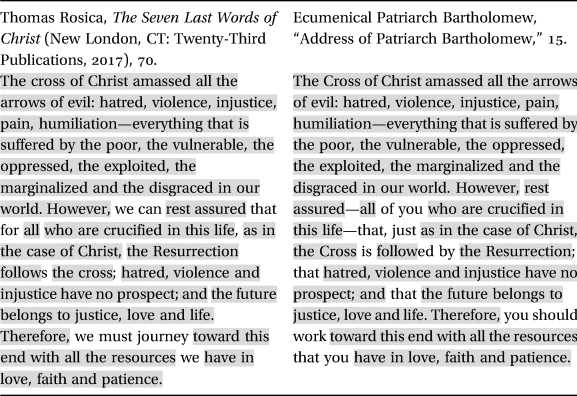
Rosica repurposed a different passage by Ecumenical Patriarch Bartholomew for his 2017 biblical commentary, The Seven Last Words of Christ (Table 8).Footnote 45 Bartholomew's text, later published by the Pontifical Council for Promoting Christian Unity, was delivered at a May 2014 ecumenical celebration at the Basilica of the Holy Sepulchre in Jerusalem, with Pope Francis and Bartholomew signing a joint declaration.Footnote 46
Comparison of Thomas Rosica's The Seven Last Words of Christ and Ecumenical Patriarch Bartholomew's 2014 Ecumenical Celebration Address in Jerusalem

Rosica repurposes the text as part of his exposition of the first part of Luke 23:46: “Father, into your hands I commend my spirit,” traditionally the seventh “word” in works of the genre expositing Christ's seven last utterances. In the original undisclosed source, Bartholomew's words form part of his exhortation that one should not fear death, spoken at the traditional site of Christ's resurrection. There are some minor modifications in the plagiarizing version: the second person plural “you” has become the first-person plural “we” throughout, the verb “work” becomes “journey,” “must” becomes “should,” and the like. These changes are minor, and the substance and structure of the two remain the same, even though the contexts of the original and the plagiarizing version are very different.
Texts by Ecumenical Patriarch Bartholomew are not technically considered magisterial in the Catholic tradition because the teaching authority of the Catholic Church is defined in Lumen Gentium to belong to the pope and those bishops who are in hierarchical communion with him. Nevertheless, the words of Bartholomew carry some weight among Christians, even to those outside of the Orthodox tradition, and they gained some level of Roman Catholic endorsement by their inclusion in the publication of the Pontifical Council for Promoting Christian Unity. When the words appear in Rosica's work, without attribution, and appearing to be original, they lack the attestation they possessed by the Ecumenical Patriarch.
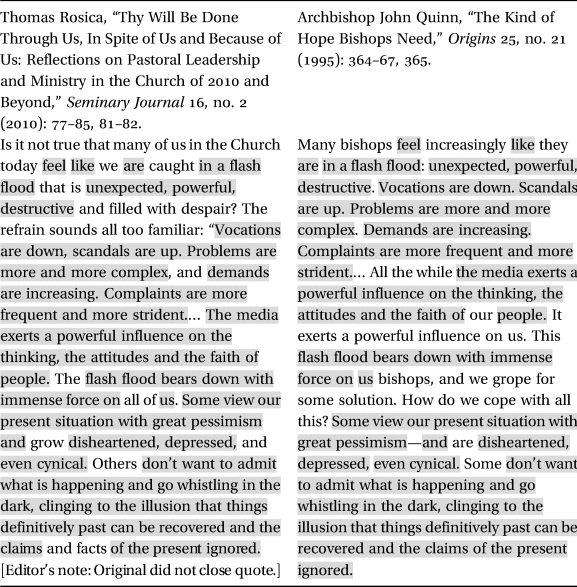
In another distinctive example of text repurposed to a new aim (Table 9), the source text is Archbishop John Quinn's keynote talk to a 1995 general meeting of Canadian bishops. Archbishop Quinn described the trials of leadership in the midst of church scandals, a decrease in vocations, and various secular challenges. Rosica first appropriated from it in an article in the theology quarterly Seminary Journal, and then later in publications from 2010 and 2011.Footnote 47
Comparison of Thomas Rosica's “Thy Will Be Done Through Us, In Spite of Us and Because of Us” and Archbishop John Quinn's “The Kind of Hope Bishops Need”

When Archbishop Quinn's words resurface in Rosica's works, they lack the original context of an archbishop addressing fellow bishops. Rosica repackages and expands the feelings of bishops in contemporary trials as the feelings of Catholics of all stations in the church. In the uncited source text, Archbishop Quinn's metaphor of a flash flood recalled an event from the 1970s that devastated a small town in his diocese, people's response to which provides a model for how bishops deal with secular challenges. Rosica's articles manipulate this autobiographical and rhetorical context.
Blending of Magisterial Texts
Sometimes Rosica's writings present as original theological reflection what is really an amalgam of several undisclosed magisterial documents. Table 10 shows Rosica presenting as his exposition of Luke 22:15 what is really a composite of three uncredited works by Pope John Paul II: his 1998 apostolic letter Dies Domini, a 2000 general audience address, and his 2004 Holy Thursday homily at St. Peter's Basilica.Footnote 48
Comparison of Thomas Rosica's Where Jesus Walked and Three Texts by John Paul II

Rosica makes small changes: “is alive” becomes “lives,” and there are minor additions and rearrangements. The content is substantively the same; the principal difference is that the declared authorship is different for each. Rosica presents selections of three magisterial texts as his own, and even the most diligent reader is unlikely to suspect that the text is a collection of excerpts from a variety of different kinds of papal pronouncements.
Some plagiarizing passages from Rosica patch together selections from more than one pope. Here Rosica's 2017 biblical commentary, The Seven Last Words of Christ, takes from two texts about the woman caught in adultery as described in the Gospel of John: a 1987 Wednesday General Audience of John Paul II, and a 2007 homily by Benedict XVI (Table 11).Footnote 49
Comparison of Thomas Rosica's The Seven Last Words of Christ and Texts by John Paul II and Benedict XVI

A few synonym substitutions appear in Rosica's use of John Paul II's text: the pope's “perception” becomes “insight”; “make love and forgiveness” becomes “place love and forgiveness”; and “brought before Jesus” becomes “dragged before Jesus.” Furthermore, in the quotation from John 8:11, Rosica has substituted the longer New Revised Standard Edition English translation for the shorter Revised Standard Edition English translation in John Paul II's address. (The text of John Paul II's address in Rosica's book corresponds to the English translation of John Paul II's address as found on the Vatican website, which notes that the address was issued in Italian and in Spanish.Footnote 50) Although Rosica makes a few small changes in the appropriation of Benedict XVI's homily, the meaning has not changed (although he omits one of Benedict's three emphases on sinning no more).
Additional Examples from Bishops and Archbishops
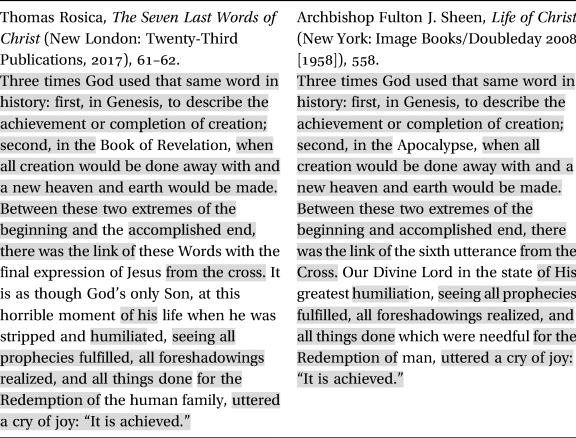
Throughout Rosica's writings, texts from various bishops and archbishops appear without any indication that the words originate elsewhere. Although most undisclosed episcopal sources are relatively recent, there are some older sources. Table 12 exhibits a passage plagiarized from the 1958 book by Archbishop Fulton Sheen, Life of Christ, now considered a classic and reprinted many times. In the passage appropriated by Rosica, Sheen is exegeting the word tetelestai (“It is achieved/accomplished/finished”) in John 19:30. Rosica appropriates the exegesis without attribution in his book, The Seven Last Words of Christ.
Comparison of Thomas Rosica's The Seven Last Words of Christ and Archbishop Fulton J. Sheen's Life of Christ

Rosica has instituted a few rhetorical changes to Archbishop Sheen's analysis. He updates Sheen's “man” to the gender-inclusive “the human family.” The title of the New Testament's last book is changed from “Apocalypse” to “Revelation.” Rosica also paraphrases with minor additions, but the exegesis of the Greek word from John's Gospel is fundamentally the same as in Archbishop Sheen's book.
At times Rosica's makes minor modifications to adjust an outdated source text. Table 13 displays Rosica's plagiarism of a passage from a 2006 speech by Archbishop (now Cardinal) Stanislaw Rylko, president of the Pontifical Council for the Laity.Footnote 51 The uncited source text in its original form references Pope John Paul II with the epithet “Servant of God.” In the five years that passed between the archbishop's talk and Rosica's article, John Paul II had been beatified, so it was necessary to change the epithet of “Servant of God” to “Blessed” when referencing the pope.
Comparison of Thomas Rosica's “Young People and the New Evangelization” and Archbishop Stanislaw Rylko's “Ecclesial Movements and New Communities”

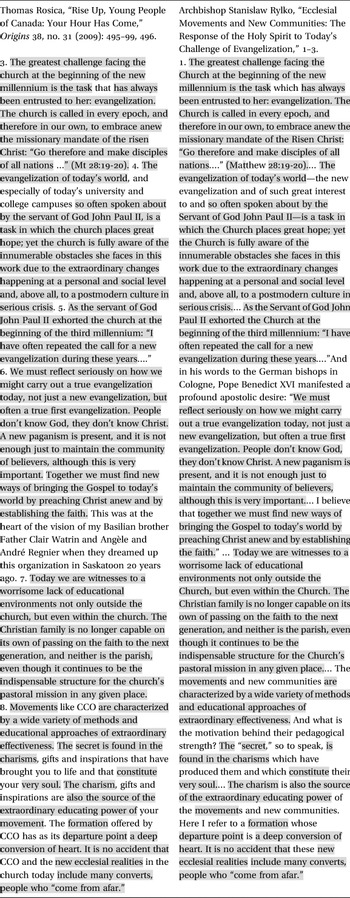
Archbishop's Rylko's passage ends with a quotation, with ellipses, from an address that Benedict XVI had given to German bishops at the Cologne archbishop's house in 2005, but in Rosica's version the ellipses have been removed, thereby presenting the pope's words less accurately than as originally delivered. In a 2009 article two years earlier, however, Rosica had plagiarized this same talk by Archbishop Rylko, but with references to Benedict XVI removed so that Rosica himself seems to be the author of the pope's words (Table 14).
Comparison of Thomas Rosica's “Rise Up, Young People of Canada: Your Hour Has Come” and Archbishop Stanislaw Rylko's “Ecclesial Movements and New Communities”

Archbishop Rylko's words about the importance of ecclesial communities and movements in the church in general are transformed in Rosica's article into praise for a specific Canadian ecclesial movement, the student organization Catholic Christian Outreach (CCO).Footnote 52 Rosica not only plagiarizes Archbishop Rylko's words, but he removes the quotations around Pope Benedict's words, so that it appears that they too are authored by Rosica. The readership of Rosica's text is thereby placed at a significant hermeneutical disadvantage. Words spoken by Benedict XVI to prelates in Germany, used by Archbishop Rylko to analyze the role of ecclesial communities, are presented as Rosica's personal panegyric to CCO. An additional hermeneutical complication is that Rosica then claims that “This was at the heart of the vision” of the Basilian founders of CCO. Readers are not aware that Rosica is asserting that words spoken by the pope to German prelates in 2005 and quoted in a 2006 analysis of ecclesial communities by the president of a pontifical council describe the intentions of the founders of CCO in the late 1980s. One may wonder about the intelligibility of plagiarizing theological works that are an amalgam of magisterial sources clandestinely repurposed to new goals and different contexts. Are they coherent works contributing to the advance of the discipline or simply theological word-salads?
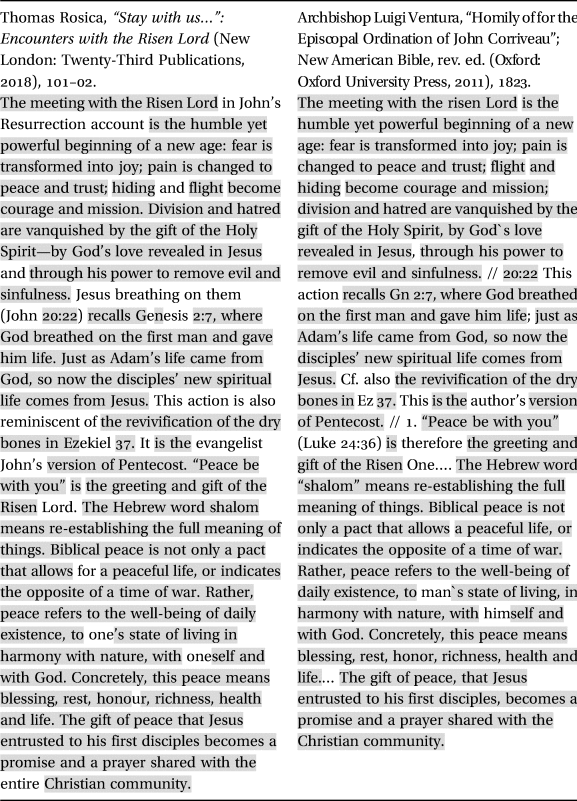
Another type of modification to source texts found in Rosica's writings involves expanding a source text by inserting within it a text from another writer. Rosica's 2018 book plagiarizes a homily by the Papal Nuncio to Canada, Archbishop Luigi Ventura, given at the episcopal ordination of John Corriveau, inserting a few sentences from a commentary on John 20:22 found in the New American Bible (Table 15).Footnote 53
Comparison of Thomas Rosica's “Stay with us…”: Encounters with the Risen Lord and Archbishop Luigi Ventura's “Homily of for the Episcopal Ordination of John Corriveau”

Additional modifications to the source texts include the gender inclusive change from “man's state” to “one's state” and the adoption of British English orthography (“honor” becomes “honour”). There are also a few changes in individual reference: the Papal Nuncio's “the Risen One” becomes Rosica's “the Risen Lord,” and the gospel “author” becomes “the evangelist John.” (The 2018 book is not the first time Rosica appropriated these passages from Archbishop Ventura; they also appear without acknowledgment in Rosica's 2012 Where Jesus Walked [104–05]). Overall, the passage is a composite of words from Archbishop Ventura and the editors of the New American Bible, with credit given to neither.
Interpreting Amoris Laetitia
The apostolic exhortation Amoris Laetitia is arguably the most controversial of Pope Francis’ magisterial documents. Apart from the ghostwriting controversies involving Archbishop Fernández noted above, the exhortation has provoked some controversies. Within months of the release of Amoris Laetitia, notable defenders of the controversial document included Cardinal Christoph Schönborn, who, when asked about its “magisterial value,” stated that it “is an act of the magisterium that makes the teaching of the Church present in the current time.”Footnote 54 He also noted:
It is evident this is an act of the magisterium: it is an apostolic exhortation. Clearly the pope is exercising his role of pastor, guide, and teacher of the faith, having benefited from the consultation of two synods. Without any doubt, I think that we are speaking of a pontifical document of great quality, an authentic lesson of sacred doctrine...Footnote 55
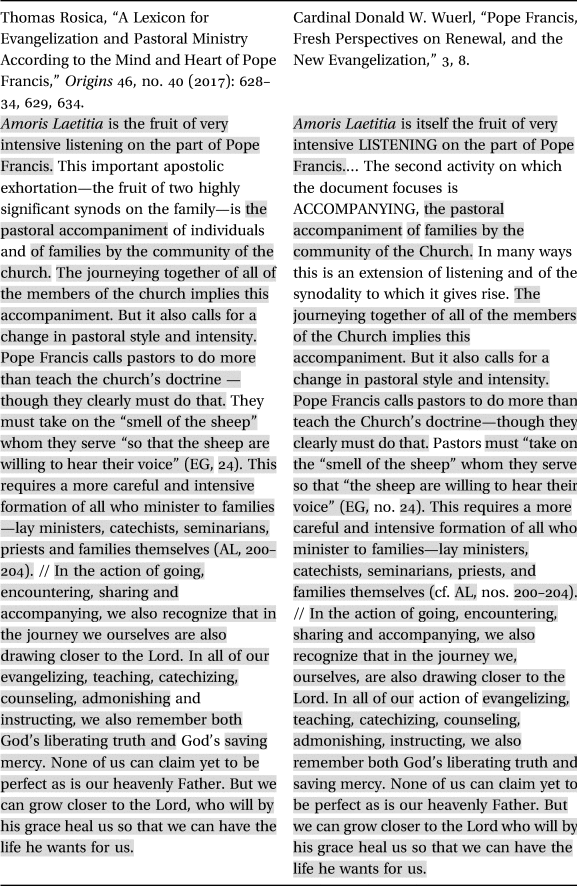
Due to its contested reception, interpretations and expositions of the document have commanded significant attention, as many in the church have attempted to defend it in the face of many criticisms. Rosica has been one of the document's vocal defenders, and Table 16 presents two passages by Rosica from the published text of Rosica's February 2017 keynote address at the annual meeting of the National Organization for Continuing Education of Roman Catholic Clergy. Rosica appears to offer his own exposition of Amoris Laetitia, but his undisclosed source is Cardinal Wuerl's address from a symposium at University of Notre Dame in October 2016.Footnote 56
Comparison of Thomas Rosica's “A Lexicon for Evangelization and Pastoral Ministry” and Cardinal Donald W. Wuerl's “Pope Francis, Fresh Perspectives on Renewal, and the New Evangelization”

Cardinal Wuerl used the occasion to defend the integrity, relevance, and authority of Amoris Laetitia. Rosica presents what is Cardinal Wuerl's defense of the document but without attribution, and so the defense is devoid of the authoritative episcopal attestation that is enabled by the ecclesiastical office held by Cardinal Wuerl. (We leave aside the further complication of whether the authority of a prelate's extrinsic attestation is devalued by later association with scandal; in any case, Rosica's plagiarism deprives Catholic readers of the opportunity to appropriately interpret and assess the authority of the claims.)
IV. Non-Magisterial Sources
Status other than formal pastoral office can allow a prominent figure in the church to carry a kind of quasi-magisterial authority among the faithful. Rosica plagiarized some non-magisterial sources that carry substantial authority for many theological readers.
Joseph Ratzinger
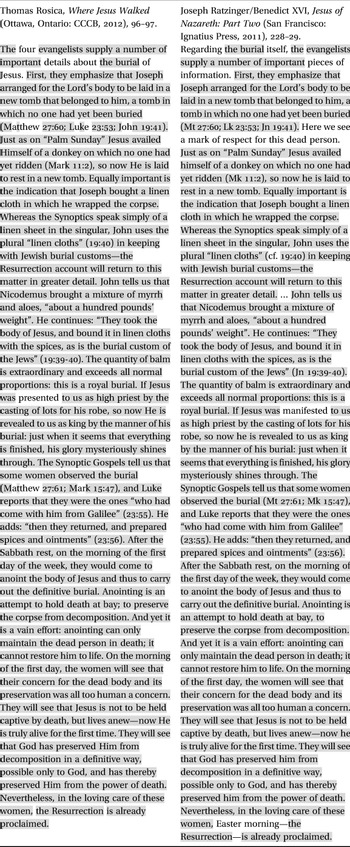
An unusual instance of plagiarism involving a non-magisterial source is Rosica's extensive appropriation, without citation, of passages from Pope Benedict XVI's three-volume Jesus of Nazareth. Although issued during his papacy, Benedict XVI stated explicitly that Jesus of Nazareth should not be considered a magisterial text. In the Foreword to the first volume, he explained, “This book is in no way an exercise of the magisterium, but is solely an expression of my personal search for ‘the face of the Lord’ (cf. Ps 27:8). Everyone is free, then, to contradict me.”Footnote 57 Perhaps to underscore the non-magisterial status to the work, the book's author was identified as “Joseph Ratzinger” in addition to “Pope Benedict XVI.” Some of those who possess magisterial authority are also accomplished theologians, and in this case Benedict XVI delineated for the reader the distinct roles of theologian and bishop. A bishop does not cease to be a theologian, and elevation to an office does preclude a bishop from contributing qua theologian to contemporary debates in the discipline. In the case of a published text by a bishop-theologian, a declaration of the intended status of the text allows readers to adopt a proper hermeneutical stance toward it.
Table 17 displays a plagiarized text from Rosica's 2012 Where Jesus Walked, which appropriates from the second volume of Benedict XVI's 2011 Jesus of Nazareth.
Comparison of Thomas Rosica's Where Jesus Walked and Joseph Ratzinger/Benedict XVI's Jesus of Nazareth

There are some minor changes in the plagiarizing version, but nearly the entire the passage is identical to the undisclosed source. Rosica's readers have no indication that they are really reading a passage from Part Two of Benedict XVI's Jesus of Nazareth, particularly because earlier in the book Rosica presents a quotation from another portion of Benedict XVI's book, complete with quotation marks and an accurate citation, remarking that the book is “masterful” and that the pope “explains very carefully and clearly what the Last Supper really was.”Footnote 58 This earlier citation disposes the reader to expect accurate attributions according the traditional norms, but nearly every page of text in Rosica's volume contains significant plagiarism. Another portion of Where Jesus Walked (on pages 72–73) plagiarizes page 7 of the pope's book. (Portions of Jesus of Nazareth appear without attribution in at least two other volumes by Rosica.Footnote 59)
Saint Teresa of Kolkata
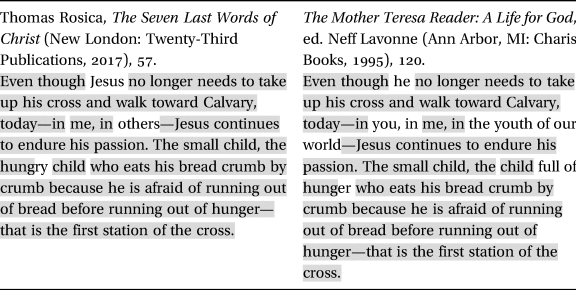
Other distinctive appropriations of non-magisterial sources involve Rosica's plagiarism of direct words by Saint Teresa of Kolkata as well as the words of commentators on her life and works. Rosica's The Seven Last Words of Christ includes a discussion of Mother Teresa's spiritual outlook, which incorporates verbatim, without any attribution, a text of Mother Teresa (Table 18). Readers who think they are encountering Rosica's analysis of the charism of the Order of the Missionaries of Charity are unknowingly encountering the founding saint's own account.
Comparison of Thomas Rosica's The Seven Last Words of Christ and The Mother Teresa Reader

There are small inconsequential changes (e.g., “full of hunger” changed to “hungry”), but though the text is fundamentally the same, the reader is disadvantaged in assessing their significance. Even though Mother Teresa's statements are not magisterial, as the sainted founder of the Missionaries of Charity she expresses the charism of her order from a privileged perspective. Rosica, passing off the interpretation as his own, denies his readers the opportunity to consider the description of the charism in its proper context.
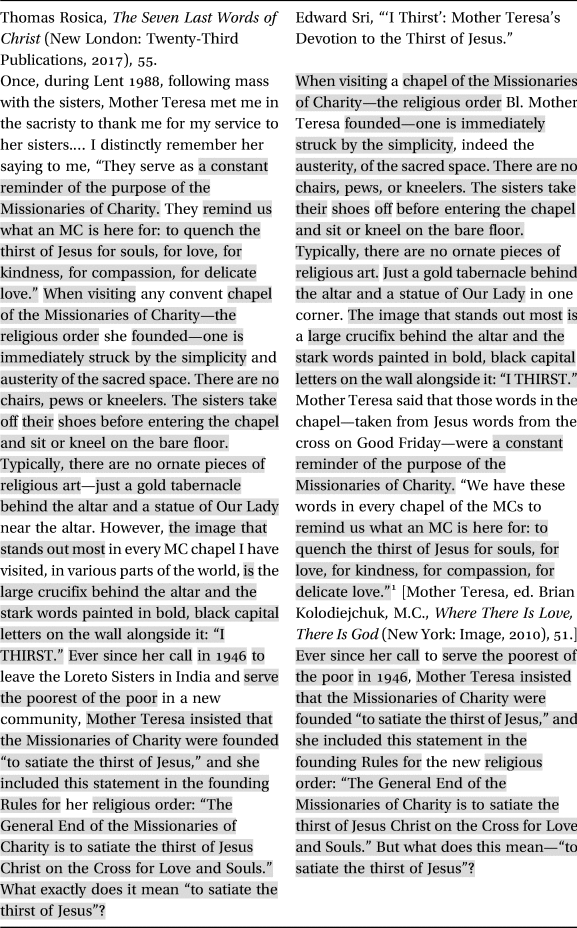
Stranger still is another passage from the same 2017 book putatively offering an autobiographical account of a private conversation between Rosica and Mother Teresa in Rome in 1988 (Table 19). The account overlaps substantially with one by theologian Edward Sri, published in 2013. Sri cites Mother Teresa's words, crediting a 2010 anthology, but in Rosica's account they are presented as words spoken by Mother Teresa directly to Rosica himself (“I distinctly remember her saying to me…”).Footnote 60
Comparison of Thomas Rosica's The Seven Last Words of Christ and Edward Sri's “‘I Thirst': Mother Teresa’s Devotion to the Thirst of Jesus”

Although he rearranged Sri's sentences and phrases, Rosica's text remains essentially “faithful” to Sri's account. Yet readers are misled, not only about the source of Rosica's words but about the nature of his experience with Mother Teresa, thus provoking confusion as to how they might evaluate the reported words of the saint. (Table 19 does not display the totality of Rosica's text that overlaps with Sri's 2013 article. Much of pages 56 and 57 of The Seven Last Words of Christ also contains significant overlap with Sri's article. No works by Sri are cited or referenced in Rosica's book.)
V. Magisterial Plagiarism of Magisterial Texts
Most of the examples considered above involve a magisterial text presented without any disclosure of its endorsement or attestation by a pope or bishop. We consider here some unusual cases of magisterial texts incorporated into other magisterial texts without credit.
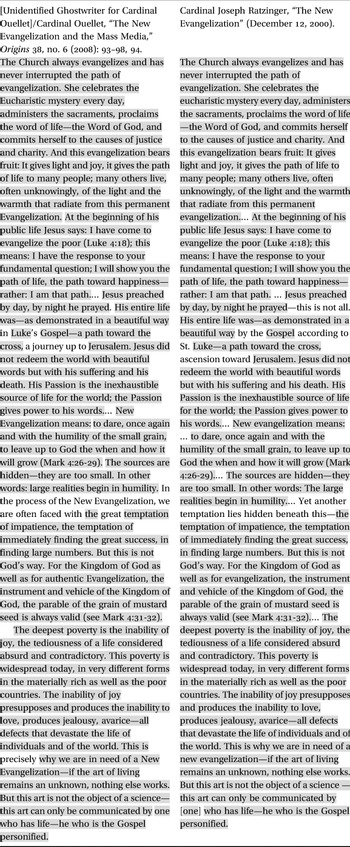
On May 30, 2008, Cardinal Marc Ouellet, Archbishop of Quebec and Primate of Canada, presented the keynote address at the Catholic Media Convention in Toronto.Footnote 61 It seems, however, that the cardinal had employed an unreliable ghostwriter. Cardinal Ouellet's unnamed ghostwriter substantially plagiarized the keynote address from a variety of magisterial and non-magisterial sources. There is no evidence that the cardinal himself, nor the original audience members of the talk, nor the subsequent readers, were aware of the extensive plagiarism. It is safe to assume that until recently, only the unidentified plagiarizing ghostwriter was aware of the plagiarism. The plagiarism is extensive, and the evidence is undeniable. The unnamed plagiarist seems to have favored texts written by colleagues of Cardinal Ouellet in the College of Cardinals. Table 20 presents an example of overlap between Cardinal Ouellet's keynote address and a speech given in late 2000 by then-Cardinal Joseph Ratzinger to catechists and religion teachers to mark the Jubilee of Catechists.Footnote 62 At the time, Cardinal Ratzinger was serving as the Prefect of the Congregation for the Doctrine of the Faith.
Comparison of Cardinal Marc Ouellet's “The New Evangelization and the Mass Media” and Cardinal Joseph Ratzinger's “The New Evangelization”

Cardinal Ouellet's unidentified ghostwriter has appropriated generously from Cardinal Ratzinger's talk, extracting various sentences and paragraphs without attribution. The audience and readership of Cardinal Ouellet's speech, while assuming that they are encountering new reflections by Cardinal Ouellet, are really encountering Ratzinger's eight-year-old reflections through the proxy of Ouellet, as excerpted by the plagiarizing ghostwriter. The audience and readership of Ouellet's reflections at the time are inaccurately encountering the words under the formality of as formulated by the archbishop of Quebec and primate of Canada, rather than under the accurate formality of as formulated by the Prefect of the Congregation for the Doctrine of the Faith who is now the pope.
As the addresses by Cardinal Ouellet and Cardinal Ratzinger are each directed to the faithful in virtue of the prelates’ respective offices, they can be judged to be magisterial documents holding some degree of weight, and perhaps the weight is best judged to be comparable. Such a judgment is not possible regarding all the hidden sources in Cardinal Ouellet's speech, however. Cardinal Ouellet's ghostwriter also secretly included verbatim text without acknowledgment from Gaudium et Spes, the Second Vatican Council Pastoral Constitution on the Church in the Modern Word (Table 21). (The ghostwriter appropriated from an English translation other than the official English translation on the Vatican website.)
Comparison of Cardinal Marc Ouellet's “The New Evangelization and the Mass Media” and Gaudium et Spes

The magisterial status of this passage from an ecumenical council is downgraded when put in the voice of Cardinal Ouellet by his ghostwriter. As plagiarized, words from Gaudium et Spes appear as part of a seemingly original reflection by the cardinal for the occasion of the keynote address, rather than as a passage originally from an ecumenical council.
Cardinal Ouellet's unidentified ghostwriter also plagiarizes four paragraphs from Archbishop Stanislaw Rylko's 2006 address “Ecclesial Movements and New Communities” (Table 22).
Comparison of Cardinal Marc Ouellet's “The New Evangelization and the Mass Media” and Archbishop Stanislaw Rylko's “Ecclesial Movements and New Communities.

Not only is the cardinal's ghostwriter's patchwork composition style the same as Rosica's, they plagiarize some of the very same source passages. The portions of text by Archbishop Rylko plagiarized here by Cardinal Ouellet's unnamed ghostwriter were also plagiarized by Rosica in his 2009 article “Young People and the New Evangelization” discussed above (see Table 14). And two of these four paragraphs were also plagiarized by Rosica in his 2011 article “Young People and the New Evangelization” (see Table 13).
As far as magisterial sources go, Archbishop Rylko's address is comparatively obscure; the text was never published on the Vatican website and appeared only in online media fora. Yet both Rosica and the unnamed ghostwriter copy from the text extensively.
Cardinal Ouellet's unidentified ghostwriter also misappropriated non-magisterial sources in compiling the keynote address. Several paragraphs are taken from articles by journalists (the kind of sources also commonly used by Rosica—including Sandro Magister) without attribution.Footnote 63 Other circumstantial evidence connects Rosica to the preparation of Ouellet's text. The first line of Cardinal Ouellet's keynote address references Rosica explicitly, thanking him for co-organizing the conference and for extending to him the invitation to speak. Cardinal Ouellet's address was published online on the website of the Salt and Light Catholic Media Foundation, where Rosica was CEO. According to Rosica, his history of collaboration with the cardinal goes back decades, and he has offered examples of having “worked closely with him.”Footnote 64
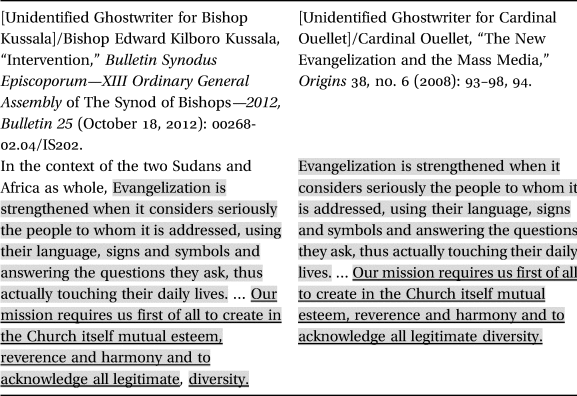
Select magisterial and non-magisterial texts, appropriated by Cardinal Ouellet's ghostwriter, acquired a new surreptitious existence in the cardinal's address, losing the attestation of their original authors and gaining the attestation of their new cardinal endorser. This unusual process did not end there, however. Four years later a ghostwriter for another prelate, Bishop Edward Hilboro Kussala, appropriated passages from Cardinal Ouellet's 2008 keynote address as the basis for an intervention at the XIII Ordinary General Assembly of the Synod of Bishops held in Rome in October 2012. This plagiarizing intervention was then published in the Bulletin Synodus Episcoporum by the Holy See Press Office.
In this situation of double plagiarism, the ghostwriter for a second bishop is plagiarizing a plagiarizing text constructed by another ghostwriter for the first bishop. The original source text remains, in part, Gaudium et Spes, which appears in both in the first plagiarism by Ouellet's ghostwriter and in the second plagiarism by the synodal bishop's ghostwriter. Table 23 displays overlap between Ouellet's 2008 address and the 2012 synodal intervention, with uncredited text from Gaudium et Spes underlined in both.
Comparison of Bishop Edward Kilboro Kussala's “Intervention” and Cardinal Marc Ouellet's “The New Evangelization and the Mass Media”

The highlighted but not underlined portions are shared by the published versions of Cardinal Ouellet's address and Bishop Kussala's intervention, and those portions do not originate in Gaudium et Spes. The presence of highlighted but not underlined text shows that Bishop Kussala's ghostwriter is working from Cardinal Ouellet's text rather than from Gaudium et Spes directly. The underlining shows clearly that same text from Gaudium et Spes nevertheless appears through two sequential occasions of plagiarism performed by ghostwriters for different prelates, words that have appeared now with three different magisterial attestations: the council fathers in 1965, Cardinal Ouellet in 2008, and Bishop Kussala in 2012.
Bishop Kussala's ghostwriter may not have been aware that Cardinal Ouellet's 2008 address itself was a plagiarizing compilation of various uncredited source texts. In any case, the audience members of the 2012 intervention and subsequent readers of its published text in the Bulletin Synodus Episcoporum would believe that they are encountering the original reflections of the African prelate who is promulgating them on the occasion of the synod.
The production of faulty magisterial documents produced by plagiarizing ecclesiastical ghostwriters is a substantial—though largely unrecognized—problem that undermines the quality of magisterial teaching. The single example discussed here suffices to illustrate the phenomenon.Footnote 65 When a prelate promulgates a plagiarizing document that is a compilation of uncredited magisterial and non-magisterial source texts, those who then encounter it are unlikely to know the original status and context of previously published texts appearing in the new magisterial document. The faithful who consider a plagiarizing magisterial document, not knowing it is plagiarized, are deprived of a chance to responsibly interpret, and practice appropriate dialectical engagement with, its source texts.
In August 2020, a journalist approached Rosica about textual evidence that he had been a ghostwriter for three of Cardinal Ouellet's works, including the aforementioned published keynote address at the Catholic Media Convention in Toronto in 2008. After an initial denial, Rosica then conceded he had compiled the three works.Footnote 66 Shortly thereafter, Origins added a note to the published version of Cardinal Ouellet's text that stated, “The editors of Origins learned in 2020 that this text contains numerous uses of the words of others without citation. Father Thomas Rosica provided Cardinal Ouellet the materials that lack citation.”
VI. An Unusual Source
The examples of the plagiarism of magisterial documents in the writings by Rosica examined in this article should not suggest that Rosica's only source texts are from popes, bishops, or canonized saints. Rosica commonly misappropriated passages from other theological scholars (Catholic, Protestant, and Jewish), as well as journalists (religious and secular). Most of these would not be relevant to our topic, except that Rosica sometimes uses these sources as implicit glosses of magisterial authority.
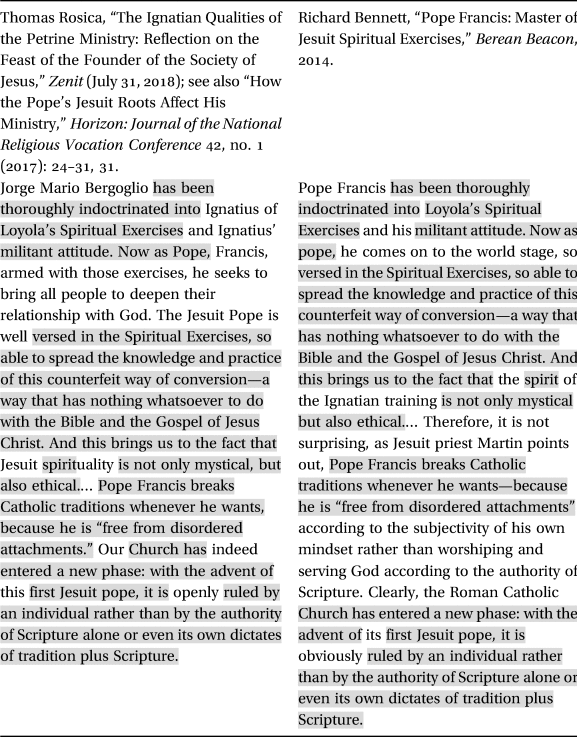
One particularly ignominious example is worth discussing here because of the character of the source, the context in which Rosica uses it, and the fact that it became the passage of Rosica's writing that has garnered the most attention. Table 24 displays the passage by Rosica and the hidden source text, which is a 2014 online essay by Richard Bennett.Footnote 67
Comparison of Thomas Rosica's “The Ignatian Qualities of the Petrine Ministry” and Richard Bennett's “Pope Francis: Master of Jesuit Spiritual Exercises”

Here we have an unusual non-magisterial source used to characterize both magisterial authority in general and Pope Francis’ distinctive embodiment of magisterial authority. The passage from Rosica is part of his reflections on the nature of Pope Francis’ distinctive exercise of Papal prerogative (an interpretation that drew widespread attention and criticism when delivered in 2018, but was first published a year earlier, after having been originally delivered in 2016).Footnote 68 Rosica intends his remarks as praise and defense of Pope Francis’ style of pastoral, ecclesiastical leadership.
As originally written, however, the words were meant as a sarcastic and even mocking criticism of Pope Francis, of the papacy, of Ignatian spirituality, and of Catholic faith. Rosica's source is a former Dominican priest, Richard Bennett, who publishes a blog seeking to persuade Catholics to “convert” to authentic, “Biblical” Christianity.Footnote 69 The particular blog post in question (in a section of the blog categorized as “Antichrist”) uses some remarks by Fr. James Martin in a video posted by America about the influence of Ignatian spirituality on Pope Francis.Footnote 70 Bennett focuses especially on Martin's claims about the Ignatian conception of “detachment,” and then (in a way presumably not intended by Martin) exaggerates this claim as a justification for autocratic papal rule. In their original context, it is so obvious that Bennett's remarks are meant critically and mockingly that it is surprising that Rosica would seek to recontextualize them as defense of and praise for Pope Francis.
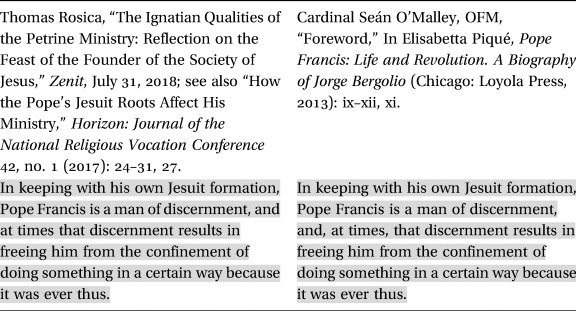
Rosica's choice is perhaps more understandable—but the hermeneutic complications of his plagiarism are that much more compounded—by the fact that he manages to stitch Bennett's anti-Catholic words together with an authentic (but unacknowledged and so plagiarized) magisterial source. Another passage from Rosica's controversial address is taken from Cardinal Seán O'Malley (Table 25).
Comparison of Thomas Rosica's “The Ignatian Qualities of the Petrine Ministry” and Cardinal Seán O'Malley's “Foreword”

In itself, the sentence from Cardinal O'Malley is not controversial (and Rosica repeats it as his own in other writings).Footnote 71 This perhaps makes it understandable how Rosica would want to use and expand upon this point. And yet, Rosica expanded upon it by adopting the words of a severe critic of Catholicism, intensifying and exaggerating the point so far as to describe a position that is at best sloppy and, arguably, contrary to Catholic teaching. In doing so, Rosica ended up casting suspicion on the original, more reasonable, and orthodox claim. The words of Cardinal O'Malley are uncontroversial in their original context and bear some magisterial authority. But when presented as the words of Rosica, in connection with the more extreme statements appropriated from Bennett, they seem to acquire a subversive and questionable character. Prior to the disclosure of the plagiarism, the passages taken from Bennett and Cardinal O'Malley were cited together by critics of Rosica as potential evidence of unorthodoxy. Prior to the disclosure of the plagiarism, Cardinal Raymond Burke responded to Rosica's characterization of Pope Francis by saying “This is nonsense” and “That's a great disservice to the office to describe the pope in this way. It's a great disservice to the office to the successor of St. Peter.”Footnote 72 Furthermore, in reporting on the controversy—again prior to the disclosure that the passages were plagiarizing Bennett and Cardinal O'Malley—Catholic Herald excerpted both passages as evidence of Rosica's divisive views.Footnote 73 Rosica's deceptive use of sources effectively muddies the waters for his readers who might want to engage his points theologically. A theologian who wanted to properly criticize Rosica's theological claims about papal authority would need to discern, and disentangle from one another, the words of Bennett, Martin, O'Malley, and any original contributions of Rosica.Footnote 74
VII. Conclusion
Although still very selective, we have cited extensive examples of plagiarism in Rosica's writing to show various ways that the privileged (magisterial or otherwise authoritative) status of a text can be obscured by plagiarism and the different injustices those cause for readers. The examples reviewed here include plagiarism of papal and episcopal documents, misappropriation of first-person narrative, repurposing and blending of texts, plagiarism of saints and influential theologians, and even contributing (in the otherwise legitimate role of ghostwriter) to plagiarism of magisterial sources by other ecclesiastical authorities. Each case raises distinct obstacles to interpreting the plagiarized utterances and to understanding the status of the documents in which they are plagiarized.
We imagine that a more thorough examination of plagiarism in Rosica's patterns of plagiarism could reveal tendencies in his own theological disposition and emphases, but that has not been our concern here. What we have tried to show is that, given the nature of Catholic theological practice, the problem of plagiarism is magnified in cases involving magisterial texts, highlighting distinctive elements of Catholic theological hermeneutics, and confirming the moral significance of plagiarism as causing harm—injustice—to readers.
We hope that documenting these many examples of plagiarism can help correct and clarify a record of theological discourse. But more than that, we aim to bring further attention to the dangers of plagiarism in theological discourse, as well as the role of authority and authorship in the practice of theology. Plagiarism of magisterial sources in theological writings is a distinctive kind of plagiarism, the harm of which has not been previously documented in the scholarly literature on plagiarism. If a Catholic theological reader who is attempting to cultivate the disposition of sentire cum ecclesia encounters a text that plagiarizes a magisterial passage but does not recognize the plagiarism, such a reader is disadvantaged in trying to interpret it. The reader will likely apply the wrong hermeneutical framework, unwittingly approaching the passage as non-magisterial. The plagiarist who passes off magisterial passages as if they are her or his own therefore injures readers by denying them the opportunity to consider texts with the status they rightly possess within a Catholic context, misdirecting and wasting attempts at theological engagement.
The hermeneutical problem is magnified when later writers cite plagiarizing theological work in good faith, not knowing that it is the product of plagiarism. A new set of readers encounters the plagiarizing work as cited, as quoted, or as extracted by other commentators. These later engagements further embed the plagiarizing work within contemporary theological conversation. Plagiarism corrupts the downstream literature as the defective work continues to be engaged by subsequent writers who believe it to be original.Footnote 75
Recently it was demonstrated that in the first decade of the twenty-first century the same passages appeared in print in works under various names, including Thomas Rosica, Jeremy Driscoll, Cardinal Ouellet, and Cardinal William Levada.Footnote 76 Identifying precise authorship is these cases is a serious challenge for the theologian, and interpreting the meaning and import of these texts is not easy when the same passages appear in a variety of genres, including academic journals and books, homilies, Catholic websites, lectures, and keynote addresses, among others. What does it mean for a theologian, for example, when much of a published address titled “The Liturgical Foundations of Theology” by the prefect of the Congregation of the Doctrine of the Faith turns out to be from an article in a theology journal authored and published years earlier by a well-established theologian, but the words also appear in Rosica's writing?Footnote 77 Because the name and office of authors can determine in large part the occasion and approach for engaging an article in theology, plagiarism disrupts teaching and research in the field. If one believes the text to be pedagogically useful, in addition to being true, which version should one cite in one's work, and which version should be assigned to students in the classroom? These questions do not have clear answers.
We believe theological scholars have an interest in policing such abuses, yet this is about more than keeping unpolluted the scholarly record. What is ultimately at stake is maintaining a particular kind of community constituted by discourse. The practice of theology is not merely an academic profession, but part of the ongoing conversation of and for the church, and in this sense the practice of theology confirms and intensifies a general truth about language, that it is not merely a mechanism of recording ideas or a tool for manipulating behavior but a living medium of communion, the activity in which language-users can achieve unity of understanding. The perversity of theological plagiarism in general, and especially of plagiarism involving sources of special authoritative status, reminds us of the dignity of a certain kind of relationship assumed among those engaging theological sources.
Theologians can thus serve not only the church but also other academic disciplines in emphasizing that plagiarism in general is an offense against justice, a wound to intellectual community. As such, plagiarism is less an offense against the past source of plagiarized words than against present and future audiences for those words, those who hope to engage with and understand the words shared. This is a particular offense when the community in question is that of Christian believers—including theologians, authoritative pastors, and those seeking to learn from them—all of whom depend on the presumption of authenticity in the currency of the words in which they trade, including the truthful presentation of the status of the persons who trade them.Footnote 78