Implications
Widespread use of tail docking in the EU seems to be accepted mainly because the alternative steps (as regards environment and stocking densities) that producers are required to take before resorting to it are not specified in detail by EU legislation. In current indoor housing systems, the use of tail docking enables producers to limit the occurrence of tail biting and its economic and welfare impacts. For tail docking to be stopped in a way that benefits animal welfare, considerable changes in the way pigs are housed and managed may first be required.
Introduction
Tail biting is a problematic behaviour in pig farming. It has a considerable welfare cost, in terms of immediate painful consequences for the victims, and by injured tails becoming an entrance for infection resulting in further suffering. Moreover, it may lead to partial or total carcass condemnation and consequent economic loss for producers. Tail biting often occurs in unpredictable outbreaks, and multiple factors are known to increase tail biting risk, although sufficient access to substrates for rooting and foraging, and to resources such as food are thought to be of primary importance (D’Eath et al., 2014). Tail docking is known to reduce the risk and severity of tail biting but does not eliminate the problem (Sutherland and Tucker, Reference Sutherland, Bryer, Krebs and McGlone2011). Tail docking is an unsatisfactory ‘solution’ to tail biting: It is an acutely painful mutilation, which masks the underlying risk factors that lead to tail biting, which are in themselves harmful to other aspects of pig welfare. It has been argued that docking enables suboptimal environments to be used (Valros and Heinonen, Reference Valros and Heinonen2015). For example, docked pigs can be reared in environments that lack sufficient space and substrate to fully occupy their behavioural need to root, chew and forage. However, tail biting does still occur in intact pigs in ‘improved’ environments and often at a higher level (Hunter et al., Reference Huirne and Dijkhuizen2001; Forkman et al., Reference Forkman, Olsen, Nørgaard, Laursen, Pedersen, Holm, Viekilde and Søndergaard2010).
The EU Directive (2001/93/EC amending Directive 91/630/EEC, now codified in Council Directive 2008/120/EC), which came into force in January 2003, states that tail docking must not ‘be carried out routinely but only where there is evidence that injuries … to other pigs’ ears or tails have occurred. Before carrying out these procedures, other measures shall be taken to prevent tail biting and other vices taking into account environment and stocking densities. For this reason, inadequate environmental conditions or management systems must be changed’ (italics added). It goes on to state that ‘… pigs must have permanent access to a sufficient quantity of material to enable proper investigation and manipulation activities, such as straw, hay, wood, sawdust, mushroom compost, peat or a mixture of such, which does not compromise the health of the animals’.
A person with little knowledge of the pig industry might assume that as routine tail docking is banned, except as a ‘last resort’, and improved environmental conditions and enrichment materials are required as an alternative, tail docking must now be a rare occurrence. However, despite this EU directive, tail docking is still widely applied in most countries in the EU, with the exception of Finland and Sweden (and non-EU countries Norway and Switzerland). Tail docking continues for 95% or more of pigs in Germany, Denmark, Belgium, France, Ireland, the Netherlands and Spain, and it is at over 80% in the United Kingdom (EFSA, 2007); and a recent slaughter study in Ireland found that 99% of pigs were docked (Harley et al., Reference Gonyou and Stricklin2012). This anomalous situation puts the EU pig industry in a difficult position in terms of public expectations and pressure for change. For example, in the Netherlands, a voluntary agreement has been reached between producers and government to phase out tail docking by 2023 (Spoolder et al., Reference Schrøder-Petersen and Simonsen2011).
In this article, we aim to understand the barriers standing in the way of the goal of the EU Council Directive 2008/120/EC: to stop or severely limit the use of tail docking in such a way that it will benefit the welfare of the affected pigs. To achieve this, we develop an economic model of four management and housing scenarios, three without tail docking and one with tail docking. In our analysis and discussion of these scenarios, we focus on legal frameworks, financial incentives, consequences for animal welfare and finally on ethical considerations.
Material and methods
In this section, we present an economic model that allows us to analyse the outcomes of four indoor housing scenarios for finishing pigs with different approaches to tail biting management.
Financial analysis of four pig production scenarios
The four scenarios are:
-
∙ Standard Docked: a standard housing scenario where pig tails are docked, 0.7 m2/pig of space is provided, the pen floor is 2/3 slatted and 1/3 solid or drained, and fixed enrichment materials such as pieces of wood attached to chains or in holders attached to the pen partition are provided, but no straw.
-
∙ Standard Undocked: as Standard Docked but with no tail docking.
-
∙ Enhanced Undocked: an improved housing scenario otherwise similar to Standard Undocked. No tail docking, and the environment is ‘enhanced’ by measures to reduce tail biting risk: increased floor area to 1.0 m2/pig, pen floors, which are 1/3 slatted and 2/3 solid, and provision of straw at 200 g/pig per day as the key measure to control tail biting.
-
∙ Efficient Undocked: an improved housing scenario similar to Enhanced Undocked except with 0.9 m2/pig and 100 g/pig per day of straw, whereas achieving similar levels of tail biting control as Enhanced Undocked.
Standard Docked resembles current Danish production where 0.7 m2/pig is recommended, even though the legal requirement is only 0.65 m2/pig; Standard Undocked is based on current Danish production but without tail docking and consequently much higher levels of tail biting. Enhanced Undocked is also based on Danish production, but draws on some elements of many Finnish farms (Niemi and Karhula, Reference Munsterhjelm, Simola, Keeling, Valros and Heinonen2011) and with other undocked systems (see D’Eath et al., 2014, Table 2). Efficient Undocked is based on Danish production, but has some similarities with the most efficient well-managed Finnish farms. We have good economic data on Danish and Finnish production, which were used to develop the scenarios, but our analysis is not intended to be a comparison of Danish v. Finnish systems, as there are many more differences than those considered here (health status, liquid v. solid feeding, genetics, etc.). The model focusses on a specialist finisher farm where the cost of tail docking labour (docking takes place on the farrowing farm, we assume costs are passed on) or costs of extra measures to prevent tail biting are added to the other variable and fixed costs. Looking at the finisher stage simplifies our analysis and focusses on the period when losses from tail biting mainly occur (Schrøder-Petersen and Simonsen, Reference Partanen, Niemi, Voutila and Jukola2001), but it ignores the possibility that some economic losses can occur as a result of tail biting in younger pigs (Zonderland et al., Reference Zonderland, Wolthuis-Fillerup, Van Reenen, Bracke, Kemp, den Hartog and Spoolder2008), meaning that the cost of tail biting may be underestimated somewhat. Although there are multiple interacting risk factors in tail biting (see e.g. EFSA, 2007; D’Eath et al., 2014), to keep our model simple, our main focus is on efforts to reduce tail biting through increased space allowance and the use of straw, which are the main differences in practice between docked and undocked systems (see Table 2 in D’Eath et al., 2014). A further simplifying assumption is that docked tails are docked according to Danish rules (no shorter than half of the tail) and that this is short enough to reduce tail biting (Sutherland and Tucker, Reference Sutherland, Bryer, Krebs and McGlone2011).
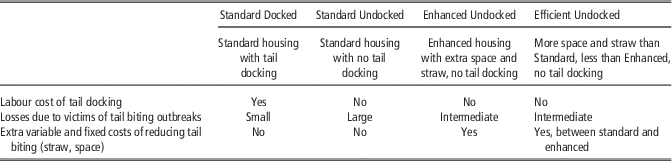
Finnish and Danish pigs differ in their slaughter weights and duration of the growing period. To be able to compare the scenarios solely from the tail biting management point of view, we have assumed similar live weight at entry (31.7 kg) and at slaughter (109.1 kg), carcass weight (81.8 kg), and duration of fattening period as well as similar prices of inputs and pig meat. Our simulation assumes that all four scenarios operate under market conditions and slaughter weights similar to those in Denmark in 2012. Table 1 illustrates qualitatively the main differences in the cost items between the four modelled scenarios.
Comparison of cost items of the modelled scenarios in relation to tail biting management practices

Financial inputs
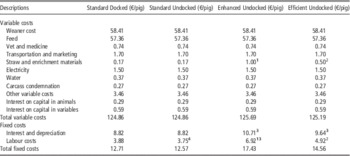
Production and price data for the four scenarios were gathered, and gross and net margins (€/pig) were estimated in the absence of any costs associated with tail biting (Table 2). The net margin for Standard Docked was based on Udesen (Reference Udesen2013). The net margins for the three Undocked scenarios were calculated by differentiating the costs by the characteristics of production. The main differences between the scenarios are labour costs associated with docking tails (used only in Standard Docked), the material and labour costs of providing straw and enrichment materials (straw is provided only in Efficient and Enhanced Undocked) and fixed costs of buildings (cost of additional space per pig in Efficient and Enhanced Undocked). In Finland, a new Decree in effect from 2013 requires that at least two-thirds of the pen floor area must be either solid or drained (i.e. perforations<10% of the area), except in already existing pig houses for which it will apply from 2028 (Finnish Government, 2012). In Denmark only one-third of the floor must be solid or drained from July 2015 (Danish Government, 2000). Hence, we have assumed that the two Standard scenarios have two-thirds slatted and the Efficient and Enhanced Undocked have one-third slatted floor. Solid or drained floor is less expensive to build than slatted floor but is more labour intensive to keep clean. Differences in fixed costs, labour costs and materials needed are reflected in our calculations (Table 3).
Summary of costs and revenues (€/pig produced) for the four finishing pig production scenarios in 2012 used in the model when not taking into account potential differences in tail biting and not taking into account potential costs associated with tail biting

1 Variable cost include: weaner cost, feed, vet and medicine, transport and marketing, straw and enrichment materials, water and electricity, carcass condemnation, interest on capital in animals and interest on capital in variable inputs.
2 Fixed cost include: interest and depreciation of fixed capital, insurance and maintenance and labour (including tail docking labour).
3 Detailed figures of variable and fixed costs are presented in Table 3.
Details of variable and fixed costs included in margin calculations when not taking into account potential differences in tail biting and not taking into account potential costs associated with tail biting

Data are based on Sinisalo et al. (Reference Parviainen2012) and Udesen (Reference Udesen2013) except items marked by superscripted numbers.
1 Assuming straw costs 6 cents/kg (providing 200 g/day per pig of chopped straw) and a labour use scenario for part-slatted systems based on information provided by Mäki-Mattila (Reference Lusk, Nilsson and Foster1998). Labour costs include the distribution of clean straw and removal of dirty straw.
2 Compared with Enhanced Undocked, these figures are lower because only 100 g/day per pig of chopped straw is provided and no labour for extra cleaning of dirty straw out of pens is assumed. Labour use for straw allocation is based on information provided by Mattson et al. (Reference Mäki-Mattila2004).
3 The cost differences between Enhanced Undocked and the two standard scenarios are because of the greater size of pens, with Efficient Undocked pen sizes (and thus costs) being intermediate. Cost per m2 of pen area is based on MAFF (Reference Lassen and Sandøe2000).
4 Cost savings compared with Standard Docked represent estimated cost of labour used in tail docking procedure at the given wage rate (Parviainen, Reference Nozick2001).
Should there be any tail biting in the pen, an extra net cost of €18.96/victim was subtracted from the net margin. This cost is due to extra medicine, veterinary, labour and material costs, increased mortality, carcass disposal and carcass condemnations, reduced daily gain and extra feed consumption. This cost was an average calculated from published studies and from industry data, but in practice these numbers can vary both within and between farms and also over time. The breakdown and justification of these costs per item are presented in a Supplementary Table (Supplementary Material). An important cost is that some bitten pigs suffer from infections and abscesses throughout the carcass that can lead to condemnation of part of or the entire carcass (Kritas and Morrison, Reference Keeling, Wallenbeck, Larsen and Holmgren2007).
It was assumed that in each scenario, there were 11 pigs/pen and that there is enough hospital pen capacity at the farm. Hence, potential extra fixed costs of hospital pens were not explicitly included although tail biting can increase the need for hospital pens. In our analysis, the extra costs per victim are weighed with the probability of occurrence according to the outbreak scenarios represented in the subsequent section.
A pen size of 11 was chosen because tail biting data used in a key study originated from a farm where there were on average 11 pigs/pen. Although pig farms often have larger pens than this (e.g. 16 pigs/pen is the most common in Denmark), extending the results to larger pens could have biased our parameters. However, there is no strong evidence suggesting large group size as a major risk factor for tail biting.
Besides pen size, the farm size was also standardised: data on production costs without the costs of tail biting was drawn from Danish farms having space for ~2200 finishing pigs, which are housed in production batches in all-in-all-out compartments each of which has space for 314 pigs. The size of a farm was not considered as a risk factor for tail biting, because the comparison is made between four scenarios applied at similarly sized farms. We assume that our results could apply equally to larger farms. In our simulation, calculations were performed at the pen level, and standard deviation parameters represent variation in the occurrence of tail biting outbreak in different pens of a farm over 2-year period.
Size of tail biting outbreaks
In all four scenarios, outbreaks of tail biting can occur. In Standard Docked, the outbreaks are expected to be less likely to occur and to affect fewer pigs than in the three Undocked scenarios. This was based on evidence from experimental studies showing that tail docking is partially effective in reducing the incidence and impact of tail biting (e.g. Sutherland et al., Reference Sutherland, Davis and McGlone2009; reviewed by Sutherland and Tucker, Reference Sutherland, Bryer, Krebs and McGlone2011). Industry figures from abattoirs can be difficult to interpret because scoring systems are not standardised across studies or locations (EFSA, 2007; Keeling et al., Reference Hunter, Jones, Guise, Penny and Hoste2012), but some studies compare pigs from different production systems delivering to the same abattoir. In a farmer system survey combined with abattoir data, docked pigs had 2% to 3% bitten tails, whereas undocked pigs had 6% to 8%, regardless of deep, light or no straw being provided (Hunter et al., Reference Huirne and Dijkhuizen2001). Data from a single Danish abattoir in which conventional (tail docked; 0.5% to 1.5% bitten), ecological and free-range pigs (tail intact; 1% to 5% bitten) were slaughtered showed higher average and more variable levels of tail biting over a 19-month period (Forkman et al., Reference Forkman, Olsen, Nørgaard, Laursen, Pedersen, Holm, Viekilde and Søndergaard2010). These studies indicate that levels of tail injury are lower in docked pigs from standard environments than in intact-tailed pigs from enriched environments.
It was stipulated that the magnitude of the expected tail biting outbreaks in a pen varies from zero (i.e. no outbreak) to small, medium and large outbreaks. The classes were:
-
- no outbreak, ‘no’;
-
- small outbreak (one victim per pen), ‘S’;
-
- medium-sized outbreak (2.8 victims per pen, covering outbreaks with two to four victims per pen), ‘M’;
-
- large outbreak (7.6 victims per pen, covering outbreaks with five or more victims per pen), ‘L’.
Probability of tail biting outbreaks
The probability of small, medium-sized and large outbreak was estimated based on data by Sinisalo et al. (Reference Parviainen2012) on the condition that the probability of no outbreak (‘P no’) is given. These data cover daily animal-level health records on 6812 fattening pigs raised in 2007–2008 in an experimental farm similar to Enhanced Undocked. Thus, for Enhanced Undocked (and for Efficient Undocked, which was assumed to have the same tail biting risk), the relationship between the probability of no outbreak and small or medium outbreak was estimated using monthly statistics about the frequencies of tail biting outbreaks (Table 4). As the use of docking and the housing environment affect tail biting, the probability of outbreak varies by scenario. The probability of no outbreak or of small, medium or large outbreaks in a pen for the two Standard scenarios was determined by extrapolation after consulting and synthesising data from various studies that give the total incidence (rather than individual pen data) in similar scenarios (Table 4). For Standard Docked, abattoir data suggest a prevalence of 0.5% to 3% (Hunter et al., Reference Herskin, Thodberg and Jensen1999; EFSA, 2007; Forkman et al., Reference Forkman, Olsen, Nørgaard, Laursen, Pedersen, Holm, Viekilde and Søndergaard2010), but these are thought to underestimate the on-farm incidence (Busch et al., Reference Busch, Wachmann, Nielsen and Petersen2004). For Standard Undocked, only small experimental studies are available (Van de Weerd et al., Reference Van de Weerd, Docking, Day and Edwards2005 and Reference Van de Weerd, Docking, Day, Breuer and Edwards2006; Zonderland et al., Reference Zonderland, Wolthuis-Fillerup, Van Reenen, Bracke, Kemp, den Hartog and Spoolder2008). In addition to the detailed data of Sinisalo et al. (Reference Parviainen2012), two further studies were available as a check of our estimated incidence for Enhanced Undocked and Efficient Undocked (Partanen et al., Reference Niemi and Karhula2012; Munsterhjelm, Reference Marchant-Forde, Lay, McMunn, Cheng, Pajor and Marchant-Forde2013). Incidence as used here and throughout this paper is meant in the sense of the % of pigs that will be affected by tail biting injury at some point during their time on the farm, rather than prevalence, which would be a snapshot of affected pigs at a given instant.
Average probabilities of tail biting outbreaks derived from data sets as used in the model

1 The probability of no outbreak in the pen is P no. Hence, the probability of either small, medium-sized or large outbreak to occur is 1−P no. Values for P no were determined after a synthesis based on estimated incidence for the different scenarios. Standard Docked: Hunter et al. (Reference Herskin, Thodberg and Jensen1999), EFSA (2007), Forkman et al. (2010); Standard Undocked: Van de Weerd et al. (Reference Van de Weerd, Docking, Day and Edwards2005), Van de Weerd et al. (Reference Van de Weerd, Docking, Day, Breuer and Edwards2006), Zonderland et al. (Reference Zonderland, Wolthuis-Fillerup, Van Reenen, Bracke, Kemp, den Hartog and Spoolder2008); Enhanced Undocked: Partanen et al. (Reference Niemi and Karhula2012), Sinisalo et al. (Reference Parviainen2012) and Munsterhjelm (Reference Marchant-Forde, Lay, McMunn, Cheng, Pajor and Marchant-Forde2013).
2 Probability P i , i=(S, M, L), refers to the probability of small (S), medium-size (M) or large (L) outbreak to occur. When probability of no outbreak P no is given, other probability parameters can be determined as follows: P S=(0.783−0.783(1−P no)) (1−P no); P L=(0.094+0.259(1−P no)) (1−P no); P M=1−P S−P L−P no. P S, P M and P L are adjusted accordingly when a value for P no is drawn from a distribution during the simulations. P i was estimated with a timeseries model and data provided by Sinisalo et al. (Reference Parviainen2012) for Enhanced Undocked, and then this was extrapolated to other scenarios based on the total expected incidence. The values in table represent average parameter values.
3 Incidence is the percentage of pigs that will be affected by tail biting injury at some point during their time on the farm.
A conditional probability was used to estimate the probability of small, medium-sized or large outbreak to occur. These conditional probabilities were eventually used in a decision tree model. P i denotes the probability of outbreak in each size category i=(no, S, M, L), and equations which determine P S, P M and P L are provided in the footnote of Table 4. As P no in each individual simulation run depends on random draws made during the simulations (see the following sections), also the values of P S, P M and P L are adjusted accordingly, and they depend on the result of a random draw made for P no. The values of P i depend also on the housing scenario h.
Decision tree model
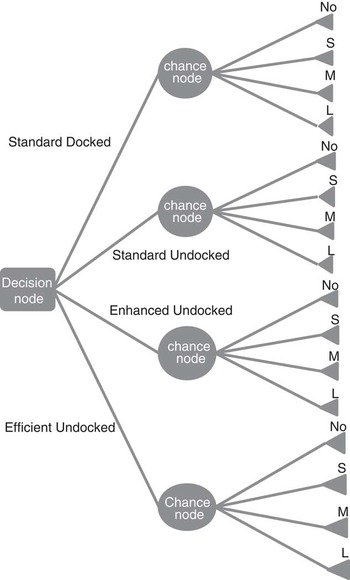
A decision tree model (Huirne and Dijkhuizen, Reference Harley, More, O’Connell, Hanlon, Teixeira and Boyle1997) presented in Figure 1 was developed using the input data gathered on margins, losses due to tail biting and estimated probabilities of outbreaks. The decision tree model was developed using Microsoft Excel software (Microsoft, 2010) and was run using TreePlan add-in simulation software (TreePlan, 2013). In the decision tree, the choice of housing scenario is represented by a square called a decision node, and the four branches represent the four scenarios. Chance events (state of nature) or outbreaks of tail biting are represented by four circles and are called chance nodes. Following each chance node there are four branches representing outbreak possibilities with certain magnitudes and probabilities. These branches include all possible outcomes assumed in this model and are mutually exhaustive.
Decision tree structure representing choices (four housing/management scenarios), four states of nature or chance nodes, four conditional probabilities including size (No, S, M and L) and probability of tail biting outbreaks for each chance node and the monetary values of outcome.

Expected monetary value (EMV) for each decision option (i.e. housing scenario) was calculated by the decision tree using the following equation:
 $${\rm EMV}(h)={\rm }\mathop {\mathop{\sum}\limits_{i,j} {(P_{i} V_{{ih}} )} }\limits_{} $$
Here h represents the decision options of housing scenarios (h=Standard Docked, Standard Undocked, Enhanced Undocked or Efficient Undocked), i represents outbreak events (the four magnitudes: no, S, M, L), P j represents the probability of each outbreak, and V ih denotes the monetary value of the outcome for the outbreak events for each housing choice and jth simulated pen.
When tails are not docked, there is a greater variation in the range of tail biting outcomes observed, that is the situation is more risky. To reflect this, the standard deviation for the three Undocked housing scenarios was set at 0.1 (according to the data of Sinisalo et al., Reference Parviainen2012), whereas for Standard Docked it was set at 0.05 as a smaller standard deviation is expected to be associated with a lower probability of tail biting outbreaks.
To capture the impact of the uncertainty about the probability of outbreaks and their magnitude on the optimal decision and on EMV, 10,000 model runs, each simulating one pen of pigs, were carried out under each of two different risk situations (RS)1 referring to a ‘standard’ situation and RS2 referring to a situation where there is increased uncertainty about the range of variation of P no in the three Undocked scenarios. ‘Probability of no outbreak’ was allowed to vary using a normal distribution, the mean and standard deviation of which was defined in Table 5. Performance of 10,000 runs meant we were able to ensure a smooth distribution of outcomes. A random sample of 5000 runs from the 10,000 resulted in <0.03% error in both the average and standard deviation of EMV. The runs were performed using RiskSim in the TreePlan Excel add-in.
Values for mean and standard deviation of probability of no outbreak (P no) for each scenario used in risk simulations RS1 and RS2

1 Standard deviations for the three Undocked scenarios were determined according to the standard deviation of probability of no outbreak observed in the data of Sinisalo et al. (Reference Parviainen2012).
Under these simulations the mean of the distribution remained constant but the standard deviations were changed. The standard deviations of the three scenarios with undocked pigs were doubled under the hypothetical simulation RS2, which refers to the case where the decision maker does not know the parameter values as well as in the case of RS1. Impacts on the net margins of each scenario and also the impacts on the optimal decision of the decision tree model were investigated.
Upon reporting the results, the simulation results for each individual pen were combined to represent one production batch of pigs housed in a single compartment with on average 314 pigs. Thus, the variation in EMV per pig is reported so as to represent variation in the mean EMV of the batch. This was done to help interpretation of results at the farm level. As a default, it was assumed that the simulation results between the pens are correlated so that for instance the most severe tail biting losses occur in pens at the same time. As an alternative, we also consider a situation where the occurrence of tail biting is not correlated across pens in the same compartment, and hence, each pen is to suffer from tail biting only due to incidental (non-systemic) reasons.
Results
EMV of the considered costs in the four housing scenarios were simulated at −€14.2/pig for Standard Docked, −€16.8/pig for Standard Undocked, −€20.6 /pig for Enhanced Undocked and −€15.8/pig for Efficient Undocked. These average payoffs were determined by our initial assumptions and calculations and would also have been found if we had used a deterministic model. Based on these results and given the input data and assumptions used, Standard Docked resulted in the largest EMV. Although Standard Docked had slightly higher costs than Standard Undocked when excluding the costs of tail biting, the losses due to tail biting are expected to be approximately five times higher in Standard Undocked than in Standard Docked (17.3% rather than 3.1% incidence; Table 4). In contrast to this, Enhanced Undocked incurs larger fixed costs and higher labour costs caused by the increased use of straw and space than the Standard housing scenarios. Efficient Undocked, in which we simulated a well managed farm, able to control tail biting with less space and straw than Enhanced Undocked, performed second only to Standard docked. Enhanced Undocked and Efficient Undocked resulted in losses due to tail biting, which are 63% lower than those in Standard Undocked.
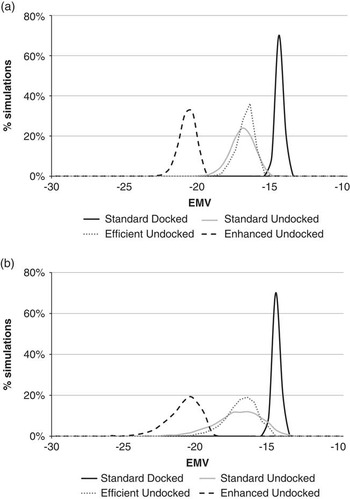
Simulation results showed that under RS1, the optimal choice of housing scenario to maximise EMV was almost always Standard Docked, and therefore, no decision was allocated to the other three scenarios. The EMV of Standard Docked varied between −€13.4 and −€15.2/pig (mean −€14.2, SD €0.2), for Standard Undocked it varied between −€14.0 and −€21.0/pig (mean −€16.8, SD €0.8), for Enhanced Undocked it ranged from −€19.0 to −€23.4/pig (mean −€20.6, SD €0.6) and for Efficient Undocked it ranged from −€16.8 to −€18.2/pig (mean −€17.0, SD €0.6; Figure 2a). Hence, Standard Undocked had more uncertainty about the returns. Taking into account uncertainty about the probability of outbreak, Standard Docked was superior, because it was preferred over Standard Undocked in virtually all simulated pens (i.e. first-order stochastic dominance). The expected benefit from Standard Docked was €2.6/pig (SD 0.6) against Standard Undocked, €6.4/pig (SD 0.3) against Enhanced Undocked and €2.8/pig (SD 0.4) against Efficient Undocked. The numbers above represent a situation where the most severe tail biting losses occur at the pens systematically at the same time. In the situation where the occurrence of tail biting is not correlated across pens in the same compartment and batch and hence a tail biting outbreak in each pen is independent from outbreaks in other pens in the same compartment and batch, the mean results are the same as above. However, the standard deviations of simulated losses at the batch level are then only 18.9% of the standard deviations reported above, that is the standard deviations are less than €0.1, €0.2, €0.1 and €0.1 for the four scenarios, respectively. Hence, if tail biting occurs non-systematically within a batch and a compartment, it reduces the variation in EMV at the batch level. Possible risk factors for tail biting (D’Eath et al., 2014) can occur at the room or farm level (e.g. feeder space, breed, changes in temperature or humidity, disease) but also at the individual level (e.g. individual susceptibility, sex, disease). Given also that the causes of any specific outbreak remain obscure, either of these two extremes (pen-level risk 100% or 0% correlated in a batch) are plausible but the truth is probably intermediate.
(a) Result of risk simulation (RS)1 when normally distributed uncertainty was added to the probability of no outbreak in each of the scenarios. The following values were used: mean (µ), standard deviation (σ); Standard Docked: (0.846, 0.05); Standard Undocked: (0.43, 0.1); Enhanced Undocked and Efficient Undocked: (0.73, 0.1). (b) Result of RS2 when normally distributed uncertainty was added to the probability of no outbreak in each of the scenarios. Following values used: Mean (µ), standard deviation (σ); Standard Docked: (0.846, 0.05); Standard Undocked: (0.43, 0.2) and Enhanced Undocked and Efficient Undocked (0.73, 0.2). The percentage values represent the share of simulated batches that fall within each €0.5 interval when grouped according to expected monetary value (EMV) and when tail biting occurs systematically in the pens of a compartment.

The results of the RS2 simulation, which had a greater variation in outcomes, showed that in 96.9% of the modelled batches, the optimal decision was in favour of Standard Docked, and 3.1% of the decisions were allocated to Standard Undocked (Figure 2b). Efficient Undocked was not selected as the optimal decision in competition with Standard Docked despite of its very close range and similar curve pattern to Standard Undocked. As found for simulation RS1, Enhanced Undocked was not selected as the best option under RS2. However, Enhanced Undocked had a higher EMV than Standard Undocked and Efficient Undocked, in more cases under RS2 than RS1.
Discussion
In this section, we will first discuss how to interpret the results of the economic modelling, before placing our results in a wider context. We consider current EU legislation, knowledge about stakeholder perception and studies in welfare science before aiming to situate the result in the ethical discussion regarding how best in the future to produce pigs.
How to interpret the results of the economic modelling
The three undocked scenarios are financially less attractive than Standard Docked under the assumptions used for the probability and magnitude of outbreaks under each scenario. In essence, this is because docking is low cost and relatively effective in preventing costly tail biting (Standard Docked v. Standard Undocked) in comparison with the use of space and enrichment (Standard Docked v. Enhanced Undocked). In the most Efficient Undocked systems, the financial returns are still less than those in Standard Docked systems but not by as much. The simulation results showed that the number of situations where Standard Docked would not be preferred is negligible when examined at the batch level.
Simulation results suggest that Standard Docked had the most stable EMV, whereas Standard Undocked had more variable returns (higher standard deviation) than the three other scenarios. For a pig producer deciding which scenario to adopt, more variation in EMV may be undesirable in itself. Farmers are typically risk-averse (Lassen and Sandøe, Reference Kritas and Morrison2009) and prefer to avoid large variations in income. This means that the perceived negative impact of risk is more than just the probability of tail biting times the expected loss per biting incident. Thus, if the financial costs of not tail docking are uncertain, this could make the cessation of tail docking even less attractive to producers.
Our results suggest that producers do not currently have an economic incentive to stop tail docking. To change this, the profitability of the Enhanced Undocked scenario would need to increase through reduced costs or increased income, and more producers would need to approach or exceed the success of our Efficient Undocked model scenario. Production costs per pig in enhanced housing (and efficient housing) were estimated to be higher (due to increased space, labour and enrichment) even without the costs of tail biting than in the two standard scenarios (which were similar in cost). Costs could be reduced for the enhanced or efficient housing: for example, automated delivery of enrichments to pigs would reduce labour costs of allocating straw. If the level of tail biting assumed for Enhanced and Efficient Undocked could be achieved in an even smaller space than that of Efficient Undocked (between 0.7 and 0.9 m2/pig), there is a potential for cost reduction. Thus, we calculate that each 0.1 m2 reduction in pen space would decrease fixed costs by €1.07/pig.
Increased income might be achieved by increasing slaughter weights in Enhanced Undocked, as the greater space allowance allows for this, as is the case in Finland when compared with Denmark. (For simplicity, our model assumes similar slaughter weights for all four scenarios). Niemi (Reference Munsterhjelm2006) found that increasing the carcass weight from 80 to 85 kg increases net returns by ~€3.2/pig, and when taking into account differences in the number of finishing days per pig, by €2.2/pig space per year. Increased income for Enhanced or Efficient Undocked might be possible if the willingness of some consumers to pay for higher animal welfare products (Lusk et al., Reference Lagerkvist and Hess2007; Arnoult et al., Reference Arnoult, Ahmadi, Stott, Cain, Guy, Seddon and Edwards2011) could be translated into improved prices for the producer (e.g. through distinct labelling and marketing). According to meta-analyses, the willingness to pay a premium for animal welfare could be 10% to 15%, although this varies between countries (Cicia and Colantuoni, Reference Cicia and Colantuoni2010; Lagerkvist and Hess, Reference Kiley-Worthington2011).
Finally, we have assumed that all scenarios have a similar level of productivity, but increased space allowance can improve both average daily gain (Gonyou and Stricklin, 1998) and feed conversion ratio (Turner et al., Reference Turner, Ewen, Rooke and Edwards2000). Meta-analysis suggests a linear relationship between space and weight gain, but only up to a threshold after which further increases in space have no further effect (Gonyou et al., Reference Forkman, Olsen, Nørgaard, Laursen, Pedersen, Holm, Viekilde and Søndergaard2006). Pigs in pens of 1.0 m2/pig (Enhanced) do not reach this threshold before slaughter, whereas at 0.7 m2/pig (Standard), pigs reach this threshold at around k=0.0317−0.0348 (where area (m2)=k×weight2/3), which equates to between 90.2 and 103 kg. After this threshold daily gain is reduced by 0.98% for each 0.001 of k (Gonyou et al., Reference Forkman, Olsen, Nørgaard, Laursen, Pedersen, Holm, Viekilde and Søndergaard2006). If we take the upper estimate of 0.0348 and assume that daily gain is reduced by the amount suggested by Gonyou et al. (Reference Forkman, Olsen, Nørgaard, Laursen, Pedersen, Holm, Viekilde and Søndergaard2006) after a threshold of 90.2 kg, then this would result in a 0.94 kg lower live weight at 90 days, which equates to 1.06 €/pig. This would reduce the difference between the scenarios, but not by enough to affect the conclusions of our model.
Our economic analysis suggests farmers are unlikely to stop tail docking pigs for economic reasons. In the next section, we consider whether existing legal requirements backed by sanctions might result in farmers stopping docking.
The legal status of tail docking in the EU
As mentioned in the Introduction, Member States of the European Union must comply with the tail docking requirements of Council Directive 2008/120/EC laying down minimum standards for the protection of pigs. The Directive is not legally binding upon pig producers directly; it is binding upon the Member States, which are required to transpose the Directive into national legislation and to ensure implementation and enforcement. This allows for different approaches across Member States.
While appearing to constitute a ban on routine tail docking, closer reading of the Directive reveals considerable room for different interpretations by Member States and their enforcement agencies. Before docking, producers must have ‘evidence that injuries … to other pigs’ ears or tails have occurred’, but it is not specified how severe or how recent this tail and ear biting must be to justify tail docking, or even how it should be documented. In practice, written advice from a veterinary surgeon that tail docking is necessary is accepted by most enforcement agencies.
The Directive requires that ‘other measures shall be taken to prevent tail biting and other vices, taking into account environment and stocking densities. For this reason, inadequate environmental conditions or management systems must be changed’ (2008/120/EC, The Council of the European Union, Reference Taylor, Main, Mendl and Edwards2008); however, no details are given. Are producers expected to go beyond the EU minimum requirements on space? What other aspects of environment should they consider? The most important risk factors (D’Eath et al., 2014) such as a lack of provision of substrates and limited access to feeder space are not specifically mentioned. Elsewhere in the Directive (Annex 1, Chapters 1, 4), the requirements on substrate are vague on quantity: ‘permanent access to a sufficient quantity of material to enable proper investigation and manipulation activities’. The inclusion of wood on the list of acceptable materials has led to a preference by producers for the use of relatively indestructible thick wooden poles as these need to be replenished less often, and the loose destructible materials that pigs seem to prefer (Studnitz et al., Reference Sinisalo, Niemi, Heinonen and Valros2007; Van de Weerd and Day, Reference Van de Weerd and Day2009) are absent or used in small amounts (due to cost and incompatibility with existing slatted floor slurry systems). The provision of materials such as solid wooden blocks on chains, which have been widely accepted as sufficient to comply with the EU Directive, can result in high levels of tail biting if docking is not also used (corresponding to Standard Undocked in our model).
The lack of more precise requirements in the Directive makes room for national legislation, which is vague and difficult to enforce. This apparently leads to widespread acceptance of (in effect) routine docking. Yet, it appears that the Member States, and their enforcement agencies, do not provide a proper implementation of the Directive if they do not ensure that tail docking is only used as a last resort. However, it must be acknowledged that there is some level of discretion for the Member States as regards what kind of documentation or evidence that must be provided. To improve on the current ambiguous and uncertain situation, an improvement in enforcement of existing legislation, as well as improved guidance (or even a new or amended Directive) would be needed.
Producer perceptions and pig industry factors affecting the decision to tail dock
Besides economics and legislation, other factors can contribute to pig producers’ decisions on how to manage their herd. A study of pig producers’ attitudes towards tail docking in the Netherlands, where docking is widespread (Bracke et al., Reference Bracke, De Lauwere, Wind and Zonderland2013) showed that conventional pig producers frequently agreed with the following statements: ‘docking is necessary to prevent tail biting’ (mean 4.9 on a scale from 1 to 6), and ‘it is better to dock all tails than to run the risk of tail biting even if it concerns just one bitten pig’ (mean 5.0). There was lower agreement with the statement ‘I know how to effectively treat tail biting when it arises’ (mean 4.1). Thus, most producers who currently use tail docking perceive the risk of tail biting as very serious, and most know some actions they could take in case of an outbreak but do not feel they can handle an outbreak of biting entirely effectively. These findings indicate that producers dislike tail biting not just because of the expected economic losses but perhaps also because they fear losing control over the situation. However, there is an absence of studies into producer attitudes to tail docking in countries where it has never been allowed or has been banned, and anecdotal reports suggest that farmers can learn to manage undocked pigs. It is also worth considering that factors other than production economics affect producer decision making. Farmers are conscious of potential conflict between production and animal welfare (Jääskeläinen et al., Reference Hunter, Jones, Guise, Penny and Hoste2014), thus farmers working with a system which they feel better meets the needs of pigs may enjoy greater job satisfaction, pride and a sense that they are promoting good animal husbandry.
However, industry trends in at least some parts of the EU may be towards reducing the number of staff per pig, and/or the level of skill and training of staff. This would be likely to reduce the likelihood that staff will be able to spot tail biting early and act appropriately to prevent the worsening of an outbreak.
In addition, some characteristics of the industry increase the motivation of producers to tail dock. In many cases, production is split-site and specialist farrowing farms provide weaners to more than one specialist weaner–finisher farm. The decision to dock should then depend on the requirement of the second farm. From the perspective of a farrowing farm, it may even be unclear which farm a litter is destined for at the time when docking is carried out, so given the possible requirement for docked pigs from the recipient farm, docking seems the prudent overall choice.
Welfare consequences of tail biting and tail docking
A literature review of the evidence for welfare consequences of tail docking and tail biting can be found in Supplementary materials, but is briefly summarised here, to give some relevant background to the following ethical discussion. The responses of pigs to tail docking suggest it is acutely painful for at least a few hours (Sutherland et al., Reference Studnitz, Jensen and Pedersen2008 and Reference Spoolder, Bracke, Mueller-Graf and Edwards2011). Behavioural changes include disrupted suckling, increased activity, lying apart from other piglets, tail wagging and increased sitting including ‘bottom scooting’. In one study, ‘tail jamming’ was elevated for 3 days following docking (Torrey et al., Reference Torrey, Devillers, Lessard, Farmer and Widowski2009). Physiological changes reflecting psychological stress such as decreased skin temperature and white blood cell counts, and elevated cortisol and/or adrenocorticotropic hormone have been reported in some (Sutherland et al., Reference Studnitz, Jensen and Pedersen2008 and Reference Spoolder, Bracke, Mueller-Graf and Edwards2011) but not all studies of docking (Marchant-Forde et al., 2009). In comparison with studies of other painful procedures performed on piglets, tail docking appears to be less acutely painful than piglet castration and similar in painfulness to teeth resection or ear tagging (Marchant-Forde et al., 2009). Identification of neuromas in healed docked pig tails (Herskin et al., Reference Gonyou, Brumm, Bush, Deen, Edwards, Fangman, McGlone, Meunier-Salaun, Morrison, Spoolder, Sundberg and Johnson2014) may indicate that docking causes chronic pain, but this has never been investigated (FAWC, Reference D’Eath, Arnott, Turner, Jensen, Lahrmann, Busch, Niemi, Lawrence and Sandøe2011).
Tail bitten pigs probably experience pain as evidenced by their vocalisations (Blackshaw, Reference Blackshaw1981), avoidance of biting pigs and changes in tail posture (Zonderland et al., Reference Zonderland, van Riel, Bracke, Kemp, den Hartog and Spoolder2009) although this has never been systematically quantified. As well as causing pain, inflammation and blood loss, tail wounds can get infected, and infection can spread to the spine (sometimes resulting in paralysis of the hind limbs) and to other organs including the lungs (Munsterhjelm et al., Reference Mattson, Susic, Lundeheim and Persson2013). Repeated tail bites resulting in a messy wound and partial or total tail loss must presumably be a more painful way for a pig to lose its tail than by tail docking in a quick single event. Furthermore, suffering due to secondary infections (which are rare following tail docking) adds further to the negative welfare consequences of being tail bitten.
The ethical balance concerning tail docking and tail biting
In this section, we first consider a consequentialist (Broome, Reference Broome1991) approach to ethics to evaluate the four scenarios in our economic model. Underlying this approach is an ethical assumption that each relevant consequence contributes to the goodness or badness of a scenario. The overall goodness of each scenario is then determined by weighing up all the good and bad features against each other, considering the number of individuals affected, enabling the scenarios to be compared.
Consider a very simple utilitarian framework for weighing up animal welfare, where the avoidance of pain and other suffering due to tail docking or tail biting are considered the only relevant features of animal welfare, with a neutral attitude to risk. Under this framework, we can compare our four scenarios in terms of their expected total animal welfare, considered for all the pigs going through those scenarios. To make this comparison, we must know how the pain of being tail docked compares with the pain of being bitten, taking their entire duration into account, and then weigh each of these with the incidence of affected individuals. If U(D) denotes the pain of tail docking (multiplied by 100% assuming all pigs are tail docked) and U(B) the pain from being bitten, using the % values for overall incidence in Table 4, the overall pain is:
Standard Docked: 100U(D)+3.1U(B)
Standard Undocked: 17.3U(B)
Enhanced (or Efficient) Undocked: 6.3U(B)
Standard Docked and Standard Undocked are equally good if 100U(D)=(17.3−3.1) U(B), that is U(B)=7.0U(D). In this example, tail docking would be better than not tail docking, if the total pain of being bitten (added up over time) were more than seven times worse than the total pain of being tail docked.
The cost of choosing Enhanced (or Efficient) Undocked rather than Standard Docked from the point of view of animal welfare is an incidence of tail biting, which is doubled, but the benefit is avoiding the pain of tail docking. These two scenarios are equally good, if 100U(D)=(6.3−3.1)U(B), that is U(B)=31.3U(D). That is, under these conditions, tail docking is better only if the pain of being bitten is more than 31.3 times worse than the pain of being tail docked. This is because, in this comparison, the total pain of tail docking of all pigs has to be balanced with the pain resulting from far fewer bitten pigs. In the previous section, we argued that tail loss through severe tail biting is considerably worse for welfare than tail docking. However, animal welfare science is not able to give us a precise numerical value for how much worse, so this question remains a matter of judgement.
It could be argued, based on these calculations and plausible assumptions, that Enhanced (or Efficient) Undocked is better from the point of view of the pigs than Standard Docked, which in turn is better than Standard Undocked. Thus, it seems plausible that comparing Standard Docked and Enhanced (or Efficient) Undocked, a doubling of the risk of tail biting, where the tail biting is still at a relatively low level, is a price worth paying for avoiding tail docking, whereas it does also seem plausible that comparing Standard Docked and Standard Undocked, an almost sixfold increase in tail biting to a level of more than one out of six pigs being bitten is a too high price to pay for avoiding tail docking. However, this relies on the assumption that the pain of tail biting is not as much as 31 times greater than the pain of docking, and this judgement will depend on the degree of pain suffered by docked pigs compared with bitten pigs. If pain during docking were reduced by the use of refined methods or effective analgesia (Sutherland et al., Reference Spoolder, Bracke, Mueller-Graf and Edwards2011), or pain resulting from being bitten were reduced, for example, by earlier detection and intervention (D’Eath et al., 2014), the balance would be altered.
These calculations are based on some crude assumptions that can be discussed. Tail docking affects all pigs on a farm, but tail biting affects an uncertain and variable number of pigs to an uncertain and variable extent. It will depend on breed, management and various aspects of the scenario (D’Eath et al., 2014), and the actual outcome for any group of pigs will be uncertain. We have simplified this by using our modelled population averages. Some of the most plausible relaxations of the simplifying assumptions underlying this framework would be: instead of adding up pains, greater levels of suffering could be given greater weight. Or instead of the expected average value of incidence, the amount of variation around these expected values could be given greater weight (reflecting risk aversion on behalf of the pigs). Perhaps surprisingly, both of these relaxations would count in favour of Standard Docked.
On the other hand, we may assume that the enriched and larger pens in Enhanced Undocked, and to a lesser extent Efficient Undocked, benefit all of the pigs in ways other than reducing tail biting. For example, these pens most likely provide a better outlet for foraging and exploratory behaviour, greater physical comfort with more choice of lying areas, greater capacity for physical exercise including play and improved social control due to the ability to associate with or avoid certain penmates. Thus, these systems could provide a positive welfare benefit for all pigs to offset the negative ‘pain’ aspects for bitten pigs included in our calculations, which would weigh in favour of Enhanced and Efficient Undocked systems. It has been suggested that an intact tail has a function for communication between pigs (Kiley-Worthington, Reference Jääskeläinen, Kauppinen, Vesala and Valros1976), and to some, it matters that docking impacts on the ‘animal integrity’ of the pig (Sutherland and Tucker, Reference Sutherland, Bryer, Krebs and McGlone2011) either or both of which would also weigh in favour of Enhanced or Efficient Undocked.
So far, the discussion has focussed on consequences for pig welfare. From a human perspective, costs and benefits apply to different parties: the financial costs of implementing the four scenarios are borne by farmers (to some extent passed on to consumers), whereas the financial benefits are the availability of affordable pig meat products (a market good for consumers). Finally, the benefits of improved welfare are a ‘non-market good’ benefiting farmers and other citizens concerned for the pigs’ welfare. An important aspect of weighing up good and bad features of the different scenarios is to ask whether there is the right balance between costs and benefits for humans and welfare consequences for the pigs. The question is whether Enhanced or Efficient Undocked systems represent an improvement in animal welfare to match the higher cost of production (compared with Standard housing), and whether society at large or a subset of consumers are willing to pay farmers to reflect this, or whether a lower financial cost of producing pig meat is a higher priority. Meta-analysis has shown that a higher income is the strongest predictor of increased willingness to pay for high animal welfare products (Lagerkvist and Hess, Reference Kiley-Worthington2011). Thus, the perception of the proper ethical balance between the pig and human perspectives is likely to be different for wealthy or poorer countries or individuals.
It is important to stress that a consequentialist perspective that accepts the weighing up of consequences does not necessarily permit the acceptance of the best of these four alternatives. Even if (for example) Standard Docked is judged to have better overall consequences than presently known versions of Enhanced Undocked, it is still not necessarily justified. If a version of Enhanced Undocked could be devised, which cost roughly the same as Standard Docked and with similarly low levels of tail biting as this scenario, it would clearly be better, and Efficient Undocked is clearly a step in this direction. From a consequentialist ethical perspective, there is always a duty to look for better strategies. For example, genetic selection of pigs to reduce tail biting behaviour may be possible and could result in lower levels of tail damage in all four scenarios (Turner, Reference Turner2011; D’Eath et al., 2014).
Finally, there is reason to mention that, for some, this sort of weighing of ethical costs and benefits is not considered acceptable. From a deontological ethical perspective, avoiding a larger evil cannot normally justify a lesser evil (Nozick, Reference Niemi1974). Tail docking does not address the underlying welfare problem, which is an important contributor to tail biting in the first place: that pigs bite due to an unmet motivational need to forage, root, investigate and explore (Taylor et al., Reference Sutherland, Bryer, Krebs and McGlone2010). Hence, from a deontological perspective, tail docking can be considered wrong. It should also be considered wrong to have a form of production, which makes tail docking necessary. Neither situation is ethically acceptable. This deontological argument demands changes to housing and management to reduce tail biting to an acceptably low level without the need for docking (Spoolder et al., Reference Schrøder-Petersen and Simonsen2011; D’Eath et al., 2014).
Conclusion
Our analysis suggests that by continuing to dock their pigs in systems specified by current EU pig housing standards, pig producers are acting in a risk-averse way, which is in their economic best interests. From a legal standpoint, there appears to be a discrepancy between the requirements of the EU Directive (to end ‘routine’ tail docking and provide manipulable materials) and the practices in the Member States, partly due to a lack of clarity in the Directive. Various ethical concerns about tail docking remain: it is a painful mutilation, fails to respect animal integrity and does not address the underlying deficiencies in the environment that increase the risk of tail biting in the first place. A total ban on tail docking in current systems, without any changes in housing and management, would likely lead to an increase in tail biting, with a negative impact on farm economy and, other things being equal, also on welfare, if we assume that being tail bitten is more than seven times more painful for a pig than being tail docked. Hence, a new management pattern is needed, considering changes to improve the housing environment to reduce tail biting risk. This also has the potential to improve pig welfare in other ways, although it would increase the cost of housing. Thus, to achieve the goal of improvement of animal welfare through a ban on tail docking, our analysis suggests that production system changes (perhaps alongside genetic selection to reduce tail biting) may be needed, provided that customers are willing to pay the increased costs.
Acknowledgements
Funding from SEGES, Danish Pig Research Centre supported this review. This funding is mainly from pig industry sources, and two of the authors of the paper also work for this organisation, resulting in a potential or perceived conflict of interest. However, the contract for this research with two of the independent academic partners (SRUC and University of Copenhagen) explicitly endorses that the work is at ‘arm’s length’ from commercial interests, and the first and senior author have led the process, and are satisfied that the result is independent. MTT Agrifood did not receive funding from SEGES. SRUC also receives funding from the Rural and Environment Science and Analytical Services (RESAS) Division of the Scottish Government. Emma Baxter and Helle Lahrmann contributed to valuable discussions and provided comments on earlier drafts.
Supplementary Material
To view supplementary material for this article, please visit http://dx.doi.org/10.1017/S1751731115002098