Introduction
Acetolactate synthase (ALS; EC 2.2.1.6) is a critical enzyme found in plants, fungi, and bacteria (Duggleby and Pang Reference Duggleby and Pang2000). It is a plastidic enzyme involved in the biosynthetic pathway of the branched-chain amino acids valine, leucine, and isoleucine (Durner et al. Reference Durner, Gailus and Boger1990; Umbarger Reference Umbarger1978). ALS is also the most common target enzyme for five different classes of herbicides: triazolopyrimidines, sulfonylureas (SUs), pyrimidinylthio-benzoates, imidazolinones (IMIs) and sulfonylamino-carbonyltriazolinones. ALS-inhibiting herbicides have been used on various crops and as highly successful commercial herbicides for more than 30 yr. However, repeated use of these herbicides has resulted in selection of resistant weeds. To date, 165 weed species have evolved resistance to one or multiple ALS-inhibiting herbicide classes globally (Heap Reference Heap2020).
Target-site mutation has been the predominant mechanism providing resistance to ALS-inhibiting herbicides. It is mostly caused by one of eight mutations in the ALS gene that result in amino acid changes (Ala-122, Pro-197, Ala-205, Asp-376, Arg-377, Trp-574, Ser-653, and Gly-654). Enhanced metabolism is another critical mechanism that confers ALS resistance (Devine and Shukla Reference Devine and Shukla2000; Yu and Powles Reference Yu and Powles2014). This mechanism has been well documented in different weeds, including blackgrass (Alopecurus myosuroides Huds.) (De Prado and Franco Reference De Prado and Franco2004), rice barnyardgrass [Echinochloa phyllopogon (Stapf) Kosso-Pol.] (Yasuor et al. Reference Yasuor, Osuna, Ortiz, Saldain, Eckert and Fisher2009), wild mustard (Sinapis arvensis L.) (Veldhuis et al. Reference Veldhuis, Hall, O’Donovan, Dyer and Hall2000), and flixweed [Descurainia sophia (L.) Webb ex Prantl] (Yang et al. Reference Yang, Deng, Li, Yu, Bai and Zheng2016). Cytochrome P450 monooxygenases (CYP450s) have been reported to be critical in herbicide metabolism (Ma et al. Reference Ma, Kaundun, Tranel, Riggins, McGinness, Hager, Hawkes, McIndoe and Riechers2013; Powles and Yu Reference Powles and Yu2010).
Redroot pigweed (Amaranthus retroflexus L.) is an annual broadleaf weed and is widespread worldwide. It is a highly competitive C4 species with high seed production (Francischini et al. Reference Francischini, Constantin, Oliveira, Santos, Franchini and Biffe2014). It can produce a million seeds that have long seed viability and prolonged germination periods (Karimmojeni et al. Reference Karimmojeni, Bazrafshan, Majidi, Torabian and Rashidi2014). Amaranthus retroflexus is widely distributed in crop fields in China, substantially affecting crop yields (Li et al. Reference Li, Zhang and Ni2004). Growers rely heavily on herbicides to control this troublesome weed. Because of the intensive application of herbicides, A. retroflexus has evolved resistance to three mechanisms of action of herbicides, including photosystem II (PSII), protoporphyrinogen oxidase (PPO), and ALS. Several mutations at Ala-122, Ala-205, Asp-376, Trp-574, and Ser-653 in ALS afford resistance to ALS-inhibiting herbicides (Chen et al. Reference Chen, Huang, Zhang, Huang, Wei, Chen and Wang2015; Huang et al. Reference Huang, Chen, Zhang, Huang, Wei, Zhou, Chen and Wang2016), and one mutation (Arg-128-Gly) in PPO2 conferring PPO-inhibitor resistance in A. retroflexus in China has been reported (Huang et al. Reference Huang, Cui, Wang, Wu, Zhang, Huang and Wei2020).
The control of A. retroflexus in soybean [Glycine max (L.) Merr.] fields has mainly relied on the ALS-inhibiting herbicide thifensulfuron-methyl since its introduction in China in 1999. Thifensulfuron-methyl is very popular because of its high efficacy in broadleaf weed control. In recent years, farmers have found that the efficacy of thifensulfuron-methyl on A. retroflexus has greatly decreased in northeast China. The general aim of this research was to determine the status of resistance to thifensulfuron-methyl in an A. retroflexus population, to examine the cross- and multiple resistance to a range of common herbicides, and to determine resistance mechanisms present in the A. retroflexus population.
Materials and Methods
Plant Materials
Seeds of a putative thifensulfuron-methyl-resistant A. retroflexus population were collected in 2018 from a soybean field (49.32°N, 125.53°E) receiving regular thifensulfuron-methyl applications for more than 7 yr. This population was treated with thifensulfuron-methyl (30 g ai ha−1), and 20 surviving seedlings were grown to maturity in a greenhouse. Seeds of the subpopulation (R population) were harvested and used in subsequent experiments. Two known herbicide-susceptible populations (S1 and S2 populations) maintained in our laboratory (Huang, et al. Reference Huang, Chen, Zhang, Huang, Wei, Zhou, Chen and Wang2016) were used as controls.
Twenty seeds of each S1, S2, and R population were planted into 8.5-cm2 pots containing 1:1 (v/v) peat:sand mixture. At 20 d after seeding, six evenly sized seedlings per pot were kept and grown in a greenhouse at a day/night temperature of 35/21 C and photoperiod 16/8 h, with regular water and fertilization.
Whole-Plant Dose–Response Experiments
Amaranthus retroflexus seedlings were treated with thifensulfuron-methyl at the 3- to 4-leaf stage in the absence and presence of malathion using a cabinet sprayer (3WP-2000, Nanjing Agricultural Mechanization Research Institute, Nanjing, China). Thifensulfuron-methyl was applied at 0, 1.88, 3.75, 7.5, 15, 30, and 60 g ai ha−1 (recommended label rate: 30 g ai ha−1) for the S1 and S2 populations and at 0, 15, 30, 60, 120, 240, and 480 g ai ha−1 for the R population. Malathion (1,000 g ai ha−1) was applied 1 h before thifensulfuron-methyl treatment (Preston et al. Reference Preston, Tardif and Christopher1996). The seedlings were grown in a greenhouse after herbicide treatments. At 21 d after thifensulfuron-methyl treatments, the aboveground parts of the plants were cut and oven-dried at 60 C in a drying chamber, and the dry weights were recorded. Plants were recorded as dead if they did not produce new healthy leaves. The experiment was conducted twice, with three replications (6 plants per replication) each.
ALS Activity Assays
The three A. retroflexus populations (S1, S2, and R) were grown as described earlier. Fresh plant tissue was harvested for the ALS activity assays. The procedures for the ALS activity assays were carried out according to the methods described by Yu et al. (Reference Yu, Frisesen, Zhang and Powles2004). Briefly, the frozen shoot tissue was homogenized with a mortar and pestle in 2 volumes of grinding buffer. The homogenate was filtered through a layer of Miracloth (Hebeiwanlian, Hengshui, China) and centrifuged at 27,000 × g for 15 min. The supernatant was brought to 50% saturation with (NH4)2SO4. The solution was centrifuged at 27,000 × g for 30 min. The pellet was redissolved in 2.5 ml resuspension buffer and desalted on a column. The desalted enzyme extract was immediately used in the assay. This enzyme extract and thifensulfuron-methyl solution (0, 10−4, 10−3, 10−2, 10−1, 1, and 10 μM for the S1 and S2 populations and 0, 10−3, 10−2, 10−1, 1, 10, 100, and 1,000 μM for the R population) were incubated at 37 C for 60 min. The reaction was stopped by adding 40 μl of 6 N H2SO4 and incubated at 60 C for 15 min. Then, 190 μl of 0.55% creatine solution and 190 μl of α-naphthol solution were added, and the mixture was incubated at 60 C for 15 min. The experiment was conducted twice, with three replications each time.
Susceptibility to Other Herbicides
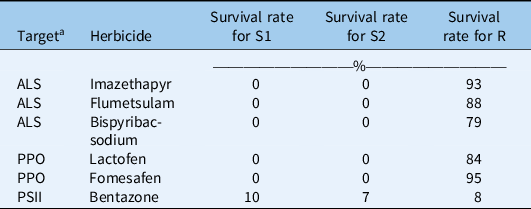
To study resistance status of the R population, seedlings (3- to 4-leaf stage) of the R, S1, and S2 populations were sprayed with herbicides at the recommended label dose (Table 1). Herbicide treatment methods were the same as those described earlier. Plants producing new leaves were recorded as alive at 21 d after herbicide treatment. The experiment was conducted twice, with four replicates (6 plants per replicate) per treatment. Plant survival rates of 80% to 100%, 20% to 80%, or 0% to 20% were considered highly resistant, poorly resistant, or sensitive, respectively.
Information on herbicides used in this study.

a ALS, acetolactate synthase; PPO, protoporphyrinogen oxidase; PSII, photosystem II.
b AS, aqueous solution; SC, suspending agent; WDG, water-dispersible granules.
ALS and PPO2 Gene Sequencing
Fresh leaves (100 mg) of 20 surviving plants after thifensulfuron-methyl treatments and 3 plants of each untreated S1 and S2 population were sampled individually. Total genomic DNA was extracted from plant samples with a DNA extraction kit (Bioteke Corporation, Beijing, China). The ALS gene that covers eight known resistance-endowing mutations was amplified using primers whose sequences have been published (Huang et al. Reference Huang, Chen, Zhang, Huang, Wei, Zhou, Chen and Wang2016). PCR was performed as follows: 5 min incubation at 94 C; 30 cycles of 30 s at 94 C, 30 s at 60 C, and 2.5 min (˜2.6 kb) at 72 C; and then 5 min at 72 C.
Leaf tissue of R plants surviving the recommended label dose of lactofen and untreated S1 and S2 plants were harvested for RNA isolation using an RNA extraction kit (Bioteke Corporation). After treatment with RNase-free DNase, the RNA was reverse-transcribed to cDNA using PrimeScript™ 1st Strand cDNA Synthesis Kit (Takara, Dalian, China). The PPO2 gene from 20 plants of the R population and 3 plants each from the S1 and S2 populations was amplified, sequenced, and compared according to the methods of Huang et al. (Reference Huang, Cui, Wang, Wu, Zhang, Huang and Wei2020).
The PCR products from the ALS gene and PPO2 gene were sequenced by Biomed (Beijing, China) after gel purification and compared using Vector NTI 12.5 (SigmaPlot Software Inc., Chicago, IL).
Statistical Analysis
Dose–response curves were obtained with a nonlinear log-logistic regression model using SigmaPlot software (v. 12.0, Systat Software, San Jose, CA, USA). The means were compared using Tukey’s HSD test at P = 0.05. The data (expressed as a percentage of control) that were not significantly different were pooled and fit to the following equation (Seefeldt et al. Reference Seefeldt, Jensen and Fuerst1995):
 $$y = C + \left[ {{{D - C} \over {1 + {{\left( {x/{{{I}}_{50}}} \right)}^b}}}} \right]$$
where C and D are the lower and upper limits, respectively, b is the slope of the curve, and I50 is the thifensulfuron-methyl dose required to reduce the plant’s growth by 50% (GR50) or to reduce ALS activity by 50% (I50). The resistance index (RI) was calculated to quantify the level of resistance by dividing the GR50 or I50 value of the R population compared with the S1 or S2 population.
Results and Discussion
Thifensulfuron-Methyl Dose–Response Assays
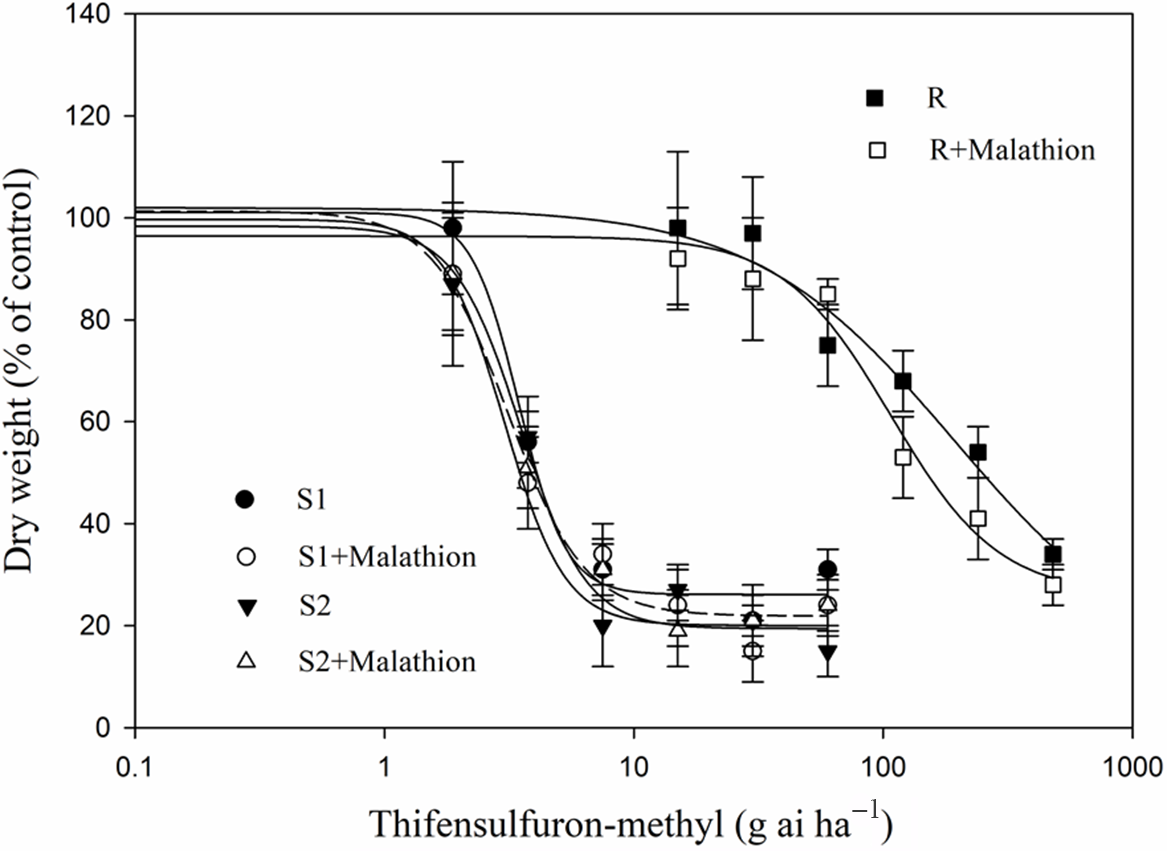
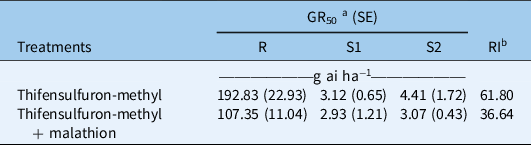
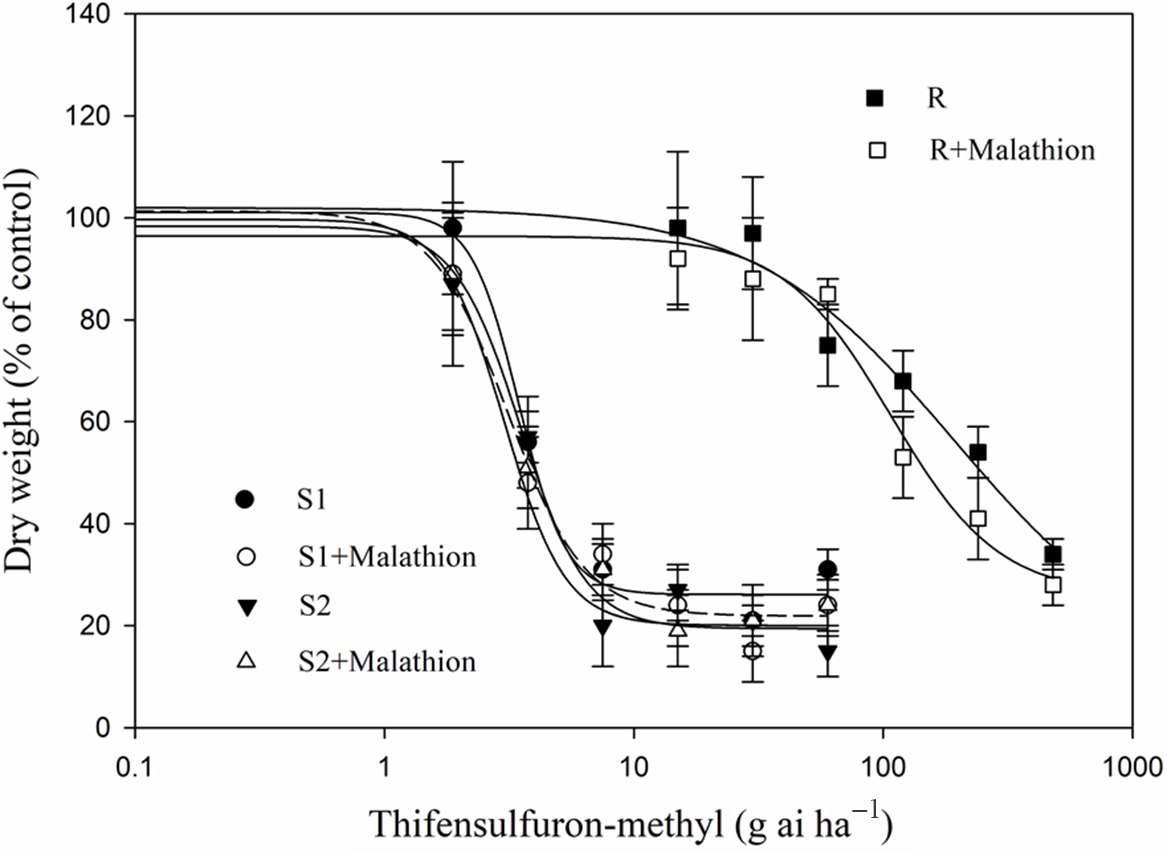
Dose–response assays confirmed that, compared with the S1 and S2 populations, the R A. retroflexus population was highly resistant to thifensulfuron-methyl. The S1 and S2 plants were not able to survive in response to 15 g ai ha−1, which was less than half the label rate. However, the R plants were not seriously injured and grew like the untreated plants. According to the GR50, the dry weight in the S1 and S2 populations decreased by 50% in response to thifensulfuron-methyl rates of 3.12 and 4.41 g ai ha−1, respectively, while the GR50 of the R population occurred in response to 192.83 g ai ha−1. Therefore, the R population was 61.80-fold more resistant to thifensulfuron-methyl than the S1 population (Figure 1; Table 2).
Dose–response curve for plant growth of the S1, S2, and R Amaranthus retroflexus populations. Vertical bars represent the SEs (P = 0.05).
Response to thifensulfuron-methyl by different Amaranthus retroflexus populations (S1, S2 and R populations) with and without malathion.

a GR50, herbicide dose causing a 50% growth reduction.
b RI, resistance index: RI = GR50(R)/GR50(S1).
In this study, we confirm that an A. retroflexus population has evolved resistance to thifensulfuron-methyl and other ALS-inhibiting herbicides, including imazethapyr, flumetsulam, and bispyribac-sodium. The same phenomenon was also observed in another A. retroflexus population with 126-fold increased resistance to thifensulfuron-methyl in Israel (Sibony et al. Reference Sibony, Michel, Haas, Rubin and Hurle2010). This high thifensulfuron-methyl resistance in the R population indicated that the resistance was likely because of a target-site mutation.
Effects of Malathion Pretreatment on Thifensulfuron-Methyl Resistance
Malathion inhibits CYP450 and is usually considered an indicator of metabolic resistance (Nakka et al. Reference Nakka, Thompson, Peterson and Jugulam2017). In this study, there were no significant effects on plant growth in the three tested A. retroflexus populations when just malathion was applied. However, malathion pretreatment with thifensulfuron-methyl resulted in greater injury to R plants than was observed with herbicide alone. The dry weight of the R plants decreased significantly following malathion plus thifensulfuron-methyl application, and the GR50 decreased by 44% (Table 2; Figure 1). In contrast, no significant difference was found in the GR50 of the S1 and S2 populations to thifensulfuron-methyl plus malathion pretreatment. These results indicate that enhanced metabolism could be contributing to resistance to thifensulfuron-methyl in the R population.
The members of the family of CYP450 enzymes play a critical role in herbicide metabolism (Duhoux et al. Reference Duhoux, Carrère, Duhoux and Délye2017; Yu and Powles Reference Yu and Powles2014). The thifensulfuron-methyl resistance in the R population could be reversed by the CYP450 inhibitor malathion in this study. This observation indicated that CYP450-mediated enhanced metabolism likely occurred in the R population. However, further research is needed to demonstrate this hypothesis. Similar results have also been found in other weed species, such as rigid ryegrass (Lolium rigidum Gaudin) (Christopher et al. Reference Christopher, Preston and Powles1994), large crabgrass [Digitaria sanguinalis (L.) Scop.] (Mei et al. Reference Mei, Si, Liu, Qiu and Zheng2017), and Palmer amaranth (Amaranthus palmeri S. Watson) (Nakka et al. Reference Nakka, Thompson, Peterson and Jugulam2017), for which malathion pretreatment significantly reduced the response of the resistant populations to the herbicide. Enhanced herbicide metabolism may afford unpredictable resistance to herbicides with different modes of action (Délye Reference Délye2013; Yu and Powles Reference Yu and Powles2014). Although malathion pretreatment with PPO-inhibiting herbicides was not performed in this research, the possibility of enhanced herbicide metabolism affording resistance to PPO herbicides cannot be excluded. In a future study, whether enhanced herbicide metabolism plays a role in PPO herbicide resistance and which candidate CYP450 genes are involved in herbicide resistance in the R population will be investigated and identified, respectively.
ALS Activity Assay
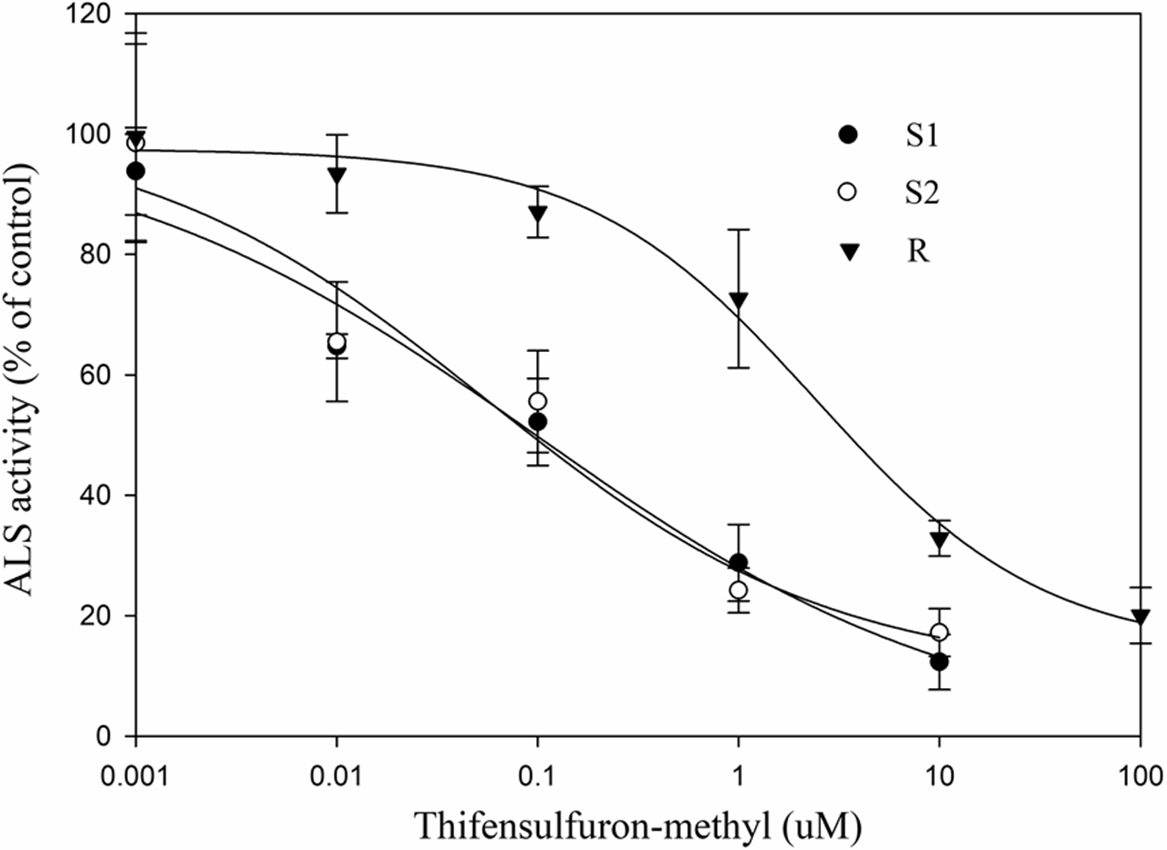
In the absence of thifensulfuron-methyl, the activity of the crude ALS enzyme was 10.06, 13.10, and 37.41 nmol acetoin mg−1 protein min−1 in S1, S2, and R populations, respectively. However, ALS within the R population was significantly resistant to thifensulfuron-methyl in the presence of thifensulfuron-methyl. As shown in Figure 2, the I50 values of S1, S2, and R populations were 0.06, 0.10, and 2.41, respectively. These results indicate that the thifensulfuron-methyl I50 value for the R population was 40.17 times greater than that of the S1 population (Table 3). These results strongly indicate a target site–based resistance mechanism within the R population. Furthermore, the resistance index of whole-plant dose responses (61.80-fold) was much higher than that of the ALS activity assays (40.17-fold), indicating that other herbicide-resistance mechanisms, such as enhanced herbicide metabolism, are at play in the R population. Enhanced herbicide metabolism to ALS-inhibiting herbicides has rarely been documented in eudicot weeds. The possible reason for this may be that it often affords low-level resistance, and compared with target-site mutation, enhanced metabolism is usually underestimated (Ahmad-Hamdani et al. Reference Ahmad-Hamdani, Yu, Han, Cawthray, Wang and Powles2012; Nakka et al. Reference Nakka, Thompson, Peterson and Jugulam2017).
Dose–response curve of acetolactate synthase (ALS) activity in S1, S2, and R populations of Amaranthus retroflexus. ALS activity is expressed as a percentage of activity, based on the untreated controls. Data were fit using a four-parameter to the equation: Y = C + [(D − C)/[1 + (x/I50) b ]. Vertical bars represent the SEs (P = 0.05).

I50 values of S1, S2, and R Amaranthus retroflexus populations treated with thifensulfuron-methyl. a

a I50, herbicide rate that inhibited acetolactate synthase (ALS) activity by 50%.
b R, resistant; S, susceptible.
c RI, resistance index.
Sequencing of the ALS and PPO Gene
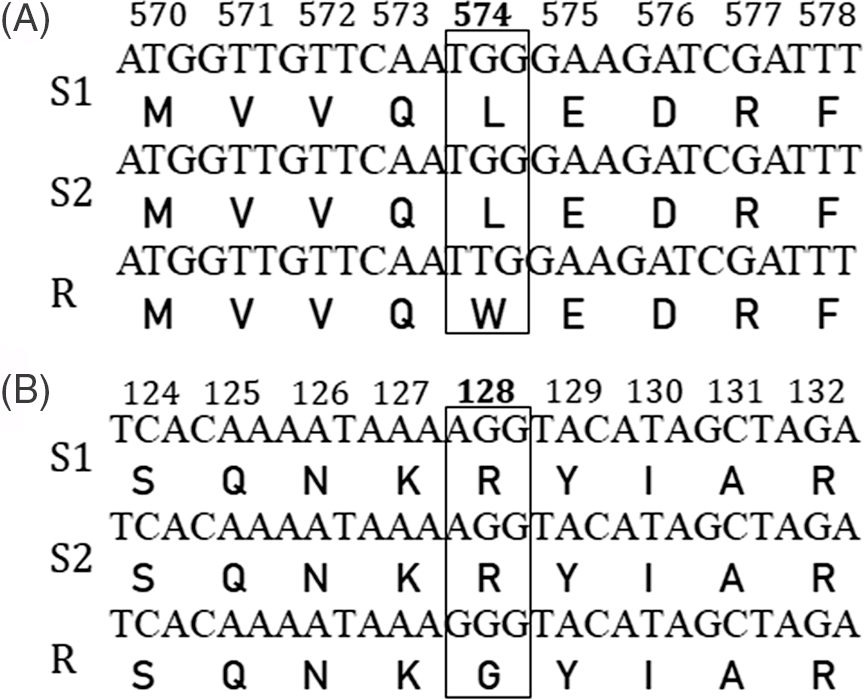
To investigate the molecular mechanism for thifensulfuron-methyl resistance, the ALS gene covering eight resistance-endowing mutations was amplified from the R, S1, and S2 populations. A comparison of the ALS gene showed that all 20 R individuals contained a nucleotide change of TGG to TTG resulting in a Trp to Leu substitution (Trp-574-Leu) at amino acid position 574 (Figure 3). The ALS sequence chromatograms exhibited double peaks at position 574 (in 13 out of 20 cases), indicating that 7 mutants were homozygous and 13 mutants were heterozygous (data not shown). The molecular results showed that Trp at position 574 of the ALS was replaced with Leu in the R population in this study. This is the same amino acid substitution documented for ALS resistance in previous studies, including waterhemp [Amaranthus tuberculatus (Moq.) Sauer] (Patzoldt and Tranel Reference Patzoldt and Tranel2007), A. retroflexus (Chen et al. Reference Chen, Huang, Zhang, Huang, Wei, Chen and Wang2015; McNaughton et al. Reference McNaughton, Letarte, Lee and Tardif2005; Scarabel et al. Reference Scarabel, Varotto and Sattin2010), and corn gromwell (Lithospermum arvense L.) (Wang et al. Reference Wang, Ge, Zhang, You, Wang, Liu and Wang2019).
Partial DNA and derived amino acid sequences of ALS and PPO2 from S1, S2, and R Amaranthus retroflexus populations. (A) Trp-574-Leu mutation in ALS gene in the R population; (B) Arg-128-Gly mutation in PPO2 gene in the R population.

As the R population was multiple resistant to PPO inhibitors fomesafen and lactofen, the herbicide target PPO2 genes from the R, S1, and S2 populations were amplified. Sequencing analysis showed an Arg-128-Gly substitution in most individuals (14 out of 20) of the R population, and 6 remaining individual plants did not have any reported PPO2 mutation (Figure 3). It should be noted that 6 plants of the R population did not have the 128 mutation or other reported PPO2 mutations. These results indicate that target-site mutation may not occur in these plants and that a non–target site resistance mechanism could contribute to resistance to PPO herbicides.
Susceptibility to Other Herbicides
To characterize the resistance status of the R population, the responses of these plants to ALS-, PPO-, and PSII-inhibiting herbicides at the label rate were investigated. The results presented in Table 4 indicated that the R population exhibited a high level of cross-resistance to the ALS-inhibiting herbicides imazethapyr, flumetsulam, and bispyribac-sodium and multiple resistance to the PPO-inhibiting herbicides lactofen and fomesafen. However, the R population was susceptible to the PSII-inhibiting herbicide bentazone. The point mutation resulting in the Trp-574-Leu amino acid change has been found to confer resistance to all five classes of ALS inhibitors (Tranel et al. Reference Tranel, Wright and Heap2020). Previous research using a whole-plant dose–response assay in another A. retroflexus population demonstrated that resistance to imazethapyr was also due to the Trp-574-Leu substitution (Chen et al. Reference Chen, Huang, Zhang, Huang, Wei, Chen and Wang2015). These results were in agreement with those of a study conducted by Ferguson et al. (Reference Ferguson, Hamill and Tardif2001), who reported that the Trp-574-Leu substitution provided cross-resistance to both IMI and SU inhibitors.
Survival rate of different Amaranthus retroflexus populations (S1, S2, and R populations) after herbicide treatments.

a ALS, acetolactate synthase; PPO, protoporphyrinogen oxidase; PSII, photosystem II.
In summary, this research illustrates for the first time the presence of both target site–based (Trp-574-Leu mutation in ALS) and likely non–target site based (enhanced herbicide metabolism) resistance to thifensulfuron-methyl coexisting in a single multiple-resistant A. retroflexus population. Further studies are underway to identify the candidate CYP450 genes that are involved in metabolic herbicide resistance in A. retroflexus. The evolution and occurrence of target-site resistance and non–target site resistance in the resistant A. retroflexus population poses a serious challenge to weed control. Moreover, multiple resistance to PPO inhibitors afforded by the Arg-128-Gly mutation in PPO2 was also found in the same A. retroflexus population. Therefore, management of this troublesome weed before it becomes a terrible threat in cropping systems is critical. Fortunately, bentazone, a PSII inhibitor, still had a satisfactory control effect on the R population. Previous studies have shown that diversity in weed control may disrupt and delay the development of herbicide resistance (Powles and Gaines Reference Powles and Gaines2016). In practice, farmers should integrate various weed management strategies, such as employing herbicides with different sites of action, using different tillage or cultural practices, and rotating crops to control herbicide-resistant weeds.
Acknowledgments
This study is supported by National Nature Science Foundation of China (31871985). No conflicts of interest have been declared.