Introduction
Seventy years after the Second World War, newsreel images of goose-stepping youth brigades in fascist countries linger in our imagination. In wartime Japan, elementary-school pupils passing through their school gates were expected to bow to the hōanden—the campus shrine containing the portraits of the emperor and his wife. The children lined up in the courtyard for morning assembly, calisthenics, and recitations of the Imperial Rescript. They assisted the local neighbourhood associations with public ceremonies, and gave send-offs for departing soldiers, shouting ‘banzai’ and singing patriotic songs. They paid their respects to wounded soldiers in hospital, and did cleaning duty at school and at state shrines. Over summer break, children aged 12 and above were sent by their schools to help farmers with the harvest. These activities were part of ‘the fundamental training of the national people’ (kokumin no kisoteki rensei) under the National School Ordinance (Kokumin gakkō rei), promulgated on 1 March 1941. Terms such as rensei (training), kunren (physical drill), and gyō (practice) appeared in the public-education discourse, stressing disciplined military drill. Terasaki Masao, historian of education, calls it a strategy to groom the people for Total War.Footnote 1 The 1941 terminology recasting elementary schools (shōgakkō) as National Schools (kokumin gakkō) and the increasing reference to children as little nationals (shōkokumin)Footnote 2 indicate that children were not to be exempted from Total War. Children, like adult civilians, were resources to be marshalled in support of the war effort.
Nevertheless, children's wartime education in Japan was more complex than might be suggested by rhetoric and parade marches. Recent scholarship shows that schools used music and theatre, introduced through the progressive ‘whole-person’ education movements of the preceding Taishō era (1912–26), to encourage children to connect emotionally with the national heroes in the textbooks.Footnote 3 Similarly, Japan's post-war mandate for equal opportunity through education was not merely an American imposition, but had roots in the education debates of the 1930s leading up to the 1941 National Education Ordinance.Footnote 4 This article builds on such efforts to trace continuities across the dramatic political shifts of pre-war, wartime, and post-war Japan. Focusing on one specific aspect of the curriculum—school diary writing—it seeks to elucidate the complexities of educational discourse and practice during the war, and give a more nuanced picture of how educators sought to shape the dispositions of children for the benefit of the state.
School diaries have been cited by historians, journalists, and editorialists to illustrate wartime hardships, but diary writing as a wartime pedagogical practice is only beginning to be explored, as scholars have tended to focus on the more obvious tools of propaganda: textbooks and children's media.Footnote 5 As historians pay more attention to the role of emotions in the dissemination of cultural ideas,Footnote 6 school diaries will be of increasing interest for exploring more subtle modes of ideological education, while gauging receptivity to them. Research emerging from a University of Manchester project (2013–16) warns of the methodological difficulty ‘of disaggregating direct adult influence from children's contributions to their life stories’ and cautions against seeking in children's writing a literature of resistance.Footnote 7 However, if taken collectively as reflecting a cluster of influences—individual temperament, peer group, parents, teachers, school policies, mass media, and state propaganda—school diaries still provide a window to the evolving shape of education during the war.
While not all public schools included reflective diary writing in their curricula, the schools affiliated with the Tokyo Women's Higher Normal School (Tōkyō Joshi Kōtō Shihan Gakkō, hereafter shortened to Tōkyō Jokōshi) assigned diary writing to pupils in all grade levels. Known today as Ochanomizu University, the Tōkyō Jokōshi was one of four elite teacher-training colleges under the auspices of the Ministry of Education. Perhaps its elementary school may therefore be considered something of a national model. Attended by children from well-to-do families, the elementary school offered a high standard of teaching, according to former pupil Mikawa Sueko.Footnote 8 The genders were segregated, although girls happened to greatly outnumber boys. After the war, an alumni committee calling itself the Faith in Peace Project 21 (Heiwa Shinnen Purojekuto 21) compiled 2,500 pages from 15 diaries written individually by girls and one diary written collaboratively by boys during their evacuation to the countryside.Footnote 9 In 1989, they donated a set of colour copies to the National Diet Library. It was one of the first sources on wartime school evacuation collected by the NDL. ‘My predecessor recognised its value,’ an acquisitions librarian explained to me. ‘Even though the library does not normally acquire photocopies, the material was unique at the time.’Footnote 10
By comparing samples of children's writing with the written feedback they received from teachers, along with the memories of two former diary writers, I aim to show how reflective diary writing functioned as soft programming for the Total War mentality. What children emphasized in their writings versus what they omitted, and how they were guided by teacher feedback, sheds light on the pressures they faced to keep personal expression consistent with group expectations. Aaron William Moore, examining a variety of children's writings in several evacuated schools, argues that children did not just parrot adults, but actively developed a shared language with their peer groups.Footnote 11 This article shows how the teaching philosophy of diary writing gave children the space enabling their participation in the construction of the collective self-image of the Little National, nudged on by teachers invested in the Ministry of Education's vision.
The relationship between the practice of personal expression through writing and the formation of the ideal Total War civilian surprised me because Japanese historians of education tend to position diary writing in the context of Taishō-era progressive education favouring individual self-expression and personal development. It challenged my common-sense assumption that Japanese ultra-nationalism produced an about-face in education, reversing progressive Taishō developments. Rather, it may be said that a Taishō-era teaching method survived into the war years because educators saw its effectiveness at cultivating attitudes, and believed it would help develop children's consciousness in ways that would support the wartime state.
The progressive origins of school diaries
As a literary form, diary writing has roots in the Heian period (794–1185). But awareness of its pedagogical potential seems to have peaked in the early twentieth century. According to Namekawa Michio's seminal three-volume history of writing education, writing teachers in the Taishō period adopted the term tsuzurikata (‘way of writing’) to distinguish the theory and practice of personal reflective writing from expository prose, such as essay composition (sakubun).Footnote 12 The word tsuzurikata consists of tsuzuri (orthography) and kata (method, form). It can be translated as composition, or simply as writing. Namekawa gives examples of children's tsuzurikata, showing how collaborations between child writers and teacher-editors produced genres over time, but he stops short of describing a wartime genre for the period 1937–45. Nevertheless, the pre-war genres merit discussion because there seem to be threads of continuity in the Tōkyō Jokōshi diaries.
The ‘writing education’ (tsuzurikata kyōiku) movement first emerged on the margins of the education field. Teachers, often working in rural public schools or progressive private schools, formed study groups and printed their pupils’ writings in school newsletters and circulars. Alternatively, they submitted their pupils’ writings to contributor columns in children's magazines, where editors gave feedback. Many of these teachers encouraged children to write down what happened each day, and include an illustration, hence the picture-diary format (enikki or enisshi), which continues in many Japanese schools to this day.
Until recently, there has been little or no scholarship on the writing education movement published outside of Japan, apart from brief definitions by Kaori Okano and Motonori Tsuchiya, and by Benjamin Duke, and a longer description by Chisato and Mary Kitagawa. In the words of Okano and Tsuchiya, the movement was ‘a subtle challenge to and a criticism of the state-imposed schooling’.Footnote 13 Kitagawa and Kitagawa draw on Namekawa Michio's narrative, touching on divisions within a movement based on progressive experimentation. During the Great Depression, a strand appeared that focused on ‘daily life writing’ (seikatsu tsuzurikata). Kitagawa and Kitagawa translate this term as ‘life experience composition’, emphasizing the importance of transcribing personal experience and direct observations.Footnote 14 Duke translates it more broadly as the ‘creative-writing association’ and the ‘life-in-education movement’.Footnote 15
Initially, teachers latched onto the idea of making children write about their own lives because they believed that the state-sanctioned textbooks were unappealing to children, written in a language that differed from local dialects, dealing with topics too removed from the experiences of ordinary people. To motivate children to practise writing, would it not be better to let them write in their own words about familiar things? As they matured, children would be able to tackle increasingly abstract topics. Here, we notice Pestalozzi's concept of object lesson, according to which education should correspond to child development; young learners begin by observing and exploring known objects and concrete experiences before turning to more complex problems. In their normal school training, teachers since the Meiji period had been exposed to the works of progressive Western educators, such as Friedrich Froebel, G. Stanley Hall, and John Dewey.Footnote 16 By the 1920s, many teachers and parents in the educated establishment romanticized childhood and valued children's self-expression.Footnote 17 Thus, instead of following the Edo-period tradition of making children copy literary models, they let children choose their own topics and write in their own childish vocabulary. A term from the Buddhist lexicon, the ‘child's heart’ (dōshin), came into vogue.
A corollary to daily life writing was the idea that children's lives could be improved by keeping diaries. This was called ‘life guidance’ (seikatsu shidō) through writing. One of its earliest advocates, Chiba Haruo (1890–1943), viewed life guidance as self-awareness emerging spontaneously from the practice of reflecting on one's daily life. ‘Guidance’ was therefore not a matter of active direction from teachers. After 1930, teachers in the proletarian literary movement saw in life guidance the possibility of social critique in addition to self-actualization. It took on the political dimension of raising consciousness about the hard lives of children affected by rural poverty.Footnote 18
Because of the leftist connotation, it is difficult to imagine how life guidance through daily life writing might survive into the war years. The conventional view is that it ended with the police crackdowns on communists, although scholars offer different dates. Duke writes that ‘the movement was essentially amorphous’, so ‘it was extremely difficult for the authorities to suppress it’. He nevertheless believes that it ended with the 1935 arrest of the founding editor of one of its journals, Northern Education (Hoppō kyōiku).Footnote 19 Namekawa briefly references the 1940–41 police campaign leading to the arrests of some 300 writing teachers, known as the Writing Classroom Incident (tsuzurikata kyōshitsu jiken). ‘The movement was crushed,’ writes Kenneth Goodman but, after the war, it ‘survived and spread’.Footnote 20 Kamemura Gorō believes that, after the Writing Classroom Incident, classroom writing became a patriotic duty to the state, centred mainly on composing letters to troops and airmen on the front lines.Footnote 21
However, some form of life writing continued into the war years, adapting to new circumstances. Kitaoka Kiyomichi finds it in Hiroshima prefecture, although he adds that most writing teachers after 1940 were too busy with ‘imperial subject training’ (kōkokumin rensei) to find the time.Footnote 22 Kawamura Minato points out certain continuities in pre-war, wartime, and post-war classroom writing.Footnote 23 Namekawa posits a genre of writing connected with ‘emperor-centred nationalism’ (kōkoku-shugi), but does not define it or describe what it might be.Footnote 24 After the war, citizens’ groups made public their school diaries in an effort to commemorate their wartime experiences. The survival of these documents shows that diary writing was commonplace in education. Furthermore, the Ministry of Education's 1941 policies included a section on ‘writing guidance’ (tsuzurikata shidō), showing signs that the life-writing movement influenced mainstream wartime education. Yet, in the instructions below, life writing accompanies a new goal: ‘awareness of national identity’. What is missing is any mention of social critique or self-actualization:
1. Help the child become accustomed to presenting its life in words. Then gradually encourage artless, simple written expressions, and nurture the basic manner of writing.
2. With regards to the events and daily behaviours that the child sees and hears, guide its way of seeing and thinking to enrich life and motivate expression.
3. Encourage the use of precise, diverse expressions, making sure that the words are clear in terms of their purpose and usage. Gradually nurture the power of expressions suited to the actual daily lives of the nation's people (kokumin seikatsu).
4. Develop the matters pertaining to point 3 to evoke a national awareness (kokuminteki jikaku), using rich expressions of the national language. Further the child's fluency in practical language.Footnote 25
Here, the sequence of points 1 to 3 (improving expression) begins with the child and its immediate environment, and culminates in point 4 on a more abstract level with ‘a national awareness’, along with practical fluency. How exactly the child is to move from points 3 to 4 is not explained, but the emphasis on language arts suggests that children were expected to develop a sense of national identity through daily practice of the national language itself. Thus, national identity would emerge passively in the repetition of language expressions, rather than through the content of the writing.
We expect to find the above ‘writing guidance’ reflected in the Tōkyō Jokōshi diaries. In other words, teachers would not tell children what to write; rather they would encourage children to be self-motivated in acquiring vocabulary and self-conscious in using vocabulary to express themselves as Japanese nationals. Presumably, the wartime state approved of daily life writing because of its perceived power for internalizing shared attitudes and good habits beneficial to the state, and not because of its potential for self-discovery and social critique. But teachers might have to step in occasionally and nudge children in the right direction. For this reason, it is important to pay attention to teachers’ written feedback.
Life guidance for endurance (gaman)
Children in the Tōkyō Jokōshi-affiliated elementary school were assigned diary writing throughout their six years of study. The diaries compiled by the Faith in Peace committee are mainly limited to the period of evacuation between 21 August 1944 and 9 March 1946. Initially, the children were evacuated to flee the American advance but, after Japan's surrender, their evacuation was extended for half a year because the Ministry of Finance had appropriated their school buildings, having lost its own in the bombings.
Not all children were evacuated with the school, only those without relatives to host them in the countryside. At first, evacuation was limited to pupils in grades 3 to 6 in keeping with Tokyo city government guidelines, but it was extended to those in grades 1 and 2 following massive American bombing raids in early 1945. (Graduating sixth-graders were sent back!) Over 200 children moved to farmland in Kumegawa on the outskirts of Tokyo, where they slept in barns, but took their meals and classes outside on all but the coldest days. After American warplanes began flying over Kumegawa, they moved north on 9 April 1945 to Fukumitsu, a country town in a plain ringed by alpine mountains in Toyama Prefecture. There, the group of 143 Kumegawa veterans and new additions (124 students and 19 staff) were joined by their school principal Hori Shichizō, who was from the region and had chosen the town where his younger brother was a local school principal.
Hori had trained in Toyama until 1906, when he moved to Tokyo and pursued further study at the Tokyo Higher Normal School (now Tsukuba University), the men's equivalent to Tōkyō Jokōshi. In 1910, he joined the teaching staff of Tōkyō Jokōshi, and later became the principal of its elementary school. Now, in early 1945, he was almost 60. He negotiated for part-time use of the Fukumitsu school facilities, and persuaded business owners to take in groups of children and supervising teachers. According to archivist Somei Chika, the teachers were recent graduates of normal school, not necessarily from Tōkyō Jokōshi, but hired by Hori.Footnote 26
The children's diaries mostly describe daily survival, which apparently took precedence over study and play. The lack of whimsy or forays into the imaginary may seem unchildlike, and perhaps reflects the trauma of the experience. Yet, it is also true that Taishō-period leaders of life writing, such as Chiba Haruo, Sasaoka Tadayoshi (1897–1937), and Kokubun Ichitarō (1911–85), stressed the importance of writing faithfully from observation and experience. They were not interested in fantasy. Rather, they focused on how children related to their local environments. In the 1930s, other pedagogical trends emerged that were likewise based on studying the local environment, but unlike, say, the nativist Hometown Education (kyōdō kyōiku) movement,Footnote 27 the life-writing movement at that time was not driven explicitly by an agenda to define national identity.
Teachers wrote short evaluations at the end of each diary booklet, but rarely commented on the rest of the pages. When they did, it was mostly to correct orthography, especially in the case of younger pupils, but occasionally there are words of encouragement. For instance, on 13 August 1945, fifth-grader N. Hanako wrote about her mother's visit: ‘For the first time in a long time, I slept with Mama.’ Her teacher echoed the happiness implicit in the narrative and the drawing of the mother bearing a gift bag: ‘It was a happy day today, wasn't it! To be able to meet your vibrant mother.’ On 21 January 1945, fifth-grader N. Tokuko describes a day of gathering firewood in the mountains. Her teacher responds: ‘I appreciate that you are fatigued after having to gather firewood twice in a row, but it's for cooking everyone's dinner. Isn't it wonderful that you have become so strong!’
It goes without saying that the wartime regime valued physical strength in its future soldiers and workers. Even so, evacuated children needed to be strong to perform demanding chores, such as folding futons, washing sheets and clothes by hand, scrubbing and filling the communal bathtub, gathering firewood, carrying bags of rations, and growing vegetables. Ō. Sueko, who joined the evacuation late, wrote on 23 March 1945 that she was so tired from the day's chores that she had to be carried back to her lodgings. Her teacher comments: ‘I think you realise from carrying rice today just how much the Kumegawa group strengthened their bodies while you were in Tokyo going to that other school.’ The teacher is implying that Sueko too will become stronger.
On 3 August 1945, N. Hanako wrote about learning to swim during a class outing to the local river. ‘Seeing M-san learn to swim for the first time made me think I could do it too, and when I tried, I found I could, which made me really happy,’ she writes. ‘Because I went to a deep place I [started to] drown. When I panicked a bit, Akusawa sensei saved me.’ The teacher's response ignores the drama of almost drowning, and stresses the importance of strength and courage: ‘Finally it has become intensely hot. Let's firmly train our minds and bodies to be strong.’ In the next line, the teacher adds: ‘Also, because spelling mistakes are appearing here, pay attention, pay attention.’
Teachers typically expressed approval for the clarity of the writing and accurate reportage, but also for the writer's positive attitude in the face of daily hardships. Most children wrote in a positive tone without complaint. They express emotions in certain predictable contexts, recording surprise at new experiences, amusement at a funny teacher, happiness at winning a sports match, or a combination of happiness and sentimental tears on days when parents were allowed to visit. If a child starts to express self-pity or demoralization, the teacher will call for self-control. For example, fourth-grader U. Eiko wrote about feeling homesick when her mother visited:
‘I want to go home’, I said, feeling safe to let out everything I had endured until now, wanting to cry. After the meal, Father came, and I was so happy. ‘I'll stay right up to 4 pm’, [closing time for parental visits] he said. After a while, there was no choice but to part ways. Everyone was talking a lot. I'm so weak; tears came to my eyes. I envy the spirit of N. and the others. (14 January 1945)
‘You will gradually get used to it,’ writes the teacher. ‘Show some spirit.’ Indeed, Eiko's diary entries seem to become more positive over time. The teacher's overall evaluation of 19 May confirms the progress, while calling for more self-control: ‘I'm delighted to see that you have become considerably more bright and cheerful than when you first arrived, but get a grip on your heart, and when you are suffering, come to your teacher who is your mother's substitute here.’
Pointing out that Eiko still cries when she receives letters from home, the teacher implies that personal morale will determine the outcome of the war: ‘Everybody wants to go home, but let's keep enduring it. This is because it's the war, you know. To end up crying and feeling gloomy is to lose.’ Eiko must therefore monitor her own morale. ‘Reflecting on your actions every single day is extremely good,’ writes the teacher. ‘Your feelings are beautiful when it comes to paying attention to little things and devoting your heart to fixing them.’ At the same time, the teacher also believes that Eiko is already too self-critical for a child: ‘But I do not want it to turn you into a gloomy adult-like child (kurai otonabita kodomo).’ This comment is especially interesting because it shows that the teacher still believes in the pre-war ‘child's heart’ trope, and thinks that precocious self-awareness will damage the presumably childlike nature of being innocent, bright, and cheerful.
Ō. Sueko is less forthcoming about her unhappiness than Eiko, although her drawings are suggestive. She devotes more space to food relative to the day's events. On 10 July 1945, she drew a picture of three girls dreaming of food. This provokes her teacher to respond: ‘Let's stop keeping a food diary!’ In the context of food shortages and severe rationing,Footnote 28 when placards around the country declared ‘Desire nothing until victory’, Sueko was showing the weakness of desire by repeatedly drawing food. It must have been hard on the teacher as well. Steering her away from the topic of hunger, the teacher instead shows sympathy when Sueko relates how classmates teased her for trying to rinse a dust cloth in the wrong bowl. ‘As this was the first time, you would not have understood that what everyone was calling the washbowl was for dishwashing,’ writes the teacher. ‘That was wrong of them. You must have felt sad’ (27 March 1945). In pictures of classmates doing group activities, Sueko tends to omit faces. Only teachers and lone self-portraits have facial features. It could signify her alienation from the peer group or, conversely, the loss of individual identity in communal life.
A particularly bold example of demoralization appears in the group diary of the fifth-grade boys’ class. Unlike the girls, who wrote their diaries individually, the boys took turns writing a group diary. There are many pictures of warplanes, unrelated to the written content, and no teacher comments until the last page. The following entry of 30 April 1945, once again illustrated by a warplane, describes a teacher reprimanding the boys as a group for failing to perform self-censorship in their letters home:
This morning we had class. In the afternoon, we wrote postcards. At that time, we all wrote, ‘There's almost no food. It's so hard I want to kill myself’, and all the things we normally think. After I paid a sick visit to my little brother, I noticed everyone gathered in Room 7, listening to something Saitō sensei was saying. When I entered and began to listen, I understood the reason. It was the postcards. After dinner all of us fifth-graders in Section Three stayed behind, and received a thorough scolding.
In this case, a teacher lectured the children, telling them what not to write. It is unclear how often teachers thought it necessary to berate pupils—examples do not appear in the girls’ diaries—but, obviously, they monitored letters home. Even here, the author does not complain directly, but indirectly through recounting the incident. Recounting it could be a form of contrition serving to remind others to endure the difficult conditions and maintain morale.
Life guidance as moral education for cooperative behaviour
Twenty years earlier in 1925, life-writing leader Chiba Haruo proposed that writing could be a form of life guidance because a child might reflect on personal behaviour while narrating the day's events. Tōkyō Jokōshi teachers likewise endorsed self-reflection through writing but, unlike Chiba, they did not leave it up to chance and individual choice. N. Tokuko's diary entry of 9 June 1945 describes a ‘self-reflection meeting’ (hansei kai), during which she and each classmate made a confession, and resolved to improve. Her teacher writes: ‘Let's show that we have thoroughly reflected on our actual behaviour.’
Pupils in several classes were expected to write a sentence or two of self-criticism in their diaries under the heading ‘Self-reflection’ (hansei). Third-grader K. Noriko writes on 4 September 1944: ‘I feel badly for thinking about home during Phys. Ed. class, and not practising seriously.’ Two days later, she writes: ‘I am sorry. I forced I-san to play with me when she did not want to.’ Fifth-grader N. Hanako's reflection of 10 August 1945 describes going to the hairdresser with two friends, because ‘Somehow the hair on the sides seemed somewhat long again’. The hairdresser trimmed her hair, but Hanako writes: ‘Because of the shape, as soon as I left the hairdresser, I ended up complaining with U-san and the others, which was wrong of me.’ Her teacher writes: ‘Your hair did seem a little long, didn't it. However, one must not complain.’ The comment is sympathetic, but also reinforces the code of conduct.
Sixth-grader N. Yukie's behaviour was of particular concern, eliciting an unusual number of comments from her teacher. On 31 August 1944, Yukie described how she and five classmates were dispatched to pick up the rations of miso (fermented soybean paste) and carry them back in a wheelbarrow. In the evening, she practised arithmetic with two classmates. ‘You are very active and cheerful,’ wrote the teacher. ‘It is good that you are making people around you happy. You are also able to do your work effectively. I am very much impressed with how you are always ahead of your group.’ However, this effusive praise merely serves to soften the criticism that follows: ‘It does not mean that you can be bossy or yell at someone who works more slowly. It will spoil your charm. Be humble. Do not boast.’ Yukie stood out, thanks to her exemplary work ethic, but she was proudly placing herself above the others. Since Yukie was not boasting in her diary, the teacher's comment is a response not to the text, but rather to observable behaviour.
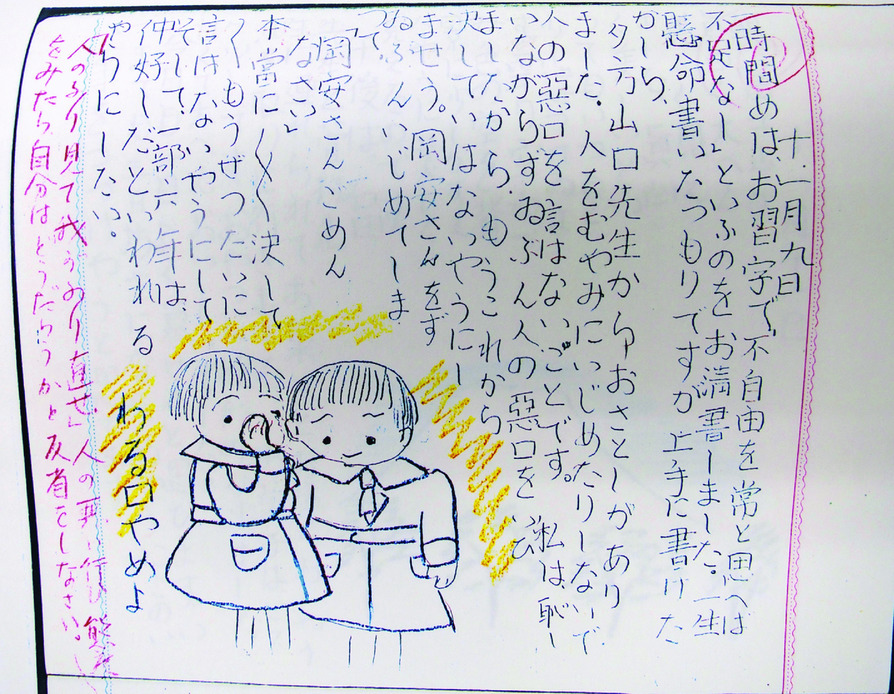
A little over a month later, on 9 November 1944, Yukie began her diary by reporting on the calligraphy lesson in the first period. ‘I think I did my best,’ she wrote, and then, as if fishing for praise, asked: ‘How well did I do, I wonder?’ There is no teacher comment. Then, Yukie changes topic and writes: ‘In the evening, I was admonished by Yamaguchi sensei. He told me not to accuse others thoughtlessly, and not to speak ill of others.’ Yukie pours out feelings of remorse:
I am ashamed of how often I spoke ill of others. I will never do it again. I was mean to O-san. I am sorry! Really, really, never, never will I speak ill about others again. I want to try to be nice so that our Grade 6 Section 1 will always be known for getting along.
An illustration shows a little girl whispering into another girl's ear. Presumably, the whisperer is Yukie, although the two figures look identical. Next to the picture (Figure 1), Yukie has written: ‘Stop speaking ill of others!’
‘Stop speaking ill of others!’ School diary of N. Yukie, 9 November 1944.

The teacher responds with a proverb—‘One person's error is another person's lesson’ (Hito no furimite, waga furinaose)—and adds: ‘When you see another person's bad behaviour, ask yourself, what about my own behaviour?’ This is a reference to the Analects of Confucius, in which the Master says: ‘When you meet someone better than yourself, turn your thoughts to becoming his equal. When you meet someone not as good as you are, look within and examine your own self.’Footnote 29 The lesson for Yukie is to guard against pride: rather than feeling superior to someone else's failings, she should monitor her own behaviour.
The next day, on 10 November, Yukie describes her physical education class, followed by the chore of digging up and cutting sweet potatoes for cooking. This time, she puts her classmates first in the narrative: ‘H-san and N-san were the first ones to cut the potatoes. I also joined in.’ Apparently, the job went well: ‘Happily, the potatoes sliced easily with a nice crisp snap.’ After describing the rest of the day, Yukie concluded: ‘Today, I think I was able to follow what my teacher taught me yesterday. If I try hard I can do it, I can do it. By all means I can do it if I make an effort.’ Rather than giving her praise, the teacher wrote: ‘When a job is well done, give that person a friendly comment on the spot.’ In other words, simply refraining from criticizing classmates is not enough. Yukie should be encouraging them.
A week later, Yukie has made progress in her behaviour. ‘I think today was a good day for me,’ she reported on 16 November. ‘For a moment I wanted to say something sarcastic, but I made myself keep my mouth shut.’ Then she added: ‘Every time I do even the slightest bad thing, I will write it down honestly as I did yesterday and today.’ The teacher's comment reinforces this resolution: ‘Yes, you must be strict about reflecting on what you do, so that you correct yourself.’ Here, we see diary writing used as a means of moral training through confession and repentance. ‘I want you to become a kind-hearted person who generously forgives others,’ writes the teacher. On 20 November, Yukie wrote: ‘For a moment, I had a hateful thought about a certain person. I will keep it only in my head, and will not say it to others.’ To this, the teacher replies: ‘Instead of writing “a certain person”, as if your diary would be seen by others, write how you came to have such a feeling.’ In other words, the teacher wants Yukie to go beyond self-control for the sake of appearances and engage in self-examination.
Three months later, on 7 February 1945, K. Yasuko, a classmate in Yukie's section, accused Yukie, together with another girl, F-san, of using sarcasm while taking cover in the air-raid shelter. Yasuko wrote that Yukie ‘bullied’ several classmates who had just returned from Tokyo, where they had attended the principal's farewell ceremony. Here, a school diary was used to inform on a classmate, showing how diaries were useful for monitoring behaviour in circumstances where a teacher might not be present (as in the air-raid shelter). The teacher's comment reinforces the code of conduct while drawing on the virtue of humility: ‘Yes, it is wrong to envy and begrudge others, isn't it? So be sure you don't imitate that sort of behaviour.’
Controlling behaviour through persuasion, not punishment
No doubt, Taishō-era experts on life writing would have viewed the moralistic tone in the comments of Yasuko's teacher as adult interference. But, in the wartime reality of school evacuation, teachers were responsible for their pupils at all times. Getting children to behave and cooperate was critical to the mission of protecting and educating them. Depressed and selfish complainers, as well as prideful personalities, put group cohesiveness at risk. This may in part explain why teachers appeared to monitor their pupils’ attitudes closely. Another reason is surely because the wartime culture of education under the National School Ordinance was more controlling, designed to benefit the state, not the individual ambitions of students. In a climate of military-style drilling, what is surprising is that Tōkyō Jokōshi teachers still sought to control the children through persuasion, not punishment.
To be sure, corporal punishment existed in other schools. Farmers’ sons I interviewed in Ibaraki Prefecture in January 2014 recalled fearing teachers who regularly slapped faces. In contrast, Tōkyō Jokōshi teachers inspired their pupils with gentleness. Was it because their pupils came from elite families? Certainly, there is evidence of special treatment. For example, Maeda Tokuko, co-founder of the Faith in Peace alumni group, told me that she and her classmates did not have to do work service on farms. Two surviving timetables show that, while in Kumegawa, the fourth-grade girls did sagyō (work) twice a week and the sixth-grade boys did sagyō four times a week. However, the nature of the work, according to Maeda and as demonstrated by the diaries, was to grow their own vegetables and dig air-raid shelters on property leased to the school. When they moved to the rural town of Fukumitsu, where they were split up and housed among the local business owners, the word sagyō disappears from their timetable. This is quite extraordinary given the severe shortage of farm labour due to military conscription. Children in other evacuated schools, housed in temples and mountain spa resorts, were expected to help on farms, just like the local children.Footnote 30
Another indication of special treatment is that Tōkyō Jokōshi children were not permitted to interact with the local children, even though they were sharing the use of Fukumitsu library and the elementary-school grounds. ‘We were told that country children were stronger, and that we weaklings (moyashiko) would not be able to hold our own in a fight,’ Maeda told me.Footnote 31 In other evacuated schools, city children might befriend country children and learn survival skills, such as foraging, as recounted in the diary of one teacher.Footnote 32
Nevertheless, the status of the school and the social background of the children are only part of the story. Education discourse published during the war stresses the value of positive role models and a trusting relationship. Tanaka Yūtarō, a lecturer of the Tokyo [men's] Higher Normal School, one of the four elite higher normal schools that included Tōkyō Jokōshi, wrote in 1942 that the best kind of teaching is to lead by positive example rather than by scolding. To gain the child's trust, the teacher must not be a strict or scary taskmaster, but a genuine friend, while remaining in charge. Children need to write in a ‘relaxed frame of mind’ without worrying about making mistakes.Footnote 33
Similarly, in Cultivating the National School ‘Good Child’ (Kokumin gakkō ‘yoi kodomo’ no shitsuke), Andō Keisuke warns against scolding or negative reinforcement, and does not mention corporal punishment. He distinguishes between outward polite behaviour and interior attitude. It is the latter that children must acquire, and they will only do so if their teachers are sincere. Unless the teacher is genuinely inspired by the child's behaviour, words of praise will fail to motivate. Teachers must forgive honest mistakes because scolding children for confessing misbehaviour will make them devious. Children who lose their childlike purity will become precocious and insincere. ‘Sincerity is the basis of Japanese education,’ Ando declares. ‘For a million hearts to beat as one,Footnote 34 to fulfil the Way of the Emperor,Footnote 35 to lead a correct and proper life, to become a Good Child (yoi kodomo written in katakana for emphasis) . . . it requires a pure heart.’Footnote 36
Andō’s academic affiliation is not stated, but his other book titles point to an interest in the value of traditional arts, such as calligraphy and buyō dance, as a means of ‘training’ (shūren) applicable to moral education. The parallelism in the structure of his prose has the flavour of Confucian aphorisms. He was most likely conservative, nostalgic for tradition, and supportive of the wartime education policy, or he would not have escaped the censors in 1942.
Andō believes that a true Japanese education requires a student–teacher relationship that returns to the intense bond that presumably existed between the Edo-period sword master and his disciples. This bond, he explains, is based on trust (shin) and sincerity (makoto)—key qualities that the teacher must possess in order to inspire the same virtues in the student. Therefore, teachers must be good role models, demonstrating the ideal characteristics of the Good Child: obedience to teachers, passion for the nation, diligence, respect for rules, and cleanliness and tidiness. In fact, similar virtues appear in the Ministry of Education's morals textbooks in the form of the ‘moral biography’. As described by Samuel Yamashita, the protagonist faces adversity and overcomes it thanks to courage, loyalty, industriousness, or some other virtue.Footnote 37 Although Andō does not discuss specific curricular subjects, such as daily life writing, he recommends that children keep a notebook to draw or write down their thoughts in order to ‘practise cheerfulness and propriety’. ‘Keeping track of one's good behaviours and thoughts will gradually help in the formation of a good person,’ he claims.Footnote 38 This is surely a reason why the Tōkyō Jokōshi school practised life guidance through daily life writing, even under the extraordinary circumstances of evacuation.
Enduring the hard conditions, many Tōkyō Jokōshi children nevertheless managed to keep up the appearance of the Good Child, who is able to ‘answer clearly, do homework regularly, be capable, be obedient, write neatly, work hard (at chores), and review homework often’.Footnote 39 A teacher, praising fifth-grader S. Michiko for expressing herself well, urges her to keep being a cheerful child (30 April 1945). Another teacher praises fifth-grader O. Hiroko for her potential to become ‘a very fine, good child’ (24 August 1944). N. Tokuko's teacher writes: ‘A bright and obedient N-san grows up before the teacher's eyes, surely to become a fine person’ (16 January 1945). A teacher praising U. Eiko echoes Andō’s belief in sincerity: ‘No matter what, if you put your all into it, and show your sincerity, you can move the hearts of readers. Even in daily life, the most important thing for human beings is sincerity. It's in the small things, and it will come through in your diary’ (9 February 1945).
For Andō, proper form is critical for good conduct. ‘Bright and cheerful’ greetings by children will build good relations with teachers, family members, and neighbours. These relationships are reciprocal, and require mutual respect.Footnote 40 Tōkyō Jokōshi children practised proper form, as described in the self-published memoir of a retired local assemblyman, Nishio Hiroshi, whose mother opened her home to them. Nishio was the son of a textile manufacturer, who had died in 1941. In the spring of 1945, he returned home on leave from his university labour service (building warplanes) and was surprised to discover 20 schoolboys (six fourth-graders and 14 fifth-graders), three teachers, and one ‘dormitory matron’ (ryōbō) living on the second floor of his large family home. Their good manners and polite diction made a lasting impression:
Returning home on occasion, I talked to them and played with them, and was impressed by their good attitude and diligent studying, thinking to myself, ‘It's only natural that such fine children would come from teachers under the direction of the Ministry of Education’. Every night before bed, the children would face the direction of Tokyo, sitting properly (in the seiza position), and recite Her Majesty the Empress's ode to school evacuees: ‘You who should shoulder the next world, grow up sound and strong in body in the villages where you relocate’. Then, right before lying down to sleep they would intone, ‘Goodnight father and mother, goodnight teachers, goodnight everyone’.Footnote 41
Local children in Fukumitsu did not behave like this, the 90-year-old Nishio told me in an interview on 11 June 2015. Clearly, teachers had successfully instilled in their pupils good manners and proper form. Nevertheless, the primal urge of hunger must have been a constant temptation for deviating from the values of the Good Child. Nishio told me that sometimes the boys sneaked into the kitchen at night to steal rice from the rice tubs. Once, while stealing umeboshi (pickled plum or Japanese apricot), they tried to hide the evidence by throwing the plum stones into the well, which clogged the pump. Many years later, when the Faith in Peace alumni group visited Fukumitsu, Nishio learned that some of his former guests stole umeboshi drying on racks on the second floor and hid the evidence in the ashes of the hearth on the ground floor.Footnote 42 Mikawa Sueko, co-leader of the Faith in Peace group, told me that such incidents were hushed up, and the culprits temporarily sequestered. Teachers seem to have preferred to keep up appearances of unity and harmony by hiding incidents rather than by making a public spectacle of the perpetrators. The choice of punishment—separating the boys from their classmates for a while—underscores how important the peer group was for children living far from home.
Interviews reveal omissions in diaries
The above case of stealing was not recorded in the children's diaries, showing complicity between the child writers and the teachers who wanted to cover it up. In interviews, Mikawa and Maeda both report that their diaries can be trusted as records of events, but not of feelings. Mikawa recalls: ‘We did not write complaints, such as “I want to go home”, “I miss my mother”, or “I'm hungry”, even though most of us felt this way.’Footnote 43 ‘My real feelings were hidden,’ she says. ‘The teacher would check our diaries and comment once a week, correcting our kanji [Chinese characters]. We could not write about the atmosphere of the time.’ ‘But we understand what was behind writing things like “We gathered firewood and mountain herbs in the hills”.’ Such a sentence triggers a recollection of hating that particular chore: ‘I wasn't used to the countryside.’ Faced with the same image, today's Japanese children would probably not understand, she surmises.Footnote 44
Maeda recalls envying the soldiers in the gymnasium commandeered by the Army, which she passed on her way to class. She could see them eating ‘rice bowl dishes (donburi) as big as this’. ‘Of course, I couldn't say anything,’ she adds. At the time, she wanted to eat what they did, and wondered why she could not: ‘I understood that the army was given more food in order to fight, but they didn't seem to be doing any training for war. In the eyes of us children they were just loitering.’ Maeda pauses thoughtfully: ‘Why were they eating so well if they were just loitering?’Footnote 45
Neither Mikawa nor Maeda recalls being told not to write their feelings. They were not afraid of their teachers. In fact, tears come to Maeda's eyes when she recalls learning in an alumni meeting that teachers spent their meagre allowances on extra food (presumably from the black market) for the children. Maeda claims that she and her classmates understood that everyone in the country must ‘endure’ (gaman suru) until Japan won the war. None of the children doubted that Japan would win. Maeda exercised self-restraint out of respect for teachers and classmates. ‘At home I never did physical work,’ she recalls. ‘I wouldn't go as far as saying I was good at endurance (gaman). Rather, I thought it would be selfish to complain when everyone else had to do the same work without complaining.’Footnote 46 Her words hint at the power of peer pressure in shaping attitudes and behaviours.
Although both considered themselves victims of evacuation, Mikawa recalls her experience as a ‘trauma’, while Maeda remembers the difficulties with more equanimity. I suspect that differences in upbringing play a role. In Maeda's case, there was consistency between home and school on the importance of maintaining fortitude in the face of adversity. ‘My mother was a straight-laced person,’ she explains. ‘So I took it for granted that I must not express selfishness.’ Apparently, her mother never complained about the country or the government. Even during the uncertainty following Japan's defeat, she did not worry openly about her husband and son in China. Maeda dared not ask, but guessed her mother's true feelings.Footnote 47
It should be added that Maeda and her three siblings were each named after a moral value in the Imperial Rescript on Education of 1890, which was routinely recited at school ceremonies. The character toku of Tokuko means virtuous. Maeda believes that her upbringing taught her to avoid causing trouble or speaking ill of others.Footnote 48 Her mother admonished her to listen to the teacher, respect elders, and refrain from bossing the maids. Thus, her home environment reinforced the morals taught at school.Footnote 49
Mikawa, by contrast, had enjoyed a more permissive upbringing as the adoptive daughter of a wealthy banker old enough to be her grandfather. By her own account, a bevy of maids catered to her whims, and today she looks back and shudders at how ‘spoiled’ she once was. Because of a series of family tragedies, Mikawa joined the evacuation late, just as her classmates were preparing to move from Kumegawa to Fukumitsu. The Kumegawa campus was familiar because the school leased it for field trips. Mikawa missed much of the transitional Kumegawa stage, and was plunged into the unknown territory of Fukumitsu.Footnote 50 The shock of the change may explain why she has no memory of enjoying herself, even though pictures of play and games occasionally appear in her diary. In contrast, Maeda, who at first regarded the evacuation to Kumegawa as a school outing, can describe a variety of games and leisure activities, such as learning how to knit, which became her lifelong hobby. As the difference between the two personal recollections of play indicates, memory in itself is an unreliable source for historians. But interviews and diaries taken together can still be of value because texts may list events later forgotten, while interviews may recall feelings that were self-censored in texts.
If the children were practising self-restraint and self-censorship in their writing, then how can it be justified as authentic self-expression and self-cultivation of Good Child values? It appears that some educators struggled with this very question. Two years before the outbreak of war in 1937, but during a turbulent time of debate over education reform, Tokuda Susumu (1907–98), an instructor of the Tōkyō Jokōshi Normal School, wrote that he saw no contradiction between encouraging personal expression and fostering a national identity. This was because he believed that Japanese linguistics conveys cultural wisdom and Japanese sensibility. For example, honorific and humble speech patterns communicate the essence of respecting elders, which lies at the root of Japan's family system. A true Japanese language education, Tokuda asserts, would involve both the direct teaching of nationhood—for example, by adding folklore studies to the writing curriculum—and the indirect absorption of nationhood as it arises spontaneously in spoken and written expressions. In other words, an individual child's vocabulary retains elements of shared consciousness.Footnote 51
By pointing out that individual expression for personal growth is not incompatible with national community building, Tokuda is seeking an acceptable reconciliation between the individual and the collective. His essay appears in a book co-authored by professors from the four elite normal schools called Innovating Modern Japanese Language and Literature Education (Gendai kokugo kyōiku no kakushin), which, according to Namekawa, was an early attempt to integrate writing education with emperor-centred nationalism.Footnote 52 To be sure, the Ministry of Education's 1941 instructions for writing education, introduced earlier in this article, likewise expresses Tokuda's belief that the teaching of Japanese language and literature at school is central to instilling in children a sense of Japanese identity. But, perhaps because Tokuda was writing well before teachers had any inkling that mass evacuation of children would one day become necessary, his notion of nationhood is loose and conceptual, only partly relevant to the unit cohesion required for survival of schoolchildren away from home in wartime. He still emphasizes the individual: ‘Guidance for life improvement (seikatsu kōjō no shidō) should be tailored to the individual,’ he writes. ‘This is the guidance of an individual spirit, which is a particular manifestation of the Japanese spirit.’Footnote 53
By 1942, with the war in full swing, education policy prioritized collective consciousness over the individual. The aforementioned Tanaka Yūtarō gives insight into how seasoned writing teachers hoped to foster collective consciousness without abandoning their earlier attachment to individual expression. He acknowledges that writing education has been racked by disagreements over ‘philosophical positions’, ‘theories of the literary establishment’, the nature of the ‘child's mind’ (dōshin), or ‘political views’. (Here he is referring to the ideological squabbles summarized by Namekawa.) Yet, whatever disagreements happened up to this point, Tanaka argues, they must now be subsumed under the two key points of the National School Ordinance's mission for writing education: technical improvement of written expression and developing the sensibility or mind-set of the imperial subject.Footnote 54
His advice on writing technicalities draws on pre-war pedagogical strategies from his 20 years of experience in the field of writing education, which he acknowledges in the preface. For example, he exhorts teachers to let children choose their own topics freely, as long as they are emotionally engaging and based on personal experience. Children should eschew ‘beautiful’ or ‘difficult’ words for the ordinary words in their environment, while practising the vocabulary they have learned in class that is tailored to their grade level.Footnote 55 Like Tokuda before him, Tanaka believes that Japanese spirit derives from the language itself. Cultivating Japanese sensibility means learning how to write uniquely Japanese sentiments expressing, for example, the aesthetic appreciation of nature or the satisfaction of being considerate to others. But Tanaka goes further, explaining why children's freedom of self-expression is not incompatible with the wartime state: children choose to write about patriotic topics because they arise in their environment. In fact, he finds children ‘refreshing’, precisely because they believe without question in Japan's future victory against the British and Americans.Footnote 56
As for the one or two children who depart from the norm, he assures us that they do not represent a danger. After all, while most take pleasure in seasonal flowers, there is always one who hates chrysanthemums. While most take pride in yielding a seat on the train to an old lady, there is one who resents the old lady for her lack of gratitude. Such children will eventually catch up with the level of their classmates’ development. He writes that the innocence of kindergartners and first-graders does not extend to older children, who become increasingly aware of their own thinking. Fourth-graders are capable of editing their own writing, selecting a theme to emphasize, while discarding ‘unnecessary information’.Footnote 57
It is in the balance of necessary and unnecessary information that Tanaka finds the key to reconciling the apparent incompatibility between self-expression and collective ideals. He explains that a child has both an individual truth and a collective truth as an imperial subject, and that it is a matter of emphasizing the latter over the former, as in the following prescient example that would one day become a daily reality for evacuated children:
In national school writing as well, it is good to have children write the truth. However, this is not a matter of writing the truth in the animalistic sense of an instinctive, uncultivated, gut reaction. It must be the truthful feelings of the Empire's Little National (kōkoku no shōkokumin). ‘My tummy is empty; I feel hungry’, is a self-evident statement, but for one's lord and master (shukun no tame naraba), the truth is, ‘Even if my tummy is empty, I will not feel hungry’. Both statements are true, and both reflect the reality of the child's life, but in the context of the national education for the Great East Asia War, we cannot accept as true a reaction that is merely instinctive, reflexive, unreflective, uncultivated, and lacking in effort.Footnote 58
Here, Tanaka explains that feeling hungry and wanting to endure one's hunger for the sake of the country are both ‘truthful’ reactions, but that only the latter is worth expressing in writing. He insists that ‘writing exactly as it is’ (ari no mama ni kaku)—a phrase meaning authenticity of expression, borrowed from modern literature by Suzuki Miekichi, founder of the leading progressive children's magazine of the Taishō period, Red Bird (Akai tori, 1918–36)—is not good writing in terms of moral development. For example, there is no justification for revealing parental weaknesses and family secrets. The child should write from the heart, while the teacher provides positive reinforcement for the parts of the composition that best reflect the mission of training the imperial people where it concerns school life and vocabulary acquisition.Footnote 59
Tanaka cites model diaries to illustrate how truthfulness lies in the sincerity of the writer's emotions. In one example, a boy describes visiting wounded soldiers in a local hospital as part of his patriotic school duties. Tanaka underlines a sentence expressing a positive emotional connection with the soldiers: ‘It pleased me so much to see how the wounded soldiers [in hospital] had recovered and were exercising happily. My brother and I cheered them on with all our hearts.’ In another essay, entitled ‘What is expected of little nationals’, a boy concludes that his duty to the country is to become strong, and he lists the daily activities that are making him stronger.Footnote 60 Likewise, in the Tōkyō Jokōshi diaries, N. Tokuko's teacher reminds her that simply listing the day's events is not enough. A good diary includes the writer's self-reflections (hansei) and feelings (kansō): ‘In the evacuated school, what's most important is “daily life” and “communal life”. Let's start reflecting on each day's sentences’ (21 September 1944).
Tanaka's relevance to the Tōkyō Jokōshi diaries lies in his effort to reconcile a facet of child-centred Taishō education with the order to train imperial subjects for the war effort. It shows that education elites continued to retain some respect for individual expression, even while they patriotically supported national goals. Thus, Tanaka and the Tōkyō Jokōshi teachers allowed children some personal leeway to express feelings, while still guiding them to internalize shared values important for wartime morale. They realized that a child-centred approach could be used as soft programming in service to the nation.
What is more, life writing may have been viewed as complementing a new direction taken by the editors of the Ministry of Education's morals textbook, as described by Samuel Yamashita. Prior editions had included stories in which child characters (‘Tarō and Takeko’, for instance) modelled good behaviour and Confucian-sounding moral attributes. In the 1941 edition, these moral exemplars lose their third-person pronouns and are referred to in the first person as ‘I’ (watakushi) or as ‘we’ (watakushitachi). This change closes the gap between the reader and the subject of the story, perhaps leading the reader to better identify with the subject. At the same time, Yamashita explains, the number of nationalistic references increases sharply in the 1941 edition, while ‘moral cultivation of the individual’ is elided into loyalty to the head of state. Yamashita concludes that ‘the individual reader was encouraged, even expected, to make the leap from self to family, then to school, and finally to the nation’.Footnote 61
Another significant change is that the language in the 1941 edition ‘attempted to engage its readers on an affective rather than conceptual level’ by trying to evoke the reader's emotions.Footnote 62 Ironically, if the goal of education was to make children relate to nationalism on a personal, emotional level, then aspects of progressive ‘whole-person’ pedagogy, such as life writing, could supply the means. There is almost no scholarship on wartime life writing, but Kobayashi Chieko has written that the Education Science Research Society in 1939 decided that life-writing teacher Kashiwazaki Sakae might hold the key to improving the effectiveness of moral education. Contributors to Education (Kyōiku) journal had been criticizing the ‘superficiality’ of moral education (dōtoku kyōiku, meaning personal morality and good behaviour) as taught through textbooks. They argued that moral education and civics (kōminka, meaning the duties of citizens to the state) should be integrated.Footnote 63
According to his own account in the journals Life School (Seikatsu gakkō, 1937 and 1938) and Iwate Education (Iwate kyōiku, 1939), Kashiwazaki assigned his pupils to raise rabbits and write daily reflections on the lessons learned. Such hands-on experience, he claimed, was more effective than textbooks at teaching children the values of diligence, responsibility, friendship, autonomy, and cooperation. Members of the Education Science Research Society questioned whether the approach could also teach ‘the dignity of the national polity’, but they recognized its usefulness for ‘cultivating the inner person’. Thus, late pre-war discourse concerning moral education informed the wartime National School Ordinance of 1941, which, as Kobayashi explains, sought to control the child's inner person (kodomo no naimen).Footnote 64 Life writing was one way to reach the inner person, along with the aforementioned strategies of using first-person narratives in the morals textbook or making children perform national heroes in school plays.
Nationalism in the Tōkyō Jokōshi diaries
This brings me to a final observation: the children's expression of nationalism and militarism in the Tōkyō Jokōshi is more subdued than one might expect during a time of war. Where nationalistic feelings are expressed is in the context of ceremony and practice. For example, in her diary entry of 21 March 1945, fourth-grader U. Eiko reflexively responds to news of the war in the context of a state ceremony:
Today is the Spring Imperial Ancestor Ceremony (Shunki kōreisai) . . . . This morning it was my turn to prepare the bath . . . . At 3 pm they announced the news about the Battle of Iwo Jima just as I was hanging out the laundry to dry . . . . When I heard the word ‘shattered jewels’, I unconsciously straightened my posture, bowed my head, and whispered, ‘Hateful, hateful enemy. Thank you Japanese soldiers’ . . . . We must become better, stronger shōkokumin (little nationals). That way we can win the war.
In this passage, the author connects an imperial ceremony with the war. Without any teacher reminding her, she adopts a ritual posture on hearing the code word ‘shattered jewels’ (gyokusai, a metaphor for a heroic warrior death). Reflexively, she voices her reverence for the soldiers who have made the final sacrifice. She understands that children have a mission (becoming better, stronger) for a higher cause (winning the war). Thus, she is able to relate her own self to the war effort. She has internalized the mind-set of the Little National.
In comparison, the authors of a collaborative diary by fifth-grade girls at the Seta National (elementary) School in Shiga Prefecture near Kyoto are more apt to repeat official slogans verbatim, or use language that aggrandizes Japan, or evokes warlike imagery, or they consciously connect their daily activities to the war effort. After describing the pleasures of fresh winter snow on 2 February 1945, the Seta girls write: ‘Then we quickly made our way across the snow, as if we were stamping out the Americans and British.’ A few days later, on 13 February, they mention rehearsing for a performance about heroes and martyrs from national history, and then imagine themselves as heroes, writing: ‘Let it be us who swat the B29s that are always coming in the sky, even if it's only one of them. It is our duty to protect the skies.’ Two days later, they draw a connection between studying and war: ‘As we study, we are fighting the war. We must win, no matter what. Like in the Death of Atsumori in Japanese class, no one knows when a bomb might come falling down.’ Again, on 2 March, they write: ‘We learnt that Noritsune was a really really strong warrior, and so we felt even more like we could crush the Americans and British.’Footnote 65 The child writers regularly repeat generic phrases in mass circulation such as ‘for the sake of the country’, ‘to win the Great East Asia war’, ‘thanks to the nice, strong soldiers’, ‘to live up to the soldiers, we try our best’, and so on.Footnote 66
The tone is different in N. Tokuko's entry of 7 July 1945:
We went to Fukumitsu Station. We went to pay our respects to the heroes who died while facing the hateful enemy. It kept raining quietly the whole time. The train arrived. The spirits of the dead were in that train. The officials wearing crests passed by us to do the ceremony somewhere we couldn't see. The sound of the bell seeped all the way into my heart.
Here, the emotion is conveyed through the description of the scene, not through exposition. This is the key to good writing according to Suzuki Miekichi, the pioneer of progressive children's literature and early writing education. He opposed assigning patriotic topics, such as ‘the national flag’, because he thought it forced children to resort to trite clichés, instead of expressing genuine feelings in their own words.Footnote 67 Miekichi's methodology was praised in 1938 as ‘successful early education’ by the future 1968 Nobel Prize laureate Kawabata Yasunari (1899–1972) in his Asahi newspaper review of the ‘direct and artless’ prose of an outstanding child diarist Toyoda Masako (published by her teachers).Footnote 68 Suzuki had recently passed away, and his ‘artistic’ philosophy was out of favour in life-writing circles, where the focus had shifted towards societal improvement. At the same time, the police were targeting his more vocal critics. After the suppression of the proletarian wing of the movement, writes Kamemura, Suzuki's artistic life writing made a comeback, precisely because its focus on technique seemed apolitical.Footnote 69
In the artistic mode of life writing, children were not to use clichés, but to write in their own vocabulary. By implication, there would be fewer slogans from the mass media in their writing. Expressions of nationalism would be more personal, specific, and authentic, and, in the case of a talented writer, subtle, conveyed by describing an actual experience, instead of imagining or opining. The relative lack of jingoism in the Tōkyō Jokōshi diaries may be the side effect of the genre, rather than a sign that the children were less nationalistic than their peers at the Seta school.
Similarly, the paucity of explicitly militaristic comments by teachers does not necessarily mean that they were closet pacifists or liberals. Admittedly, 70 years later, Maeda Tokuko speculates that her teachers might have had a liberal bent because her fourth- and fifth-year home-room teachers (Ariga Hisako and Motegi Yoshiko, respectively) would read fairy stories to the children at bedtime, including ones from the enemy nation of Great Britain.Footnote 70 But, after the announcement of surrender, Maeda's teacher (presumably Motegi, a newly minted teacher and therefore herself a child of the war years) wished to continue the fight. ‘The world has turned upside down these past four or five days,’ she writes in Tokuko's diary on 18 August 1945. ‘What a sad and regrettable thing has happened, right? To fly the Rising Sun once again over Singapore and Manila, you all must do your best to carry on no matter how hard it is. The unthinkable has truly happened.’
Militaristic comments appearing in the Tōkyō Jokōshi diaries are startling because they are few, but they remind us that teachers cooperated with the war effort. On 24 October 1944, sixth-grader S. Hiroko quotes a teacher declaring ‘Here is where you will die. Regard it as your graveyard’ in reference to the bomb shelters that teachers and sixth-graders had laboured to dig the amid the fir trees on the farm in Kumegawa. The idea of ‘finding a place to die’ derives from the eighteenth-century samurai treatise, the Hagakure (Hidden Leaves), one of the classics inspiring the kamikaze pilots.Footnote 71
A gentler but still didactic comment follows third-grader I. Sakiko's description on 18 January 1945 of the sweet treat donated by the Empress to evacuated children. The teacher writes: ‘It was really yummy candy wasn't it? It must be because Her Majesty's heart was in it. Only the national people of Japan can know this taste.’ Here, a happy snack becomes a teachable moment for nationalism. The tone contrasts with the bombast of a teacher in another school, remembered by Ueda Hiroaki as ‘a typical militaristic youth’ (gunkoku seinen). Brandishing a sword during morning assembly, the young teacher gleefully described how samurai heroes committed ritual suicide—a tactic that Ueda views as ‘image training’ for facing death.Footnote 72
Concluding thoughts: is the Tōkyō Jokōshi school exceptional or representative?
The Tōkyō Jokōshi was atypical, protecting its elementary-school pupils from both work service and from contact with the local school population. At the same time, because of its elite status, the education it provided was effective at shaping the Good Child, perhaps exceptionally so. The approach to discipline, proper form, and the mutual respect between teachers and students appears closer to Andō Keisuke's ideal of moral suasion than to Ueda's experiences at an ordinary rural school, where life writing was not practised and teachers resorted to the cruder solution of corporal punishment.Footnote 73 Tōkyō Jokōshi teachers managed to maintain control, whereas, in some other evacuated schools, according to Gregory Johnson, children refused to attend class, ran away, distressed their chaperones, or bullied weaker classmates neglected by teachers overwhelmed by the circumstances.Footnote 74
Johnson points out that evacuated schools lacked normal access to teaching supplies and equipment. Unable to meet guidelines, teachers had to improvise.Footnote 75 In this alternative scenario, the Tōkyō Jokōshi school perhaps improvised, reading British fairy stories to calm the children at bedtime. At the same time, because the evacuation was a disruption, the Tōkyō Jokōshi school could not match the Seta school at staging school plays and pageants in which children might perform nationalism. The comparative absence of nationalistic slogans in the Tōkyō Jokōshi diaries would therefore reflect the evacuated children's reduced exposure to the full school programme, as they spent more time on daily chores for survival. However, the diaries show that state holidays and ceremonies were observed, and that children regularly sang songs composed for Little Nationals by the Ministry of Education. Two timetables confirm that weekly class periods decreased after the move to Fukumitsu from 30 periods to 26 for sixth-grade boys and from 28 to 22 for fourth-grade girls. Still, it was considerably better than at Ueda's school in a Nagano farming community, where classes for sixth-graders were replaced almost entirely by labour service. Clearly, the Tōkyō Jokōshi school retained its commitment to classroom education when others did not.
Another possibility, suggested by Maeda and Mikawa, is that the school's approach to education was relatively ‘liberal’. The career of school principle Hori extended back to the First World War, when Japan and Great Britain were allies. Before the war, Hori was among a select group chosen by the Ministry of Education to observe teaching practices in London and several other cities in the Western world. From 1920 until May 1941, according to his post-war memoir, Hori served on the Ministry of Education's board to review textbooks. Nevertheless, his career continued after the National School Ordinance. He served on a Ministry of Education committee as the adviser for the elementary- and middle-school science textbooks. Moral education and life writing were not within his purview. Indeed, his summary of the daily regimen for his evacuated pupils leaves out diary writing altogether, possibly indicating its low importance in his eyes.Footnote 76
Whatever his private beliefs, being a government employee, Hori was expected to adapt to the new political situation and to carry out the Ministry of Education's policies. And that might mean adapting old methods for new goals. In the case of the life writing, the progressive movement died out in the late 1930s, but it is clear that a modified form persisted after 1941, now stressing self-cultivation for the sake of the state, not the individual. The paradox was not lost on education theorist Tanaka Yūtarō, who tried to reconcile his pre-war belief in self-expression with his new faith in the collective national consciousness.Footnote 77 The difference in tone between the Tōkyō Jokōshi and the Seta writers very likely indicates that teachers at the elite school had a better grasp of the principle of writing in one's own words instead of copying clichés. Thus, the nature of the art shaped the language used. In addition, to borrow Moore's point of view about the transmission of peer culture,Footnote 78 the Tōkyō Jokōshi writers might have developed a distinctive group voice because they were isolated from other schoolchildren.
Pre-war writing education had downplayed moralism, but diary writing could still contribute to moral education. By reflecting on each day's activities, a writer would become conscious of personal behaviour—a first step towards trying to control it. In the context of wartime education, it was a step towards acquiring the group ethos of the Good Child, reinforced elsewhere in the curriculum. To be sure, hunger and homesickness presented a constant challenge for evacuated children. But, as long as they aspired to be the Good Child, and were not merely motivated by threats and punishment, the children would remain cooperative and obedient.