Political representatives in Canada have traditionally been selected using a first-past-the-post electoral system. The major problem with this process of determining “who governs” is that larger parties are often rewarded the majority of seats in legislatures without winning a majority of popular support. Recently, the debate on electoral reform in Canada has begun to gain steam, as several provinces have started to look more seriously at alternatives (Milner 2004). Declining voter turnout may explain why even governments that benefit from the current electoral system are finding it increasingly difficult to simply sideline this issue. But what accounts for the Canadian public's more recent frustration with their traditional electoral system?
Part of the explanation may lie in the evolution of Canadian society and its implications for party politics and party support. Canada is a deeply divided society with several historically rooted cleavages, which makes both campaigning and public policy-making particularly contentious. Moreover, various structural and lifestyle changes resulting from the rhythms of late industrialism are altering the socio-cultural mix of Canadian society, possibly contributing to greater value pluralization, intensifying new social divides, and elevating the overall degree of value diversity between different social groups. Such a transformation may be increasing the level of intra-societal stress on the political system and further constraining the ability of larger brokerage parties to respond adequately to citizens' increasingly varied needs and issue demands.
Dissatisfied voters have few alternatives but to turn to smaller parties. However, under the current first-past-the-post electoral system, smaller parties typically face enormous challenges while trying to convert their popular support into a proportionate number of seats. It is possible, therefore, that this added pressure on the current party system generated by the changing socio-cultural mix of Canadian society may be contributing to a more disgruntled citizenry and depressing levels of political support (Easton 1965; Dalton 2004). Recent dissatisfaction with the traditional electoral system may be part of the result. To this point, however, few studies have actually examined this proposition using direct empirical evidence.
The purpose of this paper is to employ data from the World Values Surveys and the Canadian Election Studies to investigate two main questions. First, is there any evidence to suggest that the socio-cultural mix of Canadian society is becoming more value diverse? And second, does value diversity pose negative implications for political support, particularly support for the current first-past-the-post electoral system?
Canada's Changing Cleavage Structure
During the late 1960s, Lipset and Rokkan (1967) argued that the underlying cleavage structure that takes root within a society is usually the product of various historic and formative events, resulting from processes such as nation-building and economic development. Canada is certainly no exception to that rule. There are basic foundational reasons to suggest that ethno-religious, regional, and class differences play a significant role in contributing to levels of Canadian intra-societal stress and party competition (Hartz 1964; McRae 1964; Schwartz 1974; Elkins and Simeon 1980; Porter 1965). There are reasons to suppose, however, that cleavage structures within societies may in fact be more dynamic than originally conceived, and that such old cleavages may no longer be the only significant value divides in Canadian society.
Census data, for instance, indicate that the proportion of foreign-born residents in Canada has increased to its highest level in 70 years. More importantly, the ethnic composition of Canada's immigrants has shifted considerably. Prior to the 1960s, most immigrants arriving in Canada were primarily of European descent and from culturally similar backgrounds. Currently, the majority of immigrants come to Canada from such non-traditional sources as Asia, the Middle East, the Caribbean, Central and South America, and Africa. There are now more than 200 different ethnicities in Canada and over a 100 different languages spoken (Statistics Canada 2002a; 2003a). Because immigrants from non-traditional source countries have been socialized in less culturally similar societies, there are strong reasons to suspect that the increased presence of these newcomers may be contributing to the formation of a new value divide in Canadian society between immigrants and native-born Canadians.
There are also reasons to suppose that the values of younger generations of Canadians may be gradually diverging from those of older cohorts. Inglehart's (1977; 1990; 1997) theory of postmodern value change, for instance, contends that increased economic development contributes to an intergenerational shift in the value priorities of mass publics in advanced industrial states. Because younger generations of Canadians have been socialized during a period of relative affluence, their views toward “politics, work, family life, religion and sexual behavior” are likely to be different from those of older generations who were raised during periods of greater economic scarcity, and whose priorities, as a result, were focused toward making ends meet as opposed to issues such as environmental protection and the quality of life. It is possible, therefore, that this process is contributing to the development of a new generational value divide within Canadian society.
Lastly, the value divide between men and women in Canada may be more relevant now than it has been in the past. Societal modernization and human development in advanced industrial states have resulted in a rising tide of gender equality (Norris and Inglehart 2003; Inglehart and Norris 2003). “Throughout history, women in virtually all societies have had their life options restricted to the roles of wife and mother. Increasingly today, in postindustrial societies, almost any career and almost any lifestyle is opening up to them” (Inglehart and Norris 2003, 159).
One result of this transformation is that women are no longer as dependent on men as they may have been in the past. Another, Inglehart and Norris (2000) argue, is that the modern gender gap reflects a divergence in men and women's value orientations. The evidence indicates that Canadian women have undergone the same kinds of structural and lifestyle changes as those experienced by women in other postindustrial states (Nevitte 1996). For example, Canadian women are more educated today than they have been in the past. And they are more likely to join the paid labor force and work outside the home (Statistics Canada 2003b). There is no reason to suppose, therefore, that the trajectory of the value divide between men and women in Canada would be much different from other advanced industrial states.
Value Diversity and Political Support
Forty years ago, Easton (1965) proposed that social cleavages in a democratic society can increase the level of intra-societal stress on the political system and make governing and responding to citizens' varying concerns more difficult. There are many ways in which this might occur, all of which could have negative implications for political support. For example, recent evidence from both the United States and several other societies shows that increased community heterogeneity can interfere with the prospects of developing strong social networks as well as the production of social capital. People living in more value-diverse communities, Costa and Kahn (2003) argue, are less likely to interact and build bridges socially. And in societies where social interaction is limited, the prospects of developing the dense social networks and sufficient stocks of social capital necessary to lubricate social life and make democracy work are likely to be significantly diminished, and political support may suffer as a result. Moreover, because social capital fosters a spirit of cooperation and concern for the collective good by establishing “generalized” norms of reciprocity and building strong levels of trust, this may also make it more difficult to implement and sustain broad-based collective initiatives.
In addition, dense social networks, Putnam (2000) argues, can also serve as important training grounds for developing the practical and civic skills necessary to foster greater democratic participation. Greater value diversity, therefore, might also detract from the enhancement of people's capacity to participate in politics. This is relevant because in order for politicians and parties to respond to citizens and broker coalitions of support, they need to know what citizens want. And research shows that political authorities are more inclined to respond to those citizens who voice their opinions the loudest and those who are the most politically active (Verba, Schlozman, and Brady 1995; APSA Task Force on Inequality and American Democracy 2004). This is another way, therefore, in which greater value diversity might make it more difficult for policy makers to consider and respond to peoples' respective needs, thereby contributing to lower levels of political support.
Lastly, increased value heterogeneity may introduce new issues onto the political agenda and create an amalgamation of traditional policy concerns and new policy debates. This might make it more difficult for parties to reconcile the issue preferences of different groups and to satisfy a winning coalition of citizens. Democratic governing in multidimensional issue space, according to Dalton (2004), constitutes an uphill battle. When citizens are on the losing-side of one too many policy decisions, or feel ignored entirely by unresponsive political authorities, they are likely to develop feelings of cynicism and political discontent. “Voters dissatisfied with successive governments,” for instance, “may come to the conclusion that elections do not select a better government, but just a different government that struggles with the same policy challenges. This dynamic itself creates the potential for substantial negativity towards the politicians, parties and parliaments that are making government policy” (Dalton 2004, 147).
Data
To examine whether Canada has become a more value diverse society, this investigation draws on data from the Canadian World Values Surveys (WVS). The WVS are ideally suited for this type of analysis because they contain a variety of variables designed specifically to measure attitudes, beliefs, and behaviors across a broad range of domains. With the WVS it is possible to explore a broad spectrum of value orientations and to track values and value change across time. This analysis, for example, incorporates data from both the 1990 (n = 1,730) and the 2000 (n = 1,931) Canadian WVS.
Another benefit of working with these data is that the most recent round of the Canadian WVS contains a supplementary survey of recent immigrants—The New Immigrant Survey (NIS)—intended specifically for conducting more detailed investigations of Canada's immigrant population.1
In most every aspect, the basic features of the core WVS and the NIS are the same: both surveys contain the same questions, which are listed in the same order, using exactly the same preamble and response metrics. The only differences are that the NIS respondents were given (in addition to either French or English) the choice of having the interview conducted in Cantonese or Mandarin—and they were randomly selected from three major urban centers—Toronto, Vancouver, and Montreal. We would like to thank Neil Nevitte and Citizenship and Immigration Canada for providing us with these data. Please note that the authors remain solely responsible for the interpretation of these data.
Although the WVS contain several variables tapping different levels of specific and diffuse political support, they do not allow us to look specifically at support for the current electoral system. For this purpose, the latter part of this analysis turns to the 2000 Canadian Election Study (n = 3,651). Similar to election studies conducted in other states, these data contain variables that deal primarily with voting and elections. More importantly for the purposes of this analysis is that these data allow us to look directly at how Canadians feel about the first-past-the-post system and its often distorting effects.
The Structure of Value Orientations in Canada
Because values play a commanding role in structuring people's “functionally integrated belief systems” (Rokeach1968), they are a more “economically analytical tool for describing and explaining similarities and differences between persons, groups, nations, and cultures” than either attitudes or behavior (157–8). However, values are difficult to analyze directly because they are embedded in what people say, in how they think, and in how they act. As van Deth and Scarbrough (1995) indicate:
“We can conceptualize values as separate from these other things, but we cannot ‘get to them’ separately from their place in other things. Values cannot be researched on their own because they do not stand on their own. So we have to decide where, in the forest of activities which engage values, we look for evidence of the empirical relevance of values” (31).
The strategy in this analysis was to follow the lead of our European counterparts (see van Deth and Scarbrough 1995) and to utilize non-observable latent constructs to identify and measure values. This approach assumes that values are “a simple but general consistency generator” (Sniderman, Brody, and Tetlock 1991, 269) and that people's value orientations serve as an underlying mechanism for structuring their attitudes, behavior, and beliefs across various contexts.
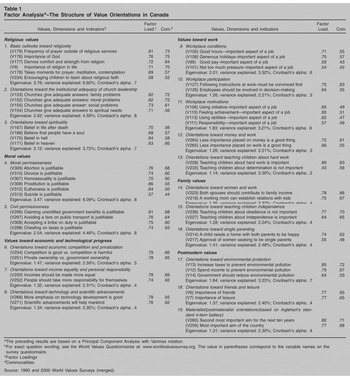
We began this investigation, therefore, by subjecting a wide spectrum of comparable indicators from the Canadian WVS2
Since the objective is to eventually probe for value change, the selection of variables was limited to only those indicators that are comparable and measurable over time.
There is recurring evidence of these same value clusters when the data are analyzed in different ways—both for different time points as well as for different demographic groups and communities within Canada. Moreover, the evidence shows that religious and moral values typically have more consistent underlying structures than other values.
Factor Analysisa–The Structure of Value Orientations in Canada

In the religious domain, three different value clusters emerge. One unites orientations on basic outlooks toward religiosity. A second brings together views toward the institutional adequacy of church leadership. And a third encompasses views toward spirituality. Similarly, Canadians' moral orientations are organized in distinct ways. The moral permissiveness dimension unites reflections on abortion, divorce, homosexuality, prostitution, euthanasia, and suicide. And the civil permissiveness dimension incorporates views on more public matters, such as the justifiability of claiming unentitled government benefits, avoiding a fare on public transport, accepting a bribe, and cheating on taxes.
Orientations toward economic and technological progress divide into three separate value structures. Views toward economic competition and privatization combine to reflect values toward the core principles of market economics. Orientations toward income equality and personal responsibility represent values toward economic fairness, and orientations toward technology development and scientific advancements come together to represent values toward technological and scientific progress.
With respect to the work world, there are at least five different sets of value patterns that appear: traditional workplace conditions; workplace participation; higher level workplace motivations; orientations toward money and work; and orientations toward teaching children about hard work.
With regards to family values, there are three specific value clusters that emerge: orientations toward women and work; orientations toward teaching children independence; and orientations toward single parenting. Likewise, three separate dimensions emerge under the domain of postmodern values: orientations toward environmental protection; orientations toward friends and leisure; and materialist and postmaterialist orientations.
Value Diversity and Support for the First-Past-the-Post Electoral System
The next step in the analysis was to examine the extent to which different social groups on opposing sides of various new and old cleavages differ on the 19 value dimensions identified above. Has the degree of value diversity in Canada increased, decreased, or remained the same over time?
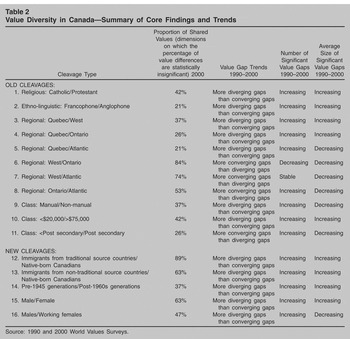
The data summarized in Table 2 begin by looking systematically at the value differences across various old cleavages, such as the religious, ethno-linguistic, regional, and class divides. Overall, the combined evidence indicates that the proportion of significant value discrepancies across various old cleavages is greater (58%) than the proportion of shared values (42%). This implies that on balance, groups on opposing sides of old value divides in Canada have more value differences than similarities.
Value Diversity in Canada—Summary of Core Findings and Trends

Moreover, the cross-time evidence shows no signs of these value differences disappearing. On the contrary, there is more consistent evidence of diverging value gaps (64%) across old cleavages than converging gaps (36%). On a majority of the old cleavages tested (9 out of 11, or 81%), the findings show that the number of significant value discrepancies between opposing groups has increased from 1990 to 2000. However, the average size of these significant value discrepancies, in a majority of cases (6 out of 11, or 55%), has declined. Certain old cleavages, therefore, may be somewhat easier to reconcile now than they were in the past. Still, the bulk of the evidence pertaining to value differences across old cleavages shows more signs of value differences and increased divergence than value similarities and convergence.
In addition, the core findings pertaining to various new cleavages indicate that immigrants from traditional source countries share more values in common with native-born Canadians than immigrants from non-traditional source countries. Similarly, males and females in general share more value similarities than differences, but when men are compared to working women, the values gap becomes much more striking. And pre-1945 and post-1960s generations have even fewer values in common than men and working women. On the whole, the combined evidence for social groups on opposing sides of various new cleavages shows more value similarities than differences, however, the cross-time results indicate more signs of value divergence than convergence.
For example, the trends over the 1990s consistently indicate that the number of significant value discrepancies for all the new cleavages for which we have comparable data has increased. In 80% of these cases, the average magnitude of these value gaps has also increased. The bulk of evidence, therefore, suggests that in addition to various old cleavages there also appears to be a broad-based trend toward greater value diversity across various new cleavages.
But does this increase in value diversity pose implications for political support and, more specifically, support for the current electoral system? Increased value diversity in Canada may be making it more difficult for traditional brokerage parties to satisfy the public's varying interests and issue demands and maintain a broad-based coalition of support. For dissatisfied voters, the alternative is to turn to smaller parties. The current electoral system, however, typically discriminates against minor parties by rewarding them with a disproportionate number of seats relative to their popular vote. Faced with these types of alternatives, it is possible that public support for the current electoral system in Canada may be negatively affected as a result.
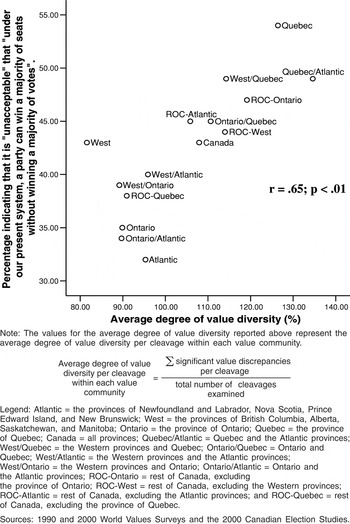
In order to examine this possibility, the final phase of this investigation explores whether there is a systematic link between value diversity and support for the current electoral system. The findings reported in Figure 1 test this proposition by analyzing the evidence from 15 different geographic configurations—all of which have differing cleavage structures and differing degrees of value diversity.4
An ideal test would be to examine cleavage structures and variation in degrees of value diversity across actual constituencies or communities. At this stage, however, we do not have sufficient data to conduct such an analysis. In this preliminary probe, therefore, we are somewhat limited in what we can explore.

Support for the first-past-the-post Electoral System by Value Diversity within Various Value Communities within Canada
Conclusion
The traditional first-past-the-post system in Canada has recently become the focus of increased debate. The preliminary evidence presented in this analysis suggests that the Canadian public's more recent frustration with their current electoral system may be driven in part by the consequences of societal change. Evidence based on 19 different value dimensions, covering a variety of value domains, including religious values, moral values, values toward economic and technological progress, values toward work, family values, and postmodern values shows that value diversity in Canada across various new and old cleavages is on the rise. Moreover, there is preliminary evidence to suggest that value diversity may be systematically linked to orientations toward the current electoral system. An examination of a variety of different geographic configurations, each with different cleavage structures and differing degrees of value diversity, suggests that the most value-diverse communities are the most likely to reject the disproportionate consequences of the current electoral system. This research is far from complete, however the results of this initial investigation appear promising.