




No CrossRef data available.
RUBBISH OR RITUAL? CONTEXTUALIZING A TERMINAL CLASSIC PROBLEMATICAL DEPOSIT AT BLUE CREEK, BELIZE: A response to “Public Architecture, Ritual, and Temporal Dynamics at the Maya Center of Blue Creek, Belize” by Thomas H. Guderjan
Published online by Cambridge University Press: 19 July 2005
Abstract
In this paper we present the results of our analysis of the contents and context of a Terminal Classic “problematical deposit” at Blue Creek, in northwestern Belize, and consider the kinds of behaviors, ritual and otherwise, that may have been responsible for it. We argue that the deposit is secondary, and not the result of a termination ritual in which whole vessels are smashed in situ on the front of a monumental structure in the site center. Based on analysis of the ceramics found in the deposit, specifically the number of whole pots and the forms of vessels represented, as well as a careful consideration of the stratigraphic evidence, we hypothesize that this problematical deposit may represent the transported remains of feasting events that occurred elsewhere at Blue Creek. The research that we present here has important implications for understanding the behaviors and events that occurred prior to the abandonment of Maya sites during the Terminal Classic period (a.d. 830/850–1000). Furthermore, we offer a methodology for the interpretation of problematical deposits that too often go unanalyzed and demonstrate that detailed investigation of such deposits contributes to a greater understanding of Maya ritual behavior.
Information
- Type
- Research Article
- Information
- Copyright
- © 2005 Cambridge University Press
In his recent article “Public Architecture, Ritual, and Temporal Dynamics at the Maya Center of Blue Creek, Belize” (2004:235–250), Thomas H. Guderjan mis-cited and misunderstood the results presented in our Society for American Archaeology (SAA) paper “Rubbish or Ritual? An Examination of Terminal Deposits at Blue Creek.” First, correct authorship for the paper is Sarah C. Clayton, Laura J. Kosakowsky, and W. David Driver (2002). Second, the focus of our SAA paper was a discussion of the analysis of ceramics from Special Deposit 1, a Terminal Classic problematical deposit from the site of Blue Creek in northwestern Belize (Figure 1), with the purpose of addressing the methodological issues involved in distinguishing ritual from nonritual events in the archaeological record and reconstructing the range of possible behaviors that may have resulted in the creation of particular deposits. This Terminal Classic deposit included thousands of ceramic sherds piled against the front of a large pyramidal structure. Similar “problematical deposits” have been excavated elsewhere in the Maya Lowlands, and interpretations of these deposits have ranged from evidence of final occupancy to termination ritual events. Guderjan (2004) states that the results of our research point conclusively to the interpretation that Special Deposit 1 at Blue Creek was a single ritual event in which whole vessels are smashed in situ on the front of Structure 3, when in fact this is not true.

Map of northwestern Belize showing the location of the site of Blue Creek and boundaries of the permit area for the Maya Research Program (drawn by Jon C. Lohse; map courtesy Blue Creek Regional Political Ecology Project).
In this paper we present the results of our analysis of the contents and context of Special Deposit 1 at Blue Creek and consider the kinds of behaviors, ritual and otherwise, that may have been responsible for it. Specifically, we argue that the deposit is secondary and not the result of a termination ritual at the site of Structure 3 that included the smashing and scattering of ceramic vessels, a scenario that too often has been prematurely implicated, without adequate investigation, in the literature concerning Maya ritual. Based on the number of whole vessels present in the deposit and the kinds of vessels represented, as well as careful consideration of the stratigraphic evidence, we hypothesize that Special Deposit 1 may represent the transported remains of feasting behaviors that occurred elsewhere at Blue Creek. The research that we present here has important implications for understanding the behaviors and events that occurred prior to the abandonment of Maya sites during the Terminal Classic period (a.d. 830/850–1000). Furthermore, we offer a methodology for the interpretation of problematical deposits that too often go unanalyzed and demonstrate that detailed investigation of such deposits contributes to a greater understanding of Maya ritual behaviors.
PROBLEMATICAL DEPOSITS IN MAYA ARCHAEOLOGY
The “problematical deposit” is an intriguing yet poorly understood terminological category in the archaeology of the Maya Lowlands. Problematical deposits generally resemble middens in composition but appear ritual in context, as they are often located at the centerline of monumental, ceremonial architecture (Houk 2000). Many problematical deposits have been interpreted as the archaeological traces of ritual behavior associated with the “termination” of structures or whole sites. In the Three Rivers Region of northwestern Belize, where Blue Creek is located, problematical deposits have been reported at other sites, such as Dos Hombres, where Brett Houk (2000) has described a thorough chronological assessment of a problematical deposit dating to the Terminal Classic period. Because many sites in the Three Rivers Region were depopulated during the Terminal Classic, problematical deposits should be regarded as important sources of data pertaining to the political demise of centers and the apparently large-scale abandonment of settlements in the region.
Termination ritual deposits have been described as either desecratory (Garber 1986) or reverential components of a pan-Maya ceremonial program of cyclical destruction and renewal. James Garber (1986:117) characterizes them as involving the intentional deposition and scattering of decomposed limestone, various ceremonial artifacts, and burned and smashed ceramic vessels. Sherds from spatially separate areas in these deposits often fit together, prompting the inference that whole vessels were ceremonially smashed and then scattered. Deposits that seem to fit this description have been found at various sites throughout the Maya Lowlands. In Belize, they include the sites of Cerros (Friedel 1986) and Dos Hombres (Houk 2000).
The practice of piling and scattering broken potsherds in ritually important architectural spaces at different Maya sites is likely a component of a larger program of ritual expression. However, classification of deposits into “behavioral types” such as “termination ritual deposits,” based on apparent similarities from one to the next on the ground obscures the range of variety in Maya ritual behavior. The ceramic contents of individual “termination ritual deposits” have rarely been thoroughly quantified and compared with other depositional categories. Although partially refitting sherds are commonly found across levels, the inference that these deposits include the broken parts of multiple whole vessels has never been effectively tested.
Until real similarities are demonstrated across sites, deposits that appear contextually similar should not be put into any category that suggests a “type” of ritual behavior that is common across the lowland Maya culture area. Interpretation of problematical deposits as traces of specific kinds of ritual practice requires validation through systematic analysis of their content.
SPECIAL DEPOSIT 1 AT BLUE CREEK
The focus of this paper, the problematical deposit called Special Deposit 1 (SD 1), found at Blue Creek, appeared to meet the criteria for a “termination ritual deposit” on the ground, and thus the contents of SD 1 and their distribution were investigated to understand better the behavior resulting in this deposit. The relationship of SD 1 to Structure 3, particularly its interference with access to the building, suggests that the structure was undergoing a change in function or became defunct at the time the materials were deposited.
There are a variety of possible ritual and nonritual interpretations of SD 1. It may indeed be the remains of ritual actions associated with the abandonment of Structure 3. The “termination ritual” concept, for example, implies a ritual event, focused on Structure 3, that included the intentional smashing and layering of vessels. An alternative explanation involving ritual actions is that SD 1 includes the redeposited remains of ceremonial activities such as feasting practiced elsewhere at the site of Blue Creek.
Alternatively, SD 1 may represent an accumulation of material of a nonritual nature, deposited over a lengthy period of time, rather than a single event focused on Structure 3. SD 1 could be provisionally discarded architectural fill material, originally intended for an unrealized construction project at Structure 3. It could also simply be terminal occupation debris left by the final occupants of Blue Creek. Peter Harrison (1999:196–198) has suggested that similar deposits at Tikal's Structure 5D-46 represent the debris of the final occupants of this structure and site. Parts of the same vessels were found widely separated within these middens, like those in “termination ritual deposits”, although Harrison (1999:196–198) infers that this indicates wide intervals between bouts of cleaning.
Through our investigation of the ceramic contents of SD 1, we discovered a need for refinement of the concepts used to characterize depositional behavior. Difficulty in differentiating “terminal occupation debris,” “ritual debris,” and “termination deposits” is largely attributable to a gap between knowledge of the Maya belief system and reconstruction of ritual behavior archaeological data.
The Architectural Context of SD 1
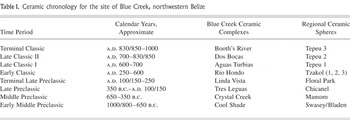
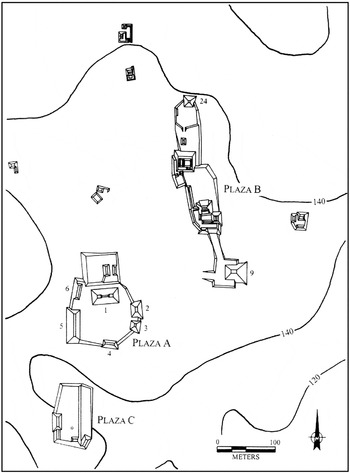
Blue Creek was occupied from at least the Middle Preclassic (beginning ca. 800 b.c.) through the Terminal Classic (a.d. 600–900/1000) (Table 1). As Guderjan (2004) described in his paper, the site core at Blue Creek comprises two major architectural groups: the Main Plaza (Plaza A) and a linear arrangement of structures, Plaza B, located northeast of Plaza A. In addition, recent fieldwork has revealed Plaza C, a less developed but no less monumental platform just to the south of Plaza A. SD 1 covered the front of Structure 3, which is one of two tall, pyramidal structures occupying the eastern side of Plaza A (Figure 2).
Ceramic chronology for the site of Blue Creek, northwestern Belize


Site map of the core area of Blue Creek showing the locations of Plazas A, B, and C and the location of Structure 3 in Plaza A. (Originally mapped by Michael Lindeman; computer work by Greg Johnson, Joe Sakaduski, and Tom Dolezal; modified by David Drier.)
None of the investigations conducted at either of these two structures (Figure 2, Structures 2 and 3) have supported Guderjan's (2004:238–239) conjecture that the buildings possess morphological similarities to E-Group architectural complexes as proposed by Oliver Ricketson and Edith Ricketson (1937) or Karl Ruppert (1940). The archetypical form of these complexes has been defined as “three small buildings on a single platform defining the eastern side of a plaza” and “a large pyramid structure” on the western side (Ruppert 1940:222). While the designated E-Groups demonstrate some significant levels of variation (Ruppert 1940:224, 227, Table II), to the point that many could not have functioned as actual solar markers, their importance as a formal and stylized ritual assemblage has been well documented (Aveni 1994; Chase and Chase 1995). In contrast to these groups, the eastern side of Plaza A contains only two structures, and, as our excavations have documented, they are set directly upon the plaza surface, not on a common platform.
Instead, the location and design of the buildings clearly resemble eastern shrine structures identified at Tikal and elsewhere (Becker 1971, 1972; Coggins 1975; Gann 1927; Haviland 1981; Leventhal 1983; McAnany 1995; Thompson 1931; Welsh 1988). Based on architectural design attributes, human remains, and associated artifacts, eastern shrines appear to have functioned as foci of ancestral veneration and corporate group ritual (Becker 1971; Leventhal 1983; McAnany 1995, 1998). Although most commonly recognized in residential groups within site settlement zones (e.g., Gann 1927; Leventhal 1983; Welsh 1988), the eastern shrine pattern has also been noted in monumental public plazas (Becker 1972; McAnany 1995:58), where it most likely represents ancestor enshrinement for the site's “ruling elite.” Multiple eastern shrines are rare but have been identified (Haviland 1981) and used to suggest an increased level of social status for the residents of the group in relation to other compounds.
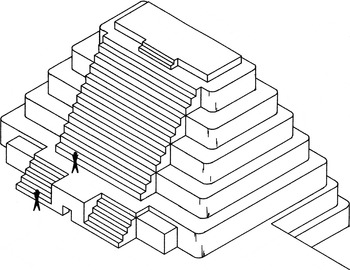
Excavations at Structure 3 in 1997 identified one major construction phase and a later minor extension of the base of the stairs. The structure had a wide central stairway, large stair side outsets, and rounded corners and appears to have been built without a superstructure (Figure 3). On the building's center line, at the base of the stairs, was a 3 m wide vaulted masonry shrine. A large limestone boulder, 60 cm in height, had been set into the floor in the center of the shrine's interior chamber. A previous discussion of the structure (Driver and Wanyerka 2002) suggested that the shrine and boulder represent components of an architectural feature identified by Karl Taube (1998) as a “hearthstone stairway shrine” and as such constitute a layered creation metaphor that would have played an important role in the construction of sacred landscapes for the Maya of Blue Creek.

Isometric drawing of Structure 3 showing central staircase and shrine.
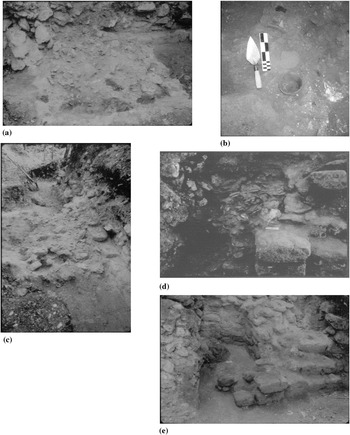
During the excavations, a dense concentration of ceramic sherds and dark soil was encountered on Structure 3's stairway. SD 1 was located along the building's centerline and extended 1.2 m into the plaza and 2.2 m up the slope of the mound (Figure 4). The material entirely covered the remains of the stairway shrine and fanned out from its sides, burying the lowest four to five steps of the stairway. Unfortunately, the northern portion of the deposit had been destroyed by a large looter's trench, and further disturbance had occurred when the trench was backfilled for safety in 1992. As a consequence of the extensive disturbance, excavations concentrated on the relatively intact southern portion of the deposit, which appears to represent approximately two-thirds of the original. The deposit was included within an excavation trench, Operation 5C, that was placed to clear the basal treads of the building's stairway and was excavated in several arbitrary lots to maximize the possibility of examining spatial variations within the deposit. To ensure maximum recovery of all associated artifacts, the matrix from these lots was screened through a quarter-inch mesh.

SD 1 during excavation at Blue Creek. (a, c) Surface of SD 1 in front of Structure 3 showing high concentration of sherds. (b) Detail of surface of SD 1 showing intact whole vessel. (d) Density of sherds in SD 1 through doorway of central shrine on Structure 3. (e) Central shrine on Structure 3 after SD 1 has been excavated.
The sherds were embedded in a dark soil matrix containing a high concentration of carbon. There were only seventeen nonceramic artifacts recovered from the deposit. These consisted of four chert bifaces, one chert blade, two obsidian blades, and ten obsidian blade fragments. Eleven of the obsidian blades and fragments and two of the chert bifaces, were recovered from inside the basal shrine chamber where they were located adjacent to, or on top of, the large boulder. Within the chamber, the matrix containing the sherds was dark black and appeared to consist of almost pure carbonized material with little soil intermixing. The boulder and the walls of the chamber were heavily stained with carbon from the matrix. This carbon film extended up the south wall to a height of 32 cm, and 38 cm up the east wall, and apparently represented the maximum extent of SD 1 when it was initially deposited within the chamber. Based on the height of this film it appears that the limestone boulder had originally been almost totally buried by the material. The unusually high concentration of sherds within SD 1, compared with other deposits from Blue Creek, suggested that SD 1 was unusual and worthy of a more detailed analysis.
METHODOLOGY
The concept of the termination ritual deposit in the Maya Lowlands (Friedel 1986; Garber 1986) implies an event in which vessels were smashed and then scattered, along with other ritually meaningful items. Thus, if SD 1 represents a termination ritual involving the destruction of ceramic vessels and their immediate deposition at Structure 3, we would expect to find numerous whole vessels in the deposit. To evaluate this possibility, we undertook an effort to refit rim sherds from all levels of the deposit. The first step in the analysis was a lot-by-lot sorting of the ceramics according to James Gifford's (1976) type-variety system to maintain regional comparability and establish a chronological framework for the deposit. In the next phase of the analysis, body and rim sherds were separated. Body sherds were counted and described; however, the rim sherds were the focus of the final analysis. For practical purposes, we assumed that fully reconstructible rims represented whole vessels.
The deposit contained an extremely large volume of ceramics (Figure 5). A total of 21,271 sherds were recovered. The vast majority of these (82% of the total) consisted of eroded or unidentifiable striated body sherds that could not be assigned to a specific ceramic complex other than the Classic period. Of the 3,785 sherds (including rim and body) that could be identified, the chronological distribution is as follows (Figure 6): 25 Late Preclassic Tres Leguas Ceramic Complex (1% of identified sherds), 8 Terminal Late Preclassic Linda Vista Ceramic Complex (less than 1%), 643 Early Classic Rio Hondo Ceramic Complex (17%), 97 Late Classic I Aguas Turbias Ceramic Complex (3%), 2486 Late Classic II Dos Bocas Ceramic Complex (66%), and 526 Terminal Classic Booth's River Ceramic Complex (14%).

Ceramics from SD 1 spread out on tables in the laboratory showing high volume of material (top), with close-up of attempts to refit Rubber Camp Brown sherds (bottom).

Chronological distribution of sherds (by time period/ceramic complex) in SD 1 (N = 3,785).
The analysis of only the rim sherds identified a minimum number of vessels (MNV) of 2,341 (Table 2). Surprisingly, most of these are represented by only one or two rim sherds, and only one vessel rim was found to be fully reconstructible (it consisted of three rim sherds). This number is a working estimate, since it may be inflated due to instances in which sherds came from the same vessels but did not directly connect. It may also be underestimated, since there is also the possibility that vessels were present with no rim sherds. Although only one “whole vessel” was counted, there were numerous cases where more than half of a rim of a vessel was present.
Minimum vessel count of ceramics in Special Deposit 1

The presence of large portions of incomplete vessels leads to questions about where the missing sherds may have been deposited. In the case of termination activities, they could have been scattered elsewhere, since the whole site was abandoned in the Terminal Classic, although similar problematical deposits did not cover the other structures in the vicinity of Structure 3. If SD 1 represents provisional discard, perhaps those other pieces missing from the ceramic vessels were incorporated elsewhere as fill. Many of the refittable sherds were found scattered throughout the different areas of the deposit. The wide-ranging chronological distribution, and the scattered and partial nature of the vessel fragments, indicates that the deposit was not created in situ. Instead, it most likely accumulated elsewhere over a long period of time, and only a portion of the refuse was transported to the current location at Structure 3. It therefore did not meet the expectations we had for a ritual event that involved the smashing of whole vessels and their immediate deposition together. This does not negate the possibility that the deposit represents ritual behavior, but the evidence does not support the scenario of destruction and deposition of whole vessels as a single ritual event.
SD 1 and Ritual Termination
By filling the shrine and burying much of the building's stairway, SD 1 would have effectively ended access to and use of Structure 3 at Blue Creek. Evidence for ritualized “termination” of structures has been widely reported, beginning with William Coe's (1959:94–95) description of a “terminal offering” at Piedras Negras. There, the offering consisted of two censers that had been smashed atop the summit of Structure K-5-2nd prior to its burial by the succeeding phase of construction. During extensive horizontal excavations conducted at the site of Cerros, a wider range of termination behaviors was identified and included smashed “jade and pottery, the removal of plaster façading, the burning of ceremonial fires, the preparation and consumption of a ceremonial beverage, and the scattering of the smashed artifacts among intentionally deposited layers of white marl” (Garber 1989:9). However, the emphasis of the rituals that produced these deposits still appeared to be on the destruction and deactivation of an obsolete building in preparation for a new construction phase, or, as Coe (1959:94) defined it, “ceremonial object-sacrifice” as a part of a “ritual of renewal.”
Coe (1965:462) also identified a variation of these types of offerings that marks the termination of a structure without a subsequent new construction. These “exposed offerings” were defined as concentrations of artifacts, often pottery, that were “encountered on the latest occupation surface but beneath humus and accumulated debris” (Coe 1965:462). Although less commonly reported than termination rituals, similar exposed offerings have been reported from other sites. A dense concentration of Tepeu 3 pottery, human bone, and jade fragments within a gray-brown matrix atop a Late Classic structure was noted at the site of Colha (Potter 1980, 1982). Concentrations of broken pottery and dark soil located on top of final structures have been encountered in the middle Belize River Valley at the sites of Ontario Village (Driver and McWilliams 1995:31–32; Garber et al. 1994:11) and Floral Park (Glassman et al. 1995:60), and at Group 1 at Blackman Eddy (where it actually intruded into the small platform; Garber et al. 1998:129–131). The deposit at Ontario Village was located at Structure A1, the site's principle building, and an eastern shrine. The sherd deposit covered the basal portion of the building's stairway and consisted of a dark, midden-like soil containing ash and carbon but no faunal material. A small Terminal Late Classic bowl had been placed on the tread of the bottom step, and several chert bifaces and stemmed points had been placed along the centerline of the stairway. While excavations into the similar, though much larger, deposit at Floral Park were discontinued before the underlying basal architecture was reached, its location on the probable front (west side) of Structure A1 suggests that it, too, was located to cover and block access to the structure. In a discussion of the deposits encountered at sites in the Belize River Valley, Garber and colleagues (1998:130) noted that the high density and mixed nature of the sherds, in combination with a general lack of domestic refuse, suggested that these ceramic concentrations were not domestic middens but, instead, represented transposed ritual middens.
SD 1 and Ritual Feasting
Special Deposit 1 may have resulted from periodic ritual activities that were focused on or included the large-scale preparation and consumption of foods through communal feasting. Recent studies have examined the role of ritual feasting in relation to the creation and maintenance of sociopolitical relationships (Blitz 1993; Dietler and Hayden 2001; Hayden 2001; Hayden and Gargett 1990; Lesure 1999), especially those concerned with ancestor veneration (Brown 2001; McAnany 1995). Examinations of the material correlates of these ritual feasts have focused on the composition of refuse midden deposits in an attempt to differentiate between those resulting from ritual feasting and those resulting from everyday domestic activities. To discriminate between these two types of midden contexts, most studies have employed some type of quantitative method to compare the ratios of serving and ceremonial vessels to storage vessels. Serving vessels included bowls, plates, and vases, while ritual vessels consisted of censers and braziers (Fox 1996; Hageman 2004; Hendon 1987). Storage containers were primarily represented by jar and large basin forms. In structure groups that were thought to have hosted ritual feasting events, middens tend to contain higher concentrations of serving vessel remains compared with those from storage vessels (2:1 ratio of serving to storage [Hageman 2004], or when rim sherd counts were used, 64% serving, 12–28% ceremonial, and 8% storage [Fox 1996]). Middens thought to have resulted solely from everyday domestic activities produced fewer remains of ceremonial and serving forms (e.g., about a 1:1 vessel ratio [Hageman 2004], or 10–32% serving-vessel rim sherds [Fox 1996:490]).
Of the total of all sherds (rim and body) in SD 1 at Blue Creek, 82% were from unslipped utilitarian types, such as striated and unslipped jars, indicating that a high proportion of the vessels might be related to food storage and preparation. However, this high percentage is produced only when one includes the body sherds and may be indicative of the fact that these jars are large in size relative to other forms of vessels; they break into numerous pieces, inflating the ratio of these body sherds to all others, especially given the significantly smaller percentage (only 9%) of rim sherds from striated and plain jars in SD 1.
When rim sherds are isolated (Table 2), the most ubiquitous ceramic types present are vessels of the Achote Black Ceramic Group that are small-diameter serving bowls, followed by larger-diameter Rubber Camp Brown and Garbutt Creek Red bowls. However, many of the types in SD 1—for example, the large-diameter Garbutt Creek Red and Rubber Camp Brown bowls—may have been used for cooking, serving, or both. It is difficult to differentiate or characterize their functions based entirely on form. If one hypothesizes that most small bowl, plate, dish, and narrow-mouth jar forms were for serving food; that large-diameter bowls were used for food serving and preparation' and that most unslipped and striated jar forms were for food storage and preparation, the numbers present in SD 1paint a very different picture.
In terms of vessel numbers, based on rim sherds only, SD 1 contains a higher ratio of serving or food-preparation vessels to storage or food-preparation vessels and thus appears to fit the expectations for feasting-related refuse as presented in the literature (Table 2). However, SD 1 does appear to differ substantially from the refuse examined in those previous feasting studies. Of the estimated vessel MNV of 2,341, 1,411 fit the “serving” category (small bowls, plates, dishes, and narrow-mouth slipped jars); 594 are large serving or food-preparation forms; and 221 are unslipped striated jar forms used for storage. (An additional 115 rims are too small and eroded to be assigned a form.) Thus, with a 9:1 ratio of serving to storage vessels (small and large serving forms are combined for a total of 2,005 vessels, compared with 221 storage vessels), the disparity between functional types is more than four times greater than expected.
Overall, the deposit comprised a wide range of types and forms, from thick, utilitarian forms to more decorative types. The “fancier” items include varieties of Achote Black, incised with geometric designs and impressions (Cubeta Incised), only a few Palmar Orange polychromes (N = 9), and some anomalous examples, including a sculptured ceramic piece and one sherd with post-firing graffiti.
Further, a number of studies on feasting document the presence of chipped- and ground-stone tools and faunal bone within both feasting and domestic middens (Brown 2001:375–377; Fox 1996:192; Masson 1997:302). In contrast to these results, very few obsidian and chert tools were recovered from SD 1, and no faunal material or ground stone was present.
These variations most likely result from the different architectural contexts in which the proposed feasting was taking place at Blue Creek and, by extension, those processes that were involved in the feasting behavior. The previous studies of feasting have primarily taken place in rural household groups or small-scale ritual contexts. In a study at the site of Cerén, where a volcanic eruption in a.d. 590 buried the community under six meters of ash and preserved articles of daily life in their original systemic context, Linda Brown (2001) argued that while feasting took place at a special ritual building, Structure 10, the storage and food preparation for feasting events was conducted in the nearby ancillary buildings and outdoor activity areas that made up the remainder of the Household 1 residential compound. Due to behavior patterns of refuse discard, household middens are commonly considered as representing total household activities, primarily because of proximity.
In contrast, SD 1 is located on a ritual civic structure within the monumental architecture of Blue Creek's site core. Although the material on Structure 3 had been relocated, it was most likely produced by activities conducted within the Plaza A area. However, because there are no residential groups located nearby where food typically would have been stored or prepared or even processed, it is likely that most of the food storage, processing, and preparation activities, and the broken utilitarian vessels and tools resulting from these activities, would have taken place in a domestic location far enough away to not be included within the refuse created by the feasting events themselves. However, if the feasting event took place within Plaza A, as hypothesized, it would follow that the broken vessels and refuse from the actual feasting activities were discarded closer to the plaza in an as yet undiscovered midden. Over a long period of time, this emphasis on serving-vessel usage over storage vessels would have produced the much heavier weighted ratios seen in the secondary deposit at Structure 3.
SUMMARY
In summary, the materials of SD 1 appear to represent a secondary deposit placed on the shrine and stairway of Structure 3. The material was most likely acquired from an undiscovered primary midden that accumulated from feasting rituals held in or near Plaza A at Blue Creek. The redeposited material was dumped in high concentrations both on the floor inside the shrine and on its central feature, as well as outside along its sides, atop its roof, and over the lower portion of Structure 3's stairway. This completely blocked off the interior of the shrine and would have greatly limited access to the summit of Structure 3. Although the chronological distribution of the ceramics indicates that much of this material was deposited in the original midden over a long period of time, the high percentage of Late and Terminal Late Classic sherds in SD 1 suggests that much of the final material was generated during ritual events that occurred just before the abandonment of Blue Creek. Because the feature was not internally stratified, and because its location effectively would have ended use of the basal shrine and a large portion of the main stairway, it appears that only this final act of secondary deposition could be assumed to have occurred as a single event. SD 1 thus appears to represent the remains of complex termination activities directly associated with the abandonment of the structure, and perhaps the site itself, but much of the material used in the Terminal Classic event had been produced by long-term feasting-refuse discard behaviors. The presence of Dos Bocas (Late Classic II) and Booth's River (Terminal Classic) Ceramic Complex materials suggests a Terminal Late Classic terminus post quem for the occurrence of the deposit, as well as the implied ritual and structural abandonment.
Problematical deposits throughout the Maya Lowlands reveal information about changes in the functions of buildings with which they are associated. In some cases they are related to the addition of new layers of construction. At Cerros, for example, “termination ritual deposits” were found just beneath new levels of construction in context with dedicatory caches. David Friedel and Linda Schele (1989) have suggested that these deposits represent ritual complements to dedication rites. In other cases, these deposits may relate to the abandonment of structures, which simply became convenient places to put trash (Harrison 1999). At any rate, they are important aspects of the archaeological record to consider when attempting to understand dynamic cultural processes, because they signify shifting relationships between people and their built environment.
Variation in the content and in the spatial and temporal contexts of problematical deposits calls for careful investigation of individual cases, prior to their interpretation. This is vital to understanding the variety of practices that may underlie them. Furthermore, we should attempt to study problematical deposits, whether ritual or not, in terms of the behavior that created them. Interpretation of ritual behavior should not be confused with the reconstruction of aspects of the Maya belief system.
At this point, our theoretical and methodological tools are inadequate for confirming the likelihood that problematical deposits represent particular behaviors. However, analyses of the contents of such deposits can yield valuable information regarding their cultural formation processes. Our analyses of SD 1 at Blue Creek demonstrate that certain behaviors, such as cumulative deposition, may be reliably inferred from archaeological remains, while others, such as the breaking of whole vessels, may not. The contents of SD 1, its lack of whole vessels, and the wide vertical separation within the deposit of refitting sherds indicate that it is a secondary deposit, not the single ritual event involving the smashing of whole vessels on Structure 3 at Blue Creek as described by Guderjan (2004). The quantitative analyses of the contents of SD 1 described in this paper have complemented our knowledge of its context. Clearly, a sharper awareness of how the content of problematical deposits contrasts with that of other kinds of deposits, within and between sites, will aid in reconstructing the behaviors that created them.
RESUMEN
Se presentan los resultados de nuestro análisis del contenido y contexto de un “depósito problemático” del clásico terminal en el sitio de Blue Creek, en el noroeste de Belice. Consideramos los distintos comportamientos, ritual y otro, que a lo mejor asuman responsabilidad del depósito. Discutimos que el depósito es secundario, o sea que, no es el resultado de un ritual terminal en que vasijas enteras fueron estrelladas en la fachada (parte delantera) de una estructura monumental (Estructura 3) en el centro del sitio. Un análisis esmerado de las cerámicas en el depósito, específicamente el número de vasijas enteras y las formas de las vasijas representadas, juntos con consideración cuidadosa de la evidencia estratigráfica, sugerimos que es posible que este depósito problemático represente los transportados restos de varios banquetes que ocurrieron en otro lugar dentro del sitio y, a una fecha posterior, fue transportado dicho depósito a Estructura 3. La investigación que presentamos aquí tiene implicaciones importantes para entender los comportamientos y los sucesos que ocurrieron antes del abandono de los sitios de los maya durante el período clásico terminal. Además, ofrecemos una metodología para la interpretación de los depósitos problemáticos que con frecuencia no se encuentran analizados, y demostramos que la investigación detallada de tales depósitos contribuye a una mayor comprensión del comportamiento del ritual de los maya.
ACKNOWLEDGMENTS
We thank the director of the Maya Research Program, Tom Guderjan, and Jon Lohse, director of the Blue Creek Regional Political Ecology Project, for the opportunity to work at Blue Creek; Deva Abela, Ellie Houghton, Yuko Shiratori, and Sarah Skinner for their assistance in the endless counting of sherds involved in the analysis of SD 1; and all those who participated in the excavation of SD 1, especially Alex Pastrana, Marnie Sloan, and Mary Kay Vance. However, any or all errors or omissions in this article are our own. Our thanks to George Cowgill and Norman Hammond for their helpful comments on this report.
References
REFERENCES
Aveni, Anthony F.
1994
Skywatchers of Ancient Mexico.
University of Texas Press,
Austin.
Becker, Marshall J.
1971
Identification of a Second Plaza Plan at Tikal, Guatemala, and Its
Implications for Ancient Maya Social Complexity.
Unpublished Ph.D. dissertation,
Department of Anthropology, University of Pennsylvania,
Philadelphia.
Blitz, John H.
1993
Big Pots for Big Shots: Feasting and Storage in a Mississippian
Community.
American Antiquity
58(1):80–96.Google Scholar
Brown, Linda A.
2001
Feasting on the Periphery: The Production of Ritual Feasting and
Village Festivals at the Ceren Site, El Salvador. In
Feasts: Archaeological and Ethnographic Perspectives on Food,
Politics, and Power, edited by
Michael Dietler and
Brian Hayden, pp.
368–390.
Smithsonian Institution Press,
Washington, DC.
Chase, Arlen F., and
Diane Z. Chase
1995
External Impetus, Internal Synthesis, and Standardization: E Group
Assemblages and the Crystallization of Classic Maya Society in the
Southern Lowlands. In
The Emergence of Lowland Maya Civilization: The Transition from the
Preclassic to the Early Classic, edited by
Nickolai Grube, pp.
87–102.
Verlag Anton Saurwein,
Mockmuhl, Germany.
Clayton, Sarah C.,
Laura J. Kosakowsky, and
W. David Driver
2002
Rubbish or Ritual? An Examination of Terminal Deposits at Blue
Creek.
Paper presented at the 67th Annual Meeting of the Society for
American Archaeology, 20–24 March, Denver, CO.
Coe, William R.
1959
Piedras Negras Archaeology: Artifacts, Caches and Burials.
University Museum,
University of Pennsylvania, Philadelphia.
Coe, William R.
1965
Caches and Offertory Practices of the Maya Lowlands. In
Handbook of Middle American Indians: Archaeology of Southern
Mesoamerica, Part 1, edited by
Robert Wauchope, pp.
462–468.
University of Texas Press,
Austin.
Coggins, Clemency C.
1975
Painting and Drawing Styles at Tikal: An Historical and Iconographic
Reconstruction.
Unpublished Ph.D. dissertation,
Department of Anthropology, Harvard University,
Cambridge, MA.
Dietler, Michael, and
Brian Hayden
2001
Digesting the Feast: Good to East, Good to Drink, Good to
Think. In
Feasts: Archaeological and Ethnographic Perspectives on Food,
Politics, and Power, edited by
Michael Dietler and
Brian Hayden, pp.
1–20.
Smithsonian Institution Press,
Washington, DC.
Driver, W. David, and
Jennifer K. McWilliams
1995
Excavations at the Ontario Village Site. In
The Belize Valley Archaeology Project: Results of the 1994 Field
Season, edited by
James F. Garber and
David M. Glassman, pp.
26–57.
Report submitted to the Department of Archaeology,
Belize, by Southwest Texas State University, San Marcos.
Driver, W. David, and
Phil Wanyerka
2002
Creation Symbolism in the Architecture and Ritual at Structure 3,
Blue Creek, Belize.
Mexicon
24(1):6–8.Google Scholar
Fox, John G.
1996
Playing with Power: Ballcourts and Political Ritual in Southern
Mesoamerica.
Current Anthropology
37(3):483–509.Google Scholar
Friedel, David A.
1986
The Monumental Architecture. In
Archaeology at Cerros, Belize, Central America, edited by
David A. Friedel and
Robin Robertson-Friedel, pp.
1–21.
Southern Methodist University Press,
Dallas, TX.
Friedel, David A., and
Linda Schele
1989
Dead Kings and Living Temples: Dedication and Termination Rituals
among the Ancient Maya. In
Word and Image in Maya Culture: Exploration in Language, Writing,
and Representation, edited by
W.F. Hanks and
D. Rice, pp.
233–243.
University of Utah Press,
Salt Lake City.
Gann, Thomas W.F.
1927
Maya Cities: A Record of Exploration and Adventure in Middle
America.
Duckworth,
London.
Garber, James F.
1986
The Artifacts. In
Archaeology at Cerros, Belize, Central America, edited by
David A. Friedel and
Robin Robertson-Friedel, pp.
117–126.
Southern Methodist University Press,
Dallas, TX.
Garber, James F.
1989
Archaeology at Cerros, Belize, Central America, Volume II: The
Artifacts.
Southern Methodist University Press,
Dallas, TX.
Garber, James F.,
W. David Driver,
Lauren A. Sullivan, and
David M. Glassman
1998
Bloody Bowls and Broken Pots: The Life, Death, and Rebirth of a
Maya House. In
The Sowing and the Dawning: Termination, Dedication, and
Transformation in the Archaeological and Ethnographic Record of
Mesoamerica, edited by
Shirley Boteler Mock, pp.
125–134.
University of New Mexico Press,
Albuquerque.
Garber, James F.,
David M. Glassman,
W. David Driver, and
Pamela Weiss
1994
The Belize Valley Archaeology Project: Results of the 1993 Field
Season.
Report submitted to the Department of Archaeology,
Belize, by Southwest Texas State University, San Marcos.
Gifford, James C.
1976
Prehistoric Pottery Analysis and the Ceramics of Barton Ramie in the
Belize Valley.
Memoirs of the Peabody Museum of Archaeology and Ethnology, Volume
18.
Harvard University,
Cambridge, MA.
Glassman, David M.,
James M. Conlon, and
James F. Garber
1995
Survey and Initial Excavations at Floral Park. In
The Belize Valley Archaeology Project: Results of the 1994 Field
Season, edited by
James F. Garber and
David M. Glassman, pp.
58–70.
Report submitted to the Department of Archaeology,
Belize, by Southwest Texas State University, San Marcos.
Guderjan, Thomas H.
2004
Public Architecture, Ritual, and Temporal Dynamics at the Maya
Center of Blue Creek, Belize.
Ancient Mesoamerica
15:235–250.Google Scholar
Hageman, Jon B.
2004
The Lineage Model and Archaeological Data in Late Classic
Northwestern Belize.
Ancient Mesoamerica
15:63–74.Google Scholar
Harrison, Peter
1999
The Lords of Tikal.
Thames and Hudson,
London.
Haviland, William A.
1981
Dower Houses and Minor Centers at Tikal, Guatemala: An
Investigation into the Identification of Valid Units in Settlement
Hierarchies. In
Lowland Maya Settlement Patterns, edited by
Wendy Ashmore, pp.
89–117.
University of New Mexico Press,
Albuquerque.
Hayden, Brian
2001
Fabulous Feasts: A Prolegomenon to the Importance of
Feasting. In
Feasts: Archaeological and Ethnographic Perspectives on Food,
Politics, and Power, edited by
Michael Dietler and
Brian Hayden, pp.
23–64.
Smithsonian Institution Press,
Washington, DC.
Hayden, Brian, and
Rob Gargett
1990
Big Man, Big Heart? A Mesoamerican View of the Emergence of Complex
Society.
Ancient Mesoamerica
1:3–20.Google Scholar
Hendon, Julia A.
1987
The Uses of Maya Structures: A Study of Architecture and Artifact
Distribution at Sepulturas, Copan, Honduras.
Unpublished Ph.D. dissertation,
Department of Anthropology, Harvard University,
Cambridge, MA.
Houk, Brett
2000
“Life, the Universe, and Everything: Re-evaluating
Problematic Deposit 2 from Dos Hombres, Belize.” In
The 1998 and 1999 Seasons of the Chan Chich Archaeological
Project, edited by
Brett Houk, pp.
141–150.
Papers of the Chan Chich Archaeological Project, Number
3.
Center for Maya Studies,
San Antonio, TX.
Lesure, Richard
1999
Platform Architecture and Activity Patterns in an Early Mesoamerican
Village in Chiapas, Mexico.
Journal of Field Archaeology
26:391–406.Google Scholar
Leventhal, Richard M.
1983
Household Groups and Classic Maya Religion. In
Prehistoric Settlement Patterns: Essays in Honor of Gordon R.
Willey, edited by
Evon Z. Vogt, Jr. and
Richard M. Leventhal, pp.
55–76.
University of New Mexico Press,
Albuquerque; Peabody Museum of Archaeology and Ethnology, Harvard
University, Cambridge, MA.
Masson, Marilyn A.
1997
Cultural Transformation at the Maya Postclassic Community at Laguna
de On, Belize.
Latin American Antiquity
8(4):293–316.Google Scholar
McAnany, Patricia A.
1995
Living with the Ancestors: Kinship and Kingship in Ancient Maya
Society.
University of Texas Press,
Austin.
McAnany, Patricia A.
1998
Ancestors and the Classic Maya Built Environment. In
Function and Meaning in Classic Maya Architecture, edited by
Stephen D. Houston, pp.
271–298.
Dumbarton Oaks Research Library and Collection,
Washington, DC.
Potter, Daniel R.
1980
Archaeological Investigations at Operation 2012. In
The Colha Project, Second Season, 1980 Interim Report, edited
by
Thomas R. Hester,
Jack D. Eaton, and
Harry J. Shafer, pp.
173–184.
Center for Archaeological Research,
University of Texas, San Antonio.
Potter, Daniel R.
1982
Some Results of the Second Year of Excavation at Operation
2012. In
Archaeology of Colha Belize: The 1981 Interim Report, edited
by
Thomas R. Hester,
Harry J. Shafer, and
Jack D. Eaton, pp.
98–122.
Center for Archaeological Research,
University of Texas, San Antonio.
Ricketson, Oliver G., Jr.,
and
Edith B. Ricketson
1937
Uaxactun, Guatemala: Group E—1926–1931.
Carnegie Institution of Washington,
Washington, DC.
Note: Astronomic features of Group E on pp. 105–110
only.
Ruppert, Karl J.
1940
A Special Assemblage of Maya Structures. In
The Maya and Their Neighbors: Essays on Middle American Anthropology
and Archaeology, edited by
Clarence L. Hay,
Ralph L. Linton,
Samuel K. Lothrop,
Harry L. Shapiro, and
George C. Vaillant, pp.
222–231.
Appleton-Century,
New York.
Taube, Karl A.
1998
The Jade Hearth: Centrality, Rulership, and the Classic Maya
Temple. In
Function and Meaning in Classic Maya Architecture, edited by
Stephen H. Houston, pp.
427–478.
Dumbarton Oaks Research Library and Collection,
Washington, DC.
Thompson, J. Eric S.
1931
Archaeological Investigations in the Southern Cayo District, British
Honduras.
Field Museum of Natural History Publication 301. Anthropological
Series Vol. 17, No. 3.
Field Museum of Natural History,
Chicago.
Welsh, W.B.M.
1988
An Analysis of Classic Lowland Maya Burials.
BAR International Series 409.
British Archaeological Reports,
Oxford.
Ceramic chronology for the site of Blue Creek, northwestern Belize
Site map of the core area of Blue Creek showing the locations of Plazas A, B, and C and the location of Structure 3 in Plaza A. (Originally mapped by Michael Lindeman; computer work by Greg Johnson, Joe Sakaduski, and Tom Dolezal; modified by David Drier.)
Isometric drawing of Structure 3 showing central staircase and shrine.
SD 1 during excavation at Blue Creek. (a, c) Surface of SD 1 in front of Structure 3 showing high concentration of sherds. (b) Detail of surface of SD 1 showing intact whole vessel. (d) Density of sherds in SD 1 through doorway of central shrine on Structure 3. (e) Central shrine on Structure 3 after SD 1 has been excavated.
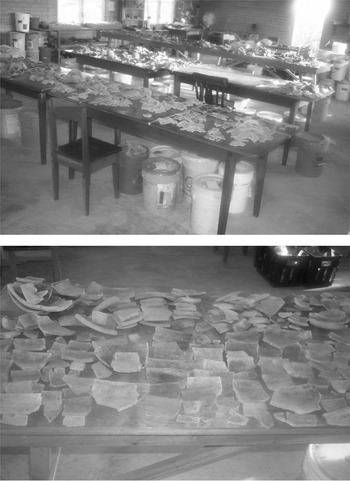
Ceramics from SD 1 spread out on tables in the laboratory showing high volume of material (top), with close-up of attempts to refit Rubber Camp Brown sherds (bottom).
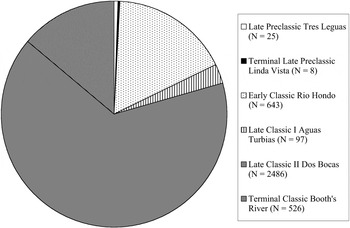
Chronological distribution of sherds (by time period/ceramic complex) in SD 1 (N = 3,785).
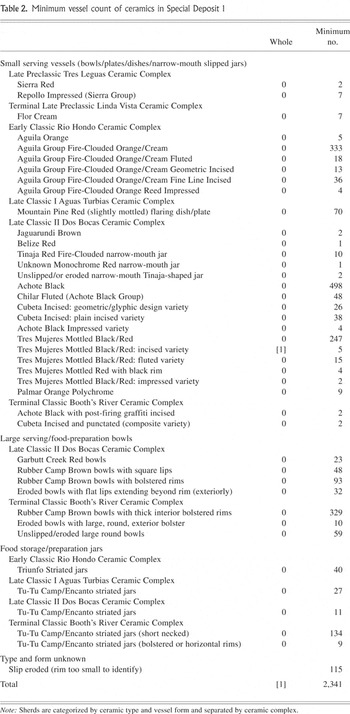
Minimum vessel count of ceramics in Special Deposit 1
 You have
Access
- 24
- Cited by