Implications
Alternatives to antibiotics have become important topics in view of the restriction applied by the European Union, owing to the increasing antibiotic resistance of some bacteria. In rabbit breeding, the use of nutrition strategies, such as feed restriction, could improve digestive health. Water restriction is an indirect way to reduce both feed intake and the mortality in the post-weaning period. The confirmation of water restriction as an alternative to antibiotics, without negative effects on animal welfare, can reduce the environmental and social impacts of rabbit production, giving greater confidence to consumers, with a positive economic impact for the rabbit industry.
Introduction
Owing to the potential development of antibiotic-resistant bacteria (Roe and Pillai, Reference Roe and Pillai2003), antibiotic growth promoters in feed for farm animals have been banned in the European Union since 2006 (European Union, 2005), and their use is under consideration around the world. This is a great problem in rabbit production as the Epizootic Rabbit Enteropathy (ERE), a complex enteritis that is the first cause of mortality in the European rabbit industry (Dewree et al., Reference Dewree, Licois, Coudert, Lassence, Vindevogel and Marlier2003), is responsible for high mortality rate (up to 70%) in the post-weaning period. As ERE can be controlled by using a preventive antibiotic medication, it is very important to identify alternative feeding strategies as replacements for antibiotics. Feed restriction can be used in rabbit production as a strategy to reduce cost and control digestive troubles. Although BW gain, and sometimes the weight at slaughter, is impaired by feed restriction, nutrient digestibility and feed conversion are more favourable in restricted rabbits (Di Meo et al., Reference Di Meo, Bovera, Marono, Vella and Nizza2007). Feed restriction can be practically applied by limiting access time to the feeders or reducing the amount of administered feed (Saleh et al., Reference Saleh, Attia and Younis1996). As the feed intake is directly correlated with the water consumption (Gidenne and Lebas, Reference Gidenne and Lebas2006), recent studies have evaluated the effects of water restriction on digestive health (Boisot et al., Reference Boisot, Duperray, Dugenétais and Guyonvarch2004; Ben Rayana et al., Reference Ben Rayana, Ben Hamouda and Bergaoui2008). In practical conditions, with growing rabbits, the access to drinking water can be limited between 1 and 4 h/day, reducing food intake, mainly as a result of short duration of watering (Gidenne et al., Reference Gidenne, Garcia, Lebas and Licois2010). However, under hot climatic conditions, it is essential that the water restriction is not severe as it can have a negative impact on animal welfare (Gidenne et al., Reference Gidenne, Combes and Fortun-Lamothe2012).
The aim of our work was to study the effects of a water restriction programme, applied during winter from weaning up to 60 days of age, on rabbit growing performance, nutrient digestibility, carcass and meat traits.
Material and methods
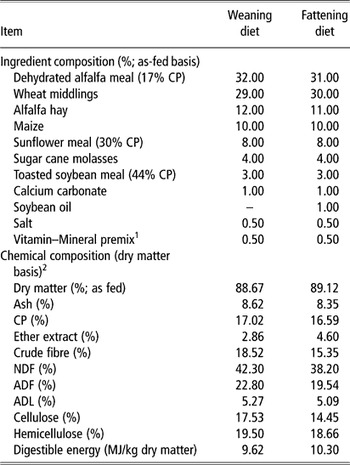
All procedures involving animals were performed according to the Italian laws on animal welfare in scientific experiments. The trial was conducted at a private rabbit farm (Benevento, Italy; 41°16′0′′ N, 14°55′0′′ E, and 667 m above sea level) during January to February 2011. A total of 1388 weaned hybrid Hyla rabbits (35 days old), with an average initial BW of 954.3 ± 67 g, were divided into two treatment groups homogeneous for BW and sex. The rabbits were housed in the same building and placed in cages (26 × 46 × 35 cm). The cages were placed in two different but adjacent rows; the average temperature in the building was 21°C ± 2°C, and the lighting programme provided 16 h of light. There were two rabbits (one male and one female) in each cage and 347 cages per treatment group. The two treatment groups were fed the same diets ad libitum both in post-weaning (35 to 60 days) and fattening (61 to 84 days) periods. The ingredients and chemical–nutritional characteristics of the diets were reported in Table 1. One treatment group (AL) also received drinking water ad libitum. The other treatment group (WR) had restricted access to drinking water in the post-weaning period (35 to 60 days of age); the time of water distribution was progressively increased according to the increase in animal age and weight as follows: from 35 to 41 days of age 2 h/day (0900 to 1100 h); from 42 to 48 days 2.5 h/day (0900 to 1130 h); from 49 to 55 days 3 h/day (0900 to 1200 h); from 56 to 60 days 4 h/day (0900 to 1300 h). During the fattening period in both treatment groups, drinking water was supplied ad libitum.
Ingredients and analysed chemical composition of the diets fed to rabbits

1Provided per kilogram of diet; Weaning diet: vitamin A, 8375 IU; vitamin D3, 1000 IU; vitamin E, 20 mg; vitamin K3, 1 mg; vitamin B1, 1 mg; vitamin B2, 2 mg; vitamin B6, 1 mg; nicotinic acid, 20 mg; choline chloride, 250 mg; magnesium, 290 mg; manganese, 20 mg; zinc, 60 mg; iodine, 1.25 mg; iron, 26 mg; copper, 10 mg; cobalt, 0.7 mg; Fattening diet: vitamin A, 6,375 IU; vitamin D3, 750 IU; vitamin E, 20 mg; vitamin K3, 1 mg; vitamin B1, 1 mg; vitamin B2, 2 mg; vitamin B6, 1 mg; nicotinic acid, 20 mg; choline chloride, 250 mg; magnesium, 290 mg; manganese, 20 mg; zinc, 60 mg; iodine, 1.25 mg; iron, 26 mg; copper, 10 mg; cobalt, 0.7 mg.
2Unless indicated otherwise.
Throughout the experiment, the mortality rate in the groups was recorded daily. Individual live weights and feed intake per cage were recorded weekly for 32 cages randomly chosen per group (64 rabbits) to calculate BW gain, average daily feed intake (ADFI) and the feed conversion ratio (FCR). Each morning, any dead rabbits were removed before feeding, and the cages, in which one or both rabbits had died, were excluded from the experiment. The apparent digestibility values of organic matter (OM), CP, ether extract (EE), crude fibre (CF), NDF, ADF, cellulose and hemicellulose were determined using acid-insoluble ash (AIA) as an inert marker according to Vogtmann et al. (Reference Vogtmann, Frirter and Prabuck1975). The hard faeces were collected on 3 consecutive days (58 to 60 days of age). Nylon nets (5 × 7 mm mesh) were placed under the same 32 cages used for the growth experiment to separate faeces from urine. At the end of each day, faeces from each cage were collected, discarding caecotrophs, and dried in a draft oven at 60°C to a constant weight. Dried faeces were pooled and ∼50 g was used for chemical analysis.
All animals were slaughtered at 84 days, after around 12 h fasting. Carcass data were collected from 16 rabbits/group (8 males and 8 females), selected to obtain similar final BW in both groups. All procedures followed the World Rabbit Science Association recommendations as described by Blasco and Ouhayoun (Reference Blasco and Ouhayoun1996). The slaughtered rabbits were bled, and then the full gastrointestinal tract, skin, distal legs and tail, and urogenital tract with empty bladder were removed. The carcasses were weighed and then chilled to 4°C for 24 h in a ventilated room. After 24 h chilling, the carcasses were weighed and the head, liver, the whole heart, lungs, oesophagus, trachea, thymus gland and kidney free of perirenal fat were removed to obtain the reference carcass. From the reference carcass hind legs were separated.
Physical criteria
With a portable instrument (Model HI 9025; Hanna Instruments, Woonsocket, RI, USA) equipped with an electrode (FC 230C; Hanna Instruments), the value of pH after 1 h slaughtering was measured in the Biceps femoris muscle. The left hind leg was used to evaluate the percentage of meat, bone and fat. The crude meat was manually separated from bone and fat, and the meat to bone ratio was calculated as follows: meat/bone = (raw hind leg weight − bone weight)/bone weight. Instrumental meat colour was measured using a colorimeter (Minolta CR-300, illuminant D65 and 0° observer; Minolta Camera Co., Osaka, Japan) with the Hunter-Lab method by repeating the measurement three times, turning the sample three times by 90° and repeating the procedure at three different places. The instrument was normalized to a standard white tile provided with the instrument before performing analysis (Y = 92.8, x = 0.3162 and y = 0.3322). The colorimetric measurements were taken 24 h post mortem on the samples dissected from the reference carcass on a fresh cut surface, made in the approximate anatomical centre of each m. biceps femoris. The arithmetic mean of the nine recordings obtained from the muscle sample was subjected to statistical analysis. The degree of tenderness was tested through Warner–Bratzler Shear Force (WBSF) on the raw meat from left hind leg. The WBSF was measured (Instron 1140; Instron, High Wycombe, UK) using a crosshead speed of 50 mm/min and a load cell of 50 N. The cut sample had a cylindrical form with a 1.27 cm diameter cut that was parallel to the muscle fibre direction. The force-deformation curve obtained served to calculate meat hardness. Shear forces were determined perpendicular to the fibre direction. Each sample was sheared three times and the arithmetic mean of the recordings obtained from each sample was subjected to statistical analysis.
Chemical criteria
Chemical analyses of the basal diets and faeces were performed using the following AOAC procedures (2004): Dry matter (DM, method 934.01), EE (method 920.39), ash (method 942.05), CP (method 954.01), CF (method 945.18), ADF and lignin resistent to acid detergent (ADL; method 973.18) and amylase-treated NDF (method 2002.04). Cellulose and hemicellulose contents were calculated, respectively, as: ADF–ADL and NDF–ADF. The content of AIAs were measured in the basal diets and in the faeces according to Vogtmann et al. (Reference Vogtmann, Frirter and Prabuck1975). The raw meat from the left hind leg dissection was ground, freeze-dried and analysed using the following AOAC procedures (1984): moisture (method 950.46), fat (method 930.27) and ash (method 950.153). Protein content, including glucidic molecules and their catabolities (0.25%; Bovera et al., Reference Bovera, Lestingi, Iannaccone, Tateo and Nizza2012) was calculated by difference.
Total lipids were extracted from the homogenized left hind leg meat samples using the chloroform/methanol method by Folch et al. (Reference Folch, Lees and Sloane-Stanley1957). Fatty-acid methyl esters were prepared by transesterification using methanol in the presence of 3% HCl in methanol (vol/vol). Gas–liquid chromatography used an automated apparatus (CE 8000 Top; Thermoquest, Milan, Italy) equipped with a flame ionization detector and a column (Supelco Omegawax 250 type capillary, 30 m length, 0.25 mm i.d. and 0.20 μm film thickness; Sigma-Aldrich, Mila, Italy). The injector and detector temperatures were both 250°C. The hydrogen flow was 1.60 ml/min (linear velocity: 40.22 cm/s at 200°C). Fatty acids (FA) were identified by comparing their retention times with those of known standard FA methyl ester mixtures (Mix C4–24, 18919- 1 AMP; Supelco, Bellafonte, PA, USA). Results were expressed as a percentage (wt/wt) of total FA methyl esters. Atherogenic and thrombogenic indexes were calculated according to Ulbricht and Southgate (Reference Ulbricht and Southgate1991) as follows:
 $${ & {\rm {Atherogenic\ index}}\, = \cr &\,\quad\left( {\rm {C\,1\:2:\,0 + 4\times C\,14\,:\,0 \cr + C\,16:\,0}} \right)\,/\, \cr & \quad\left[ {\mathop{\sum}{{\rm MUFA} + \mathop{\sum}{\left( {\rm {n} {\hbox-} 6} \right) + \mathop{\sum}{\left( {\rm {n} {\hbox-} 3} \right)} } } } \right] $$
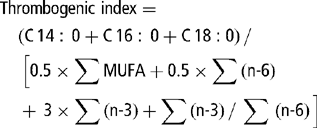 $${ &{\rm{Thrombogenic\ index}} = \cr &\quad\left( {\rm C\,14:\,0 + C\,16:\,0 + C\,18:0} \right)\,/\cr &\quad\,\left\Big[ {0.5} \right.\times \mathop{\sum}{{\rm MUFA}} + 0.5\times \mathop{\sum}{\left( {\rm {n} {\hbox-} 6} \right)} \, \cr & \quad+ \,3 \times \mathop{\sum}{\left( {\rm {n} {\hbox-} 3} \right)} + \mathop{\sum}{\left( {\rm {n} {\hbox-} 3} \right)\,} /\,\mathop{\sum}{\:\left( {\rm {n} {\hbox-} 6} \right)} \left. \, \right\Big] $$
where monounsaturated fatty acids (MUFAs) are monounsaturated fatty acids.
Statistical analyses
The data were subjected to ANOVA using the GLM procedure of SAS (SAS Institute Inc., 2000). The cage (one or two rabbits/cage) served as the experimental unit. The model included the fixed effect of water distribution, and the cage was specified as a random effect. Differences among means of treatments were compared using the Tukey's test at P ⩽ 0.05. Mortality rate was analysed by the χ2 test.
Results
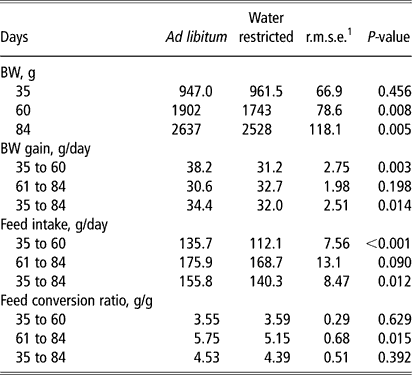
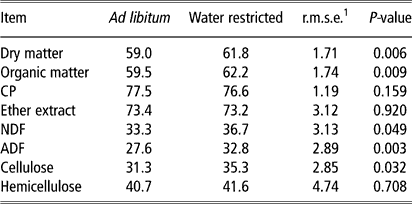
The mortality rate from 35 to 60 days was higher in the AL group (10.1% v. 5.2%, P < 0.0001). No analyses were performed to detect the cause of mortality; however, all dead rabbits showed signs of diarrhoea. After 60 days, and up to slaughter age (84 days), no mortality occurred in either group. Because of mortality, some cages in each group were discarded so that the number of cages used for statistical analysis was 29 and 31, respectively, for the AL and WR groups. Table 2 summarizes the in vivo performance recorded in the experimental period. BW gain was higher for the AL group during the post-weaning (38.2 v. 31.2 g/day, P < 0.01) and the entire period of the trial (34.4 v. 32.0 g/day, P < 0.05). No differences were recorded between the groups during the fattening period. The restricted access to drinking water reduced ADFI in the period 35 to 60 days by about 24 g/rabbit per day (−17.4%). After 60 days of age, when the access to drinking water was free, no differences for ADFI were recorded between the groups up to slaughter age. However, considering the entire period of the trial (35 to 84 days of age), ADFI was higher in the AL group (155.8 v. 140.3 g/day, P < 0.05). Feed conversion ratio was affected by dietary treatment during the fattening period (61 to 84 days) and was more favourable for the WR group (5.15 v. 5.75, P < 0.05). The digestibility values (Table 3) showed that rabbits with free access to drinking water had a lower digestibility of dry matter, OM, NDF, ADF and cellulose (+4.7%, +4.5%, +10.2%, +18.8% and +12.8%, respectively).
Effects of water restriction on in vivo performance of rabbits
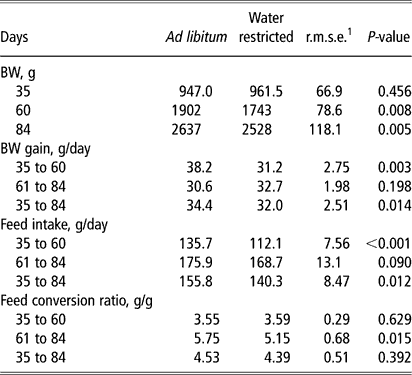
r.m.s.e. = root mean square error.
1n = 29 and 31 cages, respectively, for the ad libitum and water-restricted groups (lost three and one cages, respectively, because of mortality).
Effects of water restriction on apparent digestibility values (%) of the nutrients in rabbits at 60 days of age
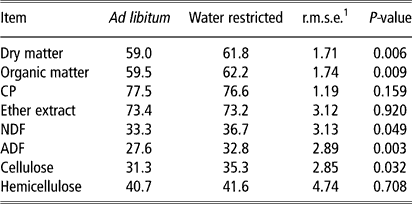
r.m.s.e. = root mean square error.
1n = 29 and 31 cages, respectively, for the ad libitum and water-restricted groups (lost three and one cages, respectively, because of mortality).
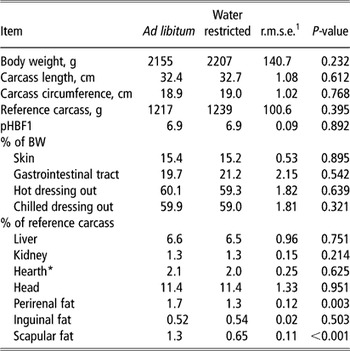
The percentages of perirenal and scapular fat (Table 4) were higher in rabbits drinking ad libitum (+30.7% and +116.6%, respectively). No effect of water restriction was observed on the weight of the left hind leg of rabbits (overall mean 179.2 g). Furthermore, there were no differences between the WR and AL groups in L*, a* and b* colour and WBSF of the left hind leg meat (overall means 50.2, 4.9, 2.0 and 0.4 kg, respectively). The results also showed that the percentage of meat, bone and fat, as well as the meat to bone ratio in the left hind leg of rabbits did not differ between the WR and AL groups (overall means 76.0%, 21.9%, 2.1% and 3.6%, respectively). In addition, the time of access to drinking water produced no changes in either the chemical composition or the frozen loss of rabbit meat (overall means 72.7%, 22.3%, 3.3%, 1.3% and 1.2%, respectively, for moisture, protein, lipid, ash and frozen loss).
Effects of water restriction on carcass traits in slaughtered rabbits (84 days of age)

r.m.s.e. = root mean square error.
1n = 16 (8 males and 8 females) per group.
pHBF1 = pH of m. biceps femoris measured 1 h after slaughtering.
*=means the whole heart, lungs, oesophagus, trachea, thymus gland.
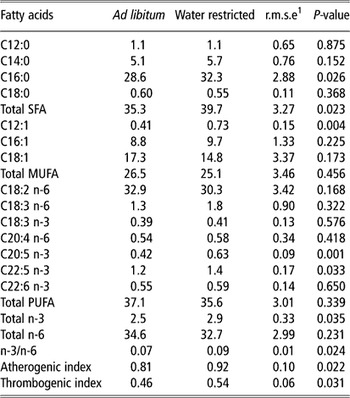
Restricted rabbits showed a higher proportion of C16:0 (+12.9%) and, as a consequence, a higher level of saturated fatty acids (+12.5%) than the AL group (Table 5). The lauroleic acid (C12:1) was also significantly higher in the WR group (+75.0%), but the total MUFA proportion was unaffected. In addition, total polyunsaturated fatty acids (PUFAs) were unaffected by water restriction, although C20:5 and C22:5 fatty acids (both n-3 FA) were higher in the WR group (+50.0% and +16.6%, respectively). Meat from WR rabbits also had higher proportions of total n-3 (+16.0%) and a higher n-3/n-6 ratio (+28.6%) than the AL group. Finally, both atherogenic and thrombogenic indexes were significantly higher in the WR group.
Effects of water restriction on fatty acid profile (% of total fatty acid methyl esters) and indexes related to human health of hind leg rabbit meat

SFA = saturated fatty acids; MUFA = monounsaturaterd fatty acids; PUFA = polyunsaturated fatty acids; r.m.s.e. = root mean square error; Atherogenic index = (C12 : 0 + 4 × C14 : 0 + C16 : 0) / [ ∑ MUFA + ∑ (n-6) +∑ (n-3)]; Thrombogenic index = (C14 : 0 + C16 : 0 + C18 :0) / [ 0.5 × ∑ MUFA +0.5 × ∑ (n-6) + 3 × ∑ (n-3) + ∑ (n-3) / ∑ (n-6)].
1n = 16 (8 males and 8 females) per group.
Discussion
The limitation of the access to drinking water as a way to reduce feed intake is obviously not in line with one of the five rules of the Farm Animal Welfare Council (in particular: freedom from hunger and thirst). However, the group submitted to the water restriction showed a lower mortality rate and, as a consequence, the freedom from pain, injury or disease was impaired. The positive effect of water restriction on mortality rate was also observed by Gidenne et al. (Reference Gidenne, Combes, Feugier, Jehl, Arveux, Boisot, Briens, Corrent, Fortune, Montessuy and Verdelhan2009a and Reference Gidenne, Murr, Travel, Corrent, Foubert, Bebin, Mevel, Rebours and Renouf2009b) who showed, according to our results, a reduction of almost half in the mortality rate when rabbits were submitted to a feed restriction of 20%. Martignon (Reference Martignon2010) underlined that the favourable effect on mortality rate was because of the reduction of the feed intake independently from the distribution procedure of the feeds.
Water restriction was confirmed as an effective way to reduce feed intake. This result agrees with the findings of El Maghraby et al. (2011) who reported that feed intake of rabbits was reduced by 19.1% when the access to water was reduced to 2 h/day in the period from 35 to 63 days of age. The same authors found that feed intake was reduced by 13.3% in the entire growing period of rabbits slaughtered at 77 days of age. Boisot et al. (Reference Boisot, Duperray, Dugenétais and Guyonvarch2004) also reported that feed intake was reduced by 18% when the access to water was reduced to 2 h/day. The growth rate of the rabbits was reduced as a consequence of feed intake reduction, both in the period when access to water was limited and in the entire period of the experiment, without an evident compensatory growth in the fattening period, when all rabbits had ad libitum access to water. Despite the higher estimated digestibility values of dry matter and organic matter obtained in the WR group in the post-weaning period, calculated intake of nutrients in the same period, particularly digestible energy and protein intakes, were higher in the AL group than in the WR one (0.68 v. 0.59 MJ/day and 15.8 v. 12.9 g/day, respectively, for AL and WR groups). The higher intake of nutrients in rabbits of the AL group explains their higher BW gain in the post-weaning period. However, in the same period, FCR was not different according to the groups.
In our trial, the higher digestibility of dry matter and organic matter was tied to a higher digestibility of NDF and, in particular, of the cellulose. Several authors (Di Meo et al., Reference Di Meo, Bovera, Marono, Vella and Nizza2007; Gidenne et al., Reference Gidenne, Combes, Feugier, Jehl, Arveux, Boisot, Briens, Corrent, Fortune, Montessuy and Verdelhan2009a) found that feed restriction can affect nutrient digestibility, also improving fibre digestion. It is well established that a reduction of feed intake induces higher retention time of the diet in the digestive tract and also could change the caecal microbial population and/or activity affecting the fibre digestion. In a recent study, Gidenne et al. (Reference Gidenne, Combes and Fortun-Lamothe2012) reported that the level of intake had no significant effect on the number of bacterial 16S rDNA copies/g of caecal content, and did not influence the bacterial community structure or diversity, although the same authors noted that the performed CE-SSCP profile analysis only takes into account the major bacterial populations. Therefore, it is possible that the reduction of feed intake, besides stimulating a high retention time of the diet through the digestive tract (Gidenne et al., Reference Gidenne, Combes and Fortun-Lamothe2012), may have affected the caecal microbial population and/or activity, also stimulating a more intense cellulose digestibility.
Most of the carcass traits were unaffected by dietary treatment, probably because of the progressively increasing time of water distribution during the post-weaning period. In general, it is thought that feed restriction leads to changes in the growth of internal organs such as the liver and digestive tract. In particular, it has been reported that digestive tract development is affected by feed restriction (Saleh et al., Reference Saleh, Attia and Younis1996; Tumova et al., Reference Tumova, Zita and Stolc2006) and that, after the restriction period, the growth of digestive organs is very rapid (Gidenne et al., Reference Gidenne, Combes and Fortun-Lamothe2012). Gidenne et al. (Reference Gidenne, Combes and Fortun-Lamothe2012) reported a final weight of the entire digestive tract (organ + digesta) about 10% higher in AL rabbits than in restricted rabbits. Bergaoui et al. (Reference Bergaoui, Kammoun and Ouerdiane2008) also found no significant differences in the digestive tract percentage of rabbits fed ad libitum or restricted to 85% from 42 to 77 days of age (20.1% v. 21.1%), whereas significant differences were found for rabbits restricted to 70% during the same period. Probably, a moderate level of feed restriction had a lower influence on the digestive tract development. The development of the digestive tract in restricted rabbits is also linked to changes in feeding behaviour, as a lower number of meals are consumed and a higher intake of feed per meal is recorded in comparison with rabbits fed ad libitum (Gidenne et al., Reference Gidenne, Combes and Fortun-Lamothe2012). Moreover, the technique used for feed restriction is very important. Gidenne et al. (Reference Gidenne, Combes and Fortun-Lamothe2012) reported that when the restriction was directly applied to the feeds (reduction of the total amount or reduction of the time of access to the trough), the rabbit adapted very quickly to the restriction strategy, with a very high intake just after the feed distribution, which reached 40% of the daily intake (within 2 h from the first access to the feed) only 8 days after the introduction of the feed restriction. The rabbit fed freely shows a relatively smooth intake behaviour with numerous meals characterized by a maximum of 10% of the daily intake 2 to 4 h after the lights have been switched off, and a minimal intake 2 to 4 h after they have been switched on, which probably correspond to the caecotrophy period (Gidenne et al., Reference Gidenne, Combes and Fortun-Lamothe2012). In our trial, feed intake was reduced by limiting access to water so that this effect was less evident. In fact, as reported by Ben Rayana et al. (Reference Ben Rayana, Ben Hamouda and Bergaoui2008), when water was supplied 2 h/day, the feed intake of rabbits reached the 40% of the total intake 4 h after access to water – double the time of feed restriction. El Maghraby (Reference El Maghraby2011), also applying a water restriction at 2 or 1 h/day, did not find significant differences in the full gastrointestinal tract between restricted and AL rabbits.
The restricted group had significantly lower percentages of perirenal and scapular fats. In subcutaneous and internal adipose tissues, feed restrictions depress the rate of de novo lipogenesis and the activities of numerous enzymes involved in the synthesis of fatty acids or responsible for generating nicotinamide adenine dinucleotide phosphate (NADPH) for the support of lipogenesis (Gondret et al., Reference Gondret, Lebas and Bonneau2000). The reduction of perirenal and scapular fat is of great interest, in view of the fact that perirenal fat is correlated with the total fat of the carcass (Ouhayoun et al., Reference Ouhayoun, Gidenne and Demarne1984).
In rabbits, the endogenous fatty acids (synthesized from carbohydrates) are mainly C16:0, C18:1 and C18:0 (Ouhayoun, Reference Ouhayoun1998). PUFA of the rabbit meat result primarily from the ingestion of exogenous lipids (Ouhayoun, Reference Ouhayoun1998), even though the synthesis of n-3 PUFA is possible from its diet precursor in the liver, and the amount produced depends on the dietary n-6/n-3 ratio (Peiretti and Meineri, Reference Peiretti and Meineri2008). However, according to Castellini et al. (Reference Castellini, Dal Bosco and Mugnai2002), the fatty acid composition of the feed and animal tissues can be modified as a result of the action of the gastrointestinal microflora because the gut microorganisms are able to hydrogenate unsaturated organic acids into more saturated ones, or even to desaturate some organic acids. Castellini et al. (Reference Castellini, Dal Bosco and Mugnai2002) highlighted the role of caecal microflora, showing that the ingestion of soft faeces by rabbits induced a greater concentration of n-3 long-chain PUFA in the meat.
In the current experiment, the main reason for the differences in the fatty acid profile in meat is that the concentrations of saturated fatty acids (SFA, mainly C16:0) and of n-3 PUFA (mainly C20:5 and C22:5) increased when water restriction was applied. Therefore, it may be that changes occurred in the caecal microflora (supported also by the changes in cellulose digestibility) and microorganisms with different preferences for fatty acid synthesis may have been favoured, affecting the fatty acid composition of the meat in the rabbits. As a consequence, the meat from restricted rabbits seemed to be healthier for humans because of the higher proportion of n-3 and the higher n-3/n-6 ratio. However, the meat from rabbits with ad libitum access to water had more favourable atherogenic and thrombogenic indexes because of the lower content of C16:0. From this point of view, the meat of rabbits from the water-restricted group appeared less healthy than that from the ad libitum group: there is epidemiological and experimental evidence indicating that a diet high in SFA (C12:0, C14:0 and C16:0) is associated with high levels of serum cholesterol, which in turn are related to high incidences of coronary heart disease.
Conclusions
Limiting the drinking access in the post-weaning period may lead to advantages for the digestive health of the growing rabbit, as mortality rate is reduced. Despite higher final live weights of rabbits drinking ad libitum, water restriction had no negative effects on carcass traits from animals of both groups with similar final weight, and carcasses from restricted rabbits had a lower content of perirenal and scapular fats. Physical and chemical meat characteristics also seem unaffected by water restriction, although fatty acid composition provides contradictory results: in fact, the meat of restricted rabbits not only had higher proportions of palmitic acid but also higher proportions of n-3 fatty acids and a higher n-3/n-6 ratio. Water restriction can be effectively used as a way to improve the sanitary status of the digestive system of young rabbits, when applied during the winter months. However, from the animal welfare point of view, a water restriction can be criticized as a method to restrict feed intake.