1. Introduction
The law and legal system of the World Trade Organization (WTO) are in principle blind to the commercial stakes involved in a dispute between its Members. As laid down by the WTO Understanding on the Settlement of Disputes (Dispute Settlement Understanding, or DSU), ‘[t]he prompt settlement of situations in which a Member considers that any benefits accruing to it directly or indirectly under the covered agreements are being impaired by measures taken by another Member is essential to the effective functioning of the WTO and the maintenance of a proper balance between the rights and obligations of Members’ (emphasis added).Footnote 1 The law makes no formal distinction between a claim of one million dollars and a claim of one billion dollars. In practice, however, it may be difficult to enforce a one million dollar claim because of the substantial resource commitments involved in a legal dispute. Under the current dispute settlement system it can take up to three years to litigate a dispute, cost more than half a million dollars in legal fees, and require a significant time commitment from government officials who may already be severely under-resourced. Moreover, all this could be for naught, since there is no assurance that a ruling will be affirmative or that the respondent will comply in a manner that leads to market access. Small claims are therefore unlikely to be pursued unless some important principle is at stake.
This is all as it should be, some would argue. If there were no implicit ‘user fees’, the dispute settlement system would implode. It has to cost something to keep out nuisance cases of insignificant value. Perhaps this is what the drafters had in mind when they, in one of the first articles of the DSU, wrote: ‘Before bringing a case, a Member shall exercise its judgment as to whether action under these procedures would be fruitful.’Footnote 2
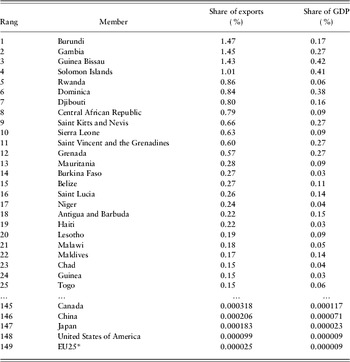
The latter interpretation is not without problems, however. What is insignificant for some Member states is highly significant to others. A million dollars in foregone export revenue may not matter much for the European Union or the United States; it would only be a few seconds worth of exports. For small developing countries such as Burundi, Gambia, and Guinea-Bissau, on the other hand, one million dollars corresponds to about 1.45% of annual exports, or put in relationship to national income, between 0.17% and 0.42% of gross domestic product (GDP) as shown in Table 1. Foregone export revenue of this magnitude would not be a small order for them.
The relative importance of USD 1 million of exports (2003)

Notes: Own calculations based on data from the WTO and UNSTAT.
* Including intra-EU25 export.
What is ‘small’ is thus a relative concept. Yet the WTO dispute settlement (DS) system does not take into account the inherent variation in exports across the WTO's membership. A case worth one million dollars is treated in the very same way (at least formally)Footnote 3 as a case worth one billion dollars. The timetable is the same; the submission requirements are the same; the standard of proof is the same; the appeal procedures are the same; everything is the same unless the parties opt for the alternative resolution mechanisms offered by the DSU, including mediation and arbitration, or the 1966 fast track procedures for cases brought by developing countries against developed ones. The alternative tracks of mediation and arbitration have only been used twice, suggesting that they are poor substitutes for the regular panel process. A major problem with these alternatives is that both parties, including the respondent, must approve the use of mediation or arbitration, and the use of such procedures may conflict with the longer-term strategic interests of respondents. By never yielding a case without a legal battle and never granting simplified procedures, respondents can develop a reputation for being tough and costly to take on, which will discourage price-sensitive complainants to take legal action. As regards the 1966 fast-track procedures, they have never been used since the WTO's creation in 1995, arguably because shorter time lines are not practical unless the complexity of the current dispute settlement process is reduced. Shorter time lines can place developing country Members at an even greater disadvantage. We further address parties' experiences with these options in Section 2.3.
In sum, where the procedures are the same while stakes differ, the system is not neutral to size. Notionally equal litigation rules provide unequal opportunities for WTO Members. Small trading nations are effectively constrained from being able to use the legal system to the full extent, constituting, in practice, a form of in-built discrimination.
One solution to this dilemma is to reduce the system's ‘user fees’ for smaller trading nations. This can be done in four principal ways, which could serve as alternatives or complements to each other. These choices can involve use of a public prosecutor, legal aid, stronger remedies, a streamlined procedure for small claims, or a combination of them, in each case changing the calculation of the costs and benefits of pursuing a case.
The first way is to create a WTO public prosecutor with objectives and powers similar to those of the European Commission within the EU legal system.Footnote 4 The public prosecutor would have the right and obligation to initiate legal proceedings against governments in the general interest of upholding the treaties.Footnote 5
A second way is to provide greater legal aid, for example by offering Members legal counsel funded out of the regular WTO budget or a designated legal aid fund. The political feasibility of this route appears constrained, however. It is not just or even primarily the cost that raises a problem, it is the use of the funds. The EU may have no interest in contributing to a legal aid fund that would enable resource-constrained countries to challenge its sensitive policies such as the Common Agricultural Policy (CAP). The US government would likewise face stiff opposition from organized labour and import competing industries at home if it contributes to a fund that would be used to challenge US anti-dumping policies. In Japan, it would be tantamount to political hara-kiri to contribute funds to foreign governments with an interest in prying open the Japanese market for rice and other culturally sensitive commodities. Indeed, neither the EU,Footnote 6 nor the US, nor Japan has contributed to the funds of the independent Advisory Centre for WTO Law (ACWL), which is the only provider of subsidized legal assistance at present, an alternative or complement that we review further below. At the same time, we would not entirely rule out the feasibility of an in-house legal aid fund. It has proven possible, for example, to create a trust to fund legal assistance for developing countries that are parties before the International Court of Justice, subject to defined criteria.Footnote 7
A third option is to increase the benefits of bringing a case, instead of reducing the costs of dispute settlement, through reforming WTO remedies. For example, if cash remedies were adopted and enforced, they could be used by a Member to help cover the cost of attorneys, potentially leading to more filings. Cash remedies would also create incentives for entrepreneurial attorneys, particularly if wrongdoers had to compensate for the damage already incurred (i.e., through retrospective remedies),Footnote 8 facilitating the bundling of smaller Members' claims in a manner roughly analogous to a ‘class action’. Even more controversially, the WTO could provide for fee shifting in all or some subset of cases, so that a losing respondent would pay the complainant's legal fees.Footnote 9 There are costs and benefits to such alternative approaches, which have been explored elsewhere, and we do not address them further in this Article.Footnote 10
A fourth option explored in this Article is to introduce simplified and less costly litigation procedures for ‘small claims’ pursuant to defined criteria that we address. As in domestic systems, it can be more socially efficient to reduce procedural complexity for small claims than to promote legal aid where the cost of litigation would exceed its social value. Indeed, that is a primary rationale for the small claims procedural alternative.Footnote 11 Of course, it is not possible to draw a direct parallel between small claims procedures at the national level and a corresponding institution at the international level. The parallel lies more in the underlying philosophy (a recognition that disadvantaged members of society face particular difficulties to access the judicial system) than in the institutional and political context. In the WTO context, the disadvantaged can be viewed either as poorer states within an ‘international community of states’ (the traditional international law perspective), or as private parties who are indirectly represented by states within the WTO and who are disadvantaged because they have small stakes. These private parties are even more disadvantaged when they have small stakes and reside in poor states, both because their stakes are not pooled within a larger collectivity and because the collectivity that represents them exercises less clout on the international stage.
The challenge is thus to find an appropriate model (or alternative mechanism) for a small claims procedure adapted to the WTO context. Indeed, can we define a ‘small claim’ in a meaningful way in a context where government policies are being disputed? Can such disputes ever be ‘small’ no matter what the monetary value? And can we expect a government to honour a ruling by an international small claims panel with no possibility of appeal now that the Appellate Body exists? Many observers may answer negatively, so that we have to think creatively if this institution is to be adapted to the WTO context.
The primary aim of this Article is to spur a policy discussion on the appropriateness of a small claims procedure in the WTO context, subject to different design criteria. We recognize the serious challenges (and have our own serious doubts, in particular regarding the obstacles from a political economy perspective). The challenges are particularly great given the path-dependent nature of institutions. Commentators on, and users of, the DSU are accustomed to the current rules and may be wary of the risk of any significant reforms – first, ‘to do no harm’, as the saying goes.Footnote 12 Yet if the system is not functioning for a party, as arguably is the case for smaller Members and their constituents, then there is also a downside risk of doing nothing. What is ultimately at stake is the legitimacy of the WTO if only a subset of the Members can make profitable use of the dispute settlement system. We therefore think it is worthwhile to discuss various options, including innovative ones like a small claims procedure.
Although we have no pretension of providing a definitive answer or model for such an institution, we offer a structured analysis of the challenges posed and of possible institutional responses to them. As an initial step, we make a prima facie case that the current DS system effectively discriminates against small claims and hence owners of small claims, and thus, in particular, against least developed countries, small island economies, and low income developing countries. This empirical task is carried out in Section 2. Section 3 examines experiences with small claims procedures domestically and supranationally, including (quite recently) within the EU. In Section 4, we assess the issues raised by adding a small claims procedure in the WTO context, and we propose specific design features that would address them. Section 5 concludes.
2. The case for a small claims procedure
The case for a small claims procedure rests on three premises that we examine sequentially. First, trade stakes vary across the Members of the WTO. Second, claims involving smaller trade stakes are not sufficiently offset by smaller litigation costs or a reduced need for domestic WTO legal expertise. Third, the alternative means to facilitate access to the DSU, and in particular the alternative dispute resolution tracks now provided by the DSU, do not substitute for a small claims procedure.
2.1 Trade stakes
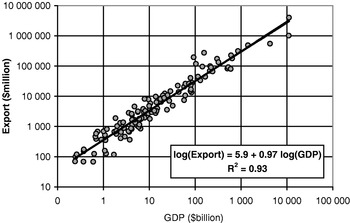
At the aggregate level of trade, the first premise is true almost by definition. Trade varies systematically with the size of the country. Figure 1 shows the strong correlation in data between aggregate trade and economic size measured by a WTO Member's GDP. It includes data for all WTO Members for 2003 apart from Liechtenstein. The European Union is treated as a single market. On average, a 1% difference in GDP between two Member states is associated with a 0.97% difference in aggregate exports.Footnote 13 Only a few WTO Members fall outside the picture (as shown by the low spread around the fitted line and the high R2 value).
Correlation between total export and GDP

Of course, trade disputes normally do not concern everything that is exported by a nation, but only the export of a specific product to a specific market, for example the export of bananas to the European Union.Footnote 14 Any evidence of de facto discrimination against smaller trading nations because of smaller aggregate trade values must therefore be verified at the disaggregated level of trade. After all, small trading nations could be large suppliers of particular products (oil, bananas, cotton, etc.) to particular markets (e.g. to neighbouring countries: Mexico to the US being a case in point) and hence be equally motivated to defend their market access under the DSU wherever it matters for that country. It is just that the number of products and markets in which they have a strong interest is much smaller, which is one reason why small economies are less active litigants overall.Footnote 15
In order to investigate the market situation at disaggregated levels of trade, we have extracted the 2003 trade matrix for each Member state at the 4-digit level of the Harmonized Commodity Description and Coding System (HS).Footnote 16 At this level of trade, the 1966 revision of the HS defines 1,241 product ‘headings’. Cotton, sugar, bananas, coffee, and milk are examples of agricultural product headings. Ships, airplanes, cars, trucks, and electronic printed circuits are examples of product headings under the industrial chapters of the HS nomenclature. Many trade disputes concern this level of trade. However, a dispute can in principle cover anything from all trade to an individual tariff line. It depends on the scope of the disputed policy measure.
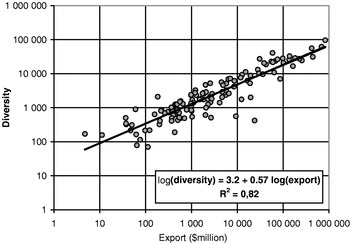
The total number of data points in our data set is close to 19 million observations, comprised of the following: 124 WTO Members (the EU is treated as a single market) times 123 potential trading partners times 1,241 potential product headings. Only 5% of the potential export records are positive, however. Most countries export only a subset of the product range to a subset of the Member markets. It is only the largest Members of the WTO that have an export interest in respect of most products and markets. A Member's export diversity is calculated as the number of entries in the matrix with positive trade (entries below USD 1,000 are discarded, that is treated as zeros). For example, a country that exports 100 product headings to an average of ten partners receives a diversity index of 1,000. The actual export diversity ranges from 70 for Saint Kitts and Nevis to 96,011 for the EU, with an average of 7,300. The theoretical maximum is 123 partners times 1,241 product headings, equal to 152,643 positive records in the trade matrix. When the result is plotted in Figure 2, we find strong evidence that larger countries export a greater variety of products to a greater variety of markets. The data for individual countries is reported in Annex 1.
Total export vs. diversity of exports

The relationship between total exports and the diversity of exports is log-linear with a slope coefficient of 0.57Footnote 17; that is, a WTO Member that exports twice as much as another Member state is on average 57% more diversified across products and markets. A large proportion of the variation in total exports can thus be attributed to the variation in a Member's export diversity. However, and this is an important argument for a small claims procedure in the WTO, 43% of the variation in aggregate exports can be attributed to variations in sales per exported product. Larger countries have, as a general rule, larger commercial stakes in absolute terms also at the product level of trade.
This finding could be a fallacy of composition, however. If large countries specialize in big-ticket items (manufactures) and small countries in small-ticket items (agricultural products), we will observe a higher average trade stake for large countries even if the trade stakes are identical in the product range that overlap. The most neutral way of making a comparison is to go product-by-product and market-by-market; that is, if we compare sales of individual products to individual markets, can we still establish that the stakes vary with the size of the country?
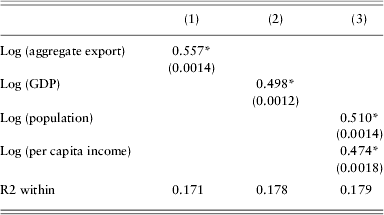
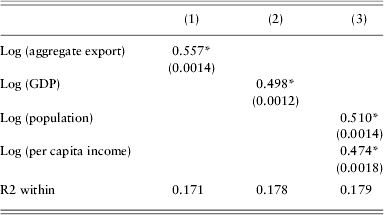
The relation between bilateral exports at the 4-digit HS level and the size of the exporting nation
Notes: * Significant at the 1% level.
The answer is in the affirmative, as shown in the statistical analysis reported in Table 2. We use a so-called fixed-effect panel model, where each panel is comprised of the countries that export a certain product heading to a certain market. The data set includes 124,333 panels in total with an average of 7.2 exporters per panel.Footnote 18
If the size of the supplying country were irrelevant for trade at the 4-digit product level, none of our measures of size would have any explanatory power. This is not the case. A country that exports twice as much as another country at the aggregate level of trade tends to export 55.7% more of those products that overlap in the export portfolio. The result is similar if we measure size in terms of GDP.
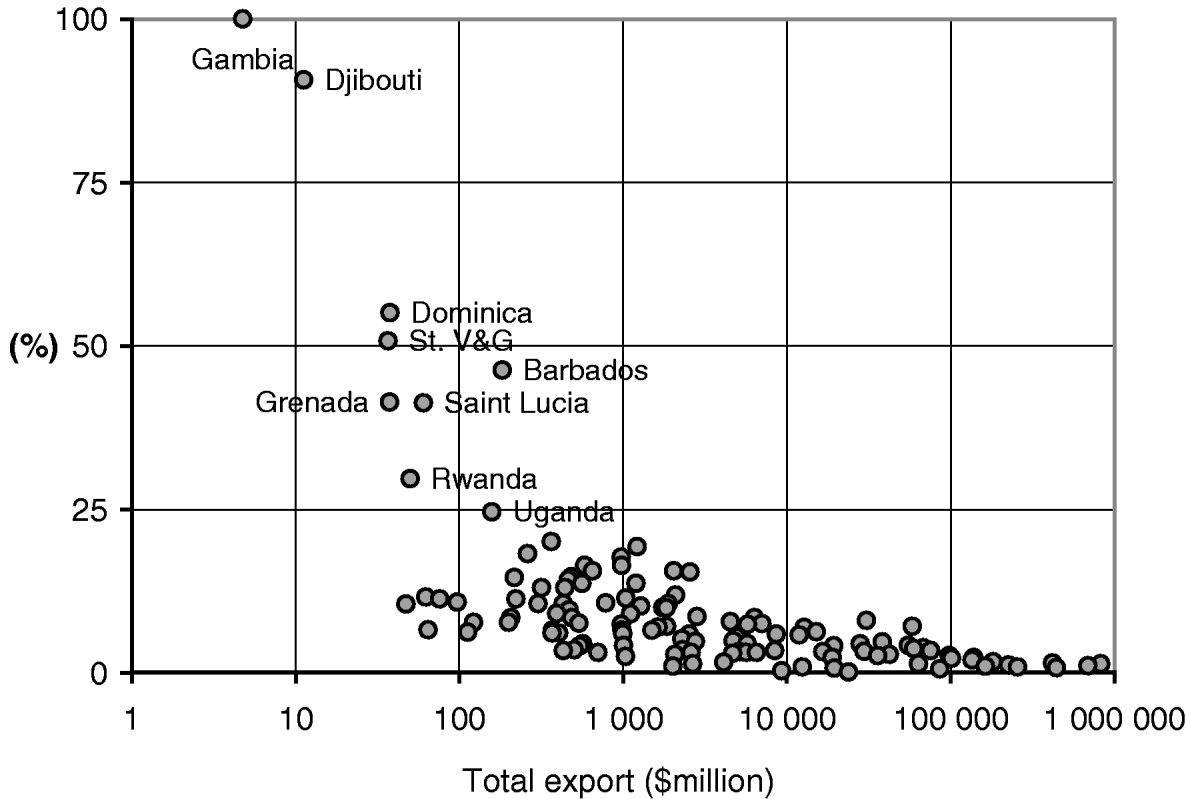
Our data set also allows us to investigate how dependent each country is on small export lots, and, in this indirect way, to investigate its sensitivity to high litigation costs (including the cost of maintaining internal personnel experienced with the DSU's complexities). Specifically, if we let the computer search through each country's export matrix at the 4-digit level, how many entries fall below the given threshold of litigation costs and what share of exports do they make up in total? The underlying idea is that rights regarding ‘small’ export lots may not be profitable to defend under the current DS system, which treats all claims equally, regardless of their value. Let us first consider a threshold of litigation costs equal to USD 1 million. The result is plotted against total exports in Figure 3. (The results are similar if instead plotted against GDP.)
Share of export below $1 million
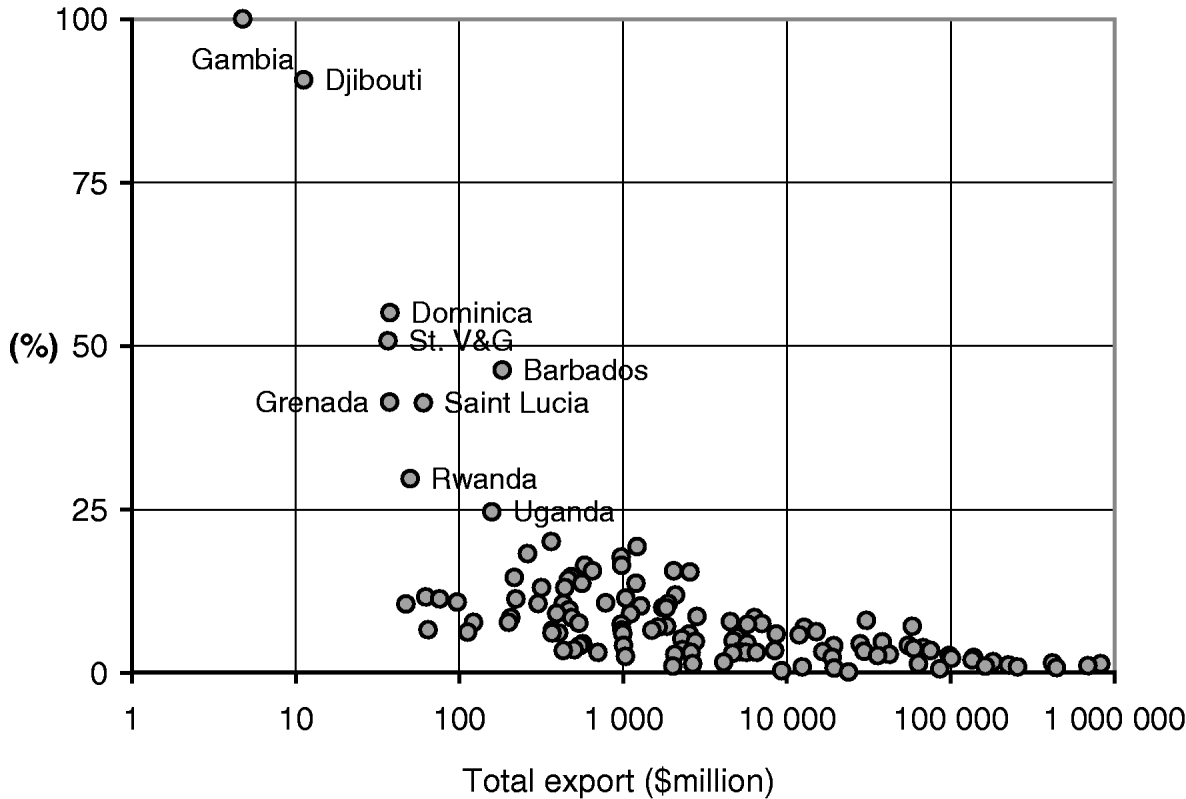
The scattered plot in Figure 3 shows that export lots below USD 1 million fall with the size of the country in a non-linear fashion and approach zero for countries with total exports of more than USD 100 billion. Two Members stick out as being extremely sensitive to high litigation costs (including demands on internally developed expertise) because of the predominance of small export lots: 100% of Gambia's exports of goods falls below the USD 1 million mark and Djibouti is not far behind at 90.7%.Footnote 19 Five Caribbean countries (Dominica, Saint Vincent and the Grenadines, Barbados, Grenada, and Saint Lucia) also depend on a large number of small export lots that may not be worthwhile defending at the WTO under the current procedures.
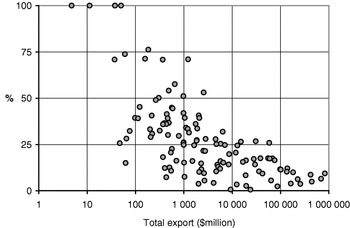
If the true threshold for profitable use of the DSU is 10 million USD, many more WTO members are effectively shut out from using the system, as shown in Figure 4. Virtually all LDCs and small island economies are at risk of being without legal protection because they may not be able to recoup the legal expenses and other costs of a successful trade dispute.Footnote 20 The situation for individual WTO Members is reported in Annex 1.
Share of export below $10 million

In sum, smaller trading nations have smaller trade stakes both at the aggregate and disaggregated levels of trade. We therefore have good reasons to believe that they are more sensitive to costly dispute settlement proceedings than larger trading nations.
2.2 Litigation costs and internal expertise
The fact that smaller trading nations have smaller trade stakes overall and at the individual product level would not cause any particular problem from the point of view of dispute settlement if it were correspondingly cheaper to litigate small cases, a point that we address in this section.
WTO Members face three primary types of costs in determining whether to bring a case. The first is the direct out-of-pocket cost for hiring outside legal counsel. The second is that of hiring and dedicating government personnel with expertise to oversee and provide necessary support in the bringing of a complaint. The third is the opportunity cost of expending scarce government resources and personnel time for this particular use as opposed to other social priorities, which in turn also affects a Member's perception of the cost. Because poorer countries have scarcer resources and perhaps more immediate economic and social priorities, they are particularly likely to perceive WTO legal costs to be significant, especially where the future benefits are uncertain.
To bring a complaint within the increasingly complex WTO legal system is not simply a matter of outsourcing a file to legal counsel. A WTO Member first needs the internal capacity to select, monitor, and coordinate with outside legal counsel, including for the development of the factual basis for a claim. WTO case law has been increasingly demanding on litigants in this respect.Footnote 21 Second, a WTO Member must make a political decision whether to invest in a WTO case or some other government priority. The aggregate amount of litigation costs arising from DSU procedures is thus clearly a factor.While many commentators may contend that WTO litigation costs are really not that significant a factor, our discussions with representatives from lesser developed countries suggest that they are certainly perceived to be a restraint.Footnote 22 They are more likely to be perceived by lesser developed countries to be high not only because the prospective future benefits from bringing a WTO complaint are smaller on account of the smaller stakes, but also because these countries face more immediate priorities that must be met with limited government budgets. They are therefore less likely to invest in a longer-term legal process where outcome is uncertain and the legal process is particularly complex and costly.
The costs of dispute settlement would be reduced if the WTO provided meaningful legal aid. But the WTO does not have the budget or the mandate to do so. The WTO agreements rather impose a rather strict impartiality constraint on the WTO Secretariat, and the WTO's budget for the provision of more general legal counsel to Members is limited. The prospect of a legal aid fund for the hiring of outside lawyers appears constrained, since it is not in the interest of key member states and since the WTO is operated on a consensus basis.
Developing countries can seek assistance from the independent Advisory Centre for WTO Law (ACWL), which provides legal assistance at discounted rates.Footnote 23 The ACWL is currently the best option for the poorest WTO Members, and will likely remain so. Yet the existence of the ACWL does not in itself undermine the need to assess the rationale for adding a small claims procedure for a number of reasons. First, the ACWL has limited staff and thus is limited in its ability to handle all matters potentially referred to it. Second, although ACWL's assistance represents a form of subsidized legal aid, it is not free.Footnote 24 At some threshold, the demands of the process are much more likely to affect the decision of a poor country to bring a complaint. Third, legal aid and a small claims procedure can be complementary. The legal aid provided (whether through ACWL or otherwise) will be more efficiently used if procedures are designed appropriately for small claims. Fourth, the current system's procedures also require considerable internal work at the national level, which is not practicable for many poorer Members. These demands exist even when outside counsel is used. A small claims procedure would reduce the demands on poorer developing countries' bureaucracies, since the procedural demands on the litigants would be simpler than under the normal procedures.
Turning to the cost of legal counsel on the private market, we have some information, although it is incomplete. Law firms do not publicly state what they bill their clients, and fees depend on the complexity of the case and how far the case goes before a settlement is reached. A case that goes the full three-year course with appeal and subsequent contestation over the respondent's implementation of the decision may cost millions of dollars. The unofficial record is the Japan–Photographic Film case, where the legal fees for each side are reported to have topped USD10 million for each party,Footnote 25 although this amount is likely being exceeded by a wide margin in the US–EU dispute over aircraft subsidies respectively granted to Airbus and Boeing.
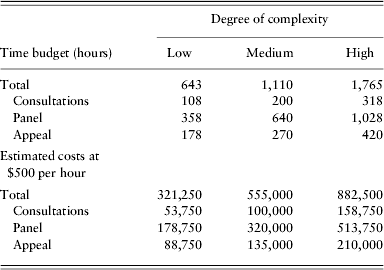
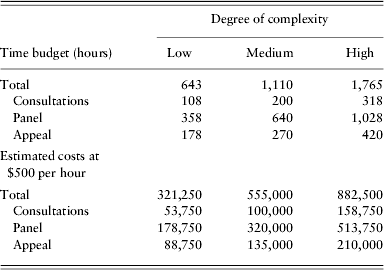
One way of conservatively ‘estimating’ the cost of legal counsel is to multiply the estimated commercial rates charged by private law firms with the indicative time budget applied by the ACWL vis-à-vis its developing country clients. The hourly rate charged by top-notch law firms in Brussels and Washington DC is somewhere in the range of USD $350 to USD $750 (or more). The higher rates apply to senior lawyers and the partners of the law firm. Let's assume for the sake of this example that the average rate is USD $500 per hour, excluding other expenses, such as for travel or where outside economic consultants are needed. The time budget published by the ACWL is conservative according to the director of the ACWL, Frieder Roessler, and private counsel handling WTO cases. The ACWL staff, we understand, typically devotes two-to-three times as many hours to a case as they actually bill their clients. Private law firms cannot be expected to waive costs in the same fashion since they are for-profit businesses, and they typically spend many more hours than listed in the ACWL's estimated time budget.Footnote 26 They spend more time preparing in order to enhance the prospects of a legal victory and bolster their reputation, including among high-paying clients in the private sector. Accordingly, we scale up the conservative ACWL time budget by a factor of 2.5, which is the estimated underreported preparatory time for the ACWL staff. The results of these back-of-the-envelope calculations are presented in Table 3.
‘Estimated’ litigation cost
Source: ACWL homepage and own calculations.
Factors that affect the cost include the complexity of the case, from both a factual and legal point of view, and how far the case proceeds before a settlement is reached. Under these back-of-the-envelop calculations, a case of average complexity would cost USD $100,000 if it ends after the initial consultations because the parties have settled or the complaint is otherwise withdrawn. If the case advanced to the panel stage, it would cost another USD $320,000. And if the panel decision were appealed, the bill would rise by another USD $135,000. The total cost would then top half a million dollars. To the extent that a party uses the ACWL, the costs would be reduced, but can still be considerable.
One particular problem for a complainant concerned about legal costs is that the total amount (as well as the prospective benefits) cannot be assessed beforehand since they depend on the actions of the other party. If the respondent decides not to settle and the case goes to a panel, the price will increase. If the respondent decides to appeal the ruling, the price will increase further. If the parties choose to litigate over compliance, the price continues to rise. If the respondent does not comply with a ruling, then the entire litigation could be for no purpose.Footnote 27 This possibility only adds to the underlying uncertainty that the complainant might not prevail legally, even if the case looks promising. WTO Members that have smaller government budgets allocated for legal affairs, and in particular smaller developing countries that need to weigh other immediate priorities will perceive the legal fees and associated uncertainties to be considerable, especially where there is no guarantee that the case will lead to a positive outcome. The dual uncertainty of possibly losing a case and of the respondent not complying with an affirmative ruling can discourage governments from filing a complaint.
Nonetheless, a small claims procedure would be needed less if small cases (in commercial terms) were less costly to litigate under the current system because they are less complex from a factual and legal perspective – that is, if costs and stakes move in tandem. Casual empiricism suggests that some high stakes cases cost more to litigate, indeed much more. The Airbus–Boeing (EC–US) dispute, for example, involves teams of lawyers and economists lined up on each side to gather factual evidence and prepare legal arguments. There appears to be little limit to spending money in such a high profile, multi-billion dollar case involving state-supported multinational companies.
Such casual empiricism, however, says little about the inherent relationship between litigation costs (including internal personnel time) and commercial stakes. What it tells us is that governments and their private clients are less fussy about the billable hours when the stakes are high. Yet there is no rule that factual and/or legal issues are inherently more complex in cases that concern a billion dollars than a million dollars. It may be true in some cases and untrue in others. Indeed, one could make the opposite case by referring to the relatively simpler rules that apply to most manufactured imports compared with agricultural imports, in spite of the fact that the former tend to involve larger values. Some of the most complex and controversial trade law issues involve relatively small commodities in value terms, such as bananas, sugar, rice, and cotton.
Even if one believes that small cases in commercial terms are inherently cheaper to prepare than large cases (which we doubt), the issue remains whether the offset is complete. If answered in the affirmative, both sides of the cost–benefit equation would move in tandem, maintaining the neutrality of the DS system with respect to size. But this result is not plausible because of the fixed costs of bringing a case. Jurisprudence must be reviewed and assessed and a factual dossier developed. The consultations, the panel process and the appeals process follow a certain track regardless of the value of the case. The complainant must have internal staff that follow the case and provide support to outside counsel, in particular for the factual dossier. That staff also needs to be of a sufficiently high bureaucratic status that they receive the necessary political support for the case in the capital. Countries with high stakes that are repeat players before the WTO dispute settlement system are more likely to have such officials, benefiting from economies of scope.Footnote 28 The result of DS procedures is to create a threshold effect that effectively discriminates against small claims and countries that have them, even though such small claims are relatively large in relation to those countries' small economies.
This conclusion is indirectly supported by the empirical research undertaken by Chad Bown.Footnote 29 The starting point of Bown's research is that many disputes involve policies having a multilateral reach. Any country with a trade interest in the product(s) affected by the disputed measure could have filed the complaint.Footnote 30 In fact, if the incentives to file were identical, as would be the case if stakes and costs moved in tandem, we should not see any relationship to size in the filing data. All potential litigants would be equally likely to file and the actual filing pattern would be a random draw. But this is not what the data show. Quite the contrary, the decision to file is systematically related to export stakes, legal capacities, and other variables that enter the cost–benefit analysis.Footnote 31 Bown's findings suggest very strongly that the DS system is not neutral to size.
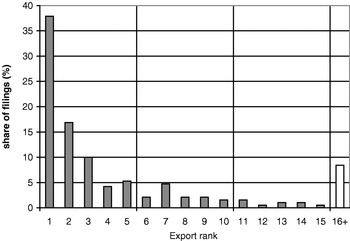
Our data compilation, using a less sophisticated method but in the same spirit, provides further evidence to this effect. Based on the product coverage reported in the Dispute Settlement Data Set assembled by Horn and Mavroidis for the World Bank,Footnote 32 we have extracted the covered trade data from COMTRADE in the year preceding the dispute. Our database covers 190 disputes between 1995 and mid 2004.Footnote 33 The results corroborate Bown's findings. In 38% of the cases, the country with the highest export stake in the covered products filed the complaint. In a further 17%, the second largest supplier filed. And in three cases out of four, the complainant(s) were among the top five suppliers. The likelihood that this pattern is random and independent of the commercial stakes is virtually nil. Figure 5 shows the relationship between the distribution of filings and the rank of the exporter in the defendant's market for the covered products.
The filing distribution (1995 to mid 2004)

Where a country can ‘piggyback’ on another WTO Member's filings, it can benefit, and even ‘free ride’. Yet small countries then become dependent on circumstance. In certain cases, they will benefit as a side-effect of another Member's litigation; in others they will not. Where a large country does not export the product, or has different interests in regards to the product, or is able to negotiate a settlement regarding the dispute that defends its interests but not that of the small country, the idea of ‘piggybacking’ and ‘free riding’ provides little less solace. In fact, most trade disputes are settled without WTO litigation, but in the shadow of potential litigation.Footnote 34 There is no assurance that these settlements extend the same benefits to other exporters of the same product (although they in principle should because of the most-favored-nation obligation), especially where parties settle a dispute outside of the WTO system without any complaint being filed.
In sum, the evidence strongly suggests that the DS system is not neutral to size. Exporters with the highest export stakes are more likely to file a complaint. In a truly neutral system, the individual stakes should not matter, and neutrality among trading nations is the stated ambition of the DSU, as laid down in DSU Article 3.3, which we cited at the start.
2.3 Alternative WTO dispute settlement mechanisms
The final issue we need to address before we have established a prima facie case for considering a small claims procedure in the WTO is that the DSU does not already offer an alternative that has a similar impact of reducing costs for Members with small trade stakes. In fact, the DSU does offer a number of alternative tracks that at least in principle could be suitable for cases of less value.
First, the DSU encourages parties to resolve their disputes amicably using the instruments of good offices, conciliation, or mediation.Footnote 35 Under good offices, the institution provides primarily logistical support to the parties to resolve their dispute. With conciliation, a third party also directly participates in the discussions and negotiations between the parties. In mediation, the mediator not only contributes to the discussions and negotiations, but also may propose a solution. The parties, however, are not obligated to accept the proposal.
Second, the DSU provides for arbitration upon agreement of the parties, with the arbitrator's decision being binding.Footnote 36 Arbitration is a potentially more expeditious procedure than the normal panel process. It may also be a less costly one since it would not be subject to appeal (although its cost-effectiveness is not guaranteed since international arbitrations can be costly). In WTO arbitration, as in international commercial arbitration generally, the parties ‘agree to abide by the arbitration award’.Footnote 37 Enforcement could therefore be less of an issue, which advantages smaller players.
These alternative tracks are only available, however, if both sides agree to use them. We have no data regarding whether mediation or arbitration has been requested by one party and refused by the other. What we know is that there has only been one joint request to the WTO Director-General for mediation, which was submitted by the Philippines, Thailand, and the European Communities in the particular context of the launching of the Doha round of trade negotiations and the granting of a ten-year waiver for the preferential agreement between the EC and Asia–Pacific–Caribbean countries (the EC–ACP Agreement).Footnote 38 Similarly, arbitration under Article 25 has never been used as an alternative to the regular panel process, although there has been one arbitration again agreed in the context of the waiver granted for the EC–ACP preferential agreement.Footnote 39 Finally, parties have, to our knowledge, only once (recently) used the good offices of the WTO Director-General,Footnote 40 although they have used good offices under the Agreement on Sanitary and Phytosanitary Standards (SPS Agreement) three times (using the Chair and secretariat of the SPS Committee).Footnote 41
We can only speculate why these alternative procedures are not used more frequently. One likely explanation is that the stronger party in a bilateral dispute is not interested in agreeing to procedures that could put the other side on a more equal footing. The possibility of raising the price for the other side by not yielding without a full-scale legal battle could induce the weaker party into a settlement on favourable terms or discourage the case from being submitted in the first place. Why yield this advantage by agreeing to a less-demanding mediation or arbitration? Defendants may, in addition, prefer to litigate WTO disputes under the full procedures for internal political reasons so that they can respond to their domestic constituencies protected by the trade measure that they have done everything possible to defend it, but now must comply with the legal ruling. Complainants, in contrast, may find that using good offices or mediation would only facilitate respondent's ability to prolong the maintenance of an illegal trade barrier. Finally, there is no defined procedure for these alternatives so that the parties would need to define the procedure each time on an ad hoc basis. Such ad hoc negotiations over procedures can be quite long and, as a result, undermine the very idea of a more ‘expeditious’ and less costly alternative.Footnote 42
The third and final option is for a party to invoke the accelerated procedures provided by the GATT Decision of 5 April 1966,Footnote 43 which has now been incorporated into the WTO.Footnote 44 This option is only available for developing country complainants against developed country respondents. Although mutual consent is not required, this accelerated procedure was applied only once by a panel during the GATT era (whose decision was blocked by the respondent and thus never adopted) and it has yet to be used under the WTO.Footnote 45 The explanation provided on the WTO homepage for developing countries' decision not to use the procedure is that ‘developing country Members tend to prefer to have more time to prepare their submissions’.Footnote 46 Indeed, litigation in the WTO has become a very demanding exercise. The legal submissions typically exceed a hundred pages, and include frequent references to previous WTO jurisprudence. These submissions are demanding to prepare even for an experienced law firm (if a Member can afford it). Shorter timeframes will not be a viable option for developing countries unless the demands on the parties are reduced correspondingly, especially for poor developing countries that are not repeat players and thus have significantly less experience with WTO law and jurisprudence. Although a developing country could prepare its initial submission before filing its complaint, it still would have reduced time for its second submission in response to the respondent's arguments, as well as for its preparation for oral hearings and any questions raised by a panel to which it must respond. Moreover, the shorter time lines under the 1966 procedure would apply only at the panel stage, and not to Appellate Body review, nor before proceedings before implementation panels and compliance panels, so that they should have little impact on total litigation costs, including in terms of personnel time.Footnote 47 The creation of multiple levels of appeal and review has made the 1966 procedures less relevant.
Before moving on to address the design of a small claims procedure, we note one important development in the Doha negotiations. A broad array of developed and developing country Members have proposed the addition of a new facilitative mechanism for the resolution of market access disputes that do not involve agricultural matters. Under their joint 2007 proposal, a new WTO mediation procedure would be created to address non-tariff barriers to trade (other than to agricultural trade) pursuant to which a Member may identify a barrier and request the initiation of a mediation procedure.Footnote 48 Under the proposal, the other party should ‘accord sympathetic consideration’ to that request, but it would retain the discretion to block the procedure's commencement. If the procedure were initiated, a ‘facilitator’, who would typically be the Chairman or vice Chairman of the relevant WTO committee within the Council for the Trade of Goods, would hear the parties' concerns and perspectives. The facilitator could ‘offer advice and propose solutions for the parties’ consideration taking into account the information presented by the parties'. The facilitator would do so within a set period of time, with 60 days being proposed in brackets. The facilitator would then write a factual report to the relevant WTO committee, summarizing the measure in question, the procedure followed, and any mutually agreed solution. We would welcome the addition of such a defined mediation procedure, which would address many of the concerns raised in this article. Even were it adopted,Footnote 49 however, there would arguably still be a need for a small claims procedure to address matters that are blocked from being heard under the procedure, are not settled through it, or are not covered by it (such as those concerning agricultural trade).
3. Small claims procedures
Before turning to an assessment of a small claims procedure in the WTO context, we briefly examine domestic and supranational experiences with such a procedure.Footnote 50 In this Section 3, we explain what small claims procedures are at the national level, what purpose they serve, how they are organized in different jurisdictions involving alternative design features, and what challenges they have faced. We also discuss the recent creation in the EU of a transnational European Small Claims Procedure, which represents a new initiative at the supranational level in this area, as well as the use of small claims procedures in international arbitration.
3.1 The national context
Most advanced national legal systems include special procedures for small claims that otherwise would be too costly to pursue.Footnote 51 The primary purpose of these procedures is to provide greater access to justice to those persons and for those situations where the normal civil justice system is too costly and time consuming.
Small claims courts in the United States originated in the first two decades of the last century as part of a legal realist reform movement, which maintained that the formal legal system failed to respond to the needs of most citizens.Footnote 52 Reformers believed that the regular civil justice system's complexities and technicalities made it virtually impossible for average citizens to use it. They hoped, for example, that a small claims procedure would enable wage earners and small businessmen to use the courts to collect wages and accounts that they were owed.Footnote 53 In the 1960s and following decades, with the rise of the consumer movement and demands for ‘access to justice’, there was a renewed push for facilitating access to the legal system. Advocates of small claims procedures again maintained that regular civil court procedures were too cumbersome for small cases, resulting in unreasonable delay and expense, and the requirement of a lawyer for parties to find their way through the system's complex procedural requirements. Advocates wished to reduce legal costs and delay by reducing filing fees, simplifying pleadings, eliminating procedural steps, and eliminating the need for litigants to hire a lawyer. They contended that citizens would look more favourably on the legal system if they were provided greater access to it. Indeed, some observers maintain that a particular benefit of small claims procedures is that claimants believe that they have access to the courts and participate effectively in proceedings where otherwise they would not, affecting their perceptions of the legal system.
Small claims procedures are typically provided for a defined category of claims before a division of an existing lower court of general jurisdiction, be it a municipal, county, or district court, although there is great variation among jurisdictions. US state courts, for example, provide small claims proceedings for civil claims that can be satisfied by money damages up to a specified dollar amount. They sometimes exclude from small claims procedures certain categories of claims, regardless of the amount sought, such as libel and slander actions, on the theory that these actions are quasi-criminal and are too serious to entrust to an informal procedure. The US has also created small claims procedures for some public law claims at the federal level, as before the US Tax Court.Footnote 54
Some jurisdictions have prohibited commercial enterprises from using small claims procedures because these parties tend to be better resourced and experienced users of litigation, so that they have less need for such procedures.Footnote 55 In Europe, for example, Ireland's small claims procedure is limited to consumer complaints, while that for England and Wales allows businesses to use it.Footnote 56 Rather than shut their doors to businesses and collection agencies, some jurisdictions limit the number of claims that any one individual or entity may file within a specified time period.Footnote 57 Most jurisdictions, however, appear to offer these procedures without quantitative limitation to businesses as well as to individuals.Footnote 58
Although the adversary process is largely retained in small claims procedures in the sense that each side to a dispute is responsible for presenting the arguments and facts in its favour, trial procedures and rules of evidence are more informal and left largely to the discretion of the trial judge. The judge, for example, can play a more active role at trial, assisting litigants in bringing out relevant facts and clarifying the legal issues involved. Court clerks can also provide some basic services to the parties, such as assisting with the filing of the complaint forms and providing advice on what types of proof are needed at trial, and how to subpoena supporting witnesses when needed. To facilitate use of these procedures, for example, the state of California has created a Small Claims Legal Advisor Program.Footnote 59
While small claims courts have broadened the access to justice for ordinary people and small businesses, they have not always lived up to expectations. Ruhnka et al. note the following concerns, although they find that at least some of these concerns are overstated:
• ‘Where business plaintiffs are permitted in small claims court they tend to dominate the caseload of these courts, and they usually sue individual (non-business) defendants;
• Plaintiffs almost always win and defendants almost always lose in small claims court (with the implication being that the process is somehow arrayed against defendants or the type of people who are often defendants);
• Where lawyers are used at trial they are most often used by business plaintiffs against un-represented individual defendants (which further disadvantages defendants);
• Small claims trials are often rushed, which tends to disadvantage inexperienced defendants;
• Many litigants, particularly un-represented individuals and small businessmen, are unable to subsequently collect their small claims judgments;
• Many small claims can be factually or legally complex and they may not be adequately dealt with in an informal proceeding;
• Role conflict problems may arise when judges attempt to mediate or settle claims instead of deciding them outright.’Footnote 60
Overall, most small claims procedures, at least in the United States, have retained many characteristics of the formal system. Lawyers can be present in most jurisdictions (although some restrict their use)Footnote 61 and judges retain much of their traditional role. As Lempert and Sanders write, ‘most small claims courts [have been] simplified versions of traditional dispute decision courts using adversarial processes to reach binary decisions’.Footnote 62 The forum remains a primarily adjudicative (and not mediative) one. Many of the points addressed above may be relevant in considering whether to create a small claims procedure adapted to the WTO context, and, if so, how to design it. We imagine, for example, that a WTO small claims procedure would largely remain a simplified version of the DSU procedures, with some adaptations that we address in Section 4.
3.2 The EU regional context
European member states have their own versions of small claims procedures. What is particularly noteworthy in Europe, however, is the move to create for the first time a small claims procedure at the supranational level. In July 2007, the EU created a new European Small Claims Procedure.Footnote 63 It covers cross-border claims of up to 2,000 Euros, other than certain categories of claims, such as for defamation. It will go into effect in all EU member states in January 2009 except for Denmark, which opted out.
In its initial proposal, the Commission made the following observations as way of background to the needs of introducing European Small Claims Procedures, many of which are relevant to our concerns:
Costs, delay and vexation of judicial proceedings do not necessarily decrease proportionally with the amount of the claim. On the contrary, the smaller the claim is, the more the weight of these obstacles increases. This has led to the creation of simplified civil procedures for Small Claims in many Member States. At the same time, the potential number of cross-border disputes is rising as a consequence of the increasing use of the EC Treaty rights of free movement of persons, goods, and services. The obstacles to obtaining a fast and inexpensive judgment are clearly intensified in a cross-border context. It will often be necessary to hire two lawyers, there are additional translation and interpretation costs and miscellaneous other factors such as extra travel costs of litigants, witnesses, lawyers etc. Potential problems are not limited to disputes between individuals. Also the owners of small businesses may face difficulties when they want to pursue their claims in another Member State. But as a consequence of the lack of a procedure, which is ‘proportional’ to the value of the litigation, the obstacles that the creditor is likely to encounter might make it questionable whether judicial recourse is economically sensible. The expense of obtaining a judgment, in particular against a defendant in another Member State, is often disproportionate to the amount of the claim involved. Many creditors, faced with the expense of the proceedings, and daunted by the practical difficulties that are likely to ensue, abandon any hope of obtaining what they believe is rightfully theirs.Footnote 64
The arguments made by the Commission parallel those made in Section 2 above, with the key difference being that WTO law is not directly applicable to private subjects (at least not in the EU, US, and most other jurisdictions) in the same way as under the EC Treaty. It is therefore not possible for businesses to file a complaint before a national court arguing that a regulation violates a WTO provision. Moreover, it is only governments that have standing at the WTO. The EU's recent creation of a European Small Claims Procedure (involving a civil procedure to be used by persons) is therefore not directly applicable to the WTO context (involving an international procedure to be used by states). It is nevertheless interesting because it recognizes the need for small claims procedures at the supranational level as well.
3.3 Small claims in international dispute settlement
Finally, we briefly turn to two precedents for the handling of small claims against states at the international level: the Iran–US Claims Tribunal and the United Nations Compensation Commission, respectively involving claims against Iran following the Iranian revolution and against Iraq following its invasion of Kuwait. The context for these claims was quite distinct, as there were close to 4,000 claims before the Iran–US Claims Tribunal and over two million claims before the UN Compensation Commission.Footnote 65 However, we note the mechanisms used in these cases since they involved claims against states at the international level in which small claims were treated distinctly.
As part of the settlement of the hostage crisis in 1981 following the Iranian revolution, the United States and Iran entered into a Claims Settlement Declaration (CSD), which established the Iran–US Claims Tribunal in the Hague.Footnote 66 The CSD created separate mechanisms for the handling of small and larger claims. While claimants would directly represent themselves at their own expense for claims that were equal or greater than $250,000, claims less than this amount were to be presented by the claimant's government on the claimant's behalf.Footnote 67 Although neither the CSD nor the tribunal created procedural rules for expediting small claims,Footnote 68 ‘a procedure evolved whereby, for small claims, the United States initially filed very brief Statements of Claim, which were then augmented with Supplemental Statements of Claim as particular cases were scheduled for further consideration by the Tribunal’.Footnote 69 By August 1989, however, the tribunal had decided only 36 of the 2,795 small claims that had been filed,Footnote 70 allegedly on account of non-cooperation of the Iranian arbitrators and the tribunal's determination to address the larger claims first.Footnote 71 Responding to the delay, the US Congress passed legislation in 1985 that gave the Foreign Claims Settlement Commission (FCSC) jurisdiction to adjudicate claims by US nationals in the event Iran and the United States entered into a lump-sum settlement agreement of the small claims.Footnote 72 Iran and the US reached a settlement agreement on 13 May 1990, pursuant to which the United States withdrew the small claims from the tribunal in return for a lump-sum payment from Iran.Footnote 73 The US then referred these claims to the FCSC for adjudication, which finished processing them in February 1995.Footnote 74
The United Nations Compensation Commission (UNCC) likewise adopted a distinct means for handling small claims arising from Iraq's invasion of Kuwait in 1990. As one commentator writes:
[a]s for the functioning of the UNCC, it is remarkable that its very first decision, adopted symbolically enough on the anniversary of Iraq's invasion, gave precedence to the processing of claims by individuals not exceeding US $100,000, as opposed to claims by corporations and governments. The political intent of the UNCC, to offer a very different model to that of the US–Iran Claims Tribunal, is evident here, and was strengthened in 1994 by Decision No. 17 of the UNCC according to which all claims in categories A, B and C would receive a minimum compensation of US $2,500 each, before starting with the payments for category D, E and F claims.Footnote 75
The first phase of minimum payments was completed in July 1999, and the Commission continued to prioritize the smaller claims of individuals until completing its work on them.Footnote 76
We mention the work of these bodies because they represent attempts to address the distinct situation of small claims at the international level. In each case, they involve a separate handling of small claims brought by private parties against a state.
4. Adaptation of a small claims procedure to the WTO context
As we emphasized in the introduction, it is not possible to make a direct parallel between small claims procedures at the national level and a corresponding institution at the international level. The parallel lies more in the underlying philosophy than in the institutional and political context. The challenge is to find a model with appropriate design features for the WTO context.
Some of the issues that need careful analysis are:
• What is a ‘small claim’ in the WTO context?
• Should a small claims proceeding be available to all WTO Members? Or should it be available only to poorer developing countries, and, if so, which ones? Should it be available against all respondents?
• Should small claims rulings have the same precedential value as regular panel reports? Or no precedential value at all?
• Should different remedies be preferred, such as cash compensation in the event of non-compliance?
• How could procedures be streamlined to save costs?
• What body would hear these claims? The same kind of ad hoc panels that hear regular cases? A new ‘small claims body’ with professional judges? A new permanent panel body?
• Should appeals be permitted, eliminated, or only made available by petition to the Appellate Body?
Our primary aim in this Section 4 is to stimulate policy debate by offering a structured analysis of these issues and of possible institutional responses to them. We nonetheless propose specific design features that we believe should be included in order to facilitate the policy discussion.
There clearly are challenges if institutional innovations developed at the national level are to be transposed to a setting where governments dispute alleged violations of an international agreement. The first characteristic to recognize is the predominantly government-to-government character of WTO law and the WTO dispute settlement process. Disputes in the WTO are formally between governments and not between private parties as in civil proceedings in the national and EU contexts.Footnote 77
Second, the subject of the disputes is very different. What is being challenged at the WTO is the law or government practice itself. A WTO dispute settlement panel must address whether a provision of a national law or administrative practice violates a WTO Agreement. If the panel finds a violation, the government must change its law or administrative practice, or be subject to retaliatory measures in an equivalent amount.Footnote 78 The process of compliance or other settlement takes time. If the respondent complies, it must modify its law or regulatory practice in accordance with its internal legislative and administrative procedures.
Third, WTO law is complex and often open to interpretation. WTO disputes do not involve the processing of simple matters such as the collection of unpaid debts, but rather the interpretation and application of complex treaties. These treaties have been negotiated among over 100 governments that do not typically agree on the meaning of each provision. The art of international negotiations includes creative drafting that allows all parties to sign, but that can leave significant ambiguities. Given the very nature of language, moreover, terms are often subject to interpretations with quite different implications. Interpretive issues are thus central to the dispute settlement process. Article 3.2 of the DSU correspondingly states the following regarding the mandate for the WTO dispute settlement process as follows:
The Members recognize that it [the dispute settlement system] serves to preserve the rights and obligations of Members under the covered agreements, and to clarify the existing provisions of those agreements in accordance with customary rules of interpretation of public international law. Recommendations and rulings of the DSB cannot add to or diminish the rights and obligations provided in the covered agreements. (emphasis added)
In cases when the law is not clearly drafted and when precedents have not yet been established, some observers may consider a small claims procedure to be inappropriate. This objection is particularly valid if there were an expectation that the respondent must comply with a ruling following a small claims procedure (constituting a remedy of specific performance) as opposed to an alternative remedy. It can be argued that if a Member must change its law or regulatory practice, then that Member should be able to defend its measures before a full legal proceeding. However, there would be a stronger rationale for making a small claims procedure available for all complaints if alternative remedies are made available, including monetary compensation in lieu of compliance, and if there is a prospect of some Appellate Body oversight, which we examine below.
In light of these characteristics of the WTO system, we address the key institutional design issues that will arise if a small claims procedure is to be adapted to the WTO context. They are: (i) the definition of a small claim; (ii) whether the procedure should be available to all parties or only a sub-set of parties; (iii) the precedential effect of a small claims procedure; (iv) the remedies available; (v) the ways in which the procedure should be streamlined to reduce costs; (vi) the possibility of using a specialized panel body; and (vi) the availability of appellate review, possibly limited to review by petition to the Appellate Body that would have the discretionary authority to grant it.
4.1 Definition of a ‘small claim’ in the WTO context
The key threshold issue that negotiators would need to address is the category of cases that would be admissible in a WTO small claims proceeding. We present two criteria in this section for consideration (monetary value and the existence of precedent), and one criterion in the next section (the identity of the complainant and/or respondent). The first criterion for using the procedure would be the monetary value of the claim. Based on our analysis in Section 2, a threshold amount could be in the range of US $1 to $10 million dollars, for example. The small claims procedure would only be available for claims up to such a defined amount, which would be negotiated by WTO Members.
Since small claims procedures must be simple to serve their purpose, one would want a simple means to assess the complaint's value. Some commentators may contend that it would be extremely difficult to determine this value. Indeed, in an analogous context, it has been notoriously difficult for arbitrators to establish the level of ‘nullification or impairment’ in order to determine the amount of permissible retaliation where a respondent has not complied with a panel decision.Footnote 79 One simple solution would be to accept the value of the complaint at face value for purposes of determining the procedure's availability. If the complainant declared that the value was less than or equal to the defined threshold, then the small claims procedure could be used. Alternatively, the respondent could be granted the right to contest this valuation, but subject to significant constraints. For example, a demanding burden of proof could be allocated to the respondent in such a way that the complaint would proceed unless the panel found that the complaint's value clearly exceeded the threshold.
The rules for the small claims procedure could be structured so that the complainant would not have an incentive to use it abusively. For example, if panel decisions in small claims procedures were to have no precedential value, then the complainant would lack an incentive to use the procedure for systemic reasons. In addition, if the remedy in the event of a respondent's non-compliance with a ruling were capped at the threshold amount, then a complainant would not have an incentive to use the procedure for high value claims. For example, were the respondent not to comply with a decision in a small claims procedure, the remedy could be retaliation in the form of a withdrawal of equivalent concessions in an amount capped by the threshold, or the payment of monetary damages subject to such maximum amount. If the complainant believed that the value of its complaint exceeded this amount, then it should use the normal panel process.
A second potential criterion (which we raise as an option, but about which we retain some scepticism) could be that sufficiently well-established precedent must apply to the issue in question as determined by the panel. The small claims procedure would thus not be applied to novel issues, but rather to more routine ones where clear precedent already existed. In this way, only the regular panel system would ‘clarify the existing provisions of [WTO] agreements in accordance with customary rules of interpretation of public international law’ pursuant to DSU Article 3.2. Using this criterion, the set of admissible cases might not be large initially, but as WTO jurisprudence develops over time, the coverage would grow and hence the usefulness of a small claims procedure.
US federal and state rules of appellate procedure provide an analogue to this criterion when the courts apply a form of truncated procedure when they find that precedent is settled. For example, the Federal Rules of Appellate Procedure require oral arguments to be heard in every case unless a panel of three judges unanimously agrees that oral argument is unnecessary for any of three reasons, one of which is that ‘the dispositive issue or issues have been authoritatively decided’.Footnote 80 By allowing courts to dispense with oral arguments in simple cases involving settled principles of law, the rule saves judicial and private litigants' resources. Similar mechanisms exist in US state court appellate systems.Footnote 81 We do not mention this domestic mechanism to suggest that oral argument should be eliminated in a WTO small claims panel proceeding, but rather to show how the existence of precedent has been a criterion in domestic court systems for adopting a more streamlined and less costly procedure.
To give an example of the potential application of this criterion in the WTO context, the WTO Appellate Body has established that the practice of ‘zeroing’ under national antidumping regulations violates the Anti-Dumping Agreement. As a result, when national officials calculate a dumping margin, they must account for all transactions in order to make a ‘fair comparison’ between prices charged in the importing country and in the home country (or a deemed equivalent), and not just those transactions in which dumping occurred.Footnote 82 Should new zeroing claims be filed that fall within the monetary threshold, a small claims panel could hear them since jurisprudence on zeroing has been sufficiently established.
If the criterion were included, any complaint involving a matter that did not fall under clear precedent would instead be referred to the regular panel system. The first task for a small claims panel would thus be to rule on the claim's admissibility in terms of whether sufficiently clear precedent existed. This issue could be addressed either in a preliminary hearing with the parties or be subject to an understanding that the case could be transferred to the regular panel system at any time when the panellists learn more about it. An additional option (which we mention with reservation because of the delays that it could trigger) would be the creation of a preliminary reference system pursuant to which a small claims panel could ask the Appellate Body specific questions for clarification of WTO law. The Appellate Body could then respond to the legal question in a manner analogous to the way that the European Court of Justice responds to questions posed by national courts regarding the interpretation of EC law.Footnote 83
Many observers (especially lawyers) will contend that it is easy to challenge the clarity of precedent as applied to different factual situations. As regards the example of zeroing, for example, panellists might have to determine how to apply WTO law to address a distinct factual scenario, or in relation to a different method of antidumping calculation deployed by antidumping officials that has a similar effect but takes a different form.Footnote 84 To the extent that the issue of ‘clear precedent’ were to be litigated, this procedural innovation could result in increased delay and costs for the bringing of ‘small claims’. In the United States, for example, the meaning and application of precedent is intensively litigated, with circuit courts of appeal and members of the Supreme Court often disagreeing.
Although we reserve definitive judgment on inclusion of this criterion in the WTO context, we have laid out both how it could work and the arguments against it. We note, in addition, other design features that can address the central concern at stake, which is the litigation of novel issues having systemic implications regarding national laws and practices without full-scale judicial review. We examine in Sections 4.3 and 4.4 below how WTO members could address this concern while maintaining the procedure's relatively streamlined nature through three other institutional design features – the provision of a limited form of appellate review of small claims panel decisions based on a petition (as in a writ of certiorari); a clarification that small claims panel decisions will have no precedential effect; and the possible tailoring of the remedy for non-compliance to include (as an option available to the complainant) the payment of cash compensation, subject to a small claims cap.
4.2 Who could bring a small claim under the procedure?
A next major issue would be who could use the small claims procedure. Just as some national jurisdictions have provided that commercial enterprises cannot use a small claims procedure because they are more likely to be able to use the regular legal system, use of a small claims procedure in the WTO context could be limited to a defined category of WTO Members.
Whether to constrain the procedure's use in this way would reflect the rationale for the procedure, and in particular whether the predominant rationale is to provide access to complainants with small trade stakes, or to facilitate the hearing of small claims generally. If the rationale were to open WTO dispute settlement for all claims of a smaller value, then the procedure should be open to all Members. If the rationale, in contrast, were to facilitate access to WTO dispute settlement for countries with smaller trade stakes because the regular procedure under the DSU has not been tailored to their needs and they otherwise will be largely excluded from bringing claims under it, then access to the procedure could be limited to these Members.
In Section 1, we noted two arguments relevant to the creation of a small claims procedure. On the one hand, it is argued that there should be implicit ‘user fees’ for the WTO dispute settlement system so that it does not implode from extensive litigation. It has to cost something to keep out nuisance cases of insignificant value. On the other hand, we noted that what constitutes a small claim is a relative concept for WTO Members. Where Members' trade stakes radically differ and DSU procedures are the same for all claims, the system is not neutral to size. Small trading nations are effectively constrained from being able to use the legal system, constituting, in practice, a form of in-built discrimination. Thus, a competing rationale for adoption of a small claims procedure focuses on the situation of the complainant as opposed to the size of the claim.
A small claims procedure could certainly be open to all WTO Members. Since private constituencies are typically behind WTO complaints, and are certainly affected by them, all of those constituencies would thus have relatively greater (indirect) access to the system, regardless of their location. There are arguments for and against making a small claims procedure available to all WTO Members. On the one hand, it can be contended that reserving the procedure to only a category of WTO members would formally create de jure inequality within the system, as opposed to the de facto inequality that exists under the current system. Reserving use of the procedure to a category of Members would inevitably involve an arbitrary cut-off. It may be politically more difficult to create a procedure available to only some WTO Members, especially where the most powerful Members would be excluded from using it.
On the other hand, there are arguments in favour of limiting access to the procedure to certain WTO Members. First, there is already a historic precedent in the 1966 procedures, which remain available only to developing country Members. This precedent suggests that the procedure could be designed in a politically acceptable way,Footnote 85 although, as we have seen, the alternative of the 1966 procedures does not fit well within the DSU context. Second, a small claims procedure open to all WTO Members could, in practice, exacerbate asymmetries within the system. Since larger developed countries are repeat users of the system for larger claims, and thus already have developed internal governmental infrastructure and know-how for making use of the system, they could be the primary users of a small claims procedure as well if it is open to all Members. In this way, adoption of a WTO small claims procedure could replicate the experience in some national civil systems in which small claims procedures have been used predominantly by wealthier and more knowledgeable creditors and landlords (repeat players) against more vulnerable parties.Footnote 86 Interestingly, one Geneva-based insider responded to us that if ‘developed countries became primary users of a small claims procedure, the process would fairly quickly get overlawyered and would simply incorporate/repeat the resource imbalances of the current process, to the detriment of small countries’.Footnote 87 In practice, a small claims procedure open to all Members could be primarily used by the US and EU to collect patent and copyright royalties that they claim have not been paid on account of violations of the Agreement on Trade-Related Aspects of Intellectual Property Rights (the TRIPs Agreement). Developing country Members may thus be wary of adopting it.
A design feature could be considered that both opens the procedure to all WTO Members and attempts to ensure that large Members do not monopolize its use (as well as to ensure that the system does not implode from excessive litigation). For example, the DSU could limit the number of times any single Member can use the small claims procedure in a given time period, such as a calendar year. A similar feature has been used in some national jurisdictions.Footnote 88
If a small claims procedure were adopted for only a set of Members as a ‘special and differential treatment’ provision on behalf of those with small trade stakes, then that set of Members would need to be defined. One option would be to make the procedure available for all developing countries, as with the 1966 procedures, but this option would likely be undesirable (and politically infeasible), since some developing countries have relatively high aggregate stakes because of the size of their economies, with Brazil, China, and India being the most prominent examples. Moreover, WTO Members self-designate whether they are to be considered ‘developing countries’, subject to challenge by another Member, which could result in considerable contestation.
Another option would limit use of the procedure to a set of developing country Members, such as the ‘least developed countries’ since this category is already a term whose definition is accepted, linked to per capita income, and related development criteria. There are currently 50 least developed countries, 32 of which are WTO Members. As indicated by Table 1 and Figures 3 and 4 above, these countries generally have the lowest average trade stakes and thus are in particular need of such a procedure. This list, moreover, could be expanded to cover other developing countries, such as small island economies and low-income developing countries pursuant to defined criteria. WTO Members agreed to an expanded list of beneficiaries of a special and differential treatment provision in the WTO Agreement on Subsidies and Countervailing Measures, which exempts 20 developing countries (in addition to the ‘least developed’) from the agreement's prohibition on export subsidies, so long as their per capita gross national product (GNP) remains less than USD 1,000 per year.Footnote 89 The ACWL also offers a potential model in its use of two proxies for a country's development status to determine the applicable legal fees charged for its services – a country's per capita income and its share of global trade. Similar criteria could be used for determining the beneficiaries of a WTO small claims procedure.
Finally, if Members maintain that it would be unfair to make the procedure one-sided – in the sense that Members who could be subject to the procedure as respondents could not use it as complainants – then it could be agreed that those benefiting from access to the small claims procedure can only bring claims against each other; that is, if the defined group of beneficiaries were all developing countries, then a complaint under the small claims procedure could only be brought against another developing country. Similarly, if it were agreed that only a set of developing countries (based on their share of world trade and per capita income) could bring claims under the procedure, then use of the procedure could be limited to claims against that same set of developing countries. In this way, there would be no inequality among those having access to the procedure as complainants and those subject to it as respondents, while providing a new procedural alternative under the DSU that is better tailored for smaller countries. The prospects of creating the procedure from a political economy perspective would also accordingly be increased. If Members with larger trade stakes are generally satisfied with current DSU procedures, and Members with small stakes are not, then this alternative may be the easiest way to proceed politically.
There is a serious drawback to this option, however, from the perspective of Members with small trading stakes. These Members' largest export markets are typically countries with the largest economies, especially those relatively nearby.Footnote 90 The EU for example is the largest market for Members from Africa, and the US for Members from Latin America. The potential value of the small claims procedure would be significantly diminished for those countries that most need it if they unable to use it against larger Members.Footnote 91 Thus, on the one hand, from the perspective of realpolitik, the US, the EU, and Japan would more likely accept the addition of a small claims procedure available only for use by the smaller Members against each other. They would more likely accept this alternative to legal aid because the procedure would not be used against them. On the other hand, such an institutional design choice would significantly curtail the procedure's benefit for Members with smaller trading stakes.
4.3 No precedential effect and cap on remedies
The small claims procedure could be structured to assuage concerns that it might be abused, such as where claims of minor monetary value are brought that can have major systemic repercussions without being subject to full judicial oversight. One could imagine, for example, a US multinational company funding a law firm to work for a small developing country to bring a complaint under a small claims procedure, as opposed to lobbying its own government to bring that same complaint, in which case the small claims cap would be vastly exceeded. Whether (and which) private party might be behind a case is not of formal legal concern to WTO panellists. Use of a small claims procedure is, however, of systemic concern for the WTO system. More generally, some observers may contend that more litigation facilitated by a small claims procedure could spur political contention that is simply not worth the cost to the system in light of the ‘small stakes’ of the claim. This concern may particularly arise when politically sensitive government policies are challenged. We have endeavoured in this Section 4 to raise design features that respond, at least in part, to these concerns. We address three design features that would limit incentives for abuse of the procedure, two in this section and a third feature in the following one. The first two address the issues of precedent and remedy. The third addresses that of appellate review.
In national settings, small claims procedures typically do not create legal precedents for cases before the regular civil justice system.Footnote 92 Some jurisdictions explicitly provide that judgments in small claims proceedings do not constitute precedent,Footnote 93 while others reach this result through other means, such as by not publishing the decisions.Footnote 94 In our view, a key feature of a WTO small claims procedure is that decisions under it would likewise have no precedential effect. Thus, a primary distinction of a WTO small claims proceeding would be that only panels operating under the regular system would ‘clarify the existing provisions of [WTO] agreements’. The DSU could state explicitly that an adopted panel decision from a small claims procedure shall have no relevance for future cases and cannot be cited in any subsequent small claims or other DSU proceeding.Footnote 95 They would thus contrast with decisions under the regular system, which the Appellate Body recognizes as creating ‘legitimate expectations’ for parties in future cases and which it cites prolifically in practice, and which commentators have found to constitute a form of de facto stare decisis.Footnote 96
Some observers may criticize the potential formalization of a ‘two-tier system’ of justice in which precedent is only created under the regular panel procedure, and not in small claims cases brought by small trading nations. However, a developing country complainant to which the small claims procedure is available could always use the normal panel process, and it could weigh the value of potentially setting precedent through litigation against the additional litigation costs. In other words, small trading nations would still retain the autonomy to choose which procedure to use in a given context based on the nature of the claim. Small trading nations constitute the vast majority of the WTO's membership and most of them have never used the DSU, which is a major rationale for creating a small claims procedure. The procedure could be a point of entry for them so that they can become more familiar with the DSU without being subject to the demands of full-fledged DSU procedures from the start. In this way, it could facilitate bottoms-up capacity building.
Second, to further constrain the systemic implications of a complaint in a small claims procedure (and thus help ensure that a small claim is indeed ‘small’), the DSU could explicitly provide that the respondent, in lieu of compliance with a panel ruling from a small claims procedure, could either be subject to retaliation in an amount equivalent to the harm caused, or provide compensation (whether financial or in the form of additional market access) up to the value of the complaint. Both alternatives, in fact, are already provided in DSU Article 22 for the normal panel procedure as ‘temporary measures available’, although they are rarely used.Footnote 97 The remedy in both cases would be subject to a cap, which would be the maximum amount for bringing a complaint under the procedure, although we would favour the DSU to provide that, for ongoing market access violations, the payment would remain due on an ongoing annual basis so long as the respondent has not complied.Footnote 98 In that case, a respondent would not simply pay a single check to get out of an ongoing market access violation, once and for all.
Although the second alternative of a cash remedy is permitted under the DSU, this remedy must be agreed between the parties to the dispute. In contrast, WTO Members could agree in the provisions establishing a small claims procedure that they will pay monetary compensation if they do not agree to comply with an adopted small claims panel ruling. Of course, the WTO does not have police powers to enforce such payment. However, since the maximum amount of payment would be limited by the definition of a small claim, then it may be easier to agree to (and comply with) such a remedy in this context.
Use of this remedy could correspondingly reduce the costs of using the DSU for small trading nations, which is an additional reason for its consideration. To the extent that countries would pay damages as determined by the panel (up to the small claims maximum amount, which again could be paid annually until compliance), then there would be no need for arbitration over the ‘reasonable period of time’ for implementing the decision, nor for arbitration over whether the respondent has actually complied with it. Payment would simply be due within a defined period of time. In addition, a small trading country would be more assured that it would receive some form of compensation and thus greater certainty as to whether bringing a complaint is worthwhile. This change would, in sum, reduce the time, cost and uncertainty of bringing a WTO complaint.
Some commentators may contend that the express provision of a cash remedy would undermine the normative pull for compliance under the current DSU, resulting in a reduction of the welfare benefits from trade liberalization. Compliance, however, could remain the preferred remedy as provided in DSU Article 22.1.Footnote 99 Indeed, a Member may well prefer to comply with a ruling rather than pay damages out of its treasury, which is why we have not seen grants of compensation under the current system except in two cases – once in the Japan–Alcoholic Beverages case (involving a temporary reduction of specific tariffs) as a temporary measure in exchange for an extension of the implementation period;Footnote 100 and once in the US–Copyright case (involving a financial transfer) in a matter that remains ongoing.Footnote 101
As we noted in Section 1, the existence of a cash remedy could facilitate the pooling of claims, led by an entrepreneurial attorney, in a manner roughly analogous to a class action. Some observers might find this result to be beneficial because Members with small trade stakes (and, indirectly, constituencies within them) would more likely be represented, and thus be able to defend (and have defended) their interests before the WTO legal system. Others might find it to be problematic, both because of the effect on compliance (with large Members possibly ‘buying out’ of compliance), and because the amount of a cash remedy could rise significantly with a pooling of claims. In that case, the payment of a cash remedy could remain voluntary as currently under the DSU.
In any event, where a Member determines that it prefers not to comply with a ruling, we believe that it should be permitted either to pay compensation (whether financial or through granting additional market access) or be subject to a withdrawal of concessions in an equivalent amount in lieu of compliance. Such an outcome is supported both by normative concerns over democratic choice in regulatory policy and theoretical law-and-economic concerns regarding ‘efficient breaches’ of agreements. Under the theory of efficient breach, where the value to a respondent of being able to breach an obligation is greater than the value to a complainant of compliance, then the respondent should be permitted not to comply with the obligation provided that the respondent compensates the complainant for the harm (whether in terms of monetary compensation or retaliation through suspension by the complainant of concessions of an equivalent amount).Footnote 102 Parties may, for example, have broader normative reasons to retain a particular regulatory policy that fails to meet WTO requirements, such as US concerns over animal welfare, as reflected in the US Shrimp–Turtle dispute, and European concerns over genetically modified foods, as reflected in the EC–Agricultural Biotechnology case. WTO Director-General, Pascal Lamy, has referred to this situation in terms of a Member's ‘collective preferences’ for regulation.Footnote 103
This being said, if non-compliance becomes an acceptable choice for respondents, it could largely eliminate the incentive to bring a complaint under the small claims procedure unless the alternative remedy is sufficiently attractive. For a complainant with a small claim, holding a right to withdraw concessions of an equivalent value will typically be a poor substitute for compliance from both an economic and a political perspective. First, withdrawing concessions may be economically counter-productive for the complainant since it would prejudice its own consumers, domestic importers, and domestic producers using imported products. Second, the rationale for providing a right of retaliation is to enable the complainant to place political pressure on the respondent to comply with a ruling, not for the complainant to receive ‘compensation’ Members bringing claims involving small stakes (especially those Members that have small markets) may exercise little political leverage over the respondent, thus undermining the value of bringing and winning a case.
We thus must find a design feature that addresses two competing concerns. On the one hand, we have argued that non-compliance should be an acceptable option since it would be unreasonable to require a government to change a law or administrative practice without the protection of full WTO procedural rights. On the other hand, the current mechanism of suspending concessions is particularly unsuitable for small claims brought by Members with small trade stakes. Relying on it as a remedy would reduce the procedure's relevance. There is, however, a way to address these dual concerns. The rules for a small claims procedure could prescribe compensation as the remedy if the respondent does not comply and the complainant so requests. If a respondent failed to comply with a ruling, it could provide compensation either through granting additional market access to the complainant of an equivalent value, subject to the usual most-favoured nation obligation, or monetary compensation. The option of withdrawing equivalent concessions would thus remain at the complainant's discretion, but it would not be favoured. Finally, in considering this option, we recall that most WTO matters (as most GATT matters in the past) settle, so that an additional rationale for this (formal) alternative remedy would be its facilitation of fair settlements. In sum, we believe that, in the context of a small claim procedure, the rules should be structured so that compensation would be the preferred alternative remedy to a suspension of concessions where the respondent does not comply.
4.4 Institutional issues: panels, appeals and procedures
WTO Members would also have to determine the distinct procedures for small claims, the make-up of the body that would hear the claims, and whether the rulings of a small claims panel would be subject to appeal before the WTO Appellate Body. Since the central idea behind the procedure is to reduce the cost of bringing a WTO complaint, we need to consider how the time period and procedural demands could be reduced in comparison with those under the current system. William Davey has already noted how the normal panel process could be expedited by eliminating the need for a second meeting of the Dispute Settlement Body before establishing a panel, by establishing a permanent panel body, by modifying and adhering to the standard times for submissions and hearings, and by eliminating the interim review procedure.Footnote 104 Even if these reforms are not adopted for the normal panel procedure, they could be adopted for small claims. In addition, a small claims procedure could consist of only one filing by each side and one oral hearing, instead of two, again reducing the time and costs. One could also consider limiting the number of pages in submissions, as is done in national jurisdictions, in order to force the parties to focus their arguments and thus reduce the demands on the judicial process, as well as on each other. (One reason why the ACWL is able to hold down the costs for its clients, it maintains, is precisely because it focuses on the key aspects of the dispute and leaves out secondary arguments that it believes are unlikely to impress a panel. Despite the ACWL's more minimalist approach, it has a good track record.) Moreover, it appears that most domestic courts, at least in the US and Europe, impose page or word limits on legal submissions.Footnote 105 Since a small claims panel decision would not create precedent, the decision could also be shorter and more to the point, saving time both in the writing of the decision and in its translation into the WTO's official languages. In a number of ways, the resulting small claims procedure would resemble the procedures under the GATT, following the 1979 reforms, yet be automatic (on account of the reverse consensus rule) and be limited to a defined set of claims in terms of their value.Footnote 106
We would also opt for a permanent body of standing panellists to hear these claims in place of the current WTO system of ad hoc panels. This shift could be part of a larger DSU reform in which a panellist body is created for all WTO disputes.Footnote 107 If a proposal for a standing pool of panellists were accepted by WTO members, then there would be no need to create a special body for small claims, since the same body could hear claims under both procedures. Many small claims courts are organized this way in the national context.
In our view, this organization would be preferable for two reasons. First, the primary rational for a permanent panel body is that it would save time and expense. The constitution of panels has become a cumbersome exercise that may take months because of disagreements between the parties. In the majority of cases (and around three-quarters of them in the 2004–2006 period), the WTO Director-General has been asked to intervene and appoint the panel, using his mandate under DSU Article 8.7. To use the same selection procedures for a small claims procedure would undermine the purpose of creating a more cost-effective, timely alternative for Members with small claims. Second, if the procedure's use were limited to cases where there is clear precedent (the second criterion discussed in Section 4.1), then a panel would have to determine whether the procedure applies in a given case. It would then be even more important to have panellists knowledgeable of WTO precedent. Even were the procedure not subject to such a criterion involving precedent, we believe that it would be advisable to use experienced panellists, especially since a panel decision in a small claims procedure might not be subject to appeal before the Appellate Body.
Time and costs could be further saved were WTO Members to agree that panel decisions in small claims proceedings would not be subject to automatic appeal before the Appellate Body. In this way, a WTO small claims procedure would reflect national practice, in which appeals in small claims procedures are often discouraged through procedural mechanisms or, where permitted, are rare. Permitting automatic appeals increases the time and costs of bringing a complaint and thus partly defeats the purpose of a small claims procedure. An appeals process could, however, still be available to ensure the system's coherence and reduce the potential for judicial error resulting from streamlined procedures. The DSU could permit a party to petition the Appellate Body to grant judicial review (as in a writ of certiorari). The Appellate Body could grant petitions on an exceptional basis if it believed that the small claims panel had no jurisdiction, that its ruling was erroneous as a matter of law, or that the case raised novel issues of systemic importance that the Appellate Body should address. The WTO system would, in this way, include a third safeguard against abusive use of a small claims procedure, and help retain the system's overall coherence.Footnote 108
Finally, we note that a particular advantage of a small claims procedure over the current WTO alternative of arbitration is that the procedure would be defined in advance as part of a revised DSU (possibly as an annex to the DSU). It thus would not need to be determined each time on an ad hoc basis. Over time, the procedure could be viewed as a ‘normal’ process for small claims as opposed to an exceptional one.
4.5 Creation for a trial period
A final option in creating a WTO small claims procedure is to adopt it on a trial basis for a period of time, such as a five-year period. After the initial trial period, the small claims procedure could either be automatically renewed or automatically discontinued, or modified, unless otherwise agreed by a consensus of those Members to whom it applies. For example, if the procedure is initially made available only to a set of WTO Members (as potential complainants and respondents), then only that set of Members might vote on renewal, discontinuation, or modification (provided the revised procedure would continue to apply only to them). If, however, Members desired to expand or limit availability of the procedure to a different set of Members, then the overall membership would determine whether to so expand or limit its availability, and modify its rules accordingly. In any case, through the initial trial period, WTO Members would learn from experience so as to determine whether a small claims procedure should be an ongoing feature of the DSU, and, if so, how best to adapt it.
5. Conclusion
In this Article, we have established a prima facie case for the creation of a small claims procedure in the WTO based on three premises. First, we have shown how trade stakes vary among WTO Members. Second, we have shown how claims involving smaller trade stakes are not offset by smaller litigation costs or a reduced need for domestic WTO legal expertise. Third, we have shown how the alternative dispute resolution tracks provided by the DSU do not substitute for a small claims procedure. We have thus demonstrated how the current system is not neutral to size but favours those WTO Members with large trade stakes. The addition of a small claims procedure would reduce the cost of using the WTO dispute settlement system for Members with small trade stakes.Footnote 109 Depending on its design, it could enhance the system's equity and efficiency, without inflicting greater net political costs on government officials from a political economy perspective.
Yet just because there is a case for creating a small claims procedure does not mean that one is appropriate in the WTO context. Any international claim against a government measure is arguably not ‘small’, regardless of the amount at stake. Maintaining orderly international economic relations can be a delicate matter so that any significant change of the relatively successful WTO dispute settlement system should be approached with caution. We have thus noted design features that could be considered to ensure the system's overall coherence and to prevent the abuse of a small claims procedure.Footnote 110
If a small claims procedure is to be considered, it should have the following key features. First, procedures should be streamlined, and we have noted some procedural steps under the current system that could be eliminated in order to reduce costs. In many ways, the small claims procedure would resemble the procedures under the GATT, following the 1979 reforms, yet be automatic (as under the current DSU) and be limited to a defined set of claims in terms of their value. Second, the small claims procedure would not replace current procedures, but would simply be an alternative option for those bringing small claims. Third, panel rulings under the procedure should have no precedential effect. Fourth, remedies should include an attractive alternative to compliance, such as the provision of compensation (financial or in the form of market access), subject to the defined cap for the procedure's use. Fifth, there should be a permanent body to hear these complaints. Sixth, appellate review should only be available by petition (as in a writ of certiorari) in order to control for judicial error and systemic coherence. Finally, we note that if WTO Members consider adopting such a procedure, they could experiment with it on a trial basis for a set period of time, subject to renewal or modification. In this way, they could learn from their experience with it.
A central issue that Members would have to address would be whether the procedure should be open to all WTO Members or to only a set of Members with small trade stakes. One's response to this issue depends on the rationale for the procedure – whether it is to facilitate the bringing of small claims generally, or to facilitate use of WTO dispute settlement by Members with small trade stakes. In the latter case, the small claims procedure could be reserved for a defined set of developing countries as a matter of special and differential treatment. In that case, however, a new issue would arise – would Members that cannot use the procedure themselves have to respond to complaints under it? Some observers may contend that rights and obligations should be in parallel: If a Member is not permitted to initiate a complaint under a procedure, it should also not have to respond to one. Although this point has some validity, governments have accepted special and differential treatment provisions in many other cases, both at the WTO level, and within many of their own domestic jurisdictions for small claims. Moreover, if use of the small claims procedure were available only against the same defined set of Members having small trading stakes, then the procedure's value would be much diminished. Countries with small economies trade primarily with Members having large economies.
The creation of a small claims procedure in the WTO context would have to be given careful consideration before its adoption. We believe that its addition with the design features that we have indicated would have a net positive effect on Members' social welfare, assessed both in terms of fairness and efficiency. These design features should also enhance its acceptance politically. A central motivation for adding a small claims procedure is to make the WTO system more equitable for those with small trade stakes. This innovation, we believe, would enhance the legitimacy of the dispute settlement system and indirectly of the WTO system at large. If developing countries sense that they have a fairer chance of enforcing market access concessions in their favour or receiving due compensation, then they should engage more actively in trade negotiations. This engagement would benefit all Members.
Annex 1: Trade data