Whereas the majority of real-time studies of language variation and change (LVC hereafter) have adopted the trend format of investigation, attempts have also been made to observe the linguistic behaviors of the same individuals as they age, that is, a panel format. The central concern shared by real-time studies is the validity of the apparent-time construct built on an individual's vernacular stability throughout the course of an adult lifetime (Labov, Reference Labov1972). A review of past literature (Sankoff, Reference Sankoff, Bayley, Cameron and Lucas2013) indicates that lifetime stability of one's vernacular is generally secured, once acquired during adolescent years, with respect to changes from below (the level of speech community members’ consciousness) (Labov, Reference Labov1966:128). Inferences derived from the apparent-time construct have been repeatedly confirmed by longitudinal data from a variety of linguistic subsystems such as vocabulary items (e.g., Barnfield & Buchstaller, Reference Barnfield and Buchstaller2010), phonological and morphosyntactic variants (e.g., Cukor-Avila & Bailey, Reference Cukor-Avila, Bailey, Chambers and Schilling2013), and discourse-pragmatic features (e.g., Tagliamonte & D'Arcy, Reference Tagliamonte and D'Arcy2004, Reference Tagliamonte and D'Arcy2009).
According to Sankoff (Reference Sankoff, Bayley, Cameron and Lucas2013), however, the robustness of the apparent-time construct becomes shaky when applied to variables classified as a change from above (Labov, Reference Labov1966:128). Whereas only a very limited number of panel studies have been available with respect to change-from-above variables (Sankoff, Reference Sankoff and Brown2006), a review of past studies reveals a rather complicated, and at times even conflicting, picture of how individuals’ vernaculars behave over time (Sankoff, Reference Sankoff, Bayley, Cameron and Lucas2013:266–72). Specifically, one's vernacular either (1) remains stable; (2) shifts in the community change direction; or (3) shifts in an opposite direction from the community change. Which of these options is exercised seems to be related to the linguistic subsystems to which a variable in question belongs, as well as to the vitality of variation specific to individual variants (Chambers, Reference Chambers2009; Nahkola & Saanilahti, Reference Nahkola and Saanilahti2004; Raumolin-Brunberg, Reference Raumolin-Brunberg2007; Sankoff, Reference Sankoff, Ulrich, Mattheier and Trudgill2005, Reference Sankoff and Brown2006; Wagner & Tagliamonte, Reference Wagner and Tagliamonte2016).
While an upsurge in real-time research on LVC seems relatively recent in Western sociolinguistics, sociolinguistics (especially dialectology) in Japan has long embraced longitudinal investigation of LVC. Historical developments unique to sociolinguistic research in Japan stem from the concept of “language lives” (gengo seikatsu) (Sibata, Reference Sibata1978:7),Footnote 1 which was coined to shed light on “(native speakers’) everyday lives envisaged through linguistic behaviors” (55, words in parenthesis added by the author). Language Lives (LL hereafter) research, led primarily by the National Institute for Japanese Language and Linguistics (NINJAL),Footnote 2 has been holistic and interdisciplinary from its inception, integrating the elements of ethnography, social psychology, and linguistic geography. For example, NINJAL's (1951) large-scale apparent-time study of five hundred people aged fifteen to sixty-nine living in the city of Shirakawa (Fukushima Prefecture in northeastern Japan) investigated the causes of dialect standardization, adopting random sampling and statistical techniques. NINJAL's series of LL studies (e.g., NINJAL, 1953, 1974, 1994, 2013, 2014, 2015) put additional emphasis on real-time investigations of variation and change in regional dialects of particular local communities (standardization) as well as sociopsychological dimensions of community members’ shifting language uses. These investigations also included community awareness of everyday language use, attitudes, and value judgments about regional dialects and kyootsuugo ‘common language,’ that is, Tokyo-based koine Japanese (CJ “Common Japanese” hereafter).
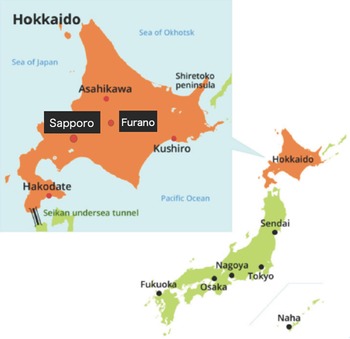
The present paper aims to contribute to a deeper understanding of the LVC mechanism by providing unprecedented types of empirical evidence with the following three areas of focus. First, the paper examines vernacular stability from a non-Western perspective. Methodological practice in LL research has focused on community members’ “competence to use CJ” as well as their local dialects on a spontaneous but conscious basis and its longitudinal transformation as well as members’ overt attitudes toward linguistic differences between the regional dialects and CJ (Yokoyama & Sanada, Reference Yokoyama and Sanada2010:42). An obvious case of a change from above, standardization, has been the consistent target of investigation. A particular change from above to examine in this paper is the standardization of regional dialects in two contrasted communities on the northern island of Hokkaido: Sapporo, the capital city, and Furano, an agriculture-based local town in Central Hokkaido (Figure 1). The progress of standardization in these two communities differs considerably, as does the sociolinguistic status of the change from above.
Fieldwork Sites: Sapporo and Furano in Hokkaido, Japan.

Second, the paper examines a rich body of empirical evidence on the standardization of regional dialects in Japan over the past half century and accounts for how sociolinguistic properties of lifespan changes can be interpreted. It particularly sheds light on different levels of grammar and differential responses to lifespan changes in individuals’ language use over time and calls for more qualitative consideration of such sociolinguistic constraints as lexical properties, longitudinal profiles of words examined (Nahkola & Saanilahti, Reference Nahkola and Saanilahti2004), and shifting communal attitudes toward bidialectalism. Finally, the present paper is concerned with diachronic changes in the linguistic domain of prosody (lexical accents).Footnote 3 While it might be assumed that prosody is deeply engraved in one's competence from earlier stages of first-language acquisition and thus impervious to change (Chambers, Reference Chambers2009), its surprisingly versatile character seems closely linked to the progress stages and related incrementation of standardization as well as to community members’ locally constructed social identities.
Real-time surveys of Hokkaido Japanese standardization over a half century
A Survey Overview
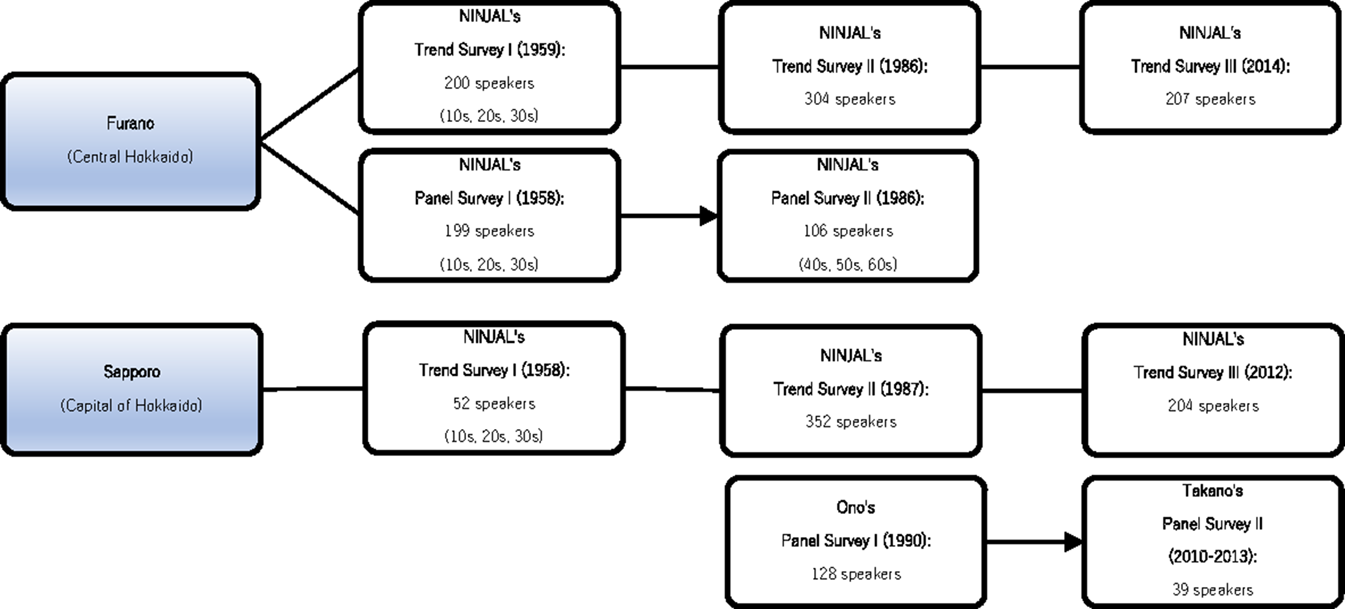
The present paper discusses both the trend and panel surveys of Hokkaido Japanese (HJ hereafter) standardization that have been conducted by NINJAL and by independent scholars (i.e., Yoneichi Ono and his research team and the present author) since the 1950s (see Figure 2).
Real-time Hokkaido Dialect Survey Design. In Furano (shaded box): Trend I (1959, 200 spks)-Trend II (1986, 304 spks)-Trend III (2014, 207 spks), and Panel I (1958, 199 spks)→Panel II (1986, 106 spks). In Sapporo (shaded box): Trend I (1958, 52 spks)-Trend II (1987, 352 spks)-Trend III (2012, 204 spks), and Panel I (1990, 128 spks)→Panel II (2010-13, 39 spks).

Both in Sapporo and Furano, three trend surveys at intervals of roughly twenty-five to thirty years (NINJAL's Trend Survey-I, II, and III) have investigated longitudinal changes in all four subsystems of language—vocabulary items, morphosyntax, segmental phonology, and lexical accents—over the past half century.Footnote 4 In the earlier surveys, however, researchers just studied the younger generations (i.e., 10s, 20s, 30s). Panel surveys of individual speakers of Furano Japanese (FJ hereafter) over time were conducted by NINJAL in 1958 (Panel Survey I) and in 1986 (Panel Survey II) with respect to the four subsystems of language. Panel surveys of Sapporo Japanese (SJ hereafter) speakers, on the other hand, were focused only on lexical accents and conducted by Yoneichi Ono and his project team in 1990 (Ono's Panel Survey I) and by the present author from 2010 to 2013 (Takano's Panel Survey II). In the latter, I additionally interviewed seven college students (three men and four women) to describe the younger generation's current variability patterns. Each interview session also contained a sociolinguistic interview on specific topics to grasp the participant's social lives, social networks, and attitudes toward SJ as well as CJ.
The standard field methodology
Unlike LVC research in the West, NINJAL's LL studies (as well as studies in Japanese dialectology in general) were not designed to reveal synchronic variation and change in progress as observed in community members’ everyday linguistic practices in natural settings. Rather, the studies attempted to capture community members’ conscious knowledge of CJ and its practice in controlled contexts of language use. Gathering community members’ vernaculars (Labov, Reference Labov1972, Reference Labov1981) was not given top priority from the beginning. Thus, analytical data were collected by prestructured, face-to-face interviews in which participants were asked to produce sounds, morphosyntactic structures, or to pick lexical items under investigation through quizzes (often with pictorial hints) and to read isolated words or sentences out of context.Footnote 5 Furthermore, as part of standard fieldwork protocol, participants were asked their subjective opinions regarding their local dialect, community, and CJ.
All of the surveys discussed in this paper were also designed to adopt these standard procedures of data collection. Data collected using these methods should be placed roughly at the most formal end of the stylistic continuum of linguistic performance, and thus obtained results may not be directly comparable with outcomes of prior real-time LVC studies based on vernaculars as analytical data. I believe, however, that scholarly contributions of the LL research in Japan remain worthwhile in the following three respects.
First and foremost, there is no best elicitation method for research on LVC. Dollinger (Reference Dollinger2015:53-86) demonstrated that it is somewhat misleading to consider vernaculars to be the optimal data (due to a variety of “fieldworker effects”). As such, one should not regard data collected through other modes of elicitation techniques as less reliable with reduced empirical values. In fact, his statistical comparisons of obtained results between written questionnaires and fieldworker interviews provided solid evidence for the equivalence of those two modes of elicitation techniques in capturing lexical variation. While such equivalence tends to be reduced with respect to other subsystems of language, written questionnaire data are still found capable of attaining a high degree of match (i.e., 70% or higher) with fieldworker interview data in accounting for phonological variation. It has been further claimed that deviant responses can be detected and interpreted through qualitative perspectives (e.g., changing social evaluations of variables in the community). Tillery (Reference Tillery2000) also asserted that self-reports do not always provide unreliable and invalid statements regarding the distribution of many linguistic features in a focal community.
Second, repeated adoption of identical (or at least largely similar) procedures for data collection throughout a series of real-time studies over an extended period of time can augment the degree of reliability of obtained results (Bailey, Wikle, & Tillery, Reference Bailey, Wikle and Tillery1997). Finally, a consistent focus on community members’ attitudes toward, or ideologies about, language use and transformations over time provides us with invaluable information in exploring the processes of language change.
Figure 3 shows the number of tokens analyzed per subsystem of language in each of the surveys. Both the Trend and Panel Surveys I and II by NINJAL share almost identical protocols for face-to-face interviews with subjects. NINJAL's Surveys III, which were commissioned to an outside survey company, adopted a revised set of target variables that partly overlapped with those of Surveys I and II. The Panel Surveys I and II in Sapporo were also conducted face to face, using an identical set of target variables (i.e., lexically assigned pitch accents).Footnote 6 Because the patterns of lexical accents inevitably vary in connected speech, it is necessary to examine identical sentences as isolated from the context of use to reliably analyze the phenomena in question.
The Number Of Vocabulary Items / Morphosyntactic Features / Segmental Sounds / Lexical Accent Items Analyzed Per Subsystem Of Language. Furano Trend I (26/19/15/29, 200 spks)-Furano Trend II (16/9/18/62, 304 spks)-Furano Trend III (4/18, 207 spks), and Furano Panel I (26/16/31/6, 199 spks)→Furano Panel II (30/16/31/6, 106 spks). Sapporo Trend I (17/16/18/82, 52 spks)-Sapporo Trend II (19/10/18/62, 352 spks)-Sapporo Trend III (4/18, 204 spks), Sapporo Panel I (131, 128 spks)→Sapporo Panel II (131, 39 spks).

Analytical procedures
In all of the surveys, the standardization progress was measured by the number of CJ variants chosen or produced (i.e., the dependent variable) by subjects relative to Hokkaido dialect variants (or others) for each subsystem of language. Average rates (%) of selected or produced CJ variants per subsystem (out of the total numbers of tokens) were given to each age group to capture generational shifts over time.
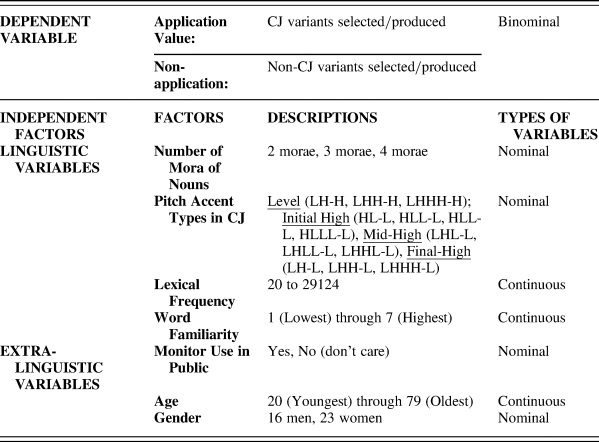
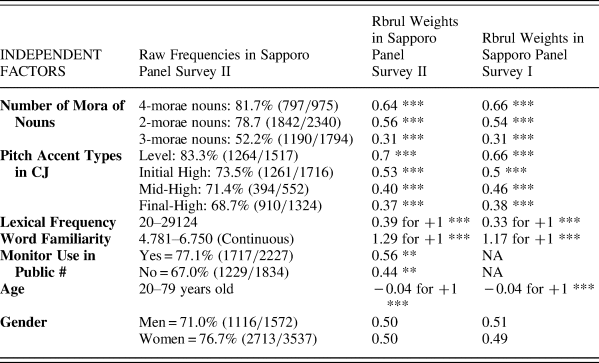
Sapporo Panel Surveys I and II in particular need further explanation (Ono, Reference Ono1991, Reference Ono1993; Takano, Reference Takano2011, Reference Takano2013, Reference Takano2014a, Reference Takanob, Reference Takanoc, Reference Takanod, Reference Takano2015). Unlike the remaining surveys, I adopted the variationist framework of analysis, taking into account a set of independent factors hypothesized to affect the subjects’ production of CJ patterns of lexical accents (see Table 1). Binominal (i.e., application = CJ variants; nonapplication = the remaining others) mixed-effects models in Rbrul, including Speaker as random effects (Johnson, Reference Johnson2012), considered a set of linguistic and extralinguistic constraints (see Table 1).Footnote 7
Factorial Design for Rbrul Analysis

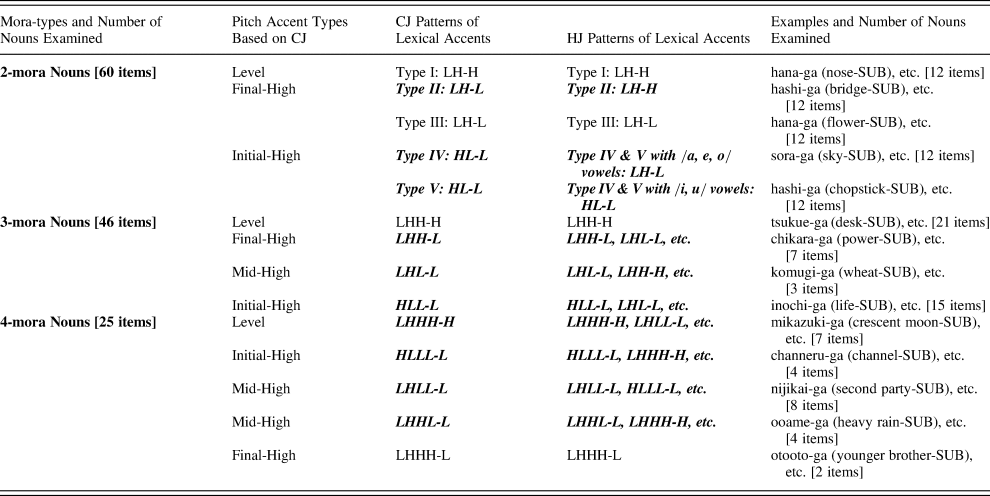
As for linguistic variables in particular, Table 2 compares CJ and HJ in terms of pitch accent patterns across two-, three-, and four-morae nouns.Footnote 8 The patterns in bold italics indicate possible discrepancies between CJ and HJ. For example, among two-mora nouns, Type II (e.g., hashi-SUB ‘bridge’; LH-L in CJ versus LH-H in HJ) and Types IV and V with open vowels (a, e, o) on the second mora (e.g., sora-ga ‘sky-SUB’; HL-L in CJ versus LH-L in HJ) have been found as relatively less standardized than the remaining types in previous studies (e.g., Ozaki, Reference Ozaki1986; Takano, Reference Takano2011, Reference Takano2014a, Reference Takanob).Footnote 9 Among three-mora nouns, Ono (Reference Ono1991) suggested that such discrepant types of accents (i.e., LHH-L, LHL-L, HLL-L in CJ) tend to lag behind standardization involving greater individual variability. Past studies have also shown that three-mora nouns are the least standardized among the three different morae (i.e., two, three, and four) nouns in SJ (Ono, Reference Ono1993; Takano, Reference Takano2015).
CJ versus HJ Patterns of Pitch Accents (131 2-mora, 3-mora, and 4-mora nouns)

I also took into more qualitative account the lexical properties of words examined as carriers of lexical accents. Given that prior studies have not seriously investigated the role of linguistic constraints on the maintenance (or fluidity) of individuals’ language use over time despite wide variation among linguistic items under observation (Takano, Reference Takano2014c, Reference Takano2015), I accommodated both the concepts of lexical frequency (Amano & Kondo, Reference Amano and Kondo2000; MacKenzie, Reference MacKenzie2017) and word familiarity (Amano & Kondo, Reference Amano and Kondo1999) in my analyses. Examination of the latter has been inspired by Sato, Yoneda, Abe, Sato, and Mizuno's (Reference Sato, Yoneda, Abe, Sato and Mizuno2014) recent finding of positive correlations between the homogenization of lexical accents toward standardization (i.e., lectal cohesion) and increasing degrees of familiarity (i.e., less saliency) with vocabulary items that carry them (cf., Oushiro, Reference Oushiro2016; Oushiro & Guy, Reference Oushiro and Guy2015).
The frequency given to each of the nouns read aloud by the panelists is derived from a large-scale publicized database Nihongo-no goi tokusei (Lexical properties of Japanese) (Amano & Kondo, Reference Amano and Kondo1999, Reference Amano and Kondo2000). Lexical frequencies in the database are based on the total of 341,771 words that appeared in Asahi Newspaper articles over fourteen years (1985 through 1998). The degrees of familiarity with the nouns read aloud are also derived from the same database. In the database, the degrees of familiarity are determined by spontaneous ratings (i.e., Lowest “1” through Highest “7”) of native Japanese-speaking examinees that listened to a number of Japanese dictionary entries pronounced along with their simultaneous displays on a computer monitor.
Results from the Trend Surveys of Two Contrasted Communities
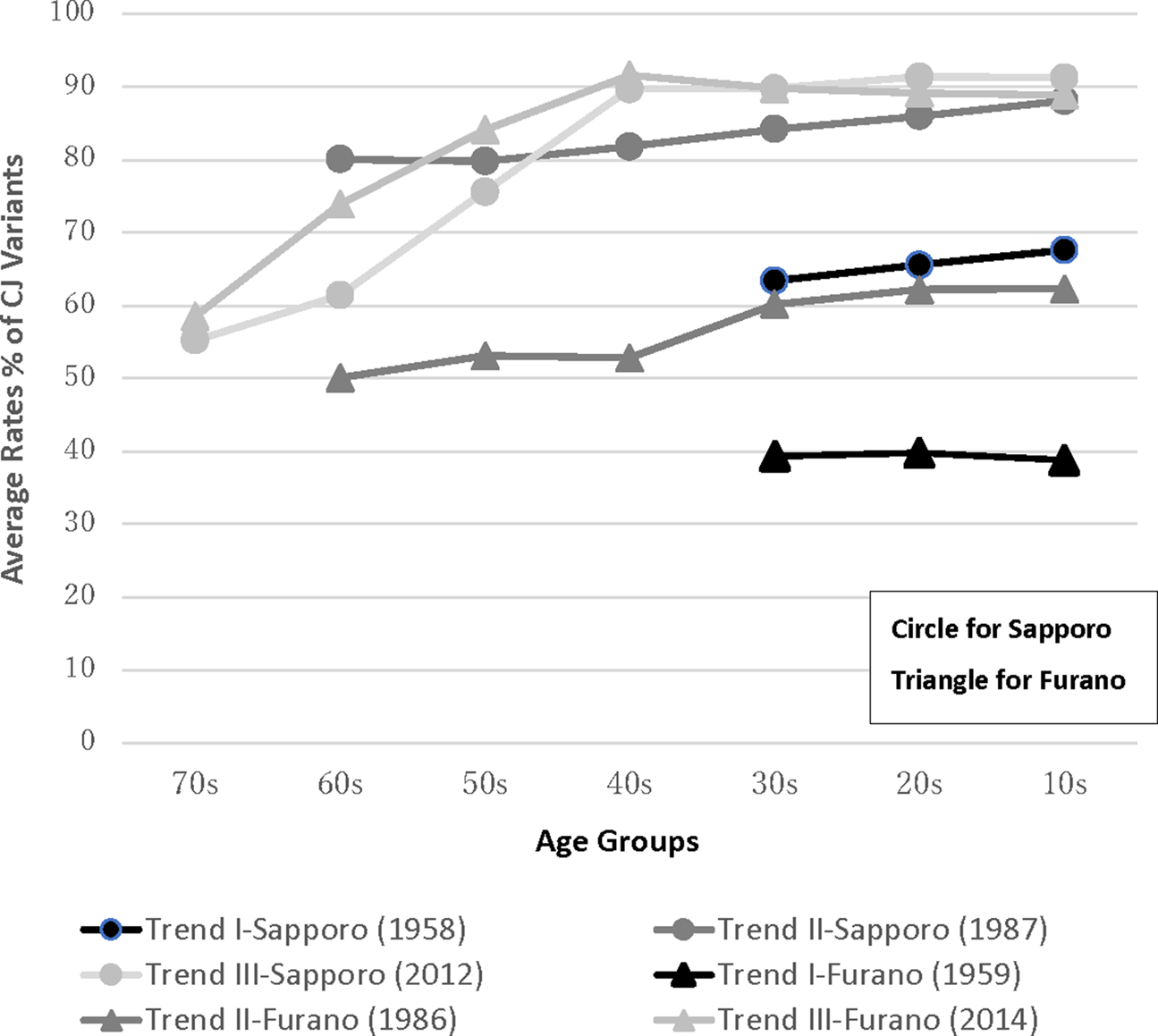
Based on the series of trend surveys, Figure 4 compares the real-time progression of standardization of HJ between Sapporo (circle) and Furano (triangle) in terms of the average uses of CJ variants over a half century. For each study, the percentage of CJ variants was calculated for each of the four subsystems individually, and then those four percentages were averaged together for each age group.Footnote 10
Real-time Trend Surveys (I, II, III) of HJ Standardization: Average Uses of CJ Variants Across Age Groups in Sapporo (circle) and in Furano (triangle).

Figure 4 illustrates that in the late 1950s when the first trend surveys were conducted in Hokkaido, Sapporo (Trend I-Sapporo [1958]: circles in 30s, 20s, 10s) was already far more advanced (i.e., approximately 25% to 30% more) than Furano (Trend I-Furano [1959]: triangles in 30s, 20s, 10s) in the spread of CJ variants. As a local agricultural community where the majority of residents spoke the local dialect, Furano has been experiencing a very drastic increase in shifting to CJ over the following fifty years since Survey I. By the time of the third surveys in the 2010s, both communities did not differ as much, and both approximated the stage of near completion of standardization.
Thus, Furano and Sapporo as the communities of Hokkaido dialects both subjected to a linguistic change from above are very contrastive in terms of the incipient stages of standardization and its rates of incrementation over time. I subsequently argue that both of these dimensions are heavily responsible for the activation of lifespan changes in individuals’ language use during their adult lifetime.
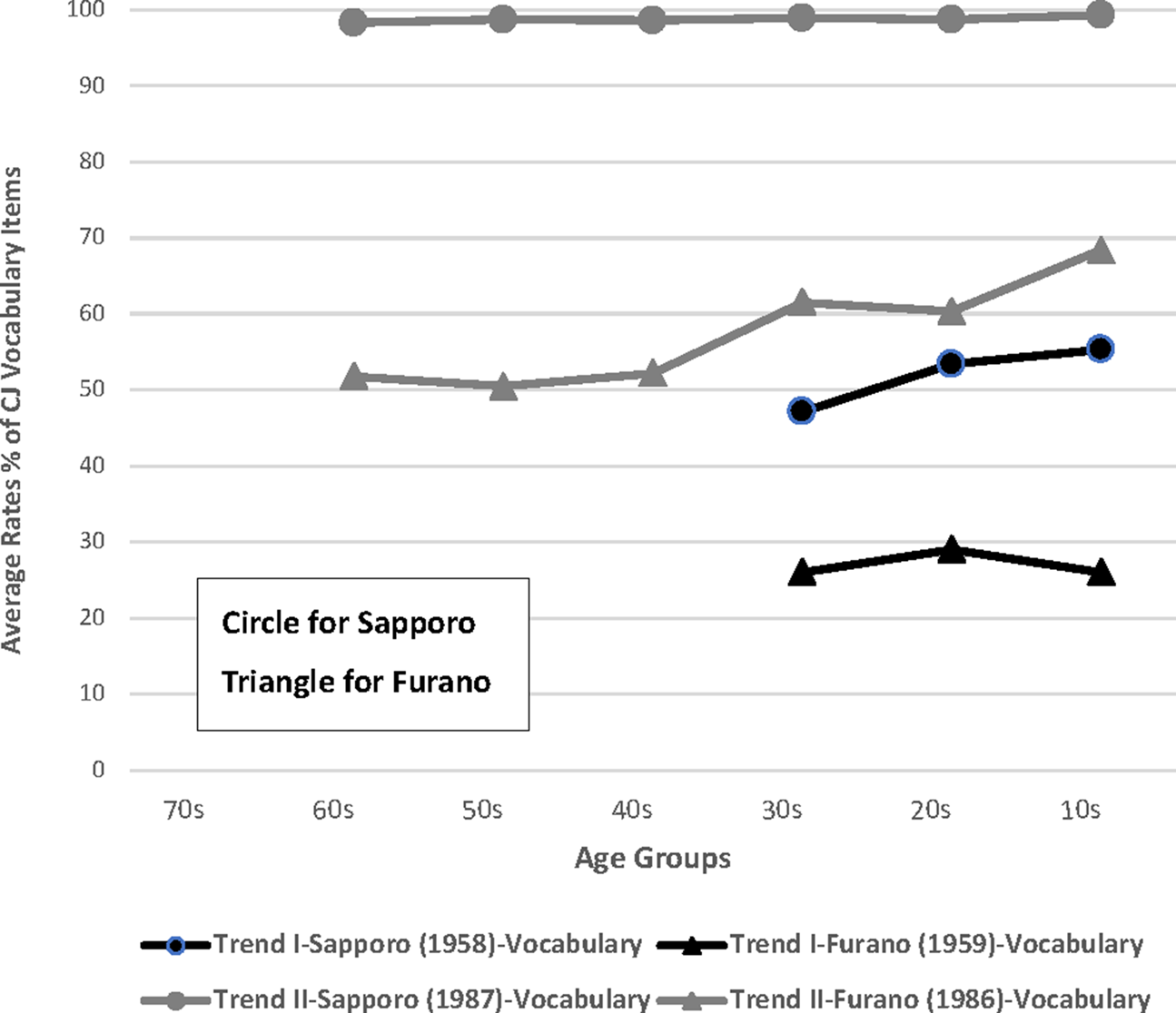
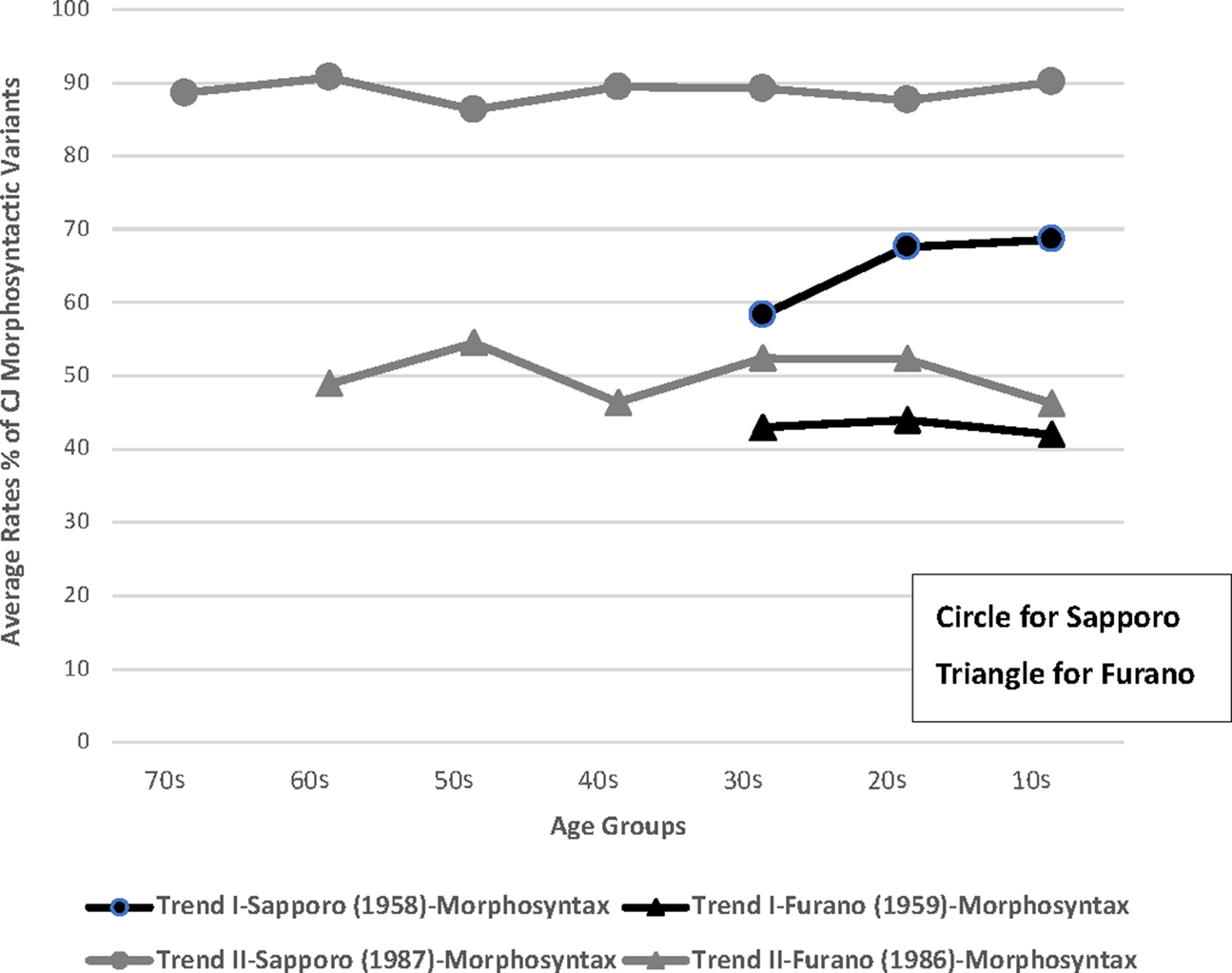
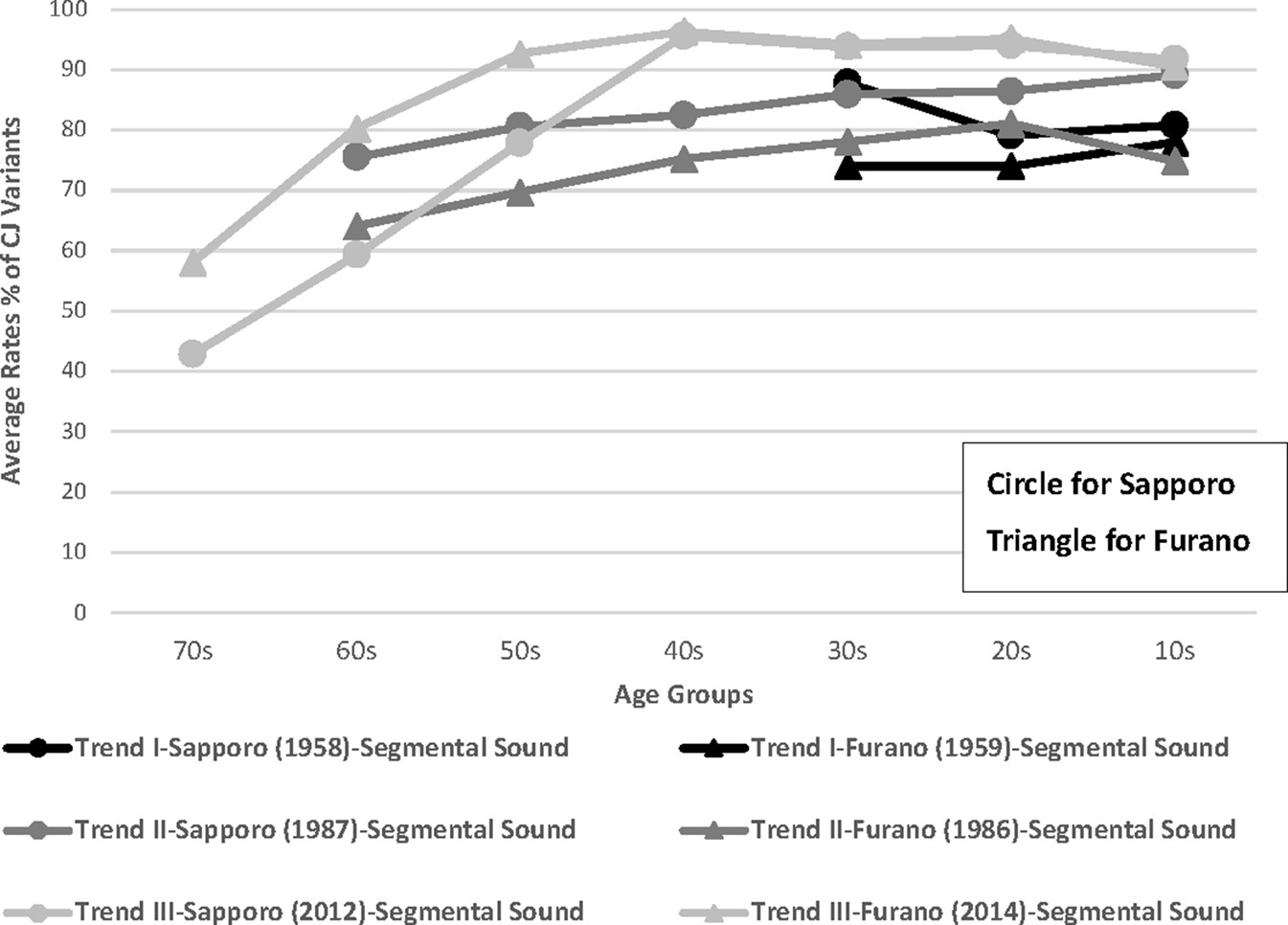
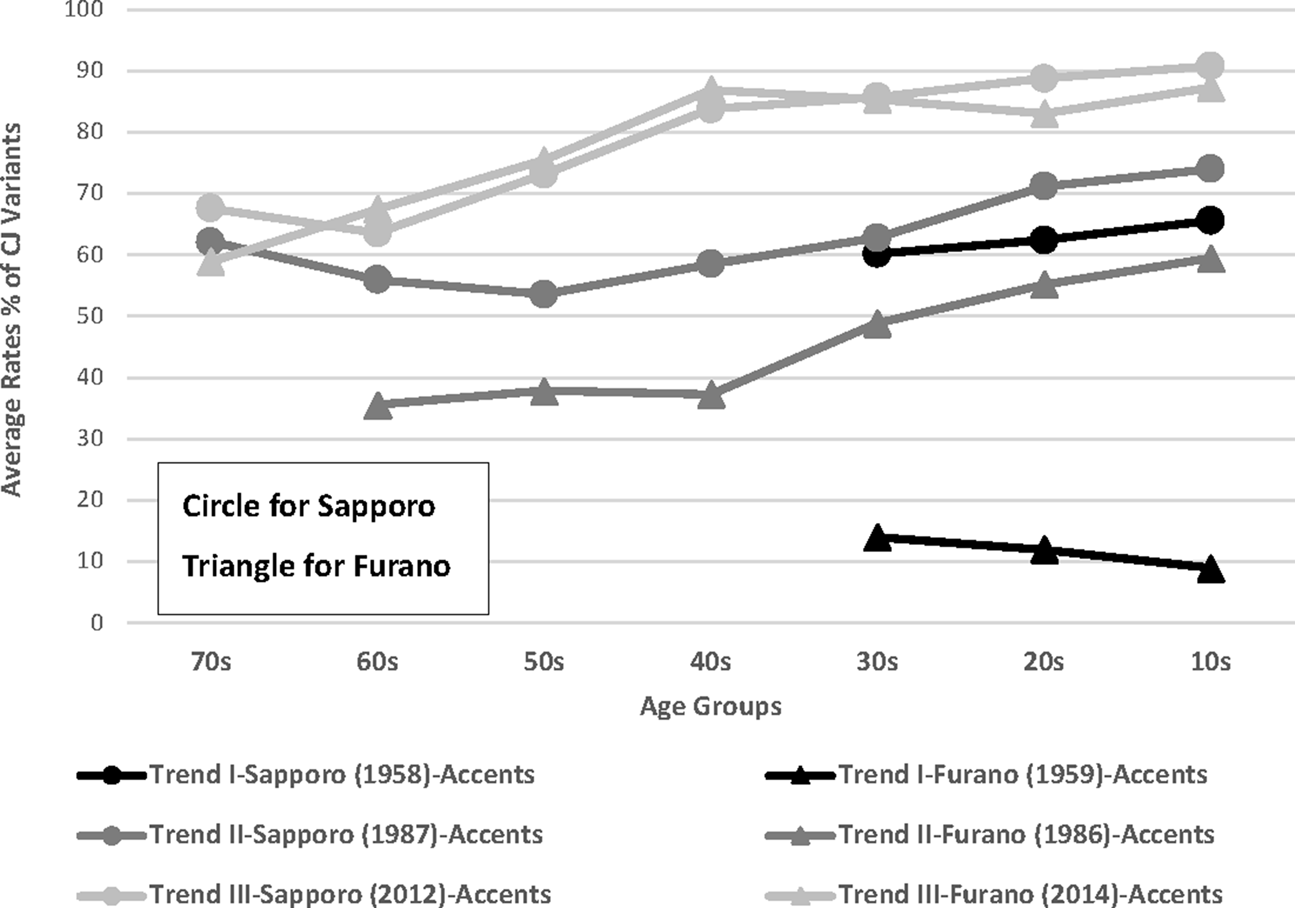
Figures 5 through 8 compare real-time shifts in the standardization of each of the four subsystems of language between the two communities.Footnote 11 The progress of standardization and the rates of change incrementation both differ across the levels of grammar as well as between the two communities. In both communities, the standardization of segmental sounds (Figure 7) has most advanced over this past half century with relatively small degrees of incrementation due to the ceiling effects. In Sapporo, although the standardization rates of the remaining three subsystems look similar in trailing segmental sounds at the time of Survey I, the rates of change incrementation since then have been highest in vocabulary items, reaching completion within the following quarter century (Figure 5). The change incrementation of morphosyntactic variants had been less advanced during that same period (Figure 6), and that of lexical accents has lagged most over this half century (Figure 8).
Average Uses of CJ Vocabulary Items Across Age Groups in Sapporo (circle) and Furano (triangle) Trend Surveys I and II.

Average Uses of CJ Morphosyntactic Variants Across Age Groups in Sapporo (circle) and Furano (triangle) Trend Surveys I and II.

Average Uses of CJ Variants in Segmental Sounds Across Age Groups in Sapporo (circle) and Furano (triangle) Trend Surveys I, II and III.

Average Uses of CJ Variants in Lexical Accents Across Age Groups in Sapporo (circle) and Furano (triangle) Trend Surveys I, II and III.

The standardization of FJ presents a rather different profile of change. Overall, the earlier stages (Survey I) are very far behind those of SJ. Unlike Sapporo, neither vocabulary items (Figure 5) nor morphosyntactic features (Figure 6) achieved the same degree of standardization after twenty-five years (i.e., Surveys I to II); however, the former displays a relatively wider range of change incrementation over that period. Most striking are the extraordinary rates of incrementation involving lexical accents over this past half century (Figure 8). This change started with a very low average of CJ variants (10% to 15%) in Survey I, and, since then, the incrementation has drastically gained an approximately 40% to 50% increase in every succeeding survey (Surveys II and III).
These observations suggest that Furano, as a community in drastic transition, has consistently embraced competing variants of HJ and CJ in the midst of changes from above as an integral part of inhabitants’ language lives over this past half century. Such competitions have been fierce, particularly at the levels of vocabulary and lexical accents. As shown in subsequent sections on panel surveys of both FJ and SJ, this fact (i.e., the magnitudes of variation differentiated among the subsystems of language) will have significant implications for the stability (or instability) of idiolects over time.
In accord with material reviewed from past studies in the West, these findings of changes from above also demonstrate that real-time processes of linguistic change are likely to differ across the levels of grammar (Cukor-Avila & Bailey, Reference Cukor-Avila, Bailey, Chambers and Schilling2013; Sankoff, Reference Sankoff, Bayley, Cameron and Lucas2013). It is shared by the two contrastive communities of differential CJ spread and degrees of incrementation that vocabulary changes are most rapidly spread during a relatively short period of time, and morphosyntactic variables are more enduring over time. Phonology has been found to lag behind the former two levels and requires a more extensive length of time to complete the change (Chambers, Reference Chambers2009). On the other hand, it is also shared by the two communities that one's phonology, depending on segmental or suprasegmental domains, involves differential responses to a linguistic change in progress over time: changes in segmental sounds are likely to spread faster than prosody. A prosodic dimension (i.e., lexical accents) in particular has also been found to be community specific. While it can be said that prosody is highly persistent (and even more so than segmental sounds) in one's grammar thus most resistant to new changes in progress among the subsystems of language (cf., Yokoyama & Sanada, Reference Yokoyama and Sanada2010), enormous degrees of change incrementation can be observed in FJ (but not so much in Sapporo). These findings necessitate a more qualitative look at community-specific dimensions of variation as well as real-time processes of change among individuals, which will be the topic of the following sections.
Panel Survey Results of Furano Japanese
In NINJAL's Panel Survey II (conducted in 1986, partially reported in NINJAL, 1997), which was to follow up on the 199 Furano-born participants in NINJAL's Panel Survey I (1965:43-67; conducted in 1958), 106 Furano residents served as the panelists for the study of the four subsystems of language.Footnote 12 The subjects’ age ranged from forty to sixty-nine years old at the time of Survey II (i.e., 10s, 20s, 30s in Survey I).
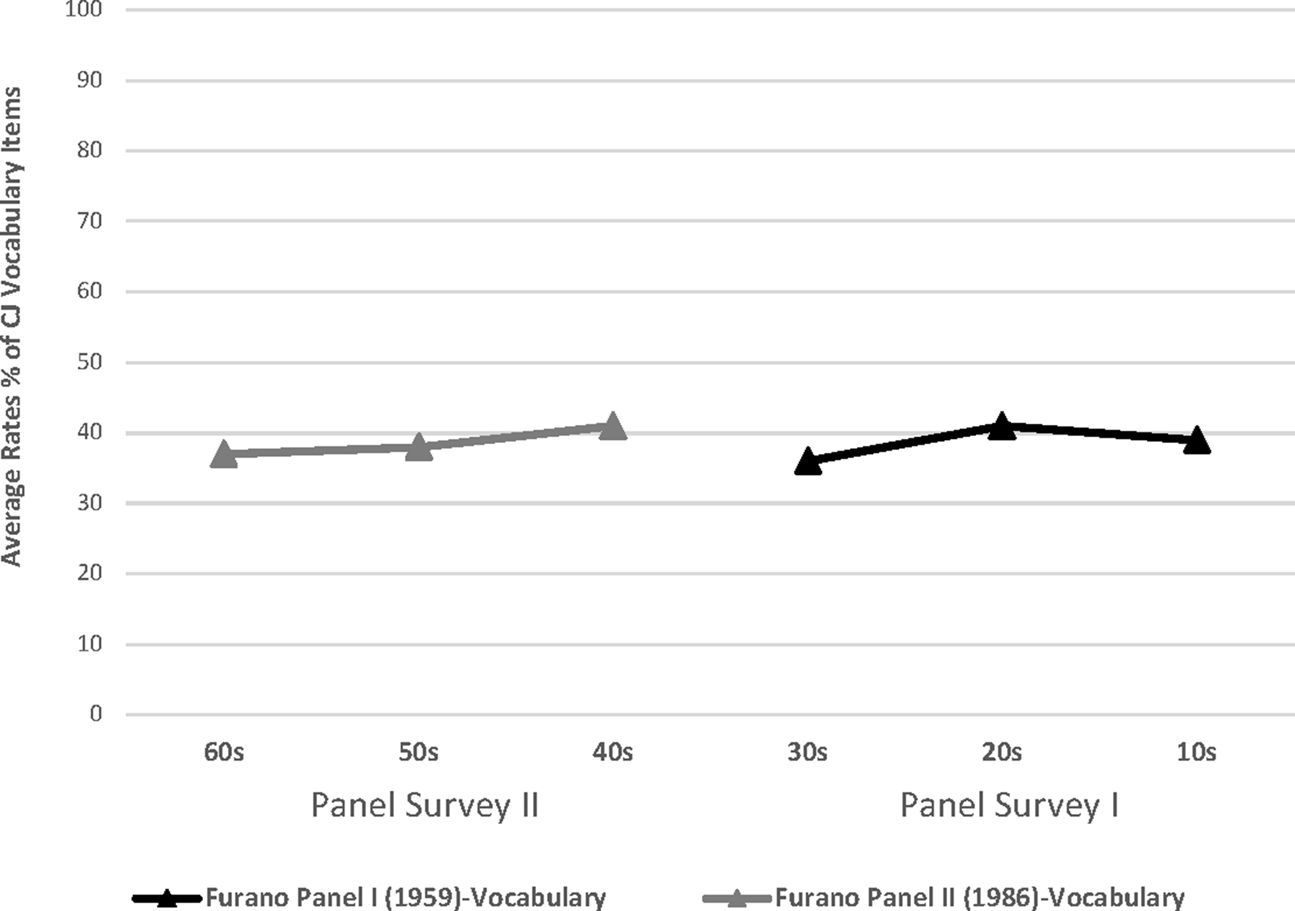
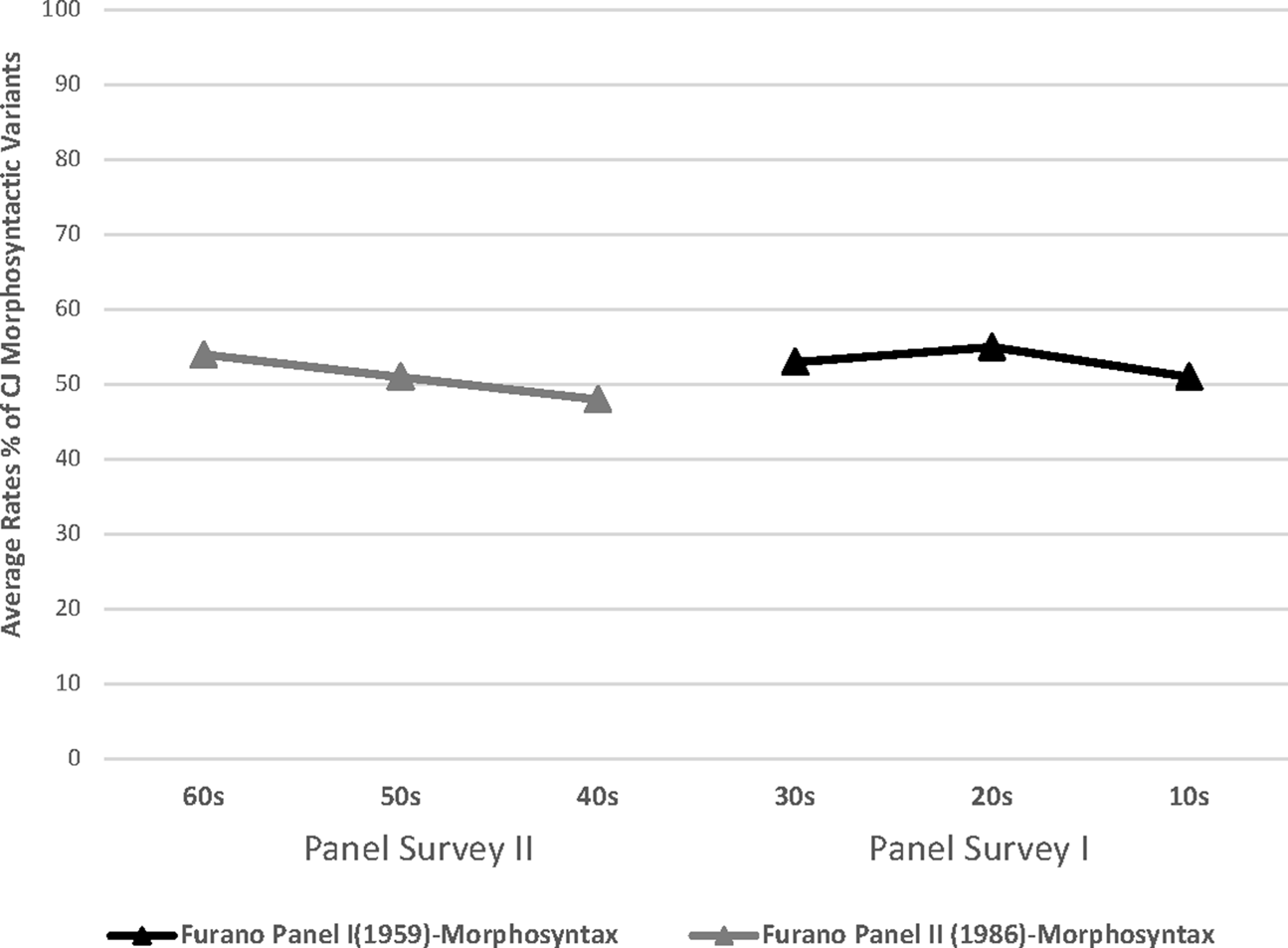
Figures 9 and 10 compare Panel Survey I with Panel Survey II in terms of real-time changes in the uses of twenty-six CJ vocabulary items and sixteen morphosyntactic items (eight features) across three age groups. Furano panelists’ language use looks stable at these levels of grammar over the twenty-five years. This stability, particularly at the level of vocabulary, seems rather unexpected, given our aforementioned observation on its drastically higher rates of incrementation at the community level (see Figure 5).
Furano Panel Surveys I and II of Standardization of Vocabulary Items.

Furano Panel Surveys I and II of Standardization of Morphosyntax.

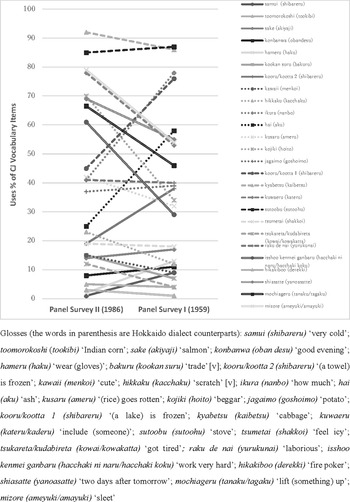
A more qualitative look at Furano panelists’ uses of each of the twenty-six individual vocabulary items, on the other hand, reveals that the apparent retention of CJ vocabulary items (as shown in Figure 9 based on average rates of overall use) results from an offset by the coexistence of items that either greatly increased or decreased over time. Real-time shifts in the panelists’ uses of the sixteen CJ morphosyntactic items (eight features) (Figure 10), on the other hand, were found not to vary across individual items as much as those of vocabulary items. Two out of eight features retrograded to local variants to a relatively minor extent, and the remaining six features remained highly stable (see Note 13 for detailed descriptions).Footnote 13
As shown in Figure 11, which narrows in on the vocabulary items studied, a number of items that belong to the intermediate stages of change in progress involve a great deal of idiolectal fluctuations over time; a number of CJ items continue to spread widely in the community, whereas quite a few items have greatly declined (i.e., local dialect vocabulary items were revitalized). Relatively stable retention over time generally applies to those items that are either highly advanced beyond the 80% level or small-scale below the 20% level in terms of standardization.
Real-time Shifts in Uses of CJ Vocabulary Items Across Furano Panel Surveys I (1959) and II (1986).

These systematic fluctuation patterns in idiolects over time can also be substantiated by findings on a wider range of grammatical levels in other languages (Nahkola & Saanilahti, Reference Nahkola and Saanilahti2004). In the present database, particular vocabulary items in the midst of stages of change in progress involving a larger amount of variation at the community level (i.e., “unsteadily advancing changes”) are likely to be subjected to lifespan changes in individual language use, whereas those that do not entail as much variation, either as advanced or minor forms, are likely to be relatively stable in idiolects over time. In regard to vocabulary items in the present database, the panelists’ idiolects exhibit multifaceted properties of both stability and instability (Raumolin-Brunberg, Reference Raumolin-Brunberg2007), the latter of which could function to accelerate the rates of change in progress in the community as a whole beyond the apparent-time estimates (Sankoff & Blondeau, Reference Sankoff and Blondeau2007).
One might then ask: what factors would be responsible for such real-time fluctuations of those mid-range items in idiolects and would it be possible to classify them into certain types? Takano (Reference Takano2013), a relatively small-scale real-time trend survey involving 241 Hokkaido dialect speakers in 2010 to 2011, showed that the majority of HJ vocabulary items that involve lifespan changes toward CJ (i.e., their CJ counterparts increased across Panel Surveys I and II in Figure 11) had already been in steady decline in the early years (i.e., the 1950s) and have drastically diminished their vitality over this half century (Takano, Reference Takano2013:6–10). In contrast, all of the HJ items that have revitalized (i.e., their CJ counterparts decreased in Figure 11) have begun to decline in relatively recent years (Takano, Reference Takano2013:8–13). That is, the stability or instability of individuals’ uses of vocabulary items seems to be captured in close linkage to different stages of the community change as a whole in which individual items acquire different longitudinal profiles over time.
Furthermore, panel studies readily allow researchers to determine social meanings of a particular linguistic change. Based on face-to-face interviews with panelists, the Furano researchers (NINJAL, 1997) pointed out that increasing bidialectalism in the community brought a change in panelists’ perceptions of the variables over the quarter century (cf., MacKenzie, Reference MacKenzie2017; Tamminga, MacKenzie, & Embick, Reference Tamminga, MacKenzie and Embick2016). It has been reported that increasing numbers of panelists in Panel Survey II self-reported that two particular local dialect vocabulary items, shibareru (samui ‘very cold’ in CJ) and haku (hameru ‘wear [gloves]’ in CJ), for instance, both of which revitalized in Figure 11, were likely to be used along with their CJ counterparts. It was also observed in Panel Survey II that increasing numbers of panelists became less aware of those items as part of the traditional HJ vocabulary after the quarter century passed. The majority of panelists regarded those items as belonging to Standard HJ, and a substantial number of panelists specifically misjudged haku as Standard Japanese (Aizawa, Reference Aizawa1990). These observations suggest that the same individuals’ perceptions of a sociolinguistic variable can be transformed over time under circumstances in which the variable experiences a massive incrementation of change from above (i.e., standardization) as shown in the FJ community (cf., Cukor-Avila, Reference Cukor-Avila2012; Trudgill, Reference Trudgill1988). Some vocabulary items are likely to undergo lifespan changes as long as they continue to be perceived as subject to a change in progress of which community members are aware. However, other items are reanalyzed as stable variants that could coexist with their standard counterparts and could be even revitalized in increasing bidialectalism.
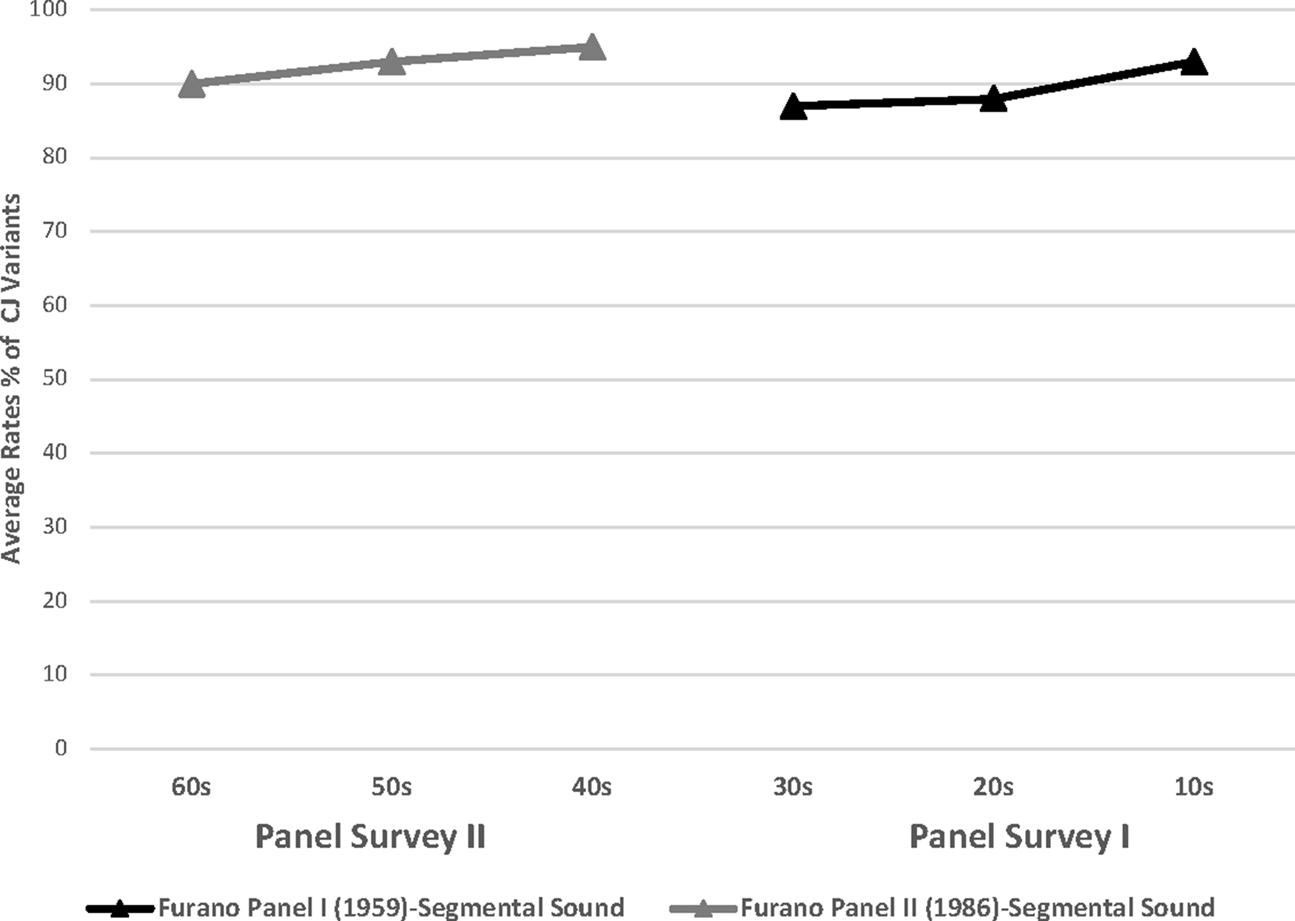
Figure 12 provides further evidence for the stability of individuals’ language use over time with respect to uses of segmental sounds (i.e., thirty-one items that can be summed up in seven phonological features specific to HJ). Qualitative analyses of individual items show that all of the seven HJ features remained highly stable over time (i.e., /i//e/ merger: FP-I 8% → FP-II 2%; voicing of voiceless consonants: FP-I 7% → FP-II 3%; vowel centralization: FP-I 8% → FP-II 2%; voicing of devoiced high vowels: FP-I 7% → FP-II 2%; nasalization of velar stops: FP-I 13% → FP-II 10%; /ç//ʃ/ merger: FP-I 2% → FP-II 3%; /i//ɯ/ merger: FP-I 32% → FP-II 32%).Footnote 14
Furano Panel Surveys I and II of Standardization of Segmental Sound.

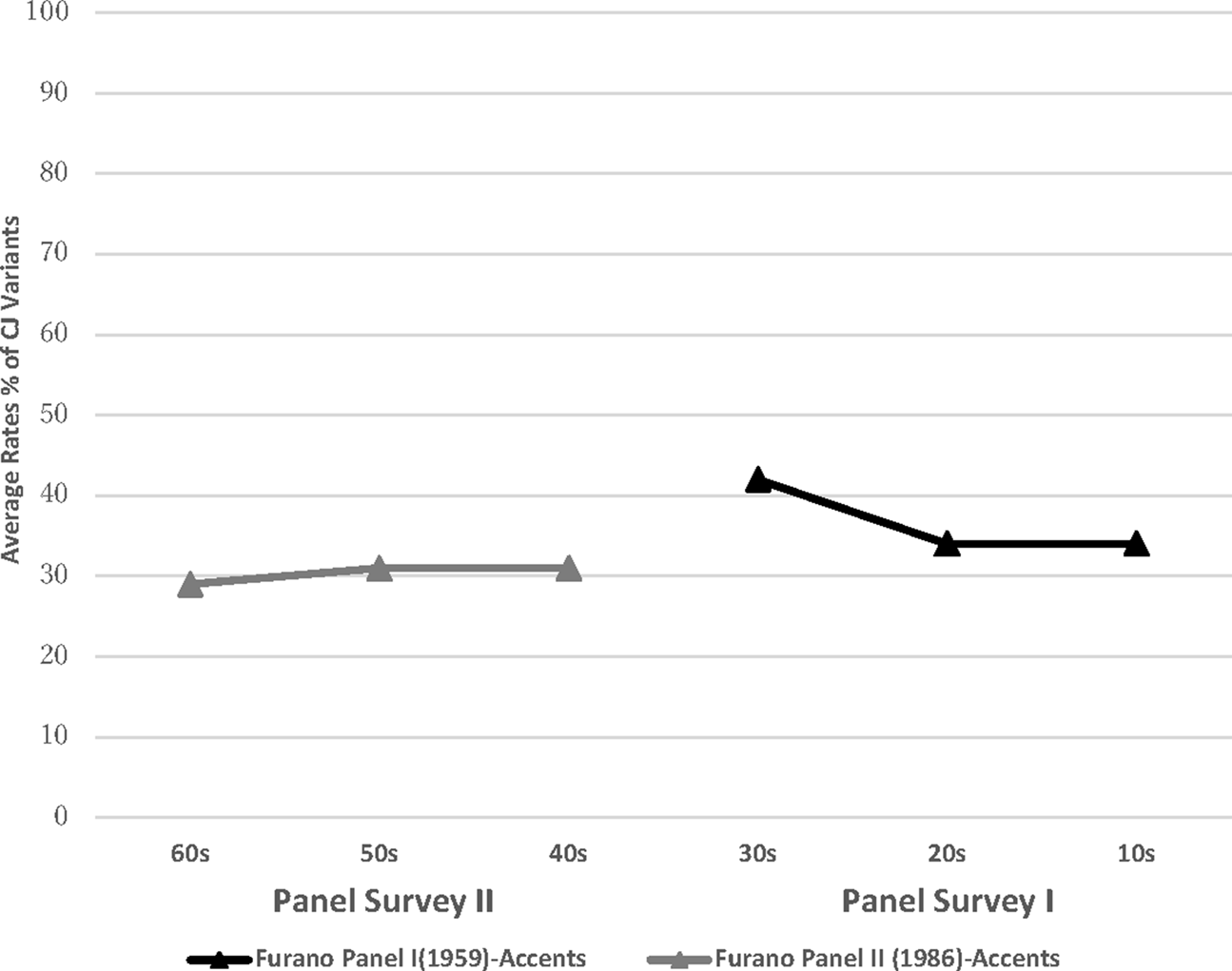
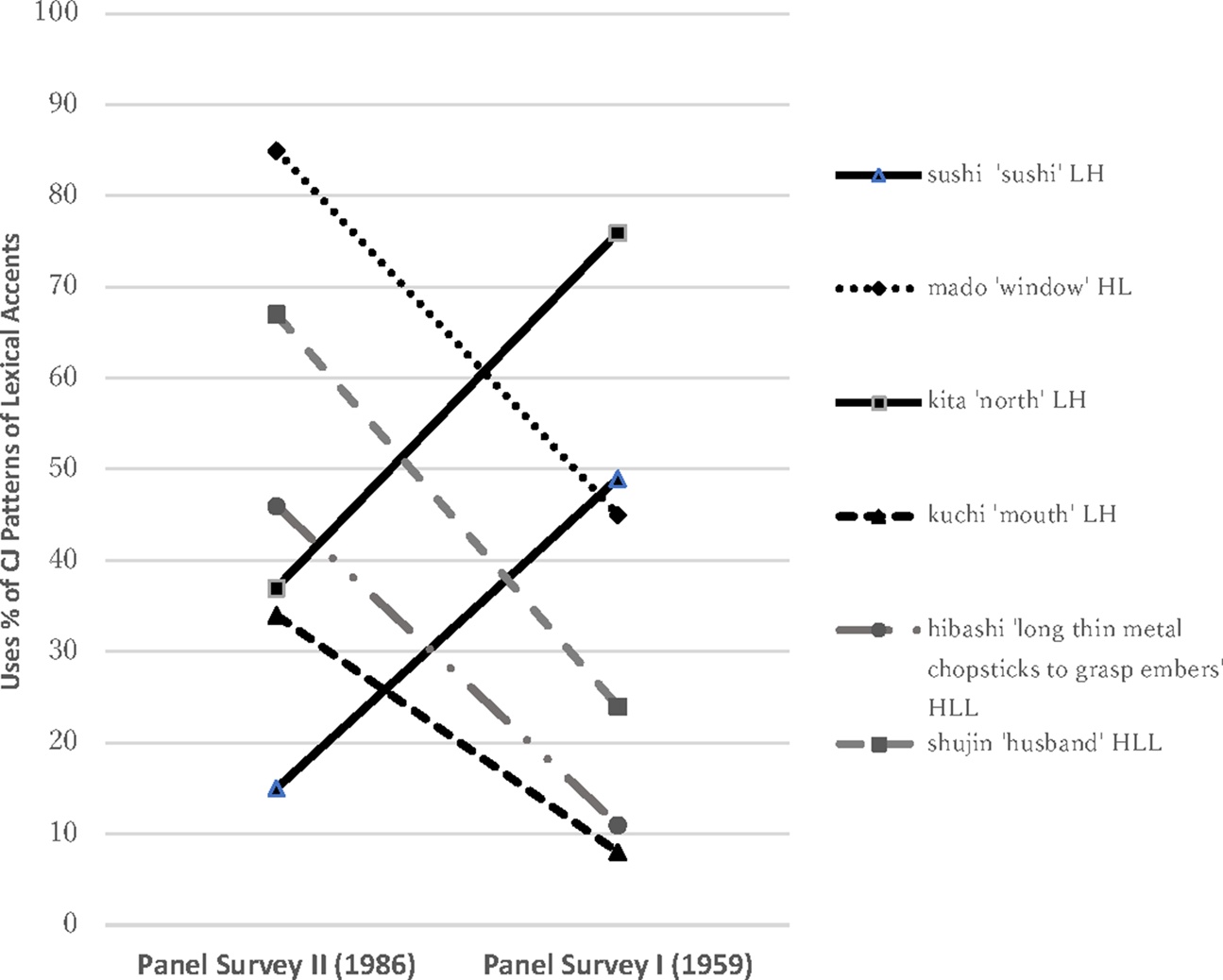
Figure 13 compares real-time shifts in Furano panelists’ uses of lexically specified accents with respect to four two-mora words and two three-mora words (NINJAL, 1997:164). Except for the oldest cohort in each of the panel surveys (i.e., 30s and 60s), the rates of CJ patterns of lexical accents remained stable over time in accord with the persistence of other levels of grammar such as morphosyntax and segmental phonology (Figures 10 and 12). These patterns of lifespan changes, however, discord dramatically with the fact that the community as a whole has experienced drastic shifts toward CJ over the past half century (see Figure 8). Parallel to lifespan changes in vocabulary items (Figure 11), Figure 14 describes a longitudinal shift for each of the six lexical items examined across the two panel surveys over twenty-five years. Here again, it demonstrates that the apparent stability of lexical accents (observed in Figure 13) result from an offset by the panelists’ increasingly mixed uses of both CJ and non-CJ variants over time.
Furano Panel Surveys I and II of Standardization of Lexical Accents.

Real-time Shifts in Uses of CJ Patterns of Lexical Accents Across Furano Panel Surveys I (1959) and II (1986).

A closer examination reveals some systematicity involved in the observed variability: the HJ pattern of the final mora accented (e.g., mado[-ga] LH[L]) is uniformly transformed to the CJ pattern of the initial mora accented (HL[L]), whereas a great majority of tokens of the remaining two two-mora items holding the CJ pattern of the final mora accented (e.g., sushi[-ga], kita[-ga] LH[L]) are also transformed to the non-CJ pattern of the initial mora accented (HL[L]). This latter type of lifespan change, however, is not exactly a retrograding shift back to the local dialect norms but a brand-new pattern. Although specific motivations require further scrutiny, I would argue that this particular pattern of lifespan change could be derived either from a newly emerging pattern of the initial mora accented in Tokyo Japanese (TJ hereafter) (pointed out with respect to the word sushi [‘Japanese sushi’]) (Kindaichi & Akinaga, Reference Kindaichi and Akinaga2015) or a creative process of new intermediate forms that reflects neither local (HJ) nor superordinate (CJ) norms as observed commonly in change-from-above situations in other languages (i.e., diaglossia) (Auer, Reference Auer, Kortmann and van der Auwera2011; Swanenberg, Reference Swanenberg and Asahito appear).
To conclude, these results of the Furano real-time panel surveys suggest that, with the exception of vocabulary and prosodic variables, individuals’ language use maintains over time even after postadolescent years, which substantiates the stability of grammar over time. On the other hand, we observe that longitudinal stability in language use is likely to be constrained by such sociolinguistic factors as levels of grammar, stages of change at the community level, related rates of its incrementation, and community members’ perceptions of and attitudes toward particular changes from above. This last factor could vary depending on the time periods in which the surveys were conducted and play a critical role in altering (or maintaining) one's language use over time.
Furthermore, lifespan changes in general could be constrained by sociolinguistic properties of individual variables in question. Variables that entail a large amount of variation with abundant competing forms vital in the community are likely to contribute to the activation of lifespan changes (Nahkola & Saanilahti, Reference Nahkola and Saanilahti2004); as such, lifespan changes are likely a phenomenon that does not necessarily affect the entire subsystem of language altogether but could be sensitive to the longitudinal profiles of particular changes occurring in a focal community. Thus, the researcher's selection of particular variables to follow over an extensive period of time would have an enormous impact on what he or she eventually gains to draw generalizations. The following section integrates this qualitative perspective into sociolinguistic properties of the variables in analytical design.
Panel Survey Results of Sapporo Japanese
Compared with Furano as a transitional community in the midst of changes from above, Sapporo can be regarded as a more stable community in which the standardization of all grammar levels has been greatly advanced (see Figures 5–8). The following results (Table 3) of the panel surveys of lexical accents (Sapporo Panel Surveys I and II) by the present author depict quite a different profile of lifespan changes from findings about prosodic variables in the preceding sections (see Figures 8, 13, and 14).
Preservation of the constraints over time
Rbrul analyses of Sapporo Panel Survey-I (SPS-I) and Sapporo Panel Survey II (SPS-II) data demonstrate that the panelists’ uses of lexical accents have been uniformly governed by the identical list of linguistic constraints and relative ranks over time as shown in Table 3. Such preservation of linguistic constraints over time can be another strong piece of evidence for the robustness of the apparent-time construct that was founded on vernacular stability over time (Milroy, Reference Milroy and Fought2004).
Results of Rbrul Analyses. 131 lexical accent items embedded in isolated sentences produced by 39 panelists (total n = 5109)

The application value = CJ variants selected/produced
# = this factor was included only in SPS-II, but excluding eight panelists (one 74-year-old woman and seven college students) who did not respond to this particular question.
*** = p < .001; ** = p < .01
Notes: 1) Lexical frequency and Word familiarity entered separate Rbrul runs to avoid potential interactions; 2) Raw lexical frequencies were converted to log scale in Rbrul anlayses; 3) the weights of the remaining factors are all taken from the runs with word familiarity.
As already pointed out in previous studies (e.g., Ono, Reference Ono1991, Reference Ono1993; Takano, Reference Takano2015), three-morae nouns (SPS-II: 0.31; SPS-I: 0.31) tend to lag most behind the change to CJ, and “mid-high” (SPS-II: 0.40; SPS-I: 0.46) and “final-high” (SPS-II: 0.37; SPS-I: 0.38) types of lexical accents tend to lag behind the remaining types (see Table 2). The type of lexical accents most susceptible to standardization is “level” type (SPS-II: 0.70; SPS-I: 0.66), which has been suggested as a prosodic innovation in TJ that possibly conveys such social meanings as being “urban” or “cosmopolitan” (Sibata, Reference Sibata1978; cf., Takano & Ota, Reference Takano and Ota2017). All of these weights and their relative ranks have been found to remain stable across the two surveys over thirty years. Some new intriguing findings have been focused on systematic relationships between the standardization of lexical accents and the lexical properties of nouns as their carriers. The results demonstrate that both lexical frequency (0.39 [SPS-II] & 0.33 [SPS-I] for +1) and the degree of word familiarity (1.29 [SPS-II] & 1.17 [SPS-II] for +1) are likely to promote standardization. That is, the more familiar speakers become with particular words by frequent encounters in their daily lives, the more likely they are to adopt CJ patterns of lexical accents with such words.
This finding can be captured well by a more generalized principle of saliency (or markedness) in lexical diffusion in LVC, which suggests that less salient (or unmarked) forms tend to promote covariation among variables toward “lectal cohesion” (Oushiro, Reference Oushiro2016; Oushiro & Guy, Reference Oushiro and Guy2015). That is, more frequently encountered, familiar vocabulary items (as the carriers of lexical accents) tend to guide speakers in adopting existing alternatives in order to transform their accentual system to the common CJ target. In the Japanese context, Sato et al.'s (Reference Sato, Yoneda, Abe, Sato and Mizuno2014) claim is also the case in point. They found positive correlations between the homogenization of lexical accents toward CJ and increasing degrees of familiarity with the vocabulary items that carry them.
Table 3 also informs us that the Sapporo panelists’ conscious language attitudes (which are examined only in SPS-II) can be a statistically significant independent factor for the standardization of SJ. The results demonstrate that the panelists’ conscious behaviors of self-correcting SJ accents in their daily encounters (i.e., monitor use in public) are likely to promote their adoption of CJ patterns of lexical accents (0.56) than otherwise (0.44). This coincides with the finding that social awareness and prestige of variants are likely to constrain the course of linguistic changes in studies of lexical diffusion in other languages as well (e.g., Oushiro, Reference Oushiro2016). As discussed in detail in later sections, this particular result will also be useful for interpreting a few exceptional panelists’ lifespan changes to CJ that are found to deviate greatly from a general pattern of the present panelist group as a whole. Lastly, Table 3 shows that the panelists’ age has statistically significant influences on the use of CJ lexical-accent patterns. Older ages disfavor it to an equal extent across SPS-II and SPS-I (-0.04 per one year older). The panelists’ gender categories, on the other hand, are found to have no significant influence on the standardization of lexical accents in SJ in both of the panel surveys.
General persistence of lexical accents over time
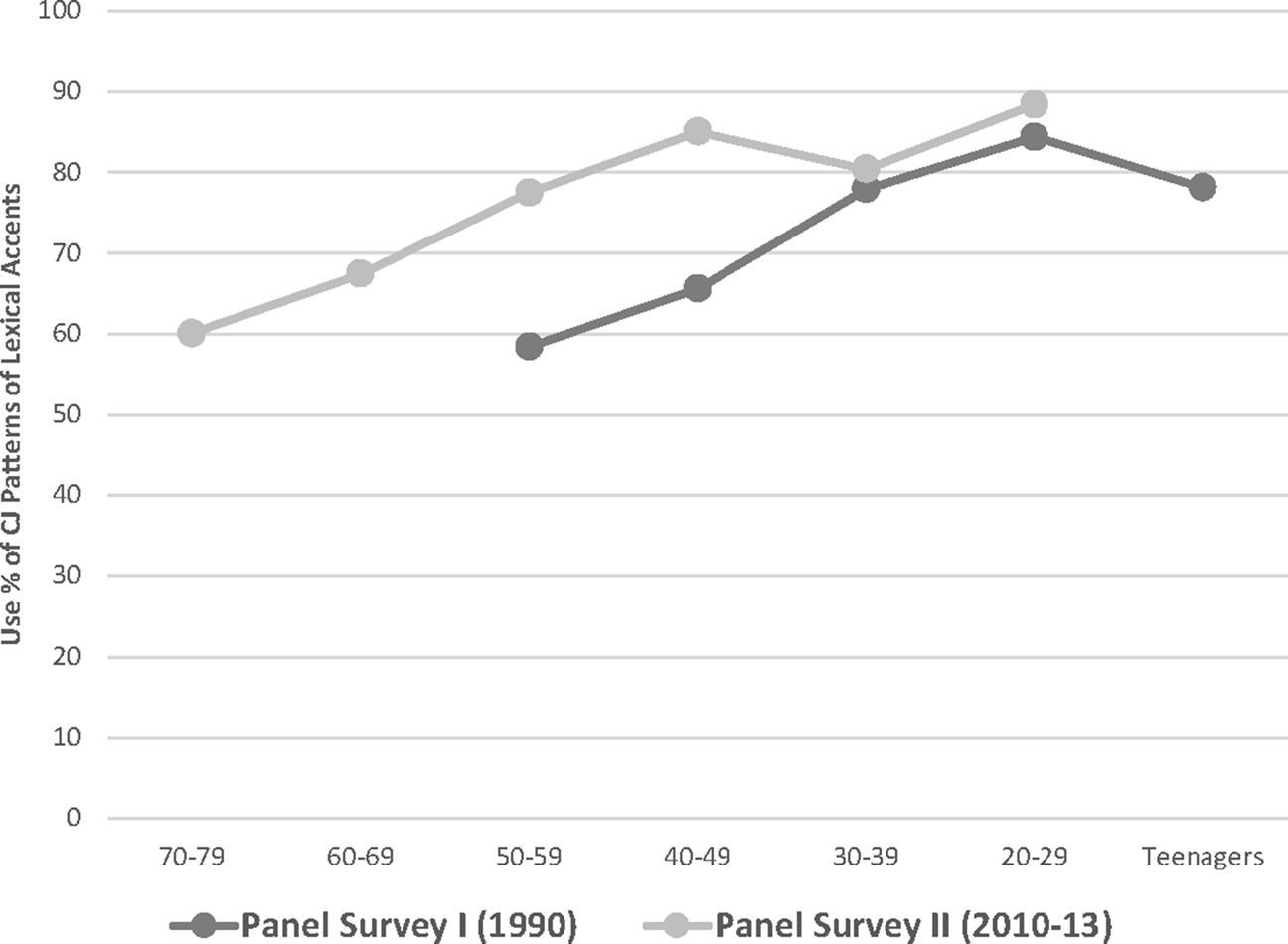
Figure 15 shows that the panelists’ uses of lexical pitch accents have remained highly stable over this past quarter century.
Real-time Changes in Uses of CJ Patterns of Lexical Accents Across Sapporo Panel Surveys I (1990) and II (2010–13). 32 panelists across the two panel surveys and 7 college students (20–29 group) only in SPSII.

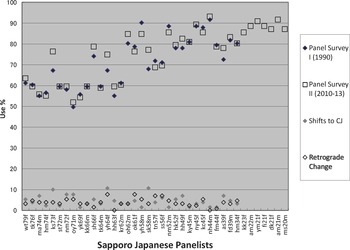
Figure 16 describes individual distribution in the thirty-two panelists’ shifting uses of pitch accents across SPS-I (black diamond) and SPS-II (hollow square) as well as the distribution of seven college students who were interviewed only in SPS-II. To contextualize the overall percentage of shift toward CJ and retrograding shift toward HJ, I provide, at the bottom of the figure, a gray diamond reflecting the percentage of the 131 items that changed toward being produced with CJ patterns and a hollow diamond reflecting the percentage of the 131 items that changed toward being produced with HJ patterns (i.e., retrograde change) in the second panel survey. These percentages are all very small (10% or less), reflecting that the majority of lexical items did not change in individuals’ language use between the two surveys. This is also reflected in the closeness of the majority of the black diamonds/hollow squares in the upper portion of the figure.
Lifespan Changes in Sapporo Panelists’ Uses of Lexical Accents: Sapporo Panel Surveys I (1990, black diamond) and II (2010–2013, hollow square). 32 panelists across SPS-I and II and 7 college students only in SPS-II. The x-axis lists the panelists in the order of age from left to right (e.g., “wt79f” means that panelist wt is a 79-year-old woman). The upper two symbols reflect the percentage of lexical items that were uttered with the CJ patterns of lexical accents in SPS-I and II. At the bottom, a grey diamond reflecting the percentage of the 131 items that changed toward being produced with CJ patterns and a hollow diamond reflecting the percentage of the 131 items that changed toward being produced with HJ patterns (i.e., retrograde change) in SPS-II.

Figure 16 reveals several general trends that coincide (or not) with findings from previous studies of lifespan changes (based primarily on changes from below variables). First, a number of panelists changed their uses of lexical accents but only to a very minor extent (i.e., less than 10% out of the total tokens) with the exception of a few panelistsFootnote 15 (cf., Sankoff & Blondeau, Reference Sankoff and Blondeau2007). These relatively minor degrees of lifespan changes involved both directions of change (i.e., a community change to CJ and a retrograding change to HJ), which is characteristic of the communities in which late-stage linguistic changes have been occurring (Sankoff, Reference Sankoff, Bayley, Cameron and Lucas2013). Furthermore, a number of panelists adopted both directions of lifespan changes over time, thus it is not feasible to group the panelists categorically according to type of lifespan change. Mere comparisons of differences in overall ratios between the two panel samples could often be misleading because the two types of changes are likely to coexist and thus offset each other in a single speaker's linguistic performance. Second, the panelists who carry out relatively larger degrees of lifespan changes are not necessarily “young adults” who are likely to have higher levels of education (cf., Naro & Scherre, Reference Naro and Scherre2002). Instead, those panelists belong to the middle cohort of the age continuum and are generally mid-range adopters of the change holding abundant competing variant choices from CJ and HJ (Sankoff & Blondeau, Reference Sankoff and Blondeau2007). While some panelists of relatively older generations (e.g., ks73f, sh66f, yh64f, oh62m) have changed their lexical accents to a relatively greater extent (Bailey, Cukor-Avila, Wikle, & Comer, Reference Bailey, Cukor-Avila, Wikle and Comer2016), all of the panelists in the youngest age cohort, who are advanced adopters, have been very stable over the quarter century. Thus, lifespan changes are likely to be linked to individual speakers’ differential degrees of participation in community changes in progress.
Lifespan changes and lexical properties
Although lifespan changes across the two surveys were generally found to be quite minor, a close examination of individual cases revealed a statistically significant degree of positive correlations between word familiarity and the number of panelists that changed their uses of lexical accents to CJ patterns (i.e., a community change) across the surveys (Pearson correlation coefficient of .300; d.f. = 44; p < .05). That is, the words holding higher scores of word familiarity tended to be susceptible to a lifespan change to CJ in a larger number of panelists’ uses of lexical accents over time.
A majority of frequent cases of lifespan changes both to CJ (a community change) and to non-CJ variants, which in fact consist of retrograde as well as brand-new nonlocal patterns of lexical accents, are the “leveled” type (e.g., LH-H, LHH-H, LHHH-H). As for the community change, this type has been found to be most susceptible to standardization of SJ lexical accents by our Rbrul analyses (Pitch Accent Types: 0.70 in SPS-II and 0.66 in SPS-I for Level in Table 3). At the same time, this leveled type had already been observed as a brand-new nonlocal change in HJ in the 1950s (NINJAL, 1965), and remained to be a nonstandard pattern shared widely by speakers in their 30s or younger (i.e., those who were born after the 1950s) at the time of SPS-I (Ono, Reference Ono1991, Reference Ono1993; cf. Swanenberg, to appear). Around the same time period, the extension of such leveled realizations of pitch accents to the sentential level (i.e., leveled sentential pitch) in TJ was interpreted as a possible conveyor of social meanings of “urbanity” or “cosmopolitan” (Sibata, Reference Sibata1978), which has more recently been found to spread nationwide (Takano & Ota, Reference Takano and Ota2017).
These particular cases of lifespan changes attest that individual grammar is more or less sensitive to longitudinal changes in target variants and their attached social meanings in a focal community, whether they represent the national norms or newly emerging “diaglossic” values (Auer, Reference Auer, Kortmann and van der Auwera2011). As our aforementioned findings have revealed so far, such sensitivity may differ across the levels of grammar in that vocabulary items and lexical accents (and words as their carriers) are more likely to be subjected to speakers’ social awareness than the remaining levels (morphosyntax and segmental phonology) and exercise vital influences on the stability of one's grammar over time (cf., Oushiro, Reference Oushiro2016). I argue that in theorizing the sociolinguistic nature of lifespan changes, lexical properties must be more qualitatively considered. We should also be aware that the researcher's choice of which grammatical levels or specific items—even at a single level of grammar—to examine over an extended period of time will critically affect what s/he eventually gains in order to draw generalizations.
Lifespan changes and social meanings
As shown in Table 3, the panelists’ conscious behaviors of self-correcting their local dialects to CJ in public (i.e., monitor use in public) are found to promote the standardization of lexical accents in SJ (0.56). My sociolinguistic interviews revealed that all three panelists (ks73f, yh64f, sk58m), who greatly deviate from the group pattern (Figure 16), are commonly characterized as acutely sensitive to how they talk and correct ways of speaking in general.
Panelist ks73f is a widow from a locally renowned family. Her late husband was the principal of a local elementary school and engaged actively in volunteer activities for the community (e.g., the chairperson of the neighborhood association called choonai kaichoo). The panelist, a full-time homemaker, had consistently joined her husband in such activities to support him. At the time of SPS-I conducted in 1990, this family played a key role in recruiting volunteer interviewees for the survey. Perhaps as a member who still wished to represent the neighborhood, she gave me impressions such as being formal, polite, and highly cooperative, carefully picking up proper words. Panelist yh64f is the sole panelist with direct contact to a CJ speaker (her husband from Yokohama) within a household. Of particular interest is her repeated praise of her late husband's ways of speaking as “sophisticated.” She also indicated her ceaseless efforts to imitate his ways to become a speaker of “sophisticated language.” Panelist sk58 m is a male executive of a company. He indicated that he has been very careful about using language in “appropriate” ways, particularly in situations in which he interacts with subordinates for business-related purposes. He also impressed me as the sole panelist who showed a keen interest in language (e.g., regularly listening to the radio programs that deal with language use as the primary theme).
Prior studies have demonstrated that the sociolinguistic status of a variable could considerably vary across regions, age groups, social classes, and gender even within a speech community where a single standard variety is shared (Kammacher, Staehr, & Jorgensen, Reference Kammacher, Staehr and Jorgensen2011). Cukor-Avila, for example, showed that social meanings of a variable are closely linked to speakers’ life histories and related language ideologies among teenagers (cited in Cukor-Avila & Bailey, Reference Cukor-Avila, Bailey, Chambers and Schilling2013:248-53). Other studies (Nichols, Reference Nichols and McConnell-Ginet1980, Reference Nichols, Thorne, Kramarae and Henley1983) have also shown that younger adults’ language use is likely to be affected by overt mainstream norms due to job market pressures. Future research on lifespan changes, especially those from above the level of awareness, should integrate these sociopsychological dimensions in an attempt to elaborate some general principles that can account for such critical issues observed repeatedly across different communities.
Community-specific dimensions of lifespan changes
Based on the series of real-time panel surveys in Furano and Sapporo, our review can be presented as a revised principle in which lifespan changes in individuals’ language use are likely to vary across different communities within a speech community of a single shared standard variety (e.g., Hokkaido). The activation/nonactivation of lifespan changes should be viewed as specific to particular local communities even within a single dialect region.
Sapporo and Furano drastically differ in terms of progressive stages of standardization and related rates of incrementation. As shown in Figures 4–8, Sapporo had already been far more advanced in the initial stages of CJ spread than Furano, although both communities had equally reached near completion of standardization today. Thus, Furano, as a local community of greater potential for standardization than Sapporo, has experienced drastic incrementation of change especially in uses of vocabulary items and lexical accents over the past half century. Lifespan changes have been observed particularly at those levels of grammar.
Furano and Sapporo also differ in terms of how members view their own communities and related attitudes toward their native dialect in relation to Standard Japanese. A great majority of people living in Hokkaido tend to regard Sapporo, the capital city of Hokkaido, as the community of Standard Japanese (Aizawa, Reference Aizawa1990; NINJAL, 1997; Ono, Reference Ono1980; Tanaka, Reference Tanaka2011). More than 80% of respondents who live in Sapporo consider SJ to be equal to Standard Japanese (Sato & Yoneda, Reference Sato and Yoneda1999), and SJ used to be considered even more authentic standard than TJ especially by people living in rural areas of Hokkaido (Ono, Reference Ono1980). Experiencing drastic globalization with increasing migration more recently, Sapporo, as the cultural center, has maintained its prestige as the standard among people living in Sapporo and for those in Hokkaido in general. The nonactivation of lifespan changes among the panelists in Sapporo could be a reflection of such value judgments attached specifically to SJ.
It could be argued that speakers of SJ, which is considered not that different from CJ, are simply unaware of linguistic differences between their own variety and CJ. As such, they do not change their language use over time. This claim, however, does not seem to hold in that a far larger number of SJ speakers are indeed aware that SJ is different from CJ than FJ speakers are aware regarding their own variety (Aizawa, Reference Aizawa1990; Ono, Reference Ono1980). Aizawa (Reference Aizawa1990) also showed that in estimating to what extent they speak CJ compared to how they speak in actuality, SJ speakers are more precise than FJ speakers who tend to be over-reporters (i.e., claim to speak with more CJ features than they actually do) (Labov, Reference Labov1972). It is conceivable that frequent contact with speakers of other regional varieties in daily life in an urban environment urges SJ speakers to develop a self-consciousness of being a dialect speaker.
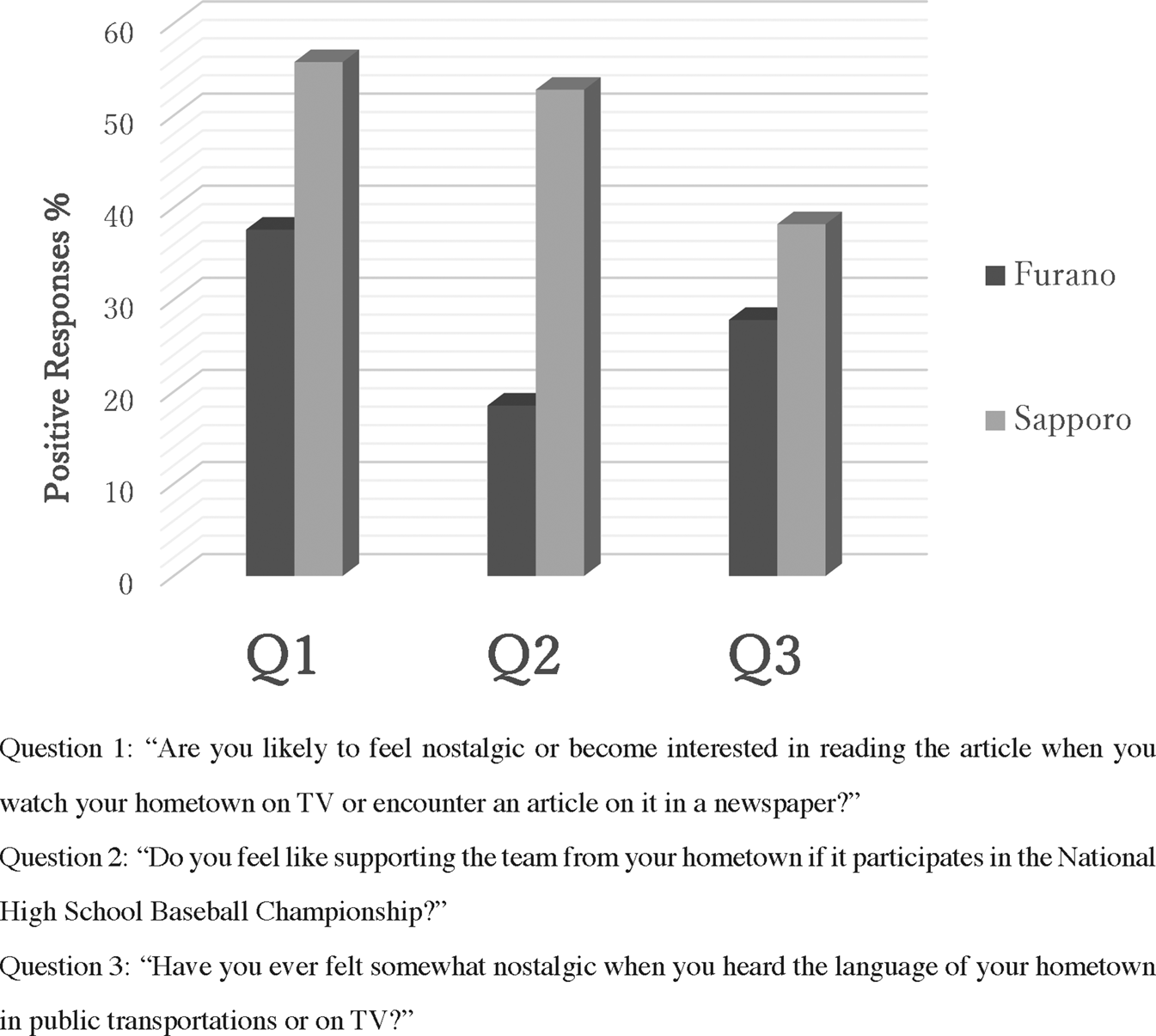
The linguistic persistency of SJ over time could also be linked closely to members’ psychological attachment and loyalty to their own community. NINJAL's real-time trend surveys conducted both in Furano and Sapporo (NINJAL, 1997) examined community-specific differences in such sociopsychological dimensions, asking three particular questions. Figure 17 demonstrates that people in Sapporo seem to share deeper feelings and loyalty to their community than those in Furano. Sato and Yoneda also reported that 93% of respondents who were born and raised in Sapporo answered that they liked Sapporo (as their hometown), which turned out to be the highest among all of the fourteen large cities investigated around the nation (Reference Sato and Yoneda1999:196).
Members’ Psychological Attachment and Loyalty to Their Community: Sapporo versus Furano.

These community-specific differences derived from comparisons of Sapporo and Furano suggest that lifespan changes in individuals’ language use over time should be interpreted partly as sociopsychological phenomena involving the issues of speakers’ social identity. It would be possible to assume that Sapporo panelists’ language use has been preserved over time by their sense of being standard (at least locally) and pride in the urban cultural center, whereas Furano panelists’ language use has been subjected to change over time by the lack of such sociopsychological drives. That is, lifespan changes, regardless of their magnitude, are unlikely to be carried out socially in a vacuum.
Conclusion
The present paper examined evidence accumulated in the Japanese sociolinguistic tradition of real-time investigation of regional dialect standardization and further substantiated the premise of the apparent-time construct—that is, the stability of one's grammar throughout the course of an adult lifetime. Given that the principles and generalizations put forth thus far have derived predominantly from studies of changes from below, this outcome leads us to conclude that this premise is also largely applicable to changes from above such as the standardization of nonstandard varieties. Furthermore, the methodological incongruity between Japanese and Western sociolinguistics in general is not necessarily something futile to consider, but instead reveals that the speaker's language use based on his or her conscious knowledge of changes in progress does not necessarily inhibit the researcher from accessing a legitimate picture of linguistic changes within the community (Dollinger, Reference Dollinger2015).
The present paper also explored the possibility that the activation of lifespan changes in a change-from-above context could vary depending on different levels of grammar through an examination of understudied prosodic aspects of one's phonology. Our comparisons of the two contrastive communities of HJ that have shifted to CJ to quite different degrees demonstrate that the rates of changes in progress vary across the levels of grammar and that high incrementation rates of changes could have a significant impact on how individuals use language over time. In the case of Furano as a community going through drastic linguistic transformations, larger degrees of incrementation at the level of vocabulary items and prosody are found to have contributed to the activation of lifespan changes. Such transformations also introduced an upsurge of bidialectalism, which has led to a reanalysis of certain variables to “stable” ones in community members’ shifting perceptions over time (MacKenzie, Reference MacKenzie2017). In a stable community like Sapporo, lifespan changes still do take place with a particular sector of community members—mid-range adopters with access to competing variants to choose in their daily lives (Sankoff & Blondeau, Reference Sankoff and Blondeau2007). It follows that different communities even within a single dialect region are likely to construct different profiles of grammatical stability at the level of individual members unless those communities have undergone similar progress stages of a linguistic change.
The present paper also argues that lifespan changes could be a particular phenomenon of lexical items, calling for the necessity of more qualitative scrutiny of their sociolinguistic properties. As the Furano Panel Survey shows (Figure 11), the panelists’ fluctuating uses of individual vocabulary items over time involved the systematicity in which mid-range items with relatively larger amounts of variation were more likely to be subjected to lifespan changes (Nahkola & Saanilahti, Reference Nahkola and Saanilahti2004). Interestingly, these changes were in different directions—a community change (to CJ), revitalization of local variants through their reanalyses in the context of bidialectalism, and newly emerging nonlocal variants.
Panelists’ perceptions of variables are also found to be a significant factor in lifespan changes. Given a crosslinguistic generalization that less saliency tends to lessen variability toward “lectal cohesion” (Oushiro & Guy, Reference Oushiro and Guy2015; Sato et al., Reference Sato, Yoneda, Abe, Sato and Mizuno2014), SPS-II also demonstrates that more familiar lexical items by frequent contact in daily lives are likely to be more standardized and could contribute to lifespan changes to the common target (CJ) with certain sectors of panelists (i.e., mid-range adopters). Moreover, synchronic accounts of Sapporo panelists’ uses of lexical accents in SPS-II indicate that their monitored uses are likely to favor standardization. This finding suggests that at least in the context of changes from above, lifespan changes need to be examined in conjunction with panelists’ awareness of linguistic prestige (as well as its longitudinal transformation). Given that their awareness is likely to differ across different levels of grammar (Oushiro, Reference Oushiro2016), the present study also demonstrates that variable uses of vocabulary items and lexical accents tend to arouse speakers’ awareness (more than other levels of grammar) and thus more strongly contribute to lifespan changes. A more qualitative look at sociolinguistic properties of individual words examined as variable carriers is vital in accounting for how individuals’ language use is transformed through the course of an adult lifetime. Otherwise, researchers' identification of lifespan changes and obtained generalizations would readily be skewed by their choices of which particular lexical items to examine over time.
Our analyses of sociopsychological dimensions of the two contrastive communities also shed light on the close linkage between lifespan changes and locally constructed social identities. The results demonstrate that community members’ monitored uses of language would promote the standardization of SJ and that a few outliers who greatly shifted their accentual patterns toward those of CJ over time have been particularly sensitive to the overt prestige of standardness. Furthermore, it is shown, based on past comparative work on language attitudes in Furano and Sapporo, that community members’ sense of loyalty to and pride in the local culture are likely to surpass prevalent ideologies attached to the nationwide standardization and can be assumed to function as the driving force for the sustainability of idiolects over time. Future work on lifespan changes should more rigorously integrate an account of panelists’ sociopsychological dimensions and their transformation over years in its heuristic paradigm
Acknowledgments
I wish to express my deep appreciation to thirty-nine Yamahana panelists for their generous cooperation and to Yoneichi Ono and Yasuo Suga for allowing me to use their panel survey database. I greatly appreciate collaborative support from Yoshiyuki Asahi, Kenjiro Matsuda, Ichiro Ota, Hitoshi Nikaido, and Shin-ichiro Sano, as well as helpful discussions with the members of Hokkaido Circle of Dialectology. I am also grateful to Satoshi Nambu for his statistical support, Soichiro Eto for his assistance on data compilation, and anonymous LVC reviewers for their insightful comments and suggestions. The present study is supported by the following grants: the NINJAL Collaborative Research Project (organized by Yoshiyuki Asahi from 2009 to 2013), MEXT's Grant-in-Aid for Scientific Research (B) (No. 25284082, represented by Kenjiro Matsuda from 2013 to 2016) and NINJAL's joint usage project (No. 20301297) in 2019 and 2020 (led by the present author).