Introduction
The term ‘cognitive remediation’ refers to a category of therapeutic interventions that were initially conceived for neurological patients and are being progressively extended to psychiatric settings. Wykes & van der Gaag (Reference Wykes and van der Gaag2001) describe cognitive remediation as a set of methods for teaching ‘thinking’ skills that focus on cognitive deficits, and that hold as a common characteristic the reliance on material having no personal relevance to the individual. Although there are various ways of categorizing cognitive remediation techniques, a straightforward distinction can be drawn between those relying on manual tasks and those that are computer assisted.
The aim of the present paper was to review computer-assisted cognitive remediation (CACR) in schizophrenia. CACR represents a relatively homogeneous subgroup of cognitive remediation interventions, typically consisting of weekly sessions of drill and practice meant to target cognitive functions such as attention, memory, and executive functions. Their common premise is that intense and regular practice on computerized tasks fosters improvement, even when the tasks involve deficient cognitive function. Several meta-analytical reviews (Kurtz et al. Reference Kurtz, Moberg, Gur and Gur2001; Pilling et al. Reference Pilling, Bebbington, Kuipers, Garety, Geddes, Martindale, Orbach and Morgan2002; Krabbendam & Aleman, Reference Krabbendam and Aleman2003; Twamley et al. Reference Twamley, Jeste and Bellack2003; McGurk et al. Reference McGurk, Twamley, Sitzer, McHugo and Mueser2007) have examined the efficacy of cognitive remediation as a whole, although, to our knowledge, none have yet been specifically devoted to the subset of computer-based methods.
The use of computer-based procedures for cognitive remediation is supported by a twofold argument. First, prolonged multimedia stimulation is considered to be a factor favouring neural plasticity (Hogarty et al. Reference Hogarty, Flesher, Ulrich, Carter, Greenwald, Pogue-Geile, Kechavan, Cooley, DiBarry, Garrett, Parepally and Zoretich2004). Second, computer activities are considered helpful in providing opportunities for acquiring new compensatory strategies, which is viewed as an important component of cognitive remediation (Kurtz et al. Reference Kurtz, Seltzer, Shagan, Thime and Wexler2007). The literature emphasizes the strong potential of computers for designing cognitive training tasks, as they provide unlimited training possibilities and numerous forms of reinforcement (Hermanutz & Gestrich, Reference Hermanutz and Gestrich1991; Field et al. Reference Field, Galletly, Anderson and Walfer1997), multisensory presentation (Medalia et al. Reference Medalia, Revheim and Casey2001), the possibility of unlimited repetitions (Field et al. Reference Field, Galletly, Anderson and Walfer1997), automatic adjustment of the difficulty level to the patient's progression (Field et al. Reference Field, Galletly, Anderson and Walfer1997; Sartory et al. Reference Sartory, Zorn, Groetzinger and Windgassen2005), objective recording of performances (Field et al. Reference Field, Galletly, Anderson and Walfer1997) and personalization of learning activities (Hermanutz & Gestrich, Reference Hermanutz and Gestrich1991; Medalia et al. Reference Medalia, Revheim and Casey2001). Computers provide structured, flexible and standardized training tasks, in addition to accurate and immediate feedback (Burda et al. Reference Burda, Starkey, Dominguez and Vera1994; Bellucci et al. Reference Bellucci, Glaberman and Haslam2003). Moreover, their stimulating and entertaining aspects are considered potentially favourable for inducing motivation (Hermanutz & Gestrich, Reference Hermanutz and Gestrich1991; Field et al. Reference Field, Galletly, Anderson and Walfer1997; Medalia et al. Reference Medalia, Revheim and Casey2001) and their non-judgemental nature in case of failure is considered reassuring (Hermanutz & Gestrich, Reference Hermanutz and Gestrich1991; Bellucci et al. Reference Bellucci, Glaberman and Haslam2003). CACR is also considered cost-effective in terms of reducing therapist time (Hermanutz & Gestrich, Reference Hermanutz and Gestrich1991; Burda et al. Reference Burda, Starkey, Dominguez and Vera1994).
CACR interventions seem extremely relevant in schizophrenia, where neurocognitive alterations pervade all ability domains and strongly influence the patients' quality of life. According to Heinrichs & Zakzanis (Reference Heinrichs and Zakzanis1998), most common neuropsychological tests reveal deficits with rates between 61% and 78% of the population with schizophrenia. Patients display a high inter-individual heterogeneity, from no or mild deficits to magnitudes approaching deficits found in neurological disorders. Neurocognitive domains such as verbal memory, immediate memory, executive functioning and vigilance are reported to bear strong relationships to functional capacities including psychosocial functioning, independent living and vocational outcome (Green et al. Reference Green, Kern, Braff and Mintz2000). Moreover, the literature suggests that cognitive deficits could be linked to negative symptoms and disorganization (Wykes & van der Gaag, Reference Wykes and van der Gaag2001).
The present article first examines the efficacy of CACR for cognitive competencies. The literature provides heterogeneous conclusions about the extent of cognitive improvements that should be expected from CACR. Several studies show a significant cognitive enhancement over various competencies (Bell et al. Reference Bell, Bryson, Greig, Corcoran and Wexler2001; Hogarty et al. Reference Hogarty, Flesher, Ulrich, Carter, Greenwald, Pogue-Geile, Kechavan, Cooley, DiBarry, Garrett, Parepally and Zoretich2004; Sartory et al. Reference Sartory, Zorn, Groetzinger and Windgassen2005), whereas others fail to observe the expected cognitive improvements (Benedict et al. Reference Benedict, Harris, Markow, McCormick, Nuechterlein and Asarnow1994; Field et al. Reference Field, Galletly, Anderson and Walfer1997; Medalia et al. Reference Medalia, Revheim and Casey2000). The variations in sample sizes could be a major cause of discrepancies among studies. In an attempt to tackle this problem, the current paper relies on meta-analytical tools that enable the statistical processing of results from different studies with various sample sizes. We hypothesized that CACR would yield significant effect sizes showing improvements in the cognitive functioning of patients with schizophrenia.
Second, the paper takes into consideration the intended goals guiding the design of CACR procedures and analyses their consistency with the actual outcomes. In particular, we examine the possibility of applying CACR in such a way that it selectively impacts specific cognitive domains that are defined as the treatment's targets. Indeed, several CACR methods are designed with the intent to specifically treat an a priori selected cognitive deficit, such as attention (Hermanutz & Gestrich, Reference Hermanutz and Gestrich1991), memory (Medalia et al. Reference Medalia, Revheim and Casey2000), problem solving (Medalia et al. Reference Medalia, Revheim and Casey2001) or affect recognition (Wölwer et al. Reference Wölwer, Frommann, Halfmann, Piaszek, Streit and Gaebel2005). This raises the question of whether the improvements in a given cognitive domain are greater when this domain is an intended target of the CACR method. We seek to address this point in the present meta-analysis by examining the links between the effects in different cognitive domains versus the cognitive deficits that were targeted by the interventions. We hypothesized that the specific cognitive domains selected as the targets of the CACR intervention would present stronger effects than those that were not explicitly acknowledged as remediation goals.
Method
Procedure
We verified whether improvements in cognitive skills following CACR training could be attributed to CACR rather than to non-specific treatment effects, by calculating mean effect sizes of differences between groups attending CACR and their control conditions. We introduced potential moderator variables to account for possible discrepancies among studies. The first one represented the type of control condition. Control groups either received treatment as usual (TAU) (passive condition) or attended an additional psychotherapeutic program unavailable to patients in the CACR groups (active condition). Among the latter, we distinguished three types of active conditions. In the first type, the control group attended a vocational program that was also used conjointly with CACR in the experimental condition but with some adjustments, such as fewer work hours (Bell et al. Reference Bell, Bryson, Greig, Corcoran and Wexler2001) or different group activities (Greig et al. Reference Greig, Zito, Wexler, Fiszdon and Bell2007). The second type consisted of a placebo intervention, such as computer literacy training (Kurtz et al. Reference Kurtz, Seltzer, Shagan, Thime and Wexler2007). The third type referred to clinically valid treatments, such as enriched supportive therapy (Hogarty et al. Reference Hogarty, Flesher, Ulrich, Carter, Greenwald, Pogue-Geile, Kechavan, Cooley, DiBarry, Garrett, Parepally and Zoretich2004). Furthermore, we checked for the influence of three other potential moderator variables: (1) the mean age of the participants, (2) the duration of treatment (in weeks), and (3) the weekly frequency of computerized training sessions.
To test our hypothesis about the specific effects on targeted cognitive domains, we determined the cognitive domains targeted in each selected study by a precise examination of the article, especially the procedure section.
Selection of studies for meta-analysis
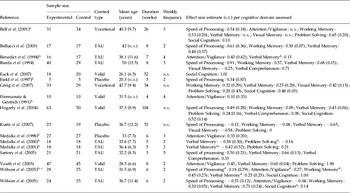
A literature search was performed on three online scientific databases: PubMed, Current Contents and PsycINFO. The selection was limited to peer-reviewed journals in the English language published before 1 January 2009. The search queries combined the following keywords: ‘computer’ or ‘computerized’; ‘cognitive’; ‘rehabilitation’, ‘remediation’ or ‘training’; and ‘schizophrenia’. The bibliographic references of each selected article were scanned for possible additional studies. Studies were selected according to the following inclusion criteria: (1) randomized controlled trials assessing cognitive training on software tasks, with a pre-post test design; (2) a pre-post test relying on at least one neurocognitive measure on which participants were not trained, so as to measure learning transferability; and (3) samples of participants diagnosed exclusively with either schizophrenia or schizo-affective disorder. The diagnoses relied on the Research Diagnostic Criteria (Spitzer et al. Reference Spitzer, Endicott and Robins1978), DSM-III, DSM-III-R, DSM-IV, or ICD-10, depending on the publication date of the study. Studies by McGurk et al. (Reference McGurk, Mueser and Pascaris2005), Lindenmayer et al. (Reference Lindenmayer, McGurk, Mueser, Khan, Wance, Hoffman, Wolfe and Xie2008) and Ueland & Rund (Reference Ueland and Rund2004) were discarded as they included participants diagnosed with neither schizophrenia nor schizo-affective disorder, but with mood disorders. The study by Benedict & Harris (Reference Benedict and Harris1989) was also excluded because it comprised two control groups (a placebo and a TAU group) for which separate data were not available. Considering these two control groups as a single one seemed problematic as it would jeopardize randomization and fail to account for differences in the two control conditions. We carefully checked that multiple articles published by the same research group would not contain overlapping data. In such cases, the article holding the most relevant information was selected and other overlapping articles were mentioned beside it (see Table 2). Whenever possible, authors were contacted for data missing from their article.
Categorization of neuropsychological tests
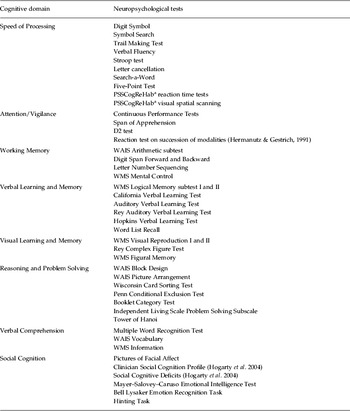
The categorization of neuropsychological tests used to assess the effects of CACR was based on recommendations devised by the Measurement and Treatment Research to Improve Cognition in Schizophrenia (MATRICS) committee following an initiative by the National Institute of Mental Health (NIMH). The MATRICS-NIMH distinguishes eight cognitive domains: Speed of Processing, Attention/Vigilance, Working Memory, Verbal Learning and Memory, Visual Learning and Memory, Reasoning and Problem Solving, Verbal Comprehension and Social Cognition (Nuechterlein et al. Reference Nuechterlein, Barch, Gold, Goldberg, Green and Heaton2004). It should be noted that Verbal Comprehension is not considered sensitive to cognitive changes, thus its inclusion is debatable. We classified neuropsychological tests in these eight domains according to recommendations by the MATRICS committee and by consensus between the first six authors, comprising two neuroscience researchers, one clinical neuropsychologist, and three researcher-psychiatrists, all of whom are Ph.D. level. Table 1 summarizes the categorization of tests found in the selected studies.
Categorization of neuropsychological tests used in the studies included in the meta-analysis

WMS, Wechsler Memory Scale; WAIS, Wechsler Adult Intelligence Scale.
a PSSCogRehab Software, Psychological Software Services Inc., Indianapolis, IN, USA (www.neuroscience.cnter.com/pss/psscogrehab.html).
Meta-analytical statistics
Analyses were performed with Statistical Analysis Software (SAS; www.sas.com). Cohen's d values, measuring the effect sizes between CACR and control groups, were calculated using means and standard deviations of neuropsychological tests, or were derived from t and F values when means and standard deviations were unavailable. For each study we computed the mean effect size encompassing all neuropsychological measures (the latter referred to as the non-specific effect size), in addition to the mean effect sizes associated with every cognitive domain assessed. The means were weighted by the reciprocal of their estimated variance so as to obtain unbiased estimates that accounted for sample size variations between studies (Wolf, Reference Wolf1986). We tested the homogeneity/heterogeneity of effect size estimates using the Q statistic.
Five studies (Hermanutz & Gestrich, Reference Hermanutz and Gestrich1991; Burda et al. Reference Burda, Starkey, Dominguez and Vera1994; Field et al. Reference Field, Galletly, Anderson and Walfer1997; Wölwer et al. Reference Wölwer, Frommann, Halfmann, Piaszek, Streit and Gaebel2005; Greig et al. Reference Greig, Zito, Wexler, Fiszdon and Bell2007) acknowledged some baseline differences between groups and, in some instances, age was co-varied out (Burda et al. Reference Burda, Starkey, Dominguez and Vera1994; Wölwer et al. Reference Wölwer, Frommann, Halfmann, Piaszek, Streit and Gaebel2005). To ascertain that there were no significant differences at intake between CACR groups and control groups in our selection, we computed the mean effect size estimates of baseline differences, whenever the data were available. The t test was then used to assess whether or not these effect sizes were significantly different from zero. Studies for which intake scores were not available (Benedict & Harris, Reference Benedict and Harris1989; Bell et al. Reference Bell, Bryson, Greig, Corcoran and Wexler2001; Hogarty et al. Reference Hogarty, Flesher, Ulrich, Carter, Greenwald, Pogue-Geile, Kechavan, Cooley, DiBarry, Garrett, Parepally and Zoretich2004; Eack et al. Reference Eack, Hogarty, Greenwald, Hogarty and Keshavan2007) reported no baseline differences between groups on neuropsychological measures.
To assess improvements following CACR, t tests were performed to evaluate whether the mean effect sizes of post-test measures were significantly different from zero. As is commonly accepted, the thresholds for small, medium and large magnitudes of Cohen's d were respectively fixed at 0.2, 0.5 and 0.8 (Zakzanis, Reference Zakzanis2001). Acknowledging the ‘file drawer problem’, that is the tendency not to publish studies with no significant results, we calculated the File-Safe N fs, which represents the number of additional studies confirming the null hypothesis that would be necessary to invalidate the results (Wolf, Reference Wolf1986). The File-Safe criterion value for Cohen's d was set at 0.2, corresponding to a small effect.
A significant correlation between a potential moderator variable and effect size estimates would indicate that the moderator variable should be used as a co-variable in the analyses of variance (ANOVAs) described later. Spearman's coefficient was used to correlate the effect size estimates with the following potential moderator variables: mean age, duration of treatment, and weekly frequency. Concerning the control condition type, t tests were performed to evaluate differences between studies sorted according to this variable.
Finally, we considered the intended goals in each CACR study. Given that several articles described CACR interventions explicitly meant to focus on a specific cognitive domain (see Table 2, for a full version of this table see Table S1 in the online Supplementary Material), we acknowledged that the non-specific effect size was mostly relevant for non-specific CACR that provided training in multiple domains. Therefore, we computed the non-specific effect size again, this time excluding the ‘domain-specific’ CACR studies. Similarly, we recalculated the effect size estimates for each domain, excluding CACR studies that did not target this domain intentionally. To tackle our second hypothesis, that is that domain-specific effects vary according to the intended targets of CACR, we considered an extra independent variable, called ‘targeted’, associated with every neuropsychological measure. In each study, this dichotomous variable enabled us to draw a distinction between the neuropsychological measures used to evaluate a cognitive domain that was targeted by the study, versus the measures associated with a domain that was not targeted by the study. Although most studies assessed the cognitive domains that they targeted, some performed additional assessments intentionally (see Table 2). A two-factor ANOVA was performed on the effect size estimates, the factors being the cognitive domains and the ‘targeted’ variable.
Details of the groups in the selected studies assessing computer-assisted cognitive remediation (CACR)

n.a., Not available; Vocational, vocation programme only; TAU, treatment as usual; Valid, valid treatment; s.d., standard deviation.
a This study did not report the data of every measure performed. Data were available only for Problem Solving, Working Memory, Speed of Processing and Social Cognition. There were overlapping studies: Bell et al. (Reference Bell, Bryson and Wexler2003, Reference Bell, Fiszdon, Bryson and Wexler2004, Reference Bell, Fiszdon, Greig, Wexler and Bryson2007), Fiszdon et al. (2006).
b These CACR interventions were domain specific.
c There was an overlapping study: Frommann et al. (Reference Frommann, Streit and Wölwer2003).
d These domains were not direct cognitive targets of the CACR.
Results
Sixteen studies complied with the inclusion criteria, totalling 805 patients (see Table 2). Wölwer et al. (Reference Wölwer, Frommann, Halfmann, Piaszek, Streit and Gaebel2005) reported two types of CACR, one for training neuropsychological skills and one for training affect recognition. Both interventions were included separately in the meta-analysis. Seven articles (Medalia et al. Reference Medalia, Revheim and Casey2000, Reference Medalia, Revheim and Casey2001; Bellucci et al. Reference Bellucci, Glaberman and Haslam2003; Hogarty et al. Reference Hogarty, Flesher, Ulrich, Carter, Greenwald, Pogue-Geile, Kechavan, Cooley, DiBarry, Garrett, Parepally and Zoretich2004; Sartory et al. Reference Sartory, Zorn, Groetzinger and Windgassen2005; Vauth et al. Reference Vauth, Corrigan, Clauss, Dietl, Dreher-Rudolph, Stieglitz and Vater2005; Kurtz et al. Reference Kurtz, Seltzer, Shagan, Thime and Wexler2007) explicitly mentioned that pre-post test evaluators were unaware of the participants' group allocation and three studies (Benedict et al. Reference Benedict, Harris, Markow, McCormick, Nuechterlein and Asarnow1994; Medalia et al. Reference Medalia, Aluma, Tryon and Merriam1998; Eack et al. Reference Eack, Hogarty, Greenwald, Hogarty and Keshavan2007) relied on computerized tests. Therefore, at least 10 studies out of 16 ensured evaluators' blindness to group allocation.
Efficacy of CACR
None of the effect sizes measuring baseline differences between the CACR groups and the control groups were significantly different from zero, except for Verbal Comprehension, where the effect size estimate was 0.37 (s.d.=0.06, t=33.09, p=0.02). Consequently, this domain was withdrawn from the subsequent analyses.
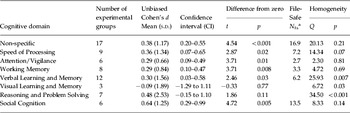
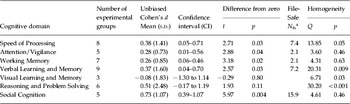
The non-specific and domain-specific unbiased effect size estimates are presented in Table 3. The t test and the File-Safe test show a significant and highly reliable improvement of the non-specific effect size. Effect size estimates are significantly different from zero for Speed of Processing, Attention/Vigilance, Working Memory, Verbal Learning and Memory, and Social Cognition. The magnitudes of effect sizes are small, except for Social Cognition, which yields a medium effect size. The File-Safe test indicates a high reliability of results for Speed of Processing, Verbal Learning and Memory and Social Cognition. However, the homogeneity tests suggest that effect sizes were heterogeneous for Verbal Learning and Memory. It should also be noted that this test came close to significance for Speed of Processing.
Unbiased Cohen's d estimates for each cognitive domain

a The File-Safe N fs are only provided for significant mean effect sizes.
The mean age, treatment duration and weekly frequency variables did not correlate significantly with the effect size estimates. Neither were there any significant differences between effect size estimates grouped according to control condition type.
Specificity of effects
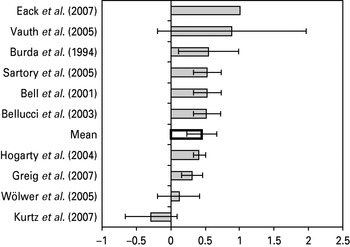
When excluding domain-specific CACR studies, the non-specific effect size for the remaining 11 interventions was still significantly different from zero, with a value of 0.45 [s.d.=1.22, confidence interval (CI) 0.23–0.67, t=4.60, p=0.001]. These studies' individual effect sizes are shown in Fig. 1.
Individual effect sizes and 95% confidence intervals for the non-specific computer-assisted cognitive remediation studies.

Table 4 presents the effect sizes per domain for interventions that target the domain, and shows that the effect sizes scarcely varied when removing studies that did not target a domain they assessed. However, most rows in Table 4 differ from Table 3 by only one study, thus precluding any statistical inference.
Unbiased Cohen's d estimates for each cognitive domain when only including the interventions that target this domain

a The File-Safe N fs are only provided for significant mean effect sizes.
The ANOVA with two factors, namely the cognitive domains and the ‘targeted’ variable, required data for each combination of the two factors. However, this prerequisite was not verified for Visual Learning and Memory (all the studies that did not target Visual Learning and Memory did not measure it either), which was therefore withdrawn from the ANOVA.
The ANOVA did not reveal a significant effect of the ‘targeted’ factor [F(1, 36)=2.36, p=0.13]. However, this result should be considered with caution given the small number of effect sizes associated with non-targeted cognitive domains (n=8) compared to targeted domains (n=40). Post-hoc tests were not performed because of the paucity of non-targeted measures for each domain taken separately.
Discussion
The results support our first hypothesis, revealing a significant overall effect of CACR on cognitive measures and thus serving to settle the earlier mentioned contradicting reports. Although it is small, the effect size found here is comparable in magnitude to those reported by other meta-analyses that cover cognitive remediation as a whole, including computerized and non-computerized methods (Krabbendam & Aleman, Reference Krabbendam and Aleman2003; Twamley et al. Reference Twamley, Jeste and Bellack2003; McGurk et al. Reference McGurk, Twamley, Sitzer, McHugo and Mueser2007). This effect size, encompassing every cognitive domain, increases when considering only non-specific CACR interventions, for which it seems more relevant than for domain-specific interventions. The variations in the type of control conditions do not seem to influence effect sizes, thus suggesting that CACR could compare favourably with other treatments, even outside the scope of traditional care. Additional comparative studies would still be required to support this claim. We did not find any influence of age, treatment duration or weekly frequency. Nevertheless, no definite conclusions should be drawn because this lack of results could be due to the fact that control groups are usually matched with experimental groups on these variables and that these variables could have an influence on both conditions.
The most notable outcome of this meta-analysis pertains to Social Cognition, which yielded the highest effect size and the only one falling into the medium range. This result may seem unexpected, given the emphasis of CACR on interacting with a machine not particularly renowned for being socially involving. In fact, CACR was combined with social group therapies in four of the six interventions assessing Social Cognition (Bell et al. Reference Bell, Bryson, Greig, Corcoran and Wexler2001; Hogarty et al. Reference Hogarty, Flesher, Ulrich, Carter, Greenwald, Pogue-Geile, Kechavan, Cooley, DiBarry, Garrett, Parepally and Zoretich2004; Eack et al. Reference Eack, Hogarty, Greenwald, Hogarty and Keshavan2007; Greig et al. Reference Greig, Zito, Wexler, Fiszdon and Bell2007). In these interventions, the intensity of CACR compared to social group therapy varies; neurocognitive enhancement therapy (Bell et al. Reference Bell, Bryson, Greig, Corcoran and Wexler2001; Greig et al. Reference Greig, Zito, Wexler, Fiszdon and Bell2007) place the emphasis on CACR whereas cognitive enhancement therapy (Hogarty et al. Reference Hogarty, Flesher, Ulrich, Carter, Greenwald, Pogue-Geile, Kechavan, Cooley, DiBarry, Garrett, Parepally and Zoretich2004; Eack et al. Reference Eack, Hogarty, Greenwald, Hogarty and Keshavan2007) focuses on social group therapy. Although the respective effects of CACR and social group therapies seem difficult to disentangle, we may hypothesize that providing CACR conjointly with social group therapies could have boosted cognitive skills useful in a social context. Cognitive enhancement therapy in fact provides CACR for this very purpose (Hogarty & Flesher, Reference Hogarty and Flesher1999). Furthermore, the fact that Social Cognition can be trained directly with CACR seems to be gaining awareness. The study by Wölwer et al. (Reference Wölwer, Frommann, Halfmann, Piaszek, Streit and Gaebel2005), which relied on software and deskwork to address affect recognition, yielded an effect size among the highest in Social Cognition. Another pilot study by Silver et al. (Reference Silver, Goodman, Knoll and Isakov2004) yielded encouraging results using specialized software for teaching emotion recognition. Their study could not be included in our meta-analysis, as it was not randomly controlled. These studies suggest that providing social group therapy separately from CACR may not be indispensable to impact Social Cognition and that novel CACR methods based on specialized software could also prove effective. Computerized tasks may offer opportunities for decomposing the cognitive aspects involved in social interactions. During CACR, the patient typically faces the computer rather than being in direct eye-to-eye contact with the therapist. This setting could be beneficial as it alleviates social demands, while still enabling social skills practice. Although CACR interventions are not classically designed to address Social Cognition, this domain appears as a relevant target that could promote interesting interdisciplinary research merging software design and psychopathology.
The following cognitive domains also yielded significant effect sizes: Speed of Processing, Attention/Vigilance, Working Memory and Verbal Learning and Memory. Given that this list encompasses neuropsychological measures associated with prevailing impairments in schizophrenia (Heinrichs & Zakzanis, Reference Heinrichs and Zakzanis1998), the effectiveness of CACR in these domains bears particular relevance, even though the magnitudes of the effect sizes were small. Whether these improvements transfer to everyday life remains unanswered by our meta-analysis. However, the results are encouraging given that verbal memory, working memory and vigilance are considered highly associated with functional outcomes in schizophrenia (Green et al. Reference Green, Kern, Braff and Mintz2000). Concerning Visual Learning and Memory, failure to reach significance may be due to the paucity of studies evaluating this domain (n=3). The non-significant outcome in Reasoning and Problem Solving reflects the inconsistencies in studies assessing this domain. A lack of significant progression in this domain was reported for two interventions out of seven: the memory remediation in the study by Medalia et al. (Reference Medalia, Revheim and Casey2001) and the computer-assisted cognitive strategy training of Vauth et al. (Reference Vauth, Corrigan, Clauss, Dietl, Dreher-Rudolph, Stieglitz and Vater2005). Taken together, these results indicate a relatively more consistent effect of CACR on verbal learning, attention, vigilance and reaction speed. A possible explanation could derive from verbal and attentional skills required to interact with a computer. Remediation software abides by mainstream Human–Computer Interface (HCI) design rules, which follow a paradigm called WIMP (Windows Icons Menus Pointers) that was strongly inspired by cognitive psychology (Dix et al. Reference Dix, Finlay, Abowd and Beale1998). For instance, menus extensively stimulate verbal memory, as they require memorizing sequences of words with specific relevance to the software. Using a pointer, which enables the computer to identify the user's focus of attention, involves searching for the graphic element representing it (e.g. the mouse arrow or the cursor in a text editing pane) and dragging it to the new focal point. These operations are constantly being performed during computer activities, thus requesting continuous attention and swift targeting.
The present meta-analysis did not confirm our second hypothesis according to which CACR would yield stronger effects in cognitive domains that were intentionally targeted. Although this outcome should be considered with caution given the low statistical power of the test performed, the literature echoes the difficulty of targeting a specific cognitive domain in CACR. For instance, CACR interventions exclusively dedicated to attention yield contradictory results: some studies report a significant improvement (Hermanutz & Gestrich, Reference Hermanutz and Gestrich1991; Medalia et al. Reference Medalia, Aluma, Tryon and Merriam1998) whereas others report none (Benedict et al. Reference Benedict, Harris, Markow, McCormick, Nuechterlein and Asarnow1994; Field et al. Reference Field, Galletly, Anderson and Walfer1997). In two studies by Medalia et al. (Reference Medalia, Revheim and Casey2000, Reference Medalia, Revheim and Casey2001), similar groups of patients attended either a memory-training program or a problem-solving program. Only the latter resulted in the expected progression. Kurtz et al. (Reference Kurtz, Seltzer, Shagan, Thime and Wexler2007) accentuate the issue by comparing a group attending CACR with a control group attending computer literacy training focusing on Microsoft Office® applications. The two groups thus differed mainly by the absence of an intended remediation goal in the control condition. The results revealed that both groups yielded comparable improvements on most neuropsychological measures, leading the authors to question the specific effect of CACR compared to mere computerized training with no treatment goals. The present meta-analysis tends to corroborate these doubts. This bears practical consequences for remediation software claimed to be specially designed for addressing specific cognitive domains. Indeed, if such software does not yield greater improvements in the targeted domain than ‘non-specific’ software, then the relevance of the software may be questioned.
The apparent lack of specificity in CACR treatments could hold several explanations. First, it is worthwhile bearing in mind that categories used for classifying neuropsychological evaluation tasks may not be relevant for classifying training tasks. The categories that were used in the present meta-analysis stem from factor analyses of neuropsychological tasks administered at a particular time (Nuechterlein et al. Reference Nuechterlein, Barch, Gold, Goldberg, Green and Heaton2004). We have to consider the possibility that factor analyses of similar tasks on series of training sessions instead of at a particular time could result in a different categorization. The cognitive training targets reported in the studies on CACR would then be misleading. Second, although tasks used for training in CACR are usually inspired from pen-and-paper neuropsychological tests, their actual software implementations often add extra features intended to enhance their entertaining aspects. These features could modify the set of cognitive functions involved. Third, the previously mentioned underlying HCI paradigms could have an influence on the cognitive skills involved in the software tasks whatever the remediation goals are. Fourth, the simultaneous stimulation of complementary competencies could conceivably play a major role in CACR. Based on this assumption, CACR treatments should cover every cognitive domain, rather than concentrate on a specific domain.
Although our arguments are in favour of a ‘non-specific’ effect of CACR on classical neurocognitive functions, different considerations may apply for Social Cognition. Further examination of individual interventions reveals that Social Cognition was the primary goal of three interventions: two studies (Hogarty et al. Reference Hogarty, Flesher, Ulrich, Carter, Greenwald, Pogue-Geile, Kechavan, Cooley, DiBarry, Garrett, Parepally and Zoretich2004; Eack et al. Reference Eack, Hogarty, Greenwald, Hogarty and Keshavan2007) evaluated cognitive enhancement therapy, which is devoted to ‘facilitate attainment of social cognitive milestones’ (Hogarty & Flesher, Reference Hogarty and Flesher1999), and a third (Wölwer et al. Reference Wölwer, Frommann, Halfmann, Piaszek, Streit and Gaebel2005) assessed a programme called ‘Training of Affect Recognition’. These three studies clearly stand out with medium or large magnitudes compared to smaller magnitudes in the other interventions assessing Social Cognition (see Table 2). Such an observation lends support to the view that interventions focused on Social Cognition (albeit not necessarily being domain specific) would have a specific effect on this domain. Although this assumption currently lacks evidence, Social Cognition could require distinct rehabilitation approaches.
There are several limitations to the present study. First, the meta-analysis did not include data on functional outcomes, which represent the ultimate goal of rehabilitation. Five studies evaluated functional outcomes quantitatively: two were based on clinicians' ratings of social, professional and family functioning (Hermanutz & Gestrich, Reference Hermanutz and Gestrich1991; Hogarty et al. Reference Hogarty, Flesher, Ulrich, Carter, Greenwald, Pogue-Geile, Kechavan, Cooley, DiBarry, Garrett, Parepally and Zoretich2004) whereas the other three focused on productivity data such as employment status, hours worked and money earned (Bell et al. Reference Bell, Bryson, Greig, Fiszdon and Wexler2005, Reference Bell, Zito, Greig and Wexler2008; Vauth et al. Reference Vauth, Corrigan, Clauss, Dietl, Dreher-Rudolph, Stieglitz and Vater2005). The former studies yielded mixed results whereas the latter provided evidence of vocational enhancements. Given the qualitative discrepancies in the data collected, we refrained from including them in the meta-analysis. Second, we did not address the effect of CACR on symptoms. Only four studies performed clinical evaluations of symptoms before and after the treatment procedure (Hermanutz & Gestrich, Reference Hermanutz and Gestrich1991; Medalia et al. Reference Medalia, Aluma, Tryon and Merriam1998; Bellucci et al. Reference Bellucci, Glaberman and Haslam2003; Vauth et al. Reference Vauth, Corrigan, Clauss, Dietl, Dreher-Rudolph, Stieglitz and Vater2005). Among these, two evaluated only the negative symptoms. It was considered inappropriate to conduct a meta-analysis of the effects on symptoms on this basis. Two studies out of the four (Medalia et al. Reference Medalia, Aluma, Tryon and Merriam1998; Bellucci et al. Reference Bellucci, Glaberman and Haslam2003) reported superior effects of CACR on symptoms compared to control conditions. Third, the meta-analyses did not assess the maintenance of the effects of CACR: only three studies included follow-up maintenance assessments of cognitive performances, carried out 4 weeks (Medalia et al. Reference Medalia, Revheim and Casey2002), 6 months (Bell et al. Reference Bell, Fiszdon, Greig, Wexler and Bryson2007) and 1 year (Hogarty et al. Reference Hogarty, Greenwald and Eack2006) after the end of the treatment. All three studies reported durable effects. Future randomized controlled trials of CACR should address functional outcomes, symptoms and maintenance, for which there is currently a lack of evidence.
Note
Supplementary material accompanies this paper on the Journal's website (http://journals.cambridge.org/psm).
Declaration of Interest
None.