Introduction
Determination of phylogenetic relationships within plant lineages, such as that for the genus Viburnum (Caprifoliaceae, Dipsacales), provides an opportunity to study evolutionary relationships of classes and levels of seed dormancy (sensu Baskin and Baskin, Reference Baskin and Baskin2004). However, there are two requirements for investigating evolutionary relationships of classes or levels of seed dormancy: (1) phylogenetic relationships of the lineage must be well understood, and (2) seed dormancy characteristics not only need to be known for the species in the lineage, but there should be some variation among them. In the case of Viburnum, phylogenetic relationships have been determined (Winkworth and Donoghue, Reference Winkworth and Donoghue2005), and it is the purpose of this paper to show that there is variation in dormancy within the genus, in addition to that reported in the literature.
Deep simple, epicotyl, morphophysiological dormancy (MPD) has been documented in seeds of V. acerifolium, V. dentatum, V. dilatatum, V. lentago, V. opulus, V. prunifolium, V. rufidulum and V. pubescens by Giersbach (Reference Giersbach1937), and it was reported in subsequent studies of V. acerifolium (Hidayati et al., Reference Hidayati, Baskin and Baskin2005) and V. opulus (Zolobova, Reference Zolobova, Bailobok and Suszka1970) seeds. Nikolaeva et al. (Reference Nikolaeva, Rasumova, Gladkova and Danilova1985) reported deep simple, epicotyl MPD in seeds of V. rafinesquianum. Seeds with MPD have underdeveloped, physiologically dormant embryos, and various levels of MPD have been distinguished based on warm and/or cold stratification requirements to break physiological dormancy (PD), temperature requirements for embryo growth and responses to gibberellic acid (GA3) (Nikolaeva, Reference Nikolaeva1969, Reference Nikolaeva and Khan1977). In the deep simple, epicotyl level of MPD, radicle dormancy is broken by high (summer) temperatures, radicles emerge and grow in autumn, dormancy of the epicotyl is broken by cold stratification in winter and the epicotyl emerges in spring. However, in seeds of V. trilobum with emerged radicles, GA3 broke dormancy of epicotyls (Fedec and Knowles, Reference Fedec and Knowles1973), causing Baskin and Baskin (Reference Baskin and Baskin1998) to speculate that epicotyls had non-deep or intermediate, rather than deep, PD.
Although there was a delay of ≥ 6 weeks between time of radicle and epicotyl emergence in seeds of V. tinus, Karlsson et al. (Reference Karlsson, Hidayati, Walck and Milberg2005) concluded that seeds had ‘weak morphophysiological dormancy and a slow growth process…’ but did not have epicotyl dormancy. They came to this conclusion because cold stratification was not required to break epicotyl dormancy. Thus, dormancy in seeds of V. tinus differs from that of Viburnum species studied by Giersbach (Reference Giersbach1937).
Dormancy in seeds of V. odoratissimum is broken by warm (1 month at 30/20°C) followed by cold (2–3 months at 5°C) stratification (Chen et al., Reference Chen, Chien, Chen and Chang1999). Fresh seeds of this species treated with 0, 500, 1000, 1500 and 2000 ppm GA3 did not germinate. However, after 4 weeks of cold stratification, seeds treated with all concentrations of GA3 germinated to 75–80%; controls germinated to 16% (radicles had to be ≥ 5 mm in length; no observations were made on epicotyl emergence) (Chien et al., Reference Chien, Chen and Chang2002). Also, seeds cold stratified at 5°C for 1–5 months and incubated at 25/15°C showed increased germination percentages (radicle emergence) with increased duration of cold stratification (Chen et al., Reference Chen, Chien, Chen and Chang1999). Thus, in contrast to seeds of other Viburnum spp., it seems that those of V. odoratissimum have PD rather than MPD. However, in the previous studies on this species, no observations or measurements were made on the embryos. Before it can be concluded that seeds of V. odoratissimum have PD only, it must be demonstrated that embryos in fresh seeds are fully developed, i.e. they do not grow in imbibed seeds prior to time of radicle emergence.
One objective of our studies was to determine if seeds of V. odoratissimum have a fully developed embryo and if seeds have PD only, as previously reported (Chen et al., Reference Chen, Chien, Chen and Chang1999; Chien et al., Reference Chien, Chen and Chang2002), or if they have an underdeveloped embryo in addition to PD, and thus MPD. Therefore, a second objective was to determine if the level of PD in seeds of V. odoratissimum was non-deep, intermediate or deep. This work is a contribution to a better understanding of the diversity of dormancy in seeds of the large (150–160 species) and geographically widespread (Mabberley, Reference Mabberley1997; Winkworth and Donoghue, Reference Winkworth and Donoghue2005) genus Viburnum.
Materials and methods
Ripe fruits of V. odoratissimum were collected on 25 June 2004 from shrubs growing at 300 m above sea level (asl) in Kao-shih-fo, Taiwan (22°08′N, 120°49′E) and on 30 June 2005 from shrubs at 500 m asl in Yang-ming-shan, Taiwan (25°09′N, 121°33′E). The dispersal unit is a drupe; thus, the exocarp and fleshy mesocarp were removed, leaving the endocarp around the true seed. Hereafter, the germination unit consisting of the endocarp+true seed is called a seed. Seeds were washed with water and allowed to air dry at room temperatures for a few days. Then, they were express (air) mailed to the University of Kentucky, where germination studies were initiated within about 3 weeks following collection. Seeds were incubated on sand moistened with distilled water in 9-cm-diameter plastic Petri dishes.
Embryo growth
Embryo growth was monitored in seeds incubated in light (14 h daily photoperiod of c. 40 μmol m− 2 s− 1, 400–700 nm of cool white fluorescent light) at constant temperatures of 5, 15 and 20°C, and at 12/12 h daily alternating temperature regimes of 20/10 and 20/15°C. Lights in the alternating-temperature incubators came on 1 h before the beginning of the high-temperature period and remained on for 1 h after the beginning of the low-temperature period. At the start of the study, on 17 July 2005 (using seeds collected in 2005), embryos were excised from 15 seeds that had imbibed in darkness at room temperature (23°C) for 24 h. After 1 week and at 2-week intervals for 12 weeks, embryos were excised from each of 15 seeds incubated at each of the five temperatures. In addition, embryos were excised and measured for 15 seeds incubated in the light at 10°C for 12 weeks. Embryos were excised using a razor blade and viewed with a dissecting microscope; the microscope was equipped with a micrometer with which embryos were measured. To determine the length that embryos must reach before the radicle will emerge, embryos that were beginning to germinate, i.e. the endocarp had split but none of the radicle had emerged, were excised from 15 seeds and measured. These seeds had been incubated at 15°C for 8 weeks. Each time embryos were measured, mean embryo length ± SE was calculated.
Radicle emergence
The temperature requirements for emergence of radicles were determined by incubating seeds in the light at various temperature regimes. At each temperature, three replicates of 50 seeds each were used. Seeds collected in 2004 were incubated at 5, 15/6, 20/10 and 25/15°C, and those collected in 2005 were incubated at 5, 10, 15, 20, 15/6, 20/10, 20/15 and 25/15°C. Seeds were monitored at 2-week intervals, and if the radicle was ≥ 1 mm, a seed was recorded as germinated and removed from the dish. The 2004 seeds were monitored for 38 weeks, and those from 2005 were monitored for 16 weeks.
In addition, three dishes each of 2004 seeds were incubated in the light at 25/15°C and at 5°C. After 12 weeks of incubation, seeds at 25/15°C were moved to the light at 20/10°C for 12 weeks and then to 15/6°C for 8 weeks; and those at 5°C were moved to the light at 15/6°C for 12 weeks and then to 20/10°C for 8 weeks. All seeds were monitored at 2-week intervals for 30 weeks. The natural altitudinal range of V. odoratissimum in Taiwan is from 100 to 1600 m asl (Li, Reference Li1963), so depending on location, seeds could be exposed to considerable seasonal variations in temperature. Seeds were exposed to 25/15°C and then to lower temperatures to simulate summer followed by autumn, and seeds were exposed to 5°C and then to higher temperatures to simulate winter followed by spring.
Cotyledon emergence
Seeds that produced an emergent radicle at 15 or 20/15°C during the week of 12–19 September 2005 were used to monitor the rate of cotyledon emergence. Five replicates of 10 seeds each (with radicle emerged) were placed in the light at 15/6, 20/10 and 25/15°C. Seeds were examined at weekly intervals for 8 weeks, at which time seeds with fully emerged cotyledons were recorded and removed from the dishes.
Results
Embryo growth
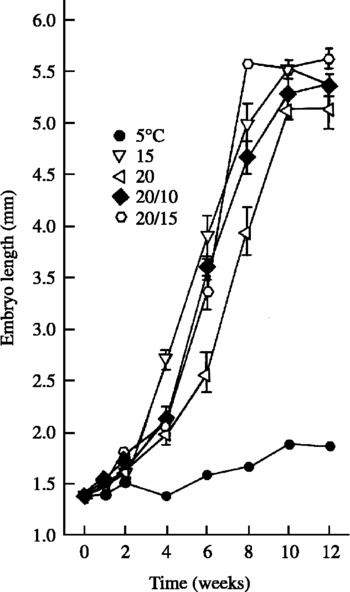
Mean ( ± SE) embryo length at the beginning of the study was 1.40 ± 0.07 mm, and it was 5.60 ± 0.20 mm in seeds that had a split endocarp. Thus, mean embryo length increased 300% prior to time of radicle emergence. After about 4 weeks, embryos grew rapidly at all temperatures except 5°C, where embryo length had increased only 35% after 12 weeks (Fig. 1). At all temperatures except 5°C, embryo length had increased ≥ 257% by week 8 or 10. After 12 weeks' incubation at 10°C, mean embryo length was 3.98 ± 1.50 mm.
Embryo length (mean ± SE, if ≥ 0.1 mm) of Viburnum odoratissimum seeds (2005 collection) incubated in light at five temperatures.

Radicle emergence
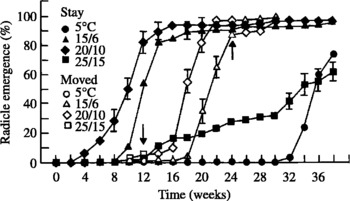
For the 2004 seeds initially placed at 5, 15/6, 20/10 and 25/15°C, the optimum temperature for radicle emergence was 20/10°C, with germination reaching 50% in 10 weeks (Fig. 2). Although seeds at 15/6°C were slower to germinate than those at 20/10°C, germination was 83% at 20/10 and 15/6°C after 10 and 12 weeks, respectively. Germination at 25/15 and 5°C was very slow and did not reach 20% until 20 and 34 weeks, respectively. Incubating seeds at simulated summer (25/15°C) and then autumn temperatures, or at simulated winter (5°C) and then spring temperatures, increased the time to 50% germination (radicle emergence) to about 18 and 21 weeks, respectively; seeds in both sequences had germinated to 98% by 30 weeks.
Percent (mean ± SE, if ≥ 5%) of radicle emergence of Viburnum odoratissimum seeds (2004 collection) incubated in light at four temperatures. Stay = seeds incubated continuously at a given temperature; Moved = seeds were moved from 25/15 to 20/10 to 15/6°C, or from 5 to 15/6 to 20/10°C; ↓ = time when seeds were moved from 25/15 to 20/10°C, or from 5 to 15/6°C; ↑ = time when seeds were moved from 20/10 to 15/6°C, or from 15/6 to 20/10°C.

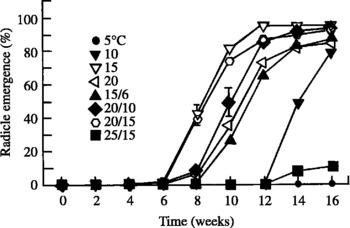
The optimum temperatures for radicle emergence for 2005 seeds were 15 and 20/15°C (Fig. 3). However, by 12 weeks, seeds at 15, 20, 20/10 and 20/15°C had germinated to ≥ 70%; those at 10°C reached 70% between weeks 14 and 16.
Percent (mean ± SE, if ≥ 5%) of radicle emergence of Viburnum odoratissimum seeds (2005 collection) incubated in light at eight temperatures.

Cotyledon emergence
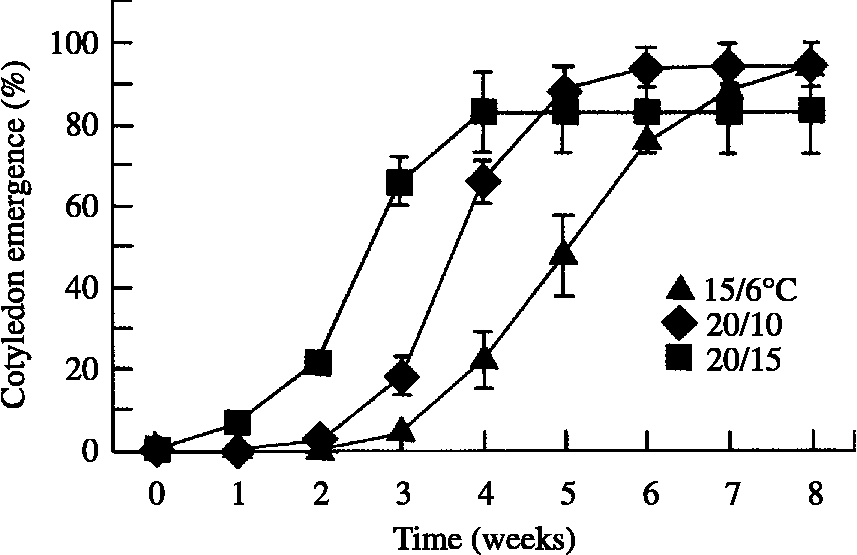
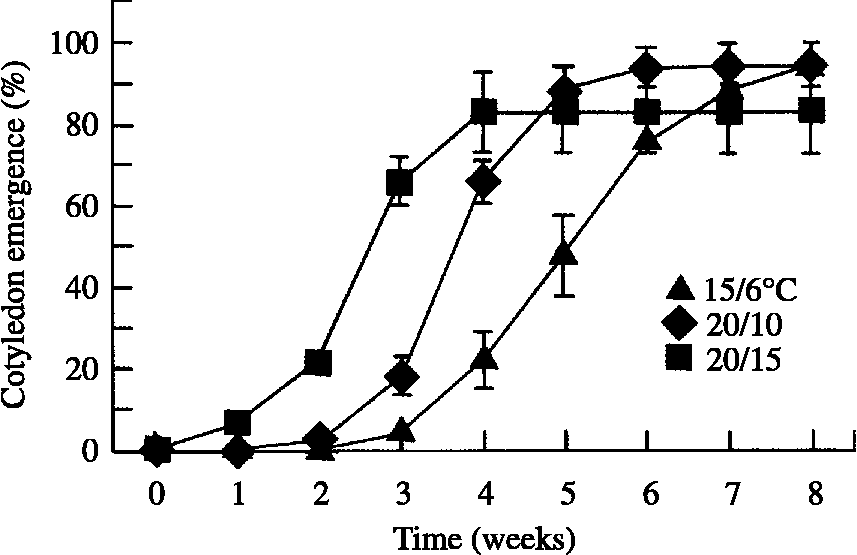
The optimum temperature for emergence rate (speed) of cotyledons was 25/15°C, but cotyledons emerged in only 83% of the seeds; the other seeds died (Fig. 4). At 20/10 and 15/6°C, 94% of the seeds had emerged cotyledons after 8 weeks. The time required for 20% cotyledon emergence was 2, 3 and 4 weeks for seeds at 25/15, 20/10 and 15/6°C, respectively, and time for 50% emergence was about 2.5, 3.5 and 5 weeks, respectively.
Percent (mean ± SE, if ≥ 5%) of cotyledon emergence of Viburnum odoratissimum seeds (2005 collection) with an emerged radicle incubated in light at three temperatures.
Discussion
The embryo in seeds of V. odoratissimum is underdeveloped, i.e. morphologically dormant, and it must grow before the radicle emerges. Data from rates of embryo growth and of germination indicate that embryos of V. odoratissimum also have some PD. Generally, if embryos have only morphological dormancy, growth is completed in a relatively short period of time, and seeds germinate in about 30 d or less (Baskin and Baskin, Reference Baskin and Baskin2004). However, embryos in V. odoratissimum seeds required 8–10 weeks for growth to be completed. In fact, 4–6 weeks were required for embryos in seeds incubated at 15, 20, 20/10 and 25/15°C to double (i.e. reach 3.0 mm) in length. Also, although embryo growth was completed at 8 weeks in seeds incubated at 20/15°C, germination was still occurring at this temperature regime when the study ended at week 16, indicating that both embryo growth and breaking of PD are required for radicle emergence. Thus, seeds of V. odoratissimum have MPD. Embryos did not grow at 5°C, but they grew in seeds incubated at 10, 15, 20, 20/10 and 20/15°C, indicating that dormancy in seeds of this species fits Nikolaeva's (Reference Nikolaeva and Khan1977) simple, rather than complex, kinds of MPD. In the simple kinds of MPD, embryos grow at relatively high temperatures ( ≥ 10°C), while in the complex kinds of MPD, embryos grow during cold stratification.
The delays in beginning of embryo growth and of radicle emergence in some seeds after embryos are fully elongated, as seen in V. odoratissimum, also occur in seeds of V. acerifolium (Hidayati et al., Reference Hidayati, Baskin and Baskin2005). However, the delay in embryo growth is longer in seeds of V. acerifolium (8 weeks) than in those of V. odoratissimum (2–3 weeks), and delay from the time of full embryo growth until all seeds have an emerged radicle is also longer in seeds of V. acerifolium (12 weeks) than in those of V. odoratissimum (4 weeks). Thus, in seeds of both species, it appears that warm stratification may release some of the PD and then the embryo grows. However, additional warm stratification may be required to break some remaining PD and promote radicle emergence.
Since seeds of V. odoratissimum have MPD, and requirements for embryo growth correspond to the general category of simple MPD, the question is: what level of simple MPD do the seeds have? The known levels of simple MPD are non-deep, intermediate, deep, deep epicotyl and deep double. In non-deep, simple MPD, embryos grow after PD is broken during exposure to warm or cold stratification, depending on the species; and after the embryo is elongated, both the radicle and shoot emerge immediately. In intermediate and deep simple MPD, part of the PD of the embryo is broken during warm stratification in summer, and the embryo grows within the seed in autumn. However, seeds do not germinate until they have received several months of cold stratification during winter, which breaks the remainder of the PD, and in spring both the radicle and epicotyl emerge. GA3 will substitute for cold stratification in seeds with intermediate simple MPD, but not in those with deep simple MPD. In deep simple epicotyl MPD, warm stratification breaks part of the PD (presumably of the radicle), and embryo growth and radicle emergence occur in autumn. Cold stratification of the seeds with an emergent radicle is required to break PD of the epicotyl; thus epicotyls emerge in spring. In deep simple double MPD, cold stratification breaks part of the PD (presumably of the radicle), and embryo growth and radicle emergence occur in spring. During the following winter, PD of the epicotyl is broken by cold stratification, and the epicotyl emerges the second spring (Nikolaeva, Reference Nikolaeva and Khan1977; Baskin and Baskin, Reference Baskin and Baskin1998).
We conclude that seeds of V. odoratissimum have epicotyl MPD. However, the kind of epicotyl MPD in seeds of this species does not match the ‘classical’ deep simple, epicotyl MPD (the only kind of epicotyl dormancy in the Nikolaeva seed dormancy classification scheme) found in seeds of species such as V. acerifolium, V. dentatum and V. dilatatum studied by Giersbach (Reference Giersbach1937), which required 2.5, 0.5 and 3.0 months, respectively, of cold stratification (of seeds with emerged radicle) to break dormancy of the epicotyl. In seeds of V. odoratissimum with an emerged radicle, there is a delay of one to several weeks between radicle and epicotyl emergence, depending on incubation temperature. Further, epicotyls emerged at 15/6, 20/10 and 25/15°C from the seeds with emerged radicles without being given a cold stratification treatment. If epicotyls of V. odoratissimum have PD, what kind is it: non-deep, intermediate or deep? Non-deep PD can be broken by exposing seeds to relatively short periods of warm or cold stratification (sometimes by dry afterripening), depending on the species, and dormancy may be broken by GA3. Intermediate PD is broken by relatively long periods of cold stratification, and GA3 may promote germination. Deep PD usually is broken only by long periods of cold stratification, and GA3 does not promote germination (Nikolaeva, Reference Nikolaeva and Khan1977; Baskin and Baskin, Reference Baskin and Baskin1998). Thus, the level of PD in epicotyls of V. odoratissimum is non-deep, whereas the level of PD in epicotyls of species such as V. acerifolium, V. dentatum and V. dilatatum is deep.
In naming the kind of epicotyl dormancy in seeds such as those of V. acerifolium, V. dentatum and V. dilatatum, Nikolaeva (Reference Nikolaeva and Khan1977) was referring to the level of PD in the epicotyl only, and she described the seeds as having ‘deep simple epicotyl MPD’, B-C3e, i.e. underdeveloped embryo (B) with an epicotyl that has deep PD, C3e. Later on, Nikolaeva (Reference Nikolaeva2001) realized that the radicle, in addition to the epicotyl, had PD, C1bB(root)-C3(epicotyl), i.e. breaking of non-deep PD of the root and growth of underdeveloped embryo [C1bB(root)] at warm temperatures, and deep epicotyl dormancy [C3(epicotyl)] broken by a long period of cold stratification. However, in her seed dormancy classification schemes (Nikolaeva, Reference Nikolaeva and Khan1977, Reference Nikolaeva2001; Nikolaeva et al., Reference Nikolaeva, Rasumova, Gladkova and Danilova1985, Reference Nikolaeva, Lyanguzova and Pozdova1999; epicotyl dormancy was not included in the 1969 version of her scheme), she considered the epicotyl to be deeply dormant, i.e. always C3, indicating deep PD. Thus, the non-deep level of PD in epicotyls of V. odoratissimum seeds clearly does not fit her definition of deep simple epicotyl MPD. Instead, seeds of V. odoratissimum have non-deep simple epicotyl MPD, a level of MPD that Nikolaeva did not describe. In accordance with Nikolaeva's latest revision of her seed dormancy classification scheme (Nikolaeva, Reference Nikolaeva2001), the formula for epicotyl dormancy in V. odoratissimum would be C1bB(root)-C1b(epicotyl), i.e. a period of warm temperatures required for embryo growth and root emergence [C1bB(root)] followed by a period of warm temperatures to break epicotyl dormancy [C1b(epicotyl)].
From the description of dormancy in seeds of V. tinus provided by Karlsson et al. (Reference Karlsson, Hidayati, Walck and Milberg2005), we conclude that seeds of this species also have non-deep simple MPD. Further, Giersbach (Reference Giersbach1937) said that seeds of V. nudum and V. scabrellum did not have epicotyl dormancy. However, when she placed seeds of these two species with emerged radicles at 21°C, shoot emergence was delayed for 1 to 1.5 months. Thus, seeds of V. nudum and V. scabrellum also have non-deep simple epicotyl MPD. As noted previously, seeds of V. trilobum (Fedec and Knowles, Reference Fedec and Knowles1973) may have non-deep (or intermediate?) simple epicotyl MPD, but more research is required to be sure. However, it is now clear that the genus Viburnum has two levels of MPD: non-deep and deep simple, epicotyl MPD. In making a determination of the level of physiological dormancy in the epicotyl of seeds of Viburnum spp., it would be useful to have data on the response of epicotyls to GA3, as well as the temperature requirements and amount of time needed for dormancy of the epicotyl to be broken.