Introduction
Tonsillectomy is one of the most common operations performed by otolaryngologists. Post-tonsillectomy pain is still a frequent and frustrating problem that can affect analgesia consumption, duration of in-patient care, oral intake and return to regular activity.Reference Catlin and Grimes1–Reference Toma, Blanshard, Eynon-Lewis and Bridger3 Thus, relief of pain after tonsillectomy plays a major role in improving the child's post-operative quality of life.Reference Ozkose, Akcabay, Kemaloglu and Sezenler4
Surgical incision and other noxious peri-operative events may induce prolonged changes in central neural function and lead to a lasting exaggerated responsiveness to pain associated with a decreased pain threshold.Reference Katz, Kavanagh, Sandler, Nierenberg, Boylan and Friedlander5, Reference Woolf6 Pre-emptive analgesia is defined as ‘analgesic intervention provided before surgery to prevent or reduce subsequent pain’. It aims to block the development of hypersensitivity and hyperalgesia and thus decrease post-operative pain.Reference Ozkose, Akcabay, Kemaloglu and Sezenler4–Reference Giannoni, White, Enneking and Morey7 Pre-emptive analgesia for tonsillectomy may be performed either by infiltration of local anaesthesia into the peritonsillar region at the beginning of surgery, or by giving analgesic agents before surgery.Reference Kaygusuz and Susaman8–Reference Anderson, Kanagasundarum and Woollard11
We designed a double-blind, randomised, controlled, parallel-group, clinical study to determine the efficacy of a pre-emptive triple analgesia protocol (delivered during anaesthesia induction and comprising diclofenac, paracetamol and tramadol) in improving post-operative pain management for children undergoing day-case tonsillectomy with or without adenoidectomy. Specific outcomes of interest included length of stay, post-operative pain scores (both in the post-anaesthesia care unit and at home), and the quality and speed of recovery.
Materials and methods
Potential study candidates included all children scheduled for tonsillectomy between February 2009 and February 2011 at the otorhinolaryngology clinic, Mansoura University Hospital, and aged between 5 and 12 years. In all cases, the indication for tonsillectomy was recurrent or chronic tonsillitis.
The approval of the otolaryngology department research and ethics committee was obtained, and the parents of children presenting for tonsillectomy were given a full verbal and written explanation of the study.
One hundred and seventy children were assessed for eligibility. Nineteen did not enter the study due to exclusion criteria, and a further 16 refused to participate. The remaining 135 children were recruited into the study, with written parental consent. All participants were classified as American Society of Anesthesiologists physical status I or II, and were scheduled for elective tonsillectomy with or without adenoidectomy.
Exclusion criteria included American Society of Anesthesiologists status III or IV, any indication for post-operative admission, developmental delay, chronic illness, premature birth, history of affective disorder, use of psychotropic medication, and a body mass index of more than 25 kg/m2. These exclusion criteria were used to standardise the study population.
All children underwent dissection tonsillectomy under general anaesthesia, after local anaesthetic infiltration of the operative bed. Haemostasis was achieved by standard surgical procedures (i.e. bipolar diathermy or suture). All tonsillectomies and adenoidectomies were performed by the first author (AMAE-F).
Prior to surgery, patients were randomised into one of two groups. Children in the study group (n = 55) received pre-emptive triple analgesia in the form of rectal diclofenac 25 mg (approximately 2 mg/kg), intravenous (IV) paracetamol (15 mg/kg) and IV tramadol (2 mg/kg), administered over 15 minutes during the induction of general anaesthesia, immediately after IV cannula insertion and before the surgical incision; they also received local anaesthetic infiltration of the operative bed. Children in the control group (n = 80) received only local anaesthetic infiltration of the operative bed.
Randomisation was achieved using a random number table. The researchers responsible for assessing the children in the otorhinolaryngology department allocated the next available number to each child on entry into the trial. The random number table list and code were then given to an anaesthesiologist who was not involved in the patient's intravenous anaesthesia, care or data collection. This anaesthesiologist prepared all the anaesthetic solutions and adjuvant drugs. The randomisation code was revealed to the researchers once recruitment and data collection were complete. All the children and their parents were blinded to group assignment for the duration of the study.
The study tested the hypothesis that pre-emptive use of multimodal, triple analgesia (i.e. rectal diclofenac (a non-steroidal anti-inflammatory drug (NSAID)), IV paracetamol (acetaminophen) and IV tramadol (an opioid)) would: (1) provide better intra-operative pain control, reflected by haemodynamic parameters (i.e. heart rate and blood pressure); (2) provide better in-patient post-operative pain control, reflected by visual analogue scale pain scores and analgesia consumption; (3) have no significant side effects; and (4) provide better pain control and quality of life at home, reflected by better Parent's Postoperative Pain Measure scores.
Technique of anaesthesia
No premedication was used in any patient. After attachment of electrocardiogram electrodes and preoxygenation, 66 per cent nitrous oxide in 33 per cent oxygen was used via a facemask to facilitate insertion of an intravenous catheter. Anaesthesia was induced using IV propofol (3 mg/kg). Endotracheal intubation was performed with atracurium (0.5 mg/kg). Ventilation was controlled in all patients, with the end-tidal carbon dioxide level maintained between 30 and 40 mmHg. Intravenous fluid management included administration of lactated Ringer's solution. The fluid deficit was calculated to be replaced over 3 hours, and maintenance fluid was calculated according to the patient's body weight. Anaesthesia was maintained with nitrous oxide in oxygen (66/33 per cent) and 0.6–1.5 per cent isoflurane. At the end of surgery, all anaesthetics were discontinued and extubation was performed when spontaneous breathing was regarded as adequate. Residual neuromuscular blockade was antagonised with 0.05 mg/kg neostigmine and 0.02 mg/kg atropine. All of the anaesthetic procedure was performed and followed by the second author (ER).
Patients were observed for a minimum of 1 hour in the post-anaesthesia care unit. After that period, the surgeon examined the patient's throat for the presence of bleeding, and the patient was transferred to the day surgery unit. Children were observed for 4–6 hours in the day surgery unit during their recovery period. The criteria for discharge were: full waking consciousness, stable vital signs for at least 30 minutes, no bleeding, no signs of excessive pain, no vomiting and able to ambulate (appropriate to age).
Assessment of pain
A visual analogue scale was used to assess the children's pain during their in-hospital stay. This scale consisted of a horizontal line 100 mm in length with the text ‘0, no pain’ and ‘10, worst imaginable pain’ written on the left and right ends of the line, respectively. Children were familiarised with the scale pre-operatively, and after the operation indicated their pain level by pointing to the appropriate point on the scale. A trained nurse, who was blinded to the child's specific procedure, assessed and recorded each child's pain on arrival at the post-anaesthesia care unit (i.e. at 0 minutes) and then again at 15, 30, 45 and 60 minutes.
On discharge from hospital, parents were given packets containing validated assessment tools for post-operative pain and recovery. Parents were asked to complete a post-operative questionnaire on which they recorded their child's well-being (i.e. pain, use of analgesia, vomiting, tiredness and sleep) during the portion of the first 24 hours post-anaesthesia for which the child was at home. Parents were also asked to complete the Parent's Postoperative Pain Measure questionnaire daily; data from day 1 (i.e. the first day at home after the day of surgery) to day 3, and from days 7, 9, 10 and 14, were recorded as part of the study. A pain score of more than 6 was taken to indicate significant pain. For pain management, parents were instructed to administer rescue analgesia in the form of rectal or oral diclofenac when needed.
Other parameters
In addition to pain assessment, data were recorded for each child in each study group regarding duration of anaesthesia (i.e. the period from induction of anaesthesia to extubation), awakening time (i.e. the period from extubation to eye opening in response to a command) and changes in haemodynamic parameters (i.e. heart rate and mean arterial pressure). Any side effects, post-operative nausea and vomiting, and indications of intra-operative recall were also noted.
Haemodynamic parameters were continuously monitored. Baseline recordings of heart rate and mean arterial pressure were made following induction but prior to administration of analgesia, and also at the l0th, 20th and 30th minute of surgery, and at the 30th minute in the post-anaesthesia care unit. Haemodynamic parameters were statistically analysed to detect differences between the two patient groups.
Statistical analysis
All statistical analyses were performed using the SPSS for Windows software program (version 16; SPSS Ltd, Chicago, Illinois, USA). Data are shown as means (standard deviation (SD)) and medians (minimum–maximum) for continuous variables and as frequencies (percentages) for categorical variables. Means were compared using the Mann–Whitney U test. The Bonferroni correction was applied to all possible comparisons. Categorical variables were compared using chi-square analysis or Fisher's exact test as appropriate. A p value of less than 0.05 was considered statistically significant.
Results and analysis
Descriptive data and haemodynamic parameters
One hundred and thirty-five children (and their parents) were enrolled in the study. The study group included 55 children aged 5 to 12 years (mean, 6.08 years; SD, 1.86 years), 30 boys and 25 girls. The control group included 80 children aged 5 to 11 years (mean, 6.31 years; SD, 1.92 years), 45 boys and 35 girls. There were no significant differences regarding sex, age or weight between the two groups.
There were no complications related to anaesthesia or operative procedure, apart from delayed recovery from anaesthesia (for a period of 10–15 minutes) in four cases (one in the study group and three in the control group).
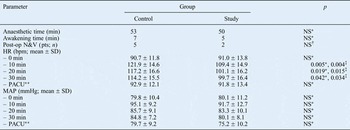
Data on haemodynamic parameters, anaesthesia duration, awakening time, and post-operative nausea and vomiting are presented in Table I.
Anaesthesia data

*Independent sample t-test; †chi-square test; ‡post-hoc analysis using Tukey's Honestly Significant Difference test. **In post-anaesthesia care unit (PACU) at 30 minutes. Min = minutes; NS = not significant; Post-op N&V = post-operative nausea and vomiting; pts = patients; HR = heart rate; bpm = beats per minute; SD = standard deviation; MAP = mean arterial pressure
Heart rate and mean arterial pressure were within the normal range in both groups throughout the operative period. Baseline values for heart rate and mean arterial pressure were not significantly different between groups. During the operation, heart rate values tended to be higher in the control group than the study group, and this difference was statistically significant (p = 0.005). On post hoc analysis, the difference was found to be significant between the control and study groups at the 10th, 20th and 30th minutes of surgery (p = 0.004). Mean arterial pressure values also tended to be higher in the control group than the study group, but this difference was not statistically significant. In the post-anaesthesia care unit (30 minutes after surgery), there were no significant differences between the two groups regarding either heart rate or mean arterial pressure.
We observed no significant differences between the two groups regarding post-operative nausea and vomiting. We did not encounter any cases with respiratory depression or peri-operative recall in this study. None of the children had any post-operative complications (e.g. bleeding) or needed hospital readmission or a second course of antibiotics.
Pain and analgesia in hospital
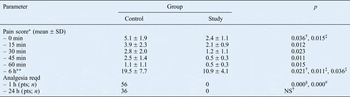
Mean in-patient visual analogue scale pain scores and post-operative analgesia requirements are shown in Table II. None of the children in the study group required analgesia during their in-patient stay, either in the post-anaesthesia care unit or after being transferred to the day surgery unit. On the other hand, 56 of the 80 control group cases (70 per cent) required rescue analgesia in the post-anaesthesia care unit, in the form of IV paracetamol (p < 0.001), while 36 of these 80 (45 per cent) required analgesia in the day surgery unit, in the form of rectal diclofenac.
Post-operative pain and analgesia data

*Visual analogue scale. †Kruskal–Wallis test; ‡Bonferroni adjusted Mann–Whitney U test; §chi-square test; #Fisher's exact test. **Mean score for 6th post-operative hour. SD = standard deviation; min = minutes; h = hours; reqd = required; pts = patients; NS = not significant
Upon awakening from surgery (i.e. at 0 minutes), the control group children had significantly higher mean visual analogue scale pain scores than the study group children (p = 0.036, Kruskal–Wallis test; p = 0.015, Bonferroni adjusted Mann–Whitney U test) (Table II). At 6 hours post-surgery, the mean visual analogue scale pain score was also significantly higher in the control group than the study group (p < 0.05).
There was no significant difference between the two groups regarding the starting time for oral intake. However, the parents' questionnaire indicated a significant difference between the two groups (p = 0.005) as regards children's well-being (i.e. drinking ability, tiredness, bad temper and quality of sleep) in the portion of the first 24 hours post-anaesthesia for which the child was at home.
Pain and analgesia at home
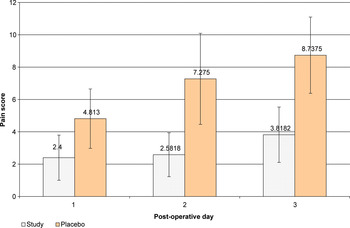
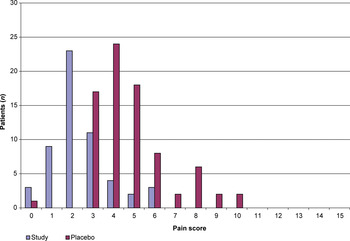
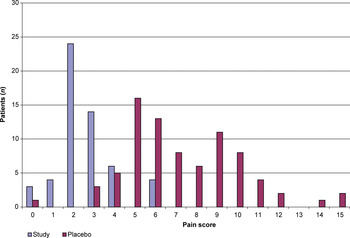
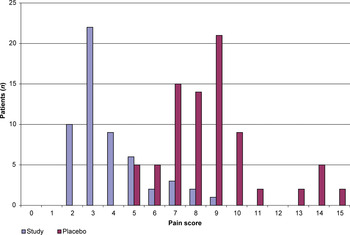
In the study group children, at-home pain scores from the Parent's Postoperative Pain Measure questionnaire (Figures 1 to 4) indicated that the following proportions suffered significant pain: 5.5 per cent on day 1 (mean score, 2.4; range, 0–6), 7.3 per cent on day 2 (mean score, 2.6; range, 0–6) and 14.5 per cent on day 3 (mean score, 3.8; range, 2–9). Rescue analgesia was reported to be required for only 8 of the 55 (18 per cent) study group children, with an average of 1 to 3 doses needed over the first 3 post-operative days at home.
Mean Parent's Postoperative Pain Measure pain scores for post-operative days 1, 2 and 3 at home. Whiskers show standard deviations.

Distribution of Parent's Postoperative Pain Measure pain scores on day 1.

Distribution of Parent's Postoperative Pain Measure pain scores on day 2.

Distribution of Parent's Postoperative Pain Measure pain scores on day 3.

The at-home pain scores of control group children were significantly higher over the first 3 post-operative days, compared with the study group (p = 0.000). The proportion of these children suffering significant pain was 25 per cent on day 1 (mean score, 4.8; range, 0–10), 68.8 per cent on day 2 (mean score, 7.3; range, 0–15) and 93.8 per cent on day 3 (mean score, 9.3; range, 5–15). Accordingly, more frequent doses of rescue analgesia were needed: parents reported an average usage of 1 to 3 doses per day, throughout the first 3 at-home days, in 76 of the 80 control group children (95 per cent).
Based on the Parent's Postoperative Pain Measure results, none of the study group children were rated as suffering significant pain (i.e. a score of more than 6) from post-operative day 7 onwards, and on average suffered no pain (i.e. a score of 0) from post-operative day 9 or 10 onwards, with complete return to routine daily activity.
In contrast, 47.5 per cent of the control group children were rated as suffering significant pain on post-operative day 7, which continued up to day 10 in 7 children (8.75 per cent). Resolution of pain and resumption of normal daily activity were delayed in this group, being seen between post-operative days 10 and 14.
None of the assessed baseline or demographic variables was significantly associated with pain severity.
Discussion
Patients' post-operative comfort is affected by both the efficacy and the timing of analgesia. The Cochrane Database of Systematic Reviews has identified 131 previous studies of pre-emptive anaesthesia (in adults and children) that suggest that administering analgesia during surgery results in less post-operative pain in the early stages of recovery. Different authors have described pre-emptive analgesia using a variety of drugs administered at various times, including before and during anaesthesia induction and during surgery.Reference Ali, Shahrbano and Ulhag12, Reference Wnek, Zajaczkowska, Wordliczek, Dobrogowski and Korbut13 Multimodal analgesia is currently recommended for effective post-operative pain control, using a combination of different analgesics that act via different mechanisms (e.g. opioids, NSAIDs, paracetamol and local anaesthetics), enabling additive or synergistic analgesia which requires lower total doses of analgesia and produces fewer side effects.Reference Michaloliakou, Chung and Sharma14–Reference Jin and Chung16
During the first 3 days after tonsillectomy surgery, 60–70 per cent of children suffer pain exceeding 30 on a visual analogue scale of 0–100, and many patients are still suffering pain 7 days after the operation.Reference Hultcrantz, Linder and Markström17, Reference Salonen, Kokki and Nuutinen18
Non-steroidal anti-inflammatory drugs are effective in reducing post-operative pain, and also lower the risk of post-operative nausea and vomiting. However, they also introduce the possibility of increased bleeding due to their antiplatelet effect.Reference Lundeberg and Lönnqvist19
Opioids provide satisfactory analgesia and better emergence in children undergoing ENT surgery; however, prolonged sedation due to opioid use is a noted cause of discharge delay following day-case surgery.Reference Viitanen and Annila20 The efficacy of tramadol in relieving post-tonsillectomy pain has been well documented.Reference Engelhardt, Steel, Johnston and Veitch21 Due to its negligible effect on respiration, tramadol may be preferable to traditional opioids; however, side effects such as post-operative nausea and vomiting do occur.Reference Lundeberg and Lönnqvist19
These side effects are avoided with the use of paracetamol, a non-opioid analgesic. The analgesic action of paracetamol is assumed to be mediated by a serotonergic mechanism, while its antipyretic action occurs via inhibition of cyclo-oxygenase-3 in the hypothalamus.Reference Pickering, Loriot, Libert, Eschalier, Beaune and Dubray22 Paracetamol also has little antiplatelet activity and does not affect bleeding time, unlike NSAIDs.Reference Graham and Scott23 Although enteral formulations of paracetamol are the most commonly used analgesics for management of pain in children, their analgesic efficacy is weak after ENT surgery.Reference Pappas, Fluder, Creech, Hotaling and Park24 An intravenous formulation of paracetamol has recently become available, which achieves the target plasma concentration more rapidly with reduced variability, compared with rectal and oral formulations.Reference Wurthwein, Koling, Reich, Hempel, Schulze-Westhoff and Pinheiro25
In the current study, children receiving pre-emptive, multimodal analgesia had significantly better intra-operative and early post-operative analgesia, compared with the control group. There was also a significant difference between the two groups regarding late post-operative pain, analgesia consumption and comfort with oral intake: these parameters tended to be better in the study group than the control group. In addition, study group children had significantly lower intra-operative heart rate values, and a non-significant trend towards lower mean arterial pressure, compared with control group children; these results indicate that the pre-emptive triple analgesia protocol was better for intra-operative analgesia, compared with the control analgesia protocol.
Vomiting has been reported to occur in 40 to 65 per cent of children after tonsillectomy, due to swallowed blood and oropharyngeal irritation.Reference Ang, Habre and Sims26, Reference Panarese, Clarke and Yardley27 In addition, the use of tracheal intubation, opioids and nitrous oxide have all been thought to increase the incidence of post-operative nausea and vomiting.Reference Ewah, Robb and Raw28 Furthermore, the administration of tramadol for post-operative analgesia may exacerbate post-operative nausea and vomiting.Reference Pang, Mok, Huang, Hung and Huang29 Our study found a lower incidence of post-operative nausea and vomiting, compared with previous reports; this may be due in part to the anaesthetic regimen used. This difference may also be influenced by our intra-operative administration of tramadol as an IV infusion over 15 minutes; this is known to reduce the incidence of post-operative nausea and vomiting compared with post-operative administration.Reference Pang, Mok, Huang, Hung and Huang29 A similar result was reported by Uysal et al. following their study of the efficacy of intravenous paracetamol versus tramadol for post-operative analgesia after paediatric adenotonsillectomy.Reference Uysal, Takmaz, Yaman, Baltaci and Başar30
In our study, the amount of post-operative, in-hospital pain was assessed using visual analogue scale pain scores and post-operative analgesic requirements. We noted that no child in the study group required analgesia during their in-hospital stay (whether in the post-anaesthesia care unit or in the day surgery unit), while 70 per cent of the control group children required rescue analgesia in the post-anaesthesia care unit and 45 per cent required analgesia in the day surgery unit. We also found a statistically significant difference in pain score between the study and control groups, from 0 minutes up to 6 hours post-surgery. Although there was no significant difference between the two groups concerning the timing of first oral intake, results from the parents' questionnaire indicated a significant difference in children's general well-being at home within the first 24 hours after anaesthesia. These results indicate that children who received pre-emptive triple analgesia suffered less pain in the early post-operative period, compared with control group children.
In our control group, results for post-operative pain at home were consistent with previously published findings.Reference Swallow, Briggs and Semple31–Reference Fortier, MacLaren, Martin, Perret-Karimi and Kain33 In their study of pain after paediatric ambulatory surgery, Fortiere et al. reported that children experienced moderate or severe pain that lasted up to two weeks.Reference Fortier, MacLaren, Martin, Perret-Karimi and Kain33 These children's pain peaked at day 2, but most continued to report significant pain throughout day 3, and close to 50 per cent continued to report significant pain one week after surgery. In our study, 68.8 per cent of the control group children suffered significant pain on day 2, with a mean Parent's Postoperative Pain Measure pain score of 7.3; this proportion increased to 93.8 per cent on day 3, with a mean pain score of 9.3. Consequently, more post-operative pain medication was needed: 95 per cent of control group children required an average of one to three analgesia doses per day. In contrast, significant pain was reported in 7.3 per cent of study group children on day 2 (mean pain score, 2.6) and in 14.5 per cent on day 3 (mean pain score, 3.8). Only 18 per cent (8 of 55) study group children required pain medication at home; those who did needed an average of 1 to 3 doses over the first 3 post-operative days.
• This study assessed pre-emptive triple analgesia for paediatric tonsillectomy pain
• Pain was assessed by a visual analogue scale (in hospital) and a parental questionnaire (at home)
• Pain on awakening and 6 hours post-surgery was significantly less, versus controls
• None of the study group required post-operative analgesia in hospital
• At home, significantly fewer children had substantial pain, and pain scores were lower, versus controls
To our knowledge, ours is the first study to use a pre-emptive, multimodal analgesia protocol (i.e. paracetamol, tramadol and diclofenac) for pain relief following paediatric tonsillectomy. This protocol enabled better post-operative pain management and general well-being.
Conclusion
The use of a pre-emptive, multimodal, triple analgesia protocol (i.e. diclofenac, paracetamol and tramadol) for paediatric tonsillectomy with or without adenoidectomy provided good intra-operative analgesia and reduced post-operative pain (and analgesia requirements) both in hospital and at home. The protocol also enabled better post-operative well-being in this group of patients.