Introduction
Rice (Oryza sativa L.) is an important food crop grown in 114 countries across the world, growing on 160 million hectares, constituting nearly 11% of the world's cultivated land (Pathak et al., Reference Pathak, Samal, Shaid, Pathak, Nayak, Jena, Singh, Samal and Sharma2018). It is the primary food for most of the Asians and over 90% of the world rice is produced and consumed in Asia (Saha and Rao, Reference Saha and Rao2010). In India rice is cultivated in about 43.5 million ha with an annual production of about 115 million ton of rice which contributes 40% of the total food grain of the country. However, the area under rice is declining and the yield is showing stagnancy during the last few decades. Therefore, a suitable technological intervention is required to increase rice production in a sustainable way to meet the required demand.
Ratoon rice, the production of a second rice crop from the stubble after the harvest of the main crop, is considered a green and resource-efficient rice production system (Wang et al., Reference Wang, He, Jiang, Sun, Jiang, Man, Ling, Cui, Huang, Peng and Nie2020). Because of its short growth period, it fits well in rainfed systems (Negalur et al., Reference Negalur, Yadahalli, Chittapur and Guruprasad2017). The advantages of rice ratooning are higher resource use efficiency, low production cost (Dustin et al., Reference Dustin, Bond and Blanche2009), higher water productivity (Oad et al., Reference Oad, Samo, Cruz and Oad2002) and environmental friendliness (Firouzi et al., Reference Firouzi, Nikkhah and Aminpanah2018). However, the potential yield of the ratoon crop can only be achieved by adopting appropriate management practices viz., land preparation, optimum plant density, use of right cultivars, appropriate fertilization (Begum et al., Reference Begum, Hassan, Hossain and Hossaim2002; Islam et al., Reference Islam, Hasanuzzaman and Rokonuzzaman2008; Ali et al., Reference Ali, Ebrahim, Hamid, Moral and Hamid2011), water management, the appropriate height of cutting (Begum et al., Reference Begum, Hassan, Hossain and Hossaim2002; Ali et al., Reference Ali, Ebrahim, Hamid, Moral and Hamid2011) and control of diseases, insects and weeds (Santos et al., Reference Santos, Fageria and Prabhu2003) both in the main as well as ratoon crops.
Rice is grown in three distinct seasons i.e, autumn, winter and summer in the Indian State of Assam. During the harvesting of summer rice at the end of May, sufficient soil moisture is available in the crop field because of good pre-monsoon rainfalls that favours ratooning of summer rice. Rice varieties like ‘Naveen’ have a good ratooning capacity which gives an additional yield advantage apart from the yield obtained from the main crop (Singh et al., Reference Singh, Satapathy and Pun2019). However, weed infestation is one of the major constrains in the success of a good ratoon crop. Keeping all this in mind, the present investigation was carried out (i) to evaluate the influence of different weed control practices on growth and yield of rice main crop and subsequent ratoon crop in Lower Brahmaputra valley zone of Assam and (ii) to study the influence of different weed control practices on nutrient use efficiency and energy use efficiency of the main crop and rice-ratoon rice system as a whole.
Materials and methods
Experimental details
A field experiment was conducted during the summer season of 2014–15 and 2015–16 at Regional Rainfed Lowland Rice Research Institute, Gerua, Assam which is located at 26°14′59″N latitude, 90°33′44″E longitude and at an altitude of 49 m above sea level. The average maximum and minimum temperature (mean of two years) during the crop growth period (last week of December to the first week of June) varied from 23.8 to 35.2°C and 8.3 to 19.1°C respectively. The main crop received about 789 mm (mean of two years) of pre-monsoon rainfall (March–May) and the ratoon crop received 473 mm (mean of two years) of monsoon rainfall (June–September). The experimental field was sandy clay loam in texture (sand 65%, clay 12.5% and silt 22.5%), having pH 5.4, organic carbon 0.95%, and medium in available nitrogen (260 kg/ha), phosphorus (16.8 kg/ha) and potassium (220.8 kg/ha).
The experiment was conducted with 10 weed control treatments in a randomized block design (RBD) and replicated thrice. All the plots having size 6.0 × 4.8 m demarcated by ridges on (20 cm high) all sides. Adequate numbers of irrigation and drainage channels were also constructed to provide irrigation independently to each plot. The treatments consisted of T1: azimsulfuron (35 g/ha) at 20 DAS, T2: flucetosulfuron (25 g/ha) at 20 DAS, T3: bispyribac sodium (30 g/ha) at 20 DAS, T4: bensulfuron-methyl + pretilachlor (60 + 600 g/ha) at 10 DAS, T5: azimsulfuron + bispyribac sodium (22 + 25 g/ha) at 20 DAS, T6: flucetosulfuron (25 g/ha) at 5 DAS followed by bispyribac sodium (25 g/ha) at 20 DAS, T7: manual weeding twice (20 and 40 DAS), T8: mechanical weeding by paddy weeder at 20 DAS followed by manual weeding at 40 DAS, T9: weed-free check (repeatedly manual weeding at 15, 30, 45 and 60 DAS) and T10: weedy check.
Pre-germinated seeds of rice variety ‘Naveen’ were sown by using ‘12 row’ drum seeder at 20 × 10 cm on puddled saturated soil during last week of December in both of the year of experimentation. A fertilizer dose of 80–40–40 kg N–P–K/ha was applied in 3 split doses to the main crop only. Weed control treatments were imposed on the main crop as per the schedule of treatments. The main crop was harvested at physiological maturity leaving 30 cm of stubble height during the first week of May during both the year of the experiment. Due to regular pre-monsoon rainfall (March to May), there was sufficient soil moisture in the rice field at the time of harvest of the main crop. Available soil moisture and temperature regime were ideal for the regeneration of tillers from the basal buds of the stubbles of the main crop. Residual soil moisture and the subsequent monsoon rainfall were sufficient to support the growth and development of ratoon rice. No fertilizer and weed management practice was followed for ratoon rice. The ratoon crop was harvested at maturity during the last week of June in both years of the experiment.
Observations on weeds
Weeds in the weedy check plots were identified and grouped into grasses, broad-leaved and sedge weeds at 45 DAS of the main crop and 7 days after harvesting of the main crop for ratoon rice. The density of weeds was recorded by placing the quadrat of 50 × 50 cm (0.25 m2) randomly at five places in the sampling area of each plot. Counting of grasses, broad-leaved weeds and sedges were taken separately, and total weed density (number of weeds/m2) was computed at 45 and 60 DAS of the main crop and 7 days after harvesting of the main crop for ratoon rice. The values were converted to express the density in the number of weeds/m2. Weeds present inside the above quadrat were uprooted and the roots were detached from the samples and the aerial parts of weeds were cleaned thoroughly by washing in water, kept in sunlight for few hours and finally dried in a hot air oven at 70°C for 72 h or more till constant weights were recorded. Samples were kept in desiccators for cooling in dehumidified conditions and their biomass was recorded with an electronic balance. Weed biomass was then converted and expressed in g/m2.
Weed control efficiency (WCE) was calculated by using the following formula and expressed in percentage (Mishra and Mishra, Reference Mishra and Mishra1997).

where WCE = Weed control efficiency (%), WDMC = Weed dry weight (aerial parts) in weedy check plot, and WDMT = Weed dry weight (aerial parts) in the treated plot.
Visual toxicity on crop
Based on visual toxicity symptoms like yellowing, chlorosis and stunting of plant growth an average estimation of visual toxicity on rice crop was done by using a 0–10 point scale where 0 = no toxicity and 10 = complete kill, discolouration, stunting etc. (Frans and Talbert, Reference Frans, Talbert and Truelove1977) at 7, 14 and 21 days after application of herbicide to different plots.
Yield and yield attributes
Rice was harvested manually and yield and yield attributes were recorded in each plot for both the main and ratoon crop. Quadrat of 50 × 30 cm (0.15 m2) placed randomly at five places in each plot, leaving border rows and central most area of 6.0 m2 undisturbed and observations on various characters, such as tiller count, plant height etc. were measured from the plants within these units. The plant height was computed by measuring the actual distance from the base of the stem at the soil surface to the tip of the tallest panicle at maturity. The average height was calculated from the observations taken on twelve hills selected at random in each plot. Days to 50% flowering and days to maturity were recorded for the main crop as well as for the ratoon crop. Harvesting was done manually from the central 6.0 m2 area earmarked for recording yield data. The harvested produce was taken to the farm floor for threshing, cleaning, drying and grain yield data was recorded at 14% moisture level.
Uptake of NPK and determination of partial factor productivity
The grain and straw samples, which were collected at the time of harvesting, were dried separately to constant weight in a hot air oven at 70°C for 72 h, ground into a fine powder using Wiley mill and used for chemical analysis. Total N, P and K content of grain and straw samples were estimated by standard procedure (Nayak et al., Reference Nayak, Bhattacharya, Shahid, Tripathi, Lal, Gautam, Mohanty, Kumar and Chatterjee2016). The N, P and K uptake by the rice grain and straw were worked out as the product of the content of these nutrients and the dry weight of rice grain and straw and expressed in kg/ha.
Economics
The cost of cultivation of different treatments was computed by taking the cost of all inputs as per price of the items in the local market (Supplementary Table 1). The gross monetary return was computed by summing up the value of economic produce (grain) and by-product (straw) based on minimum support price (MSP) and local market price, respectively (Supplementary Table 1). The net monetary return was calculated by subtracting the total cost of cultivation from the gross monetary return. The benefit to cost ratio (B:C ratio) was computed by dividing gross return with the cost of cultivation.
Calculation of productivity and system productivity
The productivity of the main rice crop and the ratoon rice crop was computed separately by dividing grain yield (kg/ha) by crop duration (days) and expressed as kg/ha/day. Similarly, system productivity was calculated by dividing rice-ratoon rice system yield (grain yield of main crop + grain yield of ratoon rice by total crop duration of rice-ratoon rice sequence).
Calculation of energetic
The energy value of rice main crop, ratoon rice and the rice-ratoon rice system was determined based on energy inputs and energy production for the individual crops in the system. Standard conversion coefficients as mentioned in Supplementary Table 2 were used to convert physical to energy units. Different energy indices for the rice-ratoon rice cropping system were computed by using the standard equations.


Statistical analysis
Weed data having zero value for density and biomass were subjected to square root transformation [√(x + 0.5)] before statistical analysis to normalize their distribution. The original data have been given in parentheses in each table along with the transformed values.
The data were analysed statistically for RBD with 3 replications following the analysis of variance (ANOVA) using online SAS (Version 9.3). The analysis of data (2 years' average as year × treatment interaction is non-significant) were performed for yield, yield attributes, productivity, economics and nutrient uptake. Before that, Levene's Test for homogeneity of variances was done (Kumar et al., Reference Kumar, Chatterjee, Deka, Kumar, Kuotsu, Ao and Ngachan2016). In all the cases, ‘P-value’ greater than 0.05 indicated that the variability in the two years of studies were not significantly different. Therefore, the mean value of the data of two different years were taken for ANOVA. The significance of treatments was tested by ‘F’ test (variance ratio) at 5% level of significance. The differences in the treatment means were tested using Duncan's Multiple Range Test (DMRT) at 5% level of probability (Gomez and Gomez, Reference Gomez and Gomez2010).
Results
Composition of weed flora, weed density, biomass and weed control efficiency
The main rice crop was infested with 14 species of weeds belonging to eight families in weedy check plots. Among the different categories of weeds, the relative density of sedges was highest (71.5%) followed by grasses (15.1%) and broad-leaved weeds (13.4%) (Supplementary Table 3). Cyperus difformis was the most dominant weed species followed by Scirpus juncoides. Other dominant weed species were Echinochloa glabrescens and Leptochloa chinensis (grasses), and Lindernia anagallis and Monochoria vaginalis (broad-leaved weeds). Whereas in succeeding ratoon rice, the relative density of broad-leaved weeds was highest (67.8%) followed by grasses (24.7%) (Supplementary Table 4). Among the broad-leaved weeds Ludwigia adscendes and M. vaginalis were dominant in ratoon rice.
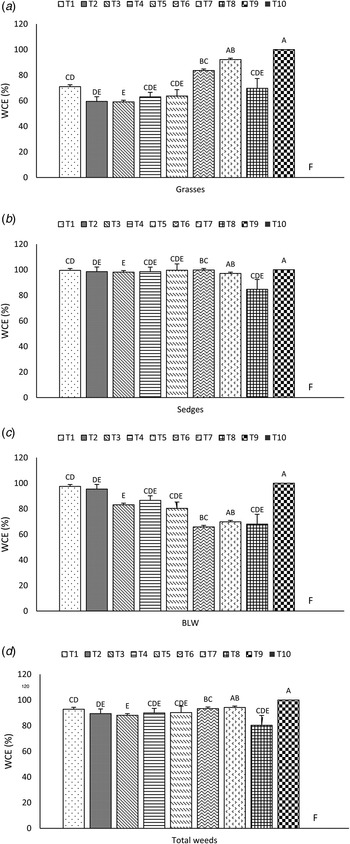
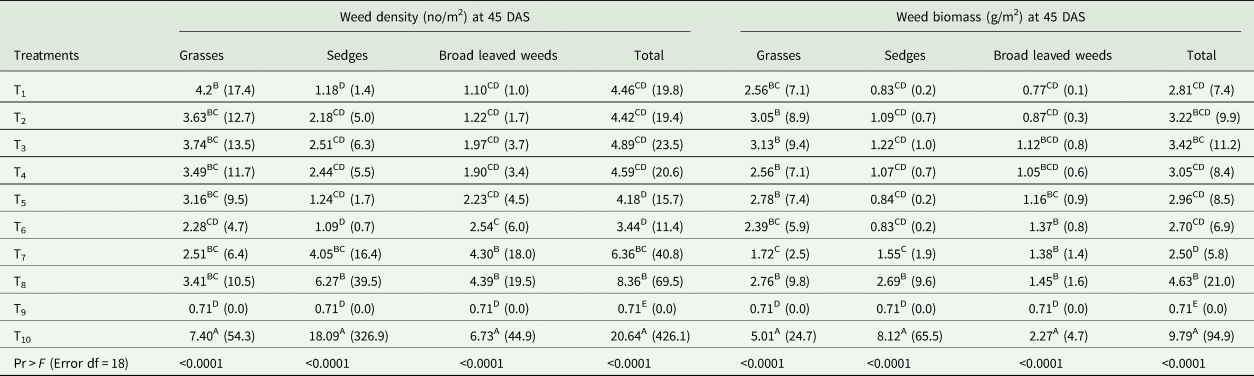
The highest weed density of grasses (54.3 m−2), sedges (326.9 m−2) and broad-leaved weeds (44.9 m−2) were recorded in weedy check plots. All the weed control practices resulted significant reduction in a weed density (Table 1). Sequential application of flucetosulfuron followed by bispyribac-sodium registered significantly lower total weed density but it was at par with ready-mix bensulfuron-methyl + pretilachlor and flucetosulfuron. Similarly, higher weed biomass of grasses (24.7 g/m2), sedges (65.5 g/m2) and broadleaved weeds (4.7 g/m2) were found in the weedy check plots. There was significant reduction in weed biomass in weed control treatments (Table 1). Manual weeding twice recorded lowest weed biomass of 5.8 g/m2. Among the herbicidal treatments ready-mix bensulfuron-methyl + pretilachlor and tank- mix azimsulfuron + bispyribac sodium found at par with the manual weeding in terms of reduction in weed biomass. The highest WCE was found in the manual weeded plots but it was at par with the treatments of ready-mix bensulfuron-methyl + pretilachlor, tank-mix application of azimsulfuron + bispyribac-sodium and sequential application of flucetosulfuron followed by bispyribac-sodium (Figs 1(a)–(d)).
Weed control efficiency (WCE) of (a) grasses, (b) sedges, (c) broad leaved weeds (BLW) and (d) total weeds as influenced by weed control practices (averaged data of two years). (T1-Azimsulfuron, T2-Flucetosulfuron, T3-Bispyribac sodium, T4-Bensulfuron-methyl + pretilachlor,T5-Azimsulfuron + bispyribac sodium, T6-Flucetosulfuron followed by bispyribac sodium, T7-Manual weeding twice, T8-Paddy weeder followed by manual weeding, T9-Weed free, T10-Weedy check) Error bar represents standard error of mean (SEM) and the number of observations are 3 (n = 3) for each bar. The bar diagram of a particular parameter followed by same letters are not statistically significant in different by Tukey HSD method at 5% level of significance (P < 0.05).

Weed density and weed biomass at 45 days after sowing (DAS) in main rice crop as influenced by weed control practices (averaged data of two years)

(Figures in parentheses are the original values. The data was transformed to SQRT (x + 0.5) before analysis; Means with at least one letter common are not statistically significant using Tukey Honestly Significant Difference (HSD) post-hoc test at P < 0.05) (T1-Azimsulfuron, T2-Flucetosulfuron, T3-Bispyribac sodium, T4-Bensulfuron-methyl + pretilachlor, T5-Azimsulfuron + bispyribac sodium, T6-Flucetosulfuron followed by bispyribac sodium, T7-Manual weeding twice, T8-Paddy-weeder fb manual weeding, T9-Weed free, T10-Weedy check).
Visual toxicity rating in rice crop
Sequential application of flucetosulfuron followed by bispyribac-sodium and bensulfuron-methyl + pretilachlor recorded a moderate to slight leaf chlorosis to rice plant at the early stage of growth. However, in the advancement of crop growth, the crop recovered from early phyto-toxicity. However, azimsulfuron, flucetosulfuron, bispyribac-sodium and tank-mix azimsulfuron + bispyribac sodium found safe to wet direct-seeded rice (Supplementary Table 5).
Plant growth and growth attributes
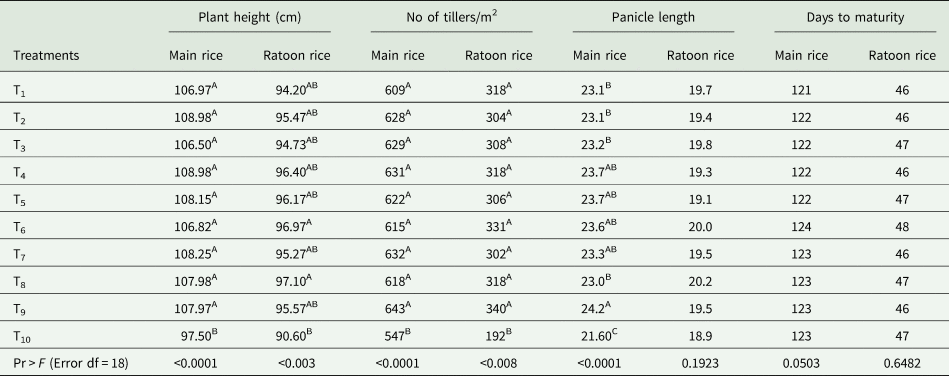
The weedy plots recorded the lowest plant height of both main (97.5 cm) as well as ratoon crop (90.6 cm) (Table 2). All the weed control treatments registered a significant increase in plant height as compared to weedy check. The number of tillers per unit area also influenced by weed infestation. Weedy plot recorded the lowest number of tillers per m2 in main rice (547) and as well in ratoon crop (192). Weed-free treatment recorded the highest number of tillers (643) which was at par with ready-mix bensulfuron-methyl + pretilachlor and tank-mix azimsulfuron + bispyribac sodium. From Table 2, it was observed that days to maturity of either the main crop or ratoon crop was not influenced by weed control treatments and weed infestation.
Effect of weed control practices on growth characters of wet direct sown rice-ratoon rice system (averaged data of two years)
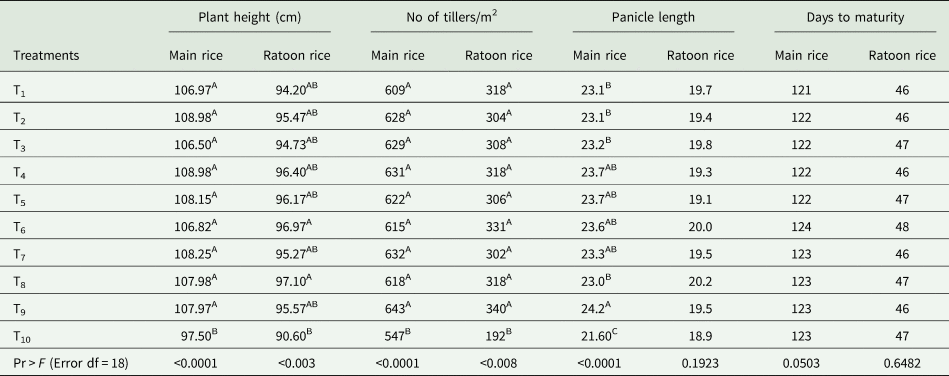
(T1-Azimsulfuron, T2-Flucetosulfuron, T3-Bispyribac sodium, T4-Bensulfuron-methyl + pretilachlor, T5-Azimsulfuron + bispyribac sodium, T6-Flucetosulfuron fb bispyribac sodium, T7-Manual weeding twice, T8-Paddy-weeder followed by manual weeding, T9-Weed free, T10-Weedy check) Means with at least one letter common are not statistically significant using Tukey Honestly Significant Difference (HSD) post-hoc test at P < 0.05).
Yield and yield attributes
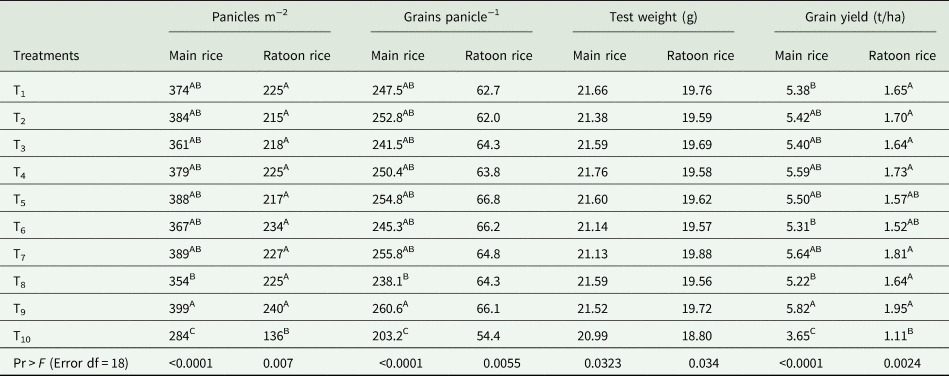
Yield attributes viz., number of panicles/m2 area and number of grains per panicle were significantly influenced by weed infestation and weed control practices (Table 3, Supplementary Tables 6 and 7). Weed free throughout the growth period registered a higher number of panicles (399 m−2) and grains per panicle (260.6) in the main crop. Similarly, in ratoon crop weed free recorded the highest higher number of panicles (240 m−2) and grains per panicle (61.1). Among the herbicidal treatments, azimsulfuron + bispyribac-sodium recorded a higher number of panicles per m−2 but it was at par with the treatments bensulfuron-methyl + pretilachlor and flucetosulfuron. Test weight (1000 grain weight) of both main and ratoon crop was not influenced by the crop weed competition and weed control treatments. Crop weed competition resulted lowest grain yield in weedy check plot both in main crop (3.65 t/ha) and ratoon rice (1.11 t/ha). Weed control treatments registered a significant increase in grain yield. Among the herbicidal treatments, bensulfuron-methyl + pretilachlor recorded grain yield (main crop 5.59 and 1.73 t/ha) which was at par with the manual weeding twice (year wise grain yield available in Supplementary Table 8). Crop weed competition in the weedy plots recorded a significant grain yield reduction of 37.3 and 43.6% in the main crop and ratoon crop respectively as compared to weed free check.
Effect of weed control practices on yield and yield attributes of wet direct sown rice-ratoon rice system (averaged data of 2 years)
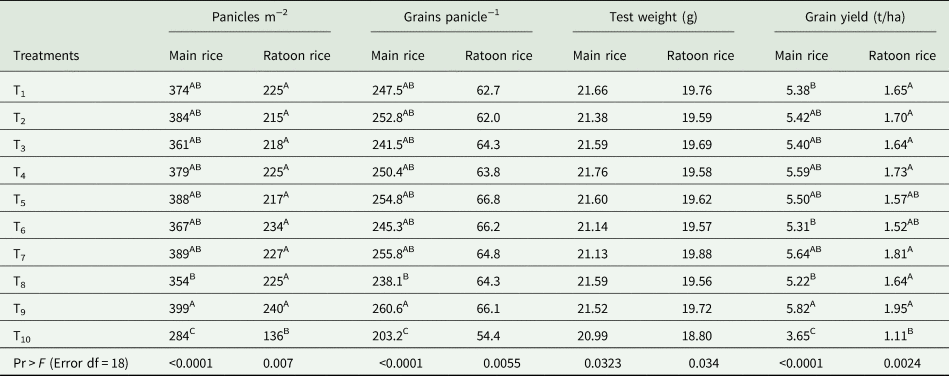
(T1-Azimsulfuron, T2-Flucetosulfuron, T3-Bispyribac sodium, T4-Bensulfuron-methyl + pretilachlor, T5-Azimsulfuron + bispyribac sodium, T6-Flucetosulfuron followed by bispyribac sodium, T7-Manual weeding twice, T8-Paddy-weeder fb manual weeding, T9-Weed free, T10-Weedy check) Means with at least one letter common are not statistically significant using Tukey Honestly Significant Difference (HSD) post-hoc test at P < 0.05).
System productivity
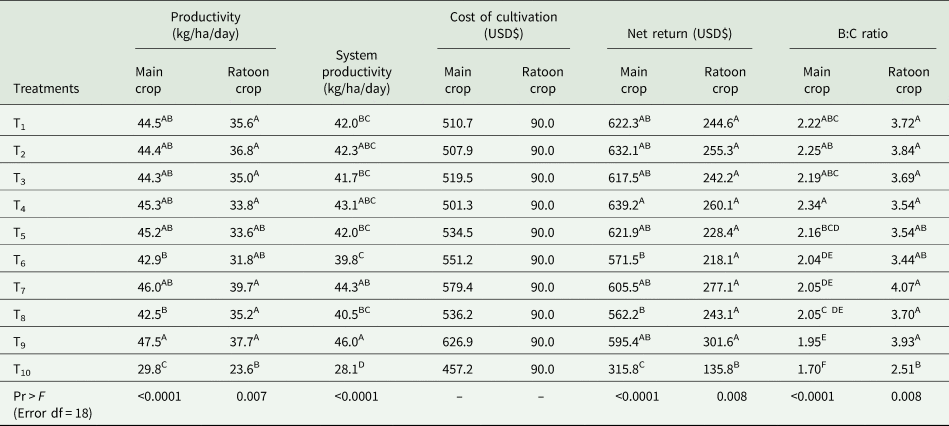
It was observed that the productivity of both the main and ratoon crop was less in the weedy plots (Table 4). All the weed control treatments registered higher productivity than the weedy check. In the weed-free plots, the main crop recorded the highest productivity of 47.5 kg/ha/day, whereas the ratoon crop registered productivity of 37.7 kg/ha/day which was the 77.8% of main crop productivity. Among the herbicidal treatments, bensulfuron-methyl + pretilachlor resulted in higher productivity of (45.3 kg/ha/day) which was comparable with manual weeding. Application of bensulfuron-methyl + pretilachlor registered higher system productivity of 40.9 kg/ha/day and was comparable with manual weeding twice.
Effect of weed control practices on productivity and economics of rice-ratoon rice cropping system (averaged data of two years)
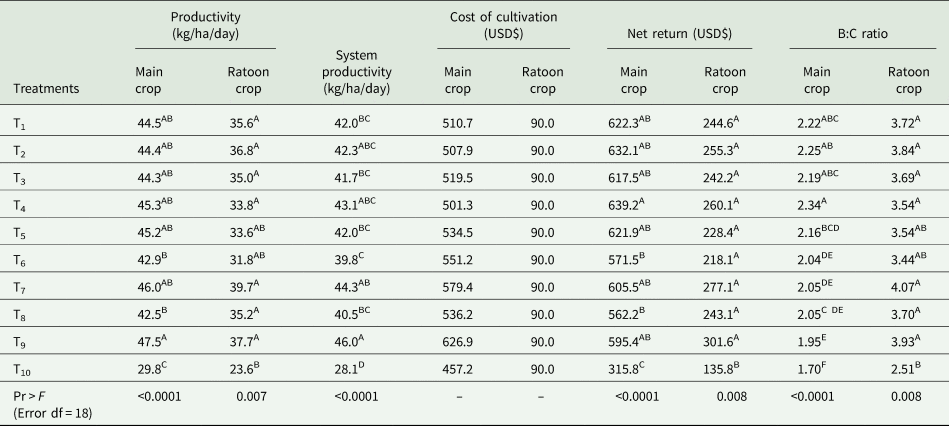
(T1-Azimsulfuron, T2-Flucetosulfuron, T3-Bispyribac sodium, T4-Bensulfuron-methyl + pretilachlor, T5-Azimsulfuron + bispyribac sodium, T6-Flucetosulfuron fb bispyribac sodium, T7-Manual weeding twice, T8-Paddy-weeder followed by manual weeding, T9-Weed free, T10-Weedy check) Means with at least one letter common are not statistically significant using Tukey Honestly Significant Difference (HSD) post-hoc test at P < 0.05).
Nutrient uptake and partial factor productivity
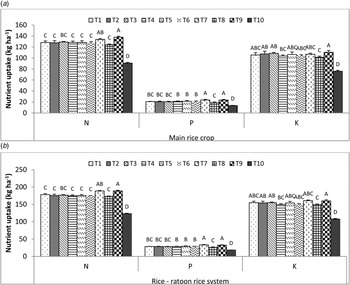
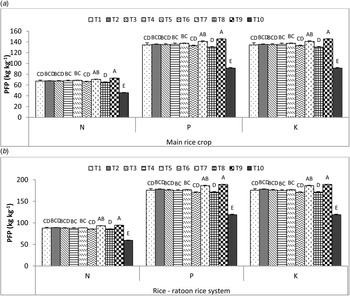
The N, P and K uptake in the main rice crop (Fig. 2(a)) showed the uptake of these nutrients in the main crop, while the uptake in rice-ratoon rice system (Fig. 2(b)) is the cumulative uptake value of a particular nutrient in main rice crop along with in ratoon crop. The weedy check recorded significantly the lowest uptake of N, P and K over other weed control treatments. Rice-ratoon rice system registered higher nutrient uptake than the rice main crop. In weed-free treatments, rice-ratoon rice system recorded 37.0, 37.0 and 44.7% increase in N, P and K total uptake respectively than the main crop (Figs 2(a) and (b)). In weed-free plots, rice-ratoon rice system enhanced total partial factor productivity by about 30% of all the major nutrients than the sole crop (Figs 3(a) and (b)).
Nutrient uptake of (a) main rice crop and (b) rice-ratoon rice system as influenced by weed control practices (averaged data of two years). (T1-Azimsulfuron, T2-Flucetosulfuron, T3-Bispyribac sodium, T4-Bensulfuron-methyl + pretilachlor,T5-Azimsulfuron + bispyribac sodium, T6-Flucetosulfuron followed by bispyribac sodium, T7-Manual weeding twice, T8-Paddy weeder fb manual weeding, T9-Weed free, T10-Weedy check) Error bar in first group (main rice crop) represents standard error of mean (SEM) with 3 (n = 3) number of observations for each bar, while error bar in the second group (rice-ratoon rice system) represents standard error of mean (SEM) of cumulative values of 3 (n = 3) number of observations for each bar. The bar diagram of a particular parameter followed by same letters are not statistically significant in different by Tukey HSD method at 5% level of significance (P < 0.05).

Partial factor productivity of (a) main rice crop and (b) rice-ratoon rice system as influenced by weed control practices (averaged data of two years). (T1-Azimsulfuron, T2-Flucetosulfuron, T3-Bispyribac sodium, T4-Bensulfuron-methyl + pretilachlor, T5-Azimsulfuron + bispyribac sodium, T6-Flucetosulfuron fb bispyribac sodium, T7-Manual weeding twice, T8-Paddy weeder followed by manual weeding, T9-Weed free, T10-Weedy check). Error bar in first group (main rice crop) represents standard error of mean (SEM) with 3 (n = 3) number of observations for each bar, while error bar in the second group (rice-ratoon rice system) represents standard error of mean (SEM) of cumulative values of 3 (n = 3) number of observations for each bar. The bar diagram of a particular parameter followed by same letters are not statistically significant in different by Tukey HSD method at 5% level of significance (P < 0.05).

Energy use efficiency and energy productivity
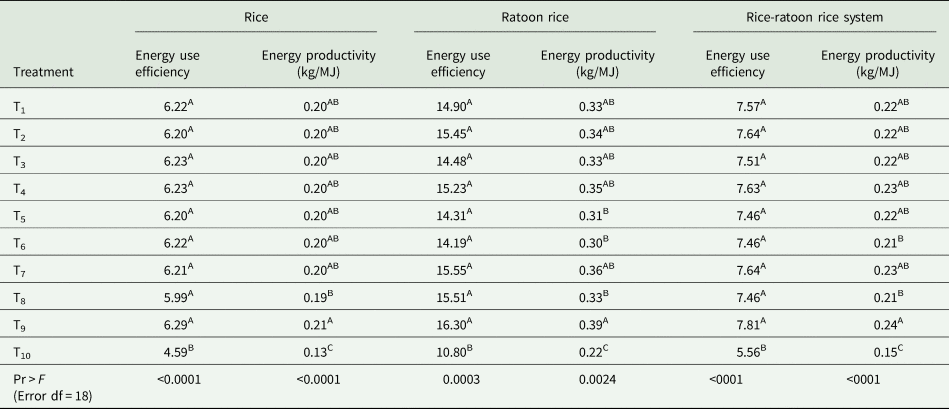
The crop weed competition in the weedy plot registered 27.2, 33.7, 28.8% reduction in energy use efficiency in the main crop, ratoon rice and rice-ratoon rice system respectively as compared to weed-free plots. Similarly, weed infestation in the weedy check recorded 35.4, 43.2 and 37.1% decreases in energy productivity as compared to weed-free treatments (Table 5). All weed control treatments registered significantly increase in energy use efficiency and energy productivity in rice-ratoon rice system. Among the weed control treatments weed-free plots recorded the highest energy productivity in the rice-ratoon rice system. All the herbicidal treatments showed energy use efficiency and energy productivity at par each other in both main rice and ratoon crop.
Energy budgeting of rice-ratoon rice cropping system as influenced by weed control practices (averaged data of two years)

(T1-Azimsulfuron, T2-Flucetosulfuron, T3-Bispyribac sodium, T4-Bensulfuron-methyl + pretilachlor, T5-Azimsulfuron + bispyribac sodium, T6-Flucetosulfuron followed by bispyribac sodium, T7-Manual weeding twice, T8-Paddy-weeder fb manual weeding, T9-Weed free, T10-Weedy check) Means with at least one letter common are not statistically significant using Tukey Honestly Significant Difference (HSD) post-hoc test at P < 0.05).
Economics
The cost of cultivation was found highest in the weed-free treatment (US $ 626.9) and the lowest investment was incurred in weedy check (US $ 457.2). Among the herbicidal treatments, ready-mix application of bensulfuron-methyl + pretilachlor registered the lowest cost of production (US $ 501.3). From the computation of economics, it was observed that the lowest net return of US $ 315.8 and US $ 135.8 recorded in weedy plot of main rice crop and ratoon crop respectively. Application of ready-mix bensulfuron-methyl + pretilachlor resulted highest net return (US $ 639.2) in the main crop. Similarly, the weedy check recorded the lowest B: C ratio (1.70) and highest B: C ratio (2.34) was registered in the plots treated with bensulfuron-methyl + pretilachlor (Table 4).
Discussion
Weed flora, weed density, biomass and weed control efficiency
Moist soil environment without standing water and slow growth of emerging seedlings during the initial period of crop establishment, favoured dominance of sedges like C. difformis and C iria in puddled drum seeded rice. It was also confirmed by Nayak et al. (Reference Nayak, Khan, Mosha and Rani2014) and Yakadri et al. (Reference Yakadri, Madhavi, Ramprakash and Leela2016), whereas in the subsequent ratoon rice, the weed pressure was less as compared to the main crop, because of the presence of rice stubbles and sufficient water level which did not allow weed seeds present in the soil to germinate. The higher number of broad-leaved weeds in the ratoon crop was due to the dominance of perennial weeds like L. adscendes and M. vaginalis which were already existing in the preceding main crop field. Sedges like C. difformis and Cyperus iria completed their life cycle and dried before the maturity of the main crop and they were not found in the subsequent ratoon crop.
The highest weed density and weed biomass were recorded in weedy plots due to non-imposition of any weed control measures. Among the weed control treatments, a higher weed density and biomass were recorded in plots treated with mechanical weed control by paddy weeder followed by manual weeding because of poor control of sedges and grasses close to the rice hills and succeeding flushes of broad-leaved weeds. Tank-mix and ready-mix herbicides registered better performance as compared to single application of azimsulfuron or bispyribac-sodium implying synergistic effect of herbicide combinations and subsequent control of broad-spectrum of weeds. Similarly, sequential application of flucetosulfuron followed by bispyribac-sodium suppressed the weeds efficiently and was at par with the manual weeding twice. The weed density and biomass in case of ratoon rice (data not presented) was lower than the main crop due to better weed-suppressing capacity of the rice stubbles, very quick regeneration of new tillers from the basal buds of the previous main crop and presence of standing water at the initial period of ratoon rice.
Toxicity rating and plant growth of rice crop
Improper dose and time of application may lead to phyto-toxicity in rice crop. Application of flucetosulfuron at 5 days after sowing (DAS) imparted slight to moderate toxicity to young emerging rice seedlings, whereas older seedlings at 20 DAS showed higher selectivity to the herbicide. Post-emergence application of azimsulfuron and bispyribac-sodium did not have phyto-toxic effect due to their high selectivity (Yadav et al., Reference Yadav, Yadav and Punia2009; Channabasavanna et al., Reference Channabasavanna, Kitturmath and Rajakumar2017). Ready-mix application of bensulfuron methyl + pretilachlor though registered slight toxicity to newly emerging rice seedlings of the main crop as reflected in the reduction of plant height (data not presented) but it recovered after a week.
Crop-weed competition caused a significant reduction in plant height of both main as well as ratoon crop due to less availability of plant nutrients, water and light as reflected in weedy plots. It was also found that the plant height of the main crop was more than the ratoon rice due to the short vegetative growth period of ratoon rice as compared to the main crop as confirmed by Faruq et al. (Reference Faruq, Taha and Prodhan2014). The average number of tillers per unit area also showed the similar trend. Similar observations were also recorded by Maqsood et al. (Reference Maqsood, Irshad, Hussain and Rafiq2000) and Faruq et al. (Reference Faruq, Taha and Prodhan2014). In all the treatments, the panicle length of the main crop was higher than the ratoon rice which was similar to the observations of Akhgari et al. (Reference Akhgari, Noorhosseini-Niyaki and Sadeghi2013) and Birhane (Reference Birhane2013).
Yield, yield attributes and system productivity
Higher weed density and biomass in weedy plots hindered the growth and development of rice crop which ultimately reflected in reduction in yield attributing characters like effective tillers m−2 and panicle numbers that led to poor grain yield in weedy plots. However, weed control practices significantly reduced the weed pressure in main as well in subsequent ratoon rice and recorded increase in grain yield per unit land and time. Ready-mix application of bensulfuron-methyl + pretilachlor registered the highest system productivity of 40.9 kg/ha/day among the herbicide treatments due to better control of all types of weeds at the early stage of crop growth. The effect of weed control practices in main crop finally reflected in the grain yield of succeeding ratoon rice. The plots treated with bensulfuron-methyl + pretilachlor of the main crop recorded the highest ratoon rice yield. The growth and yield attributes of ratoon crop were influenced by the health of the main crop (Uchida and Ohe, Reference Uchida and Ohe2016). In our study better weed control in main crop by herbicide treatment produced better plant growth and more number of tillers which ultimately reflected in tillering of the ratoon crop which helped to produce an additional rice yield without any weed control measures in ratoon rice.
Nutrient uptake and partial factor productivity
The rice crop in the weedy plots recorded significantly the lower uptake of N, P and K in comparison to other weed control plots. The enhanced growth characters in weed control treatments contributed to high dry matter production and nutrient uptake (Chongtham et al., Reference Chongtham, Singh and Singh2016; Verma et al., Reference Verma, Sharma, Nandan, Sharma, Shah and Banotra2017). Rice-ratoon rice system registered higher nutrient uptake than the rice main crop because the ratoon rice was raised without adding any additional nutrients to the ratoon crop. Similarly, the rice-ratoon rice system registered higher Partial factor productivity than the main crop because no additional nutrient was applied to the ratoon crop (Singh et al., Reference Singh, Lal, Satapathy, Gautam, Kumar and Pun2021).
Energy use efficiency (EUE) and energy productivity
Productivity and profitability of any agricultural production system depend on energy consumption and production (Alam et al., Reference Alam, Alam and Islam2005). The efficient use of energies determines the profitability and sustainability of the input intensive rice production system. The higher EUE was recorded in the plots treated with ready- mix bensulfuron-methyl + pretilachlor and it was least in weedy plots since crop-weed competition causes a considerable reduction in grain and straw yield which ultimately influences the EUE and energy productivity. The same observations were also reported by Nagarjun et al. (Reference Nagarjun, Dhanapal, Sanjay, Yoganannda and Muthuraju2019). Irrespective of weed management practices rice-ratoon rice cropping sequence recorded higher EUE and productivity than the main rice crop due to less inputs used in the ratoon crop.
Economics
Weed-free plot recorded higher grain yield in both main and ratoon crop, but the net return and B:C ratio were less in this treatment comparison to different herbicide treated plots because of higher cost involvement for repeated weeding to make the plots weed free. The same trend was recorded with manual weeding twice. Thus, a suitable recommendation for effective weed control is needed to achieve better grain yield with higher economic returns (Saha et al., Reference Saha, Munda and Adak2016; Satapathy et al., Reference Satapathy, Duary, Saha, Pun and Singh2017). Our study suggests that combined application either as ready mix or tank mix is economically competitive and viable alternate option to manual weeding in wet direct seeded rice-ratoon rice fields. Ready-mix application of bensulfuron-methyl + pretilachlor in main crop registered higher net return and B: C ratio in both rice crops and confirmed that selection of suitable herbicide is one of the valuable criteria for weed management in wet direct seeded rice-ratoon rice system which could be useful to rice farmers of lowland rice ecosystem.
Conclusion
Weed control by herbicides is economically cheapest and produces grain yield comparable with manual weeding. Ready-mix bensulfuron-methyl + pretilachlor (60 + 600 g/ha) at 10 DAS to the main crop registered higher energy use efficiency as well as higher return per rupee invested which can be recommended as an alternative to manual weeding for higher system productivity, higher net return and B:C ratio in the rice-ratoon rice cropping system. Without hampering the performance of the preceding rice crop, farmers can harvest a good ratoon rice crop with less investment. Thus, ratooning of summer rice may be recommended for intensification of rice-based cropping system of lowland ecologies in Lower Brahmaputra Valley of Assam.
Supplementary material
The supplementary material for this article can be found at https://doi.org/10.1017/S0021859622000168.
Author contributions
B. S. Satapathy: conceived and designed the study, conducted data gathering, wrote the article; Dibyendu Chatterjee: performed statistical analyses, editing, communication; Sanjoy Saha: conceived and designed the study, editing; B. Duary: conceived and designed the study, editing; and T. Singh: editing.
Financial support
This research received no specific grant from any funding agency, commercial or not-for-profit sectors.
Conflict of interest
There are no conflicts of interest to declare.
Ethical standards
Not applicable.