Introduction
The presence of certain brain structural alterations is now established in schizophrenia, with strongest evidence for increased ventricular volume and reduced global and regional grey matter volumes (Honea et al. Reference Honea, Crow, Passingham and Mackay2005). Among these, smaller hippocampal volume is a replicated finding (Honea et al. Reference Honea, Crow, Passingham and Mackay2005; Steen et al. Reference Steen, Mull, McClure, Hamer and Lieberman2006; Glahn et al. Reference Glahn, Laird, Ellison-Wright, Thelen, Robinson, Lancaster, Bullmore and Fox2008), and recent models propose that hippocampal abnormality is key to the pathogenesis of schizophrenia, underlying positive and negative symptoms, and cognitive impairments (Tamminga et al. Reference Tamminga, Stan and Wagner2010; Lodge & Grace, Reference Lodge and Grace2011). Indeed, prominent deficits in memory – particularly declarative memory – support the presence of disrupted hippocampal function in schizophrenia (Barch et al. Reference Barch, Csernansky, Conturo and Snyder2002; Weiss et al. Reference Weiss, Schacter, Goff, Rauch, Alpert, Fischman and Heckers2003).
There is also growing recognition that neuroanatomical abnormalities in psychosis may change over the course of illness, and be more marked in a subset of patients with particularly poor outcome. However, what the neuroanatomical markers of poor outcome and recovery are remains unclear. Identifying these markers is paramount to advancing understanding of psychosis and to uncovering potentially modifiable treatment targets.
For example, the observation that brain structural alterations may progress over time, both in the early and chronic illness stages, has led to the suggestion that the functional decline observed in psychosis may be related to progressive brain structure change (Cahn et al. Reference Cahn, Hulshoff Pol, Lems, van Haren, Schnack, van der Linden, Schothorst, van Engeland and Kahn2002; van Haren et al. Reference van Haren, Hulshoff Pol, Schnack, Cahn, Brans, Carati, Rais and Kahn2008; Andreasen et al. Reference Andreasen, Nopoulos, Magnotta, Pierson, Ziebell and Ho2011; Olabi et al. Reference Olabi, Ellison-Wright, McIntosh, Wood, Bullmore and Lawrie2011). However, not all studies have found change in global or regional volumes over time (Gur et al. Reference Gur, Cowell, Turetsky, Gallacher, Cannon, Bilker and Gur1998; Keshavan et al. Reference Keshavan, Haas, Kahn, Aguilar, Dick, Schooler, Sweeney and Pettegrew1998; DeLisi et al. Reference DeLisi, Sakuma, Maurizio, Relja and Hoff2004; Schaufelberger et al. Reference Schaufelberger, Lappin, Duran, Rosa, Uchida, Santos, Murray, McGuire, Scazufca, Menezes and Busatto2011). Studies investigating regional grey matter change have reported that loss over time may particularly occur in temporal and frontal cortices (van Haren et al. Reference van Haren, Hulshoff Pol, Schnack, Cahn, Mandl, Collins, Evans and Kahn2007; Andreasen et al. Reference Andreasen, Nopoulos, Magnotta, Pierson, Ziebell and Ho2011; Asami et al. Reference Asami, Bouix, Whitford, Shenton, Salisbury and McCarley2012).
Evidence for hippocampal change is more sparse: amygdalo-hippocampal volume loss has been reported 1–2 years following first-episode psychosis (FEP) (Kasai et al. Reference Kasai, Shenton, Salisbury, Hirayasu, Onitsuka, Spencer, Yurgelun-Todd, Kikinis, Jolesz and McCarley2003), while studies in chronic schizophrenia have been negative (Wood et al. Reference Wood, Velakoulis, Smith, Bond, Stuart, McGorry, Brewer, Bridle, Eritaia, Desmond, Singh, Copolov and Pantelis2001; Whitworth et al. Reference Whitworth, Kemmler, Honeder, Kremser, Felber, Hausmann, Walch, Wanko, Weiss, Stuppaeck and Fleischhacker2005; Yoshida et al. Reference Yoshida, McCarley, Nakamura, Lee, Koo, Bouix, Salisbury, Morra, Shenton and Niznikiewicz2009). Greater hippocampal abnormalities, particularly on the left side, have been found in cross-sectional studies of patients with longer duration of illness (Chakos et al. Reference Chakos, Schobel, Gu, Gerig, Bradford, Charles and Lieberman2005; Velakoulis et al. Reference Velakoulis, Wood, Wong, McGorry, Yung, Phillips, Smith, Brewer, Proffitt, Desmond and Pantelis2006), but there is a real lack of direct data demonstrating hippocampal change over time. One exception is the study of Schaufelberger et al. (Reference Schaufelberger, Lappin, Duran, Rosa, Uchida, Santos, Murray, McGuire, Scazufca, Menezes and Busatto2011) which identified hippocampal increase over the 18-month period following FEP. This is important as it suggests that neuroplastic changes may have taken place over time with a reversal of the psychosis-related baseline hippocampal differences (Schaufelberger et al. Reference Schaufelberger, Lappin, Duran, Rosa, Uchida, Santos, Murray, McGuire, Scazufca, Menezes and Busatto2011). Here, the concept of plastic potential was explored: that is, rather than examining only the degree of volume change, the capacity of the hippocampus to show any increase over time bilaterally was measured.
The present study is the first to examine change over time in both hippocampal structure and function (by testing verbal memory) following FEP. Further, it is the first study to evaluate the extent to which hippocampal and global grey matter volume changes are associated with clinical and functional outcome in a cohort of patients seen at the time of their first psychotic episode and then 6 years later as part of the AESOP (Aetiology and Ethnicity of Schizophrenia and Other Psychoses) study. Hypotheses were as follow: (i) better clinical and functional outcome at follow-up will be associated with less hippocampal and grey matter volume loss over time; and (ii) better cognitive outcome, specifically verbal memory at follow-up, will be associated with less hippocampal loss over time.
Method
Study design
This is a longitudinal cohort study, comprising two assessment time points: baseline and 6-year follow-up. At baseline, FEP subjects were recruited to an epidemiological study (AESOP) conducted in London, UK (Dazzan et al. Reference Dazzan, Morgan, Orr, Hutchinson, Chitnis, Suckling, Fearon, McGuire, Mallett, Jones, Leff and Murray2005; Lappin et al. Reference Lappin, Morgan, Morgan, Hutchison, Chitnis, Suckling, Fearon, McGuire, Jones, Leff, Murray and Dazzan2006). All 16- to 64-year-olds presenting for the first time to psychiatric services between September 1997 and August 2000 with a functional psychotic illness [Diagnostic and Statistical Manual of Mental Disorders, Fourth Edition (DSM-IV) 295–298, psychotic codings] were approached. Exclusion criteria were: (a) history of head trauma resulting in loss of consciousness; (b) central nervous system disease; (c) poor fluency in English; (d) psychotic disorder due to acute intoxication; and (e) psychotic disorder due to general medical condition. Control subjects from the same geographical area were recruited through household visits and local advertisement; full methods have been described previously (Dazzan et al. Reference Dazzan, Morgan, Orr, Hutchinson, Chitnis, Suckling, Fearon, Salvo, McGuire, Mallett, Jones, Leff and Murray2004). Follow-up was completed between July 2004 and December 2006. All baseline FEP and control subjects were invited to participate at follow-up. Tracing methods included contact with general practitioner, clinical team, local responsible health authority; and the Office of National Statistics.
Subjects
The cohort comprised 90 FEP subjects and 83 controls at baseline, and 44 FEP subjects and 37 controls at follow-up. Subjects did not differ from those not followed up on any baseline demographic or clinical variable (online Supplementary Table S1). All subjects gave written informed consent after complete description of the study, which was approved by the Maudsley and Institute of Psychiatry Research Ethics Committee.
Outcome measures
Baseline clinical evaluation
Patients were assessed using the Schedule for the Clinical Assessment in Neuropsychiatry (SCAN; Version 2; World Health Organization, 1994). Diagnostic codes were assigned according to DSM-IV criteria in consensus meetings with senior clinicians. A total symptom score was obtained by summing the SCAN's individual symptom item scores according to Wing and Sturt's procedure for the Present State Examination (Wing & Sturt, Reference Wing and Sturt1978). Pre-morbid intelligence quotient (IQ) was assessed using the National Adult Reading Test (NART; Nelson, Reference Nelson1991) and handedness using the Annett Hand Preference Questionnaire (Annett, Reference Annett1970).
Follow-up clinical and functional outcome evaluation
Length of follow-up was defined as the period in years between first presentation to psychiatric services and date of follow-up assessment. The mean follow-up interval was 6.2 years (s.d. = 1.2 years). Clinical information was obtained through subject interview, case-note review, and informant interview, and recorded using the World Health Organization Life Chart (Harrison et al. Reference Harrison, Hopper, Craig, Laska, Siegel, Wanderling, Dube, Ganev, Giel, an der Heiden, Holmberg, Janca, Lee, León, Malhotra, Marsella, Nakane, Sartorius, Shen, Skoda, Thara, Tsirkin, Varma, Walsh and Wiersma2001) adapted to include additional information on service contacts and antipsychotic treatment. Current mental state was assessed with the SCAN (World Health Organization, 1994) and the Scale for the Assessment of Negative Symptoms (SANS; Andreasen, Reference Andreasen1982). Diagnostic codes over follow-up and clinical course were agreed according to DSM-IV criteria in consensus meetings with senior clinicians. Diagnostic categories were further clustered into ‘schizophrenia’ and ‘other psychosis’ categories, the latter group comprising all non-schizophrenia diagnoses.
The primary clinical outcome measures were: course type [continuous (no period of remission exceeded 6 months' duration) or other]; and symptom severity at follow-up, measured using the Global Assessment of Function – Symptom Scale (GAF-S; Endicott et al. Reference Endicott, Spitzer, Fleiss and Cohen1976). The adapted WHO Life Chart (Harrison et al. Reference Harrison, Hopper, Craig, Laska, Siegel, Wanderling, Dube, Ganev, Giel, an der Heiden, Holmberg, Janca, Lee, León, Malhotra, Marsella, Nakane, Sartorius, Shen, Skoda, Thara, Tsirkin, Varma, Walsh and Wiersma2001) was employed to assess the key functional outcomes: proportion of follow-up in employment; and global function, scored using the Global Assessment of Function – Function Scale (GAF-F; Endicott et al. Reference Endicott, Spitzer, Fleiss and Cohen1976).
The cognitive outcome measures included verbal learning and memory, assessed using the Rey Auditory Verbal Learning Test delayed recall (trial 7) (Spreen & Strauss, Reference Spreen and Strauss1991). Pre-morbid intelligence was estimated using the NART (Nelson, Reference Nelson1991).
MRI protocol
A total of 90 FEP and 83 control subjects were scanned at baseline, and 44 FEP and 37 control subjects at follow-up. Scans were acquired with a General Electric Signa 1.5-T system (GE Medical Systems, USA), at the Maudsley Hospital, London. Exactly the same acquisition protocol was used at both time points: (a) a three-dimensional inversion recovery prepared fast spoiled GRASS T1-weighted dataset was obtained in the coronal plane with 1.5 mm contiguous sections [repetition time (TR) = 13.8 ms, inversion time (TI) = 450 ms, echo time (TE) = 2.8 ms, flip angle = 20°, 256 × 256 × 128 pixel matrix, acquisition time = 6 min 27 s]; (b) contiguous, interleaved proton density (PD)- and T2-weighted images of 3 mm thickness were acquired coronally, providing whole brain coverage. PD- and T2-weighted image acquisition was almost simultaneous (TE1 = 20 ms, TE2 = 85 ms, TR = 4000 ms, eight-echo train length, matrix size 256 × 192, field of view of 22 × 16.5 cm). Images were processed using SBAMM (structural brain analysis morphological mapping) voxel-based semi-automated methods, described previously (Suckling et al. Reference Suckling, Sigmundsson, Greenwood and Bullmore1999). In brief, extra-cerebral tissues were removed using an automated algorithm and manual editing. An iterative non-parametric method for intensity non-uniformity correction of MR volumes (N3; Sled et al. Reference Sled, Zijdenbos and Evans1998) was applied to both baseline and follow-up images to ensure optimal segmentation of the data into the correct tissue compartments. The N3 application was fully automated and applied to all images. Intracerebral tissue voxels were categorized into grey matter, white matter, cerebrospinal fluid or dura/vasculature using a modified fuzzy clustering algorithm (Suckling et al. Reference Suckling, Sigmundsson, Greenwood and Bullmore1999). A measure of intracranial volume was derived through summing these tissue volumes.
Hippocampal volumes
Automatic segmentation of brain structures from T1-weighted structural MRI data and estimation of hippocampal volumes was performed using FreeSurfer (5.0) (http://surfer.nmr.mgh.harvard.edu). Individual images (baseline and follow-up) were processed using the FreeSurfer standard procedure (Dale et al. Reference Dale, Fischl and Sereno1999; Fischl et al. Reference Fischl, Salat, Busa, Albert, Dieterich, Haselgrove, van der Kouwe, Killiany, Kennedy, Klaveness, Montillo, Makris, Rosen and Dale2002; Reuter et al. Reference Reuter, Schmansky, Rosas and Fischl2012); in brief, pre-processing (motion correction, skull stripping, Talairach transformation) was followed by subcortical segmentation and cortical reconstruction. For subcortical segmentation, FreeSurfer combines information about voxel intensity relative to a probability distribution for tissue classes with information about the spatial comparisons to neighbouring voxel labels, and with spatial comparisons with a probabilistic training atlas; structures are determined by assigning each voxel to one of approximately 40 possible labels.
Following separate baseline and follow-up image processing, images were automatically processed with the FreeSurfer longitudinal stream (Reuter et al. Reference Reuter, Schmansky, Rosas and Fischl2012). This stream comprises template creation for each subject, using both baseline and follow-up images, to provide an initial estimate for segmentation and surface reconstruction; it has been shown that this within-subject template increases reliability (Reuter et al. Reference Reuter, Schmansky, Rosas and Fischl2012). FreeSurfer methods have been demonstrated to have high reliability for hippocampal segmentation compared with manual tracing methods (Morey et al. Reference Morey, Dolcos, Petty, Cooper, Hayes, LaBar and McCarthy2009). Finally, each time point was processed ‘longitudinally’ (spatial normalization, Talairach registration, brain mask creation, segmentation and parcellation) using images of both template and time points as initial settings. Hippocampal volumes were then extracted from template-based analysis at baseline and follow-up and imported into SPSS (IBM, USA) for further statistical analyses. In total, MRI data for two subjects and five controls failed quality control or processing; there were complete data therefore for 42 FEP subjects and 32 controls.
Statistical analysis
All analyses were performed using PASW Statistics v18 (SPSS Inc., USA). Parametric and non-parametric tests were applied as appropriate. Analyses were performed comparing FEP and control subjects; and comparing schizophrenia and other psychosis diagnoses within the psychosis cohort. To determine whether brain volume changes over follow-up predicted (continuous) outcome variables, linear regression analyses were performed with the unstandardized regression coefficient (β) representing the change in outcome score per unit volume change. Where outcome variables were categorical, logistic regression analyses were conducted. When grey matter volume change was included as a predictor, age, gender, baseline grey matter volume and whole-brain volume were entered into analyses as covariates.
Some hippocampal volume data were non-normally distributed. Where indicated, non-parametric tests were applied. Because change in hippocampal volume over time ranged from below to above zero, log transformation was not possible. An additional measure for bilateral plastic potential was derived, incorporating direction (but not degree) of hippocampal change on each side; binary notation was applied such that value of 1 denoted bilateral hippocampal increase (BHI) over follow-up and value of 0 denoted hippocampal volume reduction over follow-up on either or both sides.
Results
Demographic, clinical, functional and cognitive measures
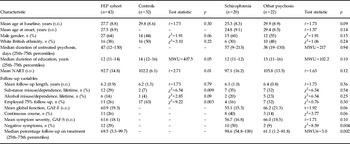
FEP subject and control characteristics are shown in Table 1. Patients were younger than controls, with a higher proportion of males and a lower proportion of white British ethnicity (Table 1). As expected, patients had significantly lower pre-morbid IQ, had been in education for significantly fewer years, and were less likely to be employed at baseline. More patients had lifetime alcohol misuse/dependence and drug misuse/dependence than controls (Table 1).
Comparison of demographic, clinical and functional characteristics between FEP (n = 42) and control (n = 32) subjects, and between schizophrenia (n = 20) and other psychosis (n = 22) patients

FEP, First-episode psychosis, s.d., standard deviation; MWU, Mann–Whitney U; NART, National Adult Reading Test; GAF-F, Global Assessment of Function – Function Scale; GAF-S, Global Assessment of Function – Symptom Scale.
Clinical outcomes
A total of 20 (48%) subjects had a follow-up diagnosis of schizophrenia and 22 (52%) other psychosis [schizo-affective disorder (n = 3), bipolar affective disorder (n = 6), depressive psychosis (n = 6), acute and transient psychosis (n = 2) and unspecified non-organic psychoses (n = 5)]. There were no statistically significant differences in sociodemographic variables between diagnostic groups (Table 1).
In terms of clinical characteristics, 26% FEP subjects developed a continuous illness course; this was more common in subjects with schizophrenia (Table 1). A diagnosis of schizophrenia was associated with lower GAF-S scores (worse symptoms), and higher rate of negative symptoms (50%) during follow-up. Patients with schizophrenia were also prescribed treatment for a significantly greater proportion of the follow-up period (Table 1).
Functional outcomes
FEP subjects were significantly less likely than controls to have been employed throughout follow-up, with no difference by diagnosis. Global function at follow-up was moderate (mean GAF-D = 60.9), with greater impairment in schizophrenia (Table 1).
Delayed verbal recall
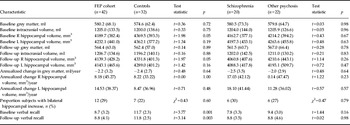
FEP subjects had worse verbal recall than controls at both baseline [mean score: patients 8.7 (s.d. = 3.2), controls 11.7 (s.d. = 2.3); t = 3.77, p = 0.001] and follow-up [mean score: patients 8.8 (s.d. = 4.1), controls 11.8 (s.d. = 2.5); t = 3.14, p = 0.003]. Interestingly, there were no significant differences between diagnoses at baseline or follow-up (Table 2).
Cognitive and structural brain measures at baseline and at follow-up, with comparisons between FEP (n = 42) and control (n = 32) subjects, and between schizophrenia (n = 20) and other psychosis (n = 22) patients

Data are given as mean (standard deviation) or as number of subjects (%).
FEP, First-episode psychosis; R, right; L, left.
Structural brain measures
Brain tissue volumes at baseline and follow-up are shown in Table 2. There was no difference between patient and control groups in grey matter volume at baseline or at follow-up. Change of grey matter volume over time (loss) was small and did not differ between patients and controls.
When mean hippocampal volume was compared across groups, right hippocampal volume was significantly smaller in FEP patients than in controls at both baseline (t = 1.98, p = 0.05) and follow-up (t = 1.97, p = 0.05) (Table 2), while left hippocampal volume was only non-significantly smaller. Mean percentage change (from baseline) in hippocampal volume was of the order of 1% and did not differ between patients and controls on either the right or left (Table 2). A repeated-measure analysis of mean right hippocampal volume over time revealed no significant difference by time between baseline and follow-up (F = 0.06, p = 0.81) in either patients or controls. There were no significant interactions when patient–control status was entered as the between-subject variable, and age, gender, and scan interval as covariates. Finally, there were no differences by diagnosis in any brain volume measure at baseline or at follow-up (Table 2).
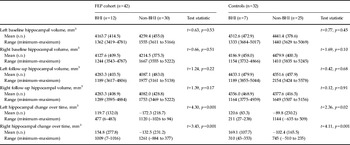
When hippocampal change was investigated as change within-subject, BHI over follow-up was present in 29% of FEP (n = 12) and 22% (n = 7) of control subjects (χ 2 = 0.43, p = 0.60) (Table 2). Mean hippocampal volumes at baseline and at follow-up by BHI and non-BHI groups are shown in Table 3; these did not differ in either patients or controls between BHI and non-BHI groups at either time point (Table 3). However, as expected, change in hippocampal volume (right and left, considered separately) differed significantly between BHI and non-BHI patients, and between BHI and non-BHI controls, with BHI subjects in each case having an increase in hippocampal volume over time and non-BHI subjects having a decrease (Table 3).
Hippocampal volumes: at baseline, at follow-up, and change over time in FEP and control subjects, by BHI and non-BHI

FEP, First-episode psychosis; BHI, bilateral hippocampal increase; s.d., standard deviation.
In patients, there was no difference between BHI and non-BHI groups in any sociodemographic or clinical characteristic, nor in proportion of follow-up on treatment or nature of antipsychotic treatment (typical versus atypical) received (all results in Table 1). Of note, alcohol abuse/dependence was entirely absent in the patients with BHI (0% in BHI; 23% in non-BHI) (χ 2 = 3.36, p = 0.08), while there was no difference between groups in rates of substance misuse/dependence (33% in BHI; 33% in non-BHI) (χ 2 = 0.00, p = 0.65). Including the proportion of the follow-up period on treatment as a covariate in these analyses did not alter any of the findings.
Relationship between brain volumes and outcome
Clinical outcome
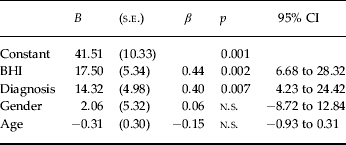
Neither course type (t = 0.72, p = 0.48) nor symptom severity (ρ = 0.23, p = 0.15) was associated with grey matter change. Non-continuous course type was significantly associated with both greater right [Mann–Whitney U (MWU) = 57.0, p = 0.001] and left (MWU = 82.0, p = 0.01) hippocampal volume at follow-up; and with right hippocampal increase over time (MWU = 82.0, p = 0.01); this was true at trend level also for left hippocampal increase over time (MWU = 105.0, p = 0.06). Considering BHI, this was significantly associated with an episodic course type (χ 2 = 5.96, p = 0.01), and subjects with a continuous course were entirely absent from the BHI group (0% in BHI; 37% in non-BHI). Further, BHI was significantly associated with less severe symptoms at follow-up (MWU = 75.0, p = 0.003). Linear regression modelling with age, gender and diagnosis as covariates indicated that BHI (β = 0.44, p = 0.002), and also diagnosis (β = 0.40, p = 0.007), were significant predictors of symptom severity, while age (β = –0.31, n.s.), and gender (β = 2.06, n.s.) were not (Table 4). The overall fit was R 2 = 0.36.
Predictors of symptom severity at follow-up

s.e., Standard error; CI, confidence interval; BHI, bilateral hippocampal increase; n.s., non-significant.
Functional outcome
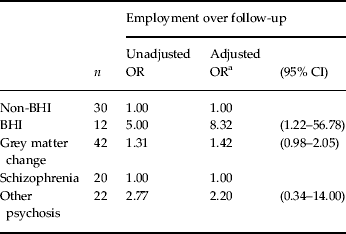
In patients, being employed was predicted by an increase in grey matter (t = 1.98, p = 0.05) but this was not so in controls (t = 0.47, p = 0.65). In patients, right hippocampal volume change over time was not associated with employment during follow-up (MWU = 119.0, p = 0.15), though there was a trend for greater levels of employment with an increase in left hippocampal volume (MWU = 105.0, p = 0.06). However, in controls, neither right (MWU = 102.5, p = 0.67) nor left (MWU = 110.5, p = 0.89) hippocampal volume change was associated with employment. Considering BHI, this predicted greater likelihood of employment during follow-up only in patients (χ 2 = 4.93, p = 0.04). Performing regression modelling in patients demonstrated that employment during follow-up was significantly predicted by BHI (adjusted B = 2.09, p = 0.03) with a very large odds ratio of 8.32 and also at trend level by grey matter volume change (adjusted B = 1.90, p = 0.07), but not by diagnosis (Table 5).
Predictors of employment over follow-up

OR, Odds ratio; CI, confidence interval; BHI, bilateral hippocampal increase.
a Adjusted for age, gender, baseline grey matter intracranial volume.
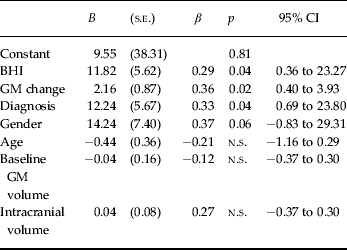
Global function at follow-up in patients was greater in BHI (mean 70.6, s.d. = 16.1) compared with non-BHI (mean 57.0, s.d. = 19.3) subjects (MWU = 100.5, p = 0.03). Regression modelling indicated that global function at follow-up was predicted strongly by BHI (β = 0.29, p = 0.04), by grey matter change (β = 0.36, p = 0.02), by diagnosis (β = 0.33, p = 0.02), and at trend level by gender (β = 0.37, p = 0.06) (Table 6). None of the other variables significantly predicted global function (Table 6). The overall fit was R 2 = 0.47.
Predictors of global function at follow-up

s.e., Standard error; CI, confidence interval; BHI, bilateral hippocampal increase; GM, grey matter; n.s., non-significant.
Verbal recall
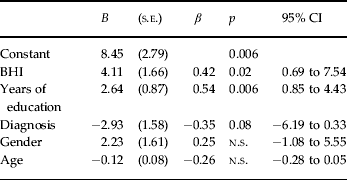
BHI was a significant predictor of verbal recall at follow-up in patients (R 2 = 0.16, β = 0.40, p = 0.02) but not in controls (R 2 = 0.03, β = 0.17, n.s.). In patients only, when the model was adjusted for age, gender, diagnosis and years of education, verbal recall was predicted by BHI (β = 0.42, p = 0.02), by years of education (β = 0.54, p = 0.006), and by diagnosis at trend level (β = 0.35, p = 0.07) (Table 7). None of the variables gender (β = 0.25, n.s.), age (β = 0.26, n.s.) or diagnosis (β = 0.35, n.s.) significantly predicted verbal recall performance. The overall model fit was R 2 = 0.44.
Predictors of verbal recall at follow-up

s.e., Standard error; CI, confidence interval; BHI, bilateral hippocampal increase; n.s., non-significant.
At baseline, neither left (ρ = 0.02, n.s.) nor right (ρ = 0.28, n.s.) hippocampal volumes correlated with baseline verbal recall scores. At follow-up, left hippocampal volume predicted better verbal recall at follow-up (ρ = 0.37, p = 0.04), and right hippocampal volume (ρ = 0.33, p = 0.06) did so at a trend level of significance. Correlations of baseline right and left hippocampal volume with baseline verbal recall scores were non-significant in controls, as were correlations of follow-up right and left hippocampal volumes with follow-up verbal recall scores (results not shown).
Discussion
For the first time, it is demonstrated here that hippocampal volume increase following FEP is associated with better subsequent clinical, functional and cognitive outcomes. Interestingly, there was no evidence of progressive global brain change in FEP patients considered as a group. Nonetheless, in these subjects the presence of grey matter loss over time was associated with poorer functional, though not clinical, outcome.
At both baseline and follow-up, right hippocampal volumes were lower in FEP patients than in controls, with no difference in mean volume change over time. Right (and at trend level, left) hippocampal volume increase over time was strongly associated with a non-continuous course type. However, over follow-up a BHI was present in a substantial proportion of FEP subjects (29%), and was highly significantly associated with a non-continuous course type. Of particular note, no subject with BHI developed a continuous illness course, despite this being observed in 40% of the sample. This is a potentially important finding that requires replication, as it may have far-reaching implications for our understanding of the pathophysiology of psychosis. Interestingly, Schlaufberger et al. (Reference Schaufelberger, Lappin, Duran, Rosa, Uchida, Santos, Murray, McGuire, Scazufca, Menezes and Busatto2011) reported an increase in right hippocampal volume at 18-month follow-up post-FEP, which represented a reversal of the hippocampal decrease they had observed in this sample at baseline (Schaufelberger et al. Reference Schaufelberger, Lappin, Duran, Rosa, Uchida, Santos, Murray, McGuire, Scazufca, Menezes and Busatto2011). Interestingly, their sample also included all psychosis subjects rather than schizophrenia only.
One possible interpretation for the absence of continuous course in subjects with BHI is that neuroplasticity is only possible in periods when the brain is free from psychotic symptoms; alternatively, if neuroplastic change is possible, psychotic processes are halted. The former interpretation is in keeping with a recent theoretical model proposed by Lodge & Grace (Reference Lodge and Grace2011) who argue that a functional dysregulation of subcortical dopamine function underlies schizophrenia, and that this dysregulation occurs secondary to abnormal hippocampal function; restoration of function alleviates dopamine-mediated symptoms and cognitive impairments. An alternative model emphasizes the primacy of stress and cortisol, the main hormone involved in the stress response and associated with changes in hippocampal neuronal function, including reduced neurogenesis (reviewed in Mondelli et al. Reference Mondelli, Cattaneo, Belvederi, Di Forti, Handley, Hepgul, Miorelli, Navari, Papadopoulos, Aitchison, Morgan, Murray, Dazzan and Pariante2011). Recent findings from our group support this, showing that a decreased hippocampal volume at FEP is associated with higher levels of stress and cortisol (Bora et al. Reference Bora, Yucel and Pantelis2009; Mondelli et al. Reference Mondelli, Pariante, Navari, Aas, D'Albenzio, Di Forti, Handley, Hepgul, Marques, Taylor, Papadopoulos, Aitchison, Murray and Dazzan2010). Speculatively, as patients begin to recover from acute psychosis, stress and cortisol levels normalize, and hippocampal neurogenesis and other processes may recover.
The association of BHI with clinical outcome was further validated by regression modelling: BHI strongly predicted lesser symptom severity, with a modelled increased GAF-S score of 17.5 points over non-BHI subjects – a highly meaningful difference. Interestingly, although symptom severity was worse in schizophrenia than in other psychosis, diagnosis did not explain the association between BHI and outcome.
In patients, BHI was also strongly associated with functional outcome: FEP subjects with BHI were eight times more likely to be employed during follow-up than those without – a huge difference in real terms. BHI was the sole significant predictor of employment, with trends for diagnosis, left hippocampal change over time, and grey matter change. BHI was also associated with follow-up global function, with a 12-point higher GAF-F in BHI compared with non-BHI subjects. Poorer global function was additionally predicted by grey matter loss, by male gender, and by schizophrenia diagnosis. These data support the notion that both global and regional brain changes have functional correlates in psychosis, with positive and negative consequences: good global function with BHI; poor global function with progressive grey matter volume loss.
Finally, BHI was associated with superior cognitive outcome: BHI subjects recalled an additional four items from a list of 15 – again, a highly meaningful difference. While this finding is entirely intuitive, given the role of the hippocampus in declarative memory and learning, it is remarkable as it provides the first evidence that cognitive function following FEP is associated with structural hippocampal change. Verbal learning and memory are the cognitive impairments with greatest effect size in schizophrenia (Heinrichs & Zakzanis, Reference Heinrichs and Zakzanis1998), and impaired recruitment of the hippocampus in verbal recall tasks is an established finding in functional imaging studies in schizophrenia (Weiss et al. Reference Weiss, Schacter, Goff, Rauch, Alpert, Fischman and Heckers2003). Nonetheless, given the small sample size, it is essential that future studies seek to replicate this finding.
Despite comparable proportions of BHI and non-BHI in controls, there was no association between BHI and global function or verbal recall. This may suggest that functional and cognitive outcomes related to hippocampal changes in patients are mediated by illness factors, and reflect the propensity to improve from levels of functioning which were lower at the time of illness. In contrast, outcome in controls was already close to ceiling.
Change in right or left hippocampal volume over time was small – of the order of 1% – and did not differ between patients and controls. However, these analyses indicate that where hippocampal increase occurs bilaterally over time following psychosis, there is better outcome across a range of domains. Speculatively, it may be necessary for both hippocampi to have neuroplastic potential to achieve structural and functional recovery. This is beyond the scope of the data presented here but it is a clear direction for future research. The finding that alcohol abuse/dependence was absent in the BHI group is noteworthy; alcohol abuse/dependence per se was not significantly associated with clinical or functional outcomes (results not shown) so is not in itself an explanation for the relationship between BHI and outcomes. Nonetheless, alcohol has a negative impact on neuronal growth, and alcohol use may have excluded BHI occurring. These results should be viewed with caution as numbers are small, but again point to important areas for future research.
The restoration of hippocampal function has been proposed as a potential target for treatment of schizophrenia (Lodge & Grace, Reference Lodge and Grace2011). Although our findings of BHI cannot be interpreted as evidence for restoration of hippocampal function, their association with recovery – superior functioning across clinical, functional and cognitive domains – provides strong indirect support for the model. While it remains to be tested whether enhancing hippocampal activity or function would lead to recovery in FEP, the application of non-invasive interventions such as exercise, recently demonstrated to enhance hippocampal activity, is a testable means of improving outcomes (Pajonk et al. Reference Pajonk, Wobrock, Gruber, Scherk, Berner, Kaizl, Kierer, Muller, Oest, Meyer, Backens, Schneider-Axmann, Thornton, Honer and Falkai2010).
In the sample as a whole there was no significant difference in grey matter volume change over time between patients and controls. It is important to acknowledge that neither baseline nor follow-up brain volumes differed between patients and controls, a finding that may appear at odds with some studies reporting grey matter loss. However, these abnormalities are generally subtle, and in the order of a 2% reduction in whole brain volume compared with healthy controls(Wright et al. Reference Wright, Rabe-Hesketh, Woodruff, David, Murray and Bullmore2000). Second, the outcomes reported here indicate that many participants experienced a relatively mild illness course (30% episodic). It is possible that global brain volume changes become evident in more severely ill populations. Some confirmation of this comes with the evidence here that even minor grey matter changes were associated with outcome: grey matter loss over time was associated strongly with unemployment and with continuous illness course. This supports recent findings that progression of grey matter change in schizophrenia is limited to a subset of poor-outcome individuals, for whom structural changes are associated with poorer outcome (Andreasen et al. Reference Andreasen, Nopoulos, Magnotta, Pierson, Ziebell and Ho2011).
On this basis, Zipursky et al. (Reference Zipursky, Reilly and Murray2012) have argued that the notion of schizophrenia as a progressive disease is ‘a myth’, based in part on selection and attrition bias: recovered patients do not return to psychiatric clinics. Another assumption is that observed changes occur as a result of disease process rather than, for example, of treatment or illicit drug use. Here, neither antipsychotic treatment nor substance use was associated with any change in the brain volume measures reported.
Major strengths of this study were the truly FEP nature of the sample – comprising a full range of diagnoses, ages and gender distribution – and the inclusion of matched controls. A limitation, inherent to all longitudinal studies, is that not all subjects were followed up. Nonetheless, there were no differences in baseline characteristics between subjects who were and were not included at follow-up, indicating that the possibility of bias is unlikely. A further limitation is the small sample size, and the small number of psychosis subjects in the subsample with BHI. Furthermore, the extent of change in hippocampal volume over time was small – of the order of 1%.
Nonetheless, despite these caveats, the findings point to the presence of a subset of FEP subjects for whom recovery is achievable, and in whom there are anatomical correlates of their cognitive, clinical and functional outcomes. These results require replication in other first-episode samples, but are exciting and provide support for models of hippocampal dysregulation and neuroplasticity underlying the pathophysiology of psychosis, which may ultimately represent modifiable treatment targets.
Supplementary material
For supplementary material accompanying this paper visit http://dx.doi.org/10.1017/S0033291713001712.
Acknowledgements
We thank the AESOP researchers who helped with data collection, and all the participants who made the study possible.
The study was supported by the National Institute for Health Research (NIHR) Biomedical Research Centre for Mental Health at South London and Maudsley NHS Foundation Trust and Institute of Psychiatry, King's College London. This work was supported by the UK Medical Research Council (grant number G0500817) and a NARSAD Young Investigator Award to J.M.L. We thank the Stanley Medical Research Institute for their support.
C.M. and R.M.M. receive funding from the Wellcome Trust (grant no. HEALTH-F2-2009-241909) (Project EU-GEI) and the European Union (European Community's Seventh Framework Program; grant no. HEALTH-F2-2009-241 909; Project EU-GEI). A.A.T.S.R. is supported by the Netherlands Organization for Scientific Research (www.nwo.nl), NWO-VENI (grant no. 451-07-009).
Declaration of Interest
The interests of P.B.J. within the past 5 years include an unrestricted investigator grant from GSK and serving on a scientific advisory board for Roche. R.M.M. has received honoraria for lectures from Roche, AstraZeneca, Janssen, Lilly and BMS.