Domestic herbivores can have an important ecological role by acting as agents of plant dissemination (Baraza & Fernández-Osores Reference BARAZA and FERNÁNDEZ-OSORES2013, Sánchez de la Vega & Godínez-Álvarez Reference SÁNCHEZ DE LA VEGA and GODÍNEZ-ÁLVAREZ2010). In the Tehuacán-Cuicatlán Valley, Mexico, which is one of the semi-arid zones of greatest biological diversity in the world (Dávila et al. Reference DÁVILA, ARIZMENDI, VALIENTE-BANUET, VILLASEÑOR, CASAS and LIRA2002), goats were introduced during the colonial period and extensive herding has since then become the most important resource for the local population. Baraza & Valiente-Banuet (Reference BARAZA and VALIENTE-BANUET2008) reported the presence of viable cactus and legume seeds in domestic goat faeces, indicating their potential role as plant dispersers. Mimosa luisana Brandegee is a legume species with an important functional role in the study area, since it is able to create favourable soil and shade conditions for the establishment of other plant species (Camargo-Ricalde et al. Reference CAMARGO-RICALDE, REYES-JARAMILLO and MONTAÑO2010). In this study, we evaluated if the domestic goat (Capra hircus L.) is a legitimate (i.e. has the potential for seeds to pass the goat digestive system without damage; Herrera Reference HERRERA1989) and efficient (i.e. deposits seeds in suitable sites for germination; Reid Reference REID1989) disperser of M. luisana seeds. Gut treatment on seeds was assessed since it is strongly linked with legitimacy, as the digestion process could destroy seeds or alter the speed of their germination, thus modifying germination patterns (Schupp Reference SCHUPP1993). We also evaluated the retention time of M. luisana seeds since it is highly connected with the distance that seeds are dispersed (Or & Ward Reference OR and WARD2003).
The study was conducted in the Tehuacán-Cuicatlán Valley, Puebla, Mexico located at 17°20′–18°53′N and 96°55′–97°44′W. Fieldwork was conducted within the municipality of Zapotitlán Salinas, at the altitudinal range of 1700–2000 m asl. The mean annual precipitation (mainly occurring from July to August) and temperature is 400 mm and 21 °C, respectively (Dávila et al. Reference DÁVILA, ARIZMENDI, VALIENTE-BANUET, VILLASEÑOR, CASAS and LIRA2002). The vegetation is classified as xeric shrubland (Rzedowski Reference RZEDOWSKI1978) and characterized by the presence of columnar cacti. Mimosa luisana, is a thorny shrub or tree, flowering from April to November and fruiting from September to December (Camargo-Ricalde et al. Reference CAMARGO-RICALDE, DHILLION and GARCÍA-GARCÍA2004) and it is endemic to Mexico (Martínez-Bernal & Grether Reference MARTÍNEZ-BERNAL, GRETHER, Novelo and Medina-Lemus2006). The fruit is a dry one-carpel pod, with each pod containing two to eight seeds. Seeds are small (2.7–3.5 mm long, 2.4–2.6 mm wide and 2.0–2.7 mm high), shiny dark brown and characterized by a lentil form (Martínez-Bernal & Grether Reference MARTÍNEZ-BERNAL, GRETHER, Novelo and Medina-Lemus2006) with hard seed coats that impose seed dormancy; consequently, scarification is needed to break seed dormancy (Camargo-Ricalde et al. Reference CAMARGO-RICALDE, DHILLION and GARCÍA-GARCÍA2004).
To evaluate deposition patterns, goat pellets were collected in four rectangular transects of 25 × 2 m randomly located in a grazing area. The microhabitat (open areas, canopy areas and boulder-dominated areas) of pellet locations were recorded. Pellet collection was repeated three times in October and November 2007 and the first collection also included old pellets already present in the transects. All goat pellets were analysed for the presence of M. luisana seeds. A chi-square test was used to assess whether goat pellet deposition in the microhabitats was independent of collection periods. A Bonferroni z-test method (P < 0.05) was used to test goat microhabitat preferences for defecation in relation to habitat occurrence (Neu et al. Reference NEU, BYERS and PEEK1974). In total (n = 1958 pellets) 77.5% were found in open areas, 19.5% in canopy areas and 3% in boulder-dominated areas. The distribution of goat pellets in the three microhabitats was independent of collection period (χ2 = 8.96; df = 4; P = 0.06) but differed among microhabitats (χ2 = 459; df = 2; P < 0.01), with pellet density higher than expected in open areas. Only one M. luisana seed was found within the transect survey.
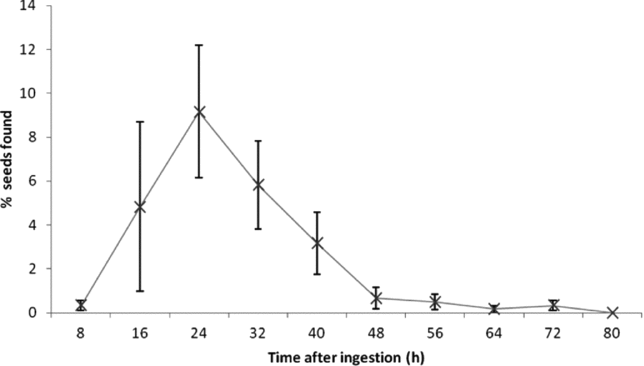
To assess seed retention time and presence of viable seeds in goat pellets, six pregnant goats (26.8 ± 1.8 kg) randomly selected from the same local herd, were penned individually and fed with 3000 M. luisana seeds mixed with alfalfa and corn stubble. The goats finished the batch in about 1 h and were then fed with alfalfa and corn stubble during the whole length of the experiment. All pellets produced by each goat were collected every 8 h over a period of 80 h (0–8, 8–16, 16–24, 24–32, etc. h after seed ingestion). A subsample of 20 g of faeces dried in thermostatic chamber (50 °C) was taken from each collection for each goat and analysed for presence of M. luisana seeds. Seeds that appeared intact under a stereomicroscope were considered as potentially dispersed. In contrast, seeds that were cracked or showed signs of digestion were considered predated and unable to germinate. Of the ingested seeds, 5.9% ± 2.86% (mean ± SD) survived the goat digestive treatment. Two seeds were found at the 0–8 h interval, 67% ± 25.9% were found 8–32 h after ingestion, and two seeds were recorded as much as 72 h after ingestion (Figure 1). Similarly to what Or & Ward (Reference OR and WARD2003) reported for Acacia sp., bruchids such as Acanthoschelides mexicanus Sharp and Acanthochselides chiricahuae Fall, can negatively influence the resistance of seeds to mastication and digestive acids. Consequently, seeds used to feed the goats were checked for infestation by bruchids and an infestation curve was built, resulting in an estimate of 44.8% seed infestation. Among recovered ingested seeds, none showed any signs of bruchid infestation.
Per cent (mean ± SE) of seeds of Mimosa luisana found in domestic goat (n = 6) faeces as a function of time since seeds were ingested, Tehuacán-Cuicatlán Valley, Mexico. Goats were fed with 3000 M. luisana seeds mixed with alfalfa and corn stubble and then fed with alfalfa and corn stubble during the whole length of the experiment. Goat pellets were collected every 8 h over a period of 80 h.

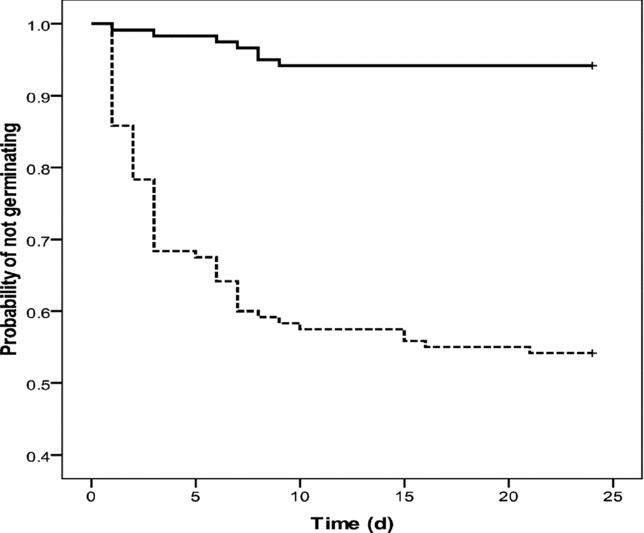
To evaluate the effects of endozoochory on seed germination, we established a germination experiment with 120 ingested and 120 control seeds collected from the same mother plants and in the same day. Cracked seeds, seeds that floated in water or showed any signs of bruchid infestation were discarded. The ingested seeds sample included seeds recovered at all retention times and reflected the retention time curve. Seeds were washed with a 3% detergent and disinfected with a 5% chlorine solution for 5 s (Camargo-Ricalde et al. Reference CAMARGO-RICALDE, DHILLION and GARCÍA-GARCÍA2004). Twenty-four Petri dishes containing five seeds each were set up for ingested and control seeds and randomly placed in a germination chamber set at a constant 25 °C and with a 12-h photoperiod for 24 d. Germination (i.e. radicle reached 1 mm in length) functions were built for each treatment by using the Kaplan–Meier estimators and compared by means of non-parametric generalized log-rank and Wilcoxon tests (McNair et al. Reference MCNAIR, SUNKARA and FORBISH2012). Germination of ingested seeds was higher than control seeds (log-rank test, χ2 = 51.9; df = 1; P < 0.001) (Figure 2). Passage through the digestive also shortened the mean germination time, which was 23.0 ± 0.39 d for control seeds and 14.9 ± 0.94 d for ingested seeds. Goat gut passage shortened the initial time of germination (χ2 = 52.1; df = 1; P < 0.001).
Probability of not germinating of ingested (stippled line) and control (solid line) Mimosa luisana seeds, based on Kaplan–Meier estimates, Tehuacán-Cuicatlán Valley, Mexico. The final crosses represent censored observation. Differences in germination curves are significant (log-rank test, P < 0.001; Wilcoxon test, P < 0.001). The germination chamber was set at a constant 25 °C and with a 12-h photoperiod for 24 d. Germination was defined as when the radicle reached 1 mm in length.
This study shows that free-ranging goats could act both as legitimate and efficient dispersers of M. luisana seeds, although the percentage of seeds able to survive the gut passage is small. Low seed survival following ungulate digestion has been found in several studies (Grande et al. Reference GRANDE, MANCILLA-LEYTÓN, DELGADO-PERTIÑEZ and MARTÍN-VICENTE2013, Mancilla-Leytón et al. Reference MANCILLA-LEYTÓN, FERNANDÉZ-ALÉS and MARTÍN VICENTE2011) and the percentage of M. luisana seeds that we retrieved intact after the gut passage (5.91%) is similar to what observed for other seeds with similar size (Mancilla-Leytón et al. Reference MANCILLA-LEYTÓN, FERNANDÉZ-ALÉS and MARTÍN VICENTE2011). Size was shown to be negatively correlated to seed recovery (Grande et al. Reference GRANDE, MANCILLA-LEYTÓN, DELGADO-PERTIÑEZ and MARTÍN-VICENTE2013) primarily due to seed mastication, as was evident by seed fragments found in the faeces. Low seed survival is also caused by high bruchid infestation (Or & Ward Reference OR and WARD2003). With the estimated bruchid infestation close to 50%, none of the ingested seeds had any sign of infestation. Thus, gut treatment apparently destroyed all bruchid-infested seeds. Accordingly the percentage of M. luisana seeds able to survive gut passage could increase in years with few bruchids.
The passage through the goat digestive system enhanced seed germination by increasing the quantity of seeds able to germinate and shortening initial and mean germination time. Since excreted seeds are virtually ready to germinate, they may take advantage of rainfall events, which could improve their seedling development and inter- and intraspecific seedling competition (Izhaki & Safriel Reference IZHAKI and SAFRIEL1990).
The spatial distribution of pellets is important to ensure seeds are potentially deposited in suitable sites. In this study, pellet density was higher than expected in open areas and lower than expected under canopy or on boulder-dominated areas. Mimosa luisana can act as a pioneer species (Badano et al. Reference BADANO, PÉREZ and VERGARA2009) and it is common in abandoned fields (Camargo-Ricalde et al. Reference CAMARGO-RICALDE, DHILLON and GRETHER2002). Since abandoned fields are used as pasture by local shepherds (pers. obs.), goats may facilitate its migration from the mother plant to open areas. The functional importance of goats is enhanced by the fact that wild large herbivores, notably the native deer, Odoicoleucus virginianus, are essentially extinct from this area (Dávila et al. Reference DÁVILA, ARIZMENDI, VALIENTE-BANUET, VILLASEÑOR, CASAS and LIRA2002).
Although only one seed was found in the pellets collected in the wild, it is important to note that this survey covered only 200 m2. Assuming a constant seed rain estimate of 1 seed per 200 m2, this would determine a deposition of 5000 seeds km−2, which could increase in years with little bruchid infestation. Considering that goats graze over an area of hundreds of km2, the total quantity of seeds they are able to deposit may, therefore, be important. Studies on long-distance dispersal have stressed that even a very small amount of seed present in the faeces can be of great significance for vegetation dynamics and population genetic structure and rare long-distance dispersal seems to be crucial for invasion dynamics and vegetation response to changes in land use (Myers et al. Reference MYERS, VELLEND, GARDESCU and MARKS2004). In addition, low seedling density allows seeds to escape from high competition environments and can be an advantage for seed and seedling survival from predators (Wang & Smith Reference WANG and SMITH2002).
In the study area, goats are released from corrals on a regular basis (pers. obs.). Seeds excreted 24 h after ingestion were more likely to be deposited outside the corral, while those excreted before 16 h or after 32 h were more likely to be deposited inside the corral. Similarly to Baraza & Fernández-Osores (Reference BARAZA and FERNÁNDEZ-OSORES2013), we found that more than half of the seeds (67%) were excreted between 8 and 32 h after ingestion and the curve peaked 24 h after ingestion, increasing the probability of seeds to be dispersed in favourable habitats.
We conclude that goats may function as legitimate and efficient dispersers of M. luisana seeds and facilitate re-colonization in abandoned agricultural fields and in degraded areas.
ACKNOWLEDGEMENTS
Oscar Delgado and Laura Asteggiano helped during the feeding experiment, Dr Alfonso Valiente-Banuet gave us access to his lab at the UNAM and the population of San Juan Raya allowed us to work in the area. The Norwegian University of Life Sciences and the Universidad Autónoma Metropolitana-Iztapalpa co-funded the study.