Introduction
Botulinum toxin has many uses in medicine, including the treatment of wrinkles, bladder dystonia, drooling, bruxism, Frey's syndrome and perspiration.Reference Moerman1 The impact of cricopharyngeal muscle dysfunction on patients’ swallowing is well documented.Reference Kelly, Koszewski, Jaradeh, Merati, Blumin and Bock2 The swallowing mechanism is very complex, but a crucial component relies on the relaxation of the cricopharyngeus muscle to facilitate movement of the food bolus through the upper oesophageal sphincter into the cervical oesophagus.
There are various described techniques for treating cricopharyngeal muscle spasm, including cricopharyngeal myotomy and bougie dilatation. Transcervical myotomy has been shown to be effective in treating cricopharyngeal muscle dysfunction; however, recurrent laryngeal nerve injury is a recognised risk.Reference Kelly3, Reference McKenna and Dedo4 There is also some evidence to suggest that, whilst effective in opening the upper oesophageal sphincter, transcervical myotomy does not alter the contractile forces of the cricopharyngeal muscle and therefore may not benefit every patient with cricopharyngeal muscle dysfunction.Reference Allen, White, Leonard and Belafsky5 Reports of successful endoscopic laser cricopharyngeal myotomy suggest that it is an effective alternative.Reference Dauer, Salassa, Iuga and Kasperbauer6
Injecting botulinum toxin into the cricopharyngeal muscle was first described by Schneider et al. in 1994 in a series of seven patients.Reference Schneider, Thumfart, Pototschnig and Eckel7 Since then, there have been several reports of this technique; these have demonstrated improvement in swallowing outcomes in all cases, with minimal complications.Reference Parameswaran and Soliman8, Reference Murry, Wasserman, Carrau and Castillo9 There are several advantages of botulinum toxin injection as compared to transcervical myotomy, including relatively lower risks overall, the potential to be performed under local anaesthesia and its use as a diagnostic tool to identify those patients who may benefit from a cricopharyngeal myotomy.Reference Scholes, McEvoy, Mousa and Wiet10, Reference Blitzer and Brin11
Our study aimed to investigate the efficacy of botulinum toxin injection into the cricopharyngeus muscle under direct endoscopic guidance and to evaluate the duration of effects in treating dysphagia.
Materials and methods
This study was approved by the Barking, Havering and Redbridge University Hospitals NHS Trust Clinical Governance Department.
A prospective study was conducted of 12 patients undergoing endoscopic-guided injection of botulinum toxin into the cricopharyngeus muscle to treat dysphagia between September 2011 and October 2014. The inclusion criteria included: patient age greater than 18 years, accurate contact details, and a documented history of cricopharyngeal dysphagia based on clinical history and radiological evidence. Exclusion criteria included: the presence of a pharyngeal pouch greater than 2 cm, a tumour or an oesophageal web.
The patients in the study took part in a telephone survey using a validated dysphagia-related quality of life instrument, the MD Anderson Dysphagia Inventory.Reference Chen, Frankowski, Bishop-Leone, Hebert, Leyk and Lewin12 This consists of a global question (scored out of 5) regarding impact on day-to-day life, and 19 items (scored out of 5) focusing on functional and emotional aspects of the swallowing disorder. Patients were scored pre-operatively, and at one month, three months and six months post-treatment.
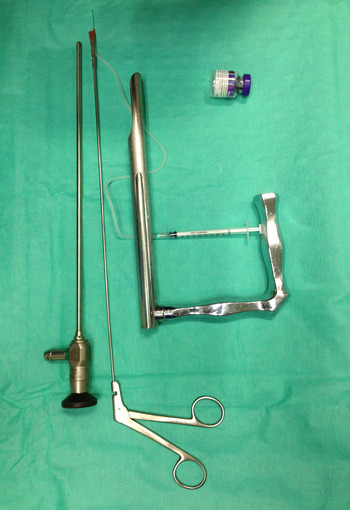
All patients received the botulinum toxin injection using the same technique. A pharyngoscope was inserted in order to visualise the cricopharyngeus muscle and secured with suspension apparatus. Botulinum A toxin (100 U) (Botox; Allergan, Irvine, California, USA) was diluted with normal saline to form a solution of 1 ml in a syringe. This was then connected to a winged infusion set (size 21 G) via flexible small-bore transparent tubing and a Luer lock (Terumo Medical, Somerset, New Jersey, USA). One of the flexible ‘wings’ were then completely removed and the other cut short, in order to permit access through the pharyngoscope and so that the winged infusion set could still be held with a pair of endoscopic grasping forceps. Figure 1 demonstrates the instruments needed for the procedure.
Instruments required for botulinum toxin injection into cricopharyngeus muscle.

The hypodermic needle of the winged infusion set was then inserted into the posterior part of the cricopharyngeus muscle (to avoid paralysis of the laryngeal muscles), and the solution was injected under endoscopic guidance at three points, at approximately four, six and eight o'clock positions. In order to ensure that none of the solution remained in the tubing, a washout of normal saline through the 1 ml syringe was used to expel the botulinum toxin from the tubing into the muscle.
Statistical analysis and comparisons were carried out using a paired student's t-test, and significance was set at p < 0.05 (GraphPad Software, La Jolla, California, USA).13
Results
Twelve patients underwent endoscopic-guided injection of botulinum toxin into the cricopharyngeus muscle during the study period. The median age of patients was 66.2 years (range, 54–79 years). Two patients had repeat injections during the study period, approximately six months after the initial injection. All 12 patients (100 per cent) underwent a barium swallow examination prior to surgical intervention. Ten patients (83 per cent) had videofluoroscopy pre-operatively; the findings demonstrated some element of cricopharyngeal muscle dysfunction in all 10 patients.
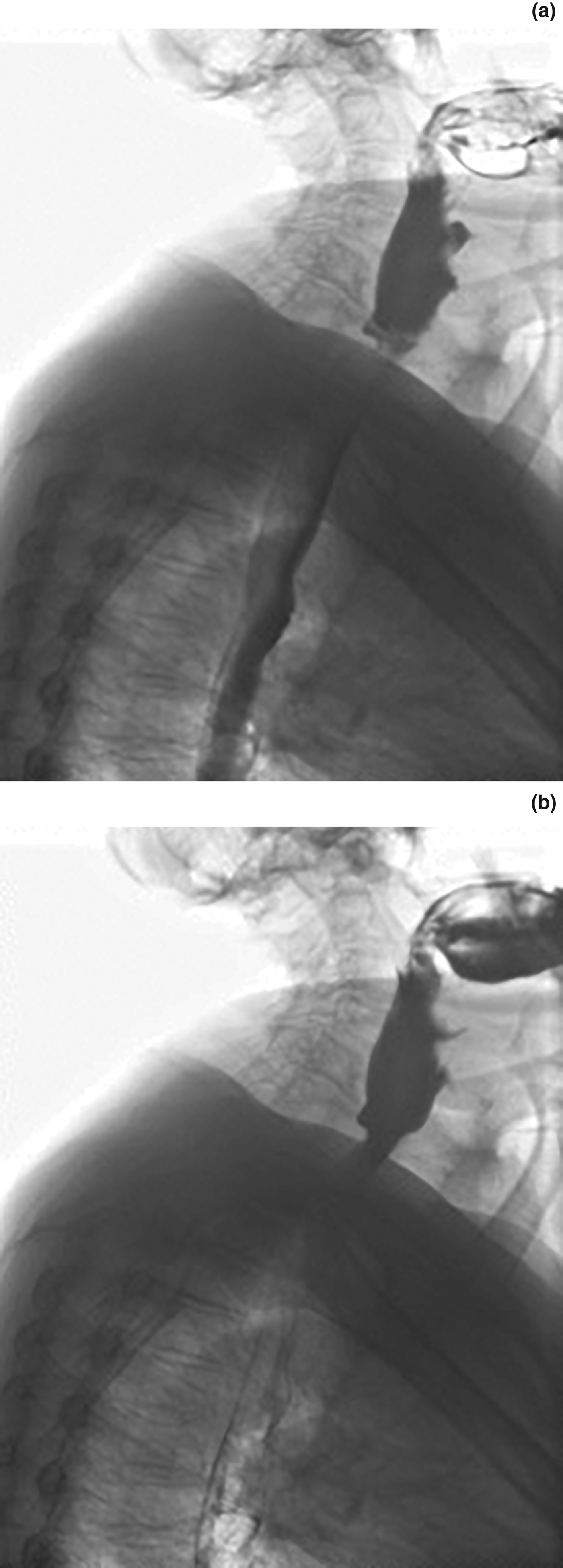
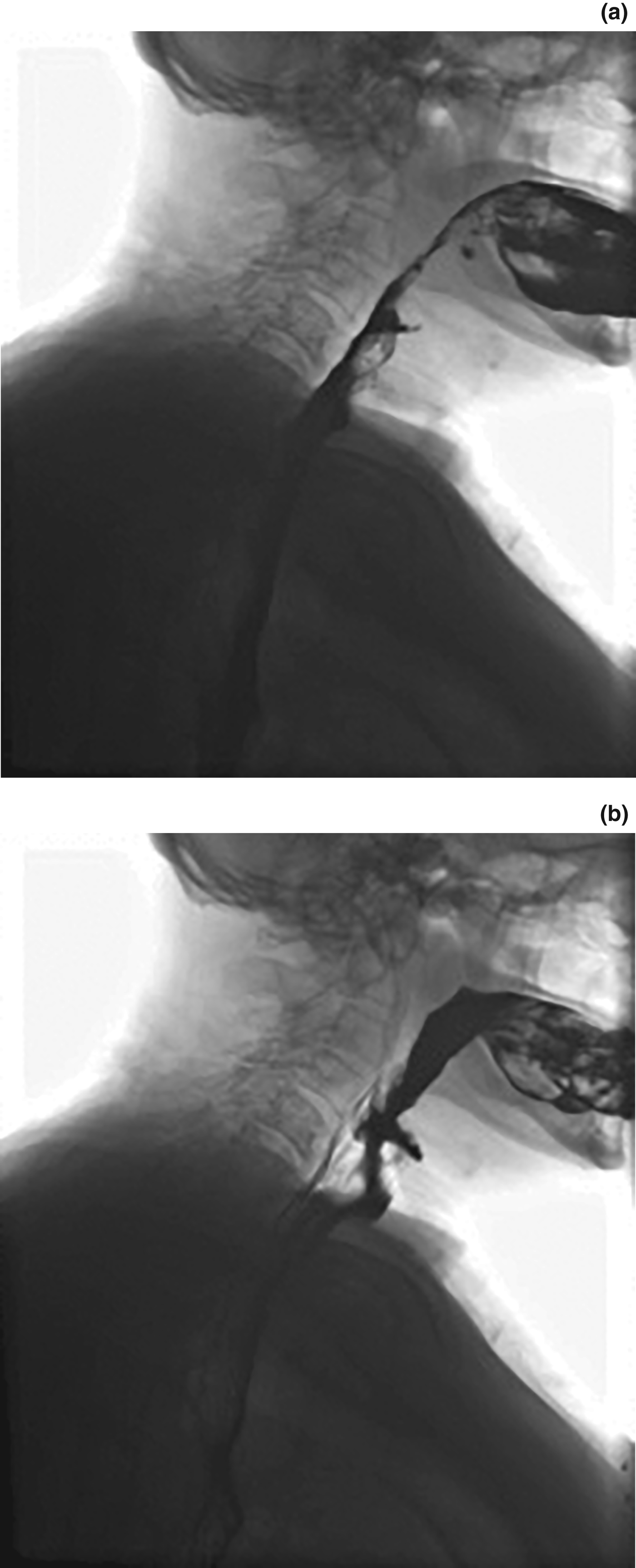
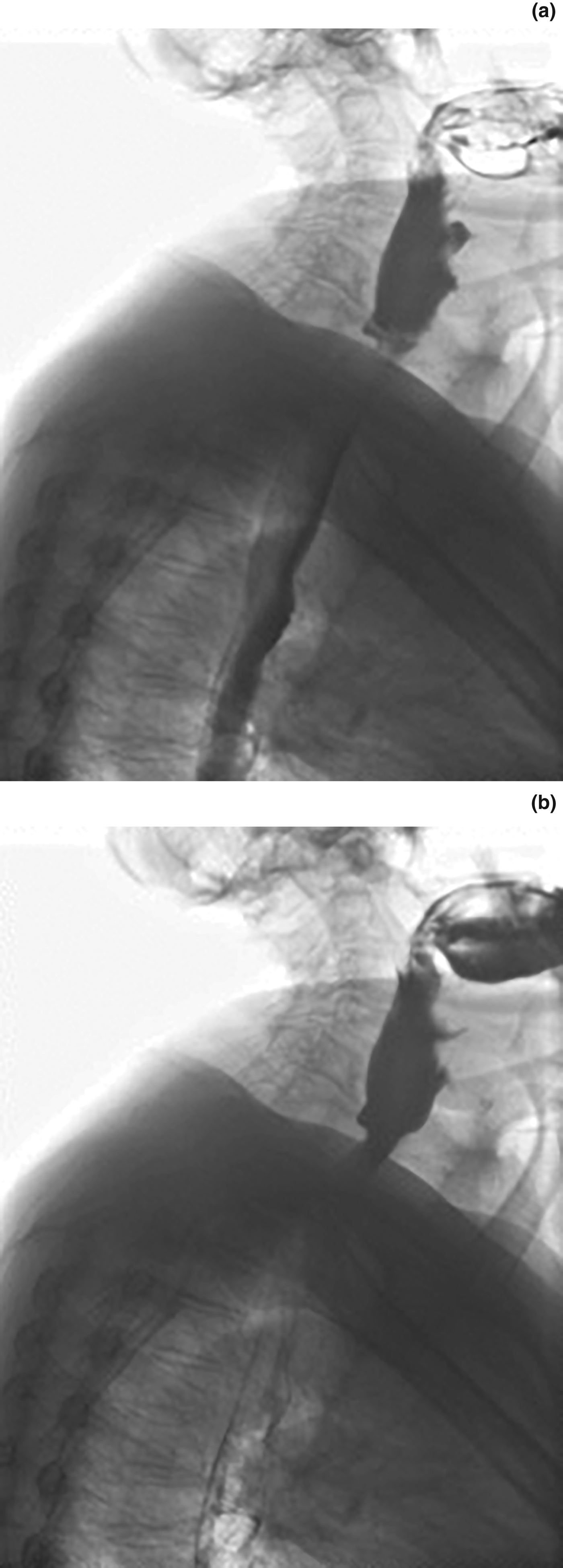
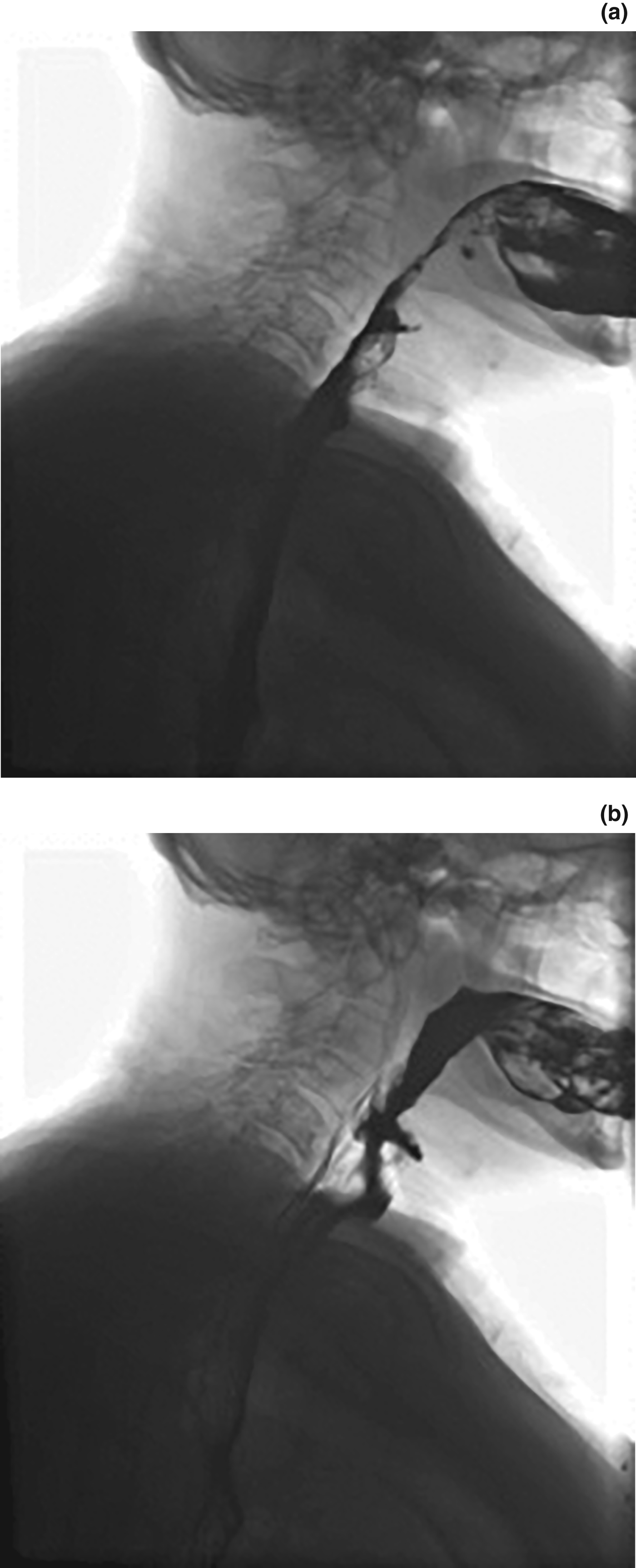
The causes of cricopharyngeal dysphagia included: idiopathic cricopharyngeal hypertrophy (8 out of 12 cases, 67 per cent), previous cerebrovascular accident (2 out of 12 cases, 17 per cent), cranial nerve palsy (1 out of 12 cases, 8 per cent) and previous chemoradiotherapy to the neck (1 out of 12 cases, 8 per cent). There were no complications post-procedure. Figures 2 and 3 demonstrate the contrast swallow test findings pre-operatively and at one month post-operatively for one of the patients.
Pre-botulinum toxin injection contrast swallow test findings (a and b), demonstrating small pouch.
Post-botulinum toxin injection contrast swallow test findings (a and b), demonstrating resolution of small pouch.
Two patients did not report a significant improvement in MD Anderson Dysphagia Inventory scores at one and three months post-operatively. One of these patients was a 57-year-old female (with a previous history of cerebrovascular accident leading to dysphagia and percutaneous endoscopic gastrostomy tube insertion 5 years previously) who was unable to swallow her own saliva and had to carry a bowl into which to spit. This contributed to her frequent admissions to hospital (almost every other month) for chest infections. Videofluoroscopy suggested no elevation of the larynx and spillover into the larynx with cricopharyngeal spasm. The patient was counselled regarding the aim of cricopharyngeal botulinum injection, which was to help her swallow her saliva. Six months after the procedure, she continues to be able to swallow her saliva and does not suffer from recurrent chest infections, but she is still dependent on her percutaneous endoscopic gastrostomy tube for feeding.
The second patient with no significant score improvement was a 67-year-old diabetic male. He had a two-year history of dysphagia and videofluoroscopy findings suggestive of a small pharyngeal pouch, with cricopharyngeal spasm. As the pouch was small, botulinum toxin injection was discussed as an option and the patient consented to this. After the procedure, there was no improvement in his dysphagia. Functional endoscopic evaluation of swallowing was performed, which revealed normal oropharyngeal swallowing. Repeat Gastrografin® swallow post-procedure showed no pouch and no more cricopharyngeal spasm. The patient was started on domperidone, but his symptoms became worse. Oesophageal manometry was performed, which revealed loss of peristalsis in the mid-third of the oesophagus. The patient's insulin regime was changed and he was counselled for percutaneous endoscopic gastrostomy tube insertion as he had lost a considerable amount of weight over the preceding two years.
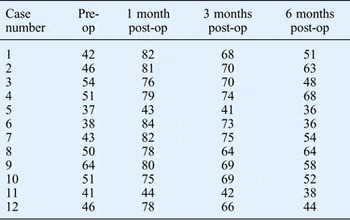
There was significant improvement in the MD Anderson Dysphagia Inventory scores at one and three months in comparison to the pre-operative scores (73.1 ± 14.9 vs 46.9 ± 7.6, p = 0.0001, and 65.1 ± 11.5 vs 46.9 ± 7.6, p = 0.0001), but there was no significant improvement in MD Anderson Dysphagia Inventory scores at six months when compared to the pre-operative scores (51.0 ± 11.0 vs 46.9 ± 7.6, p = 0.14) (Table I).
MD Anderson Dysphagia Inventory scores

Pre-op = pre-operative; post-op = post-operative
Discussion
We have demonstrated the clinical efficacy of endoscopic-guided botulinum toxin injections for treating cricopharyngeal dysfunction. The causes of cricopharyngeal dysfunction are diverse, and there is still considerable variation in the methods used to treat this condition. There are very little good data to compare different techniques, and perhaps more studies, with larger numbers of patients, are warranted to compare the efficacy of endoscopic botulinum toxin injection versus transcervical myotomy or local anaesthesia transcutaneous injections. It is difficult to make any conclusions as to who may benefit from endoscopic injection, but this method can be used as a screening tool as it is so well tolerated. Those patients who do not see much benefit from injection may be considered for more invasive interventions, whilst those patients that have a definite benefit can go on to have repeated injections as and when necessary.
We identified 22 studies in the literature, using the search items ‘botulinum toxin’, ‘cricopharyngeus’ and ‘dysphagia’, that described the efficacy of botulinum injections in the cricopharyngeus muscle.Reference Moerman1, Reference Kelly, Koszewski, Jaradeh, Merati, Blumin and Bock2, Reference Schneider, Thumfart, Pototschnig and Eckel7–Reference Murry, Wasserman, Carrau and Castillo9, Reference Blitzer and Brin11, Reference Atkinson and Rees14–Reference Woisard-Bassols, Alsehri and Simonetta-Moreau29 The majority of these studies involved small case series of up to 10 patients. The largest of these studies involved 49 patients.Reference Kelly, Koszewski, Jaradeh, Merati, Blumin and Bock2 All the studies demonstrated a significant number of patients with improvement in their symptoms post-intervention. However, there was such widespread variation in techniques, doses and patient selection that it is difficult to make meaningful comparisons. In addition, no factors have yet been identified that predict which patients will benefit from injections. Some studies have suggested that patients who do not benefit from injections may have a prolonged transition time between the oral and pharyngeal stages of swallowing, and therefore may benefit from electrophysiological assessment.Reference Alfonsi, Merlo, Ponzio, Montomoli, Tassorelli and Biancardi27
Some researchers have investigated the histology of cricopharyngeal dysfunction, and one paper has suggested that there are histological patterns in specimens taken from the cricopharyngeus muscle that can predict responses to botulinum toxin.Reference Davis, Merati, Jaradeh and Blumin30 However, there are no clear trends in this study and in other papers, and the sample sizes reported are far too small to draw any conclusions.Reference Kelly, Koszewski, Jaradeh, Merati, Blumin and Bock2
• Botulinum toxin has many uses in ENT, including treatment of drooling, bruxism, Frey's syndrome and cricopharyngeal muscle dysfunction
• Cricopharyngeal muscle dysfunction causes significant swallowing problems for patients
• The cricopharyngeal muscle is often a target for dysphagia treatment, which includes balloon dilatation, myotomy and botulinum toxin injection
• Endoscopic-guided botulinum toxin injection into the cricopharyngeus muscle is a safe and effective method for treating cricopharyngeal muscle dysfunction
• This treatment results in significant improvement of dysphagia-related quality of life
• Botulinum toxin injection can be undertaken under a short general anaesthesia with a low risk of complications, with effects lasting up to six months
Kelly et al. have previously reported that the transcutaneous injection method can fail to result in improvement because of incorrect placement of the injection.Reference Kelly, Koszewski, Jaradeh, Merati, Blumin and Bock2 They described several patients who showed significant improvement in swallowing after receiving injections under general anaesthesia with endoscopic guidance, despite no improvement being observed following injection in the clinic. This lends support to our technique being more successful, even though it does involve a short general anaesthetic.
One of the main strengths of this study was the use of a robust decision-making process for determining which patients to select for injection. The procedure was only performed by one of three surgeons within our institution who were experienced in the procedure, using the same technique and dosage for patients with cricopharyngeal dysfunction. We also used a validated questionnaire for measuring swallowing function in a prospective manner, over an extensive follow-up period, to improve the reliability of our results.
This study demonstrates the safety and efficacy of using endoscopic botulinum toxin injection for the treatment of cricopharyngeal dysfunction. A significant improvement in swallowing scores was found post-injection treatment; however, it would appear that the effects are only temporary and patients may well require repeat injections after six months.
To our knowledge, this is the first study to investigate the effect of time on improvement of dysphagia following endoscopic-guided botulinum toxin injection. Nevertheless, the number of cases is relatively small, which makes it difficult to draw meaningful statistical conclusions. In addition, there will likely be an element of responder bias as patients may well respond to questions with answers that they perceive the researcher may want to hear. However, our results, which show improvement in dysphagia scores following the intervention, are similar to those of other studies with greater case numbers from elsewhere in the world. Further studies will help to generate more evidence regarding the length of time of botulinum toxin injection efficacy.
Acknowledgement
Grateful thanks to the administrative staff in the ENT Department at Queen's Hospital, Romford, UK.