Introduction
Sexual, emotional or physical abuse or neglect in childhood significantly increase the odds of psychotic symptoms in adolescence or adulthood (Varese et al. Reference Varese, Smeets, Drukker, Lieverse, Lataster, Viechtbauer, Read, Van Os and Bentall2012). There is also evidence from cross-sectional and retrospective studies that systematic abuse of power by peers in the form of bullying may be associated with psychosis or non-clinical psychotic symptoms in 12- to 17-year-olds (van Dam et al. Reference Van Dam, Van Der, Velthorst, Selten, Morgan and De Haan2012; Varese et al. Reference Varese, Smeets, Drukker, Lieverse, Lataster, Viechtbauer, Read, Van Os and Bentall2012) and adults (Trotta et al. Reference Trotta, Di Forti, Mondelli, Dazzan, Pariante, David, Mule, Ferraro, Formica, Murray and Fisher2013). Prospective studies in early adolescence confirm these findings (Schreier et al. Reference Schreier, Wolke, Thomas, Horwood, Hollis, Gunnell, Lewis, Thompson, Zammit, Duffy, Salvi and Harrison2009; Arseneault et al. Reference Arseneault, Cannon, Fisher, Polanczyk, Moffitt and Caspi2011; Wigman et al. Reference Wigman, Van Winkela, Raaijmakersa, Ormela, Verhulst, Reijneveld, Van Os and Vollebergh2011; Mackie et al. Reference Mackie, Castellanos-Ryan and Conrod2011, Reference Mackie, O'Leary-Barrett, Al-Khudhairy, Castellanos-Ryan, Struve, Topper and Conrod2013) and the predictive relationships appear to be as high or even higher in prospective studies compared with cross-sectional studies (van Dam et al. Reference Van Dam, Van Der, Velthorst, Selten, Morgan and De Haan2012; Varese et al. Reference Varese, Smeets, Drukker, Lieverse, Lataster, Viechtbauer, Read, Van Os and Bentall2012). Where assessed, psychotic symptoms were more persistent over a 24-month period amongst adolescents who were bullied (Mackie et al. Reference Mackie, Castellanos-Ryan and Conrod2011, Reference Mackie, O'Leary-Barrett, Al-Khudhairy, Castellanos-Ryan, Struve, Topper and Conrod2013). Moreover, studies suggest that psychotic experiences in childhood predict psychotic experiences in adolescence and adulthood (Poulton et al. Reference Poulton, Caspi, Moffit, Cannon, Murray and Harrinton2000; Welham et al. Reference Welham, Scott, Williams, Najman, Bor, O'Callaghan and McGrath2009). Hence, early psychotic experiences may mediate the association between bullying and psychotic experiences in later adulthood.
However, there are only a few longitudinal studies investigating the relationship between bullying and psychotic experiences (van Dam et al. Reference Van Dam, Van Der, Velthorst, Selten, Morgan and De Haan2012). Most have short follow-up periods ranging from 12 months (Kelleher et al. Reference Kelleher, Keeley, Corcoran, Ramsay, Wasserman, Carli, Sarchiapone, Hoven, Wasserman and Cannon2013b ) to 5 years (Janssen et al. Reference Janssen, Krabbendam, Bak, Hanssen, Vollebergh, De Graaf and Van Os2004; Spauwen et al. Reference Spauwen, Krabbendam, Lieb, Wittchen and Van Os2006; Schreier et al. Reference Schreier, Wolke, Thomas, Horwood, Hollis, Gunnell, Lewis, Thompson, Zammit, Duffy, Salvi and Harrison2009) and none of the previous studies assessed bullying behaviour in childhood and psychotic experiences into late adolescence and controlled for a range of pre-existing and concurrent psychiatric and cognitive problems. The follow-up of bullied children until early adulthood, when the first expression of psychosis is expected, is necessary to clarify the direction and strength of this association (van Dam et al. Reference Van Dam, Van Der, Velthorst, Selten, Morgan and De Haan2012). Furthermore, previous research indicates that not only victims but also bullies may more often have concurrent psychotic experiences (Kelleher et al. Reference Kelleher, Harley, Lynch, Arseneault, Fitzpatrick and Cannon2008; Nishida et al. Reference Nishida, Tanii, Nishimura, Kajiki, Inoue, Okada, Sasaki and Okazaki2008) and those who bully others and become victims themselves (bully/victims) have the highest risk for any mental health problems (Arseneault et al. Reference Arseneault, Bowes and Shakoor2010; Winsper et al. Reference Winsper, Lereya, Zanarini and Wolke2012). Moreover, a dose–response relationship between the number of victimization events and the risk for psychotic symptoms in early adolescence has been found (Schreier et al. Reference Schreier, Wolke, Thomas, Horwood, Hollis, Gunnell, Lewis, Thompson, Zammit, Duffy, Salvi and Harrison2009; Arseneault et al. Reference Arseneault, Cannon, Fisher, Polanczyk, Moffitt and Caspi2011; Kelleher et al. Reference Kelleher, Keeley, Corcoran, Ramsay, Wasserman, Carli, Sarchiapone, Hoven, Wasserman and Cannon2013b ), suggesting a potential causal relationship between bullying and psychotic symptoms. Finally, although previous research has linked victimization and psychosis-like experiences (Schreier et al. Reference Schreier, Wolke, Thomas, Horwood, Hollis, Gunnell, Lewis, Thompson, Zammit, Duffy, Salvi and Harrison2009; Arseneault et al. Reference Arseneault, Cannon, Fisher, Polanczyk, Moffitt and Caspi2011), the mechanisms involved in this pathway are largely unknown. Previous cross-sectional studies indicated psychological and affective factors mediating the association between victimization and psychotic experiences (Freeman & Fowler, Reference Freeman and Fowler2009; Fisher et al. Reference Fisher, Schreier, Zammit, Maughan, Munafò, Lewis and Wolke2013a ). It has been suggested that for some individuals depression may act as an indirect mechanism operating between peer victimization and the presence of psychotic experiences (Garety et al. Reference Garety, Bebbington, Fowler, Freeman and Kuipers2007; Fisher et al. Reference Fisher, Schreier, Zammit, Maughan, Munafò, Lewis and Wolke2013a ) and thus seems a pathway worth exploring for later onset of psychotic experiences.
Prospective designs are essential for studying possible causal directions between bullying and psychotic symptoms. Thus it has been recommended that ‘future studies should assess bullying at an early age (e.g. primary school) to elucidate on time order in the causality of this association’ (van Dam et al. Reference Van Dam, Van Der, Velthorst, Selten, Morgan and De Haan2012, p. 2471). The aim of this study, therefore, was to examine the relationship between involvement in bullying in elementary school and psychotic experiences at 18 years in a prospective birth cohort study. The specific questions were: (1) What is the association between the role taken in bullying (victim, bully, bully/victim), assessed by reports of child and mother separately between 8 and 11 years, and psychotic experiences at the age of 18 years? (2) Are the effects of peer victimization on psychotic experiences at 18 years mediated by psychotic or depression symptoms assessed in early adolescence (12–14 years)? (3) Are the observed associations independent of pre-existing or concurrent cognitive, emotional and behavioural problems?
Method
Participants
The Avon Longitudinal Study of Parents and Children (ALSPAC) is a birth cohort study, set in the UK, examining the determinants of development, health and disease during childhood and beyond (Golding et al. Reference Golding, Pembrey and Jones2001). Briefly, 14 541 women who were resident in Avon while pregnant, and had an expected delivery date between 1 April 1991 and 31 December 1992 were enrolled. From the first trimester of pregnancy parents completed postal questionnaires about themselves and the study child's health and development. Children were invited to attend annual assessment clinics, including face-to face interviews, and psychological and physical tests from 7 years onward. Please note that the study website contains details of all of the data that are available through a fully searchable data dictionary (http://www.bris.ac.uk/alspac/researchers/data-access/data-dictionary/). This study is based on 4720 children who participated in the Psychosis-Like Symptoms semi-structured interview (PLIKSi) at approximately 18 years of age (Zammit et al. Reference Zammit, Kounali, Cannon, David, Gunnell, Heron, Jones, Lewis, Sullivan, Wolke and Lewis2013) (see Fig. 1). Longitudinal assessments were available on 4646 children. Ethical approval for the study was obtained from the ALSPAC Ethics and Law Committee and the Local Research Ethics Committees and informed consent from all participants.
Flowchart of psychotic experience outcomes at age 18 years.

Measures
Outcome variable: psychotic experiences at age 18 years
The PLIKSi (Zammit et al. Reference Zammit, Kounali, Cannon, David, Gunnell, Heron, Jones, Lewis, Sullivan, Wolke and Lewis2013) is a semi-structured instrument that draws on the principles of a standardized clinical examination developed for the Schedules for Clinical Assessment in Neuropsychiatry (SCAN; World Health Organization, 1994). Psychology graduates trained in assessment of the SCAN Psychosis Section and in use of the PLIKSi asked 11 ‘core’ questions eliciting key psychotic experiences occurring since age 12 years, covering hallucinations (visual and auditory), delusions (spied on, persecution, thoughts read, reference, control, grandiosity), and experiences of thought interference (broadcasting, insertion and withdrawal). Any unspecified delusions elicited were also rated. Cross-questioning was used to establish the presence of experiences, and coding followed the glossary definitions and rating rules for SCAN. Interviewers rated experiences as not present, suspected, or definitely present. We classed individuals as having psychotic experiences if they reported suspected or definite psychotic experiences not attributable to the effects of sleep or fever (n = 374, 7.9%) (see Zammit et al. Reference Zammit, Kounali, Cannon, David, Gunnell, Heron, Jones, Lewis, Sullivan, Wolke and Lewis2013).
Predictor variables
Bullying variables were constructed from child and mother reports. Child reports were collected at 8 and 10 years, using the previously validated Bullying and Friendship Interview Schedule (Wolke et al. Reference Wolke, Schreier, Zanarini and Winsper2012). Five questions were asked about experiences of overt bullying (for giving and receiving): personal belongings taken; threatened or blackmailed; hit or beaten up; tricked in a nasty way; called bad/nasty names. Also, four questions (for giving and receiving) were asked about relational bullying: exclusion to upset the child; coercive pressure to do things she/he did not want to; lies/nasty things said about others; games spoilt. Due to the skewed distribution, overt victimization was coded as present if the child confirmed that at least one of the five behaviours occurred repeatedly (four or more times in the past 6 months) or very frequently (at least once per week in the past 6 months). Similarly, relational victimization was coded as present if the child confirmed that at least one of the four behaviours occurred repeatedly or very frequently. The same criteria were applied for bullying perpetration.
A bullying status variable was constructed by summing any victimization and any bullying perpetration (overt and/or relational). The following categories were derived: neutral (no bullying victimization or perpetration); bully/victim (any reported victimization and any reported bullying perpetration); pure victim (any victimization reported but no perpetration); and pure bully (any perpetration reported but no victimization). A chronic victimization variable was also constructed: no victimization; unstable (victimization at 8 or 10 years); and stable (victimization at both 8 and 10 years).
Mother-reported victimization was assessed in a single item of the Strengths and Difficulties Questionnaire (SDQ; Goodman, Reference Goodman1997): ‘child is picked on or bullied by other children’. Bullying was also assessed by a single item: ‘in the past year the child has bullied or threatened someone’. If the response was ‘applies somewhat’ or ‘certainly applies’ at any time point (8, 9.5 and 11 years), the child was considered a mother-reported victim or bully (Schreier et al. Reference Schreier, Wolke, Thomas, Horwood, Hollis, Gunnell, Lewis, Thompson, Zammit, Duffy, Salvi and Harrison2009). The following mother-reported bullying variables were constructed: neutral; bully/victim; pure victim; and pure bully. A chronic victimization variable was constructed: none; unstable = one time point; stable = two or three time points. The overall agreement between mothers and children was κ = 0.21 (p < 0.001), which is consistent with previous inter-rater agreement of bullying victimization (Rønning et al. Reference Rønning, Sourander, Kumpulainen, Tamminen, Niemelä, Moilanen, Helenius, Piha and Almqvist2009). Hence, results are presented separately for child-reported and mother-reported bullying.
Potential confounding factors
As intelligence quotient (IQ) scores have previously been associated with psychotic experiences (Horwood et al. Reference Horwood, Salvi, Thomas, Duffy, Gunnell, Hollis, Lewis, Menezes, Thompson, Wolke, Zammit and Harrison2008), an abbreviated form of the Wechsler Intelligence Scale for Children – III (UK version) (Weschsler et al. Reference Weschsler, Golombok and Rust1992) was used to derive an overall IQ (grand mean = 107.68, s.d. = 16.09) for the children who attended the ALSPAC 8-year clinic.
Diagnostic and Statistical Manual of Mental Disorders, fourth edition (DSM-IV) (APA, 1994) psychiatric diagnoses were made at 7 years using the Development and Well-being Assessment (DAWBA; Goodman et al. Reference Goodman, Ford, Richards, Gatward and Meltzer2000) based on parent and teacher reports. The presence of any Axis I diagnosis of attention deficit hyperactivity disorder, conduct disorder, oppositional defiant disorder, depression, or anxiety versus no diagnosis was considered. A total of 5.8% (n = 218) of the children in the sample had any Axis I diagnosis.
Assessment of internalizing/externalizing behaviour was estimated using the sum of negative emotionality, hyperactivity and conduct problems taken from the SDQ (Goodman, Reference Goodman1997) completed by parents at ages 8, 9.5 and 11 years (grand mean = 15.90, s.d. = 9.96).
Potential mediating factors between peer victimization and psychotic experiences at age 18 years
Psychotic experiences were measured at the ALSPAC clinic at age 12.9 years using the semi-structured, face-to-face PLIKSi in a manner similar to that at 18 years (Horwood et al. Reference Horwood, Salvi, Thomas, Duffy, Gunnell, Hollis, Lewis, Menezes, Thompson, Wolke, Zammit and Harrison2008). The PLIKSi outcome was coded as a binary variable based on the presence of one or more PLIKSi symptoms, suspected or definite (Schreier et al. Reference Schreier, Wolke, Thomas, Horwood, Hollis, Gunnell, Lewis, Thompson, Zammit, Duffy, Salvi and Harrison2009). A total of 13.4% (n = 517) of the children in the sample had at least one psychotic experience at 12.9 years.
Depression symptoms were determined from the Short Mood and Feelings Questionnaire (Angold et al. Reference Angold, Costello, Messer, Pickles, Winder and Silver1995) administered at 12, 13 (mother report) and 14 (child report) years. Each item is rated on a three-point scale with respect to the events of the past 2 weeks. Positive items were summed yielding a total score (maximum of 26 points). Scores were collapsed into a binary variable (scores of <11 indicated non-clinical symptoms, while scores of ⩾11 indicated clinically relevant depressive symptoms) (Angold et al. Reference Angold, Erkanli, Silberg, Eaves and Costello2002). A total of 10.7% (n = 464) of children had depression symptoms at any time point.
Statistical methods
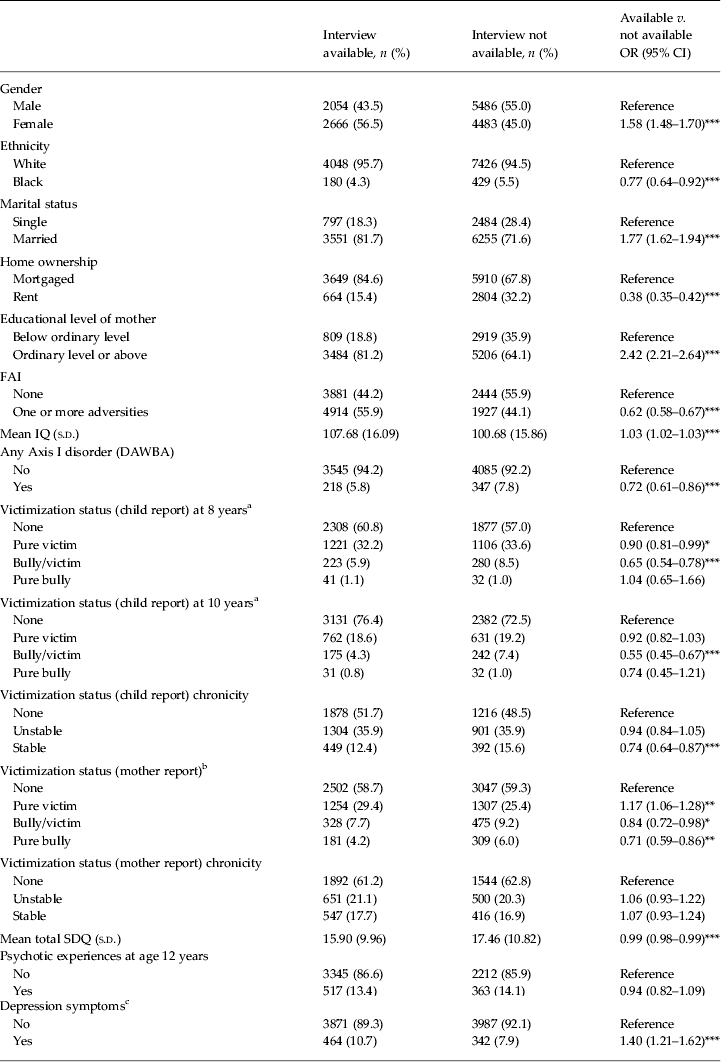
Selective drop-out was determined by comparing those who answered the PLIKSi at age 18 years with those who did not, using binary logistic regression in SPSS version 18 (IBM, USA) and odds ratios are reported with 95% confidence intervals (CIs) (Table 1). The prevalence of bullying involvement according to child and mother reports is also shown in Table 1. First, in order to assess whether involvement in bullying predicted psychotic experiences at age 18 years, three sets of logistic regression analyses were run (Table 2). Model A shows unadjusted analyses. Model B controlled for gender, IQ, any DSM-IV Axis I diagnosis (DAWBA), and internalizing/externalizing behaviour at elementary school age. Model C included all the preceding variables and additionally controlled for psychotic experiences at age 12 years and depression symptoms at age 12, 13 or 14 years. All three models were based on reduced samples, as not all the confounding variables were available for all of the participants. Path analysis using M-Plus version 6.12 was used to test the relationship of peer victimization, the association between potential confounders and psychotic experiences at age 18 years simultaneously. For this purpose, similar to previous studies (Lereya & Wolke, Reference Lereya and Wolke2013; Lereya et al. Reference Lereya, Winsper, Heron, Lewis, Gunnell, Fisher and Wolke2013), bully/victims and victims were combined. It was not possible to repeat this analysis for pure bullies, as the number of children in this category was too small. The WLSMV estimator (weighted least squares with robust standard errors, mean and variance adjusted) was used, due to its robustness and power when analysing both continuous and categorical outcomes (Flora & Curran, Reference Flora and Curran2004). The coefficients are in the form of probit regressions. Probit coefficients represent the difference that a one-unit change in the predictor variable makes in the cumulative normal probability of the outcome variable (Muthén & Muthén, Reference Muthén and Muthén2010).
Drop-out analysis with regard to availability of PLIKSi at 18 years

PLIKSi, Psychosis-Like Symptoms semi-structured interview; OR, odds ratio; CI, confidence interval; FAI, Family Adversity Index; IQ, intelligence quotient; s.d., standard deviation; DAWBA, Development and Well-being Assessment; unstable, victimization reported only at one time point; stable, victimization reported at two or more time points; SDQ, Strengths and Difficulties Questionnaire.
a Overt or relational victimization.
b Mother report at 8, 9 or 11 years.
c Depression at 12, 13 or 14 years.
* p < 0.05, ** p < 0.01, *** p < 0.001.
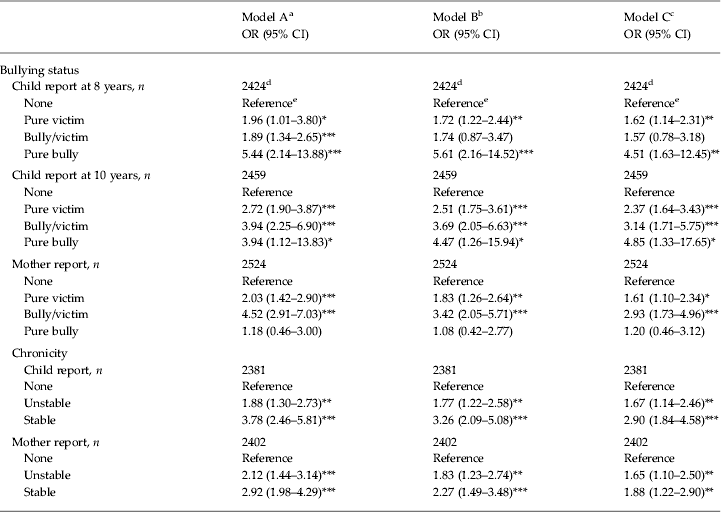
Associations between bullying behaviour and psychotic experiences at age 18 years
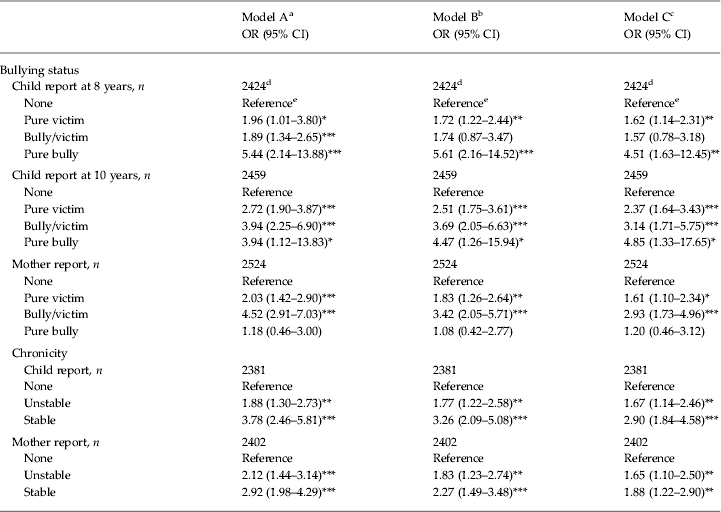
OR, Odds ratio; CI, confidence interval; unstable, victimization reported only at one time point; stable, victimization reported at two or more time points; IQ, intelligence quotient.
a Crude analyses.
b Controlling for gender, any DSM-IV Axis I diagnosis at age 7 years, IQ and internalizing/externalizing behaviour.
c Controlling for gender, any DSM-IV Axis I diagnosis at age 7 years, IQ, internalizing/externalizing behaviour, depression symptoms, and psychotic experiences at age 12 years.
d Number of participants in analysis.
e The reference group in all analyses consists of participants who are not victims.
* p < 0.05, ** p < 0.01, *** p < 0.001.
Results
Differences between participants with and without the PLIKSi
The distribution of sociodemographic factors, family environment and child characteristics is shown for ALSPAC participants with and without the PLIKSi at 18 years in Table 1. Those who did not complete the PLIKSi were more often boys, non-white, born to single mothers of lower education level, and from families living in rented properties. These children were more likely to have a lower IQ at age 8 years, to have more behavioural problems during childhood and any DSM-IV psychiatric diagnosis at age 7 years. Also, they were less likely to be pure victims (according to child report at 8 years), bully/victims (according to child reports at age 8 and 10 year and mother report), and pure bullies (according to mother report). Those lost to follow-up were more likely to be pure victims according to mother report. There were no differences in internalizing/externalizing behaviour score and suspected or definite psychotic experiences at 12 years. However, participants had higher levels of depression symptoms in adolescence.
Prevalence of involvement in bullying
The prevalence of bullying involvement according to child and mother reports is shown in Table 1. Mothers were more likely to report victimization compared with children.
Involvement in bullying and psychotic symptoms at 18 years
The associations between different bullying roles and psychotic experiences at age 18 years are presented in Table 2. In model A, unadjusted analyses, bullying involvement in any role was associated with increased risk of psychotic experiences at age 18 years according to child report at age 10 years and mother report. After controlling for gender, any Axis I diagnosis at age 7 years, IQ and internalizing/externalizing behaviours (model B) and after controlling for all confounders and mediators (model C), pure victims were more likely to have psychotic experiences at age 18 years according to all reports, bully/victims according to child report at age 10 years and mother report, and pure bullies according to child reports. Chronicity of victimization remained associated with psychotic experiences at age 18 years according to both child and mother reports.
Path analysis
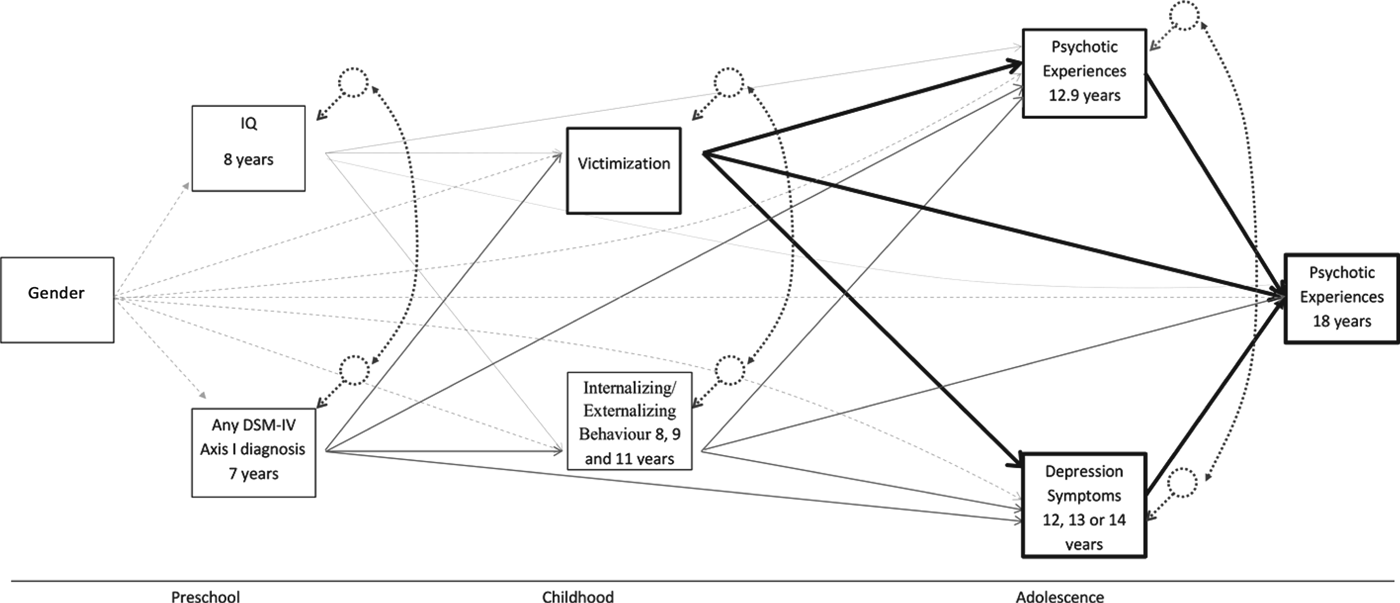
Two separate models, depending on whether the child or mother reported on peer victimization (victim or bully/victim), were specified (Fig. 2). Two fit indices were computed: root-mean square error of approximation (RMSEA) (Browne & Cudeck, Reference Browne, Cudeck, Bollen and Long1993) and the comparative fit index (CFI) (Bentler, Reference Bentler1990). For the RMSEA, values below 0.05 represent a close fit (Browne & Cudeck, Reference Browne, Cudeck, Bollen and Long1993). The CFI yields values ranging from 0 to 1, with values above 0.90 indicating a close fit of the data to the model (Hu et al. Reference Hu, Bentler and Kano1992). Both models showed good fit (child report: RMSEA = 0.011, CFI = 1.00; mother report: RMSEA = 0.000, CFI = 1.00).
Path analysis of gender, any Diagnostic and Statistical Manual, fourth edition (DSM-IV) Axis I diagnosis, intelligent quotient (IQ), peer victimization, internalizing/externalizing behaviour, psychotic experiences at 12 years, depression symptoms and psychotic experiences at 18 years. Peer victimization is at 8 or 10 years for child report and at 8, 9 or 11 years for mother report.

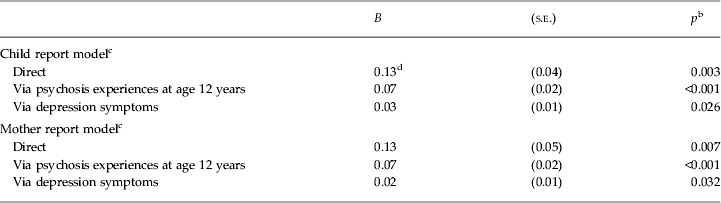
Both models showed significant direct effects of peer victimization on psychotic experiences at age 18 years. In both models, a probit coefficient of 0.13 indicates that a one-unit increase in victimization (from not victimized to victimized) resulted in an increase of 0.13 standard deviations in the predicted Z score of the cumulative normal probability distribution of psychotic experiences at age 18 years (Table 3). Additionally, there was an indirect effect of peer victimization on psychotic experiences at age 18 years via psychotic experiences at age 12 years (probit coefficient: child and mother = 0.07) and via depression symptoms (probit coefficient: child = 0.03; mother = 0.02) (Table 3). These effects were found despite controlling for all other associations simultaneously.
Unstandardized probit coefficients for the direct and indirect paths between peer victimization, psychotic experiences at age 12 years, depression symptoms and subsequent psychotic experiences outcome (at age 18 years) a

B, Probit coefficient; s.e., Standard error; RMSEA, root-mean square error of approximation; CI, confidence interval; CFI, comparative fit index.
a The ‘psychotic experiences at age 18 years’ outcome is a categorical outcome.
b Two-tailed p value.
c Model fit: child: RMSEA = 0.011 (90% CI 0.000–0.033), CFI = 1.00; mother: RMSEA = 0.000 (90% CI 0.000–0.028), CFI = 1.00.
d A probit coefficient of 0.13 indicates that for each unit increase in peer victimization, there is an increase of 0.13 standard deviations in the predicted Z score of the cumulative normal distribution of psychotic experiences at age 18 years.
Discussion
This prospective study included repeated measures of childhood bullying by different informants and repeated assessments of psychotic experiences from early to late adolescence. Our results extend findings in several ways. Despite controlling for pre-existing cognitive and psychiatric problems, concurrent internalizing/externalizing behaviour and later depression and psychotic problems, significant associations between any role in bullying behaviour and psychotic experiences at 18 years were found. Consistent with previous findings, according to child report at 10 years and mother report during elementary school, bully/victims had greater risk for psychotic experiences at 18 years than victims (Arseneault et al. Reference Arseneault, Bowes and Shakoor2010; Winsper et al. Reference Winsper, Lereya, Zanarini and Wolke2012; Wolke et al. Reference Wolke, Schreier, Zanarini and Winsper2012). Consistent with recent cross-sectional studies (Kelleher et al. Reference Kelleher, Harley, Lynch, Arseneault, Fitzpatrick and Cannon2008; Nishida et al. Reference Nishida, Tanii, Nishimura, Kajiki, Inoue, Okada, Sasaki and Okazaki2008), bullies were also at increased risk for psychotic experiences according to child reports. However, the CIs were wide due to the small number of children reporting to be pure bullies. Moreover, according to mother reports, there was not a significant association between being a pure bully and psychotic experiences. Similar to previous research (Schreier et al. Reference Schreier, Wolke, Thomas, Horwood, Hollis, Gunnell, Lewis, Thompson, Zammit, Duffy, Salvi and Harrison2009; Kelleher et al. Reference Kelleher, Keeley, Corcoran, Ramsay, Wasserman, Carli, Sarchiapone, Hoven, Wasserman and Cannon2013b ), we found a dose–response relationship, with children who were chronically bullied more likely to have psychotic experiences than those who were only bullied at one time point.. As recently shown, being bullied may increase the incidence of psychotic experiences (Kelleher et al. Reference Kelleher, Keeley, Corcoran, Ramsay, Wasserman, Carli, Sarchiapone, Hoven, Wasserman and Cannon2013b ) and act as a developmental marker for the development of later psychotic experiences. Consistent with previous findings suggesting that bully/victims are the most troubled children (Juvonen et al. Reference Juvonen, Graham and Schuster2003) and at risk for a range of psychiatric problems (Arseneault et al. Reference Arseneault, Bowes and Shakoor2010; Copeland et al. Reference Copeland, Wolke, Angold and Costello2013), this study showed that not only those who are chronic victims but also bully/victims are at highest risk for psychotic experiences in late adolescence.
Previous research suggested that peer victimization predicts psychotic experiences in early adolescence (Goodman et al. Reference Goodman, Ford, Richards, Gatward and Meltzer2000; Schreier et al. Reference Schreier, Wolke, Thomas, Horwood, Hollis, Gunnell, Lewis, Thompson, Zammit, Duffy, Salvi and Harrison2009) and these in turn may increase the likelihood of later psychotic experiences (Kelleher et al. Reference Kelleher, Keeley, Corcoran, Ramsay, Wasserman, Carli, Sarchiapone, Hoven, Wasserman and Cannon2013b ). Additionally, affective routes from childhood trauma to psychotic experiences have been previously proposed (Myin-Germeys & van Os, Reference Myin-Germeys and Van Os2007). A previous report from the ALSPAC cohort showed that depression mediated effects of bullying victimization on psychotic experiences at age 12 years (Fisher et al. Reference Fisher, Schreier, Zammit, Maughan, Munafò, Lewis and Wolke2013a ). However, a recent study found that a persistent trajectory of psychotic experiences over a 24-month period in adolescence was also predicted by depression symptoms but this became non-significant when adolescent peer victimization was considered (Mackie et al. Reference Mackie, Castellanos-Ryan and Conrod2011). Our path analysis demonstrated that a substantial proportion of the relationship between being bullied and psychotic experiences was not mediated by depression or previous psychotic experiences. The ‘direct’ effects may suggest traumatic reactions to victimization which may result in increased suspiciousness of others or detachment from reality (Read et al. Reference Read, Van Os, Morrison and Ross2005). Alternatively, the unexplained proportion of the associations could represent residual confounding or mediating factors that were not measured in this study. Depression was found to partially mediate the relationship between being bullied and psychotic experiences. Previous research consistently found that being bullied also increases the risk of depression (Reijntjes et al. Reference Reijntjes, Kamphuis, Prinzie and Telch2010; Copeland et al. Reference Copeland, Wolke, Angold and Costello2013; Zwierzynska et al. Reference Zwierzynska, Wolke and Lereya2013) and affective problems provide an additional link to increased risk for psychotic experiences (Garety et al. Reference Garety, Bebbington, Fowler, Freeman and Kuipers2007). This indicates, however, that some children who are bullied or bully in elementary school may not develop other mental health problems, such as depression, before showing psychotic experiences in late adolescence.
Although longitudinal paths identified were identical in child and mother reports, the overall agreement between different informants on peer victimization was low, congruent with previous research (Rønning et al. Reference Rønning, Sourander, Kumpulainen, Tamminen, Niemelä, Moilanen, Helenius, Piha and Almqvist2009; Copeland et al. Reference Copeland, Wolke, Angold and Costello2013). Children themselves reported being victimized more often than their parents. Many children suffer in silence, with up to 40% not telling either their parents or teachers when being victimized (Wolke et al. Reference Wolke, Woods, Bloomfield and Karstadt2000; Houndoumadi & Pateraki, Reference Houndoumadi and Pateraki2001).
How does being involved in bullying lead to psychotic experiences? Rather than a cause, exposure to bullying may be a developmental marker for the risk of later psychotic experiences (Schreier et al. Reference Schreier, Wolke, Thomas, Horwood, Hollis, Gunnell, Lewis, Thompson, Zammit, Duffy, Salvi and Harrison2009). In those who develop psychotic disorders, abnormalities in social adjustment and motor performance have been noted already during childhood (Done et al. Reference Done, Crow, Johnstone and Sacker1994). However, there is increasing evidence of a causal relationship for bullying involvement and mental health outcomes. Even when children share the same genes and the same family environment, such as monozygotic twins, but are discordant for bullying, only the twin exposed to peer victimization has been shown to have heightened risk for mental health problems (Arseneault et al. Reference Arseneault, Milne, Taylor, Adams, Delgado, Caspi and Moffitt2008, Reference Arseneault, Cannon, Fisher, Polanczyk, Moffitt and Caspi2011; Fisher et al. Reference Fisher, Moffitt, Houts, Belsky, Arseneault and Caspi2012). A recent report showed that even when controlling for the effects of psychotic experiences on exposure to bullying or other forms of trauma, unique causal effects of bullying on the incidence of psychotic experiences were found (Kelleher et al. Reference Kelleher, Keeley, Corcoran, Ramsay, Wasserman, Carli, Sarchiapone, Hoven, Wasserman and Cannon2013b ). Similarly, we controlled for pre-existing and co-existing cognitive, emotional and behaviour problems and even subsequent early adolescence psychotic experiences and depression and still found an association between bullying involvement and psychotic experiences in late adolescence.
The routes of how peer victimization may lead to psychotic symptoms are multiple and likely to be indicated by different biological, cognitive and social domains as has been suggested for childhood abuse (Cicchetti, Reference Cicchetti2010; Burnette & Cicchetti, Reference Burnette and Cicchetti2012). Being bullied may alter the physiological response to stress (Ouellet-Morin et al. Reference Ouellet-Morin, Danese, Bowes, Shakoor, Ambler, Pariante, Papadopoulos, Caspi, Moffitt and Arseneault2011), affect telomere length (Shalev et al. Reference Shalev, Moffitt, Sugden, Williams, Houts, Danese, Mill, Arseneault and Caspi2013) or the epigenome (Ouellet-Morin et al. Reference Ouellet-Morin, Wong, Danese, Pariante, Papadopoulos, Mill and Arseneault2013), interact with a genetic vulnerability to psychotic disorders, alter brain circuitry (Teicher et al. Reference Teicher, Samson, Sheu, Polcari and Mcgreenery2010) and may change cognitive responses to the environment (Toblin et al. Reference Toblin, Schwartz, Hopmeyer Gorman and Abou-Ezzeddine2005; Hixon, Reference Hixon2009), produce negative schemas about the self and the world (Freeman & Fowler, Reference Freeman and Fowler2009) and affect maladjustment through moderation by self-blame cognitions (Perren et al. Reference Perren, Ettekal and Ladd2013). Hence, a childhood marked by victimization may have an impact on threat perceptions and generate psychotic experiences – more specifically delusions and hallucinations (Arseneault et al. Reference Arseneault, Cannon, Fisher, Polanczyk, Moffitt and Caspi2011). These in turn may predispose bullied children to develop depression (Harkness et al. Reference Harkness, Stewart and Wynne-Edwards2011) or psychotic experiences (van Winkel et al. Reference Van Winkel, Stefanis and Myin-Germeys2008; Bradley & Dinan, Reference Bradley and Dinan2010). Based on studies into conduct disorder, bullies are also likely to show heightened reactivity to potential threats in the environment (Sterzer & Stadler, Reference Sterzer and Stadler2009) and altered hypothalamic–pituitary–adrenal axis activity (van Bokhoven et al. Reference Van Bokhoven, Van Goozen, Van Engeland, Schaal, Arseneault, Séguin, Nagin, Vitaro and Tremblay2005), both of which may put them at increased risk for psychosis (Toblin et al. Reference Toblin, Schwartz, Hopmeyer Gorman and Abou-Ezzeddine2005; Bradley & Dinan, Reference Bradley and Dinan2010). Bully/victims may have the most biological and cognitive alterations as they have characteristics of both victims and bullies, thus potentially having an even greater risk for depression and psychosis. Overall, adverse life events may render individuals vulnerable to psychotic experiences via increasing their emotional reactivity to subsequent stressors (Mackie et al. Reference Mackie, Castellanos-Ryan and Conrod2011). Each of these aspects of maladaptive stress responses should be targets for future research efforts.
Strengths and limitations
Strengths of the present study are: (1) the prospective study design with repeated assessments during childhood and adolescence; (2) the use of multiple informants of peer victimization providing converging evidence for an association between being bullied and psychotic experiences across informants; (3) a population-based design that minimized selection biases; (4) availability of information on a variety of cognitive, pre- or concurrent psychiatric disorders to control for confounding; (5) the ability to investigate all those involved in bullying including victims, bully/victims and bullies; and (6) the use of path analysis enabling the control of all potential relationships between the variables which is not possible with binary logistic regression or multiple mediation models.
With regard to limitations, first, not all children attended the psychosis interview. Those with higher family adversity were more likely to drop out, reducing statistical power. Nevertheless, empirical simulations demonstrate that even when drop-out is correlated to predictor/confounder variables, the relationship between predictors and outcome is unlikely to be substantially altered by selective drop-out processes (Wolke et al. Reference Wolke, Waylen, Samara, Steer, Goodman, Ford and Lamberts2009). Indeed, despite selective drop-out, we found strong and hypothesized associations between risk exposures and psychotic experiences. Second, although psychotic experiences were assessed after the bullying assessment, the age at which the symptoms actually started was not assessed and no assessment of psychotic experiences prior to the first bullying assessment at 7 years is available. Thus, it cannot be ruled out that psychotic symptoms might have been present before peer victimization. However, the relationship was not affected by general mental health problems assessed in childhood. Moreover, while psychotic experiences can be assessed reliably in adolescence, there are no reliable assessments of psychotic symptoms in children before age 8 years and to distinguish them from normal developmental experiences (Garralda, Reference Garralda1984; Edelsohn, Reference Edelsohn2006). Reassuring are recent findings that even when controlling for the effects of psychotic experiences on bullying, being bullied has unique effects on the incidence of psychotic experiences (Kelleher et al. Reference Kelleher, Keeley, Corcoran, Ramsay, Wasserman, Carli, Sarchiapone, Hoven, Wasserman and Cannon2013b ). In addition, although both sexual abuse and substance use have been linked with psychotic experiences (Arseneault et al. Reference Arseneault, Cannon, Fisher, Polanczyk, Moffitt and Caspi2011; Mackie et al. Reference Mackie, Castellanos-Ryan and Conrod2011), they were not included as confounders. However, the psychotic experiences at age 18 years were not attributable to sleep, fever or substance use. Lastly, the mothers’ and children's reports could not be formally compared as they were fundamentally different measures. Moreover, mother-reported bullying was assessed with a single item and this may have limited reliability compared with the more comprehensive child interview. Nevertheless, expected associations were found.
Conclusion
Involvement in any role in bullying may increase the risk of developing psychotic experiences in adolescence. This is extremely concerning, as psychotic experiences have been shown to put individuals at risk of a range of severe psychiatric disorders (Fisher et al. Reference Fisher, Caspi, Poulton, Meier, Houts, Harrington, Arseneault and Moffitt2013b ) and may greatly increase the likelihood of attempting suicide (Kelleher et al. Reference Kelleher, Corcoran, Keeley, Wigman, Devlin, Ramsay, Wasserman, Carli, Sarchiapone, Hoven, Wasserman and Cannon2013a ). A substantial number of children who are involved in bullying and have psychotic experiences in late adolescence may not develop depression and psychotic experiences in early adolescence and thus may not be detected early by mental health services. Therefore, bullying should be assessed and monitored by health professionals (Scrabstein, Reference Scrabstein2009) and interventions that reduce victimization should be available (Ttofi & Farrington, Reference Ttofi and Farrington2011). Such interventions are likely to reduce human suffering and long-term mental health costs and provide a safer environment for children to grow up in.
Acknowledgements
Data collection was partly funded by a UK Medical Research Council (MRC) grant (G0701503). The work of D.W. and S.T.L. on this study was supported by an Economic and Social Research Council (ESRC) grant (ES/K003593/1). H.L.F. is funded by an MRC Population Health Scientist fellowship (G1002366). S.Z. received support from a Clinician Scientist Award funded by the National Assembly for Wales. G.L. is a National Institute for Health Research (NIHR) Senior Investigator. None of the funding bodies had any further role in the collection, analysis or interpretation of data, the writing of the manuscript, or the decision to submit the paper for publication. It does not reflect the views of the ALSPAC executive.
We are extremely grateful to all the families who took part in this study, the midwives for their help in recruiting them, and the whole ALSPAC team, which includes interviewers, computer and laboratory technicians, clerical workers, research scientists, volunteers, managers, receptionists and nurses. We are also grateful for statistical advice from Jon Heron.
Declaration of Interest
None.