What makes a child's language development trajectory have the patterns that it has, and what causes differences across children in those patterns? These fundamental questions have for over half a century been at the heart of research on language development in monolingual children, on the cross-linguistic development of language in children from distinct language communities, on bilingual language development, and on development in cases of language disorders in children. Paradis has taken the important step of carefully comparing the trajectories of two populations of children—children with specific language impairment (SLI) and children growing up bilingually—who both differ in interesting ways from normally developing monolingual children. Her Keynote Article highlights striking similarities and potential differences between these two groups. This Commentary focuses on three issues: what influences developmental profiles in language development, bilinguals' development of vocabulary and syntax, and assessment issues related to treating monolinguals as the “standard.”
DEVELOPMENTAL PROFILES
The standard for language development has long been monolingual children. To be sure, through careful studies of monolingually developing children learning distinct languages, we have gained an inordinate wealth of knowledge about what contributes to language developmental trajectories. Among the insights gained are the followingFootnote 1: (a) children draw on and depend on the input to learn language (Hart & Risley, Reference Hart and Risley1995; Hoff, Reference Hoff2003); (b) children begin by learning language in context, both nonlinguistic and linguistic (Bates, Bretherton, Shore, & McNew, Reference Bates, Bretherton, Shore, McNew and Nelson1983; Bloom, Reference Bloom1973; Tomasello, Reference Tomasello2003; Theakston, Lieven, Pine, & Rowland, Reference Theakston, Lieven, Pine and Rowland2002); (c) the structure of the language influences what might be easy, what might be hard, as well as the sequence of development (Gathercole & Hoff, Reference Gathercole, Hoff, Hoff and Shatz2007; Lieven, Reference Lieven, Gallaway and Richards1994; Lieven & Guo, Reference Lieven and Guo2008); (d) children abstract out patterns from the input they are receiving (Bowerman, Reference Bowerman, Strauss and Stavy1982; Li, Reference Li and Gathercole2009; Saffran, Reference Saffran2003; Smith, Reference Smith and MacWhinney1999); and (e) cognitive development and linguistic development go hand in hand; they are cotemporaneous and they interact, so that cognitive level contributes to (McCune, Reference McCune2006; Weist, in press) and benefits from (Gopnik & Choi, Reference Gopnik and Choi1990) language level.
The weighted role that each of these factors may play in language development is still, of course, hotly debated, even for monolingual children. In addition, disruption of the normal profiles of development, as in children with SLI, has led to key theories about the underlying nature of SLI (see Rice, Reference Rice and Gathercole2009). The striking similarities brought out by Paradis in the developmental profiles of SLI children and children learning a second language (L2) at an early age demand attention. Where SLI children might appear similar to early L2 children, and where there might be differences, can help inform both theoretical and clinical issues surrounding SLI children. Do commonalities stem from the same source in the two groups? Do differences shed light on the ultimate sources of difficulties in SLI children?
It is instructive to reflect, a priori, how an early L2 child's experience with language might be different from that of a monolingual child's. We can assume that a sequential bilingual child, like the monolingual child, draws on the above factors for acquiring the L2. However, beyond these, two other features of bilinguals’ language experience are relevant. First, by definition, children growing up bilingually are hearing two languages, so, as noted by Paradis, their time hearing each language will be split between the two languages, resulting in most cases in reduced input for each language (relative to monolinguals) and distributed knowledge of each language. I will return to this below.
Second, bilingual children have two additional sources that they can draw on in developing their grammars: (a) both simultaneous bilinguals and early L2 users have, at least in principle, their other language to draw on, and (b) early L2 users are learning the L2 at a more advanced cognitive stage than monolingual children learning the same linguistic elements at an earlier age. These additional sources of information can affect the developmental trajectory of bilinguals.
The fact that bilinguals have another language to draw on is an important one for the questions at hand. Access to another language could have ramifications for error types observed: some errors could arise from possible interaction effects across the bilingual's two languages. One common proposal in current research is that where a bilingual's two languages share or have overlapping structures, the bilingual might draw on the structure in one language to use or acquire the related structure in the other language (Döpke, Reference Döpke2000; Hulk & Müller, Reference Hulk and Müller2000). Thus, for example, Fernández Fuertes and Liceras (Reference Fernández Fuertes and Liceras2008) have cited evidence that a Spanish–English bilingual child might use BE earlier in English because of the influence of the prominence of the two copulas, ser and estar, in Spanish. Silva-Corvalán, Johnson, Montes, and Sick (Reference Silva-Corvalán, Johnson, Montes and Sick2009) report that one of their bilingual Spanish–English subjects used more pronominal subjects in Spanish than monolingual children do, with the best explanation appearing to be that this is due to the influence of obligatory subjects in English.
Such findings are relevant, in that they suggest that, even if the profiles of SLI children and bilingual children are not identical, differences between them may not ultimately hinge on the underlying processes of acquisition in the two cases; that is, it does not necessarily imply that they are learning language in distinct fashion. It may simply be that bilingual children can rely in part on prior knowledge they have acquired in their other language and can bring this to bear on this L2. Such interactive influences, for example, might help account for the higher (“precocious”) use of BE structures in early L2 users cited by Paradis (see below).
This access to a first language (L1) in the case of early L2 users, or to their other language in the case of simultaneous bilinguals, is an important aspect of how bilingual children are different from monolingual children, whether typically developing or SLI. They might also be highly relevant to where we might expect sequential L2/SLI bilinguals to show a “double whammy” in the L2 and where we might predict they will not. Many researchers, as Paradis mentions, have raised the question of whether bilingual SLI children may experience a double whammy with regard to language development: If it is hard for SLI children to learn one language, it might be extra hard for them to learn two. (In theory, that could be true under either of the theoretical positions outlined by Paradis, that is, whether the difficulty experienced by SLI children is a processing deficit or has to do with the disruption of a maturational scheme. Even the latter of these would require the child to identify the language-specific lexical means for expressing the linguistic elements emerging.) However, the converse question should also be asked: if SLI children have two languages to draw on, might there be some cases in which knowing something in Language A can help facilitate the acquisition of something similar in Language B? This might be particularly relevant if the structure in question in one language is much simpler than in the other. The literature on normally developing bilinguals has suggested that at least sometimes linguistic interaction may facilitate or accelerate acquisition in one of the child's languages (Paradis & Genesee, Reference Paradis and Genesee1996). This opens up the real possibility that such facilitation might also occur in the case of bilingual SLI children.
Part (b) of the second point is also relevant: when they learn the structures in their L2, early L2 users are cognitively well beyond the more immature cognitive understanding that monolingual children have when they learn the same structures. That cognitive understanding includes not only, for example, knowledge about the world, but also, as noted by Paradis, knowledge about the communicative messages one might want to encode in language. Paradis mentions “coping” strategies that might be used by L2 users before they have the fully fledged linguistic tools they need. Such coping strategies might well result from cognitive/(L1) linguistic maturity in advance of the L2 resources for expression, and could lead to the production of many of the types of structures Paradis mentions that distinguish bilingual children's commission errors from those of SLI children. Such potential coping strategies are important to keep in mind, as they are quite different from “systemic” (Paradis & Genesee, Reference Paradis and Genesee1996) interaction at a deeper level between the bilingual child's two languages. Coping strategies can be predicted to occur earlier in development, and more sporadically/less consistently, and may ultimately tell us little about the child's linguistic system in the L2.
BILINGUAL DEVELOPMENT OF VOCABULARY AND MORPHOSYNTAX
Paradis mentions work showing lags in bilinguals’ language development. She questions whether this occurs mostly in vocabulary or also applies to syntactic development, and if it also applies to syntactic development, do bilinguals always “catch up” with monolinguals? Our work in Wales, examining children's development as simultaneous or early L2 Welsh–English bilinguals, is informative in this regard.
We have conducted a number of studies on children's development of vocabulary and grammatical constructs in Welsh and in English (Gathercole & Thomas, Reference Gathercole, Thomas, Cohen, McAlister, Rolstad and MacSwan2005, Reference Gathercole and Thomas2007, Reference Gathercole and Thomas2009; Gathercole, Thomas, & Hughes, Reference Gathercole, Thomas and Hughes2008; Thomas & Gathercole, Reference Thomas and Gathercole2007). Children growing up as bilinguals in Wales come from a variety of home language profiles, which we regularly classify as only Welsh (at least 80% of the input from the parents from birth until the time of testing has been in Welsh, “OWH”), only English (at least 80% of the input from the parents from birth until the time of testing has been in English, “OEH”) and Welsh and English (40% to 60% of the input from the parents from birth until the time of testing has been in Welsh and English, “WEH”). These input differences have consistent ramifications for vocabulary and grammatical abilities.
Vocabulary
The Welsh vocabulary profiles of 611 children aged 7 through 11 in a study by Gathercole and Thomas (Reference Gathercole and Thomas2007) showed parallel progression with age across the three home language groups. All three groups improved with age, but OWH children were consistently ahead of WEH children, who in turn, were ahead of OEH children. Thus far, similar testing of 11- through 15-year-olds (Gathercole, Thomas, & Hughes, Reference Gathercole, Thomas and Hughes2010) reveals a similar pattern. With the 720 children tested so far, OWH and WEH children show continual improvement, in parallel, through age 15; and OEH children show parallel gains up until around age 12 or 13. At that point, however, the OEH vocabulary gains appear to subside and reach a plateau. It happens to be the case that at that point, pupils have greater choices for conducting their education in English instead of Welsh, so we are exploring whether the OEH children might fall into two patterns, depending on whether they continue to pursue their education in Welsh. Thus, in Welsh, vocabulary levels appear directly tied to the amount of Welsh the children are hearing in the input, and continued input appears critical for the maintenance of Welsh vocabulary even in adulthood (Gathercole, Reference Gathercole2007a).
At initial stages, a similar picture emerges for English vocabulary (Gathercole & Thomas, Reference Gathercole and Thomas2009). At age 4, children from OWH homes lag behind OEH and WEH children in English vocabulary. However, by age 7 or 8, the groups are indistinguishable. By age 9, the home language groups are still indistinguishable, but children attending schools in which some of the instruction takes place in English outstrip their peers in schools in which everything is taught through the medium of Welsh.
The differences in Welsh and English vocabulary trajectories are directly linkable to the dominance of English in the Welsh context (Gathercole & Thomas, Reference Gathercole and Thomas2009). Similar effects have been reported in Miami: initial differences are observed across home language groups in English, but those differences become mitigated with age (Cobo-Lewis, Pearson, Eilers, & Umbel, Reference Cobo-Lewis, Pearson, Eilers, Umbel, Oller and Eilers2002, pp. 64–97); initial differences are also observed across home language groups in Spanish, but a plateau or decrease in development occurs with age in those with more limited Spanish exposure, so that differences across groups become more pronounced (Cobo-Lewis et al., Reference Cobo-Lewis, Pearson, Eilers, Umbel, Oller and Eilers2002, pp. 98–117).
Grammatical constructs
There is now considerable evidence that, as with vocabulary, bilinguals lag behind their monolingual peers in the development of grammatical structures in their two languages. The sequences of development appear similar however, and the bilinguals often “catch up.” However, this is especially true in relation to less complex structures but does not necessarily apply to all structures, especially more complex ones (versus Paradis' hint; Oller & Eilers, Reference Oller and Eilers2002; Gathercole, Reference Gathercole, Oller and Eilers2002, Reference Gathercole2007b). Again, the relative amount of input that a bilingual child receives in the given language appears to play an important role. As an example, we are currently conducting some studies in Wales for which we are testing, among other things, children's receptive knowledge of grammatical structures in English and Welsh (Gathercole et al., Reference Gathercole, Thomas, Young, Jones, Cunnington and Viñas Guasch2008). Thus far, we have tested 250 bilingual children at ages 4, 5, 7–8, and 13–15 from OWH, WEH, and OEH homes (bilinguals) on Welsh and English, as well as 42 similar-aged monolingual English children on English. The structures examined include simple active sentences, simple truncated passives, simple negation, the comparative and superlative, two tenses (present perfect, future), three types of relative clauses, and two types of quantifier expressions.
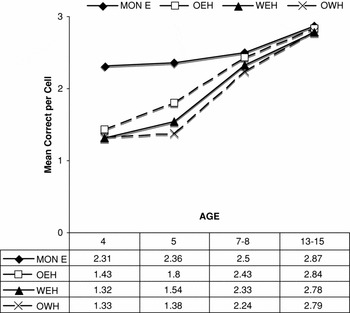
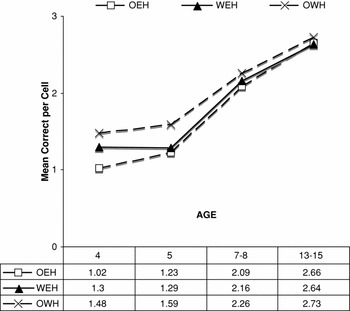
For both languages, there are significant differences at the earlier ages (see Figures 1 and 2). In English, at age 4, monolingual children outperform all the bilinguals, and at age 5, they outperform the WEH and OWH children, with the OEH children in between. By ages 7–8 and 13–15, however, there are no significant differences across groups in English. In Welsh, at ages 4 and 5, the OWH children outperform the OEH children. At ages 7–8 and 13–15, there is no overall difference across groups, but there are a few structures for which the OEH or the WEH children still perform significantly less well than the OWH children: at both 7–8 and 13–15, OWH children perform better than OEH children on the future in Welsh; and at ages 7–8, OWH also perform better than OEH children on the superlative and better than WEH children on a set of quantifier expressions.
Figure 1.The performance on English grammatical structures by age and home language in Welsh–English bilinguals and English monolinguals.
Figure 2.The performance on Welsh grammatical structures by age and home language in Welsh–English bilinguals.
Such findings support an important role for quantity of input, as well as differential effects of the dominant versus nondominant language of the community. They also concur with the gradual convergence of abilities across home language groups as children gain enough experience with the structures in question in each specific language. However, it is important that the convergence may depend on the linguistic complexity of the particular structures. In the end, there may be some very difficult structures for which differential performance across groups persists, especially in cases of complex or opaque structures in the nondominant language of the community (Gathercole & Thomas, Reference Gathercole and Thomas2009).
Given such results, one might modify the predictions Paradis has made with regard to possible double whammy effects for bilingual SLI children. Paradis proposed hypothetical profiles under the conditions that bilingual SLI children did or did not experience cumulative effects of SLI in the L2. A more elaborated model can be proposed in the light of a more detailed understanding of the acquisitional profiles of children learning two languages. In particular, the processing account of the difficulties experienced by SLI children would not necessarily imply a double whammy in all cases, because of the fact that sequential bilinguals already have an L1 that they might be able to draw on and that grammatical acquisition occurs in a sequence related to complexity and opacity.
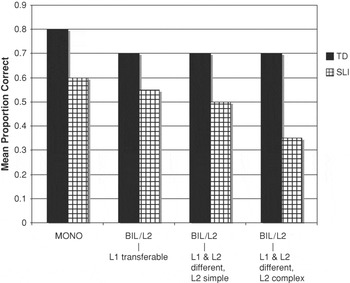
To accommodate these two factors, one might wish, instead of Paradis' figure 3b, to hypothesize patterns as in Figure 3. Bilingual SLI children may show three different effects, depending on the possible transferability of what has been learned in the L1 (bar set 2 in Figure 3), and on the simplicity or complexity of the structure in the L2 (bar sets 3 and 4). In the first case, the L1 may support and promote acquisition in the L2; in the middle case, the acquisitional process is neutral; and in the last case, highly complex structures in the L2 that are distinct from those in L1 may be the ones for which bilingual SLI children experience a double whammy. Thus, the first case might include the precocious use of BE, even by bilingual SLI children, cited by Paradis. The last case might include cases such as the acquisition of Dutch grammatical gender by Turkish L1 children with SLI (de Jong, Orgassa, Baker, & Weerman, Reference De Jong, Orgassa, Baker and Weerman2008). Because Turkish does not have grammatical gender, and grammatical gender in Dutch is relatively complex, children appear to have special difficulty here.
Figure 3.An alternative hypothetical distribution of scores in BIL children with SLI (cf. Paradis' figure 3b).
ASSESSMENT ISSUES
Paradis concludes her Keynote Article with an appeal to researchers and practitioners regarding the norming of tests for bilinguals. As she eloquently notes, identification of children with SLI is definitely problematic for L2 users, because L2 sequential bilinguals often show profiles of performance similar to those of monolingual SLI children, especially in relation to the tense and inflectional marking that have been taken as key indicators for SLI. Bilinguals are NOT two monolinguals in the same body. Their experience with each of their languages is different from that of monolinguals in either language, the timing of development for their two languages may well be different from that of monolinguals, and there may well be interactive effects that influence performance in both languages. These differences, as well as effects that spill over into other realms (Gathercole, in press), need to be understood by practitioners who deal with children, whether their focus is on language or other aspects of education or development.
Bilingual-normed language measures are needed, tools that reflect the varying profiles of development in bilinguals. Many vocabulary tests are now providing norms for bilinguals alongside norms for monolinguals (e.g., Mattes, Reference Mattes1995; Munoz-Sandoval, Cummins, Alvarado, & Ruef, Reference Munoz-Sandoval, Cummins, Alvarado and Ruef2005; Verhoeven & Vermeer, Reference Verhoeven and Vermeer1993), and some allow testing in the L2 if a child fails in the first (e.g., Brownell, Reference Brownell2000a, Reference Brownell2000b). The purpose for using the tests, of course, matters in what type of solution one wishes to pursue for testing bilinguals (see, e.g., Gathercole et al., Reference Gathercole, Thomas, Young, Jones, Cunnington and Viñas Guasch2008).
One solution we have proposed and implemented for a vocabulary measure for Welsh–English bilinguals is to provide two standardized scores for every child tested. One standardized score allows for comparison with every child in the same age group (similar to most normed vocabulary tests). The other, however, provides a normed score based on the performance of children from the same home language background as the child tested. This latter normed score allows one to compare the given child to normal developmental expectations, given the type of experience with the language that this child has had. See Gathercole et al. (Reference Gathercole, Thomas, Young, Jones, Cunnington and Viñas Guasch2008) for more information.
Testing bilinguals and norming language measures for bilingual children goes beyond this, however. Most importantly, the test needs to examine those aspects of the particular language in question that we want to be examining, not the child's other language. This includes language-specific factors and subtleties that differentiate the bilingual's two languages (for a discussion, see Kester & Peña, Reference Kester and Peña2002). This means that in many cases, the norming of an already available test (designed initially for monolinguals) in a given language is not usually enough. If, for example, that test contains vocabulary items that are cognates in the bilingual child's two languages, the child could easily rely on Language A to perform the tasks in Language B.
To elaborate, a case in point is the Test de Vocabulario en Imágenes Peabody: Adaptación Hispanoamericana (TVIP; Dunn, Padilla, Lugo, & Dunn, Reference Dunn, Padilla, Lugo and Dunn1986), a Spanish-language version of the Peabody Picture Vocabulary Test (PPVT; Dunn & Dunn, Reference Dunn and Dunn1981). The TVIP is a rough translation of the PPVT. A quick glance at the vocabulary items on the TVIP reveals that fully 61.6% of the words (77 out of 125) are obvious cognates with English. The proportion differs somewhat across the ages, but there are between 30 and 80% cognates at every age: words targeted for the beginning point of testing at 3–4 years include 30% Spanish–English cognates, at 5 years 40%, at 6 years 67%, at 7 years 50%, at 8 years 60%, at 9 years 60%, at 10 years 86%, at 11 years 40%, at 12 to 13 years 62.5%, and at 14+ years 80.6%. Given this high number of cognates, a person who knows English may be able to do well on this test even if he or she has only a minimal knowledge of Spanish or Spanish–English phonological mappings. (The high proportion of cognates also raises questions about how much lower bilinguals would have tested in, e.g., Umbel, Pearson, Fernández, & Oller's Reference Umbel, Pearson, Fernández and Oller1992 study if the vocabulary tests had controlled for the presence of cross-language cognates.) The point is that such tests, designed initially for use with monolinguals, are inadequate for testing bilinguals.
CONCLUSION
In conclusion, the Keynote Article by Paradis is a welcome exploration of crucial aspects of development linking SLI and bilingual children. It is only through such meticulous and thoughtful explorations that we will ultimately arrive at the best theoretical and clinical understanding of both groups of children.





 You have
Access
What makes a child's language development trajectory have the patterns that it has, and what causes differences across children in those patterns? These fundamental questions have for over half a century been at the heart of research on language development in monolingual children, on the cross-linguistic development of language in children from distinct language communities, on bilingual language development, and on development in cases of language disorders in children. Paradis has taken the important step of carefully comparing the trajectories of two populations of children—children with specific language impairment (SLI) and children growing up bilingually—who both differ in interesting ways from normally developing monolingual children. Her Keynote Article highlights striking similarities and potential differences between these two groups. This Commentary focuses on three issues: what influences developmental profiles in language development, bilinguals' development of vocabulary and syntax, and assessment issues related to treating monolinguals as the “standard.”
DEVELOPMENTAL PROFILES
The standard for language development has long been monolingual children. To be sure, through careful studies of monolingually developing children learning distinct languages, we have gained an inordinate wealth of knowledge about what contributes to language developmental trajectories. Among the insights gained are the followingFootnote 1: (a) children draw on and depend on the input to learn language (Hart & Risley, Reference Hart and Risley1995; Hoff, Reference Hoff2003); (b) children begin by learning language in context, both nonlinguistic and linguistic (Bates, Bretherton, Shore, & McNew, Reference Bates, Bretherton, Shore, McNew and Nelson1983; Bloom, Reference Bloom1973; Tomasello, Reference Tomasello2003; Theakston, Lieven, Pine, & Rowland, Reference Theakston, Lieven, Pine and Rowland2002); (c) the structure of the language influences what might be easy, what might be hard, as well as the sequence of development (Gathercole & Hoff, Reference Gathercole, Hoff, Hoff and Shatz2007; Lieven, Reference Lieven, Gallaway and Richards1994; Lieven & Guo, Reference Lieven and Guo2008); (d) children abstract out patterns from the input they are receiving (Bowerman, Reference Bowerman, Strauss and Stavy1982; Li, Reference Li and Gathercole2009; Saffran, Reference Saffran2003; Smith, Reference Smith and MacWhinney1999); and (e) cognitive development and linguistic development go hand in hand; they are cotemporaneous and they interact, so that cognitive level contributes to (McCune, Reference McCune2006; Weist, in press) and benefits from (Gopnik & Choi, Reference Gopnik and Choi1990) language level.
The weighted role that each of these factors may play in language development is still, of course, hotly debated, even for monolingual children. In addition, disruption of the normal profiles of development, as in children with SLI, has led to key theories about the underlying nature of SLI (see Rice, Reference Rice and Gathercole2009). The striking similarities brought out by Paradis in the developmental profiles of SLI children and children learning a second language (L2) at an early age demand attention. Where SLI children might appear similar to early L2 children, and where there might be differences, can help inform both theoretical and clinical issues surrounding SLI children. Do commonalities stem from the same source in the two groups? Do differences shed light on the ultimate sources of difficulties in SLI children?
It is instructive to reflect, a priori, how an early L2 child's experience with language might be different from that of a monolingual child's. We can assume that a sequential bilingual child, like the monolingual child, draws on the above factors for acquiring the L2. However, beyond these, two other features of bilinguals’ language experience are relevant. First, by definition, children growing up bilingually are hearing two languages, so, as noted by Paradis, their time hearing each language will be split between the two languages, resulting in most cases in reduced input for each language (relative to monolinguals) and distributed knowledge of each language. I will return to this below.
Second, bilingual children have two additional sources that they can draw on in developing their grammars: (a) both simultaneous bilinguals and early L2 users have, at least in principle, their other language to draw on, and (b) early L2 users are learning the L2 at a more advanced cognitive stage than monolingual children learning the same linguistic elements at an earlier age. These additional sources of information can affect the developmental trajectory of bilinguals.
The fact that bilinguals have another language to draw on is an important one for the questions at hand. Access to another language could have ramifications for error types observed: some errors could arise from possible interaction effects across the bilingual's two languages. One common proposal in current research is that where a bilingual's two languages share or have overlapping structures, the bilingual might draw on the structure in one language to use or acquire the related structure in the other language (Döpke, Reference Döpke2000; Hulk & Müller, Reference Hulk and Müller2000). Thus, for example, Fernández Fuertes and Liceras (Reference Fernández Fuertes and Liceras2008) have cited evidence that a Spanish–English bilingual child might use BE earlier in English because of the influence of the prominence of the two copulas, ser and estar, in Spanish. Silva-Corvalán, Johnson, Montes, and Sick (Reference Silva-Corvalán, Johnson, Montes and Sick2009) report that one of their bilingual Spanish–English subjects used more pronominal subjects in Spanish than monolingual children do, with the best explanation appearing to be that this is due to the influence of obligatory subjects in English.
Such findings are relevant, in that they suggest that, even if the profiles of SLI children and bilingual children are not identical, differences between them may not ultimately hinge on the underlying processes of acquisition in the two cases; that is, it does not necessarily imply that they are learning language in distinct fashion. It may simply be that bilingual children can rely in part on prior knowledge they have acquired in their other language and can bring this to bear on this L2. Such interactive influences, for example, might help account for the higher (“precocious”) use of BE structures in early L2 users cited by Paradis (see below).
This access to a first language (L1) in the case of early L2 users, or to their other language in the case of simultaneous bilinguals, is an important aspect of how bilingual children are different from monolingual children, whether typically developing or SLI. They might also be highly relevant to where we might expect sequential L2/SLI bilinguals to show a “double whammy” in the L2 and where we might predict they will not. Many researchers, as Paradis mentions, have raised the question of whether bilingual SLI children may experience a double whammy with regard to language development: If it is hard for SLI children to learn one language, it might be extra hard for them to learn two. (In theory, that could be true under either of the theoretical positions outlined by Paradis, that is, whether the difficulty experienced by SLI children is a processing deficit or has to do with the disruption of a maturational scheme. Even the latter of these would require the child to identify the language-specific lexical means for expressing the linguistic elements emerging.) However, the converse question should also be asked: if SLI children have two languages to draw on, might there be some cases in which knowing something in Language A can help facilitate the acquisition of something similar in Language B? This might be particularly relevant if the structure in question in one language is much simpler than in the other. The literature on normally developing bilinguals has suggested that at least sometimes linguistic interaction may facilitate or accelerate acquisition in one of the child's languages (Paradis & Genesee, Reference Paradis and Genesee1996). This opens up the real possibility that such facilitation might also occur in the case of bilingual SLI children.
Part (b) of the second point is also relevant: when they learn the structures in their L2, early L2 users are cognitively well beyond the more immature cognitive understanding that monolingual children have when they learn the same structures. That cognitive understanding includes not only, for example, knowledge about the world, but also, as noted by Paradis, knowledge about the communicative messages one might want to encode in language. Paradis mentions “coping” strategies that might be used by L2 users before they have the fully fledged linguistic tools they need. Such coping strategies might well result from cognitive/(L1) linguistic maturity in advance of the L2 resources for expression, and could lead to the production of many of the types of structures Paradis mentions that distinguish bilingual children's commission errors from those of SLI children. Such potential coping strategies are important to keep in mind, as they are quite different from “systemic” (Paradis & Genesee, Reference Paradis and Genesee1996) interaction at a deeper level between the bilingual child's two languages. Coping strategies can be predicted to occur earlier in development, and more sporadically/less consistently, and may ultimately tell us little about the child's linguistic system in the L2.
BILINGUAL DEVELOPMENT OF VOCABULARY AND MORPHOSYNTAX
Paradis mentions work showing lags in bilinguals’ language development. She questions whether this occurs mostly in vocabulary or also applies to syntactic development, and if it also applies to syntactic development, do bilinguals always “catch up” with monolinguals? Our work in Wales, examining children's development as simultaneous or early L2 Welsh–English bilinguals, is informative in this regard.
We have conducted a number of studies on children's development of vocabulary and grammatical constructs in Welsh and in English (Gathercole & Thomas, Reference Gathercole, Thomas, Cohen, McAlister, Rolstad and MacSwan2005, Reference Gathercole and Thomas2007, Reference Gathercole and Thomas2009; Gathercole, Thomas, & Hughes, Reference Gathercole, Thomas and Hughes2008; Thomas & Gathercole, Reference Thomas and Gathercole2007). Children growing up as bilinguals in Wales come from a variety of home language profiles, which we regularly classify as only Welsh (at least 80% of the input from the parents from birth until the time of testing has been in Welsh, “OWH”), only English (at least 80% of the input from the parents from birth until the time of testing has been in English, “OEH”) and Welsh and English (40% to 60% of the input from the parents from birth until the time of testing has been in Welsh and English, “WEH”). These input differences have consistent ramifications for vocabulary and grammatical abilities.
Vocabulary
The Welsh vocabulary profiles of 611 children aged 7 through 11 in a study by Gathercole and Thomas (Reference Gathercole and Thomas2007) showed parallel progression with age across the three home language groups. All three groups improved with age, but OWH children were consistently ahead of WEH children, who in turn, were ahead of OEH children. Thus far, similar testing of 11- through 15-year-olds (Gathercole, Thomas, & Hughes, Reference Gathercole, Thomas and Hughes2010) reveals a similar pattern. With the 720 children tested so far, OWH and WEH children show continual improvement, in parallel, through age 15; and OEH children show parallel gains up until around age 12 or 13. At that point, however, the OEH vocabulary gains appear to subside and reach a plateau. It happens to be the case that at that point, pupils have greater choices for conducting their education in English instead of Welsh, so we are exploring whether the OEH children might fall into two patterns, depending on whether they continue to pursue their education in Welsh. Thus, in Welsh, vocabulary levels appear directly tied to the amount of Welsh the children are hearing in the input, and continued input appears critical for the maintenance of Welsh vocabulary even in adulthood (Gathercole, Reference Gathercole2007a).
At initial stages, a similar picture emerges for English vocabulary (Gathercole & Thomas, Reference Gathercole and Thomas2009). At age 4, children from OWH homes lag behind OEH and WEH children in English vocabulary. However, by age 7 or 8, the groups are indistinguishable. By age 9, the home language groups are still indistinguishable, but children attending schools in which some of the instruction takes place in English outstrip their peers in schools in which everything is taught through the medium of Welsh.
The differences in Welsh and English vocabulary trajectories are directly linkable to the dominance of English in the Welsh context (Gathercole & Thomas, Reference Gathercole and Thomas2009). Similar effects have been reported in Miami: initial differences are observed across home language groups in English, but those differences become mitigated with age (Cobo-Lewis, Pearson, Eilers, & Umbel, Reference Cobo-Lewis, Pearson, Eilers, Umbel, Oller and Eilers2002, pp. 64–97); initial differences are also observed across home language groups in Spanish, but a plateau or decrease in development occurs with age in those with more limited Spanish exposure, so that differences across groups become more pronounced (Cobo-Lewis et al., Reference Cobo-Lewis, Pearson, Eilers, Umbel, Oller and Eilers2002, pp. 98–117).
Grammatical constructs
There is now considerable evidence that, as with vocabulary, bilinguals lag behind their monolingual peers in the development of grammatical structures in their two languages. The sequences of development appear similar however, and the bilinguals often “catch up.” However, this is especially true in relation to less complex structures but does not necessarily apply to all structures, especially more complex ones (versus Paradis' hint; Oller & Eilers, Reference Oller and Eilers2002; Gathercole, Reference Gathercole, Oller and Eilers2002, Reference Gathercole2007b). Again, the relative amount of input that a bilingual child receives in the given language appears to play an important role. As an example, we are currently conducting some studies in Wales for which we are testing, among other things, children's receptive knowledge of grammatical structures in English and Welsh (Gathercole et al., Reference Gathercole, Thomas, Young, Jones, Cunnington and Viñas Guasch2008). Thus far, we have tested 250 bilingual children at ages 4, 5, 7–8, and 13–15 from OWH, WEH, and OEH homes (bilinguals) on Welsh and English, as well as 42 similar-aged monolingual English children on English. The structures examined include simple active sentences, simple truncated passives, simple negation, the comparative and superlative, two tenses (present perfect, future), three types of relative clauses, and two types of quantifier expressions.
For both languages, there are significant differences at the earlier ages (see Figures 1 and 2). In English, at age 4, monolingual children outperform all the bilinguals, and at age 5, they outperform the WEH and OWH children, with the OEH children in between. By ages 7–8 and 13–15, however, there are no significant differences across groups in English. In Welsh, at ages 4 and 5, the OWH children outperform the OEH children. At ages 7–8 and 13–15, there is no overall difference across groups, but there are a few structures for which the OEH or the WEH children still perform significantly less well than the OWH children: at both 7–8 and 13–15, OWH children perform better than OEH children on the future in Welsh; and at ages 7–8, OWH also perform better than OEH children on the superlative and better than WEH children on a set of quantifier expressions.
The performance on English grammatical structures by age and home language in Welsh–English bilinguals and English monolinguals.
The performance on Welsh grammatical structures by age and home language in Welsh–English bilinguals.
Such findings support an important role for quantity of input, as well as differential effects of the dominant versus nondominant language of the community. They also concur with the gradual convergence of abilities across home language groups as children gain enough experience with the structures in question in each specific language. However, it is important that the convergence may depend on the linguistic complexity of the particular structures. In the end, there may be some very difficult structures for which differential performance across groups persists, especially in cases of complex or opaque structures in the nondominant language of the community (Gathercole & Thomas, Reference Gathercole and Thomas2009).
Given such results, one might modify the predictions Paradis has made with regard to possible double whammy effects for bilingual SLI children. Paradis proposed hypothetical profiles under the conditions that bilingual SLI children did or did not experience cumulative effects of SLI in the L2. A more elaborated model can be proposed in the light of a more detailed understanding of the acquisitional profiles of children learning two languages. In particular, the processing account of the difficulties experienced by SLI children would not necessarily imply a double whammy in all cases, because of the fact that sequential bilinguals already have an L1 that they might be able to draw on and that grammatical acquisition occurs in a sequence related to complexity and opacity.
To accommodate these two factors, one might wish, instead of Paradis' figure 3b, to hypothesize patterns as in Figure 3. Bilingual SLI children may show three different effects, depending on the possible transferability of what has been learned in the L1 (bar set 2 in Figure 3), and on the simplicity or complexity of the structure in the L2 (bar sets 3 and 4). In the first case, the L1 may support and promote acquisition in the L2; in the middle case, the acquisitional process is neutral; and in the last case, highly complex structures in the L2 that are distinct from those in L1 may be the ones for which bilingual SLI children experience a double whammy. Thus, the first case might include the precocious use of BE, even by bilingual SLI children, cited by Paradis. The last case might include cases such as the acquisition of Dutch grammatical gender by Turkish L1 children with SLI (de Jong, Orgassa, Baker, & Weerman, Reference De Jong, Orgassa, Baker and Weerman2008). Because Turkish does not have grammatical gender, and grammatical gender in Dutch is relatively complex, children appear to have special difficulty here.
An alternative hypothetical distribution of scores in BIL children with SLI (cf. Paradis' figure 3b).
ASSESSMENT ISSUES
Paradis concludes her Keynote Article with an appeal to researchers and practitioners regarding the norming of tests for bilinguals. As she eloquently notes, identification of children with SLI is definitely problematic for L2 users, because L2 sequential bilinguals often show profiles of performance similar to those of monolingual SLI children, especially in relation to the tense and inflectional marking that have been taken as key indicators for SLI. Bilinguals are NOT two monolinguals in the same body. Their experience with each of their languages is different from that of monolinguals in either language, the timing of development for their two languages may well be different from that of monolinguals, and there may well be interactive effects that influence performance in both languages. These differences, as well as effects that spill over into other realms (Gathercole, in press), need to be understood by practitioners who deal with children, whether their focus is on language or other aspects of education or development.
Bilingual-normed language measures are needed, tools that reflect the varying profiles of development in bilinguals. Many vocabulary tests are now providing norms for bilinguals alongside norms for monolinguals (e.g., Mattes, Reference Mattes1995; Munoz-Sandoval, Cummins, Alvarado, & Ruef, Reference Munoz-Sandoval, Cummins, Alvarado and Ruef2005; Verhoeven & Vermeer, Reference Verhoeven and Vermeer1993), and some allow testing in the L2 if a child fails in the first (e.g., Brownell, Reference Brownell2000a, Reference Brownell2000b). The purpose for using the tests, of course, matters in what type of solution one wishes to pursue for testing bilinguals (see, e.g., Gathercole et al., Reference Gathercole, Thomas, Young, Jones, Cunnington and Viñas Guasch2008).
One solution we have proposed and implemented for a vocabulary measure for Welsh–English bilinguals is to provide two standardized scores for every child tested. One standardized score allows for comparison with every child in the same age group (similar to most normed vocabulary tests). The other, however, provides a normed score based on the performance of children from the same home language background as the child tested. This latter normed score allows one to compare the given child to normal developmental expectations, given the type of experience with the language that this child has had. See Gathercole et al. (Reference Gathercole, Thomas, Young, Jones, Cunnington and Viñas Guasch2008) for more information.
Testing bilinguals and norming language measures for bilingual children goes beyond this, however. Most importantly, the test needs to examine those aspects of the particular language in question that we want to be examining, not the child's other language. This includes language-specific factors and subtleties that differentiate the bilingual's two languages (for a discussion, see Kester & Peña, Reference Kester and Peña2002). This means that in many cases, the norming of an already available test (designed initially for monolinguals) in a given language is not usually enough. If, for example, that test contains vocabulary items that are cognates in the bilingual child's two languages, the child could easily rely on Language A to perform the tasks in Language B.
To elaborate, a case in point is the Test de Vocabulario en Imágenes Peabody: Adaptación Hispanoamericana (TVIP; Dunn, Padilla, Lugo, & Dunn, Reference Dunn, Padilla, Lugo and Dunn1986), a Spanish-language version of the Peabody Picture Vocabulary Test (PPVT; Dunn & Dunn, Reference Dunn and Dunn1981). The TVIP is a rough translation of the PPVT. A quick glance at the vocabulary items on the TVIP reveals that fully 61.6% of the words (77 out of 125) are obvious cognates with English. The proportion differs somewhat across the ages, but there are between 30 and 80% cognates at every age: words targeted for the beginning point of testing at 3–4 years include 30% Spanish–English cognates, at 5 years 40%, at 6 years 67%, at 7 years 50%, at 8 years 60%, at 9 years 60%, at 10 years 86%, at 11 years 40%, at 12 to 13 years 62.5%, and at 14+ years 80.6%. Given this high number of cognates, a person who knows English may be able to do well on this test even if he or she has only a minimal knowledge of Spanish or Spanish–English phonological mappings. (The high proportion of cognates also raises questions about how much lower bilinguals would have tested in, e.g., Umbel, Pearson, Fernández, & Oller's Reference Umbel, Pearson, Fernández and Oller1992 study if the vocabulary tests had controlled for the presence of cross-language cognates.) The point is that such tests, designed initially for use with monolinguals, are inadequate for testing bilinguals.
CONCLUSION
In conclusion, the Keynote Article by Paradis is a welcome exploration of crucial aspects of development linking SLI and bilingual children. It is only through such meticulous and thoughtful explorations that we will ultimately arrive at the best theoretical and clinical understanding of both groups of children.
ACKNOWLEDGMENTS
The work cited in this Commentary owes a great deal to my long-standing collaboration with Enlli Thomas, as well as collaborations with Emma Hughes, Nia Young, Leah Jones, and Nestor Viñas Guasch. I gratefully acknowledge the support of grants that made this work possible from the ESRC and WAG/HEFCW for the ESRC Centre for Research on Bilingualism (RES-535–30-0061, to Deuchar, Gathercole, Baker, and Thierry), the ESRC for a grant for Research on the Life-Span Cognitive Effects of Bilingualism (RES-062–23-0175, to Gathercole and Thomas), the Welsh Assembly Government for standardized measures for the assessment of Welsh (to Gathercole and Thomas), and the Welsh Language Board on Language Transmission in Bilingual Families in Wales (to Gathercole, Thomas, Williams, and Deuchar).