Introduction
During the Mexican Revolution's armed phase, Constitutionalist military authorities routinely suppressed auricular (spoken) confession.Footnote 1 Although moderates close to President Venustiano Carranza (1917–20), over radicals' objections, kept confession legal under the Constitution of 1917, allies of Plutarco Elias Calles renewed attacks on the practice during the Cristero War (1926–9) and the Maximato (1929–35). While later campaigns never criminalised confession, they pushed post-revolutionary debates over the family (particularly marriage) and women's suffrage in a more conservative direction. This examination of revolutionary campaigns against confession helps explain why, in Mary Kay Vaughan's words, the revolution was a patriarchal event, and so expands recent literature gendering post-revolutionary state formation.Footnote 2 At the same time, it contributes to the growing scholarship on revolutionary anticlericalism by emphasising the importance of gender in official, semi-official and popular attacks on so-called fanaticism.Footnote 3
The trope of confessional seductions was central to revolutionary anticlericalism, but it was only obliquely related to actual indices of priestly continence. Little evidence exists that many priests serially propositioned female penitents (although some did keep concubines). Nevertheless, many Constitutionalist military officers and radical civilian intellectuals believed clergy preyed on women, especially while shriving (confessing to a priest, in this case privately). Subsequent waves of anti-confessional campaigns (1926–36) reflected heightened fears of a Catholic counter-revolutionary conspiracy stoked by the Cristero War and the politicisation of confession in some locales.Footnote 4 These later attacks on the rite of reconciliation enabled male revolutionaries to modernise the family as secular and marriage as companionate (emotionally intimate), without undermining their patriarchal natures. Charges that confession threatened conjugal intimacy and national security spilled over into the debate over women's suffrage.
Burning Booths: The First Wave of Anti-Confession Campaigns, 1914–15
On 22 July 1914 Nuevo León's recently appointed military governor, General Antonio I. Villarreal, legally secularised education, expelled most priests and banned confession. He justified the latter by saying:
The clergy, on account of its own character and peculiar methods, lives in open contradiction with Nature, the laws of which are not violated with impunity … The corruption of the clergy has become a menace to morality in Mexico. The confessional and the sacristy should be dreaded as dens of prostitution. Doing away with them is healthy and regenerating work.Footnote 5
Villarreal's decree justified draconian anticlericalism in the name of protecting women from confessional seductions.Footnote 6
As they occupied central and southern states in 1914–15, other carpet-bagging Carrancista proconsuls imposed similar measures against confession as a key part of broader reforms.Footnote 7 In Aguascalientes, Constitutionalist troops stacked and burned confession booths.Footnote 8 Governor-General Dr José Siurob torched them in the cities of Querétaro, Guanajuato and Irapuato.Footnote 9 In Colima, General Juan José Ríos condemned them as ‘foci of infection’.Footnote 10 In Chiapas, General Jesús Agustín Castro outlawed confession on 14 December 1914.Footnote 11 In Yucatán, Salvador Alvarado criminalised the practice of spoken confession.Footnote 12 Constitutionalists sequestered confession booths in Puebla, prohibited confession in the state of Mexico and legally required a government official to be present during confession in San Luis Potosí.Footnote 13 Some members of rival factions probably rhetorically opposed confession during the revolution's armed phase; at the constitutional convention at Aguascalientes in 1914 a Villista delegate, Federico Cervantes, stated that ‘the hand of the clergy has had three claws – the confessional, the pulpit and the school’.Footnote 14 However, only Carranza's Constitutionalists systematically suppressed confession with the force of law.Footnote 15
In the Constitutionalist faction, the military played a key role in incubating anticlericalism. Exclusively male, heavily norteño and mainly working and lower middle class, senior Constitutionalist officers like Manuel M. Diéguez, Alvarado and Villarreal provided a model of anti-Catholic behaviour for subordinates.Footnote 16 Barracks Jacobinism ridiculed clerical celibacy and often discursively paired predatory priests with sanctimonious and overly accommodating religious women in a mocking manner. General Abelardo Rodríguez (a future president) called Tepic ‘a lair of monks and saintly women’.Footnote 17 Praetorian anticlericals insinuated that licentious priests' close relations with churchy women were inappropriate and at times immoral.
During military (‘pre-Constitutionalist’) administrations in 1914–15, soldiers found evidence that seemed to confirm their worst suspicions about the clergy's morality. In Guadalajara, Diéguez seized (but never published) transcripts of some 300 canon law trials of priests for seducing and even raping women; Francisco Coss boasted of confiscating hidden love letters proving that priests conducted passionate affairs with patrician poblanas.Footnote 18 Factual or apocryphal, such claims spread the belief that confessional seductions were legion. But the roots of the first anti-confessional campaigns lie in the attitudes and anxieties that Constitutionalist officers brought with them to the barracks from civilian life before the revolution.
Confession, Clerical Continence and the Trope of the Predator Priest
Revolutionary anticlericals joined a battle against confession that predates the revolution. Protestant reformers decried spoken penance as a burden and non-Biblical; in response, the Catholic Church more energetically promoted it.Footnote 19 Priestly conduct in the confessional preoccupied both foes and defenders of the rite of reconciliation. The modern confession booth (1578) interposed a veiled grille between priest and penitent and partially exposed the confessor to the public gaze to ensure propriety.Footnote 20 This failed to put the issue to rest, and Enlightenment writers often pilloried priests for taking liberties with female penitents.Footnote 21 For the Church's foes, the issue served as a proxy for Rome's hypocrisy and nefarious influence over society – above all women. In the late nineteenth century, Charles Chiniquy, a former priest and a bitter foe of Catholicism, combed through European sources to assemble a long series of accusations against priests for violating their vow of celibacy, with confessional seductions a frequent theme.Footnote 22 Chiniquy also fused attacks on Catholicism with conspiracy theories that magnified Rome's political power (he charged the Church with masterminding Abraham Lincoln's assassination). Significantly, the polemical ex-priest's global influence was greatest in Spain, where his opus, The Priest, the Woman and the Confessional, was published in translation in 1908.Footnote 23
While charges of penitential propositioning became a staple of anti-Catholic discourse, assessing the actual frequency of confessional seduction remains problematic. Examining the phenomenon in early modern Spain, Stephen Haliczer argues that the Church's emphasis on regular confession coincided with its suppression of clerical concubinage. This, Haliczer hypothesises, forced wayward priests to plan assignations in the confession booth.Footnote 24 Historians seeking empirical evidence to test Haliczer's thesis in Mexico confront a number of daunting obstacles.Footnote 25 William Taylor has described documentation of alleged clerical sexual misconduct in colonial Mexico as ‘deceptively abundant’ but ultimately less than useful.Footnote 26 The same could be said of modern Mexican history, where archival sources are even more elusive.Footnote 27 For instance, Jean Meyer discovered in the Calles presidential archive copies of three romantic letters exchanged by clergy and women between 1913 and 1926. Meyer points out that it is impossible to say whether the love expressed in the missives was platonic or not, and that the letters could actually have been forgeries intended to discredit the Church.Footnote 28
Why did the idea that clerical confessors were sexual predators remain firmly lodged in the Mexican anticlerical imagination in the absence of compelling evidence for an epidemic of clerical seductions?Footnote 29 Five factors explain its persistence: the Church's own emphasis on confession; premarital confessional evaluation of women's sexuality; conflation of clerical concubinage with confessional seductions; masculine suspicions that priests manipulated women; and transnational anticlerical networks' influence in Mexico.
On the first count, Pope Pius IX made regular shriving a crucial part of his nineteenth-century spiritual reconquest of lapsed Catholic societies like Mexico.Footnote 30 Still, nothing like Tridentine Italy's confessional ‘capillary system of bureaucratic surveillance’ ever existed in Mexico, even after the Church's Porfirian renaissance.Footnote 31 Luis González's classic microhistory of San José de Gracía (Michoacán) reports that the vast majority of Catholics confessed only once a year, even in an observant Bajío community.Footnote 32 Nevertheless, the rite's secret nature, its potential to discipline Catholics and the fact that the clergy energetically sought to enforce it made it potentially subversive in anticlericals' eyes, and fed rumours regarding the clergy's intentions towards women in the booth.
Second, the mandatory confession before a sacramental wedding likely heightened anticlericals' suspicions. A prospective bride faced probing questions about her sexual past because canon law barred priests from marrying bigamists and those living in free unions (amanecibios).Footnote 33 In early nineteenth-century Mexico (and possibly later), priests used premarital confession to classify the woman to be married as a pure doncella (maiden), as the less honourable soltera (single), or worse still, as libre (unattached).Footnote 34 Revolutionary anticlericals could easily conflate priestly inquiries about sex in premarital confession with inappropriate intimacy between confessor and female penitent.
Third, anticlericals often confused seduction of penitents with concubinage, even though the causal relationship between the two is far from clear-cut. Clerical concubinage was probably no more common during the revolutionary era than at any other time in Mexican history. In the two decades before the revolution, the new Roman-trained episcopate professionalised Mexico's clergy by imposing stricter discipline, including more rigid enforcement of celibacy.Footnote 35 More rigorous seminaries, regular in-service training via synods, systematic pastoral visits by bishops, and an inflow of better-trained European regular clerics made the Mexican priesthood more mindful of its vows by the waning years of the Porfiriato.Footnote 36 Still, concubinage was likely too widespread to eradicate completely.Footnote 37 The problem was most intractable in smaller rural communities, which were difficult for bishops to visit regularly. Some of the quasi-familial bonds between priests and partners probably enjoyed a degree of popular acceptance in these communities, making their dissolution difficult – not to mention embarrassing – for the Church. Priests who did break their vow of celibacy with a long-time partner would have had good reasons to restrain themselves in the confessional. Canon law treated aggressive propositioning of women, especially if done in the confessional, much more harshly than long-standing monogamous relationships, as the latter rarely led to defrocking.Footnote 38
Fourth, for centuries, Mexican men viewed priests’ relations with women, as well as clerical sexuality, with a jaundiced eye. Tales of confessional seductions were deeply lodged in masculine culture long before the revolution. Anticlericals (and even some liberal Catholics) were infused with what William Taylor termed Christian anticlericalism, which lampooned clerical chastity with a mix of contempt and repulsion.Footnote 39 Terry Rugeley explored the vein of ribald humour running through nineteenth-century Yucatecan popular culture that highlighted the ‘tension between the priest's vocational asexuality and his nonetheless real male identity’.Footnote 40 For Jean Meyer, revolutionary anticlericals imbibed a ‘typically Latin masculinity’ that viewed priests as their rivals for women.Footnote 41 Alan Knight also noted masculinity's role, arguing that revolutionary anticlericalism was ‘inflected by macho sentiments’.Footnote 42 Even without the revolution, Mexican anticlericals would have continued to pen satirical rhetoric and cartoons pairing the predatory priest with the beata, or gullible, overly religious woman in the confessional.Footnote 43 The revolution, however, meant that anticlericals could invoke the trope to compel state action against the Church.
Fifth, many Mexican freethinkers and sceptics were linked to transnational networks that circulated critiques of priestly sexuality and confession.Footnote 44 Villarreal's Nuevo León decree reflected the strong Iberian anarcho-syndicalist tradition that he absorbed while serving as President Francisco Madero's consul in Barcelona from 1911 to 1913.Footnote 45 Several important Mexican revolutionary anticlericals came out of the nation's anarcho-syndicalist Magonista movement and the Casa del Obrero Mundial, which connected them to a Pan-American libertarian community linking North American Wobbly miners, Cuban and Spanish stevedores in Mexican ports and a Spanish-Puerto Rican feminist, Belén de Sárraga.Footnote 46 This anticlerical web was not unlike the international anticolonial network linking the Philippines and Europe recently described by Benedict Anderson, or the eighteenth-century transatlantic ‘hydrarchy’ of sailors, pirates and rebels described by Peter Linebaugh and Marcus Rediker.Footnote 47 Cosmopolitan anticlerical linkages helped knit together webs of labour activists, leftist intellectuals and revolutionary soldiers, which in turn promoted dendritic radicalisation that spread anticlericalism across Mexico with the Constitutionalists' triumph.Footnote 48 Masonic lodges, along with other free-thinking circles and explicitly anti-religious groups, also helped sustain forms of sociability that propagated anticlerical literature and ideas.Footnote 49
In 1914 and 1915, regional Constitutionalist military regimes gave anticlericals the opportunity to restrict Catholic practice dramatically. Suppression of confession ranked as one of the most important reforms imposed in the name of the revolution. In hindsight it proved to be an ephemeral achievement, one which never survived the brief period of pre-Constitutional rule that ended in 1917.
Confession in the Constitution and during Mexico's Rechristianisation, 1917–36
Anticlerical delegates to the 1916–17 constitutional convention hoped to write regional bans on confession into the nation's new charter. A Yucatecan delegate and protégé of General Salvador Alvarado, Dr Miguel Alonso Romero, proposed prohibiting confession to defend the sanctity of the family: ‘There is no doubt that every woman who confesses is an adulterer … and every husband who permits it is a complacent indulger [consentidor] of such immoral practices’.Footnote 50 Another Yucatecan delegate, Enrique Recio, accused priests of prostitution and tried to ban confession and force priests under 50 to wed because celibacy was unnatural.Footnote 51 These Yucatecan initiatives cited presumed dangers that confession presented to the natural (meaning patriarchal) order of the family, a concern that would increasingly preoccupy anticlericals.
Most delegates were unmoved by the Yucatecans' appeals and rejected the proposal to criminalise confession as impractical. One Guanajuato representative compared outlawing the rite of reconciliation to prohibiting onanism: socially beneficial in theory, but impossible to enforce in practice.Footnote 52 The convention's president and President Carranza's proxy, Luis Manuel Rojas, diplomatically praised the ‘Jacobin criteria’ of the ‘revolutionary soldiers’ like ‘General X’ (José Siurob) who burned confessionals, but opposed the ‘extemporaneous and inopportune’ legal measures against confession because it would provoke Catholic resistance at home and opprobrium abroad.Footnote 53 For the same reasons, the state-level prohibitions of sacramental marriage and baptism imposed by anticlerical military governors Antonio I. Villarreal, Francisco Murguía (Estado de México) and Cándido Aguilar (Veracruz) were never incorporated into the Constitution.Footnote 54 Post-revolutionary state formation proceeded with a sharp anticlerical edge, but confession, like other sacraments, remained legal.
While President Álvaro Obregón (1921–4) generally followed Carranza's moderate precedent on Church–state relations, President Plutarco Elías Calles (1924–8) took a harder line. Calles' confrontational attitude, exacerbated by Catholic intransigence, helped to spark the Cristero War. The schismatic Iglesia Católica Apostólica Mexicana (Mexican Catholic Apostolic Church, ICAM) was formed on the eve of the conflict with the tacit, short-lived support of revolutionary leaders (and received popular backing in some central Mexican indigenous communities), worsening Church–state tensions. The ICAM maintained most Catholic dogma but pointedly abolished priestly celibacy and confession.Footnote 55 Confession was again a bone of contention between anticlericals close to the state and Catholics.
Revolutionary militares found new reasons to oppose shriving during the Cristero War. Some charged that chaplains passed on orders to cristero combatants under the cover of confession. Federal soldiers executed Father Mateo Correa in Durango City's cemetery after he refused to reveal captured cristeros' confessions.Footnote 56 Shortly before the end of the Cristiada, General Juan B. Vargas predicted that the cristeros would be defeated only by abolishing confession and celibacy.Footnote 57 This claim was pure bluff, but in the eyes of many revolutionaries confession was tainted as treasonous by the Cristero War.
Ironically, the war's outcome protected confession from further legal attacks. As part of the mid-1929 arreglos (arrangements) that ended the Cristiada, the state promised not to meddle in the Church's internal affairs or to regulate Catholic religious practice.Footnote 58 For its part, the Church helped to suppress Catholic rebels and conceded to the state the sole right to regulate marriage.Footnote 59 Although the arreglos apparently resolved the legal debate over confession, they failed both to end Church–state conflicts permanently and to put to rest revolutionary antagonism towards confession.
By late 1931 radical anticlericals were intent on renewing restrictions on the Church, and they invoked Calles' support to do just that. As jefe máximo (‘maximum chief’, the de facto head of state and the ruling party), Calles apparently condoned this third wave of anticlericalism in his famous grito de Guadalajara (20 July 1934), in which he proclaimed a ‘psychological revolution’ to defanaticise Mexico's youth. Despite such bluster, in practice Calles walked a narrow line between radicals and moderates. On the one hand, he ensured that the constitutional reform that authorised socialist education in October 1934 was not explicitly anti-religious.Footnote 60 On the other, he increasingly favoured Tomás Garrido Canabal, the zealously anti-religious strongman of Tabasco. Garrido Canabal's south-eastern state was the epicentre of anti-Catholicism in the 1920s and 1930s, and its influence created another dendritic web of anti-Catholic organisations across the republic. As in the Cristero War, confession and priestly morality were rhetorically bashed during the Maximato (Calles' era as maximum chief from mid-1928 until mid-1935). Not until President Lázaro Cárdenas displaced Calles as head of the regime in mid-1935 did the anticlerical attacks wane.
In the second and third waves of anti-confession campaigns (the former being the Cristiada, and the latter the Maximato), the national political environment shaped initiatives. Post-revolutionary patterns of confession and changes in the clergy did too. As part of its rechristianisation of Mexico after an explicitly anticlerical social revolution, the Church was determined to reinstitute systematic confession during the post-revolutionary decades, in spite of formidable obstacles. Violence, the closure of seminaries and the expulsion of many regular European priests set back professionalisation of the clergy during the armed phase and interrupted confession in much of Mexico. After Carranza allowed the bishops' return in 1917, they slowly and unevenly restored priestly discipline and regular sacramental services.Footnote 61 The long-term trend towards a more competent and celibate priesthood and more frequent confession resumed after the armed phase, in spite of rounds of episcopal expulsions during the Cristiada and the Maximato.Footnote 62
It seems highly unlikely that confessional seductions or concubinage dramatically increased in the 1920s and early 1930s. Urban priests, the upper clergy and the remaining foreign regulars were probably less prone to lapses in celibacy than the rural, native-born lower clergy.Footnote 63 The few known cases suggest that bishops resumed suppression of clerical concubinage, although they still found the process contentious in some areas.Footnote 64 For example, in Singuilucan, Hidalgo, local landowners and officials protected a priest's long-term consensual relationship with a woman from inquiries.Footnote 65 Priests probably did not proposition female penitents because post-revolutionary bishops still punished confessional seductions much more harshly than concubinage. Moreover, the episcopate policed confessional practices even more strictly after the revolution. An official 1924 manual emphasised maintaining decorum in confessions with women.Footnote 66 Episcopal admonitions in 1932 reiterated that priests should shrive women in a ‘prudent’ way and in a ‘decent place’, and that they should avoid at all costs taking confessions from women at night, unless dispensing last rites.Footnote 67
Moreover, if priests seduced young, unmarried girls (in or out of confession), they were more likely than before the revolution to face retaliation from local civil officials, aggrieved male relatives or the entire community. In Monte de San Nicolás, Guanajuato, a priest fled in 1930 after he seduced a young woman and her father went looking for him with a knife.Footnote 68 In the state of Guerrero, Father Francisco Guerrero was charged with propositioning a young woman in San Agustín Oapan in 1936, and had his licence to minister cancelled in 1938 after complaints were filed with the federal government that he impregnated a girl in Tepecuacuilco.Footnote 69 In the early 1940s, at least four indigenous communities in Guerrero expelled or killed other priests for violating women.Footnote 70 The new bouts of anticlerical legislation might well have encouraged retribution against predatory priests, just as their demonstration effect warned priests to be more mindful of the vow of celibacy and maintain confessional propriety.Footnote 71
The legal restrictions of the second and third anticlerical waves also expelled priests (or forced them underground) and closed churches. Consequently, confession likely became less available for many Mexicans. Still, conditions varied widely from place to place. When and where the clergy enjoyed political cover, regular confessions resumed relatively early; Jesuits in León, Guanajuato, were secure enough to take 74,000 confessions from some 10,235 members of their dozen congregations during 1936.Footnote 72 In Veracruz, the domain of the fiercely anticlerical governor Adalberto Tejeda, Bishop Rafael Guizar did not dare to take confession in his own church until August 1937.Footnote 73 Even in some states like Yucatán, where anticlerical regulations were often laxly enforced, unlicensed priests could not take confession legally during much of the Maximato.Footnote 74 In hostile political climates, priests sought shelter in the houses of the elite, making it easier for middle- and upper-class women to shrive regularly. In recognition of the fact that many priests were now ministering in patrician residences, in May 1932 the episcopal leadership issued instructions to clergy on how to take confession in private homes.Footnote 75 Remarkably, at least one priest practised in the home of a male revolutionary politician at the insistence of his upper-class Catholic wife: during the Cristero War, while General Roberto Cruz ran Mexico City's police force and executed Father Miguel Pro, his spouse regularly invited a priest to hold weekly mass in their home.Footnote 76 Such situations likely fed the fears of políticos that their wives were spending too much time with priests.
Through such tactics, the rite of reconciliation survived periodic crackdowns. Its existence helped to motivate Catholic resistance to the post-revolutionary state at key junctures during the Church's rechristianisation of Mexico. At the start of the Cristiada, a rally against Calles in Salvatierra, Guanajuato, began with confession and mass in the house of the elite Herrera family.Footnote 77 During the conflict over socialist education in late 1935, the Church hierarchy ordered priests to remind shriving parents that it was a mortal sin to send their children to federal schools.Footnote 78
From the Church's perspective, the sacrament of confession was an apolitical religious act protected by the Constitution and the arreglos. Some priests used confession in a way that seemed to go beyond the spiritual. During the Maximato, some federal teachers consistently blamed priests for using the sacrament to oppose not just socialist education but also their broader social project of agrarian reform and unionisation of peons.Footnote 79 In Michoacán and Guanajuato, priests pressured penitent peasants to reject ejidos.Footnote 80 In the Altos of Jalisco, clergy turned over to the landlords incriminating evidence revealed by agraristas in confessions.Footnote 81 Several priests used the rite of reconciliation to denounce candidates identified with revolutionary reforms in spite of the Church's repeated injunctions against electoral involvement.Footnote 82 In 1932 the Villa González Ortega, Zacatecas, affiliate of the Confederación Regional Obrera Mexicana (Regional Confederation of Mexican Workers, CROM), complained that local priests in the booth were warning against voting for ‘liberals’.Footnote 83 These provocative instances, in which priests enmeshed in local anti-revolutionary coalitions politicised confession, help to explain anticlericals' continuing antipathy towards the practice, as well as a degree of grassroots support for the campaigns against it.
At times, priests also used the rite of reconciliation to challenge the state's monopoly on marriage by pressuring Catholics living in free unions to marry sacramentally. Such efforts to police and sanctify marriage often served as the fulcrum for a more sweeping political rejection of the revolutionary regime. In February 1923 Governor Felipe Carrillo Puerto of Yucatán, supported by then Secretary of Government Calles, expelled Father Pastor Molina from the Santa María Chi plantation outside the town of Conkal for chiding peons living in free unions to go to confession before pressuring them to wed in church. The priest impugned Carrillo Puerto's socialist administration for supporting ‘immoral’ common law arrangements.Footnote 84 In Nieves, Zacatecas, a strong pro-Church conservative faction running the town council encouraged a visit by two unlicensed ‘missionary’ priests for nine days of public, illegal religious ceremonies. Nieves' counter-revolutionary cacique, J. Félix Adame, ostentatiously confessed and persecuted liberals who refused to shrive and sacramentally affirm civil marriages. Priests in Nieves also offered free religious marriage ceremonies to all couples living together without requiring proof of civil marriage, thus defying the arreglos. An Adame ally asked one priest to have a ‘general confession’ for all local and federal officials. Most accepted.Footnote 85 These two cases show that rechristianisation of society through sacramental marriage was promoted aggressively through confession, and that these practices abetted political opposition to advocates of revolutionary change.
Confrontations like those between pro- and anti-revolutionary factions in Conkal and Nieves reinforced anticlericals' belief that the rite of reconciliation was being deployed instrumentally as part of a coherent strategy to reconstruct a counter-revolutionary political order. From their perspective, asserting the Church's control over marriage was nothing less than insurrectionary. The rite of reconciliation seemed especially menacing because it gave priests knowledge of and power over private life. To be sure, some of these fears were overblown. There is little doubt, though, that the Church saw marriage as a strategic social institution – the high ground that overlooked family life and oversaw human sexuality.Footnote 86 The Mexican clergy, as Kristina Boylan has shown, was certainly alarmed by the spread of secular marriage after the revolution.Footnote 87 The collaboration of some priests with landowners and conservative politicians apparently corroborated anticlericals' charges that Rome was plotting against Mexico's revolutionary regime with every weapon at its disposal – including confession. This, in turn, fuelled conspiratorial thinking evident in Cristóbal Rodríguez's charge that ‘by means of confession Rome reigns and governs, creates and destroys empires’.Footnote 88 Jacobin historia patria reinforced suspicions of clerical treason: revolutionaries remembered the Church hierarchy's support for the French intervention in the nineteenth century, and the Church's alleged blessing of Victoriano Huerta's coup.Footnote 89 Conflicts over confession in Zacatecas and Yucatán demonstrate that the debate over the rite was at times inseparable from struggles over control of marriage and political power.
Anti-Confessional Campaigns in the Calles Era, 1926–36
Revolutionary anticlericals renewed attacks on confession during the Cristiada and Maximato for a number of reasons: the old trope of the predatory priest, the war itself, the rite's politicisation, and the presence of priests in the homes of some revolutionary officials due to renewed restrictions on the clergy. Two other factors catalysed the later campaigns. First, anticlericals, several of them close to Calles, hoped to build mass support for a far-reaching transformation of Mexican society predicated on a dramatic weakening of the Catholic Church. Second, many revolutionary politicians believed confession by women imperilled marriage. Due to the political and legal difficulties of outlawing confession, in the second (Cristiada) and third (Maximato) waves of anti-confession campaigns, anticlericals used the trope of confessional seduction symbolically to represent subversive clerical influence over society and politics. At the same time, its sensational nature served to whip up a moral panic, weakening the Church politically, and to define marriage firmly as secular, companionate and patriarchal.
An influential sociologist, Stanley Cohen, defined moral panics as the result of ‘over-reporting’ and ‘exaggeration and distortion’ that stigmatised a politically marginalised group (priests, in the Mexican case); this group allegedly perpetrated crimes against sympathetic victims (women) in a way that threatened a majority or powerful group (male revolutionaries).Footnote 90 The image of the sexually predatory priest developed in the anti-confessional campaigns resembled that of the ‘sex fiend’ constructed in the media and scientific discourse between the 1880s and the Second World War in a roughly contemporary moral panic in the United States; it might well have influenced the Mexican anticlerical discourse of ‘unnatural’ sexuality.Footnote 91 In Mexico, however, widespread popular sympathy for the Church prevented a moral panic over predatory priests from gripping Mexican society. Moreover, the post-revolutionary state was divided when it came to harsh measures aimed against the Church. By the late 1920s many regional political machines affiliated with the national revolutionary ruling party relied on Catholic political brokers for support.Footnote 92 The shrillness of the campaigns might well have antagonised liberal Catholics and moderates in the revolutionary camp. By the late Maximato many anticlericals, Calles among them, had shifted their focus to the classroom.
The moral panic never spread much beyond revolutionary circles, but some determined revolutionary anticlericals used the press, film and spectacle to stoke fears of confessional seductions from the mid-1920s to the mid-1930s. The strongman of Tabasco, Tomás Garrido Canabal, produced the film La cruz y el Mauser (The Cross and the Mauser), which depicted naive women duped by depraved clergymen as well as women giving birth in church sacristies and bathing in a stream with priests. An advertisement for it blared: ‘If you want to know where the greatest threat to your daughters … wives [and] sisters lurks, come tonight.’Footnote 93 It is difficult to document exactly how many viewed La cruz in the 1920s and 1930s, but a similar Garridista anticlerical film was screened to appreciative, pro-revolutionary audiences in Michoacán, including many women, and Chihuahua in late 1934.Footnote 94 Garrido Canabal also subsidised and distributed a string of anticlerical publications to políticos, soldiers, educators and sympathisers across Mexico.Footnote 95 They often highlighted the supposedly scandalous conduct of clergy with beatas: a Tabasqueño revolutionary poet, Francisco J. Santamaria's epic ‘The Arrival of Bishop Hernández’, ridiculed the widows and old maids who supposedly competed for the bishop's attention.Footnote 96 Garrido's many admirers in high bureaucratic posts used state organs to spread the trope of the predatory priest who propositioned in the confessional booth.
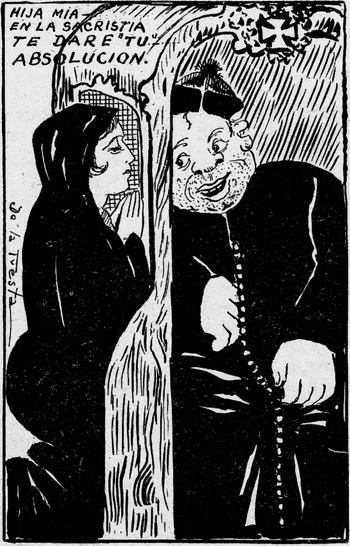
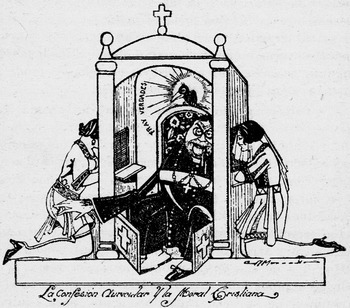
General Joaquín Amaro's army also used mass media to crank up sentiment against confession in the late 1920s and early 1930s. The army's press office, under General Cristóbal Rodríguez, churned out a string of anticlerical publications: La Patria, El Soldado (free for enlisted men) and La Voz de Juárez.Footnote 97 Rodríguez was also a frequent contributor, and his livid articles and their accompanying satirical illustrations (see Figures 1 and 2) were intended to be accessible to the general public in order to popularise anticlerical ideas.Footnote 98 He repeatedly claimed that clerical seduction of female penitents was a global, centuries-old plague that posed a real danger in contemporary Mexico.Footnote 99 In his collection of editorials, Sobre la brecha, Rodríguez devoted about one-eighth of his writings to the menace posed by immoral priests in the booth.Footnote 100
Untitled Illustration

‘Auricular Confession and Christian Morals’

Callista-era anti-confession campaigns were not just top-down events. Grassroots anticlerical groups and individuals complained to the national secretary of government and denounced lecherous priests in the bi-weekly newspaper, La Sotana (1929–31). In the heat of the Cristero War, in 1927, anticlericals in Jalisco struck the same note, warning peasant husbands that ‘the priest's nature as a man is excited by breathing the same air as a woman and he tries to discover the secrets that only you have a right to know. Think about it: Why are the confessions of a woman so long, and those of the man so short?’Footnote 101 Like elites, grassroots anticlericals could tap into the rich substrate of macho folk anticlericalism that mocked clerical chastity.
Whether politically privileged, quasi-official or popular, anticlerical efforts during the second and third waves of anti-confessional campaigns coincided on three important points: that most priests were sexually depraved, that women were exceptionally vulnerable in the confessional, and that confession's corrupting influence threatened domestic stability. Staged events dramatised these beliefs. During the early 1930s, a Sonoran state school superintendent hired a local circus to perform dramas ‘featuring depraved priests and their lurid activities during confession’ for schoolchildren.Footnote 102
Spectacle also claimed to prove that clergy killed the offspring of their secret affairs. During the Cristiada, troops under two revolutionary generals, Genovevo Rivas Guillén and Ricardo Luna, exhumed and exhibited the bones purportedly of infants fathered by errant priests.Footnote 103 These events seemingly confirmed stories circulating that infants fathered by priests or born to nuns were supposedly buried on church or convent grounds.Footnote 104 The third wave of anti-confessional campaigns also recycled this idea. On May Day 1934, anticlericals in Tehuacán, Puebla, demonstrated in favour of Garrido Canabal's project to tabasqueñizar (‘Tabasconise’) Mexico. Among the slogans on their placards: ‘Visit the EX-CONVENTS and you will find evidence that innocent infants were sacrificed, the fruit of beata nuns and hypocritical priests.’Footnote 105
Second- and third-wave anticlericals echoed first-wave claims that confession gave priests the opportunity to seduce women, although the act often served as a metaphor of emotional domination of women and clerical subversion of marriage. Still, sexuality was never far from Cristóbal Rodríguez's mind when analysing the shriving. The sacrament, he speculated, was invented by ‘lascivious priests’ to break their vow of celibacy surreptitiously.Footnote 106 In another article, Rodríguez opined that the confessor's questions ‘would make the most hardened public woman blush’.Footnote 107 Similarly, in July 1932, a writer for Garrido Canabal's mouthpiece Redención warned his (implicitly male) readers in July 1932 that were his ‘modest spouse’ to go to confession, she would be forced to reveal ‘the sensualities of the honeymoon’ to the salivating priest.Footnote 108 Second- and third-wave anticlericals pointed to confessional inquiries about female sexuality (perhaps a reference to premarital examinations of brides) to prove priests' prurience.Footnote 109 The experience of the Cristero War and religiously charged political conflicts exacerbated male revolutionaries' anxieties over confession, making such charges more credible. Seen in this light, Cristóbal Rodríguez's claim that wives, sisters, mothers and female friends who confessed became spies betraying unsuspecting male revolutionaries had a certain logic.Footnote 110
Modernising Marriage and Mexico's ‘Girl Problem’
For anticlericals, confession menaced the public and the private spheres. Its alleged threat to the family was particularly prominent in the second and third waves of anti-confessional campaigns. Defence of a revolutionary definition of marriage, not the rite's prohibition, increasingly seemed to be the campaigns' aim. Cristóbal Rodríguez reminded readers that ‘the man of the house whose spouse and daughters are slaves of the confessional cannot have dominion over his home’.Footnote 111 When a woman reveals the intimate details of her marriage to any other man (priest or not), Rodríguez fumed, ‘which of the two is the true husband?’Footnote 112 How, he asked rhetorically, could fathers and brothers tolerate their daughters and sisters going to confession?Footnote 113 A similar theme emerged in the anticlerical booklet, From My Pulpit (1933). One satirical homily entitled ‘Confiésate Niña’ (‘Confess, Little Girl’) melded centuries-old criticism of Counter-Reformation popes with attacks on the contemporary Mexican clergy's propriety: it claimed that shriving imperilled ‘perverted maidens, married women and widows’ alike.Footnote 114 Tactically, such warnings sought to shame and scare men into action to protect their wives and daughters from the dangers of the confessional booth; duly advised, the man of the house would finally put his foot down. Individual actions by husbands, fathers and brothers, not legal remedies, would end the sacrament, at least in revolutionary families. In the process of defending the patria, revolutionary men would also defend patriarchy.
Indeed, calls to ban shriving by preventing female participation often urged men to defend their domestic prerogatives. This was a time when the growing social empowerment of women, the increasingly egalitarian nature of marriage, and loosening sexual mores among young women posed a challenge to the established family order. Anticlericals harped on the fact that confessions ruptured the emotional intimacy between husband and wife on which modern marriage rested. In other words, the confessor would not necessarily cuckold the husband; rather, he would control his wife emotionally and impede her obedience to the husband. In fact, female participation in any activity in church seemed suspect to Cristóbal Rodríguez: he called religious women ‘the Church's cucarachas [cockroaches] abandoning household obligations to attend religious services’ and gossip about their neighbours.Footnote 115
In the Jazz Age, many middle- and upper-class fathers were also preoccupied by their daughters' sexuality as urban Mexico experienced an analogous situation to the ‘girl problem’ in the United States, with adolescent women rebelling against conventional standards of ‘deference and sexual purity’.Footnote 116 Katherine Bliss and Ann Blum remind us that during the 1920s and 1930s Mexico City witnessed new forms of youthful sociability enabled by new mass entertainment like the dance hall, and new technology like the automobile and recorded music.Footnote 117 The ‘seductive nature of the street’ worried parents, revolutionary officials and public reformers alike.Footnote 118 Significantly, one caricature from Rodríguez's book (see Figure 2) features young women dressed not as dowdy beatas, but as the Jazz Age ‘new woman’ known in Mexico as la pelona for her bobbed hair. The pelona's forward conduct was roundly condemned in many quarters, including the Church and the popular press.Footnote 119 Her presence in the cartoon crystallised male revolutionaries' anxiety over Mexico's ‘girl problem’, and showed how they shaped the ongoing debate over confession.
The notion that confessional seductions threatened the entire patriarchal family helped to justify harsh restrictions on the Church (though not confession) during the Maximato. In October 1934 Governor Saturnino Osornio prefaced strict anticlerical regulations in the state of Querétaro by saying that ‘in [the husband's] house and in his home there should be no confessor and the only one who commands is the head of the household’. For him, ‘the man who permits family members who go to communicate their secrets to another of bad faith … in my mind he is not a man, he has no dignity or conscience’.Footnote 120 Revolutionary manliness required the paterfamilias to prohibit any women under his roof from shriving.
Protection of women from predatory priests reaffirmed male revolutionaries' long-standing claims to – in Salvador Alvarado's words – ‘elevate’ women.Footnote 121 Realising this lofty goal often required attacking Catholicism. On 3 December 1934 a speaker at the Liga Nacional Femenil (National Women's League), in her talk on ‘Women and the Clergy’, charged that women were victims of the Church's ‘burden of obscurantism and absurd fantasies … [long] submitted to [its] capriciousness and tyranny’ and ‘denied reason by the empty promise of the afterlife and deceived by false miracles’.Footnote 122 Similarly, Cristóbal Rodríguez advocated abolishing confession by comparing it to Hindu suti: both were examples of religious backwardness that, if not destroyed by progress, would continue to harm women.Footnote 123
In all three waves of anticlericalism, revolutionaries represented themselves as forward-looking reformers who liberated women and modernised family life. Anti-confessional rhetoric, however, helped keep the process of legal secularisation of the family dating back to the nineteenth-century Liberal Reform on a firmly patriarchal path. The 1917 Family Relations Law and the 1928 Civil Code did not prohibit confession or Catholic marital and baptism ceremonies, but they did complete the removal of Catholic concepts from legal definitions of the family that had begun in the reform. Indeed, the era of Benito Juárez was long a touchstone for revolutionaries. Revolutionary legislation went much further than nineteenth-century liberal precedents by legalising divorce and giving women equal authority in some areas of family life.Footnote 124 Yet it also reproduced the unequal gender reciprocity exemplified by the 1859 Epistle of Melchor Ocampo read at the new civil marriage ceremony.Footnote 125 Revolutionary secularisation of domestic life, then, required the state to concede to women some important new rights – but not full legal equality, much less suffrage. Anti-confessional rhetoric was one important way to rationalise stopping short of a single sexual standard for men and women.Footnote 126
In spite of its limits, revolutionary reform of marriage was heralded as scientific, rational and healthy.Footnote 127 Spousal unions were now not just secular and contractual; they were also implicitly companionate. In other words, the foundation of marriage was emotional intimacy as opposed to procreation or the avoidance of sin.Footnote 128 Holly Wardlow and Jennifer Hirsch note that as companionate marriage spread to developing nations it became part of their ‘narrative of modernisation’.Footnote 129 In postcolonial Mexico, the Mexican Revolution clearly expanded upon existing notions of a companionate relationship between spouses as much as it created them.Footnote 130 Was the promotion of companionate marriage a step towards gender equality?Footnote 131 As in early nineteenth-century Costa Rica, revolutionary secularisation of marriage did not necessarily liberate women because the notion of making marriage companionate never displaced patriarchy.Footnote 132 The phantom menace of confessional seduction helps us understand how male revolutionaries in Mexico could remake marriage without giving up their authority over their wives.
The Campaigns' Outcomes
Revolutionary campaigns against confession never abolished shriving, nor did they spread a moral panic over the issue among a broad swath of Mexican society. In fact, by the second and third waves of the campaigns, anticlerical ideologues like Rodríguez had clearly shifted their focus from constitutional prohibition to the household, from public policy to conjugal integrity. However, by continuing to confirm the belief of many Mexican men that priests propositioned women in confession, the campaigns subtly shaped debates over women's legal and social status in post-revolutionary Mexico, nudging them in a more conservative direction. After the Querétaro constitutional convention (1916–17) and the arreglos (1929) restrained radical anticlerical measures aimed at shriving, charges that perverse priests preyed on women were still used to rationalise domestic patriarchy. Because campaigns against confession strengthened the idea that women were overly dependent on priests' counsel and thus vulnerable to clerical control, they helped convince male revolutionaries that women could not be trusted with legal or marital equality.
Recent literature on gender and patriarchy in modern Mexico has probed why the Mexican Revolution's radical emancipatory project left male domination unchallenged. Maxine Molyneux argues that revolutionary equality in divorce laws and the civil code aimed not at gender neutrality, but rather at creating modern, rational and patriotic notions of motherhood.Footnote 133 She also encourages researchers to tease out the ‘diffuse, often invisible mechanism of rule’ that subordinated women, such as the idea of their alleged essential ‘fanaticism’.Footnote 134 Subsequent research on gender and post-revolutionary state formation has identified other important mechanisms that provided new, revolutionary rationalisations for a patriarchal polity and social order. The revolutionary laboratory of Salvador Alvarado (1915–17) and Felipe Carrillo Puerto (1922–3) in Yucatán took the most progressive stand on women's rights in Mexico, but Stephanie Smith has documented how the influence of cutting-edge pseudo-science, like eugenics, on the law and judicial practice consolidated ‘separate and unequal gender spheres’ in spite of the ‘revolutionary legal system's liberal rhetoric of equality’.Footnote 135 Jocelyn Olcott has identified another mechanism: the gender marker of ‘La Malinche’, which enabled male revolutionaries to deny women's claims to revolutionary citizenship.Footnote 136 The archetypal La Malinche was both a victim and a betrayer – as was the woman in the confessional booth. When revolutionary legislators defied President Cárdenas by rejecting his proposal for female suffrage, some invoked the notion that gullible women were in the priest's sway.Footnote 137 One claimed that ‘if we granted women the right to vote, the Archbishop of Mexico would be the next President of the Republic’.Footnote 138 In the debate over suffrage, depictions of women as weak, fanatical and potentially counter-revolutionary were grounded in the narrative of confessional seduction. The anti-confession campaigns, like references to the gender marker of La Malinche and eugenics, helped to keep the post-revolutionary polity and social order patriarchal, even after Cristóbal Rodríguez, Garrido Canabal and their many acolytes faded from public life during the watershed presidency of Lázaro Cárdenas.
Attacking the rite of reconciliation was a central thrust of revolutionary anticlericalism. Although Mexican Jacobins failed to outlaw confession, their campaigns against it helped to gender politics as male and to define marriage and the family as patriarchal. A close examination of anti-confessional campaigns helps us understand how, in Mary Kay Vaughan's words, the Mexican Revolution repudiated ‘the rigid traditionalism defended by Catholic women in black’ without undermining either ‘male privilege or female subordination’.Footnote 139