Introduction
Tonsillectomy is one of the most common surgical procedures performed. An increasing number are being performed as day case procedures, in order to reduce the expense of patients' hospital stay. It is important to be aware of the degree of post-discharge morbidity involved in such a change of practice.
It is well known among otolaryngologists that tonsillectomy is followed by considerable pain in the days after surgery and discharge. Greater intensity of pain delays the patient's return to normal eating and to activities of normal life, such as work or school. It has been shown that more intense post-discharge pain is associated with a higher frequency of consultation with doctors and nurses, either by telephone or in person,Reference Rungby, Romeling and Borum1 thereby increasing primary healthcare costs.
Consequently, there is an ongoing need for research into the influence of tonsillectomy surgical techniques on post-discharge morbidity and pain, in order to identify techniques that cause less pain. It is also important to determine the risk of post-operative haemorrhage associated with various techniques. The UK National Prospective Tonsillectomy Audit showed that diathermy and coblation tonsillectomy had a post-operative haemorrhage rate at least three times as high as that of ‘cold steel’ tonsillectomy (i.e. without the use of a ‘hot’ technique).Reference Lowe and van der Meulen2
The most common tonsillectomy technique used in Denmark is blunt dissection followed by bipolar diathermy for haemostasis. A prospective but non-randomised study of haemostasis methods, which compared bipolar diathermy or ligation with pack compression, found significantly lower post-discharge pain scores and fewer doctor consultations for the latter method.Reference Rungby, Romeling and Borum3 However, until now, no controlled, randomised studies have been performed to confirm this finding.
The present study was designed with the aim of testing the effects of various methods of haemostasis on post-operative morbidity. The following three techniques were compared: (1) compression with gauze packs, (2) bipolar diathermy and (3) bupivacaine and adrenaline just before dissection, followed by pack compression. The controlling parameters were daily pain scores, return to swallowing without pain, return to work or school, episodes of blood-stained sputum, and the consultation rate, with doctors and nurses, by telephone or in person.
Materials and methods
This was a prospective, single-blinded, randomised study conducted within the otorhinolaryngology department of the University of Copenhagen, Gentofte Hospital, Denmark. We consecutively investigated 105 unselected patients admitted, at the patient's convenience, for elective tonsillectomy combined with adenotomy, myringotomy or grommet insertion. Since hospital care and treatment are free in Denmark, patients were admitted regardless of social status or age. The study protocol was reviewed and approved by the Danish Ethical Committee. Written, informed consent was obtained from all patients.
We included 46 males and 59 females in the study, of whom 53 were children (age range: three to 14 years) and 52 were adults (age range: 15–47 years). The patients were divided into four groups according to age and gender: (1) girls aged three to 14 years, (2) boys aged three to 14 years, (3) women aged 15–47 years, and (4) men aged 15–47 years. This division ensured that members of each group were comparable in terms of age and gender. Members of the four groups were then equally allocated to the three methods of haemostasis, using the block principle. Each patient was randomly assigned to one of the three haemostasis methods by selecting a sealed, opaque envelope from a pack of envelopes. Both the patients and the outcome assessors were blinded as to the haemostasis method used. The surgeon was blinded until general anaesthesia was initiated. The nursing staff providing post-operative care were also blinded.
Patients' indications for tonsillectomy comprised chronic tonsillitis, recurrent episodes of acute tonsillitis, foetor ex ore, or hypertrophic–obstructive tonsils with symptoms such as snoring, apnoea or dysphagia. Patients suffering peritonsillar abscess within two weeks pre-operatively were excluded from the study, as were those with chronic illnesses, such as diabetes, symptomatic heart disease, haemorrhagic diathesis, immunodeficit, cancer and psychiatric illness. We also excluded patients who were not able to read and understand Danish.
A questionnaire was distributed in order to obtain information about post-operative pain (including ear pain), swallowing, return to work or school, episodes of blood-stained sputum, and consultation with doctors and nurses (either by telephone or in person). Patients were asked to fill out the questionnaire every day for 10 days post-operatively. Pain scores were measured using a visual analogue scale (VAS); the patient made a vertical mark at a point along a 10 cm line which indicated their pain level, with zero indicating no symptoms and 10 the most intense pain.
On the 10th post-operative day, an appointment was scheduled to collect the questionnaires and to inspect the degree of tonsillar bed healing.
All patients had their tonsils removed surgically by blunt dissection with cold steel under general anaesthesia. Surgeons of all grades performed the tonsillectomy procedures.
The following haemostasis methods were used: (1) compression of the tonsillar fossa solely by packing with gauze tampons, (2) bipolar diathermy, and (3) bupivacaine with adrenaline (2.5 mg plus 5 µg/ml; 2–4 ml via peritonsillar infiltration five minutes before dissection), followed by pack compression.
A standardised anaesthetic technique was used in all patients.
Thirty-five patients were included in each group. Patients were discharged 24 hours post-operatively, after examination of the throat. For analgesia, children were given paracetamol and diclofenac according to weight, and adults were given diclofenac 150 mg per day for seven days, if necessary in combination with paracetamol 4 g maximum per day. The need for supplementary analgesia was assessed.
Results and analysis
All analyses were based on the intention-to-treat principle. The Kruskal–Wallis test was used to evaluate median age, median peri-operative haemorrhage, return to regular diet or drinking, and pain scores. Pair-wise comparisons using the Mann–Whitney test were performed if the change was significant. Chi-square testing with Yates correction was used to compare different haemostasis methods in terms of: patient's gender, incidence of primary and secondary haemorrhage, number of consultations by telephone or in person, presence of ear pain, tonsillar bed healing, and episodes of blood-stained saliva. Fisher's exact test was used to compare ‘failed’ versus ‘successful’ haemostasis. The level of statistical significance was set at 0.05.
Basic patient characteristics and results
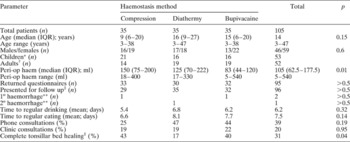
Methods of haemostasis and basic patient characteristics (i.e. mean age, gender and age group) are given in Table I. No significant differences were found between the three haemostasis groups. As shown in Table I, median peri-operative bleeding was 83 ml in the bupivacaine group, 125 ml in the diathermy group and 150 ml in the group receiving compression alone. As shown in Table I, p = 0.01 in the Kruskal-Wallis test between bupivacain group, diathermy group and compression group. Pair wise comparisons with the Mann-Whitney test were significant with p = 0.02 (bupivacain vs. diathermy) and p = 0.01 (bupivacain vs. compression). Two patients required re-operation due to primary haemorrhage and one due to secondary haemorrhage. No significant differences were found between the three methods of haemostasis in terms of incidence of primary or secondary haemorrhage.
Basic patient characteristics by haemostasis method

* Aged three to 14 years; †aged 15–47 years. ‡Post-operative day 10. **Requiring re-operation. IQR = interquartile range; peri-op = peri-operative; haem = haemorrhage; 1º = primary; 2º = secondary; phone = telephone
The questionnaire was returned by 95 patients (90 per cent), and 96 patients presented for their follow-up appointment 10 days post-operatively (91 per cent).
Patients returned to their regular diet after an average of 7.5 days and to regular drinking after an average of 6.1 days. No significant difference was found between the three haemostasis methods regarding return to regular drinking or eating.
Post-discharge, 38 per cent of patients consulted their doctor by telephone and 20 per cent in person. The compression group had fewer consultations than the two other groups, but this difference did not reach statistical significance.
Tonsillar bed healing, assessed on day 10, was delayed in the diathermy group compared with the compression and bupivacaine groups (p = 0.04).
Pain scores
Figure 1 shows the mean pain scores for each haemostasis group. There were no significant differences in VAS pain scores between the three groups, either for day-by-day analysis (p > 0.05) or for analysis of the whole post-operative period (p = 0.7, area under the curve analysis).
Post-operative visual analogue scale pain scores over time, by haemostasis method. Post-anaesth = post-anaesthetic

Ear pain
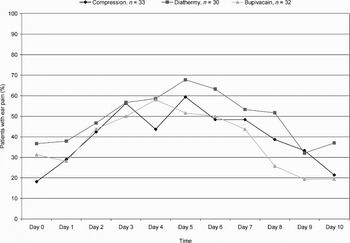
Figure 2 shows the proportion of patients with ear pain for each haemostasis group. Most patients had ear pain on post-operative days four and five. No significant differences in ear pain were found between the three haemostasis methods, either for day-by-day analysis (p > 0.05) or for analysis of the whole post-operative period (p > 0.5, area under the curve analysis). Eight patients also underwent myringotomy or grommet insertion. These additional procedures did not significantly increase the incidence of otalgia.
Post-operative ear pain over time, by haemostasis method.

Blood-stained saliva
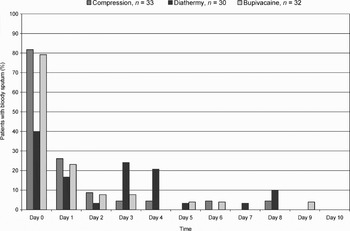
Figure 3 shows the percentage of patients experiencing post-operative episodes of blood-stained sputum, for each haemostasis group. Forty per cent of patients who received diathermy had episodes of bloody sputum on day zero, a significantly lower percentage than the compression group (82 per cent, p = 0.006) or the bupivacaine group (79 per cent, p = 0.011). The same pattern was seen on post-operative days one and two, but did not reach statistical significance. On days three and four, the pattern reversed; significantly more diathermy group patients had episodes of bloody sputum, compared with the other groups. On post-operative days five to 10, there was no difference between the haemostasis groups.
Post-operative incidence of bloody saliva over time, by haemostasis method.

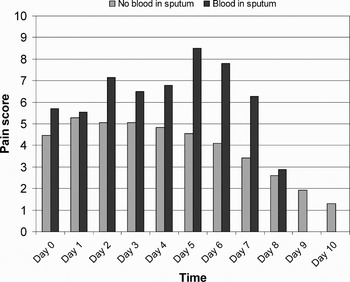
Figure 4 shows patients' VAS pain scores according to the presence or absence of blood-stained saliva. On post-operative days two to seven, pain scores were significantly higher for patients with bloody saliva (p < 0.05).
Post-operative visual analogue scale pain scores over time, by presence or absence of bloody sputum.

Haemostasis failure vs success
The haemostasis technique failed in seven (20 per cent) patients in the bupivacaine group and in 12 (34 per cent) in the compression group, and the surgeon was required to use diathermy or ligation to stop the bleeding. This difference was not significant (p = 0.28). We found no significant difference in the proportions of haemostasis success vs failure, comparing patient gender and median age.
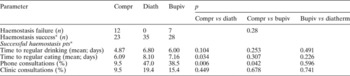
Table II shows subgroup analysis for tonsillectomies conducted with the three haemostasis techniques, used both successfully and non-successfully. Patients returned to regular diet significantly later in the successful diathermy group compared with the successful compression group (p = 0.03). Patients receiving successful compression haemostasis needed significantly fewer telephone consultations (p = 0.042) but not face-to-face consultations, compared with the bupivacaine group and the diathermy group.
Patient subgroup analysis by haemostasis method, both successful and failed

* Total patients minus patients with failed haemostasis. Compr = compression alone; diath = diathermy; bupiv = bupivacaine
Figure 5 shows mean pain scores for patients who successfully underwent each haemostasis method (i.e. cases of failed haemostasis are not shown). The successful diathermy group had slightly higher pain scores, compared with the successful compression and bupivacaine groups, for post-operative days three to 10. Nevertheless, this difference was only significant on days three, five and eight (p = 0.034, 0.034, 0.049, respectively) for successful diathermy vs successful compression, and on days nine and 10 (p = 0.033 and 0.041, respectively) for successful diathermy vs successful bupivacaine.
Post-operative visual analogue scale pain scores over time in patients receiving successful haemostasis (defined as total patient number minus patients receiving failed haemostasis), by haemostasis method. Post-anaesth = post-anaesthetic

Discussion
To our knowledge, tonsillectomy haemostasis via compression packs alone has not previously been investigated in a randomised trial. A previously published prospective, non-randomised study of method of haemostasis in cold steel tonsillectomy showed that the use of compression alone resulted in significantly lower post-discharge pain scores and fewer doctor consultations, compared with bipolar diathermy and ligation.Reference Rungby, Romeling and Borum3 Our study found no difference between these groups in terms of post-operative pain and morbidity. Selection bias could explain the difference between the results of the present, randomised study and those of the earlier, prospective, non-randomised study; that is, all the simple tonsillectomies in the non-randomised study may have employed compression haemostasis alone, while all the difficult tonsillectomies may have required diathermy or ligation haemostasis. In our study, those patients undergoing tonsillectomies conducted with successful compression and bupivacaine haemostasis had lower pain scores from days three to 10, compared with tonsillectomies conducted with failed compression and bupivacaine haemostasis.
• The most common technique for tonsillectomy in Denmark is blunt dissection followed by bipolar diathermy for haemostasis
• This study was designed to test the effect of three different haemostasis methods on post-operative morbidity
• One hundred and five patients were randomised to undergo ‘cold steel’ tonsillectomy with haemostasis from either diathermy, bupivacaine plus compression, or compression alone
• Diathermy and compression were associated with a similar degree of post-operative morbidity and pain
All outcome parameters indicated a non-significant tendency towards more morbidity and pain in the diathermy group. However, a reduction in VAS pain score of 2 cm was considered to be clinically relevant. In this study, with a calculated VAS score standard deviation of 17 mm, the power of the significance test was 80 per cent at the 5 per cent significance level.
No significant difference was found between the three haemostasis groups in terms of primary and secondary haemorrhage rates. This finding is in agreement with an earlier study by Rungby et al. Reference Rungby, Romeling and Borum3 The post-operative occurrence of episodes of blood-stained saliva was introduced as a new parameter in order to compare haemostasis techniques. Measurement of this parameter showed that the diathermy group experienced less bleeding in the first two days after surgery, followed by more bleeding over subsequent days, compared with the other two haemostasis methods. Sixty-seven per cent of all patients had blood-stained saliva on the operation day. This result is surprising compared with the paediatric post-operative survey of Lee and Sharp, who found that only 8.9 per cent of patients had blood-stained saliva during the first five days.Reference Lee and Sharp4 The higher reported incidence of blood-stained saliva in the present study probably reflects enhanced data collection and the fact that adults have a higher incidence of post-operative bleeding.
The presence of bloody saliva was associated with a higher pain score. A possible explanation could be that pain increases the blood pressure, which causes more bleeding.
Haemostasis with bupivacaine plus adrenaline was associated with less peri-operative bleeding. This finding is in agreement with an earlier study by Rasgon et al. Reference Rasgon, Cruz, Hilsinger, Korol, Callan and Wolgat5 However, use of bupivacaine with adrenaline did not reduce post-tonsillectomy pain scores. This is in line with the findings of a 2000 Cochrane review of the use of local anaesthesia in adult tonsillectomy.Reference Hollis, Burton and Millar6, Reference Orntoft, Longreen, Moiniche and Dhal7 However, some studies have shown opposite results.Reference Goldsher, Podoshin, Fradis, Malatskey, Gerstel and Vaida8–Reference Molliex, Haond, Baylot, Prades, Navez and Elkhoury11
Conclusion
During tonsillectomy, significantly less peri-operative bleeding occurred in the bupivacaine group compared with the other two haemostasis groups. After discharge, delayed healing of the tonsillar bed was seen in the diathermy group, compared with the other two haemostasis groups. No other significant differences were found between the groups, for any other outcome measures. Following discharge, the presence of blood-stained saliva was associated with higher pain scores.
Acknowledgment
We thank the ENT ward nurses for their great effort.