Introduction
Studies have documented high prevalence rates of post-traumatic stress disorder (PTSD) in war-affected communities, sometimes many years after the war (de Jong et al. Reference de Jong, Komproe, Van Ommeren, El Masri, Araya, Khaled, van de Put and Somasundaram2001; Fazel et al. Reference Fazel, Wheeler and Danesh2005; Priebe et al. Reference Priebe, Matanov, Jankovic Gavrilovic, McCrone, Ljubotina, Knezević, Kucukalić, Francisković and Schützwohl2009), yet little is known about the course of such disorders and the factors associated with persistence versus improvement over time. Longitudinal studies of PTSD, following events other than war, suggest an often persistent course, with most affected people recovering within the first 4–6 years post-trauma, after which time the condition is more likely to be unremitting (Breslau et al. Reference Breslau, Kessler, Chilcoat, Schultz, Davis and Andreski1998; Kessler et al. Reference Kessler, Sonnega, Bromet, Hughes and Nelson1995; Perkonigg et al. Reference Perkonigg, Pfister, Stein, Höfler, Lieb, Maercker and Wittchen2005).
Longitudinal research concerning war-related PTSD has been mostly conducted on war veterans and refugees in Western countries. Some studies on UK war veterans deployed in Iraq and Afghanistan found low prevalence rates of probable PTSD (4%) that remained stable at 6-year follow-up (Hotopf et al. Reference Hotopf, Hull, Fear, Browne, Horn, Iversen, Jones, Murphy, Bland, Earnshaw, Greenberg, Hughes, Tate, Dandeker, Rona and Wessely2006; Fear et al. Reference Fear, Jones, Murphy, Hull, Iversen, Coker, Machell, Sundin, Woodhead, Jones, Greenberg, Landau, Dandeker, Rona, Hotopf and Wessely2010). A prospective study of more than 50 000 US veterans deployed in the same regions found that more than 40% of those with probable PTSD at baseline had persistent self-reported PTSD symptoms 3 years later (Smith et al. Reference Smith, Ryan, Wingard, Slymen, Sallis and Kritz-Silverstein2008). Research on army personnel conducted over longer periods of time has reported remission rates of 55% after 14 years (Koenen et al. Reference Koenen, Stellman, Stellman and Sommer2003), 69% after 20 years (Solomon & Mikulincer, Reference Solomon and Mikulincer2006) and 93% after 32 years (Shlosberg & Strous, Reference Shlosberg and Strous2005).
Studies on refugee samples have considered time frames of up to 3 years after resettlement, used a variety of measures to assess symptoms and diagnosis, and provided inconsistent findings. Some of studies have reported a gradual decrease in PTSD symptoms over time (Hauff & Vaglum, Reference Hauff and Vaglum1994; Drozdek, Reference Drozdek1997; Weine et al. Reference Weine, Vojvoda, Becker, McGlashan, Hodzic, Laub, Hyman, Sawyer and Lazrove1998; Mollica et al. Reference Mollica, Sarajlic, Chernoff, Lavelle, Sarajlic and Massagli2001). For example, 77% of Bosnian refugees with PTSD living in a refugee camp in Croatia and 56% of Vietnamese refugees in Norway no longer had the disorder 3 years later. Other studies indicated that PTSD symptoms may persist or even increase, at least during the initial period after the war and resettlement (Lie, Reference Lie2002; Roth et al. Reference Roth, Ekblad and Agren2006). In Bosnian refugees living in Sweden, the symptom levels increased significantly over 3-year follow-up period, whereas among Kosovans in the same country, PTSD prevalence rose from 37% at baseline to 80% at 1½-year follow-up.
Research on PTSD in civilians living in post-conflict regions is rare. Two studies carried out in Kosovo within different time frames yielded inconsistent results. Cardozo et al. (Reference Cardozo, Kaiser, Gotway and Agani2003) found PTSD in 17% of a community sample immediately post-war and in 25% 1 year later. Eytan et al. (Reference Eytan, Guthmiller, Durieux-Paillard, Loutan and Gex-Fabry2011) reported a PTSD prevalence rate of 23% 2 years after the war and 14.5% at 6-year follow-up.
There are several factors associated with better PTSD outcomes over time. They include younger or older age (Hauff & Vaglum, Reference Hauff and Vaglum1994; Drozdek, Reference Drozdek1997; Su et al. Reference Su, Tsai, Chou, Ho, Liu and Lin2010), male gender (Breslau et al. Reference Breslau, Kessler, Chilcoat, Schultz, Davis and Andreski1998), lower education (Shlosberg & Strous, Reference Shlosberg and Strous2005), social support (Drozdek, Reference Drozdek1997; Lie, Reference Lie2002; Koenen et al. Reference Koenen, Stellman, Stellman and Sommer2003), fewer traumatic experiences during the follow-up period (Perkonigg et al. Reference Perkonigg, Pfister, Stein, Höfler, Lieb, Maercker and Wittchen2005; Breslau et al. Reference Breslau, Peterson and Schultz2008), employment (Lie, Reference Lie2002), absence of psychiatric co-morbidity, particularly with depression and other anxiety disorders (Zlotnick et al. Reference Zlotnick, Warshaw, Shea, Allsworth, Pearlstein and Keller1999; Mollica et al. Reference Mollica, Sarajlic, Chernoff, Lavelle, Sarajlic and Massagli2001; Koenen et al. Reference Koenen, Stellman, Stellman and Sommer2003; Perkonigg et al. Reference Perkonigg, Pfister, Stein, Höfler, Lieb, Maercker and Wittchen2005), and lower initial PTSD symptom levels (Koren et al. Reference Koren, Arnon and Klein2001; Kivling-Boden & Sundbom, Reference Kivling-Boden and Sundbom2002). Better outcomes in refugees and veterans have also been linked with fewer traumatic events being experienced during war (Lie, Reference Lie2002; Roth et al. Reference Roth, Ekblad and Agren2006) and, in particular, the absence or low severity of combat exposure (Hauff & Vaglum, Reference Hauff and Vaglum1994; Koenen et al. Reference Koenen, Stellman, Stellman and Sommer2003; Roy-Byrne et al. Reference Roy-Byrne, Arguelles, Vitek, Goldberg, Keane, True and Pitman2004; Fear et al. Reference Fear, Jones, Murphy, Hull, Iversen, Coker, Machell, Sundin, Woodhead, Jones, Greenberg, Landau, Dandeker, Rona, Hotopf and Wessely2010). Experiences of being ill without having access to medical care and undergoing major changes in work responsibilities were found to be associated with the persistence of war-related PTSD among civilians (Eytan et al. Reference Eytan, Guthmiller, Durieux-Paillard, Loutan and Gex-Fabry2011).
There is also a controversy in the literature about the most appropriate interventions for people suffering from war-related PTSD. Although there have been calls for the implementation of evidence-based psychiatric treatments, some have argued that such an approach may ‘medicalize’ distress, fix people in a role of victims and patients and therefore undermine their self-help potential (Hume & Summerfield, Reference Hume and Summerfield1994; Summerfield, Reference Summerfield1999). The latter position proposes that practical improvements in the social situation are likely to be more important than mental health care. So far there has been little research evidence to support either position.
In this study we aimed to explore the long-term course of war-related PTSD in people who stayed in the area of conflict and in refugees, and to identify factors associated with more or less favourable outcomes. On average 8 years after the war in the former Yugoslavia, we had previously recruited a representative sample of people with PTSD in war-affected communities in five Balkan countries: Bosnia and Herzegovina, Croatia, Kosovo (at the time of the data collection a province of Serbia and Montenegro), the Republic of Macedonia, and Serbia (Priebe et al. Reference Priebe, Bogic, Ajdukovic, Frančišković, Galeazzi, Kucukalic, Lečić-Toševski, Morina, Popovski, Wang and Schützwohl2010a, Reference Priebe, Bogic, Ashcroft, Frančišković, Galeazzi, Kucukalic, Lečić-Toševski, Morina, Popovski, Roughton, Schützwohl and Ajdukovićb). We had also interviewed compatriot refugees with PTSD who were residents of Italy, Germany and the UK (Bogic et al. Reference Bogic, Ajdukovic, Bremner, Franciskovic, Galeazzi, Kucukalic, Lecic-Tosevski, Morina, Popovski, Schützwohl, Wang and Priebe2012). Participants with PTSD at baseline were followed up a year later. To our knowledge this is the largest study conducted on the course of PTSD several years after the war both in post-conflict countries and among refugees from the same regions who resettled in the West.
Method
This was a prospective observational study conducted as part of the CONNECT project, a multi-centre European study on mental health sequelae of war and migration (Priebe et al. Reference Priebe, Jankovic Gavrilovic, Schuetzwohl, Galeazzi, Lečić-Toševski, Ajduković, Frančišković, Kucukalic and Popovski2004, Reference Priebe, Bogic, Ajdukovic, Frančišković, Galeazzi, Kucukalic, Lečić-Toševski, Morina, Popovski, Wang and Schützwohl2010a, Reference Priebe, Bogic, Ashcroft, Frančišković, Galeazzi, Kucukalic, Lečić-Toševski, Morina, Popovski, Roughton, Schützwohl and Ajdukovićb).
Sampling techniques and participants
Between January 2005 and November 2006, participants in the five Balkan countries were recruited using a multi-stage probabilistic sampling frame and random walk approach in administrative regions that had been directly exposed to war activities. We randomly selected 20% of these regions in each country and then a further three localities within each of them, resulting in a total of 15 regions and 49 localities across five countries. In each locality, streets were randomly identified and every fourth household selected until a maximum of 15 interviews were completed for one street. An adult member of each household whose birthday was closest to the date of interviewing was approached for participation. Because such methods were not feasible in Western Europe, participants in these countries were identified through data registers, community organizations and snowballing (Morina et al. Reference Morina, Böhme, Ajdukovic, Bogic, Frančišković, Galeazzi, Kucukalic, Lečić-Toševski, Popovski, Schützwohl, Stangier and Priebe2010). They were included if they had been born within the territory of former Yugoslavia; were between 18 and 65 years old; had experienced at least one war-related potentially traumatic event (to ensure that all participants had in fact been affected by war); had experienced the last war-related traumatic event at the age of ⩾16 years; and had no severe learning difficulties and no mental impairments due to brain injury or other organic causes. A total of 3313 participants were interviewed in the Balkan countries (⩾637 in each country) and 854 in the Western European countries (⩾255 in each country). Sampling techniques and baseline characteristics of the participants have been described in previous publications (Morina et al. Reference Morina, Böhme, Ajdukovic, Bogic, Frančišković, Galeazzi, Kucukalic, Lečić-Toševski, Popovski, Schützwohl, Stangier and Priebe2010; Priebe et al. Reference Priebe, Bogic, Ajdukovic, Frančišković, Galeazzi, Kucukalic, Lečić-Toševski, Morina, Popovski, Wang and Schützwohl2010a, Reference Priebe, Bogic, Ashcroft, Frančišković, Galeazzi, Kucukalic, Lečić-Toševski, Morina, Popovski, Roughton, Schützwohl and Ajdukovićb; Bogic et al. Reference Bogic, Ajdukovic, Bremner, Franciskovic, Galeazzi, Kucukalic, Lecic-Tosevski, Morina, Popovski, Schützwohl, Wang and Priebe2012). People diagnosed with PTSD were followed up 1 year after the baseline interview.
Procedures and measures
All interviews were conducted face to face. At baseline, participants' age, sex, living situation (alone versus with a partner), educational level and current employment status were obtained using a brief structured questionnaire. Potentially traumatic experiences before, during and after the war were assessed on an adapted 24-item version of the Life Stressor Checklist – Revised (Wolfe & Kimerling, Reference Wolfe, Kimerling, Wilson and Keane1997; Priebe et al. Reference Priebe, Matanov, Jankovic Gavrilovic, McCrone, Ljubotina, Knezević, Kucukalić, Francisković and Schützwohl2009).
Diagnoses of current PTSD and other mental disorders were assessed using the Mini International Neuropsychiatric Interview (MINI; Sheehan et al. Reference Sheehan, Lecrubier, Sheehan, Amorim, Janavs, Weiller, Hergueta, Baker and Dunbar1998), a structured diagnostic interview assessing the symptom criteria used in DSM-IV. The published translations of the MINI are available for the languages used in the study. The instrument was validated by a cross-national study in Europe and the USA (Sheehan et al. Reference Sheehan, Lecrubier, Sheehan, Amorim, Janavs, Weiller, Hergueta, Baker and Dunbar1998). Its reliability has been demonstrated in different cultures (Kadri et al. Reference Kadri, Agoub, El Gnaoui, Alami, Hergueta and Moussaoui2005; Otsubo et al. Reference Otsubo, Tanaka, Koda, Shinoda, Sano, Tanaka, Aoyama, Mimura and Kamijima2005) and in war-affected populations (Mufti et al. Reference Mufti, Naeem, Chaudry, Haroon, Saifi, Qureshi and Dagarwal2007; Morina & Ford, Reference Morina and Ford2008).
The levels of post-traumatic stress symptoms were measured using the Impact of Events Scale – Revised (IES-R; Weiss, Reference Weiss, Wilson and Keane2004; Franciskovic et al. Reference Franciskovic, Tovilovic, Sukovic, Stevanović, Ajduković, Kraljević, Bogić and Priebe2008). This instrument assesses 22 symptoms on five-point Likert scale (from 0 to 4) and was used previously on war-affected populations in the same regions (Priebe et al. Reference Priebe, Jankovic Gavrilovic, Matanov, Frančišković, Knezevic, Ljubotina, Mehmedbasic and Schützwohl2010c).
Social contacts were assessed on a single item of the Manchester Short Assessment of Quality of Life (MANSA; Priebe et al. Reference Priebe, Huxley, Knight and Evans1999). Participants were asked whether they had met a friend in the week prior to the interview, which was used as a simple indicator of having social contact (Priebe et al. Reference Priebe, Watzke, Hansson and Burns2008). Sociodemographic data and PTSD were reassessed at the 1-year follow-up. Additionally, an instrument with structured open questions, the Matrix for the Assessment of Community and Healthcare Service Interventions (MACSI; Etter & Perneger, Reference Etter and Perneger2000; Priebe et al. Reference Priebe, Bogic, Ajdukovic, Frančišković, Galeazzi, Kucukalic, Lečić-Toševski, Morina, Popovski, Wang and Schützwohl2010a), was used to record whether participants had used primary care and mental health care services during the follow-up period. The type and frequency of contacts were also documented.
All 33 interviewers were native speakers of regional languages (Serbian, Croatian, Bosnian, Macedonian and Albanian) or bilingual in Western European countries. They were all qualified psychologists or psychiatrists, apart from one ethnologist with a good knowledge of the population being investigated. All those instruments for which there had been no validated translations in the relevant languages were translated and back-translated into English. The interviewers were trained in using assessment instruments. A rating agreement (providing the same answers) for diagnostic assessments using the MINI was established during two mock interviews. The mean agreement among interviewers assessing 251 items was 90.2%.
A complete description of the study was provided to the potential participants and written informed consent was obtained prior to the interview. The study was approved by the relevant national ethics committees.
Statistical analysis
Data were summarized as counts and percentages, or means and standard deviations as appropriate. Characteristics of responders and non-responders were compared using χ2 tests and t tests. The change in the level of post-traumatic symptoms between baseline and follow-up was assessed using paired-sample t tests.
Linear regression was used to assess the relationship between the explanatory variables and the outcome, which was the change in self-reported PTSD symptoms (a total mean score on the IES-R). The results are presented as regression coefficients (B) with 95% confidence intervals (CIs) and p values. We first conducted univariable analyses to identify factors significantly associated with the level of post-traumatic stress symptoms (IES-R) at follow-up. The following variables were included: sociodemographic factors at baseline (age, gender, education, being unemployed, living with a partner); social contacts at baseline (having met a friend in the last 7 days); variables linked to potentially traumatic events (number of traumatic events in pre-war, war and post-war period); health service use within the 1-year follow-up period (use of primary care and mental health care services on the MACSI); and mental health indicators at baseline (PTSD co-morbidity with depression and anxiety on the MINI). In the next step, those variables that were significant at the 5% level were entered into a multivariable model with the same outcome variable. At this point the analysis was adjusted for baseline levels of post-traumatic stress symptoms on the IES-R and the length of time since the exposure to war trauma. This type of analysis can be used to assess change and is statistically more appropriate than analysing absolute change scores (Priebe et al. Reference Priebe, McCabe, Junghan, Kallert, Ruggeri, Slade and Reininghaus2011). Only variables that retained statistical significance at the 5% level were kept in the final model.
Because of the differences in sampling strategies used in the Balkans and among the refugees in the West, the two samples were analysed separately. All analyses were performed using Stata version 10.1 (StataCorp, USA).
Results
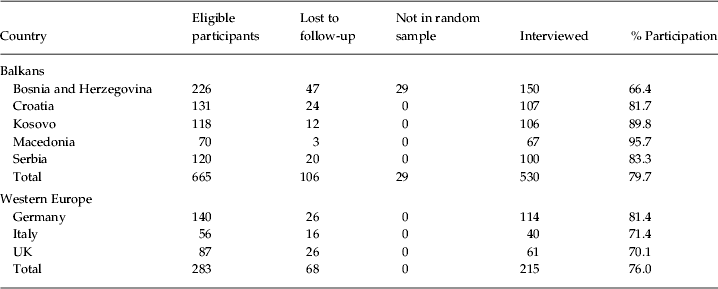
In the Balkan countries, 665 participants had been diagnosed with PTSD at baseline. Of these, 106 were lost to follow-up through not being contactable or declining to participate. A further 29 from Bosnia and Herzegovina were excluded randomly because of a high number of participants with PTSD in this country. Consequently, a total of 530 interviewees (80%) were reassessed. Eight cases were excluded from the present analysis because of missing data, resulting in a final sample of 522 participants.
In Western Europe, a total of 283 refugees with PTSD were identified at baseline and 215 (76%) of them were reinterviewed. Sixty-eight participants could not be contacted or declined to participate in the follow-up. Table 1 shows the selection processes in each country.
Eligible participants and follow-up rates in each country
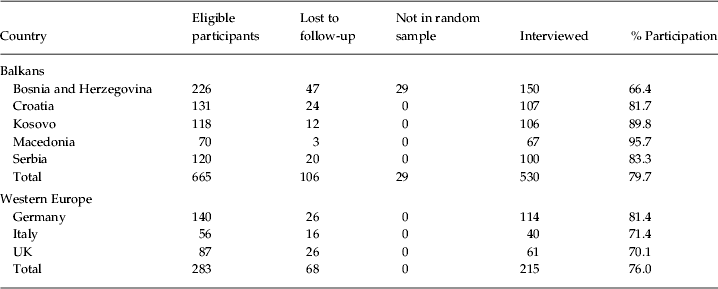
Baseline levels of PTSD symptoms were similar between participants who were reassessed and those who were lost to follow-up in both samples. However, there were significantly more females among participants who were followed up, compared to those who were not, both in the Balkan sample (55.8% v. 41.7%, p = 0.009) and among the refugees in the West (57.7% v. 39.7%, p = 0.012).
Additionally, in the Balkan sample, a χ2 test indicated a significant association between being reinterviewed and level of education (p = 0.046). There were fewer participants with secondary education (44.7% v. 55.7%) and more with higher education (16.4% v. 8.5%) among those who were followed up. They also reported fewer war-related traumatic events (mean = 5.8, s.d. = 3.1 v. mean = 6.6, s.d. = 3.4; p = 0.021) and shorter lengths of time since their occurrence (mean = 8.5, s.d. = 3.0 v. mean = 9.8, s.d. = 2.9, p < 0.0001).
Characteristics of participants
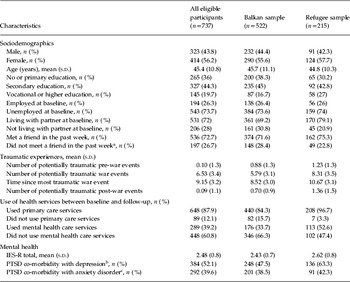
Sociodemographic, war-related, service use and mental health characteristics of participants from both the Balkan and refugee samples are presented in Table 2. Their social situations remained largely similar over the 1-year period. During the follow-up period, 440 (84.3%) participants from the Balkans reported contact with primary health care, mainly with a general practitioner (GP; n = 359; 68.8%) or a nurse (n = 128; 24.5%). Mental health services were used by 176 (33.7%) participants. The most frequently used types of contacts and/or interventions through mental health services were consultations with a psychiatrist (n = 139; 26.7%) or a psychologist (n = 14; 2.7%), pharmacotherapy (n = 96; 18.4%) and psychotherapy (n = 17; 3.3%). In the refugee sample, 208 (96.7%) participants reported using primary health care during the follow-up period, of whom 180 (83.7%) visited a GP and 14 (6.5%) visited a nurse. One hundred and thirteen (52.6%) participants used mental health services: 83 (38.6%) reported consultation with a psychiatrist; 13 (6%) reported seeing a psychologist; 17 (7.9%) received pharmacotherapy; and 15 (7.0%) received psychotherapy.
Sociodemographic, trauma, service use and mental health characteristics of the participants at baseline

IES-R, Impact of Event Scale – Revised; PTSD, post-traumatic stress disorder; s.d., standard deviation.
a Four missing values.
b Five missing values.
c Two missing values.
Change in PTSD symptoms
In Balkan residents, a paired-sample t test indicated a statistically significant decrease in the total mean score of PTSD symptoms (IES-R) from baseline (mean = 2.43, s.d. = 0.7) to follow-up (mean = 1.94, s.d. = 0.9, p < 0.001) and a corresponding reduction in all three IES-R subscales of intrusion, hyperarousal and avoidance (p < 0.001). A similar pattern was observed in refugees, with a statistically significant reduction in the mean total score of IES-R between baseline (mean = 2.61, s.d. = 0.8) and follow-up (mean = 2.17, s.d. = 1.1, p < 0.001) and significant improvements in all three IES-R subscales (p < 0.001). The improvements were also reflected in the PTSD diagnosis as assessed on the MINI. At follow-up, 184 Balkan residents (35%) and 74 refugees (34%) no longer fulfilled the diagnostic criteria for PTSD.
Factors associated with change in self-reported PTSD symptoms
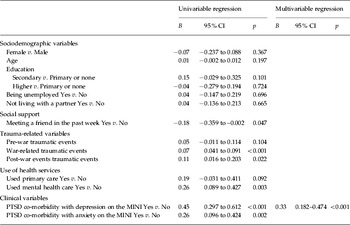
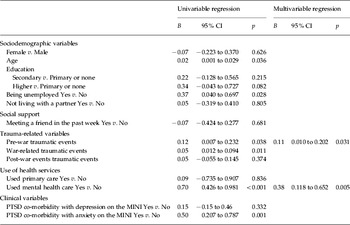
The results of the univariable and multivariable regression analyses for the Balkan and refugee samples are presented in Tables 3 and 4. Checks for multi-collinearity of predictor variables were satisfactory.
Univariable and multivariable linear regression analyses in the Balkan sample (n = 522) with post-traumatic stress symptoms (IES-R) at follow-up as an outcome variablea

PTSD, Post-traumatic stress disorder; IES-R, Impact of Event Scale – Revised (values range between 1 and 4, higher score indicates higher level of PTSD symptoms); MINI, Mini International Neuropsychiatric Interview; CI, confidence interval.
a Adjusted for baseline level of IES-R symptoms and a length of time since trauma.
Univariable and multivariable linear regression analyses in the refugee sample (n = 215) with post-traumatic stress symptoms (IES-R) at follow-up as an outcome variablea

PTSD, Post-traumatic stress disorder; IES-R, Impact of Event Scale – Revised (values range between 1 and 4, higher score indicates higher level of PTSD symptoms); MINI, Mini International Neuropsychiatric Interview; CI, confidence interval.
a Adjusted for baseline level of IES-R symptoms and a length of time since trauma.
In univariable analyses the following factors were significantly associated with lower level of PTSD symptoms at follow-up in the Balkan sample: recent contacts with friends at baseline; fewer war-related and post-war traumatic experiences; not using mental health care services during the follow-up period; and the absence of co-morbidity of PTSD with depression and anxiety disorder.
In the multivariable model, after adjusting for the influence of baseline PTSD symptom levels (B = 0.40, 95% CI 0.29–0.50, p < 0.001) and the length of time since war trauma (B = 0.07, 95% CI 0.05–0.10, p < 0.001), only the co-morbidity with depression remained significant (B = 0.33, 95% CI 0.18–0.47, p < 0.001).
In the univariable analysis conducted on the refugee sample, younger age, not being unemployed at baseline, fewer pre-war and war-related traumatic experiences, not using mental health services between baseline and follow-up and the absence of co-morbidity of PTSD and anxiety disorder were all significantly associated with a lower level of PTSD symptoms at follow-up.
In the multivariable model, after adjusting for baseline level of PTSD symptoms (B = 0.64, 95% CI 0.52–0.76, p < 0.001) and the length of time since war trauma (B = 0.01, 95% CI –0.02 to 0.04, p = 0.377), only pre-war traumatic events (B = 0.11, 95% CI 0.01–0.20, p = 0.031) and the use of mental health services between baseline and follow-up (B = 0.38, 95% CI 0.12–0.65, p = 0.005) retained their significance.
Discussion
Main findings
People who met diagnostic criteria for PTSD on average more than 8 years after the war still experienced a significant decrease in self-reported PTSD symptoms over a period of 1 year. Co-morbid depression at baseline was linked to less improvement in people who remained in the post-conflict region. In refugees, more pre-war traumatic events and using mental health services during the follow-up period were associated with poorer outcomes.
Strengths and limitations
To our knowledge, this is the largest community-based prospective study on the course of PTSD in people who had experienced war several years previously. The study used consistent assessment methods across five countries, and included civilians and people with combat experience. A multi-stage probabilistic sampling method ensured that the findings are representative for large populations in the war-affected areas. All interviewers were trained in the use of the assessment methods and spoke the mother tongue of the interviewees. Standardized instruments were used to establish PTSD and post-traumatic stress symptoms.
The study also has several limitations. As an observational study it cannot establish causality. Despite the acceptable follow-up rate in the Balkans (83%), the findings may still be affected by participation bias. The sample was not fully representative for refugees in Western European countries. This is linked to the non-availability of detailed population data, legislation and research regulations in the participating countries. These problems are encountered by many researchers who explore the issues related to refugee groups, and are not specific to this study. Although their baseline levels of post-traumatic symptoms were similar, responders and non-responders in the Balkans did differ on some variables, with a predictive value for the course of PTSD such as the number of traumatic war experiences and the length of time since their occurrence. Consequently, the improvement in symptoms may have been less favourable among people we failed to reinterview. The use of health services was assessed using only a self-report measure. We did not obtain data on the details of the treatment and it remains unclear to what extent treatment consisted of evidence-based methods.
Comparison with the literature
The improvement in PTSD symptoms reported in this study may be seen as positive, particularly considering the length of time since the war trauma and the likely duration of PTSD. We did not establish the exact onset of PTSD in this study. However, research suggests that delayed onset of PTSD is rare (Goenjian et al. Reference Goenjian, Steinberg, Najarian, Fairbanks, Tashjian and Pynoos2000), and we can therefore assume that most participants in our sample started experiencing symptoms shortly after the war.
The findings on the course of non-war-related PTSD suggest that less than 20% of individuals in whom disorder persisted for 6 years or longer recovered later on (Kessler et al. Reference Kessler, Sonnega, Bromet, Hughes and Nelson1995; Breslau et al. Reference Breslau, Kessler, Chilcoat, Schultz, Davis and Andreski1998). However, in our study, participants with long-term PTSD reported a significant decrease in symptoms over a period of 1 year. This is consistent with more positive outcomes reported in other studies on long-term war-related PTSD. For example, Eytan et al. (Reference Eytan, Guthmiller, Durieux-Paillard, Loutan and Gex-Fabry2011) found a significant reduction in the prevalence rate at the 6-year follow-up among war-afflicted population in Kosovo, while symptoms in war veterans also decreased with time (Koenen et al. Reference Koenen, Stellman, Stellman and Sommer2003; Shlosberg & Strous, Reference Shlosberg and Strous2005; Solomon & Mikulincer, Reference Solomon and Mikulincer2006).
There are two possible explanations for the improvement seen in this study compared to findings on other forms of PTSD. First, the process of recovery in people with war-related PTSD may start later. In war, people are often exposed to a variety of prolonged and repeated traumatic events, and the more complex nature of their traumatic experience may lead to a greater persistence of symptoms. They also experience higher levels of other risk factors, such as post-war socio-economic hardship, societal instability and, in the case of resettlement, adjustment in a new environment. All of these factors, along with the ongoing political uncertainty in some of the Balkan countries, may have interfered with efforts to overcome post-traumatic stress and prevented an earlier reduction in symptoms.
Alternatively, the findings may reflect a fluctuating course of PTSD, whereby many people improve but also relapse over time (Goenjian et al. Reference Goenjian, Steinberg, Najarian, Fairbanks, Tashjian and Pynoos2000; Solomon & Mikulincer, Reference Solomon and Mikulincer2006). For example, in a 20-year longitudinal study, complete remission was observed in 4% of veterans, 17% had two remissions and 24% had one remission (Solomon & Mikulincer, Reference Solomon and Mikulincer2006).
A decrease in the level of PTSD symptoms reported in our study is consistent with the findings of some (Hauff & Vaglum, Reference Hauff and Vaglum1994; Drozdek, Reference Drozdek1997; Weine et al. Reference Weine, Vojvoda, Becker, McGlashan, Hodzic, Laub, Hyman, Sawyer and Lazrove1998; Mollica et al. Reference Mollica, Sarajlic, Chernoff, Lavelle, Sarajlic and Massagli2001), but not all (Lie, Reference Lie2002; Roth et al. Reference Roth, Ekblad and Agren2006), refugee studies that considered shorter time frames. These conflicting findings may reflect methodological differences between studies or an impact of the given sociopolitical context of a host country on perpetuating symptoms. A negative association between time since trauma and symptom improvement has also been reported in populations with non-war-related PTSD (Kessler et al. Reference Kessler, Sonnega, Bromet, Hughes and Nelson1995; Breslau et al. Reference Breslau, Kessler, Chilcoat, Schultz, Davis and Andreski1998). The more time that has passed since the trauma, the less likely it is that symptoms of ongoing PTSD improve.
Experiencing fewer traumatic events before the war was linked to the reduction of symptoms in refugees, which is in line with some reports on the impact of previous trauma (Breslau et al. Reference Breslau, Chilcoat, Kessler and Davis1999). Repeated traumatization may not only increase the risk of developing PTSD but also diminish the chances to recover.
In Balkan residents, co-morbid depression predicted more persistent symptoms, a finding that is consistent with previous reports from war-related contexts (Mollica et al. Reference Mollica, Sarajlic, Chernoff, Lavelle, Sarajlic and Massagli2001; Koenen et al. Reference Koenen, Stellman, Stellman and Sommer2003). Depressive symptoms may diminish the possibility of engaging in contacts and activities that help to overcome PTSD symptoms and the negative cognitions linked to depression are likely to hinder a reappraisal of the traumatic experience.
The finding that contacts with mental health services were univariably associated with a poorer outcome in both samples is not surprising. People with more severe disorders are more likely to seek treatment and less likely to improve. However, in the refugee sample, the association retained significance even in the multivariable model, after adjusting for symptom severity and other factors. This means that the poorer outcome in people using mental health services is not explained by different baseline characteristics as far as they were considered in this study. Such results are consistent with previous research on war refugees (Drozdek, Reference Drozdek1997; Kivling-Boden & Sundbom, Reference Kivling-Boden and Sundbom2002). They also resonate with the findings of observational studies assessing the treatment outcomes of patients with PTSD several years after their war experiences, which show little, if any, improvement following treatment (Priebe et al. Reference Priebe, Jankovic Gavrilovic, Matanov, Frančišković, Knezevic, Ljubotina, Mehmedbasic and Schützwohl2010c). The finding might be explained by confounding factors that were not assessed, such as aspects of the patients' symptomatology that are not captured in the IES-R, which was used as a measure of self-reported symptoms in this study. At the same time it cannot be excluded that, in some cases, treatment may have a negative effect, possibly because patients find some forms of treatment difficult and overwhelming (Pitman et al. Reference Pitman, Altman, Greenwald, Longpre, Macklin, Poiré and Steketee1991; Foa et al. Reference Foa, Zoellner, Feeny, Hembree and Alvarez-Conrad2002) or because it strengthens the attention and focus of patients on the experience of symptoms and thus prevents helpful alternative ways of coping and forgetting. There has been a lack of systematic research, and particularly randomized controlled trials, of PTSD treatments for refugees and civilians in war-affected regions. (Nickerson et al. Reference Nickerson, Bryant, Silove and Steel2011).
Implications and conclusions
The improvement is post-traumatic stress symptoms identified in this study may provide hope to the many people who still suffer from PTSD many years after traumatic war experiences. Significant symptom improvements are still possible, and they certainly do not depend on receiving psychiatric or psychological treatment. With respect to refugees with war-related PTSD, the findings instead indicate a need to review the role, the approach and also the quality of psychiatric and psychological treatments for this patient group and possibly consider alternative approaches.
Overall, people tend to improve, but commonly assessed sociodemographic and clinical characteristics seem to have only a limited predictive value for establishing whether people with PTSD do or do not improve many years after the war.
Acknowledgements
We thank the CONNECT study group for their involvement in this study.
This study was funded by a grant from the European Commission (contract number INCO-CT-2004-509175). The funding organizations had no role in the design and conduct of the study; in the collection, analysis and interpretation of the data; or in the preparation, review or approval of the manuscript. The views expressed in the publication are those of the authors and not necessarily those of the European Commission.
Declaration of Interest
None.