

The Virgin Mary, as Mother of the Word, has long been associated with early literacy training in the medieval West. From Pamela Sheingorn's analyses of St. Anne teaching her daughter to read, to Michael Clanchy's of the Virgin conducting the Christ child to school, to Virginia Reinburg's of books of hours and their pedagogical uses, scholars have long acknowledged the Virgin's central place in elementary language instruction in the Middle Ages.Footnote 1 Whether she is a daughter learning the alphabet on her mother's lap, or a mother ensuring her holy child's attendance at grammar school, or the Queen of Heaven inspiring prayers and practice in Latin at the same time, the Virgin Mary's roles both exemplified and encouraged the cultivation of beginning reading skills, skills represented across Europe by the well-known depiction of Lady Grammar. While Gary P. Cestaro has demonstrated the ways in which representations of Lady Grammar became more maternal throughout the medieval period, I wish to demonstrate reciprocally how and why the Virgin Mother took on the persona of Lady Grammar in both verbal and material arts during and after the High Middle Ages.Footnote 2 Adopting Lady Grammar's iconography of the nourishing breast, classroom text, and punitive whip, the Virgin Mary is not only connected to basic Latin instruction, but also comes to embody its principles.
Lady Grammar, Mother of All Learning
Lady Grammar, a figure first popularized by Martianus Capella's Marriage of Philology and Mercury (ca. 410), might seem an unlikely counterpart to Our Lady.Footnote 3 Martianus depicts Lady Grammar as an old woman “of great charm” who teaches literacy by wounding untutored tongues before healing them with her instructional balm.Footnote 4 Lady Grammar's practice of causing injury before meting out mercy, as well as her boldness in speaking before Mercury and Philology's wedding guests, might seem inimical to the Virgin. To summarize and preserve tenets of Roman education from pre-Christian times, Martianus portrays Lady Grammar, along with the other six ladies of the liberal arts, offering a lecture on her field as a nuptial entertainment. Her teachings in basic language and literature necessarily preceding studies in rhetoric, logic, and the quadrivium, Lady Grammar presents herself first at the marriage feast. She is an experienced pedagogue who has worn the dress (taught the language) of Egypt, Greece, and Rome. She carries a knife to prune the verbal faults of children whom she prepares for more advanced subjects, as well as various medications to cure the injuries necessarily inflicted. She cleans the lungs, breathing passages, teeth, and tongue to clear the way for well-formed utterances. Her lecture is predictably long-winded because of the many technical aspects of grammatica: rules concerning orthography, syllabification, and agreement. In fact, her presentation is so prolix that after a discourse on modifiers, Minerva calls for the lecture's conclusion “because of the boredom that had come upon Jove and the celestial senate.”Footnote 5 The instruction deemed crucial for children in western civilization for centuries is not appropriate for a festive gathering of mature deities.
If an elderly, punitive, and verbose maiden who is preoccupied with the respiratory passages for speech does not conjure similarities to the Virgin Mary, medieval representations of a maternal Lady Grammar who promotes readings in both classical and Christian texts eventually will. In Dante and the Grammar of the Nursing Body, Cestaro documents an increasing emphasis throughout the Middle Ages on Grammar's maternity and consequent approximation to the Virgin; he observes depictions of the children at Grammar's linguistically nourishing breast and the resemblance of these depictions to those of the Christ child nursing on Mary's lap.Footnote 6 Lady Grammar became a literate mother figure who served Roman Catholic education systems and grew closer in identity to the Virgin Mary partly because of cultural expectations that mothers teach language to their children and partly because of Christianity's success in adapting linguistic training from antiquity. Classical and medieval pedagogical theory maintained the importance of caregivers to language acquisition, a role filled at home by the mother or nurse and at school by the representatives of Lady Grammar. Insisting on the mother's critical role in early language instruction, Quintilian, for instance, declares an infant's caregiver the most influential model for pronunciation and correct grammar, skills that would prepare the child for trivium studies,Footnote 7 and Martianus himself paves the way for Grammar's motherhood by depicting her as a teacher of small children. Throughout the Western Middle Ages, although the Institutes was not widely available, the processes for language instruction outlined by Quintilian and codified by Martianus were adapted for a variety of settings.Footnote 8 In European religious establishments where Latin was not the native language, Grammar became the parent of all learning and the gateway to Roman Catholic texts, liturgies, and doctrines.
Martianus had hoped to preserve a pre-Christian curriculum and could not have anticipated how thoroughly medieval Catholic schools would appropriate the liberal arts training developed by his seven maidens and their lectures, an appropriation making the merging of Lady Grammar with the Virgin possible. St. Augustine's De doctrina christiana famously sanctioned the liberal arts curriculum for the faithful's improvement only in Martianus's own time,Footnote 9 and later generations of Catholic intellectuals would build the institutions and textual practices making those programs possible. In the next century Cassiodorus made (unrealized) plans to found a Christian school in Rome, and in the ninth century, during an explosion of Catholic commentaries on the Marriage, Remigius of Auxerre fostered a Christian interpretation of Martianus that “taught people to think of [the liberal arts] not as textbooks or a set of skills, but as eternal truths immanent in the soul.”Footnote 10 Mother Grammar showed the way to such truths by providing access to Latin writings and thus giving birth to the study that would enable every other discipline that supported the faith. By the High Middle Ages, once children began formal Latin instruction, their linguistic mother was represented iconographically by Lady Grammar; by the Late Middle Ages, she became the Virgin Mary.
Among efforts to deploy the liberal arts in Catholic instruction, early grammatical theorists defined Grammatica as a Christian parent. According to St. Augustine's Soliloquia, “Est autem grammatica vocis articulatae custos et moderatrix disciplina.”Footnote 11 Grammar is a custos (guardian) of the articulate word as well as a moderatrix (mistress) of the word through discipline. In Augustine's definition, disciplina resonates with meanings concerning the principles of grammar, the body of linguistic and literary knowledge, the personal control required for learning, and the corrective punishments meted out to students along the way. The vox articulata (voice conveying meaning) that results from grammar's guardianship distinguishes speech from animal sounds or bird songs and points to the human potential to reflect God's image with speech acts.Footnote 12 In the Etymologies (ca. 625) St. Isidore of Seville would cement bridges between words and echoes of the divine in an oft-repeated definition rendering grammar the progenitor of all learning: “Grammatica,” writes Isidore, “est scientia recte loquendi, et origo et fundamentum liberalium litterarum.”Footnote 13 Isidore insists that grammar is the groundwork for all study and of recte loquendi (of speaking correctly, truthfully, and righteously).Footnote 14 For Isidore, the core principle of the Etymologies is that all understanding is laid bare through the investigation of morphemes, a practice the encyclopedia teaches its audience of monks and Visigothic princes to follow in order to discover divine will in speech. According to Valastro Canale, Isidore's philology, with its emphasis on the roots of both words and things, reveals the providential impulses in speech from the creation of the world forward.Footnote 15 Grammar is the origo (origin) of humanity's understanding of creation through the liberal arts. In the twelfth century John of Salisbury will revise Isidore's definition as follows to emphasize Grammar's maternity: grammar is “the cradle of all philosophy, and in a manner of speaking, the first nurse of the whole study of letters.”Footnote 16
Lady Grammar at Chartres
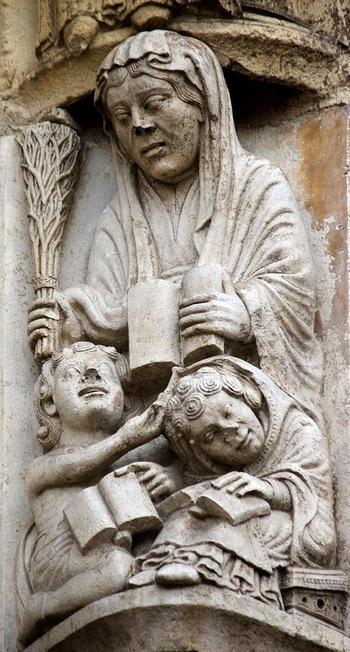
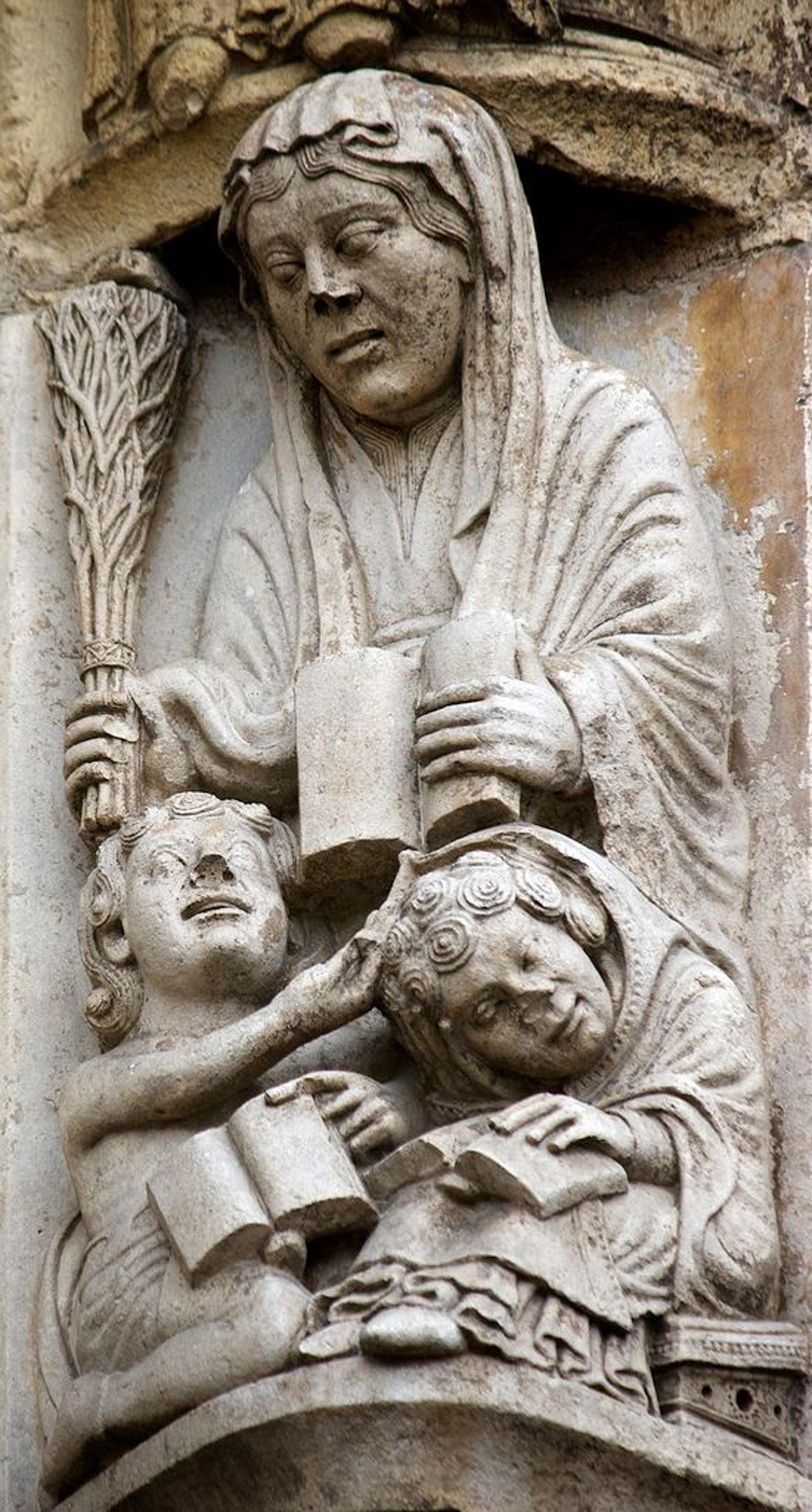
Because of the links between Lady Grammar and Christian parentage, her image had metamorphosed by the High Middle Ages to a young woman with a child at her knees or on her lap. Lady Grammar no longer brandishes a knife or transports a box of speech medicaments, as in Martianus, but the twelfth-century maiden often raises a punitive switch to represent the corporal punishment that both parents and teachers meted out in this age.Footnote 17 In her other hand, she holds a book or her nurturing breast, the gesture of nursing eventually inviting comparisons with Maria lactans. Although from the twelfth century onward Lady Grammar appears in many media across the medieval West, her classic form is sculpted (ca. 1150) on the west façade of the Cathedral of Our Lady of Chartres.Footnote 18 The chancellor of Chartres's famous school at this period, Thierry of Chartres, who describes Lady Grammar as a “matron” in the Prologue to his Heptateuchon, probably oversaw the construction of the sculpture that characterizes the cathedral's dedication to the Virgin and to a liberal arts curriculum.Footnote 19 At Chartres and elsewhere, Lady Grammar represents the trivium’s foundational Latin language and literature curriculum, her implements suggesting the central goal of that curriculum (to read a book), the process for achieving that goal (ingesting grammatical instruction), and the punishments inflicted on the children who fall short (skin-searing blows).
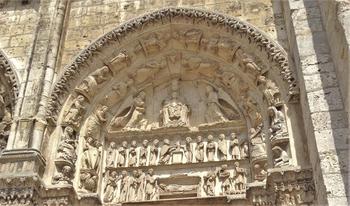
In the southern entry of Chartres's Royal Portal, Lady Grammar is installed in the lower portion of the middle archivolt beneath the Virgin Mother and Child, the holy pair being enthroned as the Seat of Wisdom in the tympanum. (Images 1 and 2). The relationship between Lady Grammar and the Virgin at Chartres depends upon a complex sculptural program that points to an interdependency between these two icons but does not yet bring them into full association. Margot E. Fassler links the Royal Portal's sculptures, as well as the cathedral's other art works, to the local history of Chartres, the Marian liturgies reflecting it, and especially the veneration of the cathedral's central relic, the Sancta Camisa (the garment believed to be worn by the Blessed Mother when she gave birth to Christ).Footnote 20 “The south portal sculpture places the Sedes at the apex of human events unfolding in time,” Fassler observes, “all of which relate to the deeper meaning of the incarnation, birth, and salvation.”Footnote 21 Because of the chemise, Chartres became an important pilgrimage site for Marian feasts: the Presentation, Annunciation, Assumption, and Nativity are all portrayed in the south entry's lower lintel. Lady Grammar, as the guide to Marian hymns and readings in Latin, represents an initial approach to the mysteries associated with the Mother.
The Virgin enthroned, Royal Portal at Chartres Cathedral. Photograph by author.

Lady Grammar, Royal Portal of Chartres Cathedral. Photo by Dr. Nick Thompson, University of Auckland. Reproduced with Thompson's permission.
As Laura Spitzer points out, the external ornamentation at Chartres was the first in both depicting the Virgin Mary's story and presenting the ladies of the liberal arts,Footnote 22 this breakthrough representing a melding of the Mariology and the liberal arts curriculum taught in this famous cathedral.Footnote 23 While research exploring Mary's association with the other liberal arts is being conducted elsewhere,Footnote 24 concentrating here on the Virgin's connection to Lady Grammar at Chartres reveals an emerging alliance between the two icons that comes to full realization in the thirteenth-century artes poetriae. Lady Grammar is located at the bottom right of the middle archivolt, where she is first among the ladies of the seven arts, who are presented in the same order as in the Marriage of Philology and Mercury. Each lady is accompanied by a male authority in her field, just as Martianus depicts the maidens in a train of venerable experts; for Lady Grammar, the counterpart has been identified as either Donatus or Priscian.Footnote 25 The Virgin and Child, encircled by this learned host,Footnote 26 construct a Sedes Sapientiae with “a more specific and profound meaning,” in Adolf Katzenellenbogen's estimation, “because the Wisdom incarnate is related to human wisdom as exemplified by its instruments, that is, the seven liberal arts and their representatives, in the archivolts.”Footnote 27 In this way, the Royal Portal announces the Boethian connection taught at Chartres's school between all of the liberal arts and holy Wisdom.Footnote 28 For young pupils, Lady Grammar offers an induction to literacy that prepares them to meet Lady Rhetoric and Lady Logic, with whom the Virgin also shares a role in expressing the Word in human forms. Streaming into the cathedral for worship and instruction, pupils enrolled in the renowned school would have passed beneath the Virgin's protection, the youngest still being under Grammar's observation.
Considering the Virgin's connection to fields of expertise, Fassler has remarked that at Chartres, where Mary is honored for the flesh that drapes the godhead, “the Virgin was defined more as Sedes than as Sapientia, as every attempt was made to herald her flesh (and her chemise) as … pregnant with meaning.”Footnote 29 If Chartres's Mary is adored for her singular role in the incarnation, the relic related to it, and the protection this relic offered to the church and city more than for her absorption of Wisdom (in the way that Barbara Newman finds a conflation between Maria and Sophia in other contemporaneous arts),Footnote 30 it is still, as Fassler clarifies, the relationship between Mary and Jesus that represents “the essence of knowing,” and it is grammar that first reveals this essence.Footnote 31 Materializing the school's method, reported by Gundissalinus, of dividing artes eloquentiae from sapientiae,Footnote 32 in the Seat of Wisdom the infant Jesus deifies the sapience which Mary eloquently conveys to a sin-darkened world.Footnote 33
Lady Grammar teaches the rules of correctness underlying all eloquence, and she often does so in medieval material arts by mirroring the Virgin's presentation of the Word: by holding a child close. Among the seven ladies of the liberal arts, the Virgin shares only with Grammar the guardianship of a young boy; the parental role of these two figures suggests an incipient association based in maternity and the divine logos. Indeed, the cathedral's west façade is invested in competing images of motherhood: first, a theological depiction on the tympanum relating the Mother to Wisdom and the Word; and second, a popular portrayal in the capital frieze of matrons in the holy family, of St. Anne escorting the young Mary to school, for instance, or of the Annunciation. Spitzer argues that the frieze, appealing to local mothers who sought miracles at the cathedral, occupies a marginalized position on the façade that reflects efforts to repress popular cults in favor of the Sedes Sapientiae. In her words, the frieze, more difficult to see and follow, portrays holy mothers “in all their prosaicness,” while the more prominently placed tympanum sculptures explain the “corpus verum.”Footnote 34 The local cult is reflected, but the Sedes Sapientiae is raised up. A maternal alliance between the Virgin and Lady Grammar in the Royal Portal supports a more theological and academic perspective on Mary's place in the incarnation.
While at Chartres Mary presents the Word, Lady Grammar teaches a small boy meant for the religious life his first Latin words. This boy, looking studious, is dressed in a monk's habit while his fellow, also at Lady Grammar's knees, is rebellious and naked. The little monk is pressed against the Lady's lap by a book; he, in turn, with a book modestly covers the penis of the naked fellow submitting his hand to the birch rod's blow. Punning on penis / poena (penis / punishment), the interaction between the boys — the little monk providing textual “clothing” for the other's nakedness — alludes to the civilizing force of language studies, a theme of Cicero's widely studied De inventione.Footnote 35 Grammar's nurture is manifest in the best pupil who huddles against her knees; her discipline imminent for the wild boy not yet tamed by her tutelage. This is the first representation of Grammar with the “good boy / bad boy” theme, which will resonate in late medieval depictions of the good boy Jesus entering a classroom of unruly students.Footnote 36 Lady Grammar, in loco parentis, prepares children — naughty and nice — for religious studies encapsulated in a book.
Soon after the completion of Chartres's Royal Portal, academic authors invented verbal imagery depicting Lady Grammar as a mother. Two important educational theorists related to Chartres in the twelfth century, John of Salisbury and Alan of Lille, wrote texts that continued to construct Lady Grammar as a mother and to do so in a way that brings her closer to the Virgin in identification.Footnote 37 In the Metalogicon (ca. 1159), defending language arts in an age of competing pedagogies, John multiplies images of marriage, copulation, and motherhood in order to illustrate the academically productive conjunction between wisdom and the sort of eloquence fostered by grammar. John expresses his debt to Martianus in decrying contemporary curricula that would wrest eloquence, represented by Mercury, from knowledge, figured in Philology.Footnote 38 Having developed his own nuptial allegory in imitation of Martianus, John praises Nature as the mother of Reason, who conceives by means of speech and thus bears the fruits of knowledge and civilization.Footnote 39 In this matrilineage, Grammar prepares her children for and eventually sustains them in more advanced participation in the liberal arts and their cultural manifestations. John's discussions of a maternal Grammar who shapes the human ability to speak and codifies linguistic patterns paved the way for artists and writers who would later depict the Virgin Mother as a Grammar molding the Word.
Like John of Salisbury, Alan of Lille connects a motherly Grammar and indeed all the liberal arts to Reason and the intellectual favors distributed to humankind by Nature. He does so especially in the Anticlaudianus (ca. 1182), but also in the De planctu naturae (ca. 1165), where Nature, the reasonable mother of creation, complains that in both speech and intimacy humankind violates the laws inherent in creation. Grammar, according to Nature, bears correct speech that propagates human decency and has the power to combat barbarous utterance and iniquity. Poor syntax mimics unlawful sex, Nature laments: like homosexuality (which Alan considered a sin), agreement errors conjoin mismatched parts in a failure to reproduce words or flesh.Footnote 40 As Jan Ziolkowski puts it, “Alan equates grammatical error with uitium (‘vice’ in the broader sense).”Footnote 41 That Alan's major representation of vice in the De planctu is an early Judeo-Christian concept of “abused” sexuality opens a way for the Virgin, icon of chastity, to epitomize the most correct and pleasing speech.
It is in the Anticlaudianus, however, that Alan goes even farther than John of Salisbury in his explorations of Grammar's motherhood and proximity to the Virgin Mary. There Alan characterizes Lady Grammar as a virgin whose breasts nevertheless “float in a deep flood of milk,” a paradox recalling Mary's virgin maternity.Footnote 42 Given breast milk's necessity for a medieval infant's survival and its connections in medieval child-development theory to the infant's evolving mind, Alan creates a Marian link between grammatical nutrition and cultural survival and between language studies and intellectual fruition. Since a morally corrupt or mentally inferior nurse was thought to convey her vitiation or ineptitude to the child, preachers entreated mothers of good standing to nurse their children themselves.Footnote 43 Their milk, as Carolyn Walker Bynum has pointed out, was believed to be reconstituted blood, the bodily fluid reminding of Jesus's salvation.Footnote 44 Having considered medieval texts and images deploying both Mary's breast and Christ's wounds as intercessory, Bynum states: “What writers in the high Middle Ages wished to say about Christ the savior who feeds the individual soul with his own blood was precisely and concisely said in the image of the nursing mother whose milk is her blood offered to the child.”Footnote 45 Through her overflowing breasts, Alan's Lady Grammar offers the life blood of literacy that leads the soul to salvific texts. Moreover, Alan stresses an association between the nursing Grammar and Virgin by suggesting that contemplation of Mary is the capstone of mortal academic endeavor.Footnote 46 When Nature's ambassador Phronesis arrives in heaven in a chariot constructed by the seven arts, her first line of inquiry involves the incarnation and Mary's concomitant virginity and maternity: Phronesis “finds herself face to face with the virgin-mother and sees that logic's arguments are refuted.”Footnote 47 Although Phronesis had expected the seven arts to prepare her for the mystery of the Virgin Birth, she discovers that they have been a vehicle toward adoration of Mary, if not divine comprehension. In the Anticlaudianus Mary is the end of liberal arts instruction, as in medieval grammars of the next generation she will prove to be the beginning.
John of Salisbury and Alan of Lille, in response to images of Lady Grammar like the one on Chartres's Royal Portal, characterized this maiden as a supportive and culturally reproductive mother who teaches with authority and metes out blows only when necessary. Expressing distaste for excessive corporal punishment, they and likeminded contemporaries constructed a Grammar who balances the sustaining and the punitive elements of her discipline, and thus they brought her closer to merciful Mary. They sponsored an increasingly nurturing image of Lady Grammar: a dame who, as Cestaro has shown, offers breasts streaming with verbal nutrition in manuscript and material images comparable to those of the Mother nursing the Christ child.Footnote 48 In John's description, Lady Grammar wields her pruning knife and healing ointments, just as in Martianus, and she bears a punishing rod, but she also appears “nursing and feeding her charges.”Footnote 49 Likewise, Alan claims that she offsets punitive blows for errors with tenderness.Footnote 50 Reciprocally, when Mary is later depicted with Grammar's birch rod, the Virgin threatens only the worst offenders, such as masters tyrannizing their classrooms, and offers punishments to the opponents of mercy.
Domestic Teachings and Latin Gram / marians
While textual and material images of a maternal Lady Grammar crested in the twelfth century, in the thirteenth century a mother with means to purchase books and educational toys could promote early literacy in her own home. With more teaching aids such as ABC tiles and devotional texts available in the Late Middle Ages, there were opportunities to train children at the hearth in the Roman alphabet and simple Latin readings. According to Danièle Alexandre-Bidon, among the instructional tools available to medieval mothers, the most popular and appropriate practice for advancement in early reading was the Ave Maria, studied in alphabet primers and books of hours.Footnote 51 Michael Clanchy, who has done so much to unearth the importance of medieval mothers and of Christ's mother in grammatical instruction, notes that the Ave Maria was added to the “ABC Primer” in the thirteenth century when the prayer became part of the catechism.Footnote 52 In addition to alphabet primers and abecedaria, books of hours, whose central text is the Office of the Blessed Virgin Mary, was “above all … a prayer book and a primer for literacy,” Virginia Reinburg observes.Footnote 53 As Chaucer's The Prioress's Tale famously illustrates, Western European children of the Late Middle Ages might learn their first Latin phonemes at home while praying with their mother to the Mother: having learned his Ave from the poor widow devoted to this only son, Chaucer's “litel clergeon” is eager to expand his skills at school in the singing of “Alma redemptoris mater.”Footnote 54 Through the early rosary and other uncomplicated devotions, late medieval mothers introduced their children to literacy in the name of Mary.
As a corollary to the mother's involvement in preparation for grammar school, many late medieval images stress the Virgin's participation in early language instruction. Mary was thought to have enjoyed and in turn offered a maternal education in speech and basic literacy. Representations of St. Anne teaching the Virgin to read and in turn of the Virgin supporting the Christ child with his reading or writing permeated late medieval culture, and, as Clanchy argues, redolent with symbolism as these images are, they had “an earthly as well as a heavenly reality” and “exhort[ed] the domestic mother to make contact between the book and her own child.”Footnote 55 The Virgin Mary of the late medieval imagination was student, teacher, and advocate for preparations for grammar school.Footnote 56 Mary herself was considered an alphabet primer, with its abc's laid out in a “Christ's cross row” and its catechism in the Credo, Pater Noster, and rosary. Mary's flesh provides the “letters” for the incarnation of the Word. This association is the basis for Guillaume Deguilleville's prayer to the Virgin in Le pèlerinage de la vie humaine and Chaucer's An ABC, which loosely translates it. These alphabetical poems promote vernacular nouns and adjectives for the Mother's attributes as the best word samples for each letter.Footnote 57 “V,” it is clear, is always for “Virgine.”
In domestic training neither the mother nor Mary fully inhabits the role of Lady Grammar, for whose discourses on linguistics and literature they are preparing children. Once small pupils entered grammar school or another form of trivium instruction, however, handbooks used there to teach basic Latin often continued the association between Marian prayers and reading skills and introduced young pupils to the Virgin Mary as Lady Grammar. In addition to cultural beliefs and practices surrounding motherhood, representations of a maternal Grammar, theories of sexual and linguistic purity, Mariological teachings, and approximations in various material arts between Mary and Lady Grammar, the tendency toward grammatical metaphors in Western discourse brought these two icons together in academic textbooks by centripetal force. Whereas medieval Grammar, according to Ziolkowski, relied on terms for syntax and meter that “had an equally precise significance in the language of love,” Mary, embodying divine love, was often venerated by means of terms for syntax and meter.Footnote 58 As John A. Alford explains, the “grammatical metaphor has a long and illustrious history, but its heyday is in the Middle Ages,”Footnote 59 as can be seen in Alan of Lille's mythopoeic narratives that both represent Grammar and develop figurative meanings for her terms. Lady Grammar becomes another of the Virgin's faces in the same way that the grammatical metaphor spread to a wide variety of texts and art forms.
While grammatical wit was deployed in all types of literatures, salacious and serious, it is through pedagogical texts such as those about to be investigated that the Virgin's role as Lady Grammar emerges. Particularly, the pun on noun declensions associated with a quotation from Psalms 13:3 and 53:4 (“omnes declinaverunt,” [all things declined]) led grammar teachers to pose the Virgin as both a model of and an antidote to “declining.” Walter of Wimborne, for example, a thirteenth-century English grammar school teacher and author of the devotional poem “Ave Virgo Mater Christi” declares that while declensions inhere in the Virgin, she protects her children from the soul's decline into iniquity:
In Wimborne's pun on declensions, the Virgin represents every Latin case except the nominative (which belongs to God). Mary is the destroyer (ablative) of death and the giver (dative) of spiritual restoration, each title dependent upon her divine motherhood, the role that ties her most tightly to Lady Grammar and to Isidore of Seville's practice of seeking origins and providential perspective through etymology. As the genitive, Mary bears the “proles,” specifically Jesus, but also the many born again through Christian salvation, whose tears would be dried and whose souls would be released from captivity, all because the Virgin Mother conveyed the Word to the world.
Wimborne wrote the “Ave Virgo” as well as other pedagogical poems amidst a burgeoning of late twelfth- and early thirteenth-century trivium school texts that laud the regina grammatice. These manuals, including Gervais of Melkley's Ars versificaria, John of Garland's Parisiana Poetria, and Eberhard the German's Laborintus, comprise one branch of the artes poetriae, employed during the late medieval period to teach language, composition, and versification to students at a variety of levels.Footnote 61 In her study of the most successful of these, Geoffrey of Vinsauf's Poetria nova, Marjorie Curry Woods finds that at least Geoffrey's ars poetriae was taught in early classrooms as well as in universities.Footnote 62 The Marian handbooks spring from Matthew of Vendôme's Ars versificatoria (ca. 1175), the earliest of the arts of poetry and prose, which promotes description as the most important exercise in beginning Latin studies.Footnote 63 Matthew's depictions of Marcia, Cato's wife, and Helen of Troy illustrate the use of proper names and the amplification or de-emphasis of appropriate characteristics. When, following Matthew's feminine exemplars, the Marian artes describe the Virgin in exemplification of grammatical teachings, they often focus on her motherhood and lineage, as does Wimborne's “Ave Virgo,” or on the sweet mercy associated with her maternal sensibilities. The descriptions of the Virgin in the Marian artes, since they show how the Virgin constructs various forms of syntax and style, can be compared to the ABC poems of Deguilleville and Chaucer mentioned earlier, versified prayers, and teaching tools that show how the Mother represents each letter of the alphabet. Matthew of Vendôme paved the way for the Marian artes not only by emphasizing effictio, but also, like his contemporary (and possibly his student) Alan of Lille, by connecting grammatical studies with sexual control, an association that would elevate the Virgin as the purest of speakers. Ostensibly tending more toward scurrility than purity, Matthew includes a number of obscene remarks as a method for demonstrating principles of language and verse, for instance the commentary on the swollen penis of disgusting Davus, a Roman slave, in order to teach the vocative, metonymy, and dactylic meter.Footnote 64 Here, Davus embodies vitium in the same way that sodomy exemplifies barbarism in Alan of Lille's De planctu naturae.Footnote 65 While Matthew seems to promote lewdness through the example of Davus, Garrett P. J. Epp has argued that the Ars versificatoria actually points in the opposite direction as it reveals aspects of both body and speech that must be controlled.Footnote 66 When Gervais, Eberhard, or John of Garland teach grammar by portraying Mary, they demonstrate that virginity is both the most elevated and appropriate topic for “recte loquendi,” with Mary herself and the exemplars about her rising to the most exacting standards. For the Marian artes the Virgin's corporeal and spiritual attributes “give flesh” to the best verbal expressions.
In the tradition of Matthew of Vendôme's feminine effictio, Gervais of Melkley's Ars versificaria (ca. 1216) displays grammatical and literary forms through descriptions of Mary, not only in the body of the instruction, but also in an encomium to the Virgin, an original poem whose lines are interwoven into examplars for two figures of speech in the treatise and are illustrative of a variety of grammatical teachings.Footnote 67 In the Hunterian manuscript the encomium occurs before the Ars versificaria, while in later manuscripts it is positioned as a culminating model of all the instruction on verse that has gone before.Footnote 68 Gervais, about whom little is known, directs his ars to one Johannes Albus and to elementary teachers who might use it in exercises for beginners.Footnote 69 Like Alan of Lille, who is credited in the Dedicatory Epistle, Gervais presents a prolific, virginal, and maternal Grammar, but he finds this disciplinary icon to be Mary. Teacher's instructions preceding the Marian encomium declare the Virgin to be the beginning of grammatical instruction and advise that students repeat verses from this poem to reinforce what has been taught from Marian exemplars during class. For instance, having in the handbook's section on Contrarietas been taught contentio — a statement containing contradictory information concerning time or place — students would repeat a passage illustrating contentio in the Marian encomium. The illustrative passage presented in both Gervais's instructions on verse and the Marian poem is “Salve clavis prophetiae, / de qua puer Ysaiae / David gigas nascitur” (Hail, Key to Isaiah's prophecy, you from whom the boy David is born a giant). This is a complicated passage declaring Mary both the access code and means of fulfillment for Isaiah's messianic prophecy; in addition, it associates Mary's son with David and calls Jesus a “giant.” Jesus is thus the culminating member of the House of David and, strangely, a reminder of 1 Samuel 17 in which David, a brave shepherd boy, battles Goliath with only a slingshot. The contentio in which the holy infant both aggrandizes the House of David and recalls its enemy demonstrates not only ingenious phrasing, but also the salvific truth that Jesus can embrace and triumph over any foe. Like the boy David with his humble weapon, Jesus is born into modest circumstances in Bethlehem but becomes a colossal force against evil — and the Virgin is the human source of Christ's victory. By reciting these verses from the Ars versificaria’s second section again in the Marian encomium's seventh stanza, the class learns through the virginal “key” how the Christ child can be described through contrarieties.Footnote 70 The Marian encomium directly reinforces what is taught in the Ars versificaria on contentio and antithesis while demonstrating other principles, such as the relative clause, apposition, repetition, apostrophe, and more during a rosary-like chant that imprints instruction in memory.
In addition to the encomium to the Virgin, Gervais includes lines from various unidentified Marian poems to demonstrate grammatical rules. Most of Gervais's Marian lines emphasize the Virgin's fertility in giving birth to the Christ child and imitable phrases: two of his demonstrations of antithesis, for instance, include “virgo parit filium” (a virgin gives birth to a son) and “fecunda virginitas” (fecund virginity).Footnote 71 As Robert Glendinning explains, the Virgin's fecundity points to the “ultimate oxymoron … which is impossible but nevertheless true” and which is a governing trope of much Christian discourse.Footnote 72 In addition, the very last lines of the Ars versificaria that demonstrate the principles of poetry recall that Mary is the flower of all sweet-smelling fruit.Footnote 73 Here, the fructus is Christ and those born in him; the flos the site of incarnation, Christian rebirth, and figures of speech, or the “flowers” of rhetoric. Representing a spiritually and linguistically productive Virgin Grammar who is implicitly connected to Nature, Gervais admires not only Alan of Lille's characterization of this disciplinary maiden, but also the whole allegory of the liberal arts in the Anticlaudianus that “teaches us more fully indirectly than directly.”Footnote 74 Also intending to proceed by indirection, Gervais imbues his Marian grammatical exercises with philosophical and theological teachings on the Mother and her discourses. As Catherine Yodice Giles argues, amidst the nominalist controversy Gervais was a realist, interested in correspondences between language and creation,Footnote 75 and in his Marian demonstrations of grammar and versification, he goes to the virgin womb (in the encomium, the beatum uterum) of all verbal invention.Footnote 76 For instance, to illustrate the coining of the verb berillare (to shine like a beryl) from the noun berillus (beryl), Gervais offers four stanzas narrating the Virgin's divine impregnation. The first stanza compares God's penetration of the Virgin's womb to the sun shining on a gem, and the third features the new verb denoting the Son's illumination of the Virgin's chaste jewel.Footnote 77 Through this example and others, Gervais illustrates the complementarity of basic principles of composition and Mariology. His Lady Grammar is the Virgin who bears both Christ and all phrases that emanate from the Word.
While Gervais continues the strains in John of Salisbury, Alan of Lille, and Matthew of Vendôme on nature, sexuality, and motherhood, John of Garland and Eberhard the German add to these familiar motifs an emphasis on the Marian reins attached to structures of versification. In their respective grammar textbooks, the Parisiana Poetria and the Laborintus, John of Garland and Eberhard the German continue to invoke the Mother's fruitfulness for discourse, associate the Virgin with figures of speech and forms of syntax, and present substantial Marian poems as the culminating examples of their teachings. Through these poems, however, they offer more technical instruction on prosody, associating the Virgin with a plethora of poetic formulae.Footnote 78 For these two thirteenth-century grammarians, the former a celebrated master and the latter an obscure teacher, Mary's inviolate body is a site for disciplined meters and structures for rhyme.
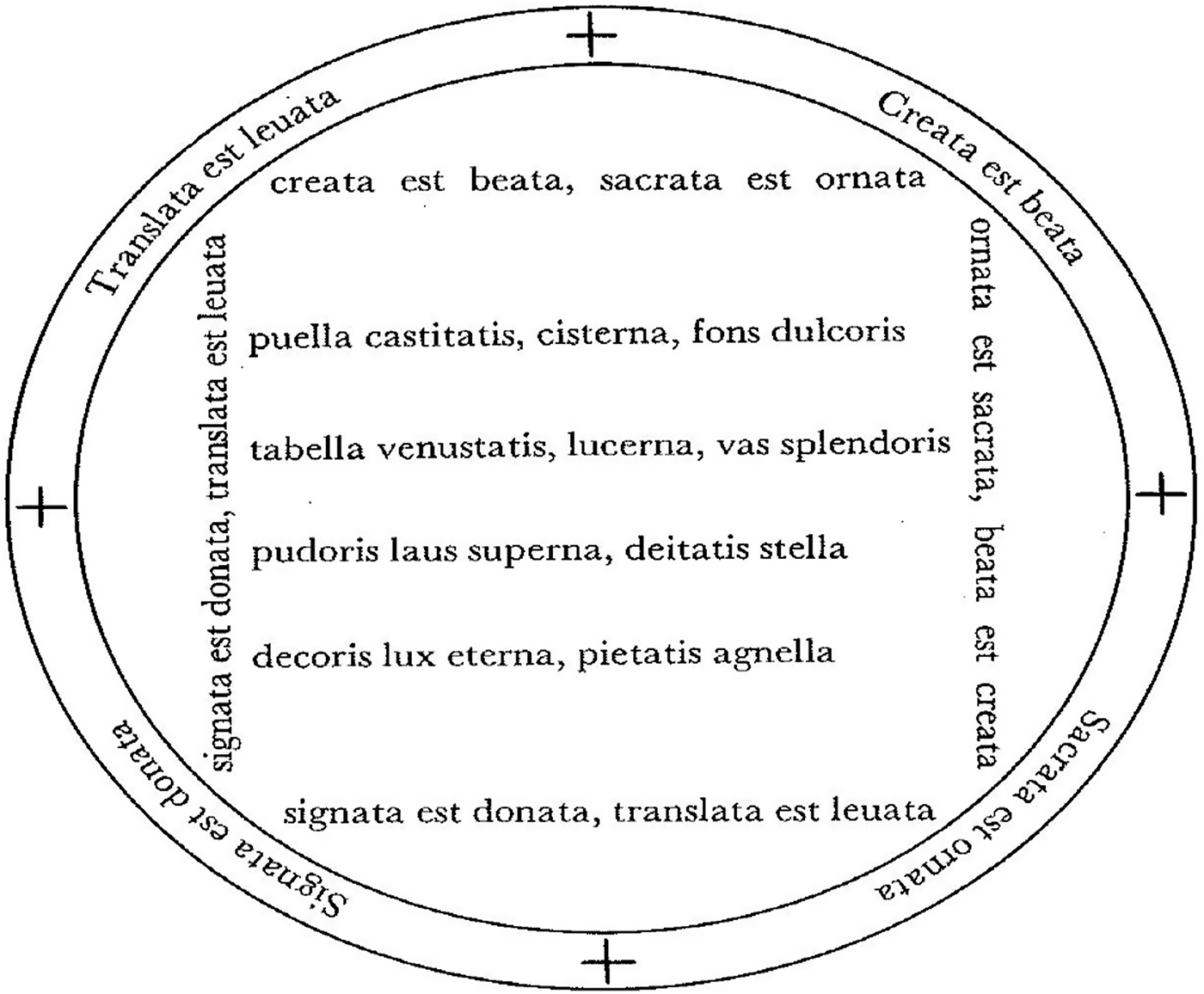
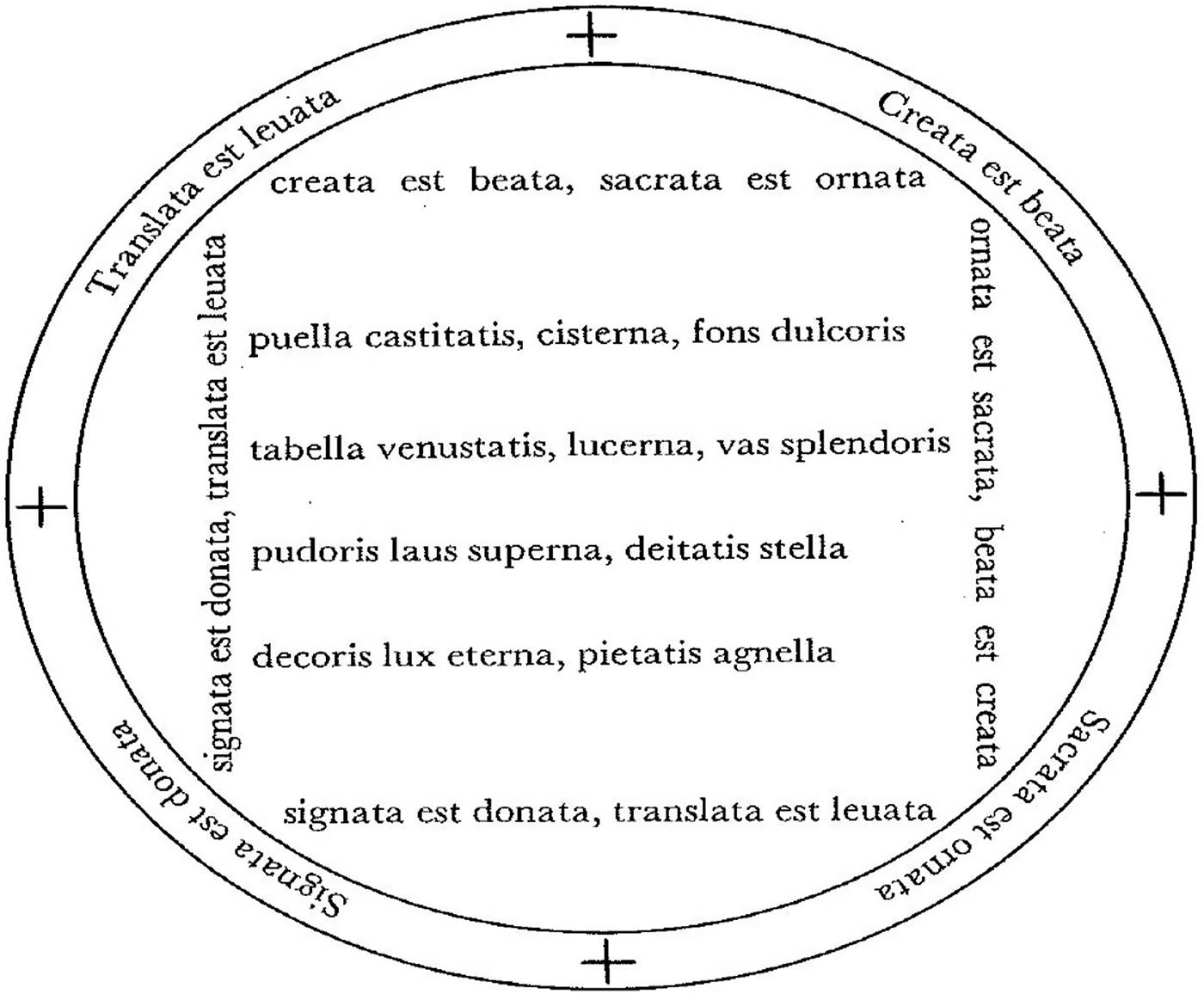
Addressing students at the universities in Paris and Toulouse, John of Garland emphasizes Marian prosody. The Parisiana Poetria offers three hymns on the Virgin's conception to illustrate three kinds of quantitative meter: the Asclepiad, Sapphic Adonic, and iambic dimeter. In addition to the triple, metrical discourse on the immaculate conception that extends grammatical motherhood to St. Anne, Marian lines dominate the long list of examples for the eight categories of rhythmic poems and hybrid types constructed by intermingling them. Many of John's sample verses derive from another of his Marian pedagogical texts, the Epithalamium Beate Marie Virginis, in which the seven liberal arts are taught through a narrative of the Virgin's betrothal to Christ.Footnote 79 Found in several manuscripts of the Parisiana Poetria, a Marian wheel demonstrating an AB rhyme pattern reinforces the principle that the Virgin's chastity, rendering her body a hortus conclusus, is a lovely garden for the study of rhyme and rhythm. (Image 3) “Creata est beata” (“The created one [the Virgin] is blessed”) begin the rhyming verses that, on the wheel's margins, position the Virgin at the center of all natural and verbal creation; “puella castitatis” (“chaste girl”) begin the verses that equate the Virgin's attributes with poetic craft in the wheel's center. In the Marian wheel John of Garland shows that principles shaping various kinds of rhyme are an offshoot of the principles of creation, brought to fruition in Mary's pure embodiment and the Virgin birth of Christ. Verse structures are one method for embellishing discourses, and in the Marian wheel the Virgin herself is a model of ornamentation. “Sacrata est ornata” (“the sanctified [Mary] is adorned”), the wheel declares, equating the Mother, consecrated by the Word in her womb, with ornate expressions. By deploying verses on the Virgin to demonstrate the alignment of sexual and verbal control taught since Matthew of Vendôme, John of Garland raises up Mary as the queen of meter, rhyme, and rhythm, and in the words of Robin R. Hass “invokes Mary as a linguistic savior.”Footnote 80
Marian wheel of verse, John of Garland's Parisiana Poetria. Reproduced by permission of Traugott Lawler from his first edition and translation of Garland's text (Yale University Press).
Writing on grammar school instruction for beginners and the master's preparation for this work, Eberhard the German appeals to the Virgin to allay the difficulties of learning versification. His lessons in prosody may repeat advice from previous artes poetriae, but his “elegiac tone,” lamenting the life of a grammarian, gives the Laborintus an original, autobiographical framework.Footnote 81 The title of Eberhard's treatise and the opening allegory concerning the grammarian's birth and development suggest the challenges undertaken by anyone born to teach the ABCs. In Edmond Faral's estimation, the title Laborintus means “labor habens intus” (having internal labor) and puns on the labyrinth of grammatical instruction and professional achievement.Footnote 82 “Labor habens intus” also plays upon Grammar's maternity and the difficulty of fostering generations of Latinists. The title admits to the schoolmaster's labor over his own linguistic expertise and to the parental care he offers the children so that they, also, might reproduce correct Latin. In Eberhard's narrative of a grammar master who wails “alpha” from birth, receives Donatus from Mother Nature, and drinks the breasts of grammatical learning, the Laborintus characterizes Lady Grammar as a hard parent whose labyrinthian ways may be lightened by the Virgin's kindness. Having presented himself as a teacher who has suffered the miseries of his profession — excessive toil, poverty, and trouble in managing his youthful charges — Eberhard appeals to the mercy of the “virgo virginum” in his poem modeling iambic lines.Footnote 83 There, she is the “fons misercordiae,” who will soothe all wretched sinners who can sing to her well-wrought praises.Footnote 84 Descriptions of the Virgin bringing succor to all who wrestle with syllabic count and moral dilemmas are meant not only to assuage the master for his sacrifices to the discipline, but also to encourage the children just beginning in it. The study of prosody provides special cause for wailing, according to the personification of Poetry in the treatise. “I am unwilling to disregard the anxiety which metre will cause your boys,” Poetry admits to the grammar masters for whom the Laborintus is intended; “An easy path of metre is best for new recruits.”Footnote 85 For Eberhard, Mary is that path, both narrow and inviting, as he invokes the “virgo serena” in his verses demonstrating both metrical and rhythmical verse types: spondees, iambs, dactyls, and more.Footnote 86
Bearing the Birch
As the Marian artes poetriae of Gervais, John of Garland, and Eberhard represent the Virgin as a well of literary devices, they emphasize her glorious, fecund, and soothing maternity, a role aligned with a Lady Grammar whose breast overflows with grammatical nutriments. Demonstrating the varieties of iambic verses, John of Garland, for instance, describes the Virgin's “bosom blooming undefiled” as she bears the Word.Footnote 87 According to Cestaro, Dante's work offers a prime example of a poet's innovations with early trivium instruction that associates Lady Grammar with Mary and the milk of holy expression. In the Paradiso Beatrice's representation as a mother bird feeding the charges in her nest, Christ's depiction as a nurse, and most transcendently, the Virgin's offer of holy milk to aspiring souls all recuperate and transform the role of the nurturer who models the speech necessary for salvation.Footnote 88 In Cestaro's analysis, the conclusion of Paradiso in Bernard's prayer to the Virgin and an invocation of “la lingua a la mammella” sanctifies the breast where Christ received milk and humanity imbibes the words of praise.Footnote 89 Yet, even while the thirteenth-century grammatical theory influencing Dante renders Mary a nourishing mother of Latin compositions, it also recalls grammatica’s punishments that are often inflicted by the birch rod, as seen in the sculpture at Chartres. In the relentless repetition of Gervais's pedagogy, the chapter in the Parisiana Poetria on stylistic vices, and especially the personal miseries documented by Eberhard, modern readers feel some of the strains of the medieval language classroom and understand the learners’ fear of punishment, should they fail to please the master and the Mother. Although Eberhard contrasts the Virgin's fountain of mercy to the disciplinary woes in which he and his young charges are drowning, there are some indications outside of the artes poetriae that in her role as Lady Grammar, Mary, too, bears the birch.
Although it is easy to see how the Virgin might occupy Lady Grammar's roles in leading young pupils to books and offering a breast for linguistic nutriments, the violence threatened by the medieval Lady Grammar's punitive birch might seem inimical to the loving Mother of God. For the holy child whom Mary nursed and taught, however, punishment was foreordained, and the Virgin oversaw not only Jesus's language learning and growth in the Word that he would excruciatingly fulfill, but also, according to medieval belief, grammar schools in which corporal punishment was standard. Whether through book, breast, or switch, the Virgin Mary, like Lady Grammar, stood as an alternative and authoritative mother to medieval pupils encountering a sometimes-painful language instruction.
In her roles as an ABC book, a mother tutoring the child on her lap, a subject for exemplary praise, and a chaste embodiment of structured verse, Mary imparts various aspects of Latin literacy and adopts the iconography of a teacher. The birch rod and the book are the unmistakable emblems of a pedagogue from Roman times through the era of early printed textbooks, as the frontispieces for Sythen's Composita verborum (1485), Niger's Ars epistolandi (1477), Rodericus's Speculum humane vite (1488), and Hilarius's Exposicio himnorum (1496) illustrate.Footnote 90 The book represents the instructor's source of knowledge, while the birch threatens a painful means of correcting errors and maintaining classroom control. Often used to slap the hands or the buttocks of a small child “mounting the horse” (with his pants down, sitting on the shoulders of an older boy), the birch rod and corrective measures adopted in medieval times from Roman practices of corporal punishment have been discussed by many scholars, both medieval and modern.Footnote 91 For instance, Eberhard the German (through the mouth of Lady Grammar) advises the master to “correct offences with words and flogging, rather harshly with words, more moderately with switches.”Footnote 92 Among more contemporary authors, Bruce W. Holsinger characterizes “violence as an integral part of the pedagogical transmission.”Footnote 93 The Virgin, acknowledging the harsh discipline accompanying medieval Latin instruction, totes the teacher's chastising rod in thirteenth-century images studied by Michael Clanchy and Eva Frojmovic.Footnote 94 Images of Mary conducting the Christ child to school portray the Virgin carrying Lady Grammar's birch rod to signify her status as a teacher: indeed, a teacher superior to the classroom master.Footnote 95 When the Virgin threatens with Lady Grammar's birch, she establishes her reign over Latin learning, especially since her academic authority is applied directly toward providential ends. As Ben Parsons notes, medieval pedagogical treatises associate “beating with agency,”Footnote 96 and the Virgin's display of the punitive birch proclaims her agency within God's larger plan, from the moment she obediently answers Gabriel's “Ave” to this apocryphal episode in which she both chooses and dominates her son's education.
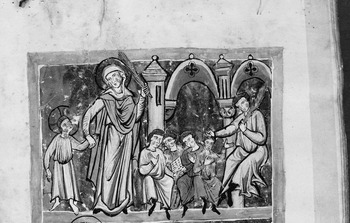
In a thirteenth-century Latin psalter created near Lake Constance for lay use (National Museums Liverpool, Mayer MS 12004), Mary leads the Christ child to school — their destination clear from Jesus's satchel of books — while she hefts the birch rod over her right shoulder.Footnote 97 (Image 4) Mary and Jesus divide between themselves the signs of a teacher; Jesus carries a book or books, while the Virgin displays the birch. Together, they represent the Christian goals of Latin learning: to acquire the reading skills that will reveal God's manifestations on earth and to facilitate devotions. Depictions of Mary as a Lady Grammar who conducts Jesus to school come geographically from Nordic and Germanic territories and scripturally from apocryphal infancy gospels that attempt to fill in the details of Jesus's early life. According to both Ps-Thomas and Ps-Matthew, between the Holy Family's flight to Egypt and twelve-year-old Jesus's teachings in the Temple, Joseph arranged for the education of the Christ child, who in turn confounded his would-be educators.Footnote 98 In the Liverpool Psalter, Mary — not her husband — leads the holy boy to the study of letters. Frojmovic comments that this “mariological reformulation … is in line with the high medieval privileging of Mary,”Footnote 99 and it is consonant with the Marian arts of poetry that were being produced around the same time. In the infancy gospels, Jesus overwhelms his new masters with an understanding of the allegories represented in the alphabet, but in the Liverpool Psalter he appears overpowered by his mother and fearful of entering upon his studies.Footnote 100 Mary draws Jesus in her right hand toward a grammar school; in her left hand, she raises the birch, a gesture of authority that competes with that of the brutal master seen grabbing the hair of a young pupil inside the school.Footnote 101 In contrast to the seated, almost diminutive figure of the master, Mary stands tall, an imposing Lady Grammar; the foreboding look with which Jesus gazes upon his mother acknowledges her power. Unlike the unfortunate student in the schoolroom whose hands are raised to be struck by the master's birch, Jesus holds onto his mother with his left hand and in his right carries the satchel. That Jesus's hands are not raised to receive a blow shows that he is not the target of his mother's ire; rather, overcoming the petty tyranny in the schoolroom seems to be her object. Mary looks over her right shoulder to establish a connection with her holy son, but humbly stops short of eye contact with him, while the master's gaze is forebodingly leveled in her direction. Still empowered over four frightened boys, he anticipates the approach of a superior Lady Grammar.
The Virgin Mary with birch rod (Liverpool, National Museums, Mayer MS 12004, fol. 13). Reproduced by permission of the National Museums.

In the Liverpool Psalter, far from embodying a nurturing opposition to a punitive patriarchal control over the grammar classroom, Mary owns the violence inherent in medieval language instruction, even though she does not approve its abuse in a vindictive master's hands. According to Frojmovic, “Mary … echoes and amplifies the punitive pedagogy familiar from the iconography of Grammatica.”Footnote 102 Her aggressive stance against the master might be compared to her combat with the devil in the famous Theophilus legend over the charter that the devil holds over the man's soul. In one thirteenth-century English Apocalypse book illustrating the Theophilus legend, a militant Mary leads an angel to pierce the devil's throat with a lance while the Virgin herself threatens with the birch and grabs the charter from the devil's hands.Footnote 103 Like the devil in the Apocalypse book, the master in the Liverpool Psalter holds power over a weakened soul through expertise in language. Whether through a command of legalese or of Latin declensions, the devil and the master are bullies who degrade others by flaunting a false linguistic superiority. The Virgin's solution is to have the devil's voice cut off and the punitive master punished.
While competing with the master's threats of force, Mary herself becomes a “contact zone,” as in Mary Louise Pratt's formulation, where the mingling of languages (vernaculars with beginning Latin instruction) can produce an agonistic environment.Footnote 104 In grammar classrooms in the medieval West, where Latin exercises were translated into vernaculars, conflict arises as the master imposes the means and the standards of correctness for passing from one linguistic community to another. The Virgin embodies a site for that conflict, since late medieval students often began their passage to Latinity by learning Marian prayers at the hearth. Mary is their guide (conducting Jesus and all pupils to school), harbinger of the difficulties to come (raising the punitive switch), and commanding mother, whose instructions and mercies prevail over punishment and sacrifice. Already having birthed the Word to the foreordained torture, the Virgin evinces both the joys and the sorrows of linguistic as well as spiritual crossings, including those involving early trivium studies that prepare for devotional reading through strict discipline. By bearing the birch, Mary represents the punishments with which Jesus is threatened and that schoolchildren must suffer in imitation of him. Anthony Bale traces the medieval belief that Christ's final stripping and whipping occurred in a prison cell and offers evidence of material arts showing Christ being beaten with a birch rod, much like Lady Grammar's.Footnote 105 As Bale notes, “In medieval Passion imagery flagellation scenes are far more popular than scenes of Christ's imprisonment, perhaps because scenes of torture more graphically show Christ's passive offering of his blood and foreground the active cruelty of Christ's persecutors.”Footnote 106 In the Liverpool Psalter, the violent master is a type of these persecutors, which the students must endure Christ-like.
Conclusion
The Virgin, a mother who bears the Word and sponsors literacy, was by the Late Middle Ages a Lady Grammar to those involved in trivium instruction. Cultural associations between motherhood and early language studies blossom into theories of a maternal Grammar and eventually a Maria grammatice: the book, the breast, and the birch for medieval students of beginning Latin. In Mary, schoolchildren and grammar scholars may find the source of linguistic knowledge, the methods for attaining it, and a powerful advocate during the hardships along the way.