I. INTRODUCTION
Jonathan Swift’s “A Modest Proposal,” written in 1729, could well be ranked by many readers, both then and now, as deserving space on a short list of the most surprising and thought-provoking essays in the English language. “Surprising,” because Swift recommended that Irish parents too poor to support their children sell them at one year of age to be eaten by persons of wealth. “Thought-provoking,” because the reader could likely ask why Swift, an ordained minister, would possibly have taken such an outrageous position. Then, once it becomes clear that Swift was being highly satirical in his recommendation, “thought-provoking” because of questions about what drove him to this extreme.
However, examining “A Modest Proposal” as satire, and in light of the socio-economic and geo-political conditions at the time of its writing, as well as other of Swift’s works, allows the reader to move beyond surprise and see the essay as addressing a broad spectrum of complex issues. These issues include the sustainability of the quality of life for the poor native Irish and the extent to which their plight was due to the actions of the English and the Anglo-Irish; how “A Modest Proposal” relates to recommendations Swift made in support of the Irish in earlier writings, which led to no positive outcome; and how Swift’s writings demonstrate an identifiable opinion about political arithmeticians and their perceived tendency to evaluate people largely according to their instrumental value rather than their intrinsic value. These and other considerations are addressed in this paper. The second section provides a description of what was happening in Ireland at the time Swift was writing. A summary of “A Modest Proposal” and its alleged advantages is given in the third section. The fourth section introduces other of Swift’s writings that address his concern for the native Irish, and how those writings’ failure to lead to a positive change drove him the extreme position in “A Modest Proposal.”Footnote 1
The fifth section explores indicators of Swift’s opinion of political arithmeticians and their views of the world that can be gleaned from his writings. The sixth section gives conclusions. Before covering these topics, it is useful to briefly review Swift’s life.
Jonathan Swift was born in Dublin, Ireland, in 1667 and died in 1745. His father died before he was born, and when Swift was four years old, his mother returned to England, leaving him to be raised by an uncle, who, Swift complained, gave him “the education of a dog,” although he did enter Trinity College at age fourteen (Hartford College 2004, p. 1). Despite belonging to the privileged Anglo-Irish class and being appointed to the deanship of St. Patrick’s Cathedral in 1713, Swift would rather have lived in England, and wrote that he found no happiness in the prospect of spending his life in Ireland (Ferguson Reference Ferguson1962, p. 6). But his complaints and the fact that he was not particularly fond of the Irish notwithstanding, he developed a sympathy for them and the ordeal they were facing that is apparent in many of his writings. For example, in “A Short View of the State of Ireland” (Swift Reference Swift and Davis1955, p. 9), he made reference to conditions in Ireland relative to elsewhere by noting: “No strangers from other Countries, make this Part of their Travels; where they can expect to see nothing, but scenes of Misery and Desolation.”Footnote 2 Swift’s support for the Irish was so strong that Temple Scott (1905, vol. VII, p. 203) described him as “Ireland’s foremost patriot.”
II. CONDITIONS IN IRELAND WHEN SWIFT WAS WRITING
Before directly covering Swift’s “A Modest Proposal” and addressing the question of what drove him to the satirical extreme he reached in this writing, it is useful to explore what life was like for the native Irish at this time. In this regard, Colin Horne (1953, p. 43) offered that while the ironic recommendation in “A Modest Proposal” may be seen as horrible, the conditions in Ireland that prompted it were worse. Very simply, Ireland was in an economic crisis throughout the entire decade of the 1720s, and living conditions bordered on unsustainable (Ehrenpreis Reference Ehrenpreis1983, p. 159).Footnote 3 Swift recognized the need to identify the chief causes of these conditions if they were to be remedied. And, in keeping with his yet-to-be published “A Modest Proposal,” he argued in “Sermon IX. On the Causes of the Wretched Conditions of Ireland” (Swift Reference Swift1803c, pp. 105–106), and in “A Proposal That All the Ladies and Women of Ireland Should Appear Constantly in Irish Manufactures” (Swift 1803f, p. 39), that the conditions and their causes were unique to Ireland, and that lessons on how to deal with them could not be derived from what was happening in “England, Holland, France, or any other country, whose inhabitants are allowed the common rights and liberties of human kind” (Swift 1803f, p. 39). While perhaps unique in their specifics, the primary causes of these conditions can be placed into four categories Swift frequently turned to in his writings: famine, trade restrictions, increases in land rents, and the movement of leased land from cropping to grazing. Of these, all but famine relate to England’s treatment of the native Irish.Footnote 4 These social circumstances were harshly described in a letter written in 1742 by Edmund Burke,Footnote 5 where he held that “They [the English] divided the nation [Ireland] into two distinct bodies, without common interest, sympathy or connection, one of which bodies was to possess all the franchises, all the property, all the education. The others were to be drawers of water and cutters of turf for them” (Burke in Crotty Reference Crotty1966, p. 11).Footnote 6
Ireland went through several years of famine in the 1720s, where harvest failures forced many of the poor to use up their stock of potatoes sooner than usual, leaving several months in the year of famine unprovided for (Clarkson and Crawford Reference Clarkson and Margaret Crawford2001, pp. 62–63; Salaman Reference Salaman1986, p. 252). At times, grain had to be imported rather than exported, and prices rose to the point where they were higher in Dublin than in London (Ehrenpreis Reference Ehrenpreis1983, pp. 509–510, 544).Footnote 7 Mobs in the south of Ireland were stopping the shipment of their grain sold to help those in need in the north, there was rioting at ports where corn was being exported, and unemployed weavers were feeding on grain and sheep’s blood from slaughterhouses (Ehrenpreis Reference Ehrenpreis1983, pp. 545, 627; Scott Reference Scott1905, p. 203). The impact of this shortage of food was suggested by M. B. DraperFootnote 8 in “A Letter to the People of Ireland” (1729), where he wrote that, “If they [the Irish] happen to hear of the Death of a Horse, they run to it as to a Feast” (Ferguson Reference Ferguson1962, p. 170).Footnote 9
As severe as the famines were, Swift did not see them as being as destructive to Ireland as its trade conditions and England’s role in creating those conditions. In “Sermon IX. On the Causes of the Wretched Conditions of Ireland” (1803c, p. 106), Swift wrote that the first cause of the Irish’s misery is “the intolerable hardships we lie under in every branch of trade.” And, in his 1729 “A Proposal That All the Ladies and Women of Ireland Should Appear Constantly in Irish Manufactures” (1803f, p. 36), he wrote:
[T]he three seasons wherein our corn has miscarried, did no more contribute to our present misery, than one spoonful of water thrown upon a rat already drowned, would contribute to his death…. If two thirds of any kingdom’s revenue be exported to another country, without one farthing of value in return; and if the said kingdom be forbidden the most profitable branches of trade wherein to employ the other third … how shall that kingdom stand?10
England was imposing severe restrictions on what and with whom the Irish could trade. The Cattle Acts, passed in 1663, placed heavy tariffs on cattle and sheep imported from Ireland by the English, and in 1666 a complete embargo was imposed on the import of Irish cattle, pigs, and sheep, forcing Ireland to stop exporting live animals and turn to a less profitable provision trade where beef was salted and packed into barrels for export anywhere other than England (Crotty Reference Crotty1966, p. 10).
But it was not just trade in meat products that was banned. In 1669, perhaps in response to complaints by English weavers, England passed a law prohibiting Irish exports of woolen goods to any country, and allowed exports of “unworked” wool to only a few, select English ports (Ferguson Reference Ferguson1962, p. 9; Swift Reference Swift and Scott1905a, pp. 157, 160). This was a major assault on Ireland’s leading manufacturing industry, whose only source of (now illegal) trade became France (Crotty Reference Crotty1966, p. 11). According to Swift in “A Proposal for the Universal Use of Irish Manufactures” (1803a, p. 12), this trade was Ireland’s “only support for several years, … furnishing us with all the little money we have to pay our rents, and go to market.”
Regarding revenue leaving Ireland, Swift saw the Irish being injured not only by a reduction of exports but also an increase in imports. Of particular concern to him was the purchase by proud and vain people of clothing manufactured abroad, leaving tradesmen and shopkeepers, who offered Irish-manufactured goods that could be acquired at about half the cost, to starve (Swift Reference Swift1803c, pp. 106–107). In his “A Proposal That All the Ladies and Women of Ireland Appear Constantly in Irish Manufactures,” Swift (1803f, p. 35) held that, as a result of their not being able to export or sell in Ireland because of imports, “about fifteen hundred weavers were forced to beg their bread, and had a general contribution made for their relief, which just served to make them drunk for a week; and then they were forced to turn rogues, or strolling beggars, or leave the kingdom.”
In addition to the increase in imports that reduced the demand for Irish-manufactured goods was the fact that many landlords had an “unnatural affection … to reside in and about London,” which resulted in over half the rents and profit going to England, for which the Irish got nothing in return (Swift Reference Swift and Scott1905a, p. 2; 1955, pp. 9–10).
Landlords played a larger role in the economic demise of Ireland than simply moving their rental income to England. They were converting large amounts of cropland to grazing land, which is cheaper to work and requires fewer tenants (Ferguson Reference Ferguson1962, p. 12). This strategy is consistent with calculations made by Petty in “A Treatise of Ireland” (1899, vol. II, p. 559) that Ireland will breed and feed six million cattle of three years of age. To do this, 300,000 herdsmen and dairy women would be adequate to manage the trade, which would allow for the departure of a large number of the Irish population.Footnote 11 Swift (1803e, p. 4) picked up on this transition and its effect on the availability of jobs in his “Answer to a Paper Called A Memorial of the Poor Inhabitants, Tradesmen, and Labourers of the Kingdom of Ireland,” where he wrote: “Thus, a vast tract of land, where twenty or thirty farmers lived, together with their cottagers and labourers in their several cabins, became all desolate, and easily managed by one or two herdsmen and their boys; whereby the master grazer, with little trouble seized to himself the livelihood of a hundred people.”
More specifically regarding the living conditions of those who worked the land, Swift wrote in “The Present Miserable State of Ireland” (1905a, p. 164) that “there are thousands of poor wretches who think themselves blessed, if they can obtain a hut worse than the squire’s dog-kennel, and an acre of ground for a potato-plantation…. What can be more deplorable, than to behold wretches starving in the midst of plenty!”
Petty made a comparable observation in The Political Anatomy of Ireland (1970b, pp. 116–117) about where the Irish live, one which strongly suggests the extent of their poverty. He divided houses into three categories—those with more than one chimney, those with one chimney, and those with no chimney—and estimated that the 1.1 million people in Ireland lived in approximately 200,000 houses. Of these houses, about 16,000 had more than one chimney, about 24,000 had only one chimney, and about 160,000 were “nasty Cabbins, without Chimney, window or door shut, and worse than those of the Savage Americans.”Footnote 12
Finally, another factor affecting conditions in Ireland when Swift was writing was the relationship between the Irish Papists (Roman Catholics) and the Irish and English Protestants. According to Petty in The Political Anatomy of Ireland (1970b, pp. 27, 28, 39), British Protestants and their churches had 3/4 of the land, 5/6 of the housing, 9/10 of the housing in walled towns and places of strength, and 2/3 of Ireland’s foreign trade. They also had the ability to be supplied with sufficient food from England to maintain themselves while destroying the 160,000 wretched cottages housing 700,000 of the 800,000 Papists. Also in The Political Anatomy of Ireland (p. 90), Petty made a connection between the Irish Papists’ not working and their religious beliefs. He wrote: “And why should they desire to fare better, tho with more labour, when they are taught, that this way of living is more like the Patriarchs of old, and the Saints of later times, by whose Prayers and Merits they are to be reliev’d, and whose Examples they are therefore to follow.”
III. SUMMARY OF “A MODEST PROPOSAL”
Having some sense of the conditions in Ireland at the time Swift was writing, it is useful to briefly explore satire before moving directly into “A Modest Proposal,” since, to many readers, satire is the defining feature of this essay. Swift has been ranked by literary scholars as among the greatest, if not the greatest, satirist in the English language, and “A Modest Proposal” has been described as English literature’s most famous and perhaps savagely ironic short satire.Footnote 13 During the eighteenth century, satire was a preferred mode of social and political commentary, and there were many highly recognized British satirists in addition to Jonathan Swift; for example, Alexander Pope, John Dryden, and Henry Fielding.Footnote 14
Reading satire has been described as “threading one’s way through a kind of rhetorical minefield” (Bogel Reference Bogel2001, p. 57), since satire is fiction that recognizably departs from literal truth in order to take a position on a specific reality, and, in so doing, draw the reader’s attention to that which the author sees as unacceptable in an effort to bring about change (Guilhamet Reference Guilhamet1987, p. 46; Zimmerman Reference Zimmerman1983, pp. 27, 62–63). This is an apt description of what Swift likely sought to accomplish with “A Modest Proposal”: to remodel, not end, the relationship between the native Irish and English.Footnote 15
There are two recognized categories into which satire can be placed: Horatian and Juvenalian. Horatian satire seeks to correct what is seen as unacceptable in a gentle and sympathetic way, while Juvenalian satire is bitter and ironic in its approach to what is seen as unacceptable. Swift’s work is generally recognized as Juvenalian (Thrall and Hibbard Reference Thrall and Hibbard1962, p. 437).
“A Modest Proposal,” the title by which most people identify this essay, is actually an abbreviation of its full title: “A Modest Proposal for Preventing the Children of Poor People From Being a Burden to Their Parents or the Country, and for Making Them Beneficial to the Public.” The full title hints at Swift’s satiric recommendation, made not in his own name but through an unnamed Projector who devises plans and proposals. Swift’s Projector argued that, on reaching one year of age, fit children born to parents who cannot support them, and who will be a burden to their parish and remain in need all their lives, should be sold live at ten shillings each to be made into “a most delicious, nourishing, and wholesome food, whether stewed, roasted, baked or boiled ” (Swift Reference Swift, Ross and Woolley1984, pp. 492–495). Being expensive, this food would be proper for “persons of quality and fortune throughout the kingdom,” including landlords who, “as they have already devoured most of the parents, seem to have the best title to the children” (p. 494). In this way, the children can go from being a burden to benefiting thousands of others as food and clothing (p. 494).Footnote 16 Swift’s Projector’s reference to children born to those not able to care for them being a burden to society is not unique to “A Modest Proposal.” In Gulliver’s Travels, Swift (2003, p. 70) referred to the Lilliputians’17 thinking that “nothing can be more unjust, than that people, in subservience to their own appetites, should bring children into the world, and leave the burthen of supporting them on the public.”
There are two important elements in “A Modest Proposal” on which the Projector’s position rests. First is his estimate of the Irish population, which allows him to state which and how many children would be available to be sold in their first year to be eaten by persons of quality and fortune. Second is his description of the Proposal’s chief advantages.
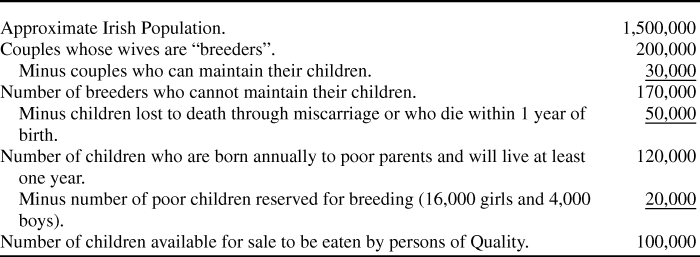
Regarding the population estimate, which is summarized in Table 1, the Projector began with a population of approximately 1.5 million.Footnote 18 This number by itself is interesting because it is very close to the 1.466 million that Petty estimated in The Political Anatomy of Ireland (1970b, p. 18) as the Irish population in 1641 when Oliver Cromwell invaded to suppress its rebellion.
The Projector’s Calculation to Determine the Number of Children to be Sold

(Swift Reference Swift, Ross and Woolley1984, pp. 493−494)
Of these 1.5 million people, the Projector estimated that there are 200,000 couples where the wives are “breeders.” Of these, 30,000 can maintain their children (although Swift was not completely comfortable with this estimate, given the current conditions in Ireland), and 170,000 cannot. Of these 170,000 couples, 50,000 will lose their child due to miscarriage or death from accident or disease before his/her first birthday, leaving 120,000 children born to poor parents annually and living for at least one year.Footnote 19 Of the 120,000 children born to poor parents, 20,000 should be saved for future breeding and the remaining 100,000 should be sold at ten shillings each to be eaten by the kingdom’s persons of quality and fortune. And, of the 20,000 children saved for breeding, only one in five should be a boy because Irish boys represent a threat to the British by being potential recruits by the French or Spanish, and because birth parents are typically not married, so that one male can serve four females (Swift Reference Swift, Ross and Woolley1984, pp. 492, 494, 496).Footnote 20
Having offered his demographic of the Irish population and recommendation on the number of poor parents’ children to be sold to be eaten, the Projector went on to identify what he saw as the many obvious and highly important advantages of the scheme. Six were listed in rank order and, after the sixth, two of many others that might be enumerated were listed without a ranking.
The first advantage is that the number of Papists would be reduced. This is an advantage because Papists, who are the dominant religious group among the native Irish, are the principal breeders (accounting for three-quarters of the infants) and a most dangerous enemy of the English.Footnote 21 As a result of this reduction, it would be harder for the Papists to take advantage of opportunities created by the departure from Ireland of dissatisfied Protestants, many of whom are landowners who have diminished employment opportunities for the native Irish by converting acres of land from more labor-intensive crop use to less labor-intensive grazing use.Footnote 22 It would also benefit Parliament by reducing the ability of the native Irish to support the king, and provide fewer potential recruits to Spain and France—England’s geo-political enemies (Swift Reference Swift, Ross and Woolley1984, pp. 492, 494, 496).Footnote 23
The second and third advantages follow from the ten shillings paid per child sold, two of which cover the costs of nursing and clothing the child in the first year, leaving eight as net profit to the parents. The second advantage is that poor Irish tenants will now have money with which to pay landlords’ rents—whereas before they had nothing. But not only do the tenants benefit; the landlords benefit as well by gaining popularity with the tenants by buying their children (Swift Reference Swift, Ross and Woolley1984, pp. 496, 498). The third advantage accrues to the nation as a whole. The 100,000 children who are sold in their first year would have, on reaching their second year, cost ten shillings per child per year to maintain. But, by not having to maintain these children, the nation’s stock is increased by £50,000 per annum and can circulate among the population (Swift Reference Swift, Ross and Woolley1984, p. 496).Footnote 24 Increasing the nation’s stock by £50,000 per annum indicates that the Projector sees this as an ongoing, not a one-time, remedy.
The fourth advantage relates to the difference between the two-shilling cost of nursing and clothing a child through the first year and the ten-shilling annual cost of maintaining a child two years of age or older. By selling one-year-old children to persons of quality and fortune, there are 100,000 fewer “useless mouths and backs” to feed and clothe, lowering parents’ costs from ten shillings to nothing per child (Swift Reference Swift, Ross and Woolley1984, pp. 496, 498).
Advantage number five is that offering children as food would increase business in taverns frequented by “fine gentlemen who justly value themselves upon their knowledge in good eating” (Swift Reference Swift, Ross and Woolley1984, p. 496). And, taking advantage of how these gentlemen value their recognition for knowing good food, skillful cooks can make the children being served as expensive as they please.
The final ranked advantage is that birth parents’ having the opportunity to sell their children to be eaten would be an inducement to marriage. Knowing that the children could be sold at one year of age would reduce voluntary abortion and the frequency with which women murder their “bastard … poor innocent babies,” more to avoid expense than shame (Swift Reference Swift, Ross and Woolley1984, p. 493).Footnote 25 Also, men would not beat or kick their pregnant wives for fear of causing a miscarriage. In fact, they would “become as fond of their wives … as they are now of their mares in foal, their cows in calf, or sows when they are ready to farrow” (Swift Reference Swift, Ross and Woolley1984, p. 497). Swift’s Projector noted that “all wise nations have either encouraged [marriage] by rewards, or enforced [marriage] by laws and penalties” (Swift Reference Swift, Ross and Woolley1984, p. 497). These acts by wise nations can be seen as being consistent with what many people consider to be a mercantilist agenda to increase the supply of labor (Grampp Reference Grampp1965, vol. 1, p. 70).Footnote 26 But, ironically, using the logic in “A Modest Proposal,” the inducement to marriage would likely result, not in an increase in the supply of Irish labor, but rather a drop, which, given the shift from cropping to grazing and the decline in trade, would be a reasonable agenda item.
The two remaining but unranked advantages of the Proposal have to do with its effect on foreign trade. The first is that it would allow 1,000 more beef carcasses to be exported, as well as a greater availability of pigs, which “are no way comparable in taste, or magnificence to a well-groomed, fat yearling child” (Swift Reference Swift, Ross and Woolley1984, p. 497).Footnote 27 The second is that the flesh of a one-year-old child is too tender to endure being salted for the amount of time necessary to allow its export to England, which means the Proposal would run no risk of offending meat suppliers and others in England (Swift, p. 498).Footnote 28
Clearly, the Proposal and its advantages were laid out in a cold, calculated way by the Projector, and this plays a prominent role in the satirical message Swift was sending. Denis Donoghue (1969, p. 142) described Swift’s satirical message in a way that strongly suggests its adversely critical economic focus: “You are murdering the people; at least do it systematically, organize it for profit, don’t waste such talents in carelessness, you are starving the people too quickly, fatten them up and sell them.”
IV. WHAT DROVE SWIFT TO THE EXTREME HE REACHED IN “A MODEST PROPOSAL”?
Given England’s role in creating the prevailing conditions in Ireland and the satirical extreme to which Swift went in recommending the sale of one-year-old children by their impoverished parents to be eaten by persons of quality and fortune, it is useful to begin exploring what drove him to this extreme by considering what is meant by “cannibalism.” The word “cannibalism” can be interpreted both literally and metaphorically. Regarding the literal interpretation, it has been argued that there is a close parallel between “A Modest Proposal” and an earlier writing by Garcilaso de Vega on breeding children for food in Peru (Potter Reference Potter1999, pp. 347–348; Ross 2007, pp. 494, 495, 499).Footnote 29 The parallel is that in both cases there is an implied inter-tribal savagery where weaker members of a racial group are consumed by stronger members of the same group.
Also connected to the social relationship between the two groups, the good a person consumes can send a signal about the class to which that person belongs (upper or lower) and their refinement or lack thereof (McCracken Reference McCracken1986, pp. 71–73). Swift’s Projector’s noting in “A Modest Proposal” (Swift Reference Swift, Ross and Woolley1984, p. 496) that one-year-old children would be appropriate food for fine gentlemen strongly suggests that cannibalism would be a vehicle for conveying a signal about social status.Footnote 30
Viewed from the metaphorical side, cannibalism has been described as representing colonialism (Potter Reference Potter1999, pp. 347–348). In “A Proposal for the Universal Use of Irish Manufactures,” Swift (1803a, p. 16) described Ireland’s relation with England as a “cruel and unjust sentence … [where] the greater part of our bowels and vitals is extracted” (as is the case with cannibalism). Since the colonial relationship had reached the point where England effectively put an end to the Irish’s ability to produce crops and manufactures for their own gain, why not take their children? In this regard, Ehrenpreis (1983, p. 630) offered that the butchering of children was tied to the overall demise of the Irish people: they were treated like cattle, passive as cattle, and figuratively reduced to pieces of meat.
It has also been suggested that Swift’s recommendation of cannibalism in “A Modest Proposal” is an indicator of his frustration after having over a decade of his efforts to address the problems of the Irish lead to no positive outcome (Phiddian Reference Phiddian1996, p. 6). While there is no clear and certain measure of the level this frustration reached and why Swift went to the satiric extreme of recommending cannibalism, some strong hints can be found in his writings. For example, in “A Modest Proposal” (Swift Reference Swift, Ross and Woolley1984, pp. 493, 497), the Projector held that it would not be possible to provide for the children of poor parents using any measure recommended up to now, and that the remedy he is offering—selling those children to be eaten—applies only to Ireland and to no other kingdom “that ever was, is, or, I think, ever can be upon the earth.” Was this the situation Swift saw Ireland facing, and, if so, why did it apply only to Ireland? One possible answer and further suggestion for Swift’s level of frustration is found in his earlier “Short View of the State of Ireland” (Swift Reference Swift and Davis1955, pp. 9–10), where, given its relation to England, he described Ireland’s flourishing as being “against every law of Nature and Reason.”
Also, “A Modest Proposal” can be read as a statement of Swift’s estimate of the most that can be expected from the rich in terms of doing good for the poor, in that they will pay to eat their children, and another indicator of his level of frustration. While not going into detail about the rich in “A Modest Proposal,” he did compare them to the poor in “Sermon VIII. On the Poor Man’s Contentment” (Swift Reference Swift1803b, pp. 99, 103–104), where he wrote:
I know not one real advantage that the rich have over the poor, except the power of doing good to others … [L]et not those on whom the bounty of Providence hath bestowed wealth and honours, despise the men who are placed in an humble and inferior station; but rather with their utmost power … encourage their daily endeavours for the virtuous support of themselves, and their families.
Another indicator of Swift’s frustration with those who are wealthy is also found in “The Poor Man’s Contentment” (Swift Reference Swift1803b, p. 98), where he wrote that the rich are not as safe as the industrious poor during public disturbances or revolutions because the industrious poor are needed, while “the rich are … oftentimes of no use but to be plundered; like some sort of birds, who are good for nothing but their feathers….” This suggests that by buying children of the poor to be eaten, the rich would finally be of use to the poor and, therefore, at a lower risk.
Interestingly, there is another, earlier recommendation Swift made that was not recognized in “A Modest Proposal.” What makes Swift’s choice not to reference this earlier recommendation interesting is that it can be directly tied to the Projector’s argument.
Recall that Swift’s Projector argued that of the 120,000 children born to poor parents each year, 20,000 would be saved for future breeding and 100,000 would be sold to be eaten by persons of quality and fortune. Given these numbers, which of the 120,000 children should be saved? Swift’s Projector offered no criterion in “A Modest Proposal.”
But, in “Sermon IX. On the Causes of the Wretched Conditions of Ireland,” Swift (1803c, pp. 109–112) argued that charity schools should be opened to children of honest parents impoverished by age, illness, or other unavoidable problems so that they can be taught to read, write, and cast accounts. He made it clear that these schools were not to admit children of wicked strollers and others whose children are bred to be idle, ignorant, dishonest, or thieves, since it would be unreasonable to expect well-intended and charitable people to contribute to something that would encourage these parents’ behaviors.
One factor supporting the expectation that Swift would have constructed his Projector to endorse this criterion for who is saved and goes to school is that Swift openly indicted many of the native Irish for their plight. He claimed that about nineteen out of twenty common beggars owe their poverty to their own laziness, negligence, indiscreet marriage without any prospect of supporting a family, drunkenness, and other vices (Swift Reference Swift1803c, p. 113). But while, at first glance, this appears to support the position that Swift’s frustration with many of the native Irish may well have led him to fit the criterion into his Projector’s argument, the criterion could be taken as largely blaming the native Irish for their own demise, which would have weakened his attack on English policy toward the Irish that was at the core of his satirical Proposal.
For one thing, while he blamed the slothful native Irish for their plight, he did not lay the entire blame at their feet. Rather, elsewhere in his writings, when describing the conditions in Ireland whose solution would ultimately require cannibalism, he attributed their cause not only to the behavior of the native Irish but also to the disadvantages and hardships Ireland faced due to trade restrictions imposed by the English and to the oppression of the natives by landlords (Swift Reference Swift1803c, p. 117). For example, regarding trade, in “The Present Miserable State Of Ireland” (Swift Reference Swift and Scott1905a, p. 164), he wrote: “We are apt to charge the Irish with laziness, because we seldom find them employed; but then we don’t consider they have nothing to do…. [T]he want of trade with us is rather owing to the cruel restraints we lie under, than to any disqualification whatsoever in our inhabitants.”
And, regarding treatment of the native Irish by landlords, in “Answer to a Paper Called A Memorial” (Swift 1803e, p. 4), he wrote: “It must be confessed that the farmers were justly punished for their knavery, brutality, and folly. But neither are the squires and landlords to be excused; for to them is owing the depopulating of the country, the vast number of beggars, and the ruin of those few sorry improvements we had.”31
Despite the extreme to which “A Modest Proposal” went, in the year following its publication, Swift attacked someone else’s recommendation for dealing with Ireland’s problems and offered an exaggerated counter-recommendation that, like “A Modest Proposal,” is highly satirical.Footnote 32 Swift, in “Answer to the Craftsman” (1803h, pp. 103, 104), wrote that he offered his counter-recommendation because of his “desire to see … [Ireland] flourish in trade and opulence, even beyond its present happy condition … [in the hope that] this happy island will become a new Arcadia.”Footnote 33
But, relatively speaking, Swift’s counter-recommendation, which was his last essay on conditions in Ireland (Ehrenpreis Reference Ehrenpreis1983, p. 685), makes “A Modest Proposal” appear to be more in touch with reality despite the brutally satirical extreme it reaches, since life in Ireland was not happy, and the loss of jobs, wealth, population, and limitation of trade to England that the counter-recommendation would likely generate could lead to the annihilation of all of Ireland, not just 100,000 children of the poor each year (Ferguson Reference Ferguson1962, p. 180).
V. SWIFT’S WRITINGS AS INDICATORS OF HIS OPINION OF POLITICAL ARITHMETICIANS
On reading “A Modest Proposal,” it is quickly apparent that the Projector’s arguments are presented in a carefully structured and unemotional way that incorporates statistics. One possible explanation for the Projector’s lack of emotion is that his family would have nothing to gain from the proposal to sell children to be eaten. In the final sentence of “A Modest Proposal,” the Projector laments: “I have no children, by which I can propose to get a single penny; the youngest being nine years old, and my wife past child-bearing” (Swift Reference Swift, Ross and Woolley1984, p. 499). Another possible explanation for the Projector’s emotionless presentation is that he was meant to be recognized by the reader as a political arithmetician.Footnote 34 In this regard, William Letwin (1965, pp. 150–151) wrote that the Proposal “included all the paraphernalia that marked Petty’s style [and explored] … in the best Pettian manner, the economic advantages of selling off … children….” Also, Michael Seidel (2003, p. xiv) described Swift’s Projector as a “strangely obsessed economic writer.”Footnote 35
If Swift’s Projector is to be recognized as a political arithmetician, the reader can well presume that this acknowledgment is not to be taken as a compliment but rather as Juvenalian satire. Swift is said to have actively disliked the views and methods of political arithmeticians who were making recommendations on how to help Ireland. Accordingly, the language Swift scripted for the Projector has been described as cold, mechanical rationalization (Phiddian Reference Phiddian1996, p. 6).Footnote 36 But, while Swift may have disliked the political arithmeticians the Projector is said to symbolize, some of the points made by the Projector—such as on the unbearable conditions in Ireland—do reflect Swift’s views (Ewald Reference Ewald1967, pp. 164–165), although the Projector was dispassionate and calculating, while Swift was angry.
Although “A Modest Proposal” can be viewed in part as an attack on political arithmeticians, it is not the only one of Swift’s writings where such an attack is suggested. In “An Examination of Certain Abuses, Corruptions, and Enormities in the City of Dublin” (Swift Reference Swift and Scott1905b, p. 270), which was written after “A Modest Proposal” and appears to be strongly Juvenalian, Swift wrote of an eminent and well-versed physician who was asked to conduct an experiment to see if one can distinguish between someone who is Irish and someone who is British, based on what they eat. The physician agreed, ran the experiment, and was able to correctly distinguish the Irish from the British in ninety-eight of one hundred trials. On seeing the details of the experiment, a reader with some familiarity with Petty might wonder if the story was intended by Swift to mock him. Petty was a physician of stature who was invited in 1654 by Lord Deputy Charles Fleetwood, then the civil and military authority over Ireland following Cromwell, to serve as his personal physician and physician to his army (Welch Reference Welch and Henderson1997, p. 168, n. 2).Footnote 37
In 1672 Petty identified oatmeal, dairy products, meat from smaller animals, rabbits, and poultry as staples of the Irish diet (Clarkson and Crawford Reference Clarkson and Margaret Crawford2001, p. 780). Thus, Petty can be described as an eminent physician who was familiar with the Irish and British diets. Also, testing people’s bodies to see whether they are Irish or British—who are in conflict with one another—can be described as evaluating the “political anatomy of Ireland” in the strictest sense of the word. What makes one suspect this was a mockery of Petty is Swift’s description of the method used by the physician to collect the data. To distinguish between the Irish and the British, the eminent physician smelled his finger after inserting it into each person’s anus (Swift Reference Swift and Scott1905b, p. 270).Footnote 38
Why would Swift attack political arithmeticians? One explanation is political arithmetic’s connection to the English invasion of Ireland, and the role the invasion and what followed played in the decimation of the native Irish population. Landa (1942, p. 165) argued that Swift’s purpose in “A Modest Proposal” was to blame the English for undermining the operation of natural economic laws in Ireland by denying the Irish the same natural rights enjoyed by others.Footnote 39
But there is another issue that ties to the typical perception of economic thinking that could well be a cornerstone of Swift’s attacks on political arithmeticians. The issue is a potential conflict between judging a person’s worth based on their intrinsic value versus their instrumental value. Intrinsic value flows from a person’s inherent nature: what they are, not what they do. Instrumental value flows from a person’s ability to accomplish an objective: what they do, not what they are. Given that Swift was a member of the clergy, one could reasonably expect that he was well aware of this distinction and supportive of recognizing peoples’ intrinsic value, whereas political arithmeticians would have been expected to have focused almost exclusively on people’s instrumental value. In this regard, Bredvold, Root, and Sherburn (1935, p. 159; quoted in Wittkowsky Reference Wittkowsky1943, p. 84n) observed that Swift’s Projector: “love[d] to figure populations, needs and productivity with dispassionate science as if men and women were nothing but so many cattle….”Footnote 40
Swift’s likely attack on political arithmeticians’ focus on people’s instrumental value can also be tied to their position that people are the riches of a nation in the sense that they have the ability to create wealth. Here again, Petty comes into the picture, this time for his reference to the labor theory of value, stating that: “labor is the father … of wealth, as lands are the mother” (Schumpeter Reference Schumpeter1966, pp. 213–214). It has been argued that Swift’s economics in “A Modest Proposal” are an inversion of the principle that people are the riches of a nation: they would be the riches of Ireland only if the Irish poor were allowed to sell their babies to be eaten (Ehrenpreis Reference Ehrenpreis1983, p. 629; Landa Reference Landa1942, p. 162).
Finally, how might one rank Swift’s skill and insight when dealing with the subject matter of economics? On the one hand, it has been said that one must be careful not to presume that Swift had unusual insight into economic issues. On the other hand, his library apparently included Petty’s Essays in Political Arithmetic (1699), Josiah Child’s Discourse in Trade (1693), as well as economic and related writings by Charles Davenant, John Graunt, John Locke, and others (Briggs Reference Briggs2005, p. 22, n. 9; Landa Reference Landa1942, p. 165, n. 18). Another factor suggesting that Swift was not particularly naive about economics is that on reading “A Modest Proposal,” one comes across points he made that suggest a familiarity with what today we call “core concepts.”
For example, Swift defined a product market when writing about the demand for one-year-old children. Here he described venison that gentlemen cannot get enough of because they have destroyed their deer as a good substitute for one-year-old children, while pig meat and school-age boys are not good substitutes because pig meat is not comparable in taste and school-age boys taste bad and have lean, tough flesh (Swift Reference Swift, Ross and Woolley1984, pp. 497, 495). This would arguably put one-year-old children and venison in the same product market, while one-year-old children would not be in the same product market as pig meat and school-age boys.Footnote 41
VI. CONCLUSION
Because Jonathan Swift’s “A Modest Proposal” is a satirical tour de force, it is reasonable to presume that today’s readers are primarily drawn to it because of its successful use of language, not the position taken on conditions in Ireland at the time it was written. But, at the time Swift was writing, a humane attitude toward the Irish was apparently disappearing and they were being regarded more as commodities. With “A Modest Proposal” and other of his writings, Swift erased the boundary between people and beasts, and delivered a message that our world has become one where normal human values no longer hold and the murder of infants is acceptable (Ehrenpreis Reference Ehrenpreis1983, p. 629; Ewald Reference Ewald1967, pp. 163, 164, 169; Wittkowsky Reference Wittkowsky1943, p. 80). Thus, to be able to read “A Modest Proposal” and other of Swift’s writings in a way that raises our awareness of what was going on in Ireland during the early eighteenth century, as well as the array of Swift’s assertions, can open doors to more penetrating approaches to issues of interest to present-day economists. These include, for example, how the lack of a clear solution to a problem can create extreme frustration, which in turn can lead to extreme proposals; why economists might be perceived by some as being disengaged and mechanistic when addressing issues having implications that go beyond that which is instrumental; and present-day political–economic issues such as how rich countries treat developing countries (Forster Reference Forster1991, p. 67; Oakleaf Reference Oakleaf2008, pp. 200–201).