The sequencing of the human genome has resulted in a vast expansion in research attempting to analyze genotype–phenotype relationships in well-defined childhood neurodevelopmental disorders, to elucidate fundamental neurodevelopmental processes. Researchers working in the field of neurodevelopmental psychopathology increasingly agree that the understanding of both typical and atypical development is essentially a multidisciplinary endeavor, involving the investigation of the pathways linking genes and neural systems to cognitive and behavioral consequences (Cicchetti, Reference Cicchetti, Rolf, Masten, Cicchetti, Nuechterlein and Weintraub1990; Cicchetti & Dawson, Reference Cicchetti and Dawson2002; Reiss, Eliez, Schmitt, Patwardhan, & Haberecht, Reference Reiss, Eliez, Schmitt, Patwardhan and Haberecht2000). This has led to significant advances in the understanding of the complexity of causality, heterogeneity of etiologies and their pathways, and the dynamic interplay between biological and psychological processes in developmental disorders (Cicchetti & Blender, Reference Cicchetti and Blender2004; Richters, Reference Richters1997; Rutter & Sroufe, Reference Rutter and Sroufe2000).
Theoretically, the striking cognitive profile of the relative strengths in language and face processing and weaknesses in visuospatial cognition and numerical processing, which are observed in adult-state Williams syndrome (WS), caused some researchers (e.g., Rossen, Jones, Wang, & Klima, Reference Rossen, Jones, Wang and Klima1996; Tager-Flusberg, Boshart, & Baron-Cohen, Reference Tager-Flusberg, Boshart and Baron-Cohen1998) to argue for the cognitive modularity of the brain and for the genetically determined, innate specification of such modules (e.g., Pinker, Reference Pinker1994, Reference Pinker1999). However, this theoretical disposition derives from adult neuropsychology, that is, patients whose brains were fully and typically developed prior to a brain insult. Opponents of this approach have argued that this conceptualization overlooks the importance of the process of development (e.g., Karmiloff-Smith, Reference Karmiloff-Smith1992, Reference Karmiloff-Smith2006, Reference Karmiloff-Smith2007a, Reference Karmiloff-Smith, Nelson and Luciana2007b). Given that genetic disorders, such as WS, are fundamentally developmental in nature (e.g., Bishop, Reference Bishop1997; Karmiloff-Smith, Reference Karmiloff-Smith1998), the modular account has been suggested to be unsuitable for describing developmental phenomena. From the viewpoint of the alternative neuroconstructivist approach, cognitive strengths in WS should be regarded as the outcome of altered neurocomputational constraints (e.g., Karmiloff-Smith, Reference Karmiloff-Smith1998; Karmiloff-Smith, Scherif, & Thomas, Reference Karmiloff-Smith, Scherif and Thomas2002; Karmiloff-Smith & Thomas, Reference Karmiloff-Smith and Thomas2003), rather than stemming from intact or typically developed modules. This assumption is founded on the notion that brain development and functioning are considerably less dependent on genetic determinism than was previously believed (Posner, Rothbart, Farah, & Bruer, Reference Posner, Rothbart, Farah and Bruer2001). Indeed, as data suggest that the neonate cortex is neither localized nor particularly specialized at birth (Goldman-Rakic, Reference Goldman-Rakic1987; Johnson, Reference Johnson2001), it has been argued that this permits environmental factors to play a significant role in gene expression as well as in the adult state cognitive phenotype (e.g., Karmiloff-Smith, Reference Karmiloff-Smith1998; Kuhl, Reference Kuhl2004; Majdan & Schatz, Reference Majdan and Schatz2006). The localization and specialization of cortex, and the progressive modularization of function (Johnson, Reference Johnson2001; Karmiloff-Smith, Reference Karmiloff-Smith1992) is a very gradual process, requiring years for the child brain to resemble that of the adult (Karmiloff-Smith, Reference Karmiloff-Smith2007a). Consequently, plasticity is the context in which development occurs both in typical and atypical development, and underlies structural changes that occur as a result of experience (e.g., Cicchetti & Tucker, Reference Cicchetti and Tucker1994; Karmiloff-Smith & Thomas, Reference Karmiloff-Smith and Thomas2003). Thus, the study of neurodevelopmental disorders is invaluable as a source to elucidate constraints on plasticity, because in such cases the neurocomputational constraints are already altered at the time of conception and deficits at the cognitive level may be the outcome of development rather a reflection of deficits in the initial state (Karmiloff-Smith & Thomas, Reference Karmiloff-Smith and Thomas2003).
Since commencing our multidisciplinary program of studies in 1995, we have adopted the so-called “behavioral neurogenetics” approach (Reiss & Dant, Reference Reiss and Dant2003) for studying individuals with WS. This umbrella term encompasses the examination of genetic risk factors, brain structure and function, neurocognition and behavior, as well as environmental factors within the same individuals, and has proven highly useful in elucidating developmental pathways of the brain, behavior, and cognition underlying neurodevelopmental disorders. This approach is founded on two underlying principles: first, given that atypicality need not be a categorical concept, the complex pathways affecting brain development are strongly genetically influenced, and are therefore more easily understood and accessible when examined within genetically homogeneous populations; and second, that research findings derived from genetically relatively homogeneous populations have direct relevance for understanding brain–behavior linkages in individuals in the general population who exhibit similar but more subtle patterns of cognitive, behavioral, and developmental characteristics. Using WS as an example of an “experiment of nature,” our studies have focused on delineating the cognitive, behavioral, and emotional development in individuals with this disorder, in addition to examining how functional outcomes are mediated by common environmental influences. Although WS is a relatively homogeneous disorder, variability still exists within this population. As Plomin and Rende (Reference Plomin and Rende1991) note, the phenotypic expression in genetic disorders such as WS is not exclusively a reflection of the genetic abnormality, but rather the individual's entire genetic endowment and its dynamic interplay with the environment, highlighting the importance of the multilevel approach to such disorders (Cicchetti & Rogosch, Reference Cicchetti and Rogosch1996). Furthermore, phenotypic features in neurogenetic disorders may not relate directly to the genetic mutation but rather, to secondary brain plasticity-related changes.
The aim of this review is to present primarily our work on the social phenotype in WS as a means to illustrate how a behavioral neurogenetics approach can inform us about the complex relationships between genetic, neurobiological, and cognitive–behavioral factors, which contribute to neurodevelopmental disability in children. In our program of studies, each individual with WS is tested at each of these levels of analysis. Unusual social behavior is a much noted, but relatively little studied hallmark of WS; it has been characterized as indiscriminate friendliness, enhanced emotional empathy, and loquaciousness among adults (see Jones et al., Reference Jones, Bellugi, Lai, Chiles, Reilly and Lincoln2000; Mervis & Klein-Tasman, Reference Mervis and Klein-Tasman2000, for reviews). The mapping of fundamental molecular events in WS to specific neurobiological substrates and social phenotypic correlates may ultimately enable the identification of direct relationships between genetic etiology and cognitive and behavioral outcomes. Although the information derived from behavioral neurogenetics will have direct benefit and relevance to individuals with WS, it also holds wider relevance in illuminating the ways in which genetic and neurobiological pathways contribute to cognition and behavior in typically developing individuals.
Genetic Basis and Phenotype of WS
Clinical features
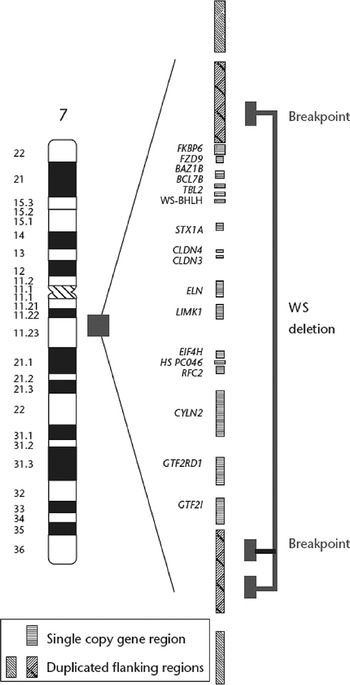
WS is a rare, genetic neurodevelopmental disorder, with an estimated prevalence ranging from 1 in 20,000 (Morris, Demsey, Leonard, Dilts, & Blackburn, Reference Morris, Demsey, Leonard, Dilts and Blackburn1988) to 1 in 7,500 (Strømme, Bjørnstad, & Ramstad, Reference Strømme, Bjørnstad and Ramstad2002) live births. It is caused by a hemizygous deletion of approximately 25 genes in chromosome band 7q11.23 on either paternal or maternal chromosome 7 (Ewart et al., Reference Ewart, Morris, Atkinson, Jin, Sternes and Spallone1993; Korenberg et al., Reference Korenberg, Chen, Hirota, Lai, Bellugi and Burian2000; see Figure 1). The WS deletion invariably includes the gene for elastin (ELN), which codes for an elastic protein in connective tissue that is particularly abundant in large blood vessels such as the aorta (Lowery et al., Reference Lowery, Morris, Ewart, Brothman, Zhu and Leonard1995). Positive diagnosis of WS is routinely determined by detecting the absence of one copy of the gene for ELN with the fluorescent in situ hybridization (FISH) test. The first deleted gene identified in the critical region of WS was ELN, which in isolation has been reliably linked to the cardiac abnormalities associated with WS (Tassabehji et al., Reference Tassabehji, Metcalfe, Karmiloff-Smith, Carette, Grant and Dennis1999). Although no further absolute genotype–phenotype linkages has been established with single genes, LIMK1, CYLN2, GTF2I, and GTF2IRD1 have been linked to nonlanguage cognitive features of the syndrome, as well as to craniofacial dismorphology (Botta et al., Reference Botta, Novelli, Mari, Novelli, Sabani and Korenberg1999; Hirota et al., Reference Hirota, Matsuoka, Chen, Salandanan, Lincoln and Rose2003; Hoogenraad et al., Reference Hoogenraad, Eussen, Langeveld, van Haperen, Winterberg and Wouters1998; Meng et al., 2003; Tassabehji et al., Reference Tassabehji, Hammond, Karmiloff-Smith, Thompson, Thorgeirsson and Durkin2005; Zhao et al., Reference Zhao, Aviles, Abel, Almli, McQuillen and Pleasure2005), and the gene GTF2I has been linked to the intellectual impairment (Morris et al., Reference Morris, Mervis, Hobart, Gregg, Bertrand and Ensing2003). The deletion is considered to be the result of unequal crossing over between chromosomes in the WS critical region during meiosis (meiotic mispairings; Korenberg, Bellugi, Salandanan, Mills, & Reiss, Reference Korenberg, Bellugi, Salandanan, Mills and Reiss2003). An analysis of the size and extent of the deletion has indicated that the size of the deletion, approximately 1.5–1.8 megabases of genomic DNA on one chromosome 7 homologue, is very much the same in approximately 98% of individuals with WS studied (Lowery et al., Reference Lowery, Morris, Ewart, Brothman, Zhu and Leonard1995). Thus, nearly all clinically diagnosed individuals with WS lack precisely the same set of genes, with breakpoints in identical places. Importantly, however, the deletions are not identical, and molecular genetic investigations have illuminated reasons for genetic instability in this region. Among others, Korenberg and colleagues (Reference Korenberg, Chen, Hirota, Lai, Bellugi and Burian2000) have suggested that this particular region of chromosome 7 may be predisposed to both genomic instability and hemideletion, in part because of the large number of repetitive sequences that surround the single copy of ELN on chromosome 7. Unraveling the genotype/phenotype correlations in WS is likely to be significantly advanced by the identification of individuals with partial chromosomal deletions in the WS region.
The region of chromosome 7, band 7q11.23, which is commonly deleted in Williams syndrome (WS), is represented by the solid square. This region is expanded to the right to illustrate its genomic organization, a region of largely single copy genes flanked by a series of genomic duplications. From “ ‘Everybody in the World Is My Friend.’ Hypersociability in Young Children With Williams Syndrome,” by T. F. Doyle, U. Bellugi, J. R. Korenberg, and J. Graham, Reference Doyle, Bellugi, Korenberg and Graham2004, American Journal of Medical Genetics, 124A. Copyright 2004 by Wiley–Liss. Adapted with permission of the author.

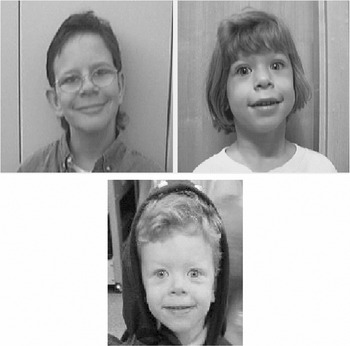
WS was originally recognized by two groups of cardiologists on the basis of the co-occurrence of cardiac abnormalities, hypercalcemia (excessive blood calcium levels), developmental delay, and distinctive “elfin” facial characteristics (Beuren, Apitz, & Harmjanz, Reference Beuren, Apitz and Harmjanz1962; Bongiovanni, Eberlein, & Jones, Reference Bongiovanni, Eberlein and Jones1957; Williams, Barratt-Boyes, & Lowe, Reference Williams, Barratt-Boyes and Lowe1961). The specific craniofacial dismorphology in WS is characterized by broad brow, full cheeks, stellate iris, flat nasal bridge, full nasal tip, long filtrum, prominent lips and ear lobes, small, widely spaced teeth, and wide mouth (see Figure 2). Other clinical features of WS include various cardiovascular difficulties, such as supravalvular aortic stenosis (SVAS), a narrowing of the aorta; failure to thrive in infancy; delayed development of language and motor milestones; abnormal sensitivities to classes of sounds (hyperacusis); a variety of connective or soft tissue disorders; and premature aging (Korenberg et al., in press; Morris & Mervis, Reference Morris and Mervis2000).
Photographs of children with Williams syndrome. Reproduced with parental permission.

Cognitive and behavioral profile
The WS gene deletion results in a cascade of cognitive, behavioral, and emotional aberrations. Karmiloff-Smith (Reference Karmiloff-Smith1998) distinguishes between the behavioral phenotype, which is based on scores from standardized instruments of overt behavior, and the cognitive phenotype, which is based on detailed analyses of the cognitive processes underlying the overt behavior. This distinction is important as equivalent behavioral scores may mask distinctly different cognitive processes. The majority of individuals with WS have mild to moderate intellectual impairment. The estimated mean full-scale intelligence quotient (FSIQ) of our sample of over 100 individuals with WS is 56, with a range from 40 to 90 (Bellugi, Lichtenberger, Jones, Lai, & St. George, Reference Bellugi, Lichtenberger, Jones, Lai and St. George2000; see also Mervis & Klein-Tasman, Reference Mervis and Klein-Tasman2000; Mervis et al., Reference Mervis, Robinson, Bertrand, Morris, Klein-Tasman and Armstrong2000). The FSIQ score camouflages an uneven profile, in which more pronounced deficits are typically seen in performance IQ than in verbal IQ (Howlin, Davies, & Udwin, Reference Howlin, Davies and Udwin1998; Udwin & Yule, Reference Udwin and Yule1990). Since we commenced our studies of WS in 1984, a highly unusual profile of cognitive dissociations has emerged in this population both within and across domains, which initially sparked the modularity debate: whereas older children and adults are relatively proficient in language and in face processing, major deficits are observed in general intellectual functioning, for example, in planning and problem solving, as well as in spatial and numerical cognition (Bellugi et al., Reference Bellugi, Lichtenberger, Jones, Lai and St. George2000; Bellugi, Lichtenberger, Mills, Galaburda, & Korenberg, Reference Bellugi, Lichtenberger, Mills, Galaburda and Korenberg1999; Karmiloff-Smith, Reference Karmiloff-Smith1998; Paterson, Girelli, Butterworth, & Karmiloff-Smith, Reference Paterson, Girelli, Butterworth and Karmiloff-Smith2006). However, although individuals with WS perform within the typical range in, for example, some standardized face-processing tasks, such as the Benton Test of Facial Recognition (Benton, Hamsher, Varney, & Spreen, Reference Benton, Hamsher, Varney and Spreen1983; Karmiloff-Smith, Reference Karmiloff-Smith1997; Rossen et al., Reference Rossen, Jones, Wang and Klima1996; Udwin & Yule, Reference Udwin and Yule1991), it has been shown that their underlying cognitive processes differ significantly from those of typical individuals (e.g., Karmiloff-Smith, Reference Karmiloff-Smith1997; Karmiloff-Smith et al., Reference Karmiloff-Smith, Scherif and Thomas2002; Mills et al., Reference Mills, Alvarez, St. George, Appelbaum, Bellugi and Neville2000; Tanaka & Farah, 1993).
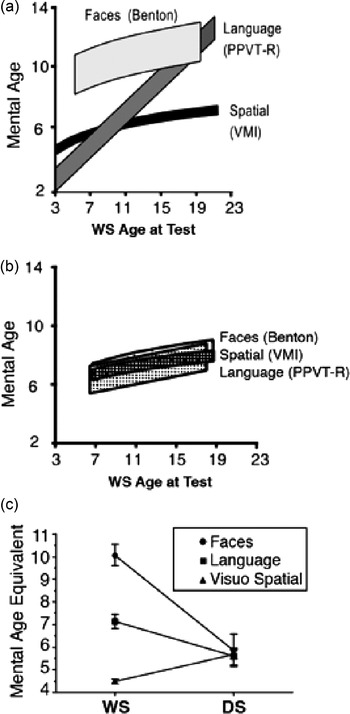
The spatial deficit is most apparent in tasks involving visual–spatial construction, such as copying (e.g., the Developmental Test of Visual–Motor Integration [VMI]; Beery, Reference Beery1989), “block construction” (e.g., the pattern construction subtest of the Differential Abilities Scale; Elliott, Reference Elliott1990), and mental rotation (Farran, Jarrold, & Gathercole, Reference Farran, Jarrold and Gathercole2001, Reference Farran, Jarrold and Gathercole2003). These visual–spatial deficits have been deemed both highly specific and virtually universal to WS (Mervis et al., Reference Mervis, Robinson, Bertrand, Morris, Klein-Tasman and Armstrong2000). This unusual cognitive profile is presented visually in Figure 3, alongside with that characterizing Down syndrome (DS); both neurodevelopmental disorders are characterized by similar overall cognitive level. As can be seen from Figure 3, individuals with DS exhibit relatively homogeneous profiles across three domains of cognition: language, spatial processing, and face processing. In contrast, WS is characterized by a different developmental trajectory in each cognitive domain. In a standard language task (Peabody Picture Vocabulary Test; Dunn & Dunn, Reference Dunn and Dunn1981), the profile associated with WS starts off low, but increases steeply with age; on a visual–spatial probe (VMI), WS is associated with a relatively flat and lower profile compared to DS; and finally, in a face-processing task (Benton Test of Facial Recognition), individuals with WS show relatively high levels of performance even at a young age. DS, by contrast, appears to be associated with equally impaired performance in each domain. These data suggest that the learning trajectories of the two syndromes, WS and DS, differ across developmental time, highlighting the significance of considering the process of development itself when studying developmental disorders (Karmiloff-Smith, Reference Karmiloff-Smith, Nelson and Luciana2007b). Although the characteristic cognitive profile of WS of visual–spatial deficits combined with relative strengths in language and face processing is observed with remarkable consistency in WS (Farran & Jarrold, Reference Farran and Jarrold2003; Mervis et al., Reference Mervis, Robinson, Bertrand, Morris, Klein-Tasman and Armstrong2000), variability has been found.
Three distinct domains of cognition in Williams syndrome (WS); DS, Down syndrome. From “Bridging Cognition, the Brain and Molecular Genetics: Evidence From Williams Syndrome,” by U. Bellugi, L. Lichtenberger, D. Mills, A. Galaburda, and J. R. Korenberg, Reference Bellugi, Lichtenberger, Mills, Galaburda and Korenberg1999, Trends in Neurosciences, 22. Copyright 1999 by Elsevier. Adapted with permission of the author.

Personality and emotional profile
The domains of cognition specified above have attracted a great deal of interest among researchers in the past decades. Despite the fact that persons with WS have been frequently described as being overly friendly, “hypersocial,” and unusually attracted to strangers (e.g., Doyle, Bellugi, Korenberg, & Graham, Reference Doyle, Bellugi, Korenberg and Graham2004; Gosch & Pankau, Reference Gosch and Pankau1994, Reference Gosch and Pankau1997; Jones et al., Reference Jones, Bellugi, Lai, Chiles, Reilly and Lincoln2000), personality remains a considerably less studied area than cognition. In addition to the increased sociability displayed by individuals with WS, they also appear highly empathetic, and have been shown to exhibit enhanced emotional empathy compared to individuals with other developmental disabilities (Tager-Flusberg & Sullivan, Reference Tager-Flusberg and Sullivan2000). At the same time, the social–behavioral profile of WS appears to have many paradoxes. For example, although individuals with WS are highly social, they show substantial problems in social adjustment, including difficulties in forming and sustaining relationships with peers (Gosch & Pankau, Reference Gosch and Pankau1994, Reference Gosch and Pankau1997). In addition, it has been suggested that they lack social judgment (Einfeld, Tonge, & Florio, Reference Einfeld, Tonge and Florio1997; Gosch & Pankau, Reference Gosch and Pankau1997), and tend to be socially isolated in the school environment (Udwin & Yule, Reference Udwin and Yule1991). Although persons with WS are socially fearless, they nevertheless show significant anxiety that has been suggested to be “nonsocial” in nature, and in particular to relate to new situations and objects (Dykens, Reference Dykens2003; Leyfer, Woodruff-Borden, Klein-Tasman, Fricke, & Mervis, Reference Leyfer, Woodruff-Borden, Klein-Tasman, Fricke and Mervis2006). Recently, Klein-Tasman and Mervis (Reference Klein-Tasman and Mervis2003) used two standardized temperament and personality questionnaires (Children's Behavior Questionnaire; Rothbart, Ahadi, Hershey, & Fisher, Reference Rothbart, Ahadi, Hershey and Fisher2001; and a parent version of the Multidimensional Personality Questionnaire; Tellegen, Reference Tellegen, Tuma and Masser1985) to construct an empirically derived personality profile of WS. The comparison group comprised children with other developmental disabilities. The findings showed that the personality characteristics that clearly distinguished individuals with WS from those with other learning disability conditions included a lack of shyness, high empathy, and gregariousness. In addition, individuals with WS were uniquely people oriented, visible, tense, and sensitive/anxious.
The relative homogeneity of the etiology of WS presents an unusual opportunity to elucidate genotype–phenotype relations also with respect to social behavior. Because the social–emotional profile described above appears to be a consistent phenotypic feature of the disorder, and the 7q11.23 deletion the only genetic factor shared between affected individuals, it might be that some of the social–affective characteristics map within the WS critical region. However, in developmental disorders clinical features may also be the result of plasticity following an initial event. Previous articles have attempted to draw genotype–phenotype relations, for example, within the spatial domain in WS (e.g., Gray, Karmiloff-Smith, Funnell, & Tassabehji, Reference Gray, Karmiloff-Smith, Funnell and Tassabehji2006), but no multidisciplinary papers exist in the domain of sociability. To begin to fill this gap, our multilevel studies have focused on defining the development of the noted increased appetitive affiliative drive of children and adults with WS.
The Development of the Social Profile
The unusually social behavior of persons with WS was first noted by von Arnim and Engel (Reference von Arnim and Engel1964). Although most researchers working with individuals with WS have since remarked on their enhanced appetitive social drive (e.g., tendency to indiscriminately approach strangers), making it a highly salient and consistent behavioral feature of the syndrome, systematic studies are relatively sparse. Thus, we currently have little understanding of how genetic factors predispose to dysfunctional social behavior, particularly early manifestations of and neural mechanisms underlying impairments in socialization, and how environmental influences modify and shape behavioral outcome in WS. Our program of studies has focused on systematically examining the variability and consistency of social–affective behavior of WS from a developmental perspective. We have combined several integrated approaches including a questionnaire measuring others' impressions of the behavior of persons with WS, direct behavioral observations, as well as experiments assessing social judgment in individuals with WS to provide an in-depth characterization of the nature of the sociability in this syndrome. We examine the convergence between questionnaire data and experimental measures, and receptive and expressive social abilities in WS, below.
Sociability in WS using parental questionnaire
Because of the unusual, but little studied increased affiliative drive frequently observed in individuals with WS, we developed an entirely new measure indexing social and affective behavior, entitled The Salk Institute Sociability Questionnaire (SISQ; for details of the psychometric properties of this instrument, see Zitzer-Comfort, Doyle, Masataka, Korenberg, & Bellugi, 2007). This is a parental report scale designed to tap central issues in quantifying social behavior (Jones et al., Reference Jones, Bellugi, Lai, Chiles, Reilly and Lincoln2000). The SISQ has been widely used to examine social behavior in early development as well as in childhood, across cultures and populations (WS, autism, DS, and typical development). The questionnaire results in both quantitative and qualitative indices of aspects of sociability that appear to be characteristic of WS (Bellugi et al., Reference Bellugi, Lichtenberger, Jones, Lai and St. George2000; Doyle, Bellugi, Korenberg, et al., Reference Doyle, Bellugi, Korenberg and Graham2004; Jones et al., Reference Jones, Bellugi, Lai, Chiles, Reilly and Lincoln2000). Questionnaire items solicit information concerning (a) willingness to approach others (familiar and unfamiliar), (b) behavior in social settings, (c) ability to remember faces and names, (d) eagerness to please others, (e) empathy, and (f) frequency of others to approach the individual. The analysis produces three composite scores: global sociability score (a cross-domain measure of sociability); social approach score and its two subscores: approach strangers and approach familiars; and social–emotional score.
Parental characterizations of sociability in children with WS
Doyle, Bellugi, Korenberg, et al. (Reference Doyle, Bellugi, Korenberg and Graham2004) used the SISQ to evaluate and contrast social behavior in children with WS, DS, and typically developing controls. Parents of children ages 1 year, 1 month (1;1) to 12;10 completed the SISQ. Whole group analyses showed that the WS group was rated significantly higher on all aspects of sociability studied. The data were then analyzed according to three different age groups: young (1–4 years), intermediate (4–7 years), and oldest (7–13 years). Comparisons among the groups at different ages revealed that heightened sociability was evident even among very young children with WS, and, significantly, children with WS exceeded typically developing controls with respect to global sociability and approach strangers in every age group, as well as children with DS, except for approach strangers in the oldest age category.
Parental characterizations of sociability in adolescents and adults with WS
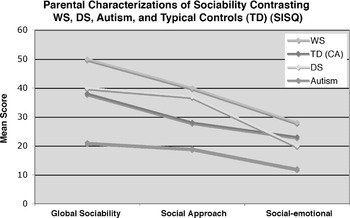
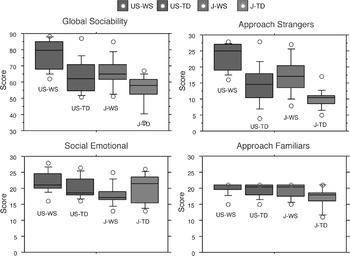
Jones et al. (Reference Jones, Bellugi, Lai, Chiles, Reilly and Lincoln2000) used the SISQ to investigate social behavior in young adults with WS (N = 20, mean age = 18.9 years), autism (N = 20, mean age = 17.9 years), and DS (N = 20, mean age = 18.9 years), contrasted with 15 typical controls (mean age = 17.0 years). The findings indicated that participants with WS were rated as being significantly more social than were those with DS, autism, or typical controls, and participants with autism were rated significantly less social relative to the other groups. DS and typical control groups were rated comparably by their parents and had mean scores between the WS and autism groups (see Figure 4). Specific differences according to subcategories of sociability were also found. The WS group was consistently rated higher than the autism group on the social–emotional items, and indeed, scored the highest of all groups on the social–emotional subscale. In addition, the autism group was consistently rated lower than the other groups, whereas the DS and typical control groups were rated similarly. Significant differences among groups were also found for the subscale measuring social approach behaviors. Participants with WS were rated highest in their interest in approaching others, whereas participants with autism were rated the lowest. Participants with DS were rated higher than typical controls and individuals with autism, but were rated lower than individuals with WS, whereas typical controls were rated significantly higher than the autism group, but significantly lower than the WS and DS groups (all reported comparisons significant).
Individuals with Williams syndrome (WS) are consistently rated higher by their parents in social behaviors using the Salk Institute Sociability Questionnaire than chronological age (CA)-matched individuals with autism, Down syndrome (DS), or typical controls; TD, typically developing. [A color version of this figure can be viewed online at www.journals.cambridge.org]

Approachability in WS
A central index of social functioning is relationships with others, either familiar people or strangers. Individuals with WS have been noted to have difficulties in forming and maintaining relationships with peers, and to prefer to interact socially with adults (Gosch & Pankau, Reference Gosch and Pankau1994, Reference Gosch and Pankau1997). Studies of social approach behaviors and social interaction styles in WS comprised a central part of our recent research.
Observations of social interaction behaviors in children
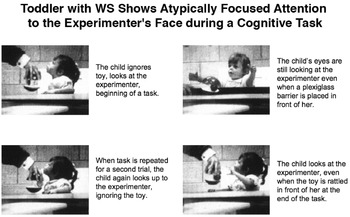
A profound attraction to other people is evident even among infants and toddlers with WS, and it appears that they show a strong preference for social over nonsocial stimuli. Our studies using a standardized instrument for laboratory assessment of early temperament (Laboratory Temperament Assessment Battery [Lab-TAB]; Goldsmith, Reilly, Lemery, Longley, & Prescott, Reference Goldsmith, Reilly, Lemery, Longley and Prescott1993) highlighted clear differences in temperament and affiliative drive in toddlers with WS compared to typical controls (Jones et al., Reference Jones, Bellugi, Lai, Chiles, Reilly and Lincoln2000). Lab-TAB comprises a set of 3- to 5-min episodes that simulate everyday situations in which one can reliably observe individual differences in the expression of emotion, in approach/avoidance, in activity level, and in regulatory aspects of behavior (or temperament). In a task to elicit emotional reactions, specifically anger and frustration, an attractive toy is placed behind a plastic barrier before the child. We were unable to collect data on many of the children with WS because rather than looking at the toy, they instead focused on the experimenter's face (see Figure 5). Although many of the control children grabbed the barrier, those with WS tended to socially engage the experimenter, by gazing into her eyes, smiling, or otherwise initiating social interaction. This finding, showing that the preoccupation with the experimenter shown by toddlers with WS interfered with the administration of tasks, is in line with findings of unusually intense-looking behaviors in children with WS reported elsewhere. For example, Mervis and colleagues (Reference Klein-Tasman and Mervis2003) reported that, unlike children with other neurodevelopmental disabilities, infants and toddlers with WS stared intently into the faces of strangers. It is of interest that we have found evidence for a robust neurobiological marker for the increased attention to faces in individuals with WS (Mills et al., Reference Mills, Alvarez, St. George, Appelbaum, Bellugi and Neville2000). It has been suggested that this intense interest in others may result in disturbances in joint attention among young children with WS (Doyle, Bellugi, Reiss, et al., Reference Reiss, Eckert, Rose, Karchemskiy, Kesler and Chang2004; Laing et al., Reference Laing, Butterworth, Ansari, Gsödl, Longhi and Panagiotaki2002). Inasmuch as the development of effective joint attention skills from infancy is linked with language acquisition in typical development (Baldwin, Reference Baldwin1991), deficiencies in the ability to participate in joint attention may be a core contributor to the abnormality and/or delay of language development in WS.
A child with Williams syndrome looking at the experimenter during a cognitive barrier task from the Laboratory Temperament Assessment Battery. From “II. Hypersociability in Williams Syndrome,” by W. Jones, U. Bellugi, Z. Lai, M. Chiles, J. Reilly, A. Lincoln, et al., Reference Jones, Bellugi, Lai, Chiles, Reilly and Lincoln2000, Journal of Cognitive Neuroscience, 12(Suppl. 1). Copyright 2000 by MIT Press. Adapted with permission of the author.

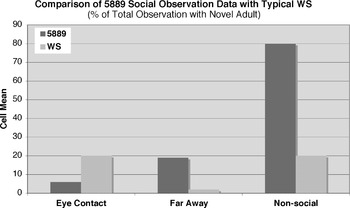
We have utilized a computerized behavior observation program (Noldus, Trienes, Hendriksen, Jansen, & Jansen, Reference Noldus, Trienes, Hendriksen, Jansen and Jansen2000) to quantify and analyze social interactions in depth (Doyle, Bellugi, Reiss, et al., Reference Reiss, Eckert, Rose, Karchemskiy, Kesler and Chang2004), in collaboration with Melissa Bauman (see Bauman, Lavenex, Mason, Capitanio, & Amaral, Reference Bauman, Lavenex, Mason, Capitanio and Amaral2004). This novel technique involves a manual event recorder for the analysis of observational data. Only behaviors performed by the child or directed to the child are coded according to a prespecified “ethogram,” or catalog of behaviors of interest. The software records the occurrence of discreet behaviors in real time, which allows latencies to act, as well as sequences and simple frequencies of behavior to be examined. In addition, the program allows recording of behavioral states simultaneously with discreet behaviors, from which data concerning total duration and mean duration of behavioral states can be obtained. We have reported social behaviors in toddlers with WS or DS under free play conditions with adults (Doyle, Bellugi, Reiss, et al., Reference Reiss, Eckert, Rose, Karchemskiy, Kesler and Chang2004). Examples of the behavioral categories included in the ethogram are gaze direction (person, other), physical location (far, near), communicative behavior (e.g., imitating, pointing, showing), interaction type (dyadic, triadic, nonsocial), and change in proximity (approach, withdrawal). Significant differences between two genetically based groups were observed both in how they interacted with adults in general, as well as whether they were interacting with their parents or a novel adult (see Figure 6). For example, it was found that children with WS (N = 8, mean age = 2.9 years) spent significantly more time in making eye contact with the novel adult than with their parent, although this was not significant for the DS group (N = 8, mean age = 3.2 years). Further, the WS group spent significantly more time than the DS group in close proximity to the experimenter, and engaged in social as opposed to nonsocial activity. Although children with DS engaged in triadic interactions to equal extents with both adults, children with WS showed the opposite pattern: they engage significantly more often in triadic interactions with the novel adult. In the case of the children with WS, their triadic interactions quickly melted into dyadic interactions, and appeared to be a “hook” to engage the novel adult. This may be a reflection of either ineffective joint attention skills in WS (Laing et al., Reference Laing, Butterworth, Ansari, Gsödl, Longhi and Panagiotaki2002), or simply their preference for dyadic interaction. In sum, these data indicate clear abnormalities in prelinguistic communication in young children with WS that appear already to reveal their unusually high appetitive social drive.
Children with Williams syndrome (WS) engage in significantly more eye contact (as a percentage of the total observation period) with the novel adult than with their parent. (a) By contrast, children with Down syndrome (DS) engage in eye contact to a similar extent with both adults. (b) Children with WS spend significantly more time in dyadic interactions with both their parent and novel adult than their counterparts with DS do. (c) Children with WS spend significantly more time in closer proximity to both the novel adult and their parent than those with DS do. From “Genes, Neural Systems, and Cognition: Social Behavior of Children With Williams Syndrome: Observing Genes at Play?” by T. F. Doyle, U. Bellugi, A. L. Reiss, A. M. Galaburda, D. L. Mills, and J. R. Korenberg. In Society for Neuroscience 34th Annual Meeting Abstracts, Reference Reiss, Eckert, Rose, Karchemskiy, Kesler and Chang2004, Washington, DC: Society for Neuroscience. Copyright 2004 by Society for Neuroscience (http://www.sfn.org). Adapted with permission of the author. [A color version of this figure can be viewed online at www.journals.cambridge.org]

Self-rated approachability in adolescents and adults with WS
Bellugi, Adolphs, Cassidy, and Chiles (Reference Bellugi, Adolphs, Cassady and Chiles1999) tested the willingness of individuals with WS to approach unfamiliar people by using an adapted version of the Approachability Task previously used by Adolphs, Tranel, and Damasio (Reference Adolphs, Tranel and Damasio1998). Twenty-six individuals with WS (mean age = 23.6 years) and 26 chronological age-matched typical controls and 26 mental age-matched controls were presented with black-and-white photographs of unfamiliar adults, which had previously been rated as the most, or the least, approachable by typical individuals. The task was to indicate one's willingness to approach and converse with the person in the photograph using a Likert-style rating scale. Although control groups performed comparably, those with WS displayed a positive bias, rating positively prejudged unfamiliar faces as significantly more approachable than did the controls. Although in this study participants with WS also perceived negatively prejudged unfamiliar faces as more approachable than did the controls, this finding has not been replicated (see Frigerio et al., Reference Frigerio, Burt, Gagliardi, Cioffi, Martelli and Perrett2006). However, an abnormally positive assessment of unfamiliar faces by individuals with WS closely reflects their real-life social behaviors (Doyle, Bellugi, Korenberg, et al., Reference Doyle, Bellugi, Korenberg and Graham2004; Jones et al., Reference Jones, Bellugi, Lai, Chiles, Reilly and Lincoln2000). Subsequent analyses of these data indicate that although there is significant variability in the approachability ratings among individuals with WS, high self-rated willingness to approach strangers may be specifically associated with poor ability to recognize facial affect in such individuals (Järvinen-Pasley, Reilly, Reiss, Korenberg, & Bellugi, Reference Järvinen-Pasley, Reilly, Reiss, Korenberg and Bellugi2006; see also Gagliardi et al., Reference Gagliardi, Frigerio, Burt, Cazzaniga, Perrett and Borgatti2003). This suggests a dissociation between social–perceptual abilities and expressive social behavioral tendencies in this population.
Social understanding
Despite the unusually social nature of individuals with WS, a growing body of research indicates that many aspects of “social intelligence” are impaired. In infancy and in toddlerhood, the atypically intense looking behaviors and interest in the human face are suggested to contribute to the failure to adequately develop joint attention, as well as reducing the children's opportunities to learn about their environment (Doyle, Bellugi, Reiss, et al., Reference Reiss, Eckert, Rose, Karchemskiy, Kesler and Chang2004; Laing et al., Reference Laing, Butterworth, Ansari, Gsödl, Longhi and Panagiotaki2002; Mervis et al., Reference Mervis, Morris, Klein-Tasman, Bertrand, Kwitny and Appelbaum2003). Studies examining receptive social perceptual and cognitive abilities in adolescents and adults with WS indicate that the ability of such individuals to identify both vocally and facially expressed affect is indistinguishable from that of mental age matched controls (Gagliardi et al., Reference Gagliardi, Frigerio, Burt, Cazzaniga, Perrett and Borgatti2003; Plesa-Skwerer, Faja, Schofield, Verbalis, & Tager-Flusberg, Reference Plesa-Skwerer, Faja, Schofield, Verbalis and Tager-Flusberg2006; Plesa-Skwerer, Verbalis, Schofield, Faja, & Tager-Flusberg, Reference Plesa-Skwerer, Verbalis, Schofield, Faja and Tager-Flusberg2005). Findings also indicate that the social–perceptual deficits may contribute to some aspects of the hypersociability in WS, for example, heightened approach behaviors toward strangers (Järvinen-Pasley et al., Reference Järvinen-Pasley, Reilly, Reiss, Korenberg and Bellugi2006). Similarly, studies assessing social cognitive abilities have revealed widespread impairments; for example, persons with WS are no better than mental age-matched controls in the attribution of second-order mental states (Sullivan & Tager-Flusberg, Reference Sullivan and Tager-Flusberg1999). Together, the ability to decode mental state information both in perceptual and more cognitively based tasks is impaired in WS, defying earlier hypotheses of “spared” theory of mind abilities in WS (Karmiloff-Smith, Klima, Bellugi, Grant, & Baron-Cohen, Reference Karmiloff-Smith, Klima, Bellugi, Grant and Baron-Cohen1995; Tager-Flusberg et al., Reference Tager-Flusberg, Boshart and Baron-Cohen1998). Tager-Flusberg and Sullivan (Reference Tager-Flusberg and Sullivan2000) distinguished between social–perceptual and social–cognitive components of theory of mind, and it appears that both components are impaired in WS. In sum, individuals with WS appear to show difficulties in interpreting others' behavior in terms of their mental states. Taken together with their overfriendly behavioral predisposition, it is perhaps not surprising that they have substantial problems in social adjustment, such as difficulty making and keeping friends (Gosch & Pankau, Reference Gosch and Pankau1994, Reference Gosch and Pankau1997), and impaired social judgment (Einfeld, Tonge, & Florio, Reference Einfeld, Tonge and Florio1997; Gosch & Pankau, Reference Gosch and Pankau1997).
Summary
A large body of evidence shows that key measures do converge on uncovering distinctive aspects of the WS social–affective phenotype that appear to be present already in infancy; for example, infants with WS look at the faces of others and smile frequently. Our data on the SISQ from over 200 individuals with WS of ages from 1 to 52 years consistently show that individuals with WS are rated significantly higher on global sociability, as well as on the approach strangers subscale, than either typical controls or participants with other neurodevelopmental disorders, such as autism or DS. The heightened parent-rated approachability is also reflected in the actual approachability judgments of individuals with WS, as well as in observational data. The distinctiveness of the social behavior in WS appears to be specifically linked to their interactions with, and approachability toward, unfamiliar people (e.g., Doyle, Bellugi, Korenberg, et al., Reference Doyle, Bellugi, Korenberg and Graham2004; Doyle, Bellugi, Reiss, Reference Doyle, Bellugi, Korenberg and Graham2004; Jones et al., Reference Jones, Bellugi, Lai, Chiles, Reilly and Lincoln2000). However, as studies with infants with WS are extremely rare, we have little understanding of the developmental mechanisms that yield this atypical social phenotype. In order to construct the full developmental trajectory of social behavior in WS, longitudinal studies are necessary. This is particularly important because persons with WS are at significant risk for developing problems in social adjustment and social understanding beginning in infancy, when their atypically focused looking at the faces of others may interfere with the development of joint attention skills. This may later manifest as compromised understanding of others' mental states and deficits in social–perceptual abilities. Better understanding of the earliest stages of development in WS will be key in developing a framework from which to design and implement both biological and environmental interventions for children with WS.
The Development of the Social Use of Language
On first encountering individuals with WS, strangers are often impressed by their apparent command of language and excessive friendliness. Although adults with WS employ language effectively as a social tool, children with WS often experience significant delays in acquiring expressive language. To provide a brief overview of language development in WS, first words often do not appear on average before the 28th month (Mervis & Robinson, Reference Mervis and Robinson2000; Singer-Harris, Bellugi, Bates, Jones, & Rossen, Reference Singer-Harris, Bellugi, Bates, Jones and Rossen1997), although significant variability in the extent and timing of the delay exists. It has also become clear that language development in WS proceeds atypically. In typical development, certain cognitive milestones emerge in a predictable sequence with milestones of language acquisition, but this appears not to be the case in WS: referential pointing emerges after the onset of expressive language (Mervis & Bertrand, Reference Mervis and Bertrand1994), and exhaustive categorization abilities are delayed well beyond the vocabulary spurt (Mervis & Bertrand, Reference Mervis, Bertrand, Adamson and Romski1997). Thus, children with WS, unlike typically developing children and children with other neurodevelopmental disabilities that result in delayed but sequentially typical developmental milestones, follow an alternate developmental path in acquiring language skills. Karmiloff-Smith (Reference Karmiloff-Smith, Nelson and Luciana2007b) argued recently that the roots of the atypical language development in WS can be traced to such early processes as delays in babbling and hand movements (Masataka, Reference Masataka2001), segmentation of the speech stream (Nazzi, Paterson, & Karmiloff-Smith, Reference Nazzi, Paterson and Karmiloff-Smith2003), and deviant planning of visual saccades (Brown et al., Reference Brown, Johnson, Paterson, Gilmore, Gsodl and Longhi2003). A recent, detailed review of language abilities in WS (Brock, Reference Brock2007) concluded that language skills in this population roughly correspond to their overall or nonverbal mental age, with the following exceptions: first, individuals with WS outperform their mental age-matched controls on tests of receptive vocabulary; second, both comprehensive and productive skills relating to spatial language are severely impaired; and third, pragmatic skills are unusual in that although individuals with WS are often extremely talkative, in conversational contexts the content of their speech lacks coherence and the perspective taking of others, and they may also initiate conversation inappropriately (LaCroix, Bernicot, & Reilly, in press; Laws & Bishop, Reference Laws and Bishop2004). We discuss below another feature of the unusual pragmatic functioning in individuals WS, namely their excessive use of social and affective devices in language (evaluative language).
The use of social evaluative language
Social use of language in children with WS
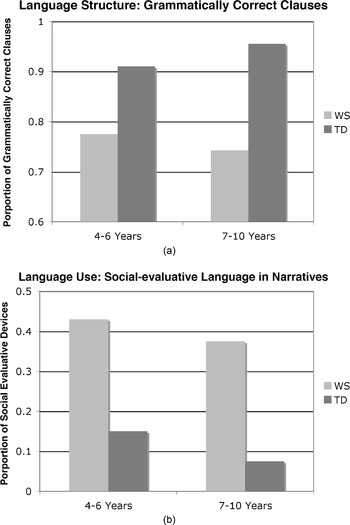
To better understand the developmental relation between sociability and language in children with WS, Losh, Bellugi, Reilly, and Anderson (Reference Losh, Bellugi, Reilly and Anderson2000) asked 30 school-age children with WS, as well as 30 chronological age- and gender-matched typically developing controls to narrate a story on the basis of the wordless picture book, Frog, Where Are You? (Mayer, Reference Mayer1969). The participants' stories were transcribed and coded for grammar and separately for the social and affective use of language (evaluative language; see Losh et al., Reference Reilly, Losh, Bellugi and Wulfeck2004, for details). Evaluative language, a term introduced by Labov and Waletsky (Reference Labov, Waletsky and Helm1967), refers to lexically conveyed affect and sociability, or language that reflects the narrator's attitude or perspective. Evaluative devices are linguistic tools used to attribute emotions or motivations to characters in the story, build suspense, and maintain audience involvement and interest, such as emphatics, intensifiers (e.g., really, very, and so), character speech, direct quotes, and sound effects. A new category of evaluative devices termed “audience hookers,” defined as devices to capture and maintain the listener's attention (e.g., “Lo and behold! There were froglets!”), was developed to specifically characterize a language function unique to the participants with WS. Analysis of the structural aspects of language included the assessment of morphosyntactic errors and the use of complex syntax. For both these indices, proportions were created using story length, as measured by the propositions, as the denominator. The analyses showed that the stories of children with WS appeared excessively social (Figure 7b). However, the sentences used by these children were simple, and their language was characterized by a significant number of grammatical errors. The children with WS made significantly more errors than their age matched controls (Figure 7a), and proportionally, their performance did not differ from that of age-matched children with specific language impairment (Reilly, Losh, Bellugi, & Wulfeck, Reference Reilly, Losh, Bellugi and Wulfeck2004). Figure 7a and b illustrates that, even as children with WS struggle with the morphosyntax of English, they nevertheless exceed their age-matched controls in the use of social evaluative language at each time point studied. It appears that even with a restricted command of English, as soon as a child with WS can recount a story, she frequently recruits evaluative devices, effectively using language for social purposes.
(a) The mastery of morphosyntax in the narratives of children with Williams syndrome (WS) and typical controls and (b) the use of social evaluation in the narratives of children with WS and typical controls; TD, typically developing. Contrasted with the mastery of morphosyntax, children with WS exhibit a pattern opposite that of the controls. [A color version of this figure can be viewed online at www.journals.cambridge.org]

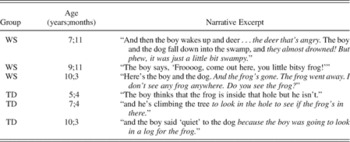
To illustrate the nature of social evaluative language and how its use differs qualitatively between the groups, Table 1 includes some examples from the narratives of children with WS and their typical controls.
Evaluative language in the narratives of children with Williams syndrome and typical controls

Note: WS, Williams syndrome; TD, typically developing. All excerpts pertain to the search for the frog in the book Frog, Where Are You? When the typical controls narrated the story, they often explicitly conveyed the purpose or motivation for the character's behaviors. However, when participants with WS discussed the same event, they often used social evaluative devices to perform as the character, thereby engaging the audience in the performance. From “Narrative as a Social Engagement Tool: The Excessive Use of Evaluation in Narratives From Children With Williams Syndrome,” by M. Losh, U. Bellugi, J. Reilly, and D. Anderson, 2000, Narrative Inquiry, 10. Copyright 2000 by Erlbaum. Adapted with permission of the author.
Social use of language in adolescents and adults with WS
In one of our early language studies on WS, we demonstrated that the use of language of adolescents with WS was exceptionally social (Reilly, Klima & Bellugi, Reference Reilly, Klima and Bellugi1990). The study included four adolescents with WS (ages 10–18 years), contrasted with four age- and IQ-matched adolescents with DS, and 10 mental age-matched typical controls. Participants were again asked to narrate the Frog story, and the stories were transcribed and coded for structural aspects of language, as well as for the use of affective prosody and evaluative language. Despite the small number of participants, a distinctive profile emerged: the WS group used social phrases, intensifiers, sound effects, and direct discourse in an unusual manner, and significantly more frequently than those with DS or typical controls. The structural analysis of language showed that, unlike for the children with WS, the adolescents with WS were relatively proficient in their use of grammar. It is of interest that, their stories were infused with affective prosody and social evaluation, whether it was the first, or the second story telling instance to the same listener. This persistently enthusiastic and affectively laden style suggests a lack of pragmatic sensitivity (see also Laws & Bishop, Reference Laws and Bishop2004; LaCroix et al., in press).
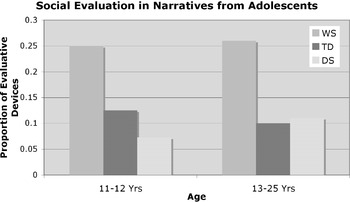
Since the first language study, we have collected narratives from a large number of individuals with WS of various ages. In one study, we asked 26 11- to 15-year-old adolescents with WS, 13 chronological age-matched participants with DS, and 24 chronological age-matched typically developing controls to narrate the wordless picture book (Kreiter et al., Reference Kreiter, Bellugi, Lichtenberger, Klima, Reilly and Kikuchi2002). The stories were again transcribed and coded for length, evaluative language, and grammar. Similar to the findings of Reilly et al. (Reference Reilly, Klima and Bellugi1990), the adolescents with WS made few morphological errors, and indeed, their grammatical performance was within the low normative range. In contrast, the individuals with DS continued to lag far behind in their mastery of English morphology. As expected, the performance of the typical controls had floored, and they made very few errors. Complex sentences, including coordinate and different types of subordinate clauses, are a major linguistic mechanism for integrating: (a) the components within an event, (b) linking events across episodes, and (c) to relating individual episodes to the story's theme of searching for the lost frog. With respect to the participants' use of complex syntax, typical controls used complex sentences with increased frequency and diversity, as they got older. For the children with WS, the findings showed that the younger group used complex syntax less frequently than did the typical group. However, by the age of 14, the performance of the individuals with WS was within the low normative range. The performance of those with DS was significantly lower than that of individuals with WS and typical controls. In sum, on indices of morphosyntax, the adolescents with WS performed at a level that was within the low normative range. Findings from the analysis of the use of social evaluation confirmed our earlier findings by showing that the individuals with WS far surpassed both those with DS and their chronological age-matched controls in the use of social evaluation, as illustrated in Figure 8.
Social evaluation in narratives of adolescents with Williams syndrome (WS) or typical controls; TD, typically developing; DS, Down syndrome. [A color version of this figure can be viewed online at www.journals.cambridge.org]

A cross-genre comparison
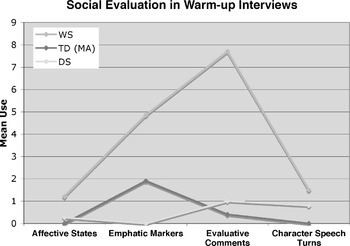
Our narrative analyses drew from the characterization of narratives presented in the landmark paper of Labov and Waletzsky (Reference Labov, Waletsky and Helm1967). The authors described two functions of narrative: first, the referential, which refers to information pertaining to the plot and the characters; and second, the evaluative, which refers to the narrator's perspective and attitude toward those events. The latter is largely related to the story's significance. Given this theoretical perspective, the possibility arose that it was in fact the particular genre, that is, the narratives themselves, and reliance upon the evaluative function, which elicited the distinctive linguistic profile in the WS group. To address this possibility, we coded and analyzed a set of warm-up interviews from adolescents with WS, DS, and mental age-matched typical controls, where experimenters asked questions about the participant's family, friends, school, and interests (Harrison, Reilly, & Klima, Reference Harrison, Reilly and Klima1995). Typically, interviews, as a genre, respect a certain structure: the interviewer asks questions and the interviewee responds. However, in the WS group, participants often reversed the roles: the participants with WS posed questions of the experimenter, which were often personal. For example when asked about their family, a WS adolescent said, “I have a sister. “Do you have a sister? How old is she?” Similar to social evaluative devices, such personal questions function to “hook” the audience, engaging the interlocuter's attention. Figure 9 shows the mean use of components of evaluative language, such as affective states, empathetic markers, evaluative comments, and character speech turns, for participants with WS, DS, and mental age-matched typical controls. These complementary data suggest that the very social use of language, evident in the narratives of the individuals with WS, is not genre specific, but a more general phenomenon.
The use of affectively laden language in the accounts of children with Williams syndrome (WS) significantly exceeded that of children with Down syndrome (DS) and mental age (MA)-matched typical controls. [A color version of this figure can be viewed online at www.journals.cambridge.org]

The use of affective prosody
Given the highly socially evaluative use of language in WS, an analysis of affective prosody provides another important index of social expressivity. In the receptive domain, Plesa-Skwerer et al. (Reference Plesa-Skwerer, Faja, Schofield, Verbalis and Tager-Flusberg2006) found that participants with WS (N = 47, ages 12–32) showed significantly impaired performance on the paralanguage subtests of the Diagnostic Analysis of Nonverbal Accuracy Scale relative to age-matched typical controls, whereas their performance was similar to that of age- and IQ-matched controls with other learning disabilities (Plesa-Skewer et al., Reference Plesa-Skwerer, Faja, Schofield, Verbalis and Tager-Flusberg2006). In a recent study, Lando, Reilly, Searcy, and Bellugi (Reference Lando, Reilly, Searcy and Bellugi2006) systematically quantified prosody in the narratives of 23 participants with WS (ages 6–15 years) and 29 age-matched typical controls using the computerized speech editor Praat (Boersma, Reference Boersma2001). The results showed that the speech of individuals of WS of all ages was characterized by more frequent use of pitch accents, greater pitch range, and higher overall pitch level compared to the controls, suggesting a dissociation between expressive and receptive abilities also in this domain.
Summary
The studies of language use in WS raise some intriguing questions. One concerns the role or purpose of social evaluation. Our hypothesis is that the excessive use of social evaluation in individuals with WS reflects a phenotypic marker. In other words, those with WS utilize their linguistic skills for social, as opposed to, for example, informational purposes. Social communication appears to play an important role in the behavioral repertoire of persons with WS, as reflected in the amount of language produced as well as in the excessive use of emotional, engagement, and evaluative devices. Our findings also show that for individuals with WS, language proficiency is not a prerequisite for extensive use of social evaluation. Indeed, it appears that as soon as a child is capable of producing a simple narrative, s/he exploits her linguistic abilities maximally for social purposes. The unusually social use of language may reflect compensatory development in the face of impairments in the more “cognitively based” language functions in WS. To better understand the role and origins of social evaluative language in WS, it will be important to carefully track the trajectories language and sociability as they emerge and interact.
Neurobiological Basis of the Social Phenotype
Anatomically, WS is associated with an overall reduction in brain volume. Consistent with the typically observed intellectual impairment, cerebral gray matter is reduced by approximately 11%, and white matter volume by approximately 18%, relative to typical controls (Reiss et al., Reference Reiss, Eckert, Rose, Karchemskiy, Kesler and Chang2004; Thompson et al., Reference Thompson, Lee, Dutton, Geaga, Hayashi and Eckert2005). When the overall brain volume is controlled for, the most pronounced reductions have been found in occipital and parietal regions relative to frontal regions (Eckert et al., Reference Eckert, Hu, Eliez, Bellugi, Galaburda and Korenberg2005; Reiss et al., Reference Reiss, Eckert, Rose, Karchemskiy, Kesler and Chang2004), the corpus callosum (Schmitt, Eliez, Warsofsky, Bellugi, & Reiss, Reference Schmitt, Eliez, Warsofsky, Bellugi and Reiss2001), and brainstem (Reiss Eliez, Scmitt, Straus, et al., Reference Reiss, Eliez, Schmitt, Straus, Lai and Jones2000). These reductions are accompanied by relative preservations in the auditory cortex (Holinger et al., Reference Holinger, Bellugi, Mills, Korenberg, Reiss and Sherman2005) and cerebellum (Jones et al., Reference Jones, Hesselink, Courchesne, Duncan, Matsuda and Bellugi2002). Recent findings indicate that WS is associated with atypical sulcal/gyral patterning (Eckert Galaburda, et al., Reference Eckert, Galaburda, Karchemskiy, Liang, Thompson and Dutton2006; Jackowski & Schultz, Reference Jackowski and Schultz2005) and increased gyrification particularly in posterior cortical regions (Schmitt et al., Reference Schmitt, Watts, Eliez, Bellugi, Galaburda and Reiss2002; Thompson et al., Reference Thompson, Lee, Dutton, Geaga, Hayashi and Eckert2005). The brain shape of individuals with WS is also unusual (Schmitt, Eliez, Bellugi, & Reiss, Reference Schmitt, Eliez, Warsofsky, Bellugi and Reiss2001), particularly with regard to hippocampus (Meyer-Lindenberg, Mervis, et al., Reference Meyer-Lindenberg, Hariri, Munoz, Mervis, Mattay, Morris and Berman2005a) and corpus callosum (Schmitt et al., Reference Schmitt, Eliez, Warsofsky, Bellugi and Reiss2001; Tomaiuolo et al., Reference Tomaiuolo, Di Paola, Caravale, Vicari, Petrides and Caltagirone2002). It is of interest that a similarly flattened corpus callosum is observed in animal brains that have not undergone the drastic frontal and temporal/parietal growth that is characteristic of healthy human brains. In addition, atypical neuron size and neuronal packing density have been observed in WS (Galaburda, Holinger, Bellugi, & Sherman, Reference Galaburda, Holinger, Bellugi and Sherman2002; Galaburda, Wang, Bellugi, & Rossen, Reference Galaburda, Wang, Bellugi and Rossen1994). Together, these neurobiological findings are indicative of dysfunction in specific neural systems in individuals with WS (see Figure 10a for a summary) that are consistent with many aspects of the neurocognitive and behavioral phenotype. We focus on the neural systems relevant to the WS social phenotype below. Specifically, the amygdala, the superior temporal gyrus (STG), and the orbitofrontal cortex (OFC) comprise the neural network assumed to be responsible for social information processing (Brothers, Reference Brothers1990).
A summary of neurobiological findings in Williams syndrome. [A color version of this figure can be viewed online at www.journals.cambridge.org]

Brain structure using magnetic resonance imaging (MRI)
An important anatomical finding using structural MRI has highlighted disproportionately large volume of the amygdala in WS (Reiss et al., Reference Reiss, Eckert, Rose, Karchemskiy, Kesler and Chang2004). These data included the scans of 43 participants with WS (mean age = 29 years, range = 12–50 years) and 40 healthy controls (mean age = 28 years, range = 18–49 years). The amygdala plays a critical role in social cognition, particularly in the perception of danger, and in the subsequent regulation of appropriate behavioral and autonomic responses to social–emotional stimuli (Adolphs, Reference Adolphs2001; LeDoux, Reference LeDoux2003). The amygdala is anatomically connected to the OFC via robust, reciprocal pathways, hypothesized to mediate the connections from sensory representations to social judgments, including emotion and cognition (Ghashghaei & Barbas, Reference Ghashghaei and Barbas2002; Price, Reference Price1999). The amygdala also receives extensive projections from the medial prefrontal cortex (MPFC), and this mechanism is hypothesized to regulate emotional arousal and expression, including endocrine and autonomic nervous system reactivity (Ghashghaei & Barbas, Reference Ghashghaei and Barbas2002; Price, Reference Price1999). Given that bilateral amygdala damage has been linked to an inability to perceive fear and enhanced sense of trustworthiness toward strangers (Adolphs et al., Reference Adolphs, Tranel and Damasio1998), this anatomical anomaly may be associated with the unusual social and emotional behaviors of individuals with WS.
Reiss et al. (Reference Reiss, Eckert, Rose, Karchemskiy, Kesler and Chang2004) also found augmented volume and gray matter density in other areas linked to social–emotional processing, namely, the anterior cingulate cortex, MPFC, OFC, STG, fusiform gyrus, and insular cortex, in their sample of participants with WS and controls. Consistent with this, Eckert, Tenforde, and colleagues (Reference Eckert, Galaburda, Karchemskiy, Liang, Thompson and Dutton2006) reported increased OFC gray matter density in eight adults with WS (mean age = 31 years), relative to nine healthy controls (mean age = 28.8 years). The anomalous brain structure in WS is largely consistent with the atypical social cognition and social behavior profile that characterizes the syndrome. Specifically, the cingulate, OFC, MPFC, insula, as well as the amygdala, are regions of the limbic system, which subserve functions related to emotion regulation, for example, heightened arousal, anxiety, and social impulsivity (Price, Reference Price1999). The insula has been suggested to provide a subjective emotionally relevant context for sensory experience, such as disgust, and plays a role in both fear avoidance and pain experience (Phillips et al., Reference Phillips, Young, Senior, Brammer, Andrew and Calder1997). It is connected to a number of other limbic-related structures, including the amygdala and OFC. The insula and temporal gyrus regions are also linked to verbal and language abilities. It is noteworthy, however, that conflicting evidence of reduced OFC gray matter volume in individuals with WS, relative to typical controls, has also been reported (Meyer-Lindenberg et al., Reference Meyer-Lindenberg, Kohn, Mervis, Kippenhan, Olsen and Morris2004). It is likely that methodological differences in controlling for the unusual brain shape in WS between the studies explain the discrepant OFC findings. The participants with WS in Meyer-Lindenberg et al.'s study were also unusually high functioning, which may further impede the comparability of these data with those of Reiss et al. (Reference Reiss, Eckert, Rose, Karchemskiy, Kesler and Chang2004) and Eckert, Tenforde, et al. (Reference Eckert, Galaburda, Karchemskiy, Liang, Thompson and Dutton2006). Figure 10a and b summarizes the main neurobiological findings in WS.
Social disinhibition is associated specifically with OFC damage in persons without WS (Rolls, Hornak, Wade, & McGrath, Reference Rolls, Hornak, Wade and McGrath1994). Recently, Frigerio et al. (Reference Frigerio, Burt, Gagliardi, Cioffi, Martelli and Perrett2006) noted similarities in the behavioral profile of individuals with WS and those with frontal lobe damage. Evidence indicates that frontal lobe volume of individuals with WS is approximately 88% of that observed in healthy controls (Reiss, Eliez, Schmidtt, Straus, et al., Reference Reiss, Eliez, Schmitt, Straus, Lai and Jones2000), and widespread cytoarchitectonic abnormalities, including coarse neurons, increased cell packing density, diminished numbers of neurons, and increased glia (Galaburda & Bellugi, Reference Galaburda and Bellugi2000; Galaburda et al., Reference Galaburda, Holinger, Bellugi and Sherman2002; Reiss et al., Reference Reiss, Eckert, Rose, Karchemskiy, Kesler and Chang2004; Thompson et al., Reference Thompson, Lee, Dutton, Geaga, Hayashi and Eckert2005). The findings of Thompson et al. (Reference Thompson, Lee, Dutton, Geaga, Hayashi and Eckert2005) indicated that although many cortical regions were associated with thickening in WS, this was particularly apparent across areas of right frontal cortex and superior temporal sulcus. They noted that although thicker cortex may be assumed to be functionally superior, similar thickening also characterizes fetal alcohol syndrome, and may instead reflect less efficient neural packing, increased gyrification, and proportionately greater loss of white than gray matter. The frontal lobe abnormalities in persons with WS may thus play a role in their characteristically social behavior.
Brain function using functional MRI (fMRI) and event-related potentials (ERPs)
Although hypotheses implicating dysfunction of brain areas can be generated on the basis of the structural data, the relationship between brain structure and brain function needs to be established using functional techniques. Further, as a complement to structural imaging studies, information about the variation in brain function will further elucidate specific gene–brain–behavior relationships. Unfortunately, studies examining functional neuroanatomy in relation to social–affective processing are sparse in WS. A recent study compared amygdala activation in response to threatening faces and scenes in 13 unusually high-functioning individuals with WS (mean age = 28.3 years) and healthy controls matched for age, gender, and intelligence (Meyer-Lindenberg, Hariri, et al., Reference Meyer-Lindenberg, Hariri, Munoz, Mervis, Mattay, Morris and Berman2005). Although both groups exhibited comparable behavioral performance, between-group differences were evident in brain activation. The controls showed greater amygdala activation to threatening faces than to threatening scenes, whereas the participants with WS exhibited the opposite pattern. The authors hypothesized that the increased amygdala reactivity to the nonsocial scenes may be linked to the significant nonsocial anxiety that is a common feature of WS (Dykens, Reference Dykens2003). Those with WS showed significantly diminished amygdala reactivity to faces compared to controls, and the controls exhibited significantly decreased amygdala activity to scenes. As the fear response is regulated by the amygdala, the abnormally reduced activation in this region in WS to threatening faces might contribute to their positive perceptual bias to unfamiliar faces and the subsequently heightened approachability toward strangers (Bellugi, Adolphs, et al., Reference Bellugi, Adolphs, Cassady and Chiles1999). Furthermore, during both tasks, individuals with WS exhibited a lack of OFC activation, and significantly increased activation in the MPFC compared to controls. Together, these findings point to abnormal neural circuitry underlying social–emotional information processing in WS: although the findings do not implicate a deficit in amygdala function per se, its interactions with the prefrontal regions, specifically the OFC, are clearly abnormal. Adolphs (Reference Adolphs2003) suggested that the specific role of the OFC and the amygdala in social cognition is the connecting of sensory representations of stimuli with social judgments made about them based on their motivational significance.
Although a review of face processing in WS per se is beyond the scope of the current paper, it is of interest to consider a few studies utilizing face stimuli in WS. These data provide clues for a neurobiological substrate underlying the enhanced salience of social–affective stimuli commonly observed in behavioral studies for individuals with WS. In an fMRI study investigating the neural mechanisms underlying face and eye gaze processing (Mobbs et al., Reference Mobbs, Garrett, Menon, Rose, Bellugi and Reiss2004), 11 individuals with WS (mean age = 31 years) and age-matched typical controls (mean age = 34 years) were presented with images of neutral faces. The task was to make judgments on eye gaze direction. The aim was to disentangle the cognitive versus social–emotional aspects of face processing in WS. Behaviorally, participants with WS exhibited delayed response latencies and a trend toward poorer accuracy for the gaze judgments. Moreover, brain activation during the viewing of the faces revealed significant between-group differences. Although individuals with WS showed a marked decrease in activation of posterior visual–spatial brain regions and heightened frontal activation, controls exhibited the opposite pattern. Activation in the structures typically associated with face processing (bilateral fusiform gyrus, superior temporal sulcus, and the amygdala) did not differ between groups. Frontal regions showing heightened activation in WS were the medial frontal gyrus and the dorsal portions of the anterior cingulate gyrus; these have been implicated in the processing of social–affective stimuli. Mobbs et al. (Reference Mobbs, Garrett, Menon, Rose, Bellugi and Reiss2004) hypothesized that the unusual pattern of increased frontal activation in participants with WS may underpin their social–emotional behavior rather than general face-processing skills. Further, the atypical frontal activation may reflect compensatory neural function; namely, reorganization of cognitive processes in frontal/limbic areas in the presence of aberrant development in the posterior regions. The atypical pattern of activation in WS may also reflect task difficulty. In a similar vein, our studies utilizing ERPs have robustly established that individuals with WS display an abnormally large negative component at 200 ms (N200) relative to both autism and typical control groups matched for age (Mills et al., Reference Mills, Alvarez, St. George, Appelbaum, Bellugi and Neville2000; see also Mills et al., submitted). As the N200 amplitude has been hypothesized to index attention to faces, the unusually large N200 in WS may provide a neurobiological marker for the heightened attention to faces in individuals with this syndrome. It is of interest that the N200 component was abnormally small in participants with autism. These data provide neurobiological correlates for the unusual profile of WS, in which strengths are seen in aspects of face processing, although at the same time, face processing sustained by clearly atypical neural processes.
Summary
The social–behavioral profile of WS appears to be associated with abnormalities in brain structure as well as in brain function when contrasted with the brains of typically developing controls. Although the structural profile of, for example, the amygdala, which is enlarged, mirrors the excessively social behavioral predisposition of WS, functional data indicates that rather than reflecting a localized amygdala dysfunction, the regulation of the amygdala by the prefrontal cortex is disrupted in WS. It has been suggested that this organization may reflect compensatory, and possibly adaptive, reorganization between cortical subregions (Meyer-Lindenberg, Hairi, et al., Reference Meyer-Lindenberg, Hariri, Munoz, Mervis, Mattay, Morris and Berman2005; Mobbs et al., Reference Mobbs, Garrett, Menon, Rose, Bellugi and Reiss2004). The neurobiological findings from individuals with WS fit well into models of social cognition (e.g., Adolphs, Reference Adolphs2001), in which amygdala function and fear response are regulated both by the OFC and MPFC. These data raise important questions about the influences of genetic variation on brain function involving social–affective processing. However, unfortunately, as with the behavioral data, most of the studies of the brain structure and function in WS have involved adult participants, and consequently, there is little understanding of the earliest manifestations of, and the development of neural mechanisms underlying the dysfunctional social behavior, genetic influences, and how environmental factors modify and shape the social outcome of WS. Comprehensive, homogeneous models and prospective longitudinal studies are needed so that neural mechanisms underlying the development and course of maladaptive social behavior, and genetic and environmental factors that influence outcome, can be described. Longitudinal studies of very young children will allow us to answer the critical question of whether children with WS develop a cognitive–behavioral profile that essentially “matches” their preexisting neuroanatomical topography, or alternatively, whether their neuroanatomy developmentally “specializes” as a result of genetic factors interacting with common environmental factors, eventually culminating in the relatively well-described adult cognitive–behavioral phenotype associated with WS.
Environmental and Biological Influences on Social Outcomes
Studies over the past two decades illustrate that individuals with WS are at risk for developing a distinctive profile of cognitive, affective, and behavioral abnormalities. It is also acknowledged that considerable variability exists in the severity of such characteristics within this population; for example, some lower functioning individuals with WS show noticeably poorer language skills than do those with higher cognitive function, despite having the same gene deletion. It is almost certain that environmental risk factors such as those pertaining to home and education environments influence the developmental outcomes of children with WS, and studies designed to improve our understanding of the ways in which family and educational factors, as well as neural function, mediate functional outcomes are needed. Such studies are also crucial for elucidating how developmental outcomes can be optimized for children with WS. Given that certain genes regulate the expression of hormones, for example, environmental stressors, may affect the level of hormones, such as cortisol, differently in WS than is the case in typical development, that may in turn influence the brain physiology and eventually structure. We are currently investigating how parental variables such as parental level of education, and the parental origin of the deletion, influence the developmental outcomes of individuals with WS. To elucidate the extent to which social behavior is genetically controlled, together with the potential mediating influences of the environment, we have conducted cross-cultural studies examining sociability and language use in individuals with WS. To examine the contributions of specific genes and groups of genes on developmental outcomes, we have studied individuals with WS with atypically small deletions. We discuss such findings with respect to the WS social phenotype below.
Cross-cultural studies of sociability and language
A cross-cultural comparison of parental characterizations of sociability in WS
Zitzer-Comfort et al. (2007) recently utilized the SISQ to examine the potential contribution of a cultural environment to the expression of sociability in children with WS. Parents of children ages 3;3 and 13;7 living in Japan (N = 24) and in the United States (N = 24) completed the parental questionnaire. Twelve children in each sample had the diagnosis of WS, and the remaining 12 children were gender- and age-matched typically developing controls. The findings showed that both the Japanese and American children with WS were rated significantly higher on global sociability, as well as the approach strangers subscale, compared to their typically developing counterparts. However, a significant effect of culture emerged in that parents of both children with WS and typical controls in the United States tended to rate their children as more sociable than did the parents of Japanese children (see Figure 11). The specific feature of sociability that distinguished the children with WS across both cultures was their enhanced approachability toward strangers; however, the finding that children in the United States were rated as higher on this feature than their Japanese counterparts suggests that culture does have a mediating influence on the expression of social behavior. We labeled this phenomenon as a genetic “proportional stamp” on the expression of sociability in WS. However, it is noteworthy that Japanese individuals differ genetically from white Americans, and this may have also influenced the findings.
The mediating effect of culture on sociability. A genetic “proportional stamp” on the expression of sociability in Williams syndrome (WS) across cultures (Japan and United States) is seen as children with WS in both cultures were rated higher on both the Global Sociability and Approach Strangers Scales than their typically developing (TD) same-culture counterparts. From “Nature and Nurture: Williams Syndrome Across Cultures,” by C. Zitzer-Comfort, T. Doyle, N. Masataka, J. R. Korenberg, and U. Bellugi, 2007, Developmental Science, 10. Copyright 2000 by Blackwell. Adapted with permission of the author. [A color version of this figure can be viewed online at www.journals.cambridge.org]

A cross-cultural comparison of the social use of language in WS
Two recent studies compared the use of social evaluative language in individuals with WS across the French, Italian, and American cultures and languages (Reilly, Bernicot, Vicari, LaCroix, & Bellugi, Reference Reilly, Bernicot, Vicari, LaCroix, Bellugi, Ravid and Shyldkrot2005; Reilly, LaCroix, et al., Reference Reilly, Bernicot, Vicari, LaCroix, Bellugi, Ravid and Shyldkrot2005). Children and adolescents with WS from France, Italy, and the United States (ages 6–18 years), and two groups of typically developing controls matched for chronological age or mental age, gender, and socioeconomic status, were asked to describe the wordless picture book (Mayer, Reference Mayer1969). As previously, the stories were coded for both the use of evaluative language and morphosyntax. Structural language analyses showed that both the speakers of Italian and American English with WS made significantly more grammatical errors than their typically developing controls, and continued to do so up adolescence. By contrast, the French-speaking individuals with WS did not significantly differ from their typical controls in terms of grammatical proficiency, despite their language being a Romance language like Italian. These findings highlight that the profile for productive language in terms of morphosyntactic proficiency in WS varies significantly across languages. Analyses of the use of social evaluative language showed that across all of the three cultures, individuals with WS significantly exceeded their typical controls in the use of social evaluation (see Figure 12). It is of interest that cultural differences were also in evidence in that the Italian speakers employed significantly more evaluative devices than American speakers, who in turn exceeded their French-speaking counterparts in this respect. Although culture does have a moderating effect on both structural and social use of language in WS, a highly consistent result is that individuals with WS use substantially more social evaluative language than their typically developing counterparts, regardless of age, language, or cultural background.
The cultural effect on social evaluative language across cultures/languages in Williams syndrome (WS); TD, typically developing; MA, mental age. [A color version of this figure can be viewed online at www.journals.cambridge.org]

Small deletions in the WS gene region
The typical WS deletion incorporates approximately 25 genes from FKBP6 through GTF2I, but because of the complex genetic structure and resulting instability in the region, a small proportion of affected individuals have atypical, smaller deletions that include ELN but exclude one or more other genes (Ewart et al., Reference Ewart, Morris, Atkinson, Jin, Sternes and Spallone1993; Korenberg et al., Reference Korenberg, Chen, Hirota, Lai, Bellugi and Burian2000). The study of individuals with WS partial deletions is of great interest: the retained genes can be linked to phenotypic features that are missing in such individuals, this providing vital clues to the contributions of specific genes to the neural and behavioral phenotypes of the syndrome (e.g., Botta et al., Reference Botta, Novelli, Mari, Novelli, Sabani and Korenberg1999; Gagliardi et al., Reference Gagliardi, Frigerio, Burt, Cazzaniga, Perrett and Borgatti2003; Hirota et al., Reference Hirota, Matsuoka, Chen, Salandanan, Lincoln and Rose2003; Karmiloff-Smith et al., Reference Karmiloff-Smith, Grant, Ewing, Carette, Metcalfe and Donnai2003; Korenberg et al., Reference Korenberg, Chen, Hirota, Lai, Bellugi and Burian2000; Tassabehji et al. Reference Tassabehji, Metcalfe, Karmiloff-Smith, Carette, Grant and Dennis1999; see Meyer-Lindenberg, Mervis, & Berman, Reference Meyer-Lindenberg, Mervis and Berman2006, for a review).
Exploiting the logic of WS partial deletions, we have described a case (5889) with many of the characteristic physical features of WS including short stature, the specific craniofacial dysorphology, and SVAS, but with atypical telomeric breakpoints resulting in a smaller deletion (Doyle, Bellugi, Korenberg, et al., Reference Reilly, Losh, Bellugi and Wulfeck2004; Korenberg et al., Reference Korenberg, Bellugi, Chen, Galaburda, Tirosh-Wagner and Galaburda2007; Korenberg & Chen, Reference Korenberg and Chen2001). Using a subset of 21 BAC probes with FISH (Chen & Korenberg, Reference Chen and Korenberg2002), the deletion in this individual begins from the centromeric region of the typical deletion in 7q11.23, and includes FKBP6 and FZD9. Thus, the centromeric breakpoint is the same as that in the typical WS deletion. However, the deletion excludes GTF2I, GTF2IRD1, and CYLN2, and TFII-I. This individual thus differs from those with the typical WS deletion by retaining a subset of genes located at the telomeric region. Cognitively, this child is relatively high functioning, with VIQ of 88 and PIQ of 71, showed no delay in language development, and has relatively preserved visual–spatial construction abilities. However, the behavioral profile of this child is highly atypical: unlike the typical, highly sociable children with WS, this child appears reticent. For example, on our first encounter with her, the child hid behind her mother's skirt and held onto her mother's leg, avoiding eye contact. Recently, Tassabehji and colleagues (2005) also reported a small deletion case in whom the overly social personality was absent. Although the breakpoints of this child's deletion differ from those of Case 5889, Tassabehji et al. (Reference Tassabehji, Hammond, Karmiloff-Smith, Thompson, Thorgeirsson and Durkin2005) hypothesized that cumulative dosage of TFII-I family genes may underlie the main phenotypic features of WS, such as the social characteristics.
We tested this child's (Case 5889) social behavior using the SISQ parent form at two different age points, 2.55 years (Doyle, Bellugi, Korenberg, et al., 2004) and 4.86 years, and also by utilizing the computerized behavior observation program (Noldus et al., Reference Noldus, Trienes, Hendriksen, Jansen and Jansen2000) to quantify and analyze the social interactions of the child in a free play situation (Doyle, Bellugi, Reiss, et al., Reference Reiss, Eckert, Rose, Karchemskiy, Kesler and Chang2004). Findings from the SISQ confirmed the atypical social profile of this child, particularly with respect to global sociability and approach strangers subscale. Figure 13 depicts the scores of this child (Case 5889) converted into z scores contrasted with that of an age- and intelligence-matched child with the typical WS deletion (Case 5837). All but the social–emotional score was significantly lower for the child with the small deletion relative to those for the control with the typical deletion. It is interesting to note that the child with the small deletion was rated significantly lower on approach familiars than her counterpart with the typical deletion, suggesting that her overall social approach behaviors were significantly depressed compared to those typical of individuals with WS (see also Figures 4 and 11).
Parental ratings (using the Salk Institute Sociability Questionnaire, scores converted into z scores) show significantly diminished sociability in a child (Case 5889) with Williams syndrome (WS) with an atypically small deletion, contrasted with an age- and intelligence-matched child with the typical WS deletion (Case 5837), at the age of 4.5 years. [A color version of this figure can be viewed online at www.journals.cambridge.org]

We tested the Case 5889 on our second social probe, namely the ethogram analysis of social interaction behaviors in a free play situation with either a parent or a novel adult, at age 2.60 years. Figure 14 below displays the total duration of three ethogram behaviors for the typical age-matched WS group contrasted with those for Case 5889 (cf. Figure 6). The findings showed that she had significantly less eye contact overall, spent significantly more time involved in nonsocial activity, and more often withdrew from the unfamiliar adult compared with age-matched children with WS with the typical deletion (Doyle, Bellugi, Reiss, et al., Reference Reiss, Eckert, Rose, Karchemskiy, Kesler and Chang2004).
A child with Williams syndrome (WS) with an atypically small deletion (Case 5889) exhibits significantly different social interaction behaviors than children with WS with typical deletions: she makes significantly less eye contact, remains significantly further away from the experimenter, and spends a significantly greater amount of time in nonsocial than social activity than is typical of children with WS. [A color version of this figure can be viewed online at www.journals.cambridge.org]

Summary
Findings from cross-cultural studies support the hypothesis of a genetic “proportional” stamp on the expression of both social behavior and language in WS across a wide range of cultures. The information derived from these studies provides a unique opportunity to understand the developmental trajectory of individuals with WS with respect to language and social behavior, as well as to elucidate the biological and environmental variables that exert the greatest influence on outcomes of children with WS. The identification of a case with an atypically small deletion displaying many of the characteristics of WS, but lacking heightened sociability, suggests the role of genes in the regulation of human social behavior. These findings provide important clues to the role of specific genes in human social behavior. However, in addition to the effects of the genetic mutation associated with WS, variations in other genetic factors or the environment, as indexed by measures of parental psychopathology and characteristics of the family and home environment, may ameliorate or exacerbate behavioral and cognitive problems associated with WS. Examples of potential confounding variables include group differences in socioeconomic status and parental IQ.
Contribution to Developmental Theory of the Study of WS
Having set the stage for understanding the behavioral, genetic, and neurobiological characteristics of the social phenotype of WS, we can now turn to examine the ways in which neurodevelopmental disorders such as WS can inform developmental theory (see also Karmiloff-Smith & Thomas, Reference Karmiloff-Smith and Thomas2003). We have considered the developmental trajectory of social behavior in WS, its neural and genetic underpinnings, as well as environmental and biological influences on developmental outcomes, from cross-sectional data. Although data from each of these domains provide strong support to the highly social phenotype of WS, future studies are needed to piece together this puzzle: namely, examining how characteristics of WS hold across the different levels of analysis within the same individuals from a developmental perspective. Thus far, the study of neurodevelopmental disorders has increased our understanding of typical development by illuminating alternate developmental pathways, by helping to define the range and variability in performance and capabilities, which in turn, has helped to define the boundaries of pathology (Reiss & Dant, Reference Reiss and Dant2003).
As has become evident, in WS, a hemizygous microdeletion of approximately 25 genes on chromosome 7q11.23 results in a cascade of highly complex events that guides the neural system along a pathway to its eventual manifestations of atypical social behavior and development. What implications do these findings hold for augmenting and challenging extant developmental theories? At the level of gene, studies have provided important clues with regard to the contribution of specific genes or a group of genes on neural and behavioral features that have relevance for understanding the architecture of human cognition as a whole. Attempts to establish genotype–phenotype linkages rely largely on the identification of rare individuals with atypical deletions in the WS region, as well as supplementary studies using mouse models. Although evidence is just beginning to emerge, and thus is both insubstantial and somewhat inconsistent, studies to date have identified CYLN2, FZ9, LIMK1, GTF2I, GTF2IRD1, and TFII-I as promising candidate genes for the cognitive, behavioral, and neural phenotypic features of WS (see Meyer-Lindenberg et al., Reference Meyer-Lindenberg, Mervis and Berman2006 for a review; see also Young et al., in press). Because LIMK1 is expressed in the nervous system early on in development (Proschel, Blouin, Gutowski, Ludwig, & Noble, Reference Proschel, Blouin, Gutowski, Ludwig and Noble1995), this gene is hypothesized to play an important role in the development of anomalous neural networks in WS (e.g., Pinker, Reference Pinker1999). Although no genes have been specifically and firmly linked to the characteristic sociability, recent evidence suggests that cumulative dosage of TFII-I family genes may play a role in the development of this profile (Korenberg et al., Reference Korenberg, Bellugi, Chen, Galaburda, Tirosh-Wagner and Galaburda2007; Tassabehji et al., Reference Tassabehji, Hammond, Karmiloff-Smith, Thompson, Thorgeirsson and Durkin2005). Because of the complexity of the genetic structure of the WS region, and the resultant instability, genotype–phenotype mappings are highly complicated in this syndrome. In addition, because of the inherently developmental nature of WS, differences in developmental timing, neuronal density and formation, firing thresholds, transmitter types and the level of their receptors, biochemical efficiency, dendritic arborization, synaptogenesis, and pruning may also confound such correlations (Karmiloff-Smith, Ansari, Campbell, Scerif, & Thomas, Reference Karmiloff-Smith, Ansari, Campbell, Scerif, Thomas, Morris, Lenhoff and Wang2006). Moreover, findings with respect to, for example, the WS social phenotype, may not relate directly to the deleted genes but rather, to secondary plasticity-related brain changes.
At the neural level, structural MRI findings highlight that the atypical social profile of individuals with WS is linked to abnormalities in the brain structures associated with social information processing; for example, the amygdala, OFC, cingulate, MPFC, and the insula (Reiss et al., Reference Reiss, Eckert, Rose, Karchemskiy, Kesler and Chang2004). Emerging functional evidence indicates that disturbances in amygdala regulation by OFCs are also implicated in the unusual social profile of WS (Meyer-Lindenberg, Hairi, et al., 2005). Moreover, face processing appears to be sustained by deviant electrophysiological activity in the brain (Mills et al., Reference Mills, Alvarez, St. George, Appelbaum, Bellugi and Neville2000, submitted). However, as these data are largely collected from adult brains, the developmental mechanisms that result in the distinctive WS brain profile remain unknown. Are such features evident in brain morpohology from the outset so that they are structurally manifest through a genetic predisposition from the earliest stages? To what extent is this profile shaped by social experience? Does atypical behavior preexist neural changes? These are crucial questions for future studies.
Within the domain of neurocognitive and neurobehavioral social development, WS is associated with increased appetitive affiliative drive, for example, a tendency to indiscriminately approach strangers, a preference for viewing and relatively strong skill in identifying faces, and unusual language characteristics, such as excessive emotional content, that increase the likelihood of social communication with others. Many such features are already evident in infancy in WS, and have been robustly established through multiple measures (parental questionnaires, experiments, language analyses, and behavioral observations). Early developmental studies are needed to track the developmental trajectories across different cognitive domains, such as face processing, language, nonverbal communication, and sociability to better understand the contribution of each of these systems to the adult-state social phenotype of WS (see Scerif & Karmiloff-Smith, Reference Scerif and Karmiloff-Smith2005).
Many neurodevelopmental disorders are the result of impairments in the experience-dependent neuronal plasticity, the process by which neural activity modifies developing neural networks (Johnston, Reference Johnston2001). Although age-related improvement is generally seen in children with neurodevelopmental disorders, their development is significantly delayed contrasted with individuals with acquired focal brain injury, suggesting that disruption in neuronal plasticity is likely to underlie many neurodevelopmental disorders. Indeed, evidence suggests that the brains of persons with WS are not associated with focal damage but instead, widespread alterations in neuroanatomical features (e.g., Meyer-Lindenberg, Hairi, et al., 2005; Meyer-Lindenberg, Mervis, et al., 2005; Reiss et al., Reference Reiss, Eckert, Rose, Karchemskiy, Kesler and Chang2004), neuronal packing and density (Galaburda et al., Reference Galaburda, Holinger, Bellugi and Sherman2002), biochemistry (Rae et al., Reference Rae, Karmiloff-Smith, Lee, Dixon, Blamire and Thompson1998), and electrophysiology (e.g., Mills et al., Reference Mills, Alvarez, St. George, Appelbaum, Bellugi and Neville2000, submitted). The multidisciplinary findings from individuals with WS suggest that a gene defect can result in a cascade of developmental effects, which can lead to an uneven neurocognitive profile. Indeed, behavioral deficits are the outcome of a lengthy process of development: cognitive structures emerge via a dynamic interplay between intrinsic neurocomputational constraints and environmental factors (Karmiloff-Smith & Thomas, Reference Karmiloff-Smith and Thomas2003).
It is also extremely important for researchers to consider how being affected with a developmental disorder alters the social and physical environment in which a child is raised (Cicchetti, Reference Cicchetti2002; Karmiloff-Smith, Reference Karmiloff-Smith2006). Parental expectations inevitably change with the knowledge of a child's disorder, and although these changes may be subtle, they can nevertheless influence the learning conditions and gene expression via the interplay between the child and the environment over development. One important future direction may be a comparison of the phenotypic outcomes in different neurogenetic disorders, for example, WS and fragile X, at multiple levels of analysis: neurobiological, cognitive, behavioral, and environmental levels. Any subtle differences at any of these levels during early development may be a factor in the variability in phenotypic manifestations. The comparative developmental study of different neurodevelopmental disorders would delineate the similarities and differences across the phenotypes, emphasizing the dynamic interaction between all levels across development.
A recent focus of developmental psychopathologists has been to examine the contributions of biology to resilience (Curtis & Cicchetti, Reference Curtis and Cicchetti2003). Cicchetti and colleagues have defined resilience as the factors contributing to positive developmental outcomes despite the presence of considerable adversity. It is emphasized that each of the following—genetics, neuroendocrinology, immunology, emotion, cognition, and neural plasticity—which all interact with environment, are likely to contribute to resilience (Curtis & Cicchetti, Reference Curtis and Cicchetti2003). Such findings may well have relevance to WS in explaining patterns of heterogeneity as well as have implications for intervention. Differences in molecular genetic factors (e.g., atypical deletions) among persons with WS are further likely to contribute to this heterogeneity. Moreover, although findings from cross-cultural studies support the idea of a genetic “proportional” stamp on the expression of both social behavior and language in WS (Reilly, Bernicot, et al., 2005; Reilly, LaCroix, et al., 2005; Zitzer-Comfort et al., 2007), there may be multiple genetically or environmentally influenced pathways to typical developmental outcomes, as well as multiple outcomes in a common genetic syndrome (Grossman et al., Reference Grossman, Churchill, McKinney, Kodish, Otte and Greenough2003).
Another recent focus of developmental research into psychopathology has been the influence of an individual's cultural background on the course of epigenesis (e.g., Cicchetti & Aber, Reference Cicchetti and Aber1998). Cultural environment may affect both symptom expression and the developmental outcome because of different goals for socialization, cultural beliefs, norms, and practices, which may suppress symptom expression in one domain while tolerating the manifestation in another (Cicchetti, Reference Cicchetti, Cicchetti and Cohen2006; Weisz, Weiss, Alicke, & Klotz, Reference Weisz, Weiss, Alicke and Klotz1987). Cross-cultural data on sociability in WS, assessed both via actual behaviors and language, suggest that the expression of social behavior in WS is modulated by cultural expectations. For example, children with WS in the United States are perceived as more sociable by their parents than in Japan. Although it might be suggested that these differences may be because of variability in perception rather than in actual behaviors per se, findings from the cross-cultural language studies suggest that cultural variability in WS is in evidence even in directly and objectively measurable behaviors, such as language.
In summary, multidisciplinary findings in WS have elucidated atypical development by pinpointing mechanisms whereby specific gene defects alter brain development, as well as the development of neuropsychological functions. The bulk of this work has begun to paint a coherent scientific picture for the syndrome, which will have significant implications for basic developmental science as well as clinicians. As development is inherently dynamic, the major task for future work is to trace the trajectory of gene, brain, and behavior relationships and their interactions with environmental influences within the same individuals with WS. Any subtle differences at any of these levels during early development may act as determinants for the variability in phenotypic manifestations. Understanding the origins and development of how social cognition and emotion regulation ultimately develop in children with WS will elucidate the development of such functions in typical development. These advances are invaluable for clinical practitioners in aiding early detection and the development of new techniques for intervention.
Conclusion and Future Research Directions
The social phenotype of WS is characterized by increased appetitive social drive (e.g., tendency to indiscriminately approach strangers), a preference for viewing and increased skill in identifying faces, and language features that increase the likelihood of social communication and interaction with others. Recent years have seen substantial progress in delineating neural systems with respect to social–affective processing that appear anomalous in WS. Specifically, disturbances in amygdala regulation by orbitofrontal cortices have been associated with the unusual social phenotype characterizing this syndrome. This review article has provided clues to the different domains in which the highly social predisposition may be apparent in WS: behavior, language, brain, and the gene. However, establishing direct linkages across these domains in the same individuals with WS is a crucial next step. The interdisciplinary findings considered in this paper underscore that WS is the outcome of a complex interaction of neurobiological, molecular–genetic, and psychological systems that must be considered from the developmental perspective, to understand the genesis and trajectory of social development in WS.
Three major questions remain to be explored in depth. First, what are the origins of the WS social phenotype, and its predictors and precursors? Longitudinal studies of sizeable samples of infants and children with WS at multiple levels are needed to enhance our understanding of the origins of the social phenotype. Such investigations should start at the earliest feasible ages and target multiple levels of function. Such studies are also crucial for a better understanding of the biological and environmental variables that impact upon cognitive and behavioral outcomes. These will help to distinguish areas of function sensitive to intervention. Further, acquiring detailed information about developmental patterns in neurodevelopmental disorders in general will help to establish whether specific interventions will result in significant improvement in functioning, and understanding specific areas of suboptimal development may help to develop novel early intervention techniques. Second, what do the paradoxes in WS social behavioral profile tell us? Individuals with WS are highly social, yet they have difficulty sustaining friendships especially with peers. Growing evidence suggests that WS is associated with a dissociation between social–perceptual abilities and social–expressive behaviors. Although individuals with WS are socially fearless, they show strong undercurrents of nonsocial anxiety. Third, defining the specific genetic basis of WS social–affective phenotype presents a major challenge. The isolation of the specific contribution of single genes and groups of genes on aspects of the social phenotype will not only provide important clues to long-standing theoretical and clinical issues in differing social profiles in neurodevelopmentally disabled populations, but will also make a significant contribution toward social–affective neuroscience in general, and thereby to elements that are central to human experience.