Introduction
There are around 15,000 people with dementia aged under 65 years in the U.K., although the true prevalence may be up to three times higher due to shortfalls in diagnosis (Alzheimer's Society, 2007; 2008a). While younger people deal with many of the same challenges as older people with dementia, they may have additional needs due to the “non-normative” timing of the disease and practical considerations such as employment and dependent children (Alzheimer's Society, 2008a). The physical fitness and activity of a younger person may also lead to challenges in care management, particularly in a service which is not age-appropriate (Freyne et al., Reference Freyne, Kidd, Coen and Lawlor1999). Further, the higher prevalence of rarer dementias (Alzheimer's Australia, 2007), misdiagnosis (Armstrong, Reference Armstrong2003), heritability (Sampson et al., Reference Sampson, Warren and Rossor2004) and more rapid deterioration (Kaiser and Panegyres, Reference Kaiser and Panegyres2007) in the under 65s suggests that the needs of younger people with dementia and their families may be different.
Dementia and the family
Much of the literature dealing with the impact of dementia of a later onset has concentrated on carer outcomes, frequently the spouse (e.g. Torti et al., Reference Torti, Gwyther, Reed, Friedman and Schulman2004). Studies have focused on the negative impact of caring and interventions (e.g. Burns et al., Reference Burns, Nichols, Martindale-Adams, Graney and Lummus2003). It has become well established in the older adult literature that caring for a relative with dementia can lead to physical and psychological problems, social isolation and financial difficulties (e.g. Schulz et al., Reference Schulz, O'Brien, Bookwala and Fleissner1995). Some studies have also acknowledged that caring can have a positive impact, such as increased gratification and well-being (e.g. Connell et al., Reference Connell, Janevic and Gallant2001).
Considering the particular needs of younger people with dementia, it follows that their carers may also face particular problems (Arai et al., Reference Arai, Matsumoto, Ikeda and Arai2007) and that a diagnosis may have an impact on “the entire family unit” (Roach and Keady, Reference Roach and Keady2008). Such problems may concern life stage issues, diagnostic difficulties, coping with symptoms and relationship changes. Exploring the impact on the family as a whole may have much to contribute to our understanding and broadening of the current knowledge base on young onset dementia.
This review aimed to explore what the literature shows about the experiences of younger people with dementia and their families. It considered the following questions:
(1) What is the impact of a diagnosis of young onset dementia on the individual?
(2) What is the impact of a diagnosis on families?
(3) Have factors been identified which affect carer outcomes?
While the needs of younger people with dementia are increasingly being recognized across the world (Alzheimer's Association, 2006; Alzheimer's Australia, 2007; Nandi et al., Reference Nandi, Biswas, Pal, Basu, Senapati and Das2008; Ikejima et al., Reference Ikejima, Yasuno, Mizukami, Sasaki, Tanimukai and Asada2009), this review will focus largely on the U.K. A thorough review of the issues and service requirements for younger people with dementia internationally is beyond the scope of this paper but will be addressed where possible.
Methods
Inclusion and exclusion criteria
As the literature concerning the psychosocial impact of a diagnosis of young onset dementia is still sparse, the inclusion criteria were broad. Studies were included if: (a) participants included those with a diagnosis of dementia under the age of 65 years, or their carers; (b) the stated aim concerned the individual experience of young onset dementia, caring experiences or implications for families; (c) they were written in English.
Studies were excluded if they dealt specifically with support or intervention evaluation, causes of young onset dementia, diagnostic or other medical considerations, prevalence and incidence, service provision and design. Studies were also excluded if their sample consisted only of older people with dementia or were non-English language. Accessible unpublished reports were included.
Search strategy
Owing to the varied terminology used to describe dementia diagnosed before the age of 65, Psychinfo and Medline databases were searched using the terms “young onset dementia OR working age dementia OR younger people with dementia OR presenile dementia OR front* dementia” combined with the terms “care*”, “family”, “child*”, “experience” and “impact”. An additional search was carried out using the “Metalib” gateway to check for further sources.
Potential papers, reports and book chapters were identified from reference lists, a Google search on “young onset dementia”, a search of the Alzheimer's Society database and recommendations from people working with young onset dementia. Finally, abstracts or excerpts were read to ensure studies met the inclusion criteria.
Procedure
Because of the scarcity of studies in this area, all studies which met the inclusion criteria were included. Data were extracted from the studies and tabulated under the following headings: study characteristics (aim, design, recruitment procedure); participant characteristics; and outcomes (outcomes measured, measures used, results, other themes). Strengths and weaknesses of each study were evaluated, with reference to guidelines (e.g. Elliott et al., Reference Elliott, Fischer and Rennie1999; Petticrew and Gilbody, 2002; Centre for Reviews and Dissemination, 2008), and descriptive synopses were written. As outcomes were so varied, a narrative synthesis was carried out by clustering study outcomes and characteristics until a framework was identified. From this, themes emerged which are reported below.
The review was carried out by the first author, with the other authors acting as an advisory team who were consulted throughout the review process.
Results
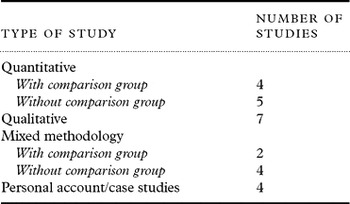
Twenty-six studies, chapters or reports met the inclusion criteria. The majority were from the U.K. (16), with the rest coming from Australia (3), the Netherlands (3), Japan (1), France (1), Ireland (1) and the U.S.A. (1). These had a variety of designs, outlined in Table 1. Where there was no clear design, the most plausible category has been chosen.
Summary of study designs

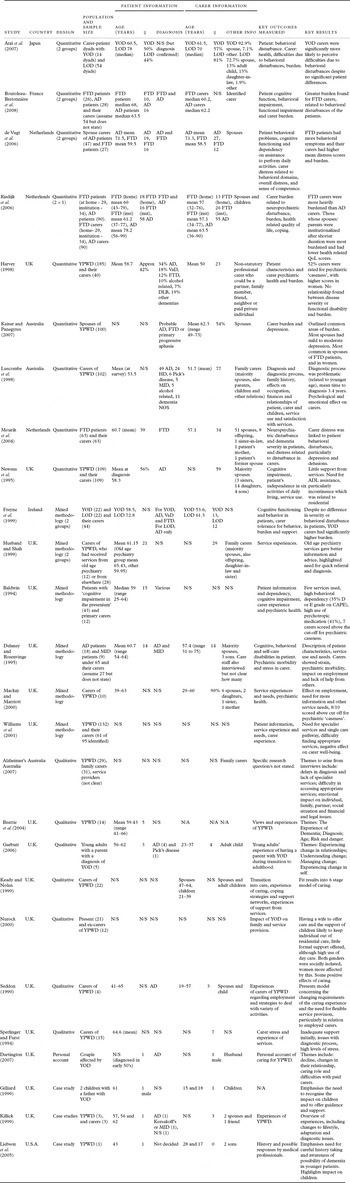
A summary of the studies and their findings is presented in Table 2.
Summary of study findings

♀ = female; N/S = not stated; N/A = not applicable; YOD = young onset dementia; LOD = later onset dementia; AD = Alzheimer's disease; VaD = vascular dementia; FTD = frontotemporal dementia; DLB = dementia with Lewy bodies; HD = Huntington's disease; MID = multi-infarct dementia; YPWD = younger people with dementia; inst = institution; CAPE = Clifton Assessment Procedures for the Elderly.
The studies represent a variety of designs and offer a broad view of the experiences of younger people with dementia and their families (Table 1). Findings have been organized into themes to give an overview of key issues.
General methodological considerations are discussed in the next section, although evaluation of studies was problematic due to the differing methodologies used. Where there are particular limitations or advantages, these will be mentioned.
Impact on the individual
Most of the studies reviewed invited only carers to participate, or included the person with dementia with their carer. Only two studies aimed to speak directly to the younger person with dementia.
Beattie et al. (Reference Beattie, Daker-White, Gilliard and Means2004) emphasized the subjective experience of young onset dementia. Interviewing 14 younger people with dementia, they developed four themes: “the experience of dementia”; “diagnosis”; “age” (in particular, the usefulness of age-appropriate services) and “risk and danger”. They emphasized that the views of the individual with dementia may differ from those of their carers. Limitations in this study include the lack of information about diagnoses and the short duration of interviews; however, it highlights the need to speak to younger people about their experiences with dementia and gives suggestions about how to approach this.
Killick (Reference Killick, Cox and Keady1999) aimed to elucidate the issues in communicating with younger people with dementia. He reported three case studies which raise issues such as lifestyle changes, coping strategies and diagnostic difficulties.
A report created by Alzheimer's Australia (2007) included younger people with dementia in the sample, and outlines many of the key issues they experience, such as: younger people's status as a minority group; the need for a holistic approach and the emotional impact of receiving a diagnosis. This is an exploratory study to map the needs of younger people with dementia in Australia, although weaknesses include unclear methodology particularly in data collection.
The lack of data on the individual experience of younger people with dementia raises the issue of research with those who do not have a carer. For example, a study by Harvey (Reference Harvey1998) identified 185 patients but only 40 carers; Baldwin (Reference Baldwin1994) interviewed 12 carers although 43 patients met the entry criteria; Williams et al. (Reference Williams, Dearden and Cameron2001) identified 132 younger people but interviewed only 61 carers. Other studies (e.g. Freyne et al., Reference Freyne, Kidd, Coen and Lawlor1999; de Vugt et al., Reference de Vugt, Riedijk, Aalten, Tibben, van Swieten and Verhey2006) included only carer-patient dyads. However, those individuals without carers may be the most in need. For example, they may be more likely to be placed in residential care (Newens et al., Reference Newens, Forster and Kay1995; Alzheimer's Australia, 2007).
Diagnostic difficulties
Seven of the studies (Sperlinger and Furst, Reference Sperlinger and Furst1994; Luscombe et al., Reference Luscombe, Brodaty and Freeth1998; Husband and Shah, Reference Husband and Shah1999; Williams et al., Reference Williams, Dearden and Cameron2001; Liebson et al., Reference Liebson, Rauch, Graff and Folstein2005; Alzheimer's Australia, 2007; Dartington, Reference Dartington2007) broached the difficulties in gaining a diagnosis, including long delays to receive a diagnosis, misdiagnoses, being turned away from professionals and lack of communication. Diagnostic problems seem to be exacerbated by diverse initial signs of dementia (Sperlinger and Furst, Reference Sperlinger and Furst1994) and the gradual nature of changes (Liebson et al., Reference Liebson, Rauch, Graff and Folstein2005). Recent research (e.g. Iliffe et al., Reference Iliffe, Wilcock and Haworth2006) has also highlighted the lack of specialist training and resources in primary care settings, which may exacerbate difficulties in diagnosing young onset dementia (Department of Health, 2009).
Impact on the family
General carer outcomes
Seventeen of the studies discuss the impact on the carer, usually the spouse, focusing almost exclusively on negative outcomes. Only Nurock (Reference Nurock2000) reported positive outcomes with 11 of 12 ex-carers reporting higher self-esteem and increased assertiveness.
Eleven studies (Baldwin, Reference Baldwin1994; Sperlinger and Furst, Reference Sperlinger and Furst1994; Delaney and Rosenvinge, Reference Delany and Rosenvinge1995; Harvey, Reference Harvey1998; Keady and Nolan, Reference Keady, Nolan, Cox and Keady1999; Luscombe et al., Reference Luscombe, Brodaty and Freeth1998; Mackay and Marriott, Reference Mackay and Marriott2000; Nurock, Reference Nurock2000; Williams et al., Reference Williams, Dearden and Cameron2001; Alzheimer's Australia, 2007; Kaiser and Panegyres, Reference Kaiser and Panegyres2007) have reported a range of negative outcomes for carers of younger people with dementia. Unfortunately, a variety of measures were used making comparison difficult. The most commonly used measure, the General Health Questionnaire (GHQ) (Goldberg, Reference Goldberg1978) was used by four of the studies (Baldwin, Reference Baldwin1994; Delaney and Rosenvinge, Reference Delany and Rosenvinge1995; Harvey, Reference Harvey1998; Mackay and Marriott, Reference Mackay and Marriott2000), all of which report that 50% or over of their sample scored above the cut-off for psychiatric “caseness”. However, these studies differ in the diagnostic criteria they include, recruitment methods used and definition of carer, so are not directly comparable. Other negative outcomes reported are burden and depression (Harvey, Reference Harvey1998; Kaiser and Panegyres, Reference Kaiser and Panegyres2007), poor emotional well-being (Williams et al., Reference Williams, Dearden and Cameron2001), anxiety (Harvey, Reference Harvey1998), stress (Sperlinger and Furst, Reference Sperlinger and Furst1994; Delaney and Rosenvinge, Reference Delany and Rosenvinge1995) and other psychological effects such as frustration and grief (Luscombe et al., Reference Luscombe, Brodaty and Freeth1998). Three qualitative studies give further insight.
The Alzheimer's Australia (2007) report considers the emotional impact on carers, including feeling “robbed of the future” (p. 40) and the guilt associated with this, having to manage role changes in becoming “like a parent” (p. 41) and changes in their feelings towards the person with dementia, including issues around intimacy and sexuality.
Nurock (Reference Nurock2000) reports on the experiences of 33 present and ex-carers. A key finding was that carers reported poor physical health which tended to be more long-lasting than mental health problems, and reported that their mental health improved after the death of their relative.
Keady and Nolan (Reference Keady, Nolan, Cox and Keady1999) conducted in-depth semi-structured interviews with 22 spouse and adult child carers of younger people with dementia. They placed their results within a “temporal model of care” in order to contextualize them. The authors suggest that younger carers receive little information and emphasize the need for services dedicated to the whole family. However, the use of a predetermined model is questionable, particularly in light of their use of grounded theory methodology.
Dartington's (Reference Dartington2007) personal account of caring for his wife raises further issues including the rapid decline in her functioning and difficulty obtaining a diagnosis but also reflects on her loss of role and his adjustment to their house becoming “an institution”.
The above studies demonstrate the negative out-comes for carers of younger people with dementia but they cannot comment on risk or protective factors which may influence these outcomes. Other studies which have considered these have focused on age and diagnostic factors.
Age of person with dementia and carer outcome
Freyne et al. (Reference Freyne, Kidd, Coen and Lawlor1999) and Arai et al. (Reference Arai, Matsumoto, Ikeda and Arai2007) both compared the clinical characteristics and carer outcomes between younger and older people with dementia in a community sample. Both found that, despite no significant differences in cognitive functioning or behavioral disturbance, there was a significant difference between carers. Carers of younger people with dementia had significantly higher levels of burden (Freyne et al. Reference Freyne, Kidd, Coen and Lawlor1999) and they were also more likely to perceive difficulties due to behavioral problems (Arai et al. Reference Arai, Matsumoto, Ikeda and Arai2007). This difference in burden may be due to carers of younger people with dementia having a longer duration of caring and less support than older carers, or to individual factors influencing carer response (Freyne et al. Reference Freyne, Kidd, Coen and Lawlor1999). However, there are weaknesses within the studies which call into question the causes of these outcomes. Of note, differences in the participants' diagnoses may account for higher burden in carers due to the type of behavioral disturbance rather than the amount.
Symptoms and carer outcome
Four studies considered symptoms related to a diagnosis of frontotemporal dementia. Although they do not relate specifically to the under-65s, and most include over-65s, given the higher prevalence of frontotemporal dementia in younger people these studies raise the question of whether carer outcomes in younger people may be related to particular diagnostic issues.
These studies highlight that individuals with a diagnosis of frontotemporal dementia differ in behavioral symptoms to those with Alzheimer's disease (AD) (Boutoleau-Bretonnière et al., Reference Boutoleau-Bretonnière, Vercelletto, Volteau, Renou and Lamy2008), with disinhibition, apathy and aberrant motor behavior more common in people with a diagnosis of frontotemporal dementia (Mourik et al., Reference Mourik, Rosso, Niermeijer, Duivenvoorden, Swieten and Tibben2004; de Vugt et al., Reference de Vugt, Riedijk, Aalten, Tibben, van Swieten and Verhey2006). Carers of people with frontotemporal dementia were found to have higher burden (Boutoleau-Bretonnière et al., Reference Boutoleau-Bretonnière, Vercelletto, Volteau, Renou and Lamy2008) and distress (de Vugt et al., Reference de Vugt, Riedijk, Aalten, Tibben, van Swieten and Verhey2006), with distress being linked to disinhibition and apathy (de Vugt et al., Reference de Vugt, Riedijk, Aalten, Tibben, van Swieten and Verhey2006). Both de Vugt et al. (Reference de Vugt, Riedijk, Aalten, Tibben, van Swieten and Verhey2006) and Mourik et al. (Reference Mourik, Rosso, Niermeijer, Duivenvoorden, Swieten and Tibben2004) also found a difference in carer responses to particular behavioral symptoms of frontotemporal dementia. For example, while depression was more common in people with AD, where it was observed in those with frontotemporal dementia, their carers found it more distressing (de Vugt et al., Reference de Vugt, Riedijk, Aalten, Tibben, van Swieten and Verhey2006). In addition, Riedjik et al. (Reference Riedijk2006) found that carers of people with frontotemporal dementia were significantly more burdened by the process of caring overall and reported that behavioral symptoms were more intense and were experienced more frequently compared to carers of those with AD. This study did not control for age despite the individuals with frontotemporal dementia and their carers being younger than those with AD. Thus, another explanation for the results is that factors related to age may affect burden in carers which could be unrelated to behavioral symptoms.
While the findings of these studies could indicate that carers of younger people with dementia may be more psychologically affected due to particular symptoms, all four studies note that other factors such as life stage issues, relationship difficulties and availability of support may also be important. It has also been suggested that individual factors in the carer may influence their response to a diagnosis of young onset dementia, and a number of studies have considered the role of gender.
Gender and carer outcome
Five studies consider gender differences in carer outcome. Higher rates of depression (Harvey Reference Harvey1998; Nurock, Reference Nurock2000; Kaiser and Panegyres, Reference Kaiser and Panegyres2007) and anxiety (Harvey, Reference Harvey1998) are reported by female than male carers. Psychological and emotional effects including grief have also been reported by more female than male carers (Luscombe et al., Reference Luscombe, Brodaty and Freeth1998). Although the literature does not suggest why this may be, two studies (Luscombe et al., Reference Luscombe, Brodaty and Freeth1998; Nurock, Reference Nurock2000) do suggest that men are more likely to ask for additional assistance than women.
In the 26 studies reviewed here, a number of further issues related to the diagnosis of dementia have been found to affect carer outcomes. The effect of diagnosis on employment for both the individual and their carer (e.g. Seddon, Reference Seddon, Cox and Keady1999); financial and legal issues (e.g. Mackay and Marriott, 2007); social isolation (e.g. Delaney and Rosenvinge, Reference Delany and Rosenvinge1995) and residential placement (e.g. Newens et al., Reference Newens, Forster and Kay1995; Riedijk et al., Reference Riedijk2006) may all be important. Although causal relationships cannot be established, these issues, both alone and cumulatively, could exacerbate the impact of a diagnosis on an individual and their family.
Impact on children
Despite acknowledging that young onset dementia affects the family as a whole (Roach and Keady, Reference Roach and Keady2008), very few studies have considered the impact of a diagnosis on children. A number of studies included adult children of younger people with dementia as carers, with the youngest age reported as 21 years. Six studies (Delaney and Rosenvinge, Reference Delany and Rosenvinge1995; Newens, Reference Newens, Forster and Kay1995; Husband and Shah, Reference Husband and Shah1999; Keady and Nolan, Reference Keady, Nolan, Cox and Keady1999; Mackay and Marriott, Reference Mackay and Marriott2000; Mourik et al., Reference Mourik, Rosso, Niermeijer, Duivenvoorden, Swieten and Tibben2004) included adult children as carers, but unfortunately did not compare them with spouse carers. In contrast, Riedijk et al. (Reference Riedijk2006) compared level of burden with relationship to patient and found no difference between spouses and adult children, and Mackay and Marriott (Reference Mackay and Marriott2000) noted that, while eight of the ten carers they studied scored above the cut-off for psychiatric “caseness” on the GHQ, higher levels of distress were reported by spouse carers than by others.
Only two studies have aimed to report specifically on the experience of children. In a single case study, Gilliard (Reference Gilliard, Cox and Keady1999) acknowledged the additional challenges for children who become carers and emphasized the different way of working that is necessary with children who are carers, describing a more flexible approach and informing other supportive people (such as teachers) about dementia to help them best support the child. Garbutt (Reference Garbutt2006) developed this in a qualitative study. She interviewed five young adults aged 23–37 years, finding that developmental tasks, such as changes in independence, identity, roles and relationships, are affected.
Five studies (Luscombe et al., Reference Luscombe, Brodaty and Freeth1998; Seddon, Reference Seddon, Cox and Keady1999; Nurock, Reference Nurock2000; Liebson et al., Reference Liebson, Rauch, Graff and Folstein2005; Alzheimer's Australia, 2007) also acknowledge the impact on children. They highlight issues such as the role of children in offering support, the psychological and emotional effect of this and the exclusion of children from services.
General methodological issues
A number of issues should be taken into account concerning the methodologies of these studies. Many of the studies recruit through services, excluding those who may not be in contact with specialist services. Sample sizes are frequently small. Regarding participant information, only Harvey (Reference Harvey1998) reports on black and minority ethnic participants. More pertinently, studies differ in age range and in the stringency of their inclusion criteria regarding diagnoses. Such heterogeneity in groups may affect the comparability of these studies, and factors related to age, symptoms or related issues may have confounded results. Studies also differ in their description of carer details, with 20 studies giving information on the identity of the carer, most commonly a spouse. Six do not comment on the relationship of the carer to the individual with dementia, and three studies seem to include carers who are not family members, despite the relationship to the person with dementia being relevant, particularly if carer-related factors may influence outcomes.
Of the 15 quantitative or mixed methodology studies, a wide variety of measures are used to assess carer outcome, most frequently the GHQ (Goldberg, Reference Goldberg1978) and the Zarit Burden Interview (Zarit et al., Reference Zarit, Orr and Zarit1985). While the studies indicate that carers do experience negative outcomes, due to the variety of measures used, it is difficult to ascertain which are most commonly found or their relevance. Regarding analysis, of the nine quantitative studies included, most use multiple analyses to target the variety of aims in each study. As few specify hypotheses but instead have more exploratory aims, such repeated analyses could increase Type I errors. Further, the multiple questions asked make meaningful comparison difficult. Of the seven qualitative studies, only two (Keady and Nolan, Reference Keady, Nolan, Cox and Keady1999; Garbutt, Reference Garbutt2006) report their analyses. Similarly, of the six mixed methodology studies, only Freyne et al. (Reference Freyne, Kidd, Coen and Lawlor1999) comment on the statistical analysis, although they do not give information about how interviews were analyzed.
Discussion
The studies reviewed here demonstrate the wide ranging impact that a diagnosis of young onset dementia can have on an individual and their family, not only due to symptoms but also to subsequent changes to lifestyle and role.
A number of limitations should be taken into account concerning this review. The variety of study aims and methodologies makes it difficult to pinpoint key issues. While narrative synthesis enabled key themes to be considered and reflected the scope of current research, the subjectivity of such an approach should be noted, and the breadth of the review may have prevented further commonalities being reported. It would seem appropriate that future research should focus on using clear and replicable methodologies to enable more comprehensive analysis. Another limitation of the review is the emphasis on U.K. studies and services. As people with young onset dementia are increasingly being recognized around the world as a group in urgent need of support, a broader review could assist in recognizing areas of good practice. Finally, as the papers were reviewed by a single researcher, the reliability of the review may have been compromised.
The studies of younger people with dementia highlight their subjective experience, but emphasize the lack of research conducted. Killick (Reference Killick, Cox and Keady1999) highlights the need to form relationships with younger people with dementia in order to explore their experiences. This is particularly significant in the light of government directives for service user involvement (Department of Health, 2001) and the suggestion that those without carers may have the most important information about their needs. Two recent reviews (Steeman et al., Reference Steeman, Dierckx de Casterlé, Godderis and Grypdonck2006; de Boer et al., Reference de Boer, Hertogh, Dröes, Riphagen, Jonker and Eefsting2007) describe the coping strategies used by people with dementia, including younger people. Further research with younger people with dementia could increase knowledge and awareness of young onset dementia, an important issue considering the frequency of diagnostic difficulties and stigma in dementia generally (Alzheimer's Society, 2008b). Insight into the lived experience of younger people with dementia could help develop strategies to promote quality of life for them and their families. Further, while the studies reviewed here focus on the outcomes of dementia, there has been an increasing focus on the prevention of dementia, which may be particularly pertinent to the families of younger people with dementia related to HIV/AIDS, traumatic brain injury or alcohol abuse (McMurtray et al., Reference McMurtray, Clark, Christine and Mendez2006).
The review reveals the greater amount of research conducted with carers, with the impact on families – including changes to employment, finances, social circumstances and residence as well as psychological and emotional outcomes. These studies suggest that carers of younger people with dementia do experience greater negative outcomes than carers of older people with dementia. A number of factors were suggested to account for this, in particular, age of the person with dementia and behavioral symptoms as well as individual carer factors (specifically gender). This indicates that particular support may reduce distress and, potentially, prevent residential placement (e.g. Newens et al., Reference Newens, Forster and Kay1995). However, other factors may account for negative outcomes, and a combination of factors may interact to cause greater carer distress. For example, only Freyne et al. (Reference Freyne, Kidd, Coen and Lawlor1999) mention that younger people may have a longer duration of caring. Considering the longer average duration of young onset dementia compared to later onset, lasting on average 3.4 years longer than for older people with dementia (Tindall and Manthorpe, Reference Tindall and Manthorpe1997), the fatigue this may cause could alone account for higher burden in carers of younger people with dementia. Combined with the more rapid progression of early onset dementias (Kaiser and Panegyres, Reference Kaiser and Panegyres2007), this could increase distress over a prolonged period of time.
Attention must turn to how best to support younger people with dementia and their families. A number of studies in this review considered service needs, with commonly raised needs being age-appropriate services, increased support in the home and appropriate respite and out-of-hours services. It is also apparent how little services have moved on since Baldwin (Reference Baldwin1994) and Newens et al. (Reference Newens, Forster and Kay1995) highlighted the need for age-appropriate day care.
It is most important perhaps to consider how to begin to meet identified needs, when the reality may still be far from that (Nurock, Reference Nurock2000). The negative outcomes identified would imply that there is a need for additional support for carers, although this may be as simple as increased information (e.g. Harvey et al., Reference Harvey, Roques, Fox and Rossor1998).
This review also raises a number of questions about the direction of future research. First, should people with dementia in general be differentiated by age or diagnosis? Differentiation by age may be pertinent due to the stated importance of age-appropriate services. However, the different experiences of those with frontotemporal dementia in comparison to AD might indicate that research focusing on such differences, and exploring differences between other diagnoses, may lead to more appropriate management and support. Frequent misdiagnosis (e.g. Mendez, Reference Mendez2006) and the expense of confirming probable diagnoses would be an obstacle. A study comparing people with dementia and their carers both in age and diagnosis might give an indication of whether these may separately impact on the individual and their family, or whether they interact in some way. However, considering the difficulties of service provision for people with dementia in general, such a focus may detract from the more important task of improving services overall.
Secondly, further research is needed concerning the impact of a diagnosis of young onset dementia on the family system. The impact on children is outlined but not considered in depth, despite the obvious implications for the family as a whole, particularly issues around heritability. The dual caring role for spouses who may have young children is not attended to. Further, while some studies (e.g. Luscombe et al., Reference Luscombe, Brodaty and Freeth1998; Mackay and Marriott, Reference Mackay and Marriott2000; Mourik et al., Reference Mourik, Rosso, Niermeijer, Duivenvoorden, Swieten and Tibben2004) include parent carers, no mention is made of the impact on parents of looking after a child with young onset dementia, despite the possibility that they may have also cared for their own spouse.
While the studies reviewed here demonstrate the ways in which a diagnosis of young onset dementia can impact on multiple areas of life for the individual and their family, perhaps what they outline most clearly is how much research is still necessary to establish the unmet needs of this population.
Conflict of interest
None.
Description of authors' roles
E. Svanberg formulated the research questions, designed the research protocol, conducted the literature searches, reviewed the literature and wrote the paper. J. Stott and A. Spector advised on the formulation of the research questions and on the review protocol, offered supervision and edited the paper.
Acknowledgments
The authors would like to thank Chris Barker for offering supervision and guidance throughout the review process.