Introduction
Grasshoppers are important components of grassland systems throughout North America (Whiles & Charlton, Reference Whiles and Charlton2006), as they periodically remove significant amounts of aboveground vegetation during outbreaks (Branson et al., Reference Branson, Joern and Sword2006). Grasshopper population dynamics are driven by a combination of abiotic and biotic factors (Jonas & Joern, Reference Jonas and Joern2007), including the presence of natural enemies, such as predators and parasitoids (Joern & Gaines, Reference Joern, Gaines, Chapman and Joern1990; Belovsky & Joern, Reference Belovsky, Joern, Cappucino and Price1995; Lockwood, Reference Lockwood, Gangwere, Muralirangan and Muralirangan1997). Grasshoppers are host to multiple species of dipteran parasitoids that can sometimes have strong impacts on grasshopper survival (Joern & Gaines, Reference Joern, Gaines, Chapman and Joern1990; Hughes & Grabowski, Reference Hughes and Grabowski2006), but little is known about how grasshopper-parasitoid interactions vary among habitat types. In grassland systems, fire and grazing treatments have strong effects on the biotic and abiotic context by altering habitat variables such as food quality and availability, temperature regime, and enemy assemblages (Arenz & Joern, Reference Arenz, Joern, Samson and Knopf1996; Panzer, Reference Panzer2002; Joern, Reference Joern2004). To predict how grasshopper population dynamics are affected by parasitoids, it is important to understand how grasshopper life-history traits, including fecundity, respond to parasitoid infection and how those responses vary with land use.
Grasshoppers are hosts for multiple parasitoid species that include several families of dipteran larvae. However, the effects of parasitoids on grasshopper fecundity have been examined only for a few grasshopper species from a limited number of environments (Prescott, Reference Prescott1960; Rees, Reference Rees1986; Sanchez & Onsager, Reference Sanchez and Onsager1994). Similarly, reports of parasitoid prevalence (the proportion of hosts infected with parasitoids (Margolis et al., Reference Margolis, Esch, Holmes, Kuris and Schad1982)) vary widely among species and populations (Prescott, Reference Prescott1960; Rees, Reference Rees1973), and it is unclear how parasitoid prevalence may vary with common land use practices such as grazing in grassland systems.
Forecasting grasshopper population dynamics requires consideration of how parasitoids can alter grasshopper life history traits in a range of environments. Here, we report on a three-year study examining fecundity responses to parasitoid infection for nine common grasshopper species at Konza Prairie Biological Station. Experimental grazing and fire treatments at Konza Prairie provide an opportunity to examine how parasitoid prevalence and grasshopper fecundity responses to parasitism vary with habitat type. By examining multiple species and habitat types simultaneously, we can look for patterns in grasshopper relative susceptibility to parasitoid infection, which will eventually facilitate understanding of when and how parasitoids affect grasshopper population dynamics.
Methods
Field site and study organisms
This study was conducted at Konza Prairie Biological Station, a tallgrass prairie near Manhattan, KS, USA; 39°05′N, 96°35′W (for full site description, see Knapp et al., Reference Knapp, Briggs, Hartnett and Collins1998). Bison grazing and prescribed burning treatments applied at the watershed level comprise the long-term management of Konza Prairie (Knapp et al., Reference Knapp, Briggs, Hartnett and Collins1998) creating a mosaic of habitat types that vary in vegetation characteristics and grasshopper species composition (Joern, Reference Joern2004, Reference Joern2005). The Konza bison herd is maintained at approximately 300 individuals with unrestricted access to a 1012 ha portion of the site. Grazed sites have more forbs and more open canopies than ungrazed sites, which are dominated by grasses.
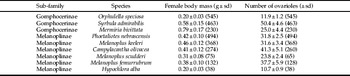
Our study focused on nine common grasshopper species that occur at Konza Prairie: Orphulella speciosa (Scudder), Syrbula admirabilis (Uhler), Phoetaliotes nebrascensis (Thomas), Melanoplus keeleri (Thomas), Campylacantha olivacea (Scudder), M. scudderi (Uhler), M. femurrubrum (DeGeer), Mermiria bivittata (Serville) and Hypochlora alba (Dodge) (Orthoptera: Acrididae). Each of these species is univoltine and overwinters as nymphs, and varies in average body size and phylogeny (table 1).
Basic traits for the nine grasshopper species collected for the study. We used species from two subfamilies, Gomphocerinae and Melanoplinae. Body mass and ovariole number were measured for unparasitized grasshoppers and averaged across all three years of study. N is given in parentheses.

Grasshoppers host a variety of parasitoids from several dipteran families, including Nemestrinidae and Tachinidae (reviewed in Greathead, Reference Greathead1963; Rees, Reference Rees1973; Joern & Gaines, Reference Joern, Gaines, Chapman and Joern1990). Nemestrinid grasshopper parasitoids are univoltine, where adults emerge from the soil in summer to mate and lay eggs. The larvae are dispersed by wind and may survive up to two weeks before finding a late instar or adult grasshopper host. Nemestrinid larvae have a long development period of four instars in grasshopper hosts before emergence (Rees, Reference Rees1973). The large family Tachinidae includes many species that are parasitoids of grasshoppers. Females lay eggs or live larvae, either on vegetation or directly on the grasshopper host. Tachinid larvae complete at least three instars in the grasshopper before emergence (Rees, Reference Rees1973).
Field sampling of grasshoppers and parasitoids
The study took place over three summers (2007–2009). Adult female grasshoppers were collected with sweep nets four times each year, beginning once adults were observed in the field (early August) and ending in early October when grasshoppers began to die off. We attempted to collect grasshoppers during similar dates each year, but grasshoppers from the second sampling event in 2008 were lost.
Grasshoppers were collected from eight watersheds with different grazing and spring prescribed fire treatments to examine if parasitoid prevalence and effects on grasshopper fecundity vary with management. We sampled in two watersheds with each of the following management treatments: bison grazing, annual burns (N1A, N1B); bison grazing, four-year burns (N4B, N4D); ungrazed, annual burns (K1B, 1D); ungrazed, four-year burns (K4B, 4B).
The five most common grasshopper species were sampled more intensively: O. speciosa, S. admirabilis, P. nebrascensis, M. keeleri and C. olivacea (C. olivacea only sampled intensively in 2008–2009). We attempted to collect ten females of each of these species in each watershed every sampling session. This was not always possible due to variation in species composition and abundance among watersheds and years. The remaining four species were less common, and we collected them as they were encountered. Collected grasshoppers were frozen so that reproductive output could be measured (see below: Phipps, Reference Phipps1949; Singh, Reference Singh1958; Sundberg et al., Reference Sundberg, Luong-Skovmand and Whitman2001; Laws & Joern, Reference Laws and Joernin press). During dissection, any internal parasitoids were recorded and identified to family.
Grasshopper density was measured at each watershed before grasshoppers were collected, using the ring count method (Onsager, Reference Onsager1977). We used two transects of 25 rings (0.1 m2) placed 1.5 m apart in each watershed. Rings were slowly approached and the number of grasshoppers in each ring was counted.
Grasshopper fecundity measurements
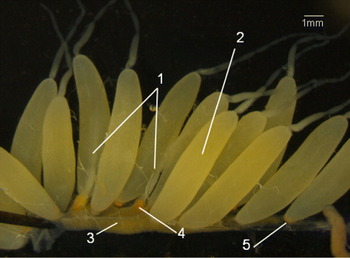
Grasshoppers oviposit eggs in successive pods, which are only produced in the adult stage. Grasshopper reproductive tracts consist of a number of ovarioles that produce the eggs (plate 1). Ovariole number varies by species and determines maximum pod size (Uvarov, Reference Uvarov1966). Mature eggs leave behind a yellow or whitish follicle resorption body (FRB) at the base of the ovariole. Some eggs are resorbed by the female, leaving a distinctive bright orange oocyte resorption body (ORB) at the base of the ovariole. FRBs and ORBs for successive pods stack on top of one another, but begin to break down after about three pods (Sundberg et al., Reference Sundberg, Luong-Skovmand and Whitman2001). By counting FRBs and ORBs, we can measure the number of pods laid by each female, and the number of eggs in each pod. For females that may have produced more than three pods (mainly O. speciosa from later sampling sessions), our method may underestimate fecundity. However, for most individuals, fewer than three pods were observed.
One side of a reproductive tract from Melanoplus keeleri showing (1) non-functional ovarioles, (2) functional ovarioles, (3) oviduct, (4) oocyte resorption bodies and (5) follicle resorption bodies.

In addition to counting FRBs and ORBs, we measured the length and number of eggs currently being formed in the ovarioles, termed functional ovarioles. While the number of eggs produced gives a good measure of past reproduction, the number of functional ovarioles provides a good measure of current reproductive activity (Branson, Reference Branson2003b). Functional ovarioles were weighted by development (number of functional ovarioles×length of functional ovarioles×the mature egg length−1). By weighting ovarioles by size, large functional ovarioles near maturity were given more value than small functional ovarioles just beginning to grow (Laws & Joern, in press).
Hind femur length was measured with calipers for all females before dissection. Hind femur length is a good metric of grasshopper body size (Wall & Begon, Reference Wall and Begon1987; Danner & Joern, Reference Danner and Joern2004; Branson, Reference Branson2008) and is preferable to body mass, which can be confounded by ovariole development (Branson, Reference Branson2008) and parasitoid mass.
Analyses
Measurements of parasitoid prevalence were calculated across all sampling events and refer to prevalence among adult females only, as no males or nymphs were sampled. We used regression analysis to look for patterns between parasitoid prevalence (dependent variable) and grasshopper density (independent variable) among grazed and ungrazed watersheds.
We examined whether the impacts of parasitoid infection on grasshopper fecundity varied with management treatment. All individuals were pooled because sample sizes of parasitized individuals in some management types were low for many species. Comparisons of fecundity between parasitized and unparasitized individuals were only made for sampling events where the grasshoppers were allocating resources to reproduction. For example, M. keeleri and P. nebrascensis typically did not produce any eggs or functional ovarioles before the third sample event each year; so, the first two sampling events were not included in fecundity analyses for these species (Laws & Joern, in press). Because species have different ovariole numbers (and, therefore, different maximum pod sizes), we standardized fecundity among species by calculating the proportion of eggs laid out of the total number of possible eggs (eggs laid per number of ovarioles×number of pods) and the proportion of functional ovarioles out of the total possible (number of functional ovarioles/total number of ovarioles). Proportional values were transformed using an arcsine transformation (Zar, Reference Zar1999). We used a general linear model where management treatment (grazing and burn frequency) and parasitoid (none, Tachinidae, Nemestrinidae) were independent variables and fecundity was a dependent variable.
The effects of parasitoids on individual body size (hind femur length) were examined by comparing body size of parasitized vs unparasitized grasshoppers using a general linear model for each species. Year and parasitism were independent variables, and body size was a dependent variable. Data for each species was pooled within years.
Results
Parasitoid prevalence
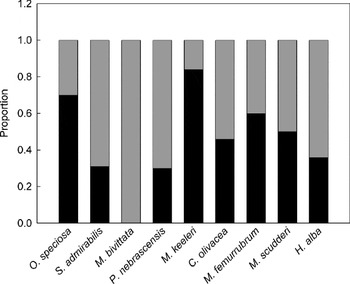
Internal parasitoids infecting grasshoppers were primarily dipterans from the families Nemestrinidae (52%) and Tachinidae (48%). All parasitoids were found in the abdominal cavity. Relative prevalence of the parasitoid types varied among grasshopper species (fig. 1). For example, O. speciosa and M. keeleri were most often parasitized by nemestrinid larvae, while S. admirabilis and P. nebrascensis were most often parasitized by tachinid larvae (fig. 1).
Proportion of infected grasshoppers parasitized by Nemestrinidae (black) and Tachinidae (grey). Only one M. bivittata was found infected with a parasite.

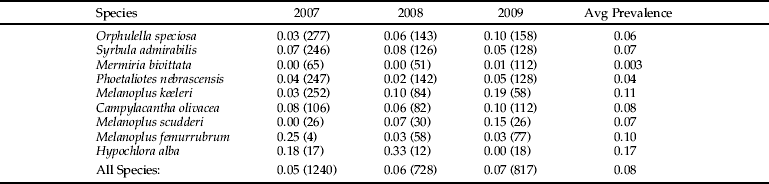
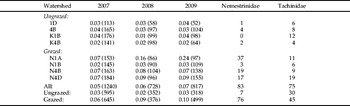
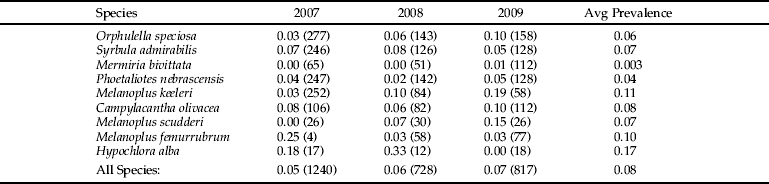
Total parasitoid prevalence (all types) varied among species, watersheds and years (tables 2 and 3). Within years, parasitoid prevalence among species varied from 0% to 33% (pooled across all watersheds) (table 2). Melanoplus keeleri and H. alba typically had the highest parasitoid prevalence (X=0.11 and X=0.17, respectively, averaged across years). In contrast, only a single parasitized M. bivittata was found in all three years (N=234). Parasitoid prevalence for most species was highest in 2009 (table 2).
Dipteran parasitoid prevalence (proportion of individuals with parasitoids) is given for each species in each of the study years. Species are pooled across all watersheds. The number in parentheses indicates the total number of individuals dissected.
Dipteran parasitoid prevalence for each watershed is given for each year of the study. The total number of each type of parasitoid found in each watershed is also given. Data is pooled for all species at a watershed. The number in parentheses indicates the total number of grasshoppers dissected.

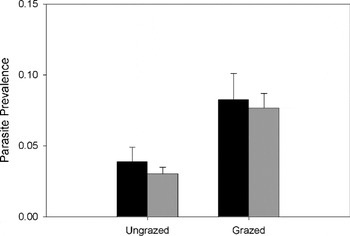
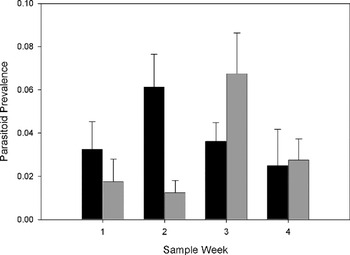
Parasitoid prevalence varied significantly with grazing treatment (F1,77=11.0, P=0.001), but not with burn interval (F1,77=0.16, P=0.69), or the interaction term (F1,77=0.01, P=0.99; fig. 2). In each year, ∼70–80% of infected individuals were found in grazed watersheds (table 3). The exception to this was watershed N1B, which had low parasitoid prevalence more similar to ungrazed than to grazed watersheds (table 3). Tachinids were generally more common than nemestrinids in ungrazed sites and in N1B. Nemestrinids were typically more common in grazed than in ungrazed watersheds (table 3). Within years, nemestrinids were more common than tachinids in the early samples and began to decline by the third sample week in late September when Tachinids began to increase (fig. 3). Besides a single grasshopper infected with one tachinid and one nemestrinid, superparasitism was only observed among Tachinidae and was more common in grazed (N=20) vs ungrazed (N=7) watersheds.
Average parasitoid prevalence (the proportion of grasshoppers infected with parasitoids) is plotted against management treatment for the four-year and one-year burn treatments. Bars are standard error (▪, annual burns;  , 4-yr burns).

Average parasitoid prevalence (±SE) of Nemestrinidae and Tachinidae is plotted against sample weeks. Parasitoid prevalence is measured as the proportion of grasshoppers infected with parasitoids. Bars are standard error (▪, Nemestrinidae; , Tachinidae).

During the study, grasshopper density among watersheds ranged from 1 to 12 m−2. However, there was no significant relationship between parasitoid prevalence and grasshopper density for either grazed (r2=0.001, P=0.88) or ungrazed (r2=0.005, P=0.71) watersheds.
Effects of parasitoid infection on individual grasshopper performance
Although there are reports that grasshopper parasitoids feed on the host's reproductive tissues (Rees, Reference Rees1973), we rarely observed this. For the vast majority of parasitized grasshoppers, the reproductive tracts were intact and in good condition.
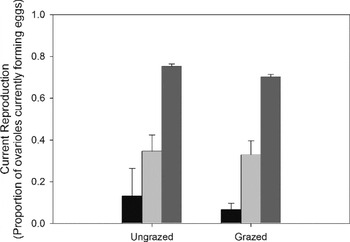
Observed grasshopper body size and ovariole number are given in table 1. As expected, parasitoid presence per family significantly affected both current (F4,1798=16.08, P<0.01) and past (F4,1798=7.55, P<0.01) fecundity. Management treatment had no effect on past fecundity (grazing: F1,1798=0.29, P=0.59; fire: F1,1798=0.76, P=0.13). However, current fecundity was significantly affected by grazing treatment (F1,1798=8.81, P=0.003) but not by fire treatment (F1,1798=1.51, P=0.22). Parasitized grasshoppers had fewer functional ovarioles in grazed watersheds compared to ungrazed watersheds (fig. 4).
Current reproduction is plotted against grazing treatment for parasitized and unparasitized individuals. Individuals are pooled across species, so current reproduction is plotted as the proportion of functional ovarioles out of the total number of ovarioles. This is done to standardize comparisons among species with different ovariole number (see text). Bars are standard error (▪, Nemestrinidae; , Tachinidae;  , no parasites).

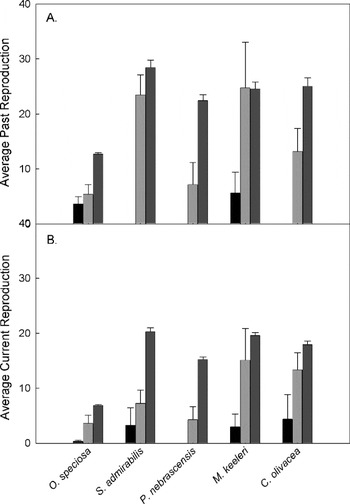
Reductions in individual fecundity with parasitism varied widely from 0% to 100%. Reductions in current reproduction were typically of larger magnitude than reductions in past reproduction (fig. 5). Parasitoid identity was important to determining the strength of parasitoid effects on fecundity in many species. Nemestrinids typically had much stronger impact on grasshopper fecundity than tachinids (fig. 5). In four species (S. admirabilis, P. nebrascensis, C. olivacea, M. femurrubrum) no individuals produced eggs when infected with nemestrinids, but these species did produce eggs when infected with tachinids (fig. 5a). Similarly, all species except H. alba produced fewer functional ovarioles (or none) when infected with nemestrinids than when infected with tachinids (fig. 5b). The number of tachinid larvae infecting a host had no significant effects on either past (R2=0.001, P=0.82) or current (R2=0.03, P=0.14) fecundity among individuals infected with tachinids.
(a) Average past reproduction and (b) average current reproduction is given for unparasitized individuals and for individuals infected with Nemestrinidae and Tachinidae for each of the five most common species. No individuals of S. admirabilis, P. nebrascensis, and C. olivacea parasitized by Nemestrinidae produced eggs. Phoetaliotes nebrascensis had no current reproduction when parasitized by Nemestrinidae. Bars are standard error (▪, Nemestrinidae; , Tachinidae; , Unparasitized).

Grasshopper body size (hind femur length) varied significantly among years for M. keeleri (F2,368=15.8, P<0.01), C. olivacea (F2,257=12.5, P<0.01), O. speciosa (F2,544=20.3, P<0.01) and P. nebrascensis (F2,455=6.2, P<0.01). However, parasitoid infection had no effect on grasshopper body size in any species except O. speciosa and M. keeleri (F1,544=11.2, P<0.01; F1,368=15.8, P<0.01), which were slightly larger when parasitized.
Discussion
Parasitoid prevalence
We observed variation in parasitoid prevalence and in the relative prevalence of tachinid vs nemestrinid parasitoids among nine grasshopper species. This variation may indicate differences in host preferences by the two parasitoid families, and/or differences in susceptibility to parasitoid infection among the grasshopper species. Parasitoid prevalence for most species was highest in 2009 when grasshopper densities were ∼40% lower than in 2008. If parasitoid densities remained relatively constant across the three years of the study, increased parasitoid prevalence in 2009 may be due to a smaller pool of hosts. However, within years, we observed no relationship between grasshopper density and parasitoid prevalence. Further data is needed to determine the relationship between grasshopper density and parasitoid prevalence among years.
In general, parasitoid prevalence was higher in grazed watersheds than ungrazed watersheds, especially for nemestrinids. At Konza Prairie, grazed watersheds differ from ungrazed watersheds in that they have a larger proportion of forbs and a more open canopy (Joern, Reference Joern2004, Reference Joern2005). The increased forb availability may provide nectar resources for adults of some dipteran parasitoids, including nemestrinids. Nemestrinid larvae disperse by wind (Rees, Reference Rees1973), so a more open canopy may facilitate larvae dispersal and location of hosts, which largely occurs by chance. Bison grazed watersheds at Konza Prairie typically have higher grasshopper densities and higher grasshopper diversity than ungrazed watersheds (Joern, Reference Joern2004, Reference Joern2005), which may also facilitate parasitoid prevalence in grazed sites.
Finally, we found that phenology of nemestrinids and tachinids differed. Nemestrinids were commonly encountered in grasshopper hosts earlier in the summer than tachinids, and started to decline in mid- to late September as tachinids numbers started to increase. This may be an adaptation to reduce competition between tachinid and nemestrinid parasitoids in hosts (May & Hassell, Reference May and Hassell1981; Hackett-Jones et al., Reference Hackett-Jones, Cobbold and White2009). During the study, we only observed one grasshopper parasitized by both dipteran families.
Effects of parasitism, grazing and burn interval on grasshopper body size
Parasitized females of O. speciosa and M. keeleri were slightly larger than unparasitized females. One hypothesis may be that within host species, parasitoids selectively choose larger hosts, thus providing more resources to the parasitoid (Danyk et al., Reference Danyk, Johnson and Mackauer2000). In contrast, parasitoid infection did not affect grasshopper body size for the remaining seven species. This suggests that these grasshoppers are either mainly infected during the adult stage after growth has taken place (Miura & Hsak, Reference Miura and Hsak2007) or that parasitoids do not affect grasshopper growth even if grasshoppers are parasitized as nymphs. This might occur if dipteran parasitoids initially grow slowly and use few resources after infection. For example, Caron et al. (Reference Caron, Janmaat, Ericsson and Myers2008) found that tachinid parasitoids infecting lepidopterans initially grew slowly until the host reached a specific developmental stage, possibly as an adaptation to avoid host immune responses.
Effects on grasshopper fecundity
We observed variable responses of grasshopper fecundity to parasitoid infection. Nemestrinids typically had strong negative effects on grasshopper fecundity. Responses to tachinids were less severe and more variable among species. This was observed despite the tendency for superparasitism among tachinids but not nemestrinids.
The observed reductions in fecundity are consistent with other studies examining grasshopper fecundity responses to parasite and parasitoid infection. Laws (Reference Laws2009) found that fecundity in M. dawsoni infected with mermithid nematodes was reduced by 40% (eggs laid) and 48% (functional ovarioles), but the strength of the effect depended on grasshopper density. Branson (Reference Branson2003a) reported reductions in fecundity of 39% and 44% for M. sanguinipes (Fabricius) and Ageneotettix deorum (Scudder) (Orthoptera: Acrididae), respectively, in response to ectoparasitic mites. Rees (Reference Rees1986) found that dipteran parasitoids reduced the number of pods laid, but not the number of eggs per pod in Melanoplus sanguinipes. Prescott (Reference Prescott1960) observed reduced fecundity with nemestrinid infection in the grasshopper species M. bivittatus (Say) and M. femurrubrum (DeGeer) (Orthoptera: Acrididae) and also found fewer egg pods in the soil where grasshopper populations were heavily parasitized.
Parasitoid effects on past reproduction did not vary with grazing treatment or burn interval. However, current reproduction of parasitized grasshoppers was significantly lower in grazed watersheds compared to ungrazed watersheds. This is mainly due to a stronger effect of nemestrinid parasitoids in grazed compared to ungrazed watersheds. This effect of grazing treatment is somewhat surprising, as fecundity of uninfected grasshoppers at Konza Prairie showed little response to management treatment, either grazing or burn interval, during the study (Laws & Joern, in press). Parasitoids generally had stronger effects on current fecundity than on past fecundity, so it may be that habitat effects on grasshopper fecundity and host-parasitoid interactions become more important as the parasitoid grows and removes more nutrients from the host.
Reductions in host fecundity with parasitoid infection may be due to trade-offs between reproduction and immune responses (Kraaijeveld et al., Reference Kraaijeveld, Ferrari and Godfray2002; Gwynn et al., Reference Gwynn, Callaghan, Gorham, Walters and Fellowes2005). Reductions in fecundity of infected hosts may also be caused by reduced resource acquisition by parasitized hosts as a consequence of altered feeding or by resource competition between host and parasitoid (Hurd, Reference Hurd2001). We believe that this is the most likely mechanism acting in our system. First, effects of parasitoids were generally stronger on current reproductive effort than on past fecundity. This is expected if resource competition intensified over time as the parasitoids grow and require more resources. Sanchez & Onsager (Reference Sanchez and Onsager1994) similarly found that fecundity in M. sanguinipes was more strongly reduced in females infected with later instar dipteran parasitoids than earlier instar parasitoids, suggesting that the effect of parasitoids increases over time as the parasitoids' resource demands grow. Interactions between the grasshopper M. sanguinipes and the parasitoid Blaesoxipha atlanis (Aldrich) (Diptera: Sarcophagidae) are most likely driven by resource competition (Danyk et al., Reference Danyk, Johnson and Mackauer2000, Reference Danyk, Mackauer and Johnson2005), as parasitized grasshoppers fed less than unparasitized grasshoppers (Danyk et al., Reference Danyk, Mackauer and Johnson2005). Finally, density dependent effects of parasites, including nematodes (Laws, Reference Laws2009) and ectoparasitic mites (Branson, Reference Branson2003a), on grasshopper fecundity suggest that resource availability determines the magnitude of parasite effects on grasshopper performance. Similar density dependent responses may be expected in response to parasitoid infection.
We observed decreases in individual fecundity with parasitoid infection. However, the effects of parasitoids on host fecundity at the population level will depend on several factors, including parasitoid prevalence and parasitoid community composition (both of which are affected by grazing), as grasshoppers responded differently to the two parasitoid families. The phenology of parasitoid infection may also be important to determining parasitoid effects on population level fecundity. We observed that many parasitized individuals were able to successfully produce egg pods, either before being parasitized or in the early stages of infection; and parasitoids had stronger effects on current reproduction then on past reproduction. Therefore, parasitoid effects on population level fecundity should be stronger if parasitoids are common earlier in the season rather than later. Fourth, effects of parasitoids on grasshopper populations may also depend on whether pods from parasitized females are less likely to hatch successfully than pods from unparasitized females. Data on this are limited. However, in a laboratory experiment with dipteran parasitoids, Rees (Reference Rees1986) found that egg hatching success did not differ for pods from parasitized vs unparasitized M. sanguinipes. Finally, the effects of parasitoids on population recruitment will also depend on whether grasshopper populations are limited by the number of eggs produced in the population. If grasshoppers are not limited by egg production, but by other factors such as survival or predation, then even moderate reductions in population level fecundity resulting from parasitoid infection may be unimportant to population recruitment, especially when parasitoid prevalence is low.
Grasshopper fecundity at Konza Prairie is similar among watersheds with different grazing and burning management treatments, and population level fecundity (as opposed to per capita fecundity) is likely strongly affected by population density (Laws & Joern, in press). Therefore, in most years, the most important effects of parasitoids on population level fecundity may be indirect, through reductions in grasshopper survival and population size.
Our data show that grasshopper fecundity responses to parasitoids can vary widely among species and habitat types. Grasshopper species varied in how strongly parasitoid infection reduced individual fecundity and in their responses to the two parasitoid families. These interactions were mediated by management type. Bison grazing had important effects on host-parasitoid interactions by influencing parasitoid prevalence, parasitoid community composition and by influencing the magnitude of effects of parasitoids on grasshopper fecundity. Understanding how host performance responses to parasitoid infection vary with land use and over time is an important step to quantifying how parasitoids can influence host population dynamics.
Acknowledgements
S. Parsons assisted with parasitoid identification. E. Welti, E. Laws, S. Bailey, B. Caulderon, K. Baker, A. Rippe, D. Mick and J. Taylor assisted with data collection and processing. This manuscript was improved by thoughtful feedback from two anonymous reviewers. Funding was provided by the NSF Kansas EPSCoR Ecological Forecasting Consortium, the Kansas State University Institute of Grassland Studies and the Kansas State University Division of Biology. The Konza Prairie is owned by the Nature Conservancy and managed by the Kansas State University Division of Biology.