Introduction
Sleep disturbances in older people have been implicated in more frequent and longer daytime napping (Monk et al., Reference Monk, Buysse, Carrier, Billy and Rose2001), a higher fragmentation of the sleep-wake cycle (Huang et al., Reference Huang, Liu, Wang, Van Someren, Xu and Zhou2002), nocturnal waking and waking too early (Dijk et al., Reference Dijk, Duffy and Czeisler2001; Yoon et al., Reference Yoon, Kripke, Youngstedt and Elliott2003), and difficulty maintaining sleep (Duffy et al., Reference Duffy, Dijk, Klerman and Czeisler1998). Various individual factors are currently considered to determine sleep patterns in older people, including age and sociodemographic, mental health, and lifestyle factors (Luik et al., Reference Luik, Zuurbier, Hofman, Van Someren and Tiemeier2013). One such factor, the circadian motor activity pattern, has been widely examined in biological clock research performed in older people with dementia (Swaab et al., Reference Swaab, Van Someren, Zhou and Hofman1996; Van Someren et al., Reference Van Someren, Kessler, Mirmiran and Swaab1997; Van Someren et al., Reference Van Someren, Swaab, Colenda, Cohen, McCall and Rosenquist1999; Hofman et al., Reference Hofman2011), and changes in circadian motor activity patterns can document the circadian rhythm's stability (Interdaily Stability (IS)), fragmentation (Intradaily Variability (IV)), and relative amplitude (RA) of the rest-active cycle as determined using actigraph data for 7 to 21 days (Van Someren et al., Reference Van Someren, Kessler, Mirmiran and Swaab1997; Van Someren and Riemersma-Van Der Lek Reference Van Someren and Riemersma-Van Der Lek2007). In particular, a less stable rhythm and a more fragmented rhythm have been reported as specific indicators for older people with dementia (Van Someren et al., Reference Van Someren1996; Van Someren et al., Reference Van Someren, Kessler, Mirmiran and Swaab1997; Oosterman et al., Reference Oosterman, van Someren, Vogels, Van Harten and Scherder2009).
In addition, these circadian motor activity patterns have been shown to change according to light exposure (Wever, Reference Wever1989; Honma et al., Reference Honma, Honma, Nakamura, Sasaki, Endo and Takahashi1995), physical activity, and social activity within a community (Aschoff et al., Reference Aschoff, Fatranská, Giedke, Doerr, Stamm and Wisser1971; Ehlers et al., Reference Ehlers, Frank and Kupfer1988). The circadian patterns in older people are known to be affected by community living; a commonly observed environmental effect on the circadian pattern is the absence of a boundary rhythm between day and night in nursing-home residents with dementia (Motohashi et al., Reference Motohashi, Maeda, Wakamatsu, Higuchi and Yuasa2000), thus lending credibility to the view that sleep and physical activity patterns in older people with or without dementia are influenced by placement in a nursing home (Ersser et al., Reference Ersser, Wiles, Taylor, Wade, Walsh and Bentley1999; Cooke and Ancoli-Israel, Reference Cooke and Ancoli-Israel2011; Anderiesen et al., Reference Anderiesen, Scherder, Goossens and Sonneveld2014; Brown et al., Reference Brown, Westbury and Schuz2015). So far, the available information is sufficient to support a relationship between sleep disturbances in older adults with dementia and living placement, whereas the relationship between circadian motor activity patterns in older people with dementia and living within a community have not been well documented. Because the biological clock of the brain changes with ageing (Swaab et al., Reference Swaab, Van Someren, Zhou and Hofman1996), the potential effect of circadian patterns in older people with or without dementia cannot be estimated without further investigation, taking different living placements into consideration. Therefore, we hypothesized that community living and the presence of dementia would have characteristic effects on the sleep/awake status and the circadian motor activity patterns among older nursing-home residents with or without dementia and older community-dwelling people without dementia.
The objective of the present study was to clarify the effects of community living and dementia on the sleep/awake status and circadian motor activity patterns in older people. To examine these effects, a 3-arm design was applied in the present study, comparing the sleep/awake status and the circadian motor activity patterns among older nursing-home residents with or without dementia and older community-dwelling people without dementia. Furthermore, we were interested in examining the relationship between the sleep/awake status and the demographic status of cognition and functional capacity, as well as the circadian motor activity patterns, in each group.
Methods
Participants
Invitation letters were sent to nursing homes and seniors clubs in Akita prefecture. Four nursing homes and three seniors clubs agreed to participate in the present study. Participants who were over 75 years of age, which reflects the majority (90.8%) of nursing-home residents in Japan (MHLA, 2014), were selected. Nursing-home residents and community-dwelling people belonging to seniors clubs who had been hospitalized or who had used benzodiazepine for sleep disturbances within one month of the study period were excluded, since adaptation to a different living environment and sleep medication can influence sleep and circadian activity patterns. Participants with substance-related disorders or mental retardation were also excluded. Informed consent was obtained from each participant and each facility director.
After agreement was obtained, the Barthel index (BI) and Clinical Dementia Rating (CDR) (Hughes et al., Reference Hughes, Berg, Danziger, Coben and Martin1982) of the participants were assessed by staff members at each nursing facility. The dementia diagnoses were also assessed by a trained medical doctor using the residents’ medical records and the Structured Clinical Interview for Diagnostic and Statistical Manual of Mental Disorders, Fifth Edition (Dilip et al., Reference Dilip, Jeffrey, David and Roger2013); patients with a CDR score of more than 1.0 (range, 0–3: without dementia = 0, possible = 0.5, mild = 1.0, moderate = 2.0, severe = 3.0) were regarded as having dementia (Hughes et al., Reference Hughes, Berg, Danziger, Coben and Martin1982; Paavilainen et al., Reference Paavilainen2005). The demographic details of the community-dwelling people were collected by trained rehabilitative staff members. All the participants were asked to wear a sleep-monitoring actigraph device on his or her non-dominant wrist for 7 days (168 hours) without removal (e.g. during showering, etc.). For the nursing-home residents, the management of the actigraph's use was performed by staff members at each facility. The present study was approved by the ethics committee of the Department of Health Sciences, Akita University (approval No. 1257) and was performed in accordance with the Declaration of Helsinki II.
Measurement
Sleep-wake activity was recorded and stored at one-minute intervals using an actigraph (Actiwatch 2; Philips Respironics Inc., USA). The raw data collected by the actigraph was then analyzed using Actiware System, version 6.08 (Philips Respironics Inc., USA), and the sleep/awake status throughout the night was determined (i.e. total sleep time, sleep latency, sleep efficiency, and awake time/awaking frequency).
The circadian motor activity patterns (Van Someren et al., Reference Van Someren, Swaab, Colenda, Cohen, McCall and Rosenquist1999) were also examined using all the data obtained during the 168 hours study period. The circadian parameters consisted of the IS, the IV, and the RA, which together characterized the rest-active cycle.
The IS quantifies the invariability from day to day, as calculated using the following formula:
 $$\begin{equation*}
\ {\rm{IS}} = \frac{{{\rm{n}}\mathop \sum \nolimits_{h = 1}^p {{\left( {{{\bar{x}}_h} - \bar{x}} \right)}^2}}}{{p\mathop \sum \nolimits_{i = 1}^n {{\left( {{x_i} - \bar{x}} \right)}^2}}}.
\end{equation*}$$
The IV measures the fragmentation of the rhythm, as calculated using the following formula:
 $$\begin{equation*}
{\rm{IV}} = \frac{{{\rm{n}}\mathop \sum \nolimits_{i = 2}^n {{\left( {{x_i} - {x_{i - 1}}} \right)}^2}}}{{\left( {n - 1} \right)\mathop \sum \nolimits_{i = 1}^n {{\left( {{x_i} - \bar{x}} \right)}^2}}},
\end{equation*}$$
where n was the total number of data, p was the number of data entries per day (in this study, 24),
 ${\bar{x}_h}$
was the hourly mean,
 $\bar{x}$
was the mean of all the data, and xi
was the individual data point. The IS varied between zero for Gaussian noise, which consisted of normal distribution noise, and one for perfect IS. The IV also varied between zero for a perfect sine wave and two for Gaussian noise.
The RA of the day or night activity was calculated from the ratio of the most active 10-hour period (M10) to the least active 5-hour period (L5) across an average 24-hour profile, as follows:
 $$\begin{equation*}
{\rm{RA}} = \frac{{M10 - L5}}{{M10 + L5}}.
\end{equation*}$$
In addition, daily activity counts were conducted from the averaged 24-hour profiles.
Statistical analysis
Age, CDR, and BI were compared using an analysis of variance for repeated measures (rANOVAs), while gender was compared using a χ2 test. As the sleep and circadian measurements, except for the RA and daily activity counts, were normally distributed according to the Kolmogorov–Smirnov test, parametric tests were applied. A non-parametric test was applied for the RA values and the daily activity counts. The statistical analysis of the sleep measurements and circadian motor activity parameters (IS and IV) was conducted using rANOVAs with the Tukey's honestly significant difference test as a post-hoc test. The Kruskal–Wallis test was applied to compare the median of the RA and the daily activity counts among the groups using the Steel–Dwass test for post-hoc tests. Pearson's or Spearman's correlation were also applied to analyze the relationship between the sleep/awake status and the demographic data or circadian motor activity parameters. SPSS Version 21.0 for Windows (SPSS Inc., Chicago, IL) was used for the analysis, and the level of significance was set at p = 0.05.
Results
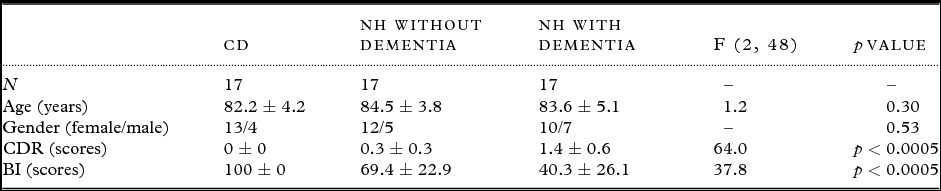
In total, 125 older people consented to participate in the present study, consisting of 64 community-dwelling people and 61 nursing-home residents. Fifty-one participants, consisting of 17 community-dwelling people and 34 nursing-home residents, satisfied the inclusion criteria for the present study: an age of over 75 years, continued wearing of the device during the recording period without its removal, and no use of benzodiazepine for sleep disturbances. Half of the nursing-home participants (50%) had a documented diagnosis of dementia. The age and gender of the participants were not significantly different among the groups, as shown in Table 1.
Demographics of participants (mean ± SD)

CD: older community-dwelling people without dementia.
NH without Dementia: older nursing-home residents without dementia.
NH with Dementia: older nursing-home residents with dementia.
CDR: Clinical Dementia Rating, range, 0–3: without dementia = 0, possible = 0.5, Mild =1, Moderate = 2, Severe = 3.
BI: Barthel Index, the score ranges from 0 to 100.
Age, CDR, and BI showed the p value of the repeated-measurement ANOVA among groups.
The dementia group consists of 10 older people with Alzheimer's dementia and seven older people with Vascular's dementia.
Gender showed the p value of the χ2 test.
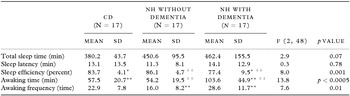
Table 2 shows the sleep measurements. Sleep efficiency (F (2, 48) = 8.0, p = 0.001), awake time (F (2, 48) = 13.8, p < 0.0005) and awaking frequency (F (2, 48) = 7.6, p = 0.01) during the night varied significantly among older community-dwelling people without dementia and older nursing-home residents with or without dementia. According to a multiple comparison with the Tukey's honestly significant difference test, older nursing-home residents with dementia had significantly lower rates of sleep efficiency and a longer awake time during the night than the other groups. The awaking frequency during the night in older nursing-home residents with dementia was significantly higher than that in the nursing-home residents without dementia.
Sleep/awake status throughout the night among groups

*p < 0.05, **p < 0.01; + p < 0.05, ++ p < 0.01; Tukey's honestly significant difference test.
CD: older community-dwelling people without dementia.
NH without Dementia: older nursing-home residents without dementia.
NH with Dementia: older nursing-home residents with dementia.
SD: Standard deviation.
Table 2 showed F statistic and p value of the repeated-measurement ANOVA among groups.
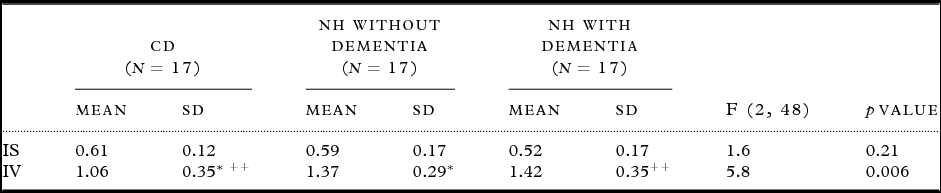
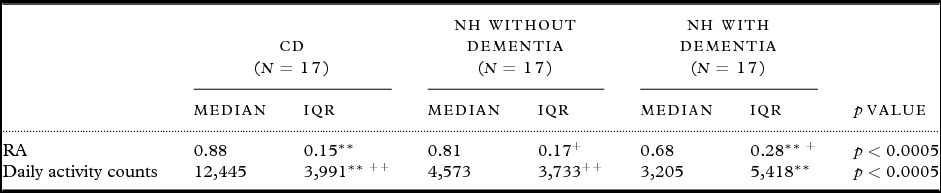
Tables 3 and 4 list the circadian parameters. The IV differed significantly among the groups (F (2, 48) = 5.8, p = 0.006). Older community-dwelling people without dementia had significantly lower IV values than nursing-home residents with or without dementia according to a multiple comparison with the Tukey's honestly significant difference test. In addition, the RA (p < 0.0005) and daily activity counts (p < 0.0005) were significantly different among the groups according to a Kruskal–Wallis test as a nonparametric ANOVA. According to a nonparametric multiple comparison using the Steel–Dwass test, nursing-home residents with dementia had significantly lower RA values than the other groups, and older community-dwelling people had higher daily activity counts than nursing-home residents with or without dementia.
Circadian parameters (IS and IV) among groups

*p < 0.05; + p < 0.05; Tukey's honestly significant difference test.
CD: older community-dwelling people without dementia.
NH without Dementia: older nursing-home residents without dementia.
NH with Dementia: older nursing-home residents with dementia.
SD: Standard deviation.
IS: interdaily stability, IV: intradaily variability.
Table 3 showed F statistic and p value of the repeated-measurement ANOVA among groups.
Circadian parameter (RA) and daily activity counts among groups

*p < 0.05, **p < 0.01; + p < 0.05, ++ p < 0.01; Steel–Dwass test.
CD: older community-dwelling people without dementia.
NH without Dementia: older nursing-home residents without dementia.
NH with Dementia: older nursing-home residents with dementia.
IQR: Inter quartile range.
RA: relative amplitude.
Table 4 showed p value of Kruskal–Wallis test among groups.
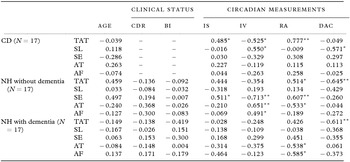
Correlation analyses for age, clinical status, and circadian measurements as dependent variables for the sleep/awake status showed significant results for some circadian parameters in each group, as shown in Table 5.
Relationships between sleep/awake status throughout the night and clinical status or circadian motor activity patterns in each group

Statistics represent Pearson r correlations for Age, Clinical status, Sleep/awake status and IS & IV of Circadian parameters.
Statistics represent Spearman r correlations for RA & DAC of Circadian parameters.
CD: older community-dwelling people without dementia.
NH without Dementia: older nursing-home residents without dementia.
NH with Dementia: older nursing-home residents with dementia.
CDR: clinical dementia rating, BI: barthel index.
TST: Total sleep time, SL: sleep latency, SE: sleep efficiency, AT: awake time, AF: awaking frequency.
IS: interdaily stability, IV: intradaily variability, RA: relative amplitude, DAC: daily activity counts.
*p < 0.05, **p < 0.01.
Discussion
The aim of this study was to respectively clarify the effects of community living and dementia on the sleep/awake status and circadian motor activity patterns among older nursing-home residents with or without dementia and older community-dwelling people without dementia. Our findings indicate that older nursing-home residents with dementia had significantly lower rates of sleep efficiency and longer awake times during the night than the other groups, and the awaking frequency during the night of older nursing-home residents with dementia was significantly higher than that in nursing-home residents without dementia. Older nursing-home residents with or without dementia also had a more fragmented rhythm than community-dwelling people without dementia. In addition, the RA of the rest-active cycle in older nursing-home residents with dementia was significantly lower than that in the other groups, and the daily activity counts in nursing-home residents with or without dementia were significantly lower than those in older community-dwelling people. According to correlation analyses, the sleep/awake status during the night was significantly associated with several circadian motor activity patterns in older people with or without dementia.
Our results concerning sleep at night concur with Ancoli-Israel's report (Reference Ancoli-Israel2009) that older adults sleep for about 7 hour a night. However, our findings for sleep efficiency and awake time in nursing-home residents with dementia do not agree with those reported by Brown et al. (Reference Brown, Westbury and Schuz2015), with a lower rate of sleep efficiency under the 85% cut-off value (Lacks and Morin, Reference Lacks and Morin1992) and a longer awake time as well as a higher awaking frequency during the night. These results suggest that older people in the present study achieved a sufficient amount of sleep, but that the sleep quality was reduced and that the nursing-home residents with dementia, in particular, had an insufficient sleep efficiency.
Several possible explanations can account for the fact that the circadian motor activity patterns are interrupted in nursing-home residents with or without dementia. A less stable rhythm and a more fragmented rhythm have been widely reported as specific indicators for older people with dementia (Van Someren et al., Reference Van Someren1996; Van Someren et al., Reference Van Someren, Kessler, Mirmiran and Swaab1997; Oosterman et al., Reference Oosterman, van Someren, Vogels, Van Harten and Scherder2009). The current results provided clear evidence supporting this finding, resulting in low IS values and high IV values among nursing-home residents with dementia. In the current study, however, the IV of nursing-home residents without dementia was similar to that of the residents with dementia. Although only a few reports support this finding, a difference in circadian activity rhythms has been reported between nursing-home residents with or without dementia, including a lower daytime activity and a higher nocturnal activity compared with residents without dementia (Paavilainen et al., Reference Paavilainen2005). The report by Paavilainen et al. (Reference Paavilainen2005) may support the low rates of RA and insufficient daily activity counts in nursing-home residents. The results of the present study support these findings, which showed lower RA values in nursing-home residents with dementia than in the other groups and lower daily activity counts in older nursing-home residents with or without dementia, compared with those in older community-dwelling people without dementia. Our findings show that circadian motor activity disturbances in older people are not only affected by the presence of dementia, but also by community living.
In view of the relationship between sleep and the clinical status of older people with dementia, our results do not agree with those of Brown et al. (Reference Brown, Westbury and Schuz2015), who reported that night-sleep time is negatively associated with clinical symptoms such as agitation in nursing-home residents with dementia. Agitation assessments were not included in the current data used to determine the CDR. However, several circadian motor activity patterns were significantly associated with the sleep/awake status throughout the night in each older group. The present results are in better accordance with the finding that correlations between circadian activity parameters and the quality of sleep are weak but statistically significant (Paavilaien et al., Reference Paavilainen2005). Therefore, these findings suggest that for older people with or without dementia, the sleep/awake status throughout the night is associated with circadian motor activity patterns, regardless of their community living status.
Several limitations of our study should be mentioned. The statistical power of this study was limited because of the relatively small number of participants (n = 51). The dementia classification might also be a potential weakness in the present study, since the circadian rhythm patterns of older people with Alzheimer disease differ from those with other types of dementia (Harper et al., Reference Harper2001). Medications for various diseases that are commonly used by older adults should also be considered in future research, including sedative antidepressants or sedative antipsychotics. Furthermore, the level of physical disability of the participants might underlie the difference in circadian motor activities between older adults living in a community and those living in a nursing home. As discussed above, the present results agree with those of previous studies and thus provide evidence of poor sleep/awake status throughout the night and interrupted circadian activity rhythms in nursing-home residents with or without dementia. From the clinical point of view that older people with dementia may have sleep-related problems, our results support the use of circadian motor activity patterns in the long-term screening of older people with dementia.
Conclusion
This study provides new and important information on significant differences in sleep/awake status throughout the night and circadian motor activity patterns among older nursing-home residents with or without dementia and older community-dwelling people without dementia as well as the relationships between the sleep/awake status and the circadian motor activity patterns documented in each group of older individuals. Further studies are needed to clarify the quality of sleep and circadian motor activity patterns with regard to dementia classifications, medications for various diseases, and physical disability levels in older adults.
Conflict of interest declaration
None.
Description of authors’ roles
Yu Kume designed the study, analyzed the collected data for the study, and wrote the article. Ayuto Kodama, Kotaro Sato, Satoko Kurosawa, Takashi Ishikawa, and Sachiko Ishikawa helped to recruit all participants and measured the actigraph data and the clinical characteristics.
Acknowledgments
We wish to thank staffs at Kodama clinic, Aizenen, Kurakakenosato and Nakamichi care center for the patient's recruitment, and all the participants of Akita city, Katakami city, Yokote city, and Kamiiwakawa area at Mitane town.