Introduction
At the onset of language acquisition, infants lack knowledge of how to interpret the sounds in their environments. It is unclear which sounds are relevant in the ambient language and will map to meanings. Moreover, infants learning multiple spoken languages must determine how to interpret sounds in multiple phonological systems. They hear a broader inventory of linguistic sounds than monolinguals and the languages may contain conflicting information. For example, infants learning a tonal and a nontonal language must interpret pitch contours as contrastive, indicating distinct words in their tonal language (e.g., Mandarin Chinese), and must treat pitch as non-contrastive in their non-tonal language (e.g., English). Experience shapes how infants interpret potential word forms when linking sounds to meanings. For bilinguals, variable experience with linguistic sounds may promote flexibility in learning new words, including those that are inconsistent with the ambient languages (e.g., Graf Estes & Hay, Reference Graf Estes and Hay2015). However, hearing broad distributions of sounds may also allow bilinguals to readily detect when an acoustic form falls outside the range of their inventories. Bilingual input may promote effective rejection of atypical forms outside the range of spoken languages, making bilinguals more selective in label learning than monolinguals. The present research investigates bilingual selectivity during object label learning by presenting bilingual infants with nonspeech sounds as object labels.
Prior research on flexibility in bilingual label learning has produced mixed results. In some cases, bilinguals show greater openness than monolinguals and in other cases they do not. For spoken labels, Graf Estes and Hay (Reference Graf Estes and Hay2015) found that bilingual infants accepted labels containing a non-native contrast when monolinguals did not (Hay, Graf Estes, Wang & Saffran, Reference Hay, Graf Estes, Wang and Saffran2015). Infants without tonal language experience heard labels for two novel objects in a habituation-based labeling task. Critically, the labels had identical phonemes (“ku”) but differed in a pitch contour contrast that occurs in Mandarin Chinese (rising versus falling). At 14 months, both monolinguals and bilinguals successfully learned the labels, but learning diverged later in development. Bilinguals maintained openness to the pitch contour labels at 19 months, but monolinguals failed to learn them by 17 months. By 22 months, bilinguals also rejected the labels (Graf Estes & Hay, Reference Graf Estes and Hay2015). This suggests that bilinguals show greater acceptance of linguistic labels with non-native sound contrasts than monolinguals. However, in a task that examined infants’ detection of pitch contour changes in new object labels, Singh, Hui, Chan, and Golinkoff (Reference Singh, Hui, Chan and Golinkoff2014) found that monolinguals and bilinguals showed similar developmental patterns in interpretating non-native pitch contours; both groups shifted from attending to pitch at 18 months to disregarding it at 24 months.
In another habituation-based label learning task, Singh (Reference Singh2018) presented additional evidence of bilingual openness to labels containing non-native linguistic sounds. She tested how Mandarin–English bilingual 19-month-olds processed click consonant contrasts from a Zimbabwean language, Ndebele. Infants viewed familiar objects on a computer screen and heard their labels. Subsequent trials displayed a novel object labeled with a syllable containing a click consonant (e.g., a dental click). In testing, infants detected when the same object was presented with a novel click consonant (e.g., a lateral click). In contrast, monolingual English-learning infants did not detect the switch (see also May & Werker, Reference May and Werker2014).
Singh (Reference Singh2018) also tested whether infants’ interpretation of labels containing click consonants extended to nonspeech contrasts that shared acoustic characteristics with the clicks, snap and clap sounds. Neither monolingual nor bilingual 19-month-olds detected the change in the label from one nonspeech sound (e.g., snap during habituation) to the other (e.g., clap during testing), even though infants could discriminate the sounds in an object-free task. These findings suggest that, at 19 months, bilinguals are not more open to nonspeech labels than monolinguals. However, another study found that bilinguals may accept nonspeech labels longer than monolinguals. Thom and Sandhofer (Reference Thom and Sandhofer2014) presented 18- and 24-month-old monolingual (English) and bilingual (Spanish–English) infants with nonspeech object labels played from a computer during a social interaction (e.g., “This is a [bang]!”). Monolinguals learned the labels at 18 months, but not at 24 months, whereas bilinguals learned them at both ages. This suggests that monolinguals showed earlier narrowing of their acceptance of unusual labels than bilinguals.
The literature reviewed above suggests that bilinguals show greater flexibility for learning non-native linguistic labels than monolinguals (Graf Estes & Hay, Reference Graf Estes and Hay2015; Singh, Reference Singh2018), but there are conflicting results regarding nonspeech labels (Singh, Reference Singh2018; Thom & Sandhofer, Reference Thom and Sandhofer2014). The incongruency may arise from the labels used (i.e., clicks versus computer sounds), labeling settings (habituation versus social interaction), or other factors. The findings illustrate the importance of following these novel discoveries with experiments that use consistent methods, matched speech and nonspeech labels, and bilingual and monolingual infants from a range of ages.
Therefore, the present research investigated bilinguals’ nonspeech label learning using a task that allows for comparison across ages, language experience (monolingual or bilingual), and closely matched speech and nonspeech labels. Specifically, we tested 14- and 19-month-old bilinguals in a label learning task using nonspeech tone labels. We compared their performance to recent data from monolinguals in the same task (Graf Estes, Antovich & Hay, Reference Graf Estes, Antovich and Hay2018) and to bilinguals learning matched spoken linguistic tones (Graf Estes & Hay, Reference Graf Estes and Hay2015). In the present experiment and the comparison experiments, infants came from the same population and were presented with the same stimuli and procedure.
Just as developmental change occurs in the interpretation of linguistic tones (Hay et al., Reference Hay, Graf Estes, Wang and Saffran2015), there is recent evidence of developmental change in the acceptance of nonspeech tone labels. Graf Estes and colleagues (Reference Graf Estes, Antovich and Hay2018) presented infants with a pair of nonspeech synthesized tones that incorporated distinct pitch contours taken from spoken labels (rising versus falling tones). Fourteen-month-olds accepted nonspeech tone labels, but 19-month-olds did not (Graf Estes et al., Reference Graf Estes, Antovich and Hay2018). When familiar words were added to provide referential support, 19-month-olds still displayed no evidence of learning. The series of experiments by Graf Estes et al. illustrated ways that development, label properties, and labeling context interact to influence word learning (Werker & Curtin, Reference Werker and Curtin2005). The labels from the experiments also allow for comparisons of infants’ learning of linguistic and nonspeech labels that share salient acoustic characteristics (i.e., pitch contour). The present research explores how experience acquiring multiple languages interacts with label properties to shape how infants link sounds to meanings. We used the nonspeech tone label task from Graf Estes et al.'s (Reference Graf Estes, Antovich and Hay2018) recent work establishing that monolinguals’ acceptance of nonspeech tone labels changes between 14 and 19 months. Using the same stimuli and task design, we investigated whether there are developmental changes in bilinguals’ openness to nonspeech labels that parallel monolinguals’ changes.
We anticipated three possible outcomes. First, bilinguals may be open to learning nonspeech labels for an extended developmental period relative to monolinguals. Bilinguals hear a broad range of sounds as labels in their native languages, which supports learning of non-native linguistic contrasts in labels. This breadth may support learning nonspeech labels as well. Alternatively, the range of bilinguals’ experience could provide information about the forms that labels do and do not take. The breadth of sounds that occur across two languages may allow bilinguals to reject nonspeech sounds as labels at an earlier age than monolinguals. Finally, bilinguals may show a nonspeech label learning trajectory that is similar to monolinguals (i.e., 14- but not 19-month-olds accept the labels) because both groups have similar experience with the functions of speech sounds and neither monolinguals nor bilinguals have heard nonspeech sounds used as labels in their native languages. The present experiment tests these possibilities.
Method
Participants
Seventeen 14-month-old (M = 14 months 8 days, range 13.36–14.28; 7 females) and seventeen 19-month-old (M = 19 months 22 days, range 1;6.26 to 1;8.15; 6 females) bilingual infants participated. Infants were full term and had no history of vision or hearing problems. According to parental report, infants heard 25–75% of their language exposure in English in addition to another language: Spanish (n = 20), Tagalog (4), German (2), Ukrainian, Turkish, Hindi, Portuguese, French, Polish, Arabic, Nepali (all n = 1). No infants heard tonal languages. Average English exposure was 56.6% (SD = 16.2) at 14 months and 50.9% (SD = 16.2) at 19 months. Fourteen additional infants were excluded due to fussiness (14 months: 4; 19 months: 7), equipment failure (14 months: 1; 19 months: 1), or moving out of frame (14 months: 1).
Stimuli
Objects
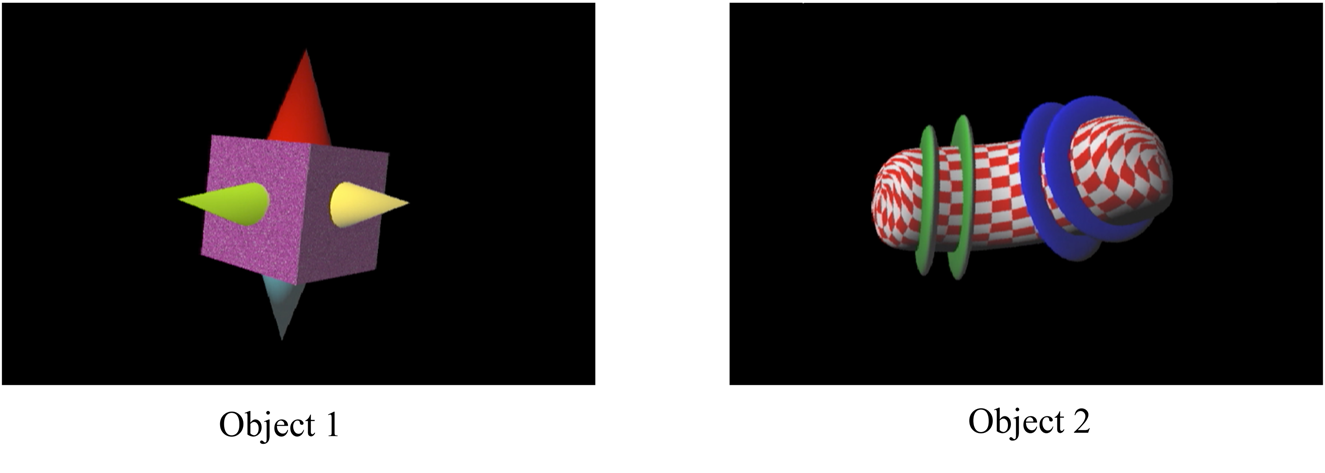
Infants viewed two novel objects, each paired with a nonspeech tone. The objects (see Figure 1) were identical to those used by Hay et al. (Reference Hay, Graf Estes, Wang and Saffran2015) and Graf Estes et al. (Reference Graf Estes, Antovich and Hay2018). Objects moved slowly from side to side within a black rectangle centered on a television screen.
Objects used in label-object association task. Label-object pairings were counterbalanced.

Labels
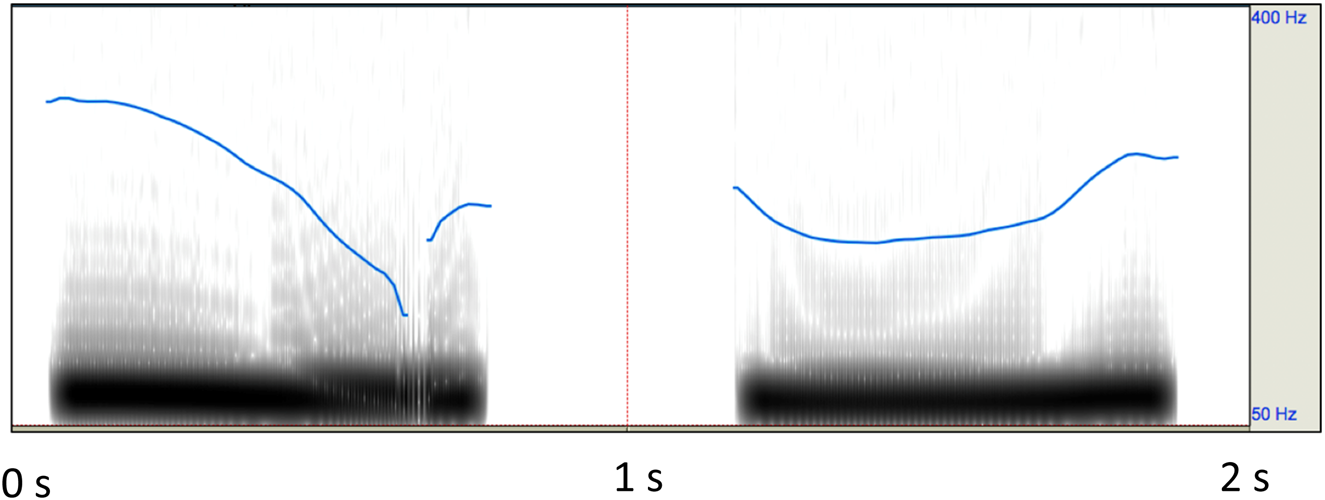
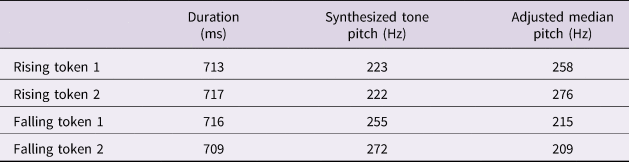
The two labels were nonspeech tones incorporating natural linguistic pitch contours, originally created by Graf Estes et al. (Reference Graf Estes, Antovich and Hay2018). The labels were closely matched to spoken labels. Each label started as a synthesized constant tone generated in Audacity (Ash et al., Reference Ash, Crook, Dannenberg, Drung, Johnson, Lucius and Zuraw2014) (see Table 1) to match the mean fundamental frequency of the vowel in the spoken rising or falling tones used by Hay et al. (Reference Hay, Graf Estes, Wang and Saffran2015). Using Praat (Boersma & Weenink, Reference Boersma and Weenink2010), tones were superimposed with either a rising or falling pitch contour. Contours were extracted from the vowel portion of the syllable “ku” produced by a native Mandarin speaker using tone2 and tone4, respectively (using stimuli from Hay et al., Reference Hay, Graf Estes, Wang and Saffran2015). Two tokens of each tone were created. Nonspeech labels were edited to match the original spoken labels in duration and median pitch (see Table 1). Figure 2 shows spectrograms of the labels.
Spectrogram and pitch contours (blue lines) for nonspeech labels.

Acoustic properties of label tokens.

Note. Synthesized tone pitch refers to the fundamental frequency (F0) of the original synthesized tone that was subsequently superimposed with a pitch contour. Adjusted median pitch refers to the median pitch (F0) of the labels with the pitch contours added.
Procedure
Each infant sat on a caregiver's lap in a sound-attenuated booth. Caregivers were instructed not to interact with the infant and wore headphones playing classical music to mask stimuli and prevent interference. An experimenter, located in a separate booth, controlled stimuli presentation and recorded looking times using the program Habit 2 (Oakes, Sperka & Cantrell, Reference Oakes, Sperka and Cantrell2019). Stimuli appeared on a large television with external speakers. An animated cartoon played before each trial to capture infant attention. This experiment used a modified version of the Switch task (Werker, Cohen, Lloyd, Casasola & Stager, Reference Werker, Cohen, Lloyd, Casasola and Stager1998) that has demonstrated learning in previous experiments (Graf Estes, Evans, Alibali & Saffran, Reference Graf Estes, Evans, Alibali and Saffran2007; Hay, Pelucchi, Graf Estes & Saffran, Reference Hay, Pelucchi, Graf Estes and Saffran2011; Thiessen, Reference Thiessen2007). The experiment started with a pretest trial intended to familiarize infants with viewing items on the screen and hearing sounds; they heard the syllable “la” while a gray screen rotated. During habituation trials, an object appeared on the screen, moving horizontally. Label repetitions played with 750 ms of silence between tokens (label repetitions were not synchronized with object motion). Each trial ended when the infant looked away from the screen for at least 1 s or after 20 s of looking time. The label-object pairings were presented randomized by blocks (i.e., the same object did not appear in more than two consecutive trials). The habituation phase ended when the infant met the habituation criterion, a 50% decrease in looking time on three consecutive trials relative to the first three trials, or after 25 trials.
The test phase included eight trials: four Same trials, in which an object was paired with its label from habituation; and four Switch trials, in which an object was paired with the alternate label (e.g., object 1–label 2). Two blocks of four trials were presented in eight counterbalanced orders; a block included one same and one switch trial per object. If infants associated a label with an object during habituation, they should look longer to a mismatch between the label and the object (switch trial) than to the original pairing (same trial) (Werker et al., Reference Werker, Cohen, Lloyd, Casasola and Stager1998).
Results
Fourteen-month-olds habituated in an average of 12.53 trials (SD = 4.82), accumulating 147.11 s (SD = 71.96) of looking time. Nineteen-month-olds habituated in an average of 12.18 trials (SD = 5.76), accumulating 143.80 s (SD = 67.70) of looking time.
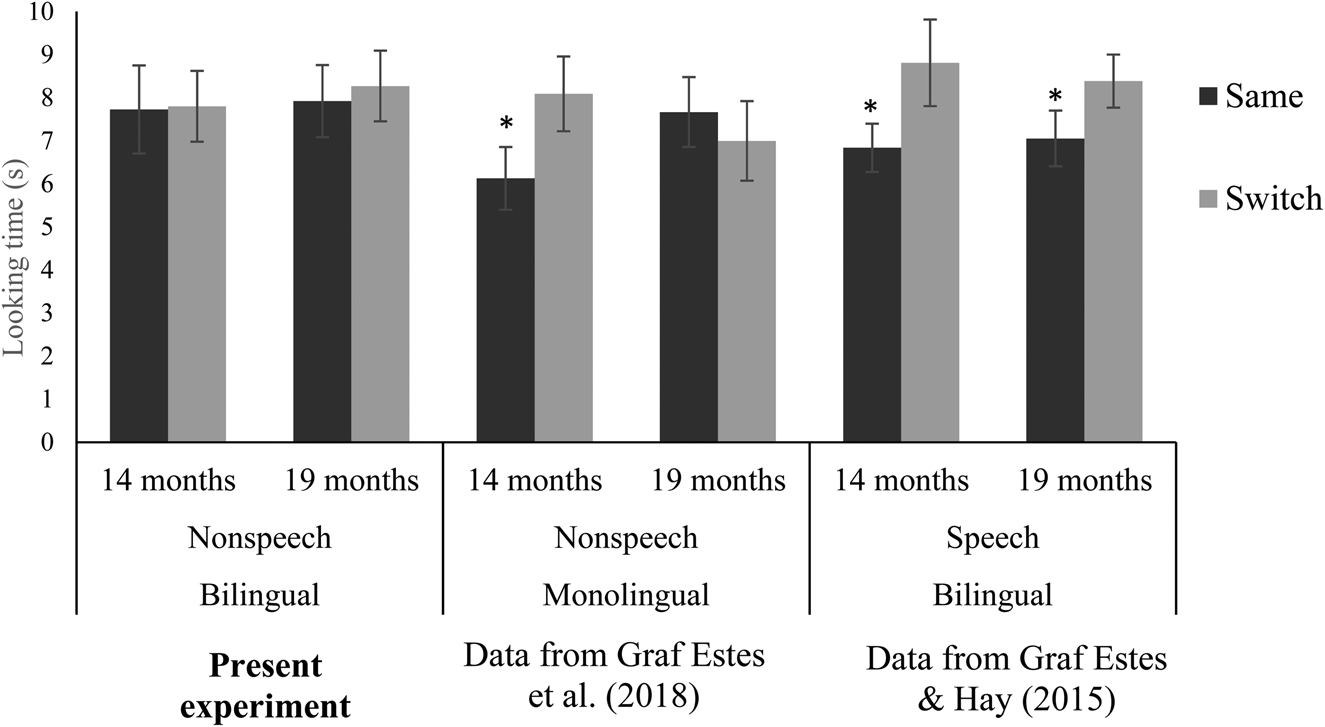
To examine label learning, we performed a 2 (Trial type: Same vs. Switch, within subjects) x 2 (Test block 1 vs. 2, within subjects) x 2 (Age group: 14 vs. 19 months, between subjects) mixed design Anova of infants’ looking times. There were no main effects of trial type, F(1, 32) = 0.17, p = .682, η p2 = .005, test block, F(1, 32) = 2.22, p = .146, η p2 = .065, or age, F(1, 32) = 0.06, p = .771, η p2 = .003. There were also no significant interactions (all Fs < 1). There was no evidence bilingual infants learned the nonspeech labels; they failed to look reliably longer on trials with switched label-object pairings (M = 8.03 s, SD = 3.35) compared to trials with the original pairings (M = 7.82 s, SD = 3.80). Figure 3 shows infants’ looking times. Although the Anova did not reveal any age effects, for transparency and for comparison with prior research (below), results are displayed separated by age.
Infant's mean looking time to Same and Switch test trials. Error bars indicate standard errors. *p < .05.

Infants did not show evidence of learning in either test block and there was no significant change in overall attention across blocks (non-significant test block effect). Thus, infants did not display learning at the start of testing that was masked by declines in attention across testing.
To support interpretation of the findings, we calculated Bayes factors in addition to the Anova (Rouder, Speckman, Sun, Morey & Iverson, Reference Rouder, Speckman, Sun, Morey and Iverson2009; Wagenmakers, Marsman, Jamil, Ly, Verhagen, Love, Selker, Gronau, Šmíra, Epskamp, Matzke, Rouder & Morey, Reference Wagenmakers, Marsman, Jamil, Ly, Verhagen, Love, Selker, Gronau, Šmíra, Epskamp, Matzke, Rouder and Morey2018). Bayes factors quantify the strength of support for a null hypothesis (i.e., the absence of an effect) or an alternative hypothesis (i.e., the presence of an effect). We used the formula by Rouder et al. (Reference Rouder, Speckman, Sun, Morey and Iverson2009) to compare means on the same versus switch trials (collapsed across ages). The estimated Bayes factor indicated that the null hypothesis that looking times were not different was 5.00 times more likely than the alternative hypothesis (that the values were different). Thus, the analysis supports the conclusion that infants did not learn the mappings.
Because this experiment aligns with recent monolingual work, we also tested whether bilinguals’ performance differed from same-aged monolinguals in the same task (n = 19 at 14 months and n = 20 at 19 months; Graf Estes et al., Reference Graf Estes, Antovich and Hay2018, Experiment 1). Monolinguals viewed the same stimuli with the same presentation parameters in Habit. They were tested in the same lab and came from the same participant pool as the present bilingual sample. The monolingual group provides a key comparison for interpreting the bilinguals’ apparent failure to learn. In a 2 (Trial type) x 2 (Age group) x 2 (Language experience: monolingual vs. bilingual) mixed Anova of looking time, there was a significant interaction of trial type, age group, and language experience, F(1, 69) = 4.51, p = .037, η p2 = .061. The remaining main effects and interactions were not significant (ps > .08). We broke down the interaction by considering the language groups separately. The analysis above demonstrated that bilinguals did not differentiate same versus switch trials. In contrast, Graf Estes et al. (Reference Graf Estes, Antovich and Hay2018) reported that monolinguals’ looking times on same and switch trials differed at 14 versus 19 months. As shown in Figure 3, only the monolingual 14-month-olds looked significantly longer on switch trials, t(18) = 2.77, p = .013, d = 0.64; 19-month-olds did not, t(19) = -1.61, p = .260, d = -0.36.
We also compared the present data to prior published work examining bilinguals’ learning of spoken labels containing the same pitch contours (Graf Estes & Hay, Reference Graf Estes and Hay2015). Bilinguals in both experiments came from the same participant pool, met the same language criteria, and were tested in the same lab. They were all non-tonal learners. Average exposure to English was 49.5% (Graf Estes & Hay, Reference Graf Estes and Hay2015). The visual stimuli and test parameters in Habit were identical to the present experiment. The only change was that the labels in Graf Estes and Hay's (Reference Graf Estes and Hay2015) experiment were spoken; 14- (n = 16) and 19-month-old (n = 16) bilinguals heard the syllable “ku” produced with natural pitch contours. The same contours were synthesized in our nonspeech tone labels. We performed a 2 (Trial type) x 2 (Age group) x 2 (Label type: speech vs. nonspeech) mixed Anova. There was a main effect of trial; infants looked longer during same trials than switch trials, F(1, 62) = 6.89, p = .012, η p2 = .097. There was a marginal interaction of trial and label type, F(1, 62) = 3.99, p = .050, η p2 = .060. As shown above, bilinguals who heard nonspeech labels did not differentiate same and switch trials. Graf Estes and Hay previously reported that bilinguals who heard linguistic labels for the same objects in the same task differentiated same and switch trials at 14 months, t(15) = 2.28, p = .038, d = .63, and 19 months, t(15) = 2.57, p = .021, d = .52. Thus, bilingual infants appear to interpret non-native linguistic tones differently from nonspeech tones, accepting only the linguistic tones as labels.
Discussion
We found that bilinguals displayed no evidence of learning nonspeech labels consisting of synthesized tones with distinct pitch contours. This lack of learning is interesting in the context of two pieces of prior evidence. First, with the same stimuli, procedure, and participant pool, monolingual 14-month-olds learned the same labels (Graf Estes et al., Reference Graf Estes, Antovich and Hay2018). Second, bilinguals from the same participant pool at 14 and 19 months learned spoken pitch contour labels in the same task (Graf Estes & Hay, Reference Graf Estes and Hay2015). This suggests that bilinguals show greater selectivity in nonspeech label learning than monolinguals and greater selectivity for nonspeech labels than for non-native spoken labels. This work is valuable because it helps elucidate how infants shift from being open to learning any of the world's languages to specializing in their native language(s). Much like perceptual narrowing in speech perception (Maurer & Werker, Reference Maurer and Werker2014), word learning undergoes interpretational narrowing, so that infants become more specific about the acoustic forms they accept as labels, a specialization that may support efficient word learning. We have revealed a novel phenomenon in interpretational narrowing: bilinguals show greater selectivity than monolinguals in learning nonspeech tone labels.
Importantly, the bilingual data from the present work are directly comparable to recent work with monolinguals and bilinguals from Graf Estes et al. (Reference Graf Estes, Antovich and Hay2018) and Graf Estes and Hay (Reference Graf Estes and Hay2015), as the stimuli and testing procedure were identical and the infants were from the same participant pool. Our current work addresses both developmental (i.e., 14- vs. 19-month-olds) and experiential (e.g., monolinguals vs. bilinguals) factors related to infant tone processing. Processing Rich Information from Multidimensional Interactive Representations (PRIMIR) provides a framework for understanding why infants use phonological and lexical information in different ways in different contexts (Curtin, Byers-Heinlein & Werker, Reference Curtin, Byers-Heinlein and Werker2011; Werker & Curtin, Reference Werker and Curtin2005). The framework suggests that initial biases, learning mechanisms, developmental capacities, and task demands interact, affecting infants’ performance in speech processing and word learning tasks. This approach is helpful for interpreting the different patterns of learning exhibited by bilinguals and monolinguals of different ages. The PRIMIR framework proposes that the initial bias toward human speech helps orient infants’ attention amid a rich and complex auditory environment. The range of speech sounds and word forms present in bilinguals’ input may build on this initial bias, highlighting the diversity of communicative speech sounds and emphasizing the distinction between informative and uninformative sounds. Through this process, the distribution of linguistic sounds that bilinguals experience may affect their acceptance of label forms. The interpretation of nonspeech tones may reflect an early fundamental underlying meta-linguistic awareness, a domain in which bilinguals have shown advanced development relative to monolinguals (reviewed in Akhtar & Menjivar, Reference Akhtar, Menjivar and Benson2012; Byers-Heinlein, Chen & Xu, Reference Byers-Heinlein, Chen and Xu2014).
The broad phonological variation that bilinguals hear may support extended flexibility for some linguistic contrasts, exhibited as longer openness to learning non-native spoken pitch contour contrasts (e.g., Graf Estes & Hay, Reference Graf Estes and Hay2015) and non-native phoneme contrasts (i.e., clicks; Singh, Reference Singh2018). Bilingual input reveals that many speech sound variants and combinations are possible, promoting openness to unfamiliar linguistic features. However, tracking the range of phonological variants that occur across two languages may also help bilinguals define boundaries of acceptable label forms. Bilinguals have to navigate tradeoffs between flexibility and efficiency. Flexibility regarding different spoken word forms may be helpful, but having stricter boundaries for what is non-linguistic may help provide greater efficiency in the complexity of bilingual word learning. By 14 months of age, boundary information can guide interpretation when a potential label, like a nonspeech tone, falls far outside the prior distributions. In contrast, monolingual 14-month-olds, who have had a narrower distribution of speech sounds than bilinguals, demonstrate less defined limits to the range of acceptable labels, which may include nonspeech forms (Graf Estes et al., Reference Graf Estes, Antovich and Hay2018). However, by 19 months, monolinguals are also resistant to learning nonspeech labels. Thus, through the lens of PRIMIR, the same mechanism (tracking distributions in speech sounds) may produce disparate trajectories through the interaction of different categories of input (i.e., speech vs. nonspeech labels), types of experience (monolingual vs. bilingual), and developmental levels (14 vs 19 months).
The present work used synthesized nonspeech labels that share an acoustic feature with spoken labels (i.e., non-native pitch contours). We do not yet know how bilingual infants interpret many other types of atypical label forms or bilinguals’ precise definition for acceptable labels. Work with monolinguals has revealed differences in the types of labels that infants accept by testing many label forms, from artificial sounds to non-linguistic mouth noises to natural spoken words that conflict or comply with the infants’ own native language experience (MacKenzie, Curtin & Graham, Reference MacKenzie, Curtin and Graham2012a, Reference MacKenzie, Curtin and Graham2012b; MacKenzie, Graham & Curtin, Reference MacKenzie, Graham and Curtin2011; MacKenzie, Graham, Curtin & Archer, Reference MacKenzie, Graham, Curtin and Archer2014). We are just beginning to understand how bilingual experience shapes infant interpretation of these forms of label variability.
Our findings expand on the recent demonstration that neither bilingual nor monolingual 19-month-olds treat nonspeech click sounds like labels (Singh, Reference Singh2018); 19-month-old bilinguals and monolinguals show the same pattern for nonspeech tone labels (Graf Estes et al., Reference Graf Estes, Antovich and Hay2018). While there is evidence that monolingual (but not bilingual) 14-month-olds accept nonspeech tones as labels, we do not yet know whether bilinguals and monolinguals at this age also differ in learning click or snap nonspeech labels. It will be important to examine infants’ learning of nonspeech tone and nonspeech click sounds as labels in the same task. We presented infants with two label-object pairs, whereas Singh used a single-object habituation procedure in which infants first viewed familiar objects. PRIMIR suggests that task demands affect infant learning abilities. Presenting nonspeech labels with additional context may have influenced performance, as previous studies have found that monolingual infants are more open to unusual labels in social tasks than in simplified labeling tasks without social or referential support (Campbell & Namy, Reference Campbell and Namy2003; Vukatana, Curtin & Graham, Reference Vukatana, Curtin and Graham2016). This may also explain why Thom and Sandhofer's (Reference Thom and Sandhofer2014) findings diverge from our own. They found greater openness to nonspeech labels in bilinguals at 24 months of age, compared to monolinguals. Their task was socially interactive; an experimenter showed infants the object, introduced it with a labeling phrase, and played a recorded sound. Perhaps bilinguals are more receptive to social influences on label learning than monolinguals. This is a reasonable prediction, given the social demands of switching languages. There is evidence that exposure to multiple languages supports the precocious development of dimensions of early social cognition, like interpreting others’ intentions (Liberman, Woodward, Keysar & Kinzler, Reference Liberman, Woodward, Keysar and Kinzler2017). We do not yet know how experiencing labels with or without social support affects bilingual learning. Additional experiments manipulating age, label properties, and labeling context are necessary to disentangle possible contributions to word learning.
The present findings demonstrate another way that infants narrow their expectations about what constitutes a word (Namy & Waxman, Reference Namy and Waxman1998). This narrowing may facilitate lexical development by focusing on acoustic forms that are relevant in the ambient language(s). For bilinguals, it is critical to maintain flexibility in linguistic processing in order to gather often conflicting information about phonological, lexical, and syntactic structures across two languages. However, the breadth of acoustic experience may also shape bilingual learning, by eliminating irrelevant sounds as label candidates earlier than monolinguals. Our findings demonstrate one way that bilingual experience shapes how infants balance selectivity and flexibility in word learning.
Acknowledgements
This research was supported by a grant to KGE from the National Institute of Child Health and Human Development (R03HD084941). We would like to thank members of the Language Learning Lab at UC Davis for their assistance with this research. Thanks also to Jessica Hay for helpful discussions on this topic. We also thank the families who generously contributed their time.